뇌졸중 환자의 Plasma Fibrinogen Level 및 Platelet Counts에 따른 한방 변증 비교 분석
이혜진․강병갑1․안정조․유호룡․김윤식․설인찬․조현경*
대전대학교 한의과대학 심계내과학교실, 1 : 한국한의학연구원 융합연구본부 뇌질환연구센터
Comparative Analysis of the Characterastics of Oriental Medicine Pattern Identification according to the Plasma Fibrinogen Levels and
Platelet Counts in Stroke Patients
Hye Jin Lee, Byoung Kab Kang1, Jung Jo Ahn, Ho Ryong Yoo, Yoon Sik Kim, In Chan Seol, Hyun Kyung Jo*
Division of Circulatory System, Department of Internal Medicine, College of Oriental Medicine, Daejeon University, 1 : Division of TKM Integrated Research-Brain Disease Research Center, Korea Institute of Oriental Medicine
The aim of this study was to evaluate oriental medicine pattern identification in patients with stroke on the basis of plasma fibrinogen levels and platelet counts. 555 patients diagnosed with stroke between November 2006 and February 2010 were divided in several ways according to the plasma fibrinogen levels and platelet counts on admission. And comparative analysis of the distribution ratio of oriental medicine pattern identification was done between the groups. The mean value of the plasma fibrinogen levels of whole population was 449.18 mg/dL, and it was higher than normal range. The mean value of the platelet counts of whole population was 244.29 /mL, and it was lower but in normal range. Oriental medicine pattern identifications were not characteristic between groups divided according to the serum levels of fibrinogen and platelet counts. In this study, there was not significant correlation between Oriental medicine pattern identifications and the thrombotic factor like plasma fibrinogen levels and platelet counts. This study could be the steppingstone for the next study to develope the objective indicator for the Oriental medicine pattern identifications.
Key words : stroke, pattern Identification, plasma fibrinogen levels, platelet counts
* 교신저자 : 조현경, 대전시 중구 대흥동 22-5, 대전대학교 부속 한방병원
․E-mail : [email protected], ․Tel : 042-229-6924
․접수 : 2011/04/18 ․수정 : 2011/05/15 ․채택 : 2011/05/31
서 론
뇌졸중은 한국인의 주요한 사망 원인이며1), 예방을 위해 많 은 요인들이 위험 인자로 지목되고 있다.
특히 혈액 응고 인자는 뇌졸중 발병에 있어 주요한 독립 위 험 인자로 여겨지고 있어서2)현대 의학에서는 뇌혈관, 심혈관 질 환의 1차, 2차 예방 및 치료에 항혈소판제나 항응고제를 처방하 는 항혈전요법이 효과적 방법으로 인지되고 있다3).
Fibrinogen은 혈액의 응고 과정에 관여하는 중요한 단백질 로서, 분자량이 340,000Da이며 간에서 생성되어 생체 내에서 응
고가 활성화되면 Fibrin으로 바뀌고 응고혈전을 만들어 지혈 작 용을 하게 된다4).
그러나 Fibrinogen의 혈중 상승은 뇌경색, 허혈성 심장질환, 정맥 혈전증, 말초 동맥 질환 등의 독립적 위험 요인이 되는 것 으로 알려져 있다4-11).
Platelet은 여러 생리학적인 자극에 의해 응집이 일어나 혈전 성 질환을 일으키며, 따라서 뇌경색의 위험 요인이 된다12,13). 그 동안 혈액응고 인자와 뇌졸중의 상관성에 대해 임상 경과8), 유병
률4-7,14-18), 생존률11)등 기존의 많은 연구가 있었으나 한방 변증과
의 상관 관계를 살핀 국내 연구는 미미하였다.
이에 저자는 Fibrinogen과 Platelet의 한방 변증 진단의 객관 적 지표로서의 활용 등 응고인자의 진단적 활용도를 높이고자 본 연구를 수행하였다.
연구대상 및 방법
1. 연구기간 및 대상
본 연구는 2006년 11월부터 2010년 2월까지 대전대학교 부 속 대전한방병원에 입원한 발병 1개월 이내의 급성기 및 아급성 기 뇌졸중 환자 555명을 총 연구 대상으로 하였다.
2. 변증진단
연구 대상자들의 한방 변증은 한의 중풍 변증 표준화위원회 회의를 통해 제정된 습담(濕痰, Dampness-phlegm Pattern), 화 열(火熱, Fire-heat Pattern), 기허(氣虛, Qi Dificiency Pattern), 음허(陰虛, Yin Dificiency Pattern), 어혈(瘀血, Blood stagnation Pattern)의 5개 변증 진단 지표를 사용하여 이루어졌다. 수련의 변증과 전문가 변증이 일치하는 경우에 해당 변증으로 판단하였 으며, 일치하지 않는 경우에는 변증 불일치군으로 별도 집계되 었다.
3. 연구 방법 1) Grouping 방법
상술한 바와 같이 선정된 뇌졸중 환자군은 다시 Fibrinogen (이하 Fbg) 및 Platelet(이하 Plt) 혈중 농도를 기준으로 그룹을 나 누었는데, 기준으로 사용된 수치는 다음과 같다.
․Fbg 정상 범위 기준 : 200 ~ 400 mg/dL19)
․Plt 정상 범위 기준 : 150,000 ~ 400,000/µL19)
연구 대상자들을 상기 기준에 따라 아래의 방법으로 그룹을 나누었다.
첫째, 전체 연구 대상자를 제시된 혈액 응고 인자의 정상 범 위를 기준으로 정상군과 저하군, 그리고 증가군으로 나누어 각 그룹별로 한의학적 변증 유형의 특이적 분포 여부를 조사하였다.
Plt 계수에 따라 나눈 경우를 P-Group, 혈중 Fbg 농도에 따라 나 눈 경우를 F-Group이라 명시하였다.
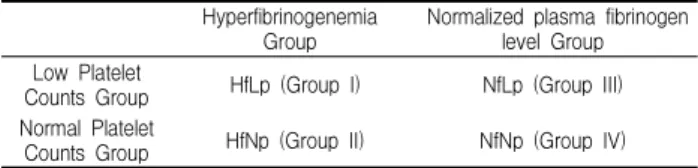
둘째, 혈중 Fbg 농도 증가와 정상, Plt 계수 저하와 정상의 네 가지 조건을 조합한 4그룹(이하F*P Group)으로 나뉘었다 (Table 1). 이는 전체 연구 대상자 내에서 혈액 응고 인자 수치의 특정 경향성에 의한 것으로, 전체 연구 대상자를 분석한 결과 Plt 수치는 정상군과 저하군이 많고, 증가군은 전체의 2.16%로 매우 낮았으며(Table 2), Fbg의 경우는 증가군과 정상군이 많고, 저하 군은 전체의 0.9%로 매우 낮았다(Table 3).
이러한 특성을 바탕으로 Plt의 낮은 농도, Fbg의 높은 농도 가 뇌졸중 발병과 연관이 있으리라는 가설 아래 혈중 Fbg 농도 증가와 정상, Plt 계수 저하와 정상의 네 가지 조건을 조합한 F*P Group을 만들었다(Table 1). 이는 혈중 Fbg 농도와 Plt 계수 모 두 비정상 범위인 그룹(Group I, 이하 HfLp), 상기 조건 중 한 가 지만 정상 범위인 경우, 즉 높은 혈중 Fbg 농도와 정상 범위의 Plt 계수를 가진 그룹(Group II, 이하 HfNp)과 정상 범위의 혈중 Fbg 농도와 저하된 Plt 계수를 보이는 그룹(Group III, 이하 NfLp), 그리고 두 가지 모두 정상 범위인 정상군(Group IV, 이하 NfNp)의 4 그룹이다.
Table 1. Method of Grouping of F*P Group Hyperfibrinogenemia
Group Normalized plasma fibrinogen level Group Low Platelet
Counts Group HfLp (Group I) NfLp (Group III) Normal Platelet
Counts Group HfNp (Group II) NfNp (Group IV)
Table 2. Distribution of P-Group
Plt N(%)
Hp 12 (2.16)
Np 394(70.99)
Lp 149(26.84)
Total 555
Values are N(%). N: numbers of subject. P-Group: distinct groups derived from Plt counts. Hp: high Plt counts group, Lp: low Plt counts group, Np: normal Plt counts group
Table 3. Distribution of F-Group
Fbg N(%)
Hf 335(60.36)
Nf 215(38.74)
Lf 5(0.90)
Total 555
Values are N(%). N: numbers of subject. F-Group: distinct groups derived from plasma Fbg level. Hf: hyperfibrinogenemia group, Lf: hypofibrinogenemia group, Nf: normalized plasma fibrinogen level group
2) 변증과의 상관성 분석
첫째, P-Group, F-Group, F*P Group 각 그룹 내에서의 변증 분포의 비율을 비교하였다.
둘째, 각 변증 분형별로 혈중 Fbg 농도 및 Plt 계수의 평균값 을 비교하였다.
4. 통계 처리 및 분석
모든 통계 분석은 SAS program(ver 9.1)을 이용하였으며, 이 산형 변수에 대한 분석은 Chi-square test, 연속형 변수에 대한 분석은 Two samples T-test, 세집단 이상인 경우는 ANOVA 분 석을 실시하였으며, P값의 유의수준은 0.05 이하로 하였다.
결 과
전체 대상군의 혈중 Fbg 농도 및 혈중 Plt 농도의 평균값을 분석한 결과, 혈중 Fbg 농도의 평균값은 449.18 mg/dL로 정상 범위인 200~400 mg/dL19)보다 높았으며, 혈중 Plt 계수의 평균값 은 244.29/ml로 정상범주이나 낮은 편에 속하였다(Table 4).
Table 4. Mean Value of Thrombotic Factor
Thrombotic Factor mean±SD
Fbg (mg/dL) 449.18±146.38
Plt (103/µL) 244.29±68.25
SD : standard deviation
1. 혈액 응고 인자와 변증과의 관계 1) 혈중 Platelet 농도에 따른 변증 분포
혈중 Plt 농도에 따라 정상군, 저하군, 증가군으로 나누었을 때, 정상군이 가장 많았고, 저하군, 증가군의 순이었다(Table 2).
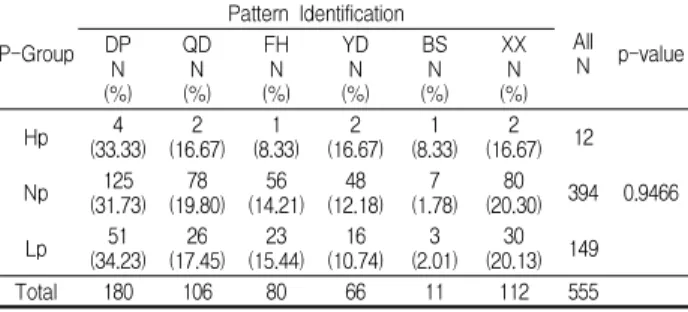
각 그룹 모두 습담 변증이 가장 많았으며, 그룹에 따른 변증 분 포의 특이성은 없었다(Table 5).
Table 5. Pattern identification distribution of P-group P-Group
Pattern Identification
AllN p-value DPN
(%) QDN (%)
FHN (%)
YDN (%)
BSN (%)
XXN (%)
Hp 4
(33.33) 2 (16.67) 1
(8.33) 2 (16.67) 1
(8.33) 2 (16.67) 12
0.9466
Np 125
(31.73) 78 (19.80) 56
(14.21) 48 (12.18) 7
(1.78) 80 (20.30) 394
Lp 51
(34.23) 26 (17.45) 23
(15.44) 16 (10.74) 3
(2.01) 30 (20.13) 149
Total 180 106 80 66 11 112 555
Values are N(%). P-Group: distinct groups derived from Plt counts, PI-Group: pattern identification group. Hp: High Plt counts group, Np: Normal Plt counts group, Lp: Low Plt counts group. DP: Dampness-phlegm pattern, QD: Qi Dificiency pattern, FH: Fire-heat pattern, YD: Yin Dificiency pattern, BS: Blood stagnation Pattern, XX: Disagreement of pattern. N: numbers of subject. p-value by Chi-Square Test
2) 혈중 Fibrinogen 농도에 따른 변증 분포
혈중 Fbg 농도에 따라 정상군, 저하군, 증가군으로 나누었을 때, 증가군이 가장 많았고, 정상군, 저하군의 순이었다. 각 그룹 모두 습담 변증이 가장 많았으며, 역시 그룹에 따른 변증 분포의 특이성은 없었다(Table 6).
Table 6. Pattern identification distribution of F-group F-Group
Pattern Identification
AllN p-value DPN
(%) QDN (%)
FHN (%)
YDN (%)
BSN (%)
XXN (%)
Hf 115
(34.33) 53 (15.82) 48
(14.33) 46 (13.73) 6
(1.79) 67 (20.00) 335
0.4684
Nf 64
(29.77) 51 (23.72) 31
(14.42) 20 (9.30) 5
(2.33) 44 (20.47) 215
Lf 1
(20.00) 2 (40.00) 1
(20.00) 0 (0.00) 0
(0.00) 1 (20.00) 5
Total 180 106 80 66 11 112 555
Values are N(%). F-group: distinct groups derived from plasma Fbg levels, PI-Group:
pattern identification group. Hf: Hyperfibrinogenemia group, Nf: Normalized plasma Fbg level group, Lf: Hypofibrinogenemia group. DP: Dampness-phlegm pattern, QD: Qi Dificiency pattern, FH: Fire-heat pattern, YD: Yin Dificiency pattern, BS: Blood stagnation Pattern, XX: Disagreement of pattern. N: numbers of subject. p-value by Chi-Square Test Table 7. Pattern Identification Distribution of Each Group
F*P Group
Pattern Identification
AllN p-value DPN
(%) QDN (%)
FHN (%)
YDN (%)
BSN (%)
XXN (%)
HfLp 31
(35.63) 14 (16.09) 14
(16.09) 10 (11.49) 1
(1.15) 17 (19.54) 87
0.8050
HfNp 82
(34.02) 38 (15.77) 33
(13.69) 34 (14.11) 5
(2.07) 49 (20.33) 241
NfLp 19
(32.20) 11 (18.64) 9
(15.25) 6 (10.17) 2
(3.39) 12 (20.34) 59
NfNp 43
(28.48) 39 (25.83) 22
(14.57) 14 (9.27) 2
(1.32) 31 (20.53) 151
Total 175 102 78 64 10 109 538
Values are N(%). F*P Group : distinct groups derived from Plasma Fbg Levels and Plt Counts, PI-Group: pattern identification group. HfLp: hyperfibrinogenemia with low Plt counts group, HfNp: hyperfibrinogenemia with normal Plt counts group, NfLp: normalized plasma Fbg level with low Plt counts group, NfNp: normalized plasma Fbg level with normal Plt counts group. DP: Dampness-phlegm pattern, QD: Qi Dificiency pattern, FH:
Fire-heat pattern, YD: Yin Dificiency pattern, BS: Blood stagnation Pattern, XX:
Disagreement of pattern. N: numbers of subject. p-value by Chi-Square Test 3) 혈중 Fibrinogen 농도 및 Platelet 계수에 따른 그룹별 변증
분포
혈중 Fbg 농도 및 Plt 계수에 따른 그룹별 변증 분포는 네 그룹 모두 습담 변증의 비율이 가장 많았다. HfNp에서 타 그룹 에 비해 음허 변증의 비율이 높은 경향성을 보이고, NfNp에서는 타 그룹에 비해 기허 변증의 비율이 높은 경향성을 보였으나 유 의성 있는 수준은 아니었다. 전체 연구 대상자들은 습담 변증이 가장 많고, 그룹에 따른 변증 분포의 특이성은 없었다(Table 7).
4) 변증별 혈중 Fibrinogen 농도 및 Platelet 계수 비교 변증별로 혈액 응고 인자 수치를 비교해 본 결과, 각 변증 간에 혈중 Fbg 농도 및 Plt 계수 간에 유의한 차이는 없었다.
(Table 8)
Table 8. Mean Value of Thrombotic Factor of Each Pattern Identificatioin
Pattern Identification DPN
mean±SD QDN mean±SD
FHN mean±SD
YDN mean±SD
BSN mean±SD (mg/dL)Fbg 180
442.61±125.10 106
429.55±156.28 80
453.26±153.19 66
466.59±127.85 11 431.36±111.96 (103/µL)Plt 180
234.38±62.65 106
255.17±71.97 80
234.38±62.65 66
244.41±69.68 11 257.64±82.97 PI Group: Pattern Identificatioin. DP: Dampness-phlegm pattern, QD: Qi Dificiency pattern, FH: Fire-heat pattern, YD: Yin Dificiency pattern, BS: Blood stagnation Pattern.
N: numbers of subject, SD: standard deviation
고 찰
2008년 사망원인 순위 국내통계에 따르면 뇌혈관 질환은 악 성 신생물에 이어 사망 원인 2위를 차지하고 있는 질환으로1) 예 방을 위해서는 관련 위험 인자에 대한 인지20,21)가 필요하다. 혈액 응고 인자는 뇌졸중 발생에 있어 대표적 위험 인자라 할 수 있으 며 많은 연구 결과들이 이를 뒷받침하고 있다4-11,14-18).
Fibrinogen의 혈중 상승은 뇌경색, 허혈성 심장질환, 정맥 혈 전증, 말초 동맥 질환 등의 독립적 위험 요인이 되고4-11), Platelet 은 여러 생리 자극에 의해 응집되어 뇌경색 유발 위험 요인이 된
다12,13). 이에 상기 혈액 응고 인자들이 뇌졸중에 미치는 영향에
대하여 임상 경과8), 유병률4-7,14-18), 생존률11)등의 연구가 이루어져 있으나, 이들 혈액 응고인자와 한방 변증 간의 상관 관계에 관 한 연구는 미미한 실정이다.
이에 저자는 pro-thrombotic 표지자 중 혈중 Fibrinogen 농 도 및 Platelet 계수를 지표로 하여 한방 변증과의 상관관계를 밝 히고자 하였다.
연구 대상은 2006년 11월부터 2010년 2월까지 대전대학교 부속 대전한방병원에 입원한 발병 1개월 이내의 급성기 및 아급 성기 뇌졸중 환자 555명을 대상으로 하여 진행되었다. 한방 변증 은 2005년부터 한국한의학연구원 「뇌혈관 질환의 한의학 변증 지표 표준화 및 과학화 기반 연구」에서 사용되고 있는 습담(濕 痰), 화열(火熱), 기허(氣虛), 음허(陰虛), 어혈(瘀血)의 5개 변증 진단 지표를 사용했다.
또한 전체 연구 대상자의 혈중 Fibrinogen 농도 및 Platelet 계수의 평균을 구해본 결과, 혈중 Fibrinogen 농도는 평균 449.18 mg/dL로 정상 범위19)보다 높았으며, 혈중 Platelet 계수의 평균
값은 244.29/ml로 정상 범위19)이나 낮은 편에 속하였다. 이는 발병 후 3일째의 급성기 뇌졸중 환자에서 높은 혈중 Fibrinogen 농도 및 낮은 혈중 Platelet 계수의 경향성을 발견하여 fibrinogen 과 platelet의 두 parameter 사이에 inverse correlation이 존재함 을 보고한 D'Erasmo E22)의 연구와도 부합한다. D'Erasmo E22)의 연구가 급성기 환자들만을 대상으로 이루어진데 반해, 본 전체 연구 대상자는 급성기 및 아급성기의 환자를 포함하여, 상기 연 구에 비해 급성기의 특징적 혈액학적 변화를 민감하게 반영하지 못했으리라는 제약에도 불구하고 특징적인 결과로 보인다.
전체 연구 대상자에서 혈액 응고 인자와 변증과의 관계를 살펴 본 결과, 혈중 Platelet 계수에 따른 변증 분포는 증가군, 정 상군, 저하군 모두 습담 변증이 가장 많았으나, 그룹에 따른 변증 의 경향성은 없었다. 혈중 Fibrinogen 농도에 따른 변증 분포에 있어서도 마찬가지로, Fibrinogen 증가군, 정상군, 저하군 모두 습담 변증이 가장 많았으며 그룹에 따른 변증의 경향성은 없었 다. 또한, 혈중 Fibrinogen 농도와 Platelet 계수의 특징에 따라 분 류된 4 그룹에서 변증 분포의 특징을 분석한 결과, 역시 4 그룹 모두 습담 변증의 비율이 가장 많았다. HfNp에서 타 그룹에 비 해 음허 변증의 비율이 높은 경향성을 보이고, NfNp에서는 타 그룹에 비해 기허 변증의 비율이 높은 경향성을 보였으나 통계 적인 유의성은 없었다. 이는 신23), 김24), 신25)등이 초기 뇌졸중 환 자를 대상으로 한 연구에서 습담 변증이 차지하는 비율이 가장 높았던 것과 일치한다. 습담 변증 이외 변증들의 분포 비율은 각 그룹 별로 기허, 화열, 음허, 어혈 변증의 순으로 나타나는 공통 점을 보였는데 이는 신23)의 연구 결과와도 일치한다.
중풍 5개 변증과 혈액 응고 인자와의 연관성 여부를 다른 각 도에서 확인해보고자 각 변증별로 혈중 Fibrinogen 농도 및 Platelet 계수의 평균을 비교해 보았으나 역시 통계학적으로 유의 한 차이는 없었다.
본 연구에서는 혈중 Fibrinogen 농도와 Platelet 계수 변화에 따른 한방 변증을 비교하였다. 그러나 연구의 대상이 되는 뇌졸 중 환자군이 급성기 뿐 아니라 아급성기를 포함하므로 혈액 검 사 결과가 급성기의 혈액학적 특징적 변화를 민감하게 반영하지 못하는 점, 혈액 검사 시점이 다양함에 따라 뇌경색 환자군에 있 어서 진단 후 항응고, 항혈전 약물 투약에 따른 영향을 통제할 수 없었다는 점이 한계로 남았다. 향후 연구에서 상기 한계점들 이 보완되면 혈액 응고 인자와 한방 변증 사이의 관계에 대한 더 욱 신뢰할 만한 새로운 결과가 나오리라고 사료되며, 향후 지속 적 연구를 통한 한의 변증 객관적 지표의 저변 확대가 이루어지 길 기대해 본다.
결 론
본 연구는 2006년 11월부터 2010년 2월까지 대전대학교 부 속 대전한방병원에 입원한 발병 1개월 이내의 급성기 및 아급성 기 뇌졸중 환자를 대상으로 하여 혈중 Fbg 농도와 Plt 계수의 특 징에 따라 나누어진 그룹 간의 한방 변증 분포 특성을 비교 분석 한 것으로 결과는 다음과 같다.
전체 대상군의 평균 혈중 Fbg 농도는 449.18mg/dL로 정상 범위보다 높았으며, 평균 혈중 Plt 계수는 244.29/ml로 정상범 주이나 낮은 편에 속하였다.
혈중 Fbg 농도 및 혈중 Plt 계수에 따른 변증 분포는 모든 그룹에서 습담 변증이 가장 많았으나 그룹에 따른 변증 분포의 특이성은 없었다.
이상의 결과에서 발병 1개월 이내 뇌졸중 환자의 혈중 Fbg 농도 및 Plt 계수는 한방 변증과 특이적 상관관계가 없으며, 급성 기 및 아급성기 뇌졸중 환자의 한방 변증은 혈중 혈액응고 인자 농도와 관계없이 습담 변증이 차지하는 비중이 큰 것을 알 수 있 었다.
참고문헌
1. http://www.kosis.kr/ups/ups_01List01.jsp?pubcode=YD 2. 김수현, 정명호, 이민구, 고점석, 박근호, 심두선, et al. 급성
심근경색환자에서 lipoprotein a와 섬유소원 농도에 따른 임 상 경과. 전남의대학술지 46(1):38-43, 2010.
3. Jeffery, I. Weitz. Antiplatelet, Anticoagulant and Fibrolytic Drugs. In: Fauci, Braubwald, Kasper, Hauser, Longo, Jameson, loscalzo. Harrison's Principles of Internal Medicine. 17th Edition. Seoul: MIP; pp 894-909, 2010.
4. Lee, A.J., Lowe, G.D., Woodward, M., Tunstall-Pedoe H.
Fibrinogen in relation to personal history of prevalent hypertension, diabetes, stroke, intermittent claudication, coronary heart disease, and family history: the Scottish Heart Health Study. Br Heart J. 69: 338-342, 1993.
5. Ernst, E., Resch, K.L. Fibrinogen as a cardiovascular risk factor: a meta analysis and review of the literature. Ann Intern Med. 118: 956-963, 1993.
6. Kannel, W.B., D’gostino, R.B., Belanger, A.J. Update on fibrinogen as a cardiovascular risk factor. Ann Epidemiol.
2: 457-466, 1992.
7. Wilhelmsen, L., Svardsudd, K., Korsan-Bengtsen, K., Larsson, B., Welin, L., Tibblin, G. Fibrinogen as risk factor for stroke and Myocardial infarction. N Engl J Med 311:
501-505, 1984.
8. del Zoppo, G.J., Levy, D.E., Wasiewski, W.W., Pancioli, A.M., Demchuck, A.M., Trammel, J., Demaerschalk, B.M., Kaste, M., Albers, G.W., Rigelstein, E.B.
Hyperfibrinogenemia and functional outcome from acute ischemic stroke. Stroke. 40: 1687-1691, 2009.
9. Qizilbash, N., Jones, L., Warlow, C., Mann, J. Fibrinogen and lipid concentrations as risk factors for transient ischaemic attacks and minor ischaemic strokes. BMJ. 303:
605-609, 1991.
10. Di Napoli, M., Papa, F. Should neurologists measure fibrinogen concentrations? J Neurol Sci. 246: 5, 2006.
11. Turaj, W., Slowik, A., Dziedzic, T., Pulyk, R., Adamski, M., Strojny, J., Szczudlik, A. Increased plasma fibrinogen predicts one-year mortality in patients with acute schemic stroke. J Neurol Sci. 246: 13-19, 2006.
12. Anti-platelet Trialists’Collaborative Study. Collaborative over-view of randomized trials of antiplatelet therapy I:Prevention of death, myocardial infarction and stroke by prolonged antiplatelet therapy in various categories of patients. Br Med J 308: 81-106, 1994.
13. Hideo, T., Shu, K., Satoshi, T., Daizo, K., Ryushi, K., Hiroaki, T. Activated coagulation/fibrinolysis system and platelet function in acute thrombotic stroke patients with increased C-reactive protein levels. Thromb Res 100:
373-379, 2000.
14. Plasma Thrombomodulin, Fibrinogen, and Activity of Tissue Factor as Risk Factors for Acute Cerebral Infarction.
American journal of clinical pathology. 128(2):287-292, 2007.
15. Chen, X. Study of the association between cerebral infarction and the Thr312Ala polymorphism in fibrinogen gene. Journal of stroke and cerebrovascular diseases.
17(5):2-15, 2008.
16. Siegerink, B., Rosendaal, F.R., Algra, A. Genetic variation in fibrinogen; its relationship to fibrinogen levels and the risk of myocardial infarction and ischemic stroke. Journal of thrombosis and haemostasis. 7(3):385-390, 2009.
17. Gu, W.P., Song, X.M., Gong, J.E. Negative association of FGA gene 128C/G polymorphism with cerebral infarction
and its effect on plasma fibrinogen in Hunan Hans.
Chinese medical association. 27(3):286-289, 2010.
18. van Oijen, M., Cheung, E.Y.L., Geluk, C.E.M., Hofman, A., Koudstaal, P.J., Breteler, M.M.B., de Maat, M.P. Haplotypes of the fibrinogen gene and cerebral small vessel disease:
the Rotterdam scan study. Journal of neurology, neurosurgery and psychiatry. 79(7):799-803, 2008.
19. 이삼열, 정윤섭, 권오헌, 송경순. 임상병리검사법. 제7판. 서 울, 한국; 연세대학교 출판부, p 136, 174, 2000.
20. Abbott, R.D., Yin Yin, M.A., Reed, D.M., Yang, K. Risk of stroke in male cigaertte smokers. N. Engl. J. Med. 315: 717, 1986.
21. P. Harmsen, A. Rosengren, A. Tsipogianni and L.
Wilhelmsen. Risk factors for stroke in middle-aged men in Goteborg, Sweden. Stroke, 21: 223-229.
22. D'Erasmo, E., Acca, M., Celi, F.S., Medici, F., Palmerini, T., Pisani, D. Plasma Fibrinogen and Platelet Count in Stroke.
J Med. 24(2-3):185-191, 1993.
23. 신현수, 강병갑, 안정조, 유호룡, 김윤식, 설인찬, 조현경. 中 風환자의 5개 辨證과 혈중지질의 상관관계 연구. 동의생리병 리학회지 24(5):883-891, 2010.
24. 김민지, 강병갑, 안정조, 조현경, 유호룡, 김윤식, 설인찬. 중
풍환자의 습담변증과 혈중지질의 상관성에 관한
Case-Control 연구. 동의생리병리학회지 23(6):1470-1479, 2009.
25. 신애숙, 이인환, 곽자영, 조승연, 박성욱, 박정미 외. 급성기 중풍 환자들의 위험요인 및 중풍유형과 변증형의 관련성 연 구. 大韓中風學會誌 9(1):19-24, 2008.