End-to-End Soft QoS Approach for IMS-based Integrated Satellite/Terrestrial Network Architecture
Mostafa Zaman Chowdhury * and Yeong Min Jang **
ABSTRACT
The satellite networks provide global coverage. The integration of terrestrial networks with a satellite network is the most attractive approach to develop a global communication system. The IP Multimedia Subsystem (IMS) is intended to be the system that will merge the internet with the telecom world. A user with a dual-mode terminal can access both the satellite network and terrestrial network. The seamless handoff between two networks and a user’s QoS level is the major issue concerning this integration. In this paper, we propose IMS-based satellite/terrestrial integrated network architecture for a global communication system. Based on the proposed architecture, an inter-network handoff and end-to-end soft QoS procedure is discussed. Our proposed soft QoS scheme is also analyzed to calculate the number of rejected calls.Key Words : Global communication, satellite, handoff, soft QoS, IMS.
I . Introduction
The vision for the next generation wireless communication is to allow users to access information at anytime and from anywhere. To do such, the future wireless networks trends for convergence among heterogeneous access networks. The heterogeneous wireless networks integrate different access networks.
A satellite-based communication system can be used to interconnect heterogeneous networks to provide global communication. A satellite communication system has global coverage, an inherent broadcast capability, bandwidth-on- demand flexibility, and the ability to support mobility. A satellite system can cover the entire surface of the earth. It can provide a communication system to remote areas where a terrestrial communication infrastructure is not possible. The main drawbacks of satellite network are its bandwidth, which is a very valuable resource and long end-to-end (E2E) delay due to large propagation distance. In addition, a satellite communication infrastructure is expensive. Hence, an integrated satellite and terrestrial network communication system is an excellent candidate to provide a huge set of innovative services to a user, offering global coverage at anytime, anywhere. However, the interoperation factors like handover, QoS management, etc. between a satellite system and the existing terrestrial one
introduces big challenges. The IMS, which is based on the 3GPP architecture, can be used for a satellite/terrestrial integrated network communi- cation system to communicate with each other, combining voice, imaging, and video within a single session.
In this paper, we propose IMS-based integrated satellite/terrestrial network architecture.
Based on the proposed architecture, we describe an inter-system handover and an end-to-end soft QoS procedure. We also analyze our soft QoS scheme to calculate the number of rejected calls.
The rest of the paper is arranged as follows.
Section II summarizes the satellite/terrestrial integrated network, research related to satellite/
terrestrial communication system, and the details of handoff procedures. The end-to-end soft QoS interworking procedure and numerical results are described in Section III. We draw our conclusion in section IV.
II. Integrated Network Architecture
1. Architecture Description
The proposed network architecture shown in Fig. 1 consists of three parts: the mobile user, the access network and the IMS-based core network.
The mobile user has a dual-mode mobile terminal (MT) which can access both the terrestrial network and satellite network. This means the
School of Electrical Engineering, Kookmin University, Korea. *[email protected], ** [email protected]
※ This research was supported by the MIC (Ministry of Information and Communication), Korea, under the ITRC
(Information Technology Research Center) support program supervised by the IITA (Institute of Information Technology
Advancement) (IITA-2007-C1090-0603-0019). This work was also supported by the 2007 research fund of Kookmin
University and Kookmin University research center UICRC in Korea.
user can switch from one network to another as required.
Fig. 1. IMS-based Network Architecture
There are two types of access network here, one of them for the terrestrial network and the other for the satellite network. In the terrestrial network part, enhanced UTRAN NodeB (eNB) is connected to the core network through a serving GPRS support node (SGSN) and a gateway GPRS support node (GGSN). The earth station (ES) of the satellite network part is also connected to the core network through SGSN and GGSN.
The core network is IMS-based. The Proxy-CSCF (P-CSCF) is the first contact point within the IP multimedia (IM) core network (CN) subsystem. The P-CSCF behaves like a Proxy, i.e., it accepts requests and either services them internally or forwards them on. The P-CSCF may behave as a User Agent (UE), and in abnormal conditions it may terminate and independently generate SIP transactions [6]. The Serving-CSCF (S-CSCF) performs session control services for the UE. It maintains a session state as needed by the network operator to support the services, to accept registration requests, and to make its information available through the Home Subscriber Server (HSS) [6]. Interrogating-CSCF (I-CSCF) is the contact point within an operator's network for all connections destined to a user of that network operator or a roaming user currently located within that network operator's service area [6]. The HSS is a database server. HSS stores information in its database system and is responsible for policing what information will be provided to each individual Application Server (AS).
This IMS is based on 3GPP architecture;
enables person-to-person services, which enrich the way that people communicate with each other by combining voice, imaging and video within a single session. IMS is a system that can merge the Internet with the telecom world. IMS enables the convergence of fixed and wireless networks
and seamless user roaming irrespective of access technologies, facilitates services transparency and allows for common services and applications development. In other word, IMS is able to support ubiquitous access to any service from any device.
2. Related Works
The vision of 4G is revolution or evolution.
Revolution is developing an innovative system and evolution is interworking with existing systems. So, many researchers are currently interested in integration of WLAN, WMAN, cellular or even satellite network to define 4G network.
In [1] the authors focus on the design of a gateway station that acts as an interworking unit between the satellite and terrestrial networks.
Their design activity focuses on seamless roaming between the two heterogeneous wireless and wired environments, integration between the two IP service models (IntServ and DiffServ), and mapping of terrestrial onto satellite bearer for traffic with different profiles and QoS requirements.
The authors in [4] present the architecture of an IP-based integrated terrestrial/satellite mobile communications network. Their model adopts technologies such as Mobile-IP, Intelligent Network and dual-mode mobile terminal.
The authors in [5] propose the handover decision method for inter-system handover between satellite communication system and terrestrial communication system by analyzing the characteristics of satellite signal. They also design the handover decision method to reflect the characteristics.
The authors in [7] propose a dynamic bandwidth allocation technique based on traffic prediction. They introduce corrective factor to predicted traffic level and then they applied this approach to a satellite IP network based on the DVB-RCS standard.
In this paper, we present IMS-based satellite/terrestrial integrated network architecture.
Then we present protocols for handover between satellite and terrestrial networks. We also propose IMS-based end-to-end soft QoS mechanism.
3. Inter-System Handover
Seamless handover is a challenging issue for the integrated satellite/terrestrial network. A fast and efficient inter-network handover is needed for the following reasons:
- The costs of satellite link and terrestrial link
are not same. So user should have the right
to choose a suitable access network using
its dual-mode mobile terminal.
- According to the geographical location, the user can choose a suitable access network.
- Using fast handover procedure, user can reduce delay, jitter and packet loss.
- A reduction in signaling flow between MT and network can improve the efficiency of network.
The handover can be occurred either in
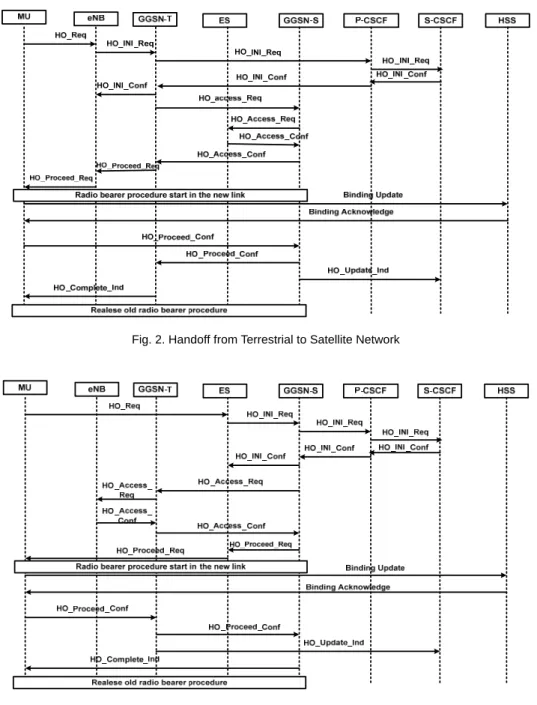
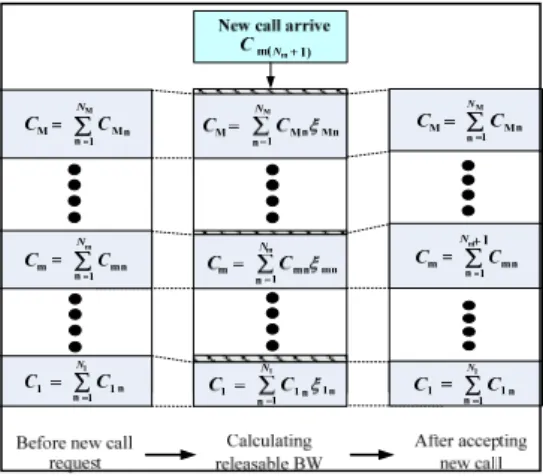
satellite to terrestrial direction or terrestrial to satellite direction. Both of the handover directions, shown in Fig. 2 and Fig. 3, have three phases:
handover initiation, decision and execution. The handover procedures for the both cases are very similar. So, only terrestrial to satellite inter-system handover protocols are described in this paper.
At the handover initiation phase, when the MT detects some QoS change or some handoff
Fig. 2. Handoff from Terrestrial to Satellite Network
Fig. 3. Handoff from Terrestrial to Satellite Network
criteria, it sends a handoff request to the network.
Then the handoff initiation request is forwarded to S-CSCF through SGSN, GGSN of terrestrial access network and P-CSCF of IMS core network to inform the home network about the intention to make a handover. The home network checks the request and identifies the target earth satellite station and also sends the confirmation message whether mobile user (MU) can connect to the satellite network or not.
At the handover decision phase, GGSN of terrestrial network (GGSN-T) sends a request to GGSN of satellite (GGSN-S) network to access satellite network. GGSN-S then sends a resource access request message to ES. If resource is available, GGSN-S sends a confirmation message to GGSN-T. Now GGSN-T sends a message including the information about new radio link to MU to start the handover process.
At the starting of execution phase, MU updates data by giving his information to HSS. MU sends a handover proceed confirmation to GGSN-S. After this message, GGSN-S sends a message to GGSN-T to connect with the satellite network.
After connecting to satellite network, MU releases connection with the old terrestrial network.
III. End-to-End Soft QoS Interworking
1. Soft QoS
In wireless communication systems, it is very critical to achieve high resource utilization and to maintain good QoS level simultaneously. User QoS level and resource allocation are related to each other: the more the allocated resource, the higher the QoS level. However, the additional allocation of resource for a user reduces the number of users to access the network. For heavy traffic condition, users can either use fewer resources or can release some of its resources to increase the number of users to access the network. This release of resources can be done by negotiating with end users using the soft QoS.
There are some algorithms those can be used for soft QoS process.
The authors in [8] define normalized
Q as
i(1)
where, QoS
irepresents the requested QoS by a
call,
maxQoS
irepresents the maximum QoS required and QoS i min represents the minimum
QoS required. This
Q
imonotonically can be varied with the range of [0, 1].
Q
i= 0 indicates that a job is executed with its minimum QoS level,
min
QoS i and Q i =1 indicates that the job is executed with its maximum QoS level,
maxQoS
i. Thus a user can release some of its resources by reducing its QoS level from QoS i max to
min
QoS i .
Bandwidth degradation process is also one kind of soft QoS scheme, where allocated bandwidth for ongoing calls or new calls is less than the requested bandwidth to accommodate more calls when the traffic load is high and total bandwidth is not sufficient to accept calls.
2. Proposed Soft QoS Scheme
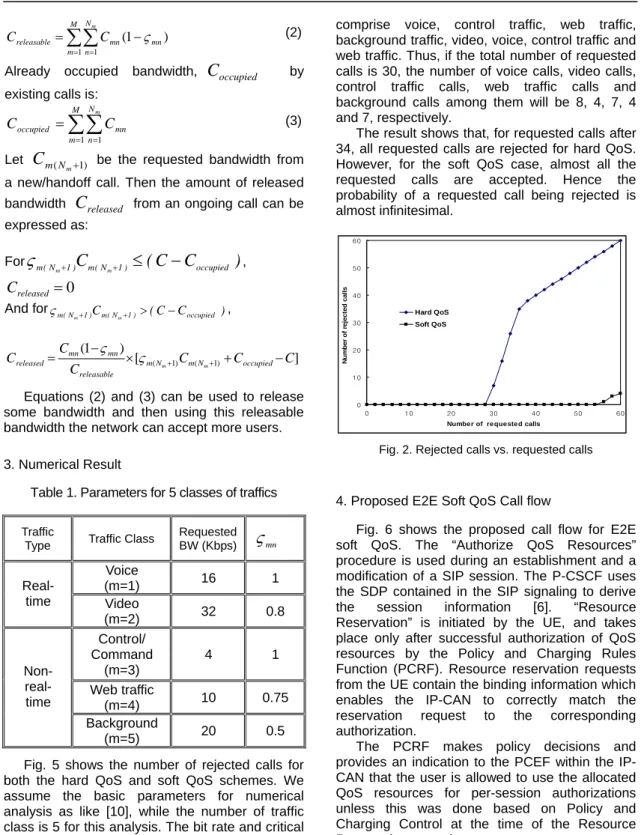
Our proposed soft QoS scheme to release some resources is based on critical bandwidth ratio, ς mn [9]. The critical bandwidth ratio is defined as the ratio of the allocated bandwidth for a call and users’ bandwidth requirement. Fig. 4 shows a basic concept of the proposed scheme.
C is the total bandwidth of satellite link. C m is the total bandwidth occupied by all calls of traffic class m.
Fig. 4. A basic concept of a proposed scheme
We assume that the total number of traffic class is m and N m is the total number of calls for m th class. Suppose
mN
mC is the allocated bandwidth (BW) for N m th
call whose traffic class is m. Now the maximum amount of releasable bandwidth C releasable can be calculated as:
min i max
i
min i i
i
QoS QoS
QoS Q QoS
−
= −
∑∑
= =−
=
Mm N
n
mn mn releasable
m
C C
1 1
) 1
( ς (2) Already occupied bandwidth, C occupied by
existing calls is:
∑∑
= ==
Mm N
n mn occupied
m
C C
1 1
(3)
Let ( + 1 )
N
mC m be the requested bandwidth from a new/handoff call. Then the amount of released bandwidth C released from an ongoing call can be expressed as:
For
m(N 1)C
m(N 1)( C C
occupied)
m
m+ +
≤ −
ς ,
= 0
released
C
And for
m(N 1)C
m(N 1)( C C
occupied)
m
m+ +
> −
ς ,
] ) [
1 (
) 1 ( ) 1
(
C C C
C
C C
mN mN occupiedreleasable mn mn
released
− ×
m m+ −
= ς ς
+ +Equations (2) and (3) can be used to release some bandwidth and then using this releasable bandwidth the network can accept more users.
3. Numerical Result
Table 1. Parameters for 5 classes of traffics
Fig. 5 shows the number of rejected calls for both the hard QoS and soft QoS schemes. We assume the basic parameters for numerical analysis as like [10], while the number of traffic class is 5 for this analysis. The bit rate and critical bandwidth ratio for 5 classes are depicted in Table 1. The call request sequence is assumed to
comprise voice, control traffic, web traffic, background traffic, video, voice, control traffic and web traffic. Thus, if the total number of requested calls is 30, the number of voice calls, video calls, control traffic calls, web traffic calls and background calls among them will be 8, 4, 7, 4 and 7, respectively.
The result shows that, for requested calls after 34, all requested calls are rejected for hard QoS.
However, for the soft QoS case, almost all the requested calls are accepted. Hence the probability of a requested call being rejected is almost infinitesimal.
0 10 20 30 40 50 60
0 10 20 30 40 50 60
Number of requested calls
Number of rejected calls
Hard QoS Soft QoS
Fig. 2. Rejected calls vs. requested calls
4. Proposed E2E Soft QoS Call flow
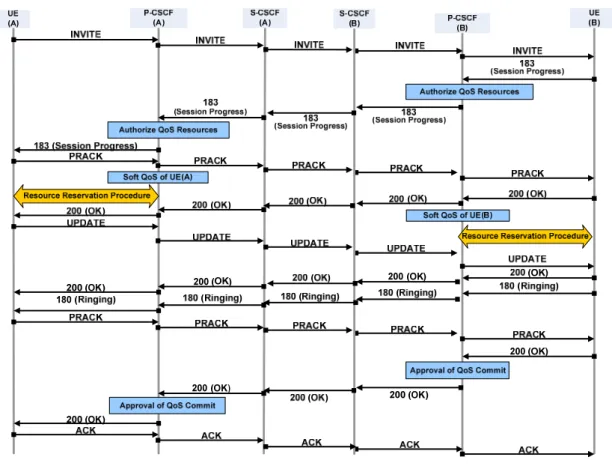
Fig. 6 shows the proposed call flow for E2E soft QoS. The “Authorize QoS Resources”
procedure is used during an establishment and a modification of a SIP session. The P-CSCF uses the SDP contained in the SIP signaling to derive the session information [6]. “Resource Reservation” is initiated by the UE, and takes place only after successful authorization of QoS resources by the Policy and Charging Rules Function (PCRF). Resource reservation requests from the UE contain the binding information which enables the IP-CAN to correctly match the reservation request to the corresponding authorization.
The PCRF makes policy decisions and provides an indication to the PCEF within the IP- CAN that the user is allowed to use the allocated QoS resources for per-session authorizations unless this was done based on Policy and Charging Control at the time of the Resource Reservation procedure.
Traffic
Type Traffic Class Requested BW (Kbps)
ς mn
Voice
(m=1) 16 1
Real-
time Video
(m=2) 32 0.8
Control/
Command (m=3)
4 1 Web traffic
(m=4) 10 0.75
Non- real- time
Background
(m=5) 20 0.5
IV. Conclusion
A satellite system is the only way to connect all the access networks of the world in a common platform. The real global communication is possible with a satellite/ terrestrial integrated network only when seamless handover and proper resource management are possible. In this paper, a new architecture for IMS-based integrated terrestrial/satellite mobile communi- cation network architecture has been proposed.
We described inter-network handover procedure and end-to-end soft QoS procedure. Our proposed architecture is able to fulfill the 4G requirement. The numerical result shows that almost all the requested calls can be accepted using soft QoS procedure. Thus probability of a requested call being rejected is extremely small.
References
[1] Antonio Lera, Antonella Molinaro, “Designing the Interworking of Terrestrial and Satellite IP-
Based Networks,” IEEE Communications Magazine, pp. 136-144, February 2002.
[2] P. Conforto, C. Tocci, V. Schena, L. Secondiani, N. Blefari-Melazzi,P. M. L. Chan, and F. Delli Priscoli, “End-to-end QoS and Global Mobility Management in an Integrated Satellite/
Terrestrial Network,” International Journal of Satellite Comm. Network, 2004.
[3] Yurong Hu and Victor O. K. Li, “Satellite-Based Internet: A Tutoria,” IEEE Communications Magazine, pp. 154-162, March. 2001.
[4] L. Fan, M. E. Woodward, and J. G. Gardiner,
“Architecture and Protocols in an IP-Based Integrated Terrestrial/Satellite Mobile Commu- nications Network,” IEEE International Conference on Communications, vol.9, pp.
2850–854, June 2001.
[5] Tae Chul Hong, Kun Seok Kang, Do-Seob Ahn, and Ho-Jin Lee, “Inter-System Handover Analysis in Integrated Terrestrial and GEO Satellite Communication Networks for Seamless Mobility,” IEEE/ICACT, pp. 717-721, February2007.
[6] 3GPP TS 23.228, “IP Multimedia Subsystem (IMS),” [1] December 2007.
Fig. 5. IMS-based E2E Soft QoS