• 검색 결과가 없습니다.

Fauna Diversity at the Deukjin River, Hapcheon-gun, Korea

N/A
N/A
Protected

Academic year: 2021

Share "Fauna Diversity at the Deukjin River, Hapcheon-gun, Korea"

Copied!
5
0
0

로드 중.... (전체 텍스트 보기)

전체 글

(1)

Fauna Diversity at the Deukjin River, Hapcheon-gun, Korea

Man Kyu Huh*

Division of Applied Bioengineering, Dong-eui University 995 Eomgwangno, Busanjin-gu, Busan 47340, Korea Received September 19, 2017 /Revised October 30, 2017 /Accepted October 30, 2017

Biodiversity (or biological diversity) is defined as the variability of living organisms, the “diversity of life on Earth,” and the complex relationships that make up ecosystems. This study aimed to inves- tigate the spatial and temporal patterns in animal species composition and diversity at the Deukjin River, located in Hapcheon Province, Korea. The fauna community at the Deukjin River during 2016 season was identified with a total of 55 taxa, representing the following six classes: Mammalia (mammals), Actinopterygii (bony fish), Chondrichthyes (cartilaginous fish), Aves (birds), Amphibia (amphibians), Reptilia (reptiles), and invertebrates. The Berger–Parker index (BPI) for mammals var- ied from 0.233 (Station A) to 0.333 (Station D). The Shannon–Weaver index (H´) and two diversity indexes (N1 and N2) for mammals and birds in the upper region were higher than those in the lower region. The values of ß-diversity for animals varied from 0.229 for fish to 0.339 for invertebrates. The richness indices for animal taxa also varied among the stations and seasons. Station A showed consid- erably high richness in mammals, birds, and reptiles/amphibians. Although the richness indices (R1 and R2) for six animal kingdoms during the seasons were different from each other, the difference was not significant (p<0.05). The evenness indices for five animal kingdoms were different from each other, but again, the difference was not significant (p<0.05).

Key words : Deukjin River, richness indices, Shannon-Weaver indices, spatial and temporal patterns

*Corresponding author

*Tel : +82-505-182-6870, Fax : +82-51-890-1529

*E-mail : [email protected]

This is an Open-Access article distributed under the terms of the Creative Commons Attribution Non-Commercial License (http://creativecommons.org/licenses/by-nc/3.0) which permits unrestricted non-commercial use, distribution, and reproduction in any medium, provided the original work is properly cited.

Journal of Life Science 2018 Vol. 28. No. 1. 105~109 DOI : https://doi.org/10.5352/JLS.2018.28.1.105

Introduction

Understanding the spatial and temporal distribution of species is a central issue in ecology and evolutionary biology.

All species have limits to their geographical ranges beyond which they are not found, presumably because at these loca- tions their tolerances and capacities are constrained or dis- persal from source populations is limited. The geographical ranges of species distributions may result from the interplay between many factors including habitat availability, local en- vironmental conditions, metapopulation dynamics, bio- logical interactions and species-specific traits, such as phys- iological tolerances, dispersal potential and vital rates [1].

Biodiversity (or biological diversity) is defined as the varia- bility of living organisms, the ‘diversity of life on Earth’, and the complex relationships that make up ecosystems [14].

This can refer to genetic variation, ecosystem variation or species variation (number of species) within an area

or biome. A large body of literature exists on the relation- ship between diversity patterns and multiple spatial scales in terrestrial systems [3, 6, 8].

In spite of many tools and data sources, biodiversity re- mains difficult to quantify precisely. But precise answers are seldom needed to devise an effective understanding of where biodiversity is, how it is changing over space and time, the drivers responsible for such change, the con- sequences of such change for ecosystem services and human well-being, and the response options available [17].

Primarily, it is necessary to measure the abundance of all organisms over space and time, using taxonomy (such as the number of species). Because biodiversity is the sum total of all biotic variation from the level of genes to ecosystems, the challenge is to find an efficient way to express or to measure this complexity [16]. Currently, it is not possible to do this with much accuracy because the data are lacking.

The Deukjin River is started at the mountains and the Songgok Reservoir. The most floodplains of the river have been converted to agricultural or horticultural fields, hous- ing, restricting the river bed to a small channel. The purpose of this study is to investigate the fauna on the Deukjin River at four regions during four seasons on 2016. Assessing the relative contribution of local diversity to regional bio- diversity may be the key to understanding large-scale and

- Note -

(2)

Fig. 1. The four stations at the Deukjin River in Hapcheon-gun, Korea.

even global patterns in species diversity [5]. The purpose of this study is to investigate the fauna on the Deukjin River at four regions during four. These can be used to provide first-order approximations of the true extent and changes in taxonomic diversity.

Materials and Methods

This study was carried out on the Deukjin River, located at Samga-myeon province (upper region: 35°416‘549’‘N /128°063’971‘’E, low region: 35°413‘807’‘N/128°083’909‘’E), Hapcheon-gun province in Korea (Fig. 1). The areas of this river are located at middle altitude (140 m above sea level) and consist of a mosaic of agricultural fields and farming houses. Animal identification using a means of marking is a process done to identify and track specific animals. A small dredge is also used to collect sediments from the bottom of the river to determine the numbers and kinds of in- vertebrates present. Identifications of mammals and herpe- tology were based on Weon [21]. The identification of birds followed Lee et al. [12]. Identifications of herpetology were based on Lee et al. [11]. Identifications of fishes were based on Choi [2]. Identifications of invertebrates were based on Kim et al. [10].

Several indices have been created to measure diversity, and the most frequently used are the Shannon-Wiener (H') [18] and Hill [7].

H' = -Σ pi ln pi

pi is the proportion of important value of the ith species (pi = ni / N, ni is the important value index of ith species and N is the important value index of all the species).

N1 = e

H'

N2 = 1/λ

Where λ (Simpson’s index) for a sample is defined as

λ = ∑ ni(ni-1) N(N-1)

The species richness of animals was calculated by using the method, Berger-Parker’s index (BPI) and Margalef’s in- dices (R1 and R2) of richness [13].

Evenness indices (E1~E5) was calculated using important value index of species [7, 15]. ß-diversity was calculated us- ing the method of Tuomisto [20]. The homogeneity of var- iance or mean values to infer whether differences exist among the stations samples or seasons was tested.

Results and Discussion

Although the studied area was not wide, but the fauna

were very diverse and the fauna community at the Deukjin

River during 2016 season was identified with a total of 55

taxa, representing six classes; Mammalia (mammals), Acti-

nopterygii (bony fish), Chondrichthyes (cartilaginous fish),

(3)

Table 1. Diversity index for mammals, birds, and reptile/amphibians in the studied areas of Deukjin River

Indices Mammal Bird Reptile /Amphibian

St. A St. B St. C St. D St. A St. B St. C St. D St. A St. B St. C St. D Richness

BPI R1 R2

0.233 2.058 1.461

0.301 1.335 1.118

0.313 1.082 1.002

0.333 1.207 1.155

0.143 3.478 2.004

0.136 2.907 1.809

0.211 2.199 1.460

0.250 1.888 1.429

0.282 1.911 1.281

0.355 1.747 1.257

0.375 1.443 1.061

0.201 1.898 1.265 Diversity

H' N1 N2

1.977 7.224 8.208

1.544 4.686 5.429

1.371 3.937 4.800

1.358 3.888 5.077

2.597 13.426 14.951

2.390 10.913 12.959

2.105 8.204 9.130

1.878 6.539 7.886

1.881 6.557 6.500

1.762 5.823 5.602

1.591 4.911 4.636

1.965 7.131 7.573 Evenness

E1 E2 E3 E4 E5

0.951 0.903 0.889 1.136 1.158

0.960 0.937 0.921 1.159 1.202

0.989 0.984 0.979 1.219 1.294

0.980 0.972 0.963 1.306 1.412

0.959 0.895 0.888 1.114 1.123

0.962 0.909 0.901 1.187 0.206

0.958 0.912 0.901 1.113 1.128

0.965 0.934 0.923 1.206 1.243

0.904 0.820 0.794 0.991 0.990

0.905 0.832 0.804 0.962 0.954

0.888 0.818 0.782 0.944 0.930

0.945 0.891 0.876 1.062 1.072

Table 2. Diversity index for fishes and invertebrates in the studied areas of Deukjin River

Indices Fish Invertebrates

St. A St. B St. C St. D St. A St. B St. C St. D

Richness BPI R1 R2

0.265 1.701 1.200

0.308 1.535 1.177

0.259 1.517 1.155

0.226 2.088 1.437

0.250 2.308 1.591

0.179 2.101 1.512

0.207 2.376 1.671

0.250 2.711 1.739 Diversity

H' N1 N2

1.804 6.072 6.303

1.685 5.391 5.804

1.716 5.564 6.268

2.014 7.490 8.774

2.063 7.780 8.267

2.027 7.590 9.450

2.121 8.340 10.150

2.214 8.155 9.176 Evenness

E1 E2 E3 E4 E5

0.927 0.867 0.845 1.038 1.046

0.940 0.898 0.878 1.077 1.094

0.958 0.927 0.913 1.126 1.54

0.968 0.936 0.927 1.171 1.198

0.939 0.874 0.859 1.050 1.058

0.975 0.949 0.941 1.245 1.282

0.965 0.927 0.918 1.217 1.247

0.923 0.832 0.816 1.002 1.003

Aves (birds), Amphibia (amphibians) and Reptilia (reptiles) and invertebrates (Table 1). Mammals accounted for nine taxa for only four seasons within the studied areas. They were the most poorly represented of the terrestrial vertebrate groups. Birds (Aves) exhibited the greatest species diversity with 17 taxa identified. There were nine taxa of reptiles/am- phibians (Sauropsida/Amphibia) at four sites for four seasons. Fish represented by 8 taxa. There were twelve taxa of invertebrates. The mean numbers of species were 47 taxa within the St. A, 38 taxa within the St. B, 34 taxa within the St. C, and 38 taxa within the St. D. Mammals and birds were shown with the relative high individual density or abundance in upper region (station A). Many individuals

were found in this area because the abundant food supply by one large reservoir. Fish and invertebrate animals were shown with the relative high abundance in low region. It is the junction of two rivers in this area.

Berger-Parker’s index (BPI) for mammals was varied from

0.233 (Station A) to 0.333 (Station D), meaning dominant spe-

cies were different according to stations or seasons. St. B

was considerable low BPI in birds (0.136) and invertebrates

(0.179). Shannon-Weaver index (H´) and two other diversity

(N1 and N2) for mammals and birds at upper region was

higher than those of low region. This area is a forest area

and is good habitat for them. Mean H´ of diversity for rep-

tiles/amphibians was varied from 1.591 (St. C) to 1.965 (St.

(4)

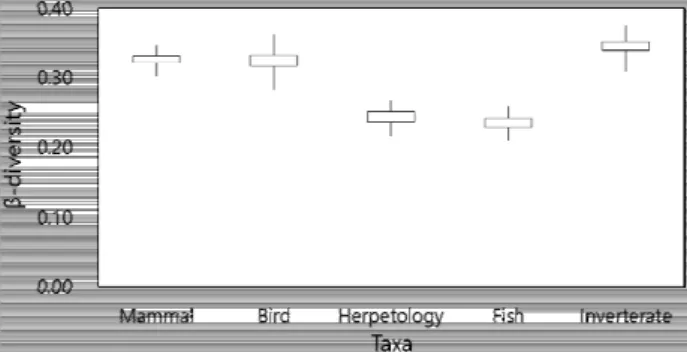
Fig. 2. Occurrence index (β-diversity) for five animal kingdoms at four stations.

Fig. 3. Occurrence index (β-diversity) of four stations for five animal kingdoms.

Table 3. Ecological distance (upper diagonal) based on Bray- Curtis’ formulae analysis and geographic distances (km) (low diagonal) among four stations at the Deu- kjin River

Station St. A St. B St. C St. D

St. A St. B St. C St. D

- 0.613 1.425 1.890

0.025 - 0.812 1.277

0.126 0.009 - 0.465

0.275 0.228 0.037 - D). St. D was considerable high H´ in fish and invertebrates.

Richness indices for animal taxa were also varied among the stations and seasons. St. A was also considerable high richness in mammals, birds, and reptiles/amphibians.

Although richness indices (R1 and R2) for five animal king- doms during seasons were different from each other, there were not shown significant differences (p<0.05). Evenness in- dices (E1-E5) for five animal kingdoms were different from each other, however there were not shown significant differ- ences (p<0.05).

The values of ß-diversity for animals were varied from 0.229 for fish to 0.339 for invertebrates (Fig. 2). For the com- munity as a whole, the values of ß-diversity were the low (from 0.170 for St. D to 0.203 for St. B) (Fig. 3). The Bray- Curtis’ distances were calculated from differences in abun- dance of each species according to geographic distances among four stations at the Deukjin River (Table 3). Neigh- boring stations such as St. B and St. C had the similar species composition (91.0%) and the highest remote populations (St.

A and St. D) had shared only 77.2% species.

Theory and small-scale experiments predict that bio- diversity losses can decrease the magnitude and stability of ecosystem services such as production and nutrient cycling

[4]. Artificial disturbances such as roads or house con- struction are increasing at St. D (Fig. 1). Recently industrial facilities are being introduced into rural areas in order to utilize the surplus labor force of elderly people living in ru- ral areas. Many forests and agricultural lands were con- verted into industrial sites. This artificial action reduced the water's natural filtration action and eliminated the habitat of many animals.

Those results indicated that heterogeneity in species com- positions among the replicates were high. It is usually as- sumed that habitat quality and the biological characters are based on their ability in the heterogeneous environments.

Alternatively, isolation would be a game of chance, where stochastic principles would favor the isolation of more abun- dant community members and sample heterogeneity would determine seasonal migration (migratory birds) for favor habitat [9]. Small-scale spatial variability (among replicate quadrats) increased with depth when multivariate analyses were based on presence/absence data, whilst the opposite was observed when abundance data were analysed without transformation. These patterns reflected changes in the scale of aggregation of organisms relative to the size of the sam- pling unit [19]. The results of ecological diversity and rich- ness of animals at the Deukjin River showed a spatial varia- bility according to sites.

References

1. Araujo, R. M., Serrao, E. A., Sousa-Pinto, I. and Aberg, P.

2014. Spatial and temporal dynamics of fucoid populations (Ascophyllum nodosum and Fucus serratus): A comparison be- tween central and range edge populations. PLoS One 9, e92177.

2. Choi, K. C. 2001. Guide of Korean Fresh Water Fish in Color (Excluded Lepidoptera), pp. 1-671, Hyeoamsa, Seoul, Korea.

3. Chown, S. L. and Gaston, K. J. 2000. Areas, cradles and mu- seums: the latitudinal gradient in species richness. Trends Ecol. Evol. 15, 311-315.

4. France, K. E. and Duffy, J. E. 2006. Diversity and dispersal

(5)

초록:합천군 덕진천의 동물상에 대한 다양성 허만규*

(동의대학교 바이오응용공학부)

생물다양성은 생존하는 유기체들의 변이성으로 정의하며 지구상의 생물의 다양성과 생태계를 구성하는 복잡한 상호작용을 일컫는다. 본 연구는 합천군 덕진천에 서식하는 동물의 종조성과 다양성을 공간적 시간적 양상으로 실시하였다. 2016년 시즌에 동정된 포유류, 연골어류, 경골어류, 조류, 양서류, 파충류, 어류 종의 수는 55분류군이 었다. 포유류의 Berger-Parker’s index (BPI)는 0.233(지점 A)에서 0.333(지점 D)로 나타났다. 포유류와 조류에 대한 Shannon-Weaver index (H´)와 두 다른 다양성 척도(N1과 N2)는 상류지역이 하류 지역보다 높았다. 동물 분류군 에 대한 ß-다양성은 어류 0.229에서 무척추동물 0.339까지 나타났다. 동물종에 대한 풍부도 지수는 지점과 시기에 따라 변화가 있었다. 지점 A는 포유류, 조류, 양서/파충류에서 높은 풍부도를 나타내었다. 비록 다섯 동물 강에 대한 풍부도 지수(R1, R2)가 시즌 별로 다르지만 유의성을 나타내지는 않았다. 균등도 지수(E1-E5) 역시 시즌 별로 다르지만 유의성을 나타내지는 않았다.

interactively affect predictability of ecosystem function.

Nature 441, 1139-1143.

5. Gaever, S. V., Raes, M., Pasotti, F. and Vanreusel, A. 2010.

Spatial scale and habitat-dependent diversity patterns in nematode communities in three seepage related sites along the Norwegian Sea margin. Mar. Ecol. 31, 66-77.

6. Godfray, H. C. J. and Lawton, J. H. 2001. Scale and species numbers. Trends Ecol. Evol. 16, 400-404.

7. Hill, M. O. 1973. Diversity and evenness: a unifying notation and its consequences. Ecology 54, 423-432.

8. Hill, J. K. and Hamer, K. C. 2004. Determining impacts of habitat modification on diversity of tropical forest fauna:

the importance of spatial scale. J. Appl. Ecol. 41, 744-754.

9. Huh, M. K. 2015. Monitoring change in biodiversity of king- dom animalia at the Cheongok River, Uiryeong-gun, Korea.

Int. J. Eng. Appl. Sci. 2, 54-58.

10. Kim, M. C., Cheon, S. P. and Lee, J. K. 2013. Invertebrates in Korean Freshwater Ecosystems, pp. 1-483, Geobook, Seoul, Korea.

11. Lee, J. H., Chun, H. J. and Seo, J. H. 2012. Ecological Guide Book of Herpetofauna, pp. 1-270, National Institute of Environ- mental Research, Incheon, Korea.

12. Lee, U. S., Ku, T. H. and Park, J. Y. 2005. A Field Guide to the Birds of Korea, pp. 1-320, LG Evergreen Foundation, Seoul, Korea.

13. Magurran, A. E. 1988. Ecological Diversity and Its Measurement,

pp. 81-120, Univ. Press, Cambridge, USA.

14. Millennium Ecosystem Assessment. 2005. Ecosystems and Human Well-being: Biodiversity Synthesis, pp. 1-137, World Resources Institute, Washington, DC.

15. Pielou, E. C. 1966. The measurement of diversity in different types of biological collection. J. Theor. Biol. 13, 131-144.

16. Purvis, A. and Hector, A. 2000. Getting the measure of biodiversity. Nature 405, 212-219.

17. Ring, I., Hansjurgens, B., Elmqvist, T., Wittmer, H. and Sukhdev, P. 2010. Challenges in framing the economics of ecosystems and biodiversity: the TEEB initiative. Curr. Opin.

Environ. Sustain. 2, 1-12.

18. Shannon, C. E. and Weaver, W. 1963. The Measurement Theory of Communication, pp. 1-117, Univ. of Illinois Press, Urbana.

19. Terlizzi, A., Anderson, M. J., Fraschetti, S. and Benedetti- Cecchi, B. 2007. Scales of spatial variation in Mediterranean subtidal sessile assemblages at different depths. Mar. Ecol.

Prog. Ser. 332, 25-39.

20. Tuomisto, H. 2010. A diversity of beta diversities: straight- ening up a concept gone awry. Part 1. Defining beta diver- sity as a function of alpha and gamma diversity. Ecography 33, 2-22.

21. Weon, B. H. 1967. Mammal species in Korea. Ministry of

Education, Seoul, Korea.

수치

Table  2.  Diversity  index  for  fishes  and  invertebrates  in  the  studied  areas  of  Deukjin  River
Fig.  3.  Occurrence  index  (β-diversity)  of  four  stations  for  five  animal  kingdoms.

참조

관련 문서

Moving from Traditional Payment Rails to Payment Networks 73 Fiat Currency Stablecoins Create More Interoperability between Ecosystems 74 Cryptocurrency and

The lava field of the Hantangang River extends over Yeoncheon-gun, Gyeonggi-do, Pocheon-si and Cheorwon-gun, Gangwon-do, and extends about 110 kilometers, in the central part

This study suggested diversity in the configuration of expression through expression of abstract images, the style of modern painting, which are expressed

Purpose: This study was aimed to compare the functional outcomes of the continuous and discontinuous fractures, retrospectively, in multiple thoracolumbar

Further, in this course, students will learn all the capabilities necessary for the modeling of the practical fluid phenomena in the river and for the analysis

In the present study, 10 study stations were established, and seasonal changes for various ecological aspects of the community such as species composition, number of

For the discharge described in Example 5.5 2, calculate the equilibrium partial pressure of the chemical above the river at the discharge point Is volatilization from the

This is the research that studies conflicts over differences in learning patterns at work and school, which leads confusion and maladaptation to work place