139
JOURNALOF KOREAN FOREST SOCIETY ISSN 0445-4650(Print), ISSN 2289-0904(Online) http://e-journal.kfs21.or.kr
유아 숲 체험활동의 효과에 대한 메타분석: 중재변인별 효과크기를 중심으로
조영민1*·김동준2·연평식2·이효은1·이규하1·박근태1·이은정1·이보배2
1충북대학교 산림치유학과, 2충북대학교 산림학과
A Meta-Analysis for the Effect of Forest Experience on Young Children:
Effect Size on the Moderating Variables
Young-Min Cho
1*, Dong-Jun Kim
2, Poung-Sik Yeoun
2, Kyu-Ha Lee
1, Hyo-Eun Lee
1, Kuen-Tae Park
1, Eun-Jeong Lee
1and Bo-Bae Lee
21Department of Forest Therapy, Chungbuk National University, Cheongju 28644, Korea
2Department of Forest Science, Chungbuk National University, Cheongju 28644, Korea
요 약: 본 연구는 유아 숲 체험활동의 효과에 관한 연구결과들을 메타분석에 의해 종합하고, 효과적인 프로그램 구 성 및 운영을 위한 지침을 제시하기 위한 것이다. 분석을 위해 국내에서 수행된 연구 30편을 선정하고 동질성 검정 후 고정효과모형을 적용하여 효과크기를 산출하였다. 연구결과 유아 숲 체험활동의 전체효과크기는 0.797로 나타났 으며 Cohen의 효과크기 해석에 따라 큰 효과크기를 나타내었다. 중재변인별 효과크기는 매일형이 가장 큰 효과를 나타내었으며(ES=0.939), 활동기간별 효과크기는 4개월 이상이 큰 효과를 나타내었다(ES=0.972). 활동집단별 효과크 기는 10-20명이 가장 큰 효과크기를 나타내었으며(ES=0.980), 활동시간별 효과크기는 180분이 가장 큰 효과크기를 나타내었다(ES=1.318). 마지막으로 유아 숲 체험활동의 종속변인별 효과크기는 다중지능이 가장 큰 효과크기를 나타 내었다(ES=0.957).
Abstract: The purpose of this study was to evaluate critically the effects of forest experience on young children using meta-analysis. To test this, a total 30 studies were identified, and mean effect size of variables was calculated by applying Fixed-effect model. As a result, the overall effect size of forest experience on young children was 0.797. The effect sizes of daily type as a program type had an effect than experience type at the level of .939. And also the effect sizes of period program (more 4month), number of participants (10-20people), program time (180minute), dependant variables (multiple intelligence) yield effects 0.972, 0.980, 1.138 and 0.957 respectively. As the result, this study implies a way which is to derive effectively further studies on the forest experience on young children.
Key words: effect size, forest experience, program, children, Meta-analysis
서 론
현대의 생활환경은 유아들에게 많은 정보를 받아들이 도록 요구하고, 부모들 또한 자녀에게 많은 기대를 함으 로써 유아들에게 스트레스를 줄 수 있는 가능성을 가지고 있다(Alsop and McCaffrey, 1993). 또한, 지금까지의 우리 나라 교육은 유아들의 능력 개발을 통한 성장 발달에 치 중하여 과도한 방법으로 몰두하고 있으며, 그 결과 유아 들의 능력은 뛰어나지만 심한 스트레스로 정서불안이나
신경과민증 등 심리적인 문제에 시달리거나, 심하게는 공 격적인 모습을 보이는 경우가 발생되고 있다(Choi and Seo, 2010).
따라서 유아의 일상생활에서 과도한 스트레스를 받지 않는 환경을 만들어주는 것이 중요하며, 특히 유아기관에 서 보내는 시간이 증가함으로 인해서 유아교육기관에서 스트레스를 줄여 줄 수 있는 환경을 만들어주는 것이 필 요하다(Lee, 2014). 이런 배경으로 인하여 유아들에게 신 체적·정신적 건강을 회복시켜주고, 탐구적 학습 환경을 제공하기 위해 자연 체험 또는 숲체험 프로그램이 각광받 게 되었다. 우리나라에서는 Lee(2003)가 독일의 숲 유치
*Corresponding author
E-mail: [email protected]
원을 소개하면서 유아 숲 체험활동이 처음 소개되었다.
2008년 산림청에서 숲 유치원 포럼이 개최되면서 국내에 서도 숲 유치원 프로그램이 활성화되었고, 다양한 연구를 통해서 숲 체험 활동이 유아들에게 긍정적인 영향을 주는 것으로 보고되었다. 유아 숲 체험활동의 효과에 관한 논 문은 Yoon(2004)의 자연체험을 통한 유아의 창의성 증진 변화에 대한 연구로 처음 발표되기 시작되었으며, 2004년 이후 매년 연구가 꾸준히 지속되어 왔다. 따라서 지난 11 년간 유아 숲 체험활동 연구는 지속적으로 축적되어 개개 의 연구들을 통합하여 살펴보는 메타분석의 필요성이 강조 된다. 메타분석이란 ‘분석들의 분석(Analysis of Analysis)’
을 한다는 의미로, 동일한 연구 문제를 다루고 있는 개별 연구의 결과들을 통계적으로 통합하여 분석하는 방법이 다. 따라서 특정 연구 주제의 결과가 누적되었을 때 이러 한 연구의 결과들을 모아 일관된 체제 속에서 통합, 분석 해봄으로 연구 결과들을 보다 명확하게 밝힐 수 있는 분 석이다(Oh, 2009). 현재, 유아 숲 체험활동 관련된 메타분 석 연구로써 Park(2014)의 연구가 있었으나 숲 유치원이 유아에게 미치는 조절변인으로 연구결과를 보고하였을 뿐 중재변인별로 유아 숲 체험활동의 메타분석은 실시하지 않았다. 또한, 프로그램의 효과는 한 가지 요인에 의해서 변화되는 것이 아니라 프로그램을 어떻게 설계하느냐에 결과가 달라질 수 있다. 프로그램의 진행요소가 잘 구성 되었다는 것은 프로그램의 통계적 유의도와 프로그램 참 여자에게 훨씬 더 많은 혜택을 부여한다는 것을 의미한다 (Durlak and Dupre, 2008). 따라서 본 연구에서는 지속적 으로 축적된 유아 숲 체험활동 연구들을 중재변인별로 메 타분석을 실시하여 추후 유아 숲 체험활동의 효과를 증대 시키기 위한 요인을 제시하고 추후 프로그램 개발을 위한 기초자료를 제공하고자 한다. 구체적인 목표는 다음과 같 다. 첫째, 유아 숲 체험활동의 전체효과크기는 얼마인지 분석한다. 둘째, 각 중재변인들에 따라 평균효과크기가 어 떻게 나타나는지 분석한다. 셋째, 유아 숲 체험활동의 종 속변인별 평균효과크기는 얼마인지 분석한다.
연구방법
1. 분석대상
본 연구는 유아 숲 체험 활동을 주제로 한 국내 연구를 수집하기 위해 2006년부터 2015년까지 최근 10년간 국내 에서 발표된 석·박사 학위 논문 및 학술지에 발표된 논 문, 학술대회 발표 논문 등을 대상으로 분석하였다. 논문 의 검색을 위해 한국교육학술정보원(RISS), 한국학술정보 (KISS), 국회도서관, 누리미디어(DBpia), Google Scholar 등의 다양한 온라인 검색 데이터베이스를 활용하여 분석 대상 논문을 검색하였다. 주제어는 ‘유아’, ‘자연’, ‘숲’,
‘체험’, ‘프로그램’ 등을 사용하였으며, 다양한 키워드로 검색하여 관련 문헌을 수집하였다. 1차 자료 검색결과 149 편의 논문이 수집되었으며, 1차 수집된 논문 중에서 Park(2014)의 기준을 바탕으로 2차 수집논문을 선정하였 다. 수집기준은 첫째, 메타분석을 위한 조건으로 실험집단 과 통제집단이 존재하는 실험연구를 논문으로 선정한다.
둘째, 연구의 설계가 실험연구로서 질적연구는 연구대상 에서 제외하였으며, 실험연구라 해도 단순 빈도분석으로 통계처리하여 독립변인과 종속변인의 관계를 파악할 수 없는 논문은 분석대상에서 제외하였다. 셋째, 연구결과가 부적절하게 제시된 연구들도 제외시켰다. 예를 들면, 사후 검사의 평균과 표준편차를 제시하지 않았거나, 사전검사 와 사후검사간의 차이만을 제시하거나, 사후검사 결과만 제시한 연구들은 제외시켰다. 넷째, 실험집단과 통제집단 의 평균점수, 표준편차, 사례 수, t값, F값이 제시된 논문 을 선정하였다. 1차 수집된 149편중에는 메타분석에 필요 한 통계 값이 충분히 보고되지 않고 메타분석을 할 수 없 는 질적 연구이거나 개별연구가 학위, 학술지에 중복 게 재 혹은 동일한 개별연구가 서로 다른 학술지에 게재된 119편을 제외하였다. 최종적으로 30편의 논문이 선정되었 으며, 석·박사학위논문 19편, 학술지 논문 11편으로 이 루어졌다.
2. 메타분석에 포함된 연구들의 특성과 자료코딩 본 연구에서는 수집된 연구들의 특성을 파악하고 변인 별로 어떤 영향을 미치는지를 알아보기 위해 Oh(2002)의 분석기준을 참고하여 본 연구의 목적에 맞게 수정하여 사 용하였다. 활동기간별, 활동집단별, 활동유형별, 종속변인 별 등을 범주형 변수로 간주하여 하위그룹분석(Sub-Group Analysis)을 위해 코딩하였다(Table 1). 코딩절차는 다음과 같다. 먼저 코딩지를 개발하여 제1저자와 대학원생 4인이 코딩을 실시하는 과정에서 차이가 나타나는 경우에는 다 섯 사람이 협의를 통해서 해결하였다. 그리고 5명의 코딩 자의 의견이 불일치하는 경우에는 다른 공동연구자의 의 견을 반영 후 코딩하여 불일치 문제를 해소하였다.
3. 효과크기의 산출 및 해석
효과크기(Effect size)란 실험집단과 통제집단, 두 개의 집단 평균치의 차이를 통제집단의 표준편차로 나눈 값을 말한다. 이것은 상호 의미 있게 비교하기 위해 두 집단 간 의 평균치의 차이 점수를 일종의 단위 표준 점수로 나타 낸 것이다(Lipscy and Wilsin, 2002). 효과크기를 표현하는 방식은 연구논문의 상황에 따라 여러 가지가 존재하며, 효 과크기를 계산하는 방식도 다양하다(Seo, 2004). 일반적으 로 많이 쓰이는 효과크기는 표준화된 평균 차, 상관계수, 승산비(Odd-Ratio) 등이 많이 쓰인다. 본 연구에서는 효과
크기의 공통지수로 나타내는 방법인 표준화된 평균 차로 나타내는 효과크기를 정의하고 통합표준편차를 산출하는 과정을 선정하였다.
ESsm : Mean Effect Size
: Mean Average Score of Post Experiment Group : Mean Average Score of Post Control Group spooled: Combine Standard Deviations of Post Experiment
Group and Post Control Group 통합표준편차의 공식은 다음과 같다.
sp: Combine Standard Deviations n1: Number of Experiment Group n2: Number of Control Group
S1: Standard Deviations of Experiment Group S2: Standard Deviations of Control Group
표준화된 평균차에 의한 효과크기를 산출할 때 표본 수 가 적을 경우에는 효과크기가 실제 값보다 크게 산출되는 경향이 나타나게 된다(Oh, 2009). 이에 따라 본 연구의 연 구대상 논문의 개별연구의 소표본(small sample size)으로 인한 문제점을 교정하기 위해 교정된 효과크기 변환공식 을 사용하였다(Nam and Kim, 2012).
: Calibration Factor of Effect Size
N : Number of Experiment Group + Number of Control Group
4. 출판편의 검증
메타분석 결과의 타당성 확보를 위해 출판편의 검증을 ESsm xe–xc
sp ---
=
xe xc
Sp (n1+1)S12+(n2–1)S22 n1+n2–2
( )
---
=
ES′sm ESsm 1 3 4N 9– --- –
=
ES′sm Table 1. Characteristic to subject of analysis.
No Author Year Reference Type Program Type Program
period
Program person
Time once per program
1 Oh, S. H. 2014 Master's Experience 3months 10-20persons 90minute
2 Kim et al. 2006 Journal Experience 2months 20-30persons -
3 Song, E. J. 2009 Master's Experience 2months 20-30persons 60minute
4 Lee, D. R. 2013 Master's Experience 2months 20-30persons 210minute
5 Park, S. J. 2012 Doctoral Experience 4months 20-30persons 210minute
6 Lee, M. H. 2011 Journal Experience More than 4months 20-30persons -
7 Kim, E. S. 2013 Journal Experience More than 4months 20-30persons 180minute
8 Jeon, H. S. 2014 Master's Experience 2months 10-20persons 90minute
9 Kim et al. 2015 Journal Experience 3months more than 40persons -
10 On, E. A. 2013 Master's Experience 2months 20-30persons 60minute
11 Kim, E. S. 2013 Journal Daily More than 4months 20-30persons 60minute
12 An, M. S. 2014 Doctoral Experience More than 4months 20-30persons 60minute
13 Choi, S. K. 2013 Doctoral Experience 3months 20-30persons -
14 Mun, Y. H. 2009 Master's Experience 2months 10-20persons -
15 So, M. S. 2012 Master's Experience More than 4months 20-30persons 120minute
16 Hong, Y. S. 2015 Master's Experience 2months 10-20persons 90minute
17 Ma, J. S. 2008 Journal Experience 1months 10-20persons 60minute
18 Lee, I. W. 2014 Journal Experience 2months 10-20persons 60minute
19 Lee, Y. N. 2014 Doctoral Experience 3months 20-30persons 60minute
20 Kim et al. 2009 Journal Experience 2months 20-30persons -
21 Yoo et al. 2014 Journal Experience More than 4months 20-30persons -
22 Shin, J. Y. 2012 Journal Daily More than 4months 20-30persons 120minute
23 Kim, Y. 2010 Master's Daily More than 4months 20-30persons 60minute
24 Lee, S. H. 2012 Journal Daily 2months 10-20persons 60minute
25 Seo, Y. M. 2014 Doctoral Experience 1months 10-20persons 150minute
26 Lee, I. S. 2008 Master's Experience 3months 20-30persons 60minute
27 Lee, J. H. 2013 Master's Daily More than 4months 20-30persons 90minute
28 Lee, G. M. 2012 Master's Experience More than 4months 20-30persons 120minute
29 Yun, K. E. 2013 Master's Experience 2months 20-30persons 60minute
30 Lee, E. Y. 2014 Master's Experience 2months 20-30persons 60minute
실시하였다. 출판편의 검증 방법으로는 Orwin(1983)의 안 정성 계수(Nfs)와 퍼넬플롯(Funnel Plot) 및 추정치가감법 (trim and fill)을 사용하였다. 먼저, 안정성 계수는 유의한 메타분석의 결과를 유의하지 않게 하기 위해 몇 편의 연 구물이 더 필요한지 계산하는 방법이다. 안정성 계수는 아 래식과 같이 추정할 수 있다.
Nfs: Fail-Safe N k : Number of Studies d : Mean Effect Size
de : Effect Size obtained for the Omitted Studies
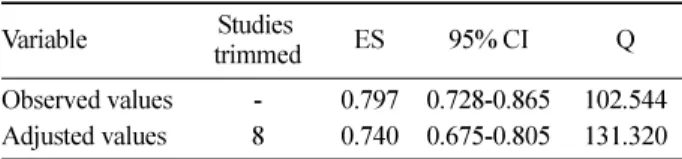
연구대상 30개의 논문 중 74개의 효과크기를 산출하였 다. 전체효과크기는 0.797이었는데, 이 효과크기가 작은 효과크기 0.2가 되기 위해서는 효과가 전혀 없는 결과가 나온 연구 86편이 필요하므로, 전체 효과크기에 대한 출 판편의가 높지 않는 것으로 판단된다. 또한, 퍼넬플롯 (Funnel Plot)으로 출판편의를 확인해본 결과 대칭으로 이 루어지지 않았다. 이에 Duvall과 Tweedie(2000)의 추정치 가감법(trim & fill)으로 일종의 민감도 분석을 해본 결과, 조율된 연구물의 보정 값과 관찰 값의 큰 차이가 나타나 지 않아 출판편향이 존재한다고 보기 어려웠다(Table 2).
5. 자료처리 방법
본 연구에서는 선정기준에 의해 선별된 논문의 연구내 용을 Excel로 처리하였다. 주요내용은 ① 논문제목, 저자, 전공, 년도, ② 메타분석에 필요한 실험집단과 통제집단의 평균, 표준편차, 집단수, ③ 활동유형, 활동기간, 활동집단, 활동시간 등 중재변인으로 구성하였다. 메타분석을 위해 메타분석 전용 소프트웨어인 CMA(Comprehensive Meta Analysis 2.0 Ver.2)를 활용하여 메타분석을 실시하였다.
결과 및 고찰
1. 동질성 검정에 따른 분석모형 선택
본 연구에서는 개별 연구물의 결과가 같은 모집단에서 나온 것이라는 가정에서 고정효과모형으로 진행되는 동 질성 결과, 총 분산 대비 연구간 분산의 비율을 나타내는
값은 28.812으로 나타나 개별 연구들의 효과크기가 이 질적이지 않는 것으로 나타났다. 따라서 이 연구에서는 고정효과모형으로 효과크기를 산출하기로 결정하였다 (Table 3).
2. 전체효과크기
연구대상 연구물 각각을 하나의 단위로 사용하여 고정 효과모형으로 ‘표준화된 평균차’ 효과크기를 산출하였다.
분석결과, 고정효과모형으로 도출된 전체 효과크기 값은 0.797이고, 신뢰구간에 해당하는 값은 0.728-0.866로 나타 나, 신뢰구간 내에 0이 포함되지 않으므로, 통계적으로 유 의하다고 할 수 있다. 이 신뢰구간은 하한선과 상한선으 로 제시되는 범위가 적을수록 효과크기가 정밀하다고 볼 수 있는데 메타분석에서의 유의성은 p-value보다는 구체 적인 신뢰구간을 활용하는 것이 보편화 되었다(Hwang, 2014). 또한, Cohen(1988)은 효과크기가 ES ≥ .50인 경우 중간 정도의 효과가 있으며 ES ≥ .80인 경우 효과가 큰 것 으로 해석하였다. 이를 적용하면, 유아의 숲 체험활동에 대한 전체효과는 높은 효과크기를 가진 것으로 볼 수 있다.
3. 중재변인에 따른 효과크기
프로그램을 어떠한 요소로 구성하느냐에 따라서 프로 그램의 결과가 달라질 수 있다. 그렇기에 프로그램에서 산 출된 결과뿐만 아니라 그 결과에 영향을 미치는 프로그램 의 구성요소를 이해하는 것은 프로그램의 효과를 포괄적 으로 평가하기 위한 중요한 요소이다. Bae et al.(2010)은 정신장애인의 재활 성과에 영향을 미치는 구체적인 프로 그램의 구성요소(프로그램 유형, 제공시간 등)을 분석한 결과, 정신장애인의 고용성과를 높이는 데에는 참여시간 이, 삶의 만족도 관련해서는 레크리에이션 및 교육 참여 시간과 회의 참여 시간, 입원 관련에는 스트레스 관리 프 로그램의 참여시간 등이 긍정적인 영향을 미친다고 하였 다. 또한 연구자마다 프로그램의 구성요소에 대한 정의가 약간씩 차이가 있으나, 일반적으로 프로그램 제공 시 포 함되어야 할 기본적 구성요소로는 참가자, 실시주체, 활동 내용, 실시방법, 장비나 도구, 실시시간, 횟수, 환경 및 장 소, 프로그램 담당자 등이 있다(Shin and Kim, 2010). 따 라서 본 연구에서는 이러한 선정방법을 활용하여 프로그 램의 유형, 활동기간, 활동집단, 활동시간을 프로그램의 구성요소로 선정하였다.
Nfs=k d d( – e) d⁄ e
Table 2. Trim and fill verification results.
Variable Studies
trimmed ES 95% CI Q
Observed values - 0.797 0.728-0.865 102.544 Adjusted values 8 0.740 0.675-0.805 131.320
*ES: Effect Size, 95%CI : Confidence Interval, Q: Q-statistic
Table 3. Fixed-effects model as the results of homogeneity.
N Q p I2 ES 95% CI SE
30 102.545 .000 28.812 0.797 0.728-0.866 0.035
*Q: Q-statistic, p: p-value, I2: I-squared, ES: Effect Size, 95%CI:
Confidence Interval, SE: Standard Error
1) 유형별 효과크기
숲체험 유형은 Kim et al.(2014)의 연구를 참조하여 반 일 혹은 하루 종일 자연을 체험하고 다양한 놀이를 하는 매일형과 주 1-2회 또는 월 1-4회 숲 체험교육 프로그램 에 참여하거나 활동하는 경우 체험형으로 분류하고 분석 하였다. 유아 숲 체험 활동의 유형별 효과크기를 살펴본 결과, 매일형 집단이 효과크기가 큰 것으로 나타났다 (ES=0.939). 하지만, 체험형 집단의 효과크기도 0.782로 높 은 효과크기를 나타내었다(Table 4).
2) 활동기간별 효과크기
프로그램의 기간을 두고 장·단기 프로그램의 효과성 을 두고 논쟁이 있어 왔다. 정신요법이나 가족교육(pilling et al., 2002, pitschel-walz et al., 2001)의 경우 단기보다 는 장기적으로 제공 시 클라이언트의 회복률 증가와 아울 러 재발률 및 입원율 감소에 효과적이라는 반면, Smit et al.(2012)는 인지행동치료, 대인관계 치료, 정신분서기료와 같은 정신요법은 장·단기와 관련 없이 특히 회복률 (recovery rate)에 미치는 효과성은 비슷하다고 보고 있다.
춤 및 운동 관련 프로그램(Leste and Rust, 1990; Ritter and Low, 1996)에서도 단기 프로그램이 심리적 변화를 개 선하는데 효과적이었다고 한 반면, Chistup(1974)는 단기 프로그램은 심리적 변화를 주기에 불충분하다는 등 일치 되지 않는 결과들이 발표되고 있다. 따라서 이러한 점을 고려하여 유아 숲 체험활동의 활동기간별 효과크기를 검
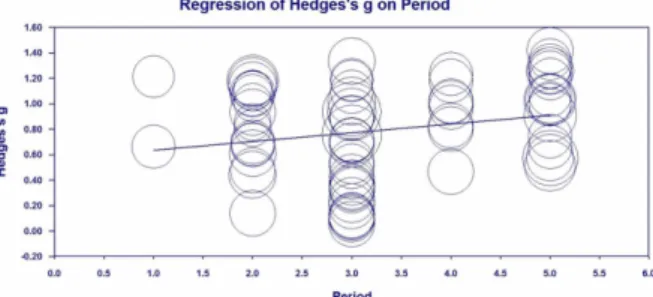
증할 필요가 있다. 유아 숲 체험 활동의 활동기간별 효과 크기를 살펴본 결과, 4개월 이상 집단의 효과크기가 큰 것 으로 나타났다(ES=0.972). 4개월 이상 다음으로 4개월 (ES=0.930), 1개월(ES=0923), 2개월(ES=0.843), 3개월 (ES=0.618)순으로 효과크기가 나타났고, 모두 중간이상의 효과크기가 나타났다(Table 5). 본 연구에서는 단기적인 활동기간보다는 장기적인 활동기간이 효과크기가 크게 나 타났지만, 2, 3개월 효과크기가 1개월 효과크기 보다 낮게 나타나 활동기간이 길수록 높아지지는 않음을 알 수 있었 다. 또한 연속형 변수는 메타회귀분석으로 진행하여야 한 다. 따라서 활동기간별로 효과크기를 메타회귀분석한 결 과 4개월부터 4개월 이상 증가함에 따라 효과크기도 증가 하였으나 1개월, 2개월, 3개월은 효과크기가 불규칙한 양 상이 나타나고 있다. 따라서 4개월, 4개월 이상까지는 연 관성이 있지만 그 외에는 연관성이 없는 것으로 판단된다.
활동기간의 회귀선의 기울기 계수는 0.0689이었으며 하한 선 -0.0011, 상한선 0.1389이었다. 또한, 진 효과크기의 분산 을 나타내는 T2값은 0.0327이었다(Table 6, Figure 1).
3) 활동집단별 효과크기
메타분석 연구결과에 의하면 집단크기에 따라 개입의 효과크기가 달라지고 있는 것을 확인할 수 있다. 예를 들 면, 대인관계기술, 사회기술훈련의 경우 집단 크기를 4-10
Table 5. The effect size of program period of experience type.
Variable N ES SE p 95%CI Q
1months 2 0.923 0.232 .000 0.468-1.378
1.343*
2months 18 0.843 0.074 .000 0.697-0.989
3months 28 0.618 0.056 .000 0.509-0.727
4months 8 0.930 0.111 .000 0.713-1.147
More than 4months 18 0.972 0.069 .000 0.836-1.108
*p<05
Table 6. The period of meta regression analysis.
Variable Coefficient SE 95%CI Z p T2
Period Slope 0.0689 0.0357 -0.0011-0.1389 1.93 0.000
0.0327
Intercept 0.5687 0.1259 0.3219-0.8156 4.52 0.000
*SE: Standard Error, 95%CI: Confidence Interval, Z: Z-value, p: p-value, T2: Tau-squared
Figure 1. The period of meta regression analysis.
Table 4. The effect size of program type.
Variable N ES SE p 95%CI Q
Daily type 6 0.939 0.115 .000 0.713-1.260 1.516 Experience type 68 0.782 0.045 .000 0.710-0.854
*ES: Effect Size, SE: Standard Error, p: p-value, 95%CI:
Confidence Interval, Q: Q-statistic
Table 7. The effect size of program person.
Variable N ES SE p 95%CI Q
10-20persons 20 0.980 0.078 .000 0.828-1.133
7.535*
20-30persons 45 0.723 0.046 .000 0.632-0.813
30-40persons 7 0.917 0.097 .000 0.726-1.107
more than 40persons 2 0.853 0.146 .000 0.567-1.139
*p<05
명 정도로 구성하여 집단구성원들이 적극적으로 참여할 수 있는 기회를 제공하는 것이 적절하다고 권장하고 있다 (Son, 1999). 반면 미술치료와 인지-행동적 집단상담에 관 한 메타분석에서도 집단크기에 따라 효과크기가 달라지 며 10명 이하로 구성하는 것이 가장 효과적이었다고 보고 하고 있다. 하지만 집단크기가 16명 이상일 경우에도 10 명 이하로 구성할 때와 같이 거의 유사한 효과크기를 보 인다고 연구보고들도 있다(Kim, 2001; Kim 2007). 따라서 본 연구는 10명을 기준으로 집단크기를 구성하여 유아 숲 체험 활동의 다양한 기능을 향상을 위해 효과적인 집단크 기를 분석하고자 한다. 유아 숲 체험 활동의 활동집단별 효과크기를 살펴본 결과, 10-20명 집단이 효과크기가 큰 것으로 나타났다(ES=0.980). 그 다음으로 30-40명(ES=
0.917), 40명 이상(ES=0.853), 20-30명(ES=0.723)순으로 효과크기가 나타났다(Table 7).
4) 활동시간별 효과크기
진행시간은 프로그램의 구성회기와 마찬가지로 프로그 램의 성과에 영향을 미치는 구성요소로 입증되고 있다. 때 문에 연구자들은 적절한 진행시간을 규정하여 제시하고 있다. 예를 들어 교육 관련 프로그램은 40-60분이 적절하 다는 연구가 보고 되었고(Son, 1999), 정신장애인을 위한 사회기술 메타분석 결과를 살펴보면, 61-120분이 가장 효 과적인 진행 시간임을 제시하고 있다(Song, 2004). Kim
(2010)은 우울 관련 연구물 53편의 회기 당 시간별 분포를 살펴 본 결과, 21편(39.6%)이 60분 이하, 30편(56.6%)은 61-120분 이하로 진행되었으며, 11분 이상은 1편(1.9%)인 것으로 파악되었다. 특히 진행시간이 61-120분 이하로 제 공될 때의 효과가 가장 좋은 것으로 나타났다. 이처럼 선 행연구들을 살펴본 결과, 대다수의 프로그램이 60분 이하 와 61-120분 이하로 진행될 때 그 효과성이 컸다고 보고 한 반면, 121분 이상은 사례가 충분하지 못해 이에 대한 효과성 크기 파악에 한계가 있었던 부분도 있다. 이에 본 연구에서는 선행연구에서 진행시간의 범주가 효과적이라 고 보고한 것에 근거하여 활동시간별 범주를 설정하고자 한다. 유아 숲 체험 활동의 활동시간별 효과크기를 분석 한 결과, 180분 집단이 효과크기가 큰 것으로 나타났다 (ES=1.318). 그 다음으로 150분(ES=1.240), 210분(ES=
0.947), 90분(ES=0.798), 120분(ES=0.788), 60분(ES=0.712) 순으로 효과크기가 나타났다(Table 8). 본 연구에서는 180 분의 장시간의 프로그램이 효과가 높은 것으로 확인되었 으나 변수의 수가 적기 때문에 연구결과를 일반화 하기는 어렵다. 또한 메타회귀분석으로 분석한 결과, 60분부터 90 분으로 증가함에 따라 효과크기도 증가하였지만, 그 외 변 수는 수가 적어 연관성을 입증하기 어려웠다. 활동기간의 회귀선의 기울기 계수는 0.0570이었으며 하한선 0.0016, 상한선 0.1124이었다. 또한, 진 효과크기의 분산을 나타내 는 T2 값은 0.0487이었다(Table 9, Figure 2).
Table 8. The effect size of time once per program.
Variable N ES SE p 95%CI Q
60minute 37 0.712 .051 .000 0.612-0.812
0.177*
90minute 5 0.798 .139 .000 0.525-1.070
120minute 4 0.788 .017 .000 0.532-1.045
150minute 1 1.240 .119 .000 0.563-1.917
180minute 1 1.318 .101 .000 0.694-1.942
210minute 8 0.947 .113 .000 0.726-1.168
*p<05
Table 9. The time of meta regression analysis.
Variable Coefficient SE 95%CI Z p T2
Time Slope 0.0570 0.0283 0.0016-0.1124 2.02 0.0000
0.0487
Intercept 0.6458 0.0769 0.4950-0.7966 8.39 0.0000
4. 유아 숲 체험활동의 종속별인별 효과크기
숲체험활동이 유아들의 발달영역에 따라 개별 평균 효 과크기가 어떻게 다르며 유의미한 차이가 있는 알아볼 필 요가 있다. 유아 숲 체험 활동의 종속변인별 효과크기는, 5개 이상의 종속변인별 효과크기를 산출하여 분석하였다.
연구결과, 다중지능(ES=0.957)의 효과크기가 가장 큰 것 으로 나타났다. 그 다음으로는 창의성(ES=0.919), 언어능 력(ES=0.865), 감성지능(ES=0.836)순으로 나타났으며 모 두, 중간이상의 효과크기가 나타났다(Table 9).
결 론
본 연구는 유아 숲 체험활동의 효과를 체계적이고 종합 적으로 보고하고자 메타분석(Meta-Analysis)을 이용하여 선행연구를 분석하였다. 메타분석 선정기준에 의거하여 총 30편의 논문을 선정하였으며, CMA프로그램을 이용하 여 동질성 검정 후 고정효과모형을 적용하여 효과크기를 산출하였다. 연구결과, 유아 숲 체험활동의 전체효과크기 는 0.797로 나타났으며, Cohen의 효과크기 기준으로 큰 효과크기를 나타내었다. 이는 유아와 관련된 메타분석 연 구(Kim and Park, 2014; Lee, 2014)들의 효과크기와 같이 동일하게 높은 수준의 효과크기를 나타내었다. 유아 숲 체 험활동의 중재변인별 효과를 알아보기 위해 범주형 변수 에 따라 효과크기를 분석하였는데, 연구결과, 유형별 효과 크기는 매일형이 가장 큰 효과를 나타내었으며(ES=0.939), 활동기간별 효과크기는 4개월 이상 큰 효과를 나타내었다 (0.972). Jung(2005)은 프로그램의 실시기간이 지나치게 길 거나 짧게 되면 참가자의 의욕에 있어서도 문제가 생길
수 있기 때문에 실시기간을 적절하게 편성하는 것이 바람 직하다고 하였다. 본 연구결과에서 유아 숲 체험활동의 가 장 효과적인 프로그램 활동기간은 4개월 이상, 매일형으 로 나타났지만 각 유아 숲 유치원의 현장여건과 규모에 따라 적절히 조절되어야 할 것이다. 활동집단별 효과크기 는 10-20명이 가장 큰 효과크기를 나타내었다(ES=0.980).
이는 Kang(2014)이 집단의 응집성과 역동성을 고려해 볼 때 소집단일 경우가 더 효과적이라는 연구결과와 일치하 였다. 본 연구결과에서 가장 효과적인 프로그램 집단크기 는 1-20명으로 나타났으나, Kang(2011)의 연구결과에서 처럼 집단크기를 결정하기 위해서는 집단의 목표, 구성원 의 연령, 프로그램 유형 등이 고려되어져야 할 것으로 판 단된다. 활동시간별 효과크기는 180분이 가장 큰 효과크 기를 나타내었다(ES=1.318). 이러한 연구결과는 Lee(2003) 와 Kim(2003)의 결과와 일치한 것으로 나타났다. Jang et al.(2013)은 집단회기의 활동기간은 내담자의 연령이나 모 임의 종류, 크기 및 모임의 빈도에 따라 달라지며, 집단구 성원 상호간의 의사소통을 할 수 있는 분위기 조성, 개인 의 집중능력, 그 회기의 주요 작업이 충분히 이루어질 수 있도록 조정되어야 한다고 하였다. 마지막으로 유아 숲 체 험활동의 종속변인별 효과크기는 다중지능이 가장 큰 효 과크기를 나타내었다(ES=0.957). Park(2014)의 연구에서 는 숲체험을 통한 활동이 유아의 환경·체험 영역과 사 회·정서 영역에 아주 큰 효과를 나타나 주로 정서적인 부분에 효과가 나타났지만 본 연구에서는 다차원적인 여 러 가지 하위능력을 나타내는 다중지능이 큰 효과를 나타 내었다. 이러한 결과는 숲이라는 공간은 다른 기능보다 유 아에게 다중지능을 두드러지게 발달시키는 공간이라고 볼 수 있으므로 추후 유아 숲 유치원 프로그램 개발 시 다중 지능에 대한 영역을 확대시키는 방안을 고려할 필요가 있다.
메타분석의 기본적인 특징은 사후적으로(Post Hoc Nature) 이루어지므로, 긍정적 결과가 확실한 인과관계를 나타낸다고 할 수 없지만, 향후 연구의 방향을 제시하는 역할은 할 수 있다(Borenstein et al., 2009). 따라서 이 연 구는 유아 숲 체험활동에 대한 개별 연구의 현 상태를 보 여주고, 유아 숲 체험활동에 대한 지식을 축적(Knowledge Building)하는 데 의미 있는 기초를 제공하고, 향후 연구 방향을 제시해 준다는 점에서 의의가 있다.
Table 10. The effect size of dependent variables.
Variable N ES SE p 95%CI Q
Emotional intelligence 12 0.836 0.081 .000 0.677-0.995
49.846*
Multiple intelligence 15 0.957 0.083 .000 0.744-1.168
Creativity 6 0.919 0.123 .000 0.678-1.160
Linguistic competence 6 0.865 0.123 .000 0.624-1.106
*p<05
Figure 2. The time of meta regression analysis.
본 논문은 유아 숲 체험활동 연구들을 중재변인별로 메 타분석을 실시하여 추후 유아 숲 체험활동의 효과를 증대 시키기 위한 요인을 제시하고자 시도하였다. 하지만 메타 분석에서 나온 연구결과들이 현장에 적용하여 동일한 결 과가 나타나지 않을 수 있는 한계점이 있다. 따라서 메타 분석으로 나온 결과를 통하여 현장에서 실제적인 실험을 거쳐 근거중심실천의 연구가 이루어져야 한다. 또한, 본 연구는 국내 연구들로 메타분석을 실시하였지만 유아 숲 체험 활동을 실시하고 있는 독일이나 일본의 연구사례를 적용하여 보다 심층적인 연구가 진행되어야 한다.
References
Alsop, P. and McCaffrey, T. 1993. How to Cope with Child- hood stress: A Practical Guide for Trachers. Longman, UK.
pp. 214-215.
An, M.S. 2014. The development and effectiveness of child art activities program through play in the forest[disserta- tion]. Incheon National University, Korea.
Borenstein, M., Hedges, L.V., Higgins. J.P.T., and Rothstein, H.R. 2009. Introduction to Meta-Analysis. John Wiley &
Sons, Ltd. West Sussex. pp. 15-19.
Bea, S.W., Kim, E.Y., and Son, J.A. 2010. verifying the effective- ness of psychosocial rehabilitation programs : identifying programs total 8 individual effects. Social Science Research Review 26(4): 247-269.
Cho, Y.M., Shin, W.S., and Yeoun, P.S. 2011. The influence of forest experience program length on sociality and psy- chology stability of children form low income families.
The Journal of Korean Institute of Forest Recreation 15(4):
97-103.
Choi, J.E. and Seo, H.A. 2010. The effects of the forest trip program on children's attitude toward the environment and their ability of engage in scientific inquiry. Korean Soci- ety for Eco Early Childhood Education 9(1): 71-94.
Choi, S.K. 2013. The development and effects of young chil- dren's play program in the forest[dissertation]. Yeungnam University, Korea.
Christup, H. 1974. The effect of dance therapy on the con- cept of body image. In M. Costonis(Ed.), Therapy in motion (pp. 152-161), Urbana: University of Illinois Press.
Cohen, J. 1988. Statistical power analysis for the behavioral sci- ence (2nd ed). Lawrence Erlbaum, Hillsdale, NJ. pp. 274- 288.
Durlak. J.A. and Dupre, E.P. 2008. Implementation matters:
A review of research on the influence of implementation on program outcomes and the factors affecting implemen- tation. American Journal of Community Psychology 41:
327-350.
Duval, S.J. and Tweedie, R.L. 2000. Trim and fill: A simple funnel-plot-based method of testing and adjusting for publica-
tion bias in meta-analysis. Biometrics 56: 455-463.
Ritter, M., Low, K.G. 1996. Eddects of dance/movement ther- apy: a meta-analysis. The arts in Psychotherapy 23(3): 249- 260.
Hong, Y.S. 2015. The effect of forest-kindergarten's forests activi- ties on the self-leadership of infant[dissertation]. Hankuk Uni- versity, Korea.
Hwang, S.D. 2014. Intuitive understanding of the meta-analy- sis. Hakjisa, Korea. pp. 1-320.
Jang, S.H., Kim, K.B., and Koo, S.S. 2013. Group counsel- ing. Dongmunsa, Korea. pp. 14-57.
Jeon, H.S. 2015. The effects of forest experience activities as an outdoor paly on the creativity of young children[dis- sertation]. Soongsil University, Korea.
Jung, M.S. 2005. Social welfare program development.
Hakhyeoksa, Korea. pp. 53-130.
Kang, J.R. 2011. Group counseling. Hakjisa, Korea. pp. 16-47.
Kang, S.Y. 2014. The development and effectiveness of the mindfulness meditation-based forest healing program for reducing poor children’s stress recognition[dissertation].
Seoul National University of Education. Korea.
Kim, D.G. and Kim, H.J. 2006. The effect of forest experi- ence activities to the children's emotional intelligence. Jour- nal of Future Early Childhood Education 5(1): 57-78.
Kim, E.S. 2013a. Impact of play in the forest on children's creativity. Korean Society for Holistic Education 17(2):
23-42.
Kim, E.S. 2013b. Impact of play in forest on children's pro- social ability. The Journal of Korea Open Association for Early Childhood Education 18(4): 205-229.
Kim, S.H. 2007. Meta-analysis for the effectiveness of researches related to horticultural therapy[dissertation]. Konkuk Uni- versity, Korea.
Kim. S.J. 2001. The Meta-analysis of the cognitive-behav- ioral group counseling effect on depression[dissertation].
Sookmyoung Women’s University.
Kim. E.R. 2010. (A)meta-analysis of the group art therapy effect on depression[dissertation]. Kyungsung University.
Kim, H.T. 2003. Theory and practice of psychology consulta- tion. Dongmunsa, Korea. pp. 1-502.
Kim, S.L., Ahn, H.J., and Lee, S.J. 2014. The Research Trends of Korean Articles on Forest Kindergarten. Journal of Future Early Childhood Education 21(1): 87-113.
Kim, K.C. and Park, S.D. 2014. A meta-analysis of electronic media effects in early childhood education. The Journal of Korea Open Association for Early Childhood Educa- tion 19(3): 219-246.
Kim, S.H., Park, H.J., and Kim, S.Y. 2015. The effects of forest play activity in young children's emotional regulation ability and problem behavior. Korea Journal of Child Care and Education 90: 1-21.
Kim, Y. 2011. Impact on the child's creativity of free play in the Korea's first forest kindergarten[dissertation]. Incheon
National University, Korea.
Kim, Y.H. and Lee, J.H. 2009. The effects of nature friendly education program on preschooler's ecological knowledge and positive attitudes toward nature. Korean Journal Commu- nity Living Science 20(3): 331-341.
Lee, D.R. 2013. lnfluence of forest activity on children's emo- tional intelligence and awareness of respect for life[disser- tation]. Dongguk University, Korea.
Lee, E.Y. 2014. A study on effects of forest experience activ- ities in connection with nature photography appreciation on science process skills and environment friendly atti- tudes of young children[dissertation]. Chungang Univer- sity, Korea.
Lee, H.W. 2014. A meta-analysis on the effects of multi-cul- tural education programs for children. Theory and Prac- tice of Education 14(1): 43-63.
Lee, I.S. 2008. An influence of forest experience activity on child's language expression and nature-friendly attitude [dissertation]. Sungshin Women’s University, Korea.
Lee, I.W. 2014. The effects of forest experience activities upon young children's daily stress reduction. The Journal of Korea Open Association for Childhood Education 19(6):
83-103.
Lee, J.H. 2003. Principles and practices of group counseling.
Beopmunsa, Korea. pp. 1-650.
Lee, J.H. 2013. The effects of nature-friendly inquiry activities in the forest on children's creativity[dissertation]. Kyungnam University, Korea.
Lee, K.M. 2012. The influence of forest experience activities upon children's emotional intelligence[dissertation]. Chun- gang University, Korea.
Lee, M.H. 2003. A study of the variety of the infant educa- tional institutions in Germany. Journal of Future Early Childhood Education 10(4): 25-62.
Lee, M.H. and Kim, E.S. 2011. The effects of forest educa- tion on children's attentiveness. The Korean Society for Eco Early Childhood Education 10(4): 149-170.
Lee, S.H. 2012. Influence of extended poetry activities based upon nature experience on young children's literacy abil- ity. Korean Journal of Early Childhood Education 14(2):
159-186.
Lee, Y.N. 2014. Development and effects of infant-led play- centered forest walk program: Perspective in ecological early childhood education[dissertation]. Duksung Women's University, Korea.
Lipscy, M.W. and Wilsin, D.B. 2002. Practical meta-analysis.
Sage Publication, CA. pp. 1-264.
Leste, A. and Rust, J. 1990. Effects of dance on anxiety. Ameri- can Journal of Dance Therapy, 12:19-25.
Ma, J.S. 2008. The influence of forests activities based on children's science ability and science attitude. The Jour- nal of Korean Association for Child Physical Education 9(1): 85-101.
Mun, Y.H. 2010. Impact of music activities through forest on the development of the music ability of preschoolers[dis- sertation]. Incheon University, Korea.
Nam, J.H. and Kim, E.R. 2012. A meta-analysis of the group art therapy effect on depression. Korean Journal of Art Therapy 19(5): 993-1006.
Oh, S.H. 2014. The influence of forest experience activities on the children's emotional intelligence and the changing process of perception & attitudes towards Nature[disserta- tion]. Dongguk University, Korea.
Oh, S.S. 2002. Theory and practice of meta-analysis. Konkuk University Publishing Department, Korea. pp. 36-132.
Oh, S.S. 2009. Investigation of meta-analytic techniques for integrating research results. The Research Institute of Agricultural Resources Development Konkuk University, Korea. pp. 150-283.
On, E.A. 2013. The effects of forest experience activities on the early children emotional intelligent development and aggressive decrease[dissertation]. Chonbuk National Uni- versity, Korea.
Orwin, R.G. 1983. Afail-safe N for effect size in meta-analy- sis. Journal of Educational Statistics 8: 157-159.
Park, E.H. 2014. The meta-analysis on the effects of commu- nication-training counseling program[dissertation]. Kyung- buk National University, Korea.
Park, S.D. 2014. A meta analysis of forest kindergarten effects in early childhood education. Journal of Future Early Child- hood Education 21(4): 67-89.
Park, S.J. 2012. Forest activity's effect on young children's multiple intelligence[dissertation]. Catholic University, Korea.
Pilling, S., Bebbington, P., Kuipers, E., Garetu, P., Geddes, J., Orbach, G. 2002. Psychological treatments in schizophrenia:
I, Meta-analysis of gamily intervention and cognitive behaviour therapy. Psychological Medicine 32: 793-782.
Pitschel-Walz, G., Leucht, S., Baeuml, J., Kissling W., and Engel, R.R. 2001. The effect of family interventions on relapse and rehospitalization in schizophrenia-a meta-anal- ysis. Schizophrenia Bulletin 27: 73-92.
Seo, Y.K. 2004. The meta-analysis of academic achievement variables for the underachieving Gifted Children[disserta- tion]. Sookmyung Women’s University, Korea.
Seo, Y.M. 2015. Development and application of natural object theme-based forest education program for young chil- dren[dissertation]. Chungang University, Korea.
Shin, J.Y. 2012. The development and effects of the forest kindergarten education program focusing on expressive life area. Korean Society for Early Childhood Teacher Education 16(1): 163-188.
So, M.S. 2012. Effects of play activity using natural materi- als on children's creativity in forest kindergarten[disserta- tion]. Seoul National University of Education, Korea.
Song, E.J. 2009. The effects of forest experience activities on young children's spatial abilities[dissertation]. Seoul
National University of Education, Korea.
Son, M.J. 1999. 1st Psychosocial rehabilitation program. Korean Clinical Psychology Association 2:1-54.
Song, J.H. 2004. A meta-analysis on effects of social skills training for the mentally disabled[dissertation]. Gwangju University, Korea.
Shin, W.S. and Kim. M.J. 2010. Program development and evaluation. gongdongche, Korea. pp. 34-187.
Smit, Y., Huibers, M.J.H., Ioannidis, J.P.A., Dyck can R., Til- burg, van W., and Arntz, A. 2012. The effectiveness of long- term psychoanalysis psychotherapy: A meta-analysis of randomized controlled trials, Clinical Psychology Review 32: 81-92.
Yoo, G.J., Kim, E.A., and Yoo, H.J. 2014. The effect of the content-based naturalistic activity program on multiple intelligence of young children-focused on five-year-olds.
The Journal of Korea Open Association Foe Early Child- hood Education 19(4): 353-381.
Yoon, I.G. 2004. The effect of a nature experience activity program on young children's creativity[dissertation]. Chung- nam National University. Korea.
Yun, K.E. 2013. The effects of forest play activity upon chil- dren's daily stress reduction[dissertation]. Seoul National University of Education, Korea.
(Received: August 17, 2015; Accepted: January 11, 2016)