도시과학 제9권 제1호 2020. 06 51-59쪽
1. Introduction
In recent years, with the continuous expansion of China's industrialization scale and the wide popularity of private cars, the social and economic benefits have been concurrently improving; however with this expansion, the problem of urban air pollution is becoming more and more serious. According to Yong Liang's paper, Air pollution, such as haze, is becoming a serious concern. Air pollution is not only negatively impacting air quality in China, but also threatening the health and quality of life for the urban residents . The main manifestations of air pollution include high content of sulfur dioxide, high concentration of total suspended particulate matter, and the increase in the number of motor vehicles- all leading to an increase in pollutant emissions. As a result, nitrogen oxide pollution is becoming an alarming issue. At present, air pollution in China is primarily evident through the presence of continuous haze weather and acid rain which only adds to the growing pollution in most areas.
Therefore, it is extremely important to improve the management of urban environment.
Zhang Lihong argues in his paper that Only by actively taking reasonable and scientific management measures, strengthening the treatment of urban air pollution, and improving the treatment methods, can we effectively improve the level of urban air quality and guarantee the quality of life and physical health of urban residents . This article compares China and Korea's management of air pollution along with their individual policies and research in order to improve upon and strengthen China’s air pollution control.
2. Korea’s Air Pollution Management Policy
2.1 Air Pollution Management Policy of Korea on the change of Environmental law
As the first country to regulate the entire environment, Korea proactively administered the Pollution Control Act (1963 – 1977). Sequentially, the Environmental Conservation Act (1977-1990) was enacted to comprehensively and actively solve environmental problems as the public became aware of environmental pollution due to the success of the economic development
* School of Foreign Languages, Hefei University, Hefei, 230601, China
** Department of Environmental Eng. Incheon National University, Incheon, 22012, Korea
*** Department of Environmental Eng. Incheon National University, Incheon, 22012, Korea
Comparison of Air Pollution Management Policies between China and Korea
SHEN Ping*,PARK Jae Hong** JUNG Jong tai***
Abstract: With the rapid development of China's industrialization and urbanization, air pollution has become a growing concern. The emergence of air pollution not only affects people's health, but also restricts the development of China's social economy. This paper puts forward specific measures for air pollution control by examining the causes of air pollution and by comparing air pollution status and management policies between Korea and China. Methods of control involve improving the urban environmental management mechanism, spreading awareness of urban environmental management and air pollution management laws and regulations system, strengthening clean energy utilization and urban environmental greening, increasing investment and management funds and more. Through these measures, urban environmental management in China can be accelerated and level of environmental management improved
Key Words: Urban environmental management; Air pollution; Management Policy; Regulation; China and Korea
plan and various environmental pollution incidents.
Then, the Framework Act on Environmental Policy was enacted in 1990 to present the basic idea and direction of the national environmental conservation initiatives and to define the responsibilities and obligations of the state and the people. Six separate laws were enacted, including the Act on the Conservation of the Air Environment and the Water Quality Conservation Act.
Among the six laws, the Act on the Conservation of the Air Environment specified the establishment of emission acceptance criteria, and modification of the emission levy system considering the type of pollutants, emission time, and emission amount. In addition, it detailed the establishment of sulfur content standards for fuel, regulations on lifestyle, and car defects correction agent. The law also included enhanced regulations on the installation and operation of emission and prevention facilities.
In December 2003, the "Special Act on the Improvement of the Air Quality in the Capital Region" was enacted with the aim of improving air quality in the Greater Seoul area, a city which was at the time considered the worst in air quality compared to other major cities in the OECD. The main contents of this Act included the basic plans for air environment management in the Seoul metropolitan area, the goals for improving the air environment and allocating the total amount of local emission permits and of pollutants in business sites. The Act also included actions to boost the supply of low-emission cars and strengthen the management of operating automobile emissions.
Every 10 years, the government is required to establish a "basic plan for atmospheric environmental management in the metropolitan area" in order to reduce nitrogen oxides, sulfur oxides, VOCs and dust.
2.2 Changes in Environment-Related Departments of Korea
In February 1967, the Ministry of Health and Social Affairs started with four employees in environmental hygiene department when environmental and pollution problems were
highlighted as serious affairs during the industrialization process.
At the 98th vice-ministerial meeting held in December 1979, the government decided to create a central administrative agency (the Environmental Administration) exclusively to efficiently manage pollution problems that were becoming increasingly problematic as a result of industrial refinement, development of society, and improvement in people's lives. As a response to a growing society, the
"Environmental Government Employees' System" was approved as means to oversee offices for air, water quality, and other environmental conservations.
However, there were limitations in the establishment and implementation of environmental policies, because the vice minister-level administration did not have the right to enact or consult laws and attend Cabinet meetings. Therefore, the Environmental Administration was promoted to Environment Ministry (1991-1994.12) in January 1990 with internal and external conditions stating for the Environment Ministry to oversee preparations for a government-level meeting and to be in charge of the relevant ministries at the Rio Conference, a world-class environmental conference scheduled for 1992.
The two water pollution incidents in the Nakdong River in 1991 and 1994 led to the need for stronger national environmental policies. As a response to the incidents, Environment Ministry was promoted to the Ministry of Environment (1994.12 - present) following the revision of the Government Organization Act.
In 1998, the responsibility of national park management was reassigned from the Ministry of the Interior to the Ministry of Environment.
The following year, the work related to protecting and hunting wild life was transferred from the Korea Forest Service to the Ministry of Environment. This change provided an administrative system for systematically implementing the country's environmental policies.
According to the Air Pollution Control Department and its agencies, which are currently operated by the Environment Ministry, the Air Environment Policy Officer and Climate
Change Policy Officer are operating in the Living Environment Policy Office at the headquarters. The former is responsible for setting up and implementing a comprehensive plan for improving the air environment and plans for managing air pollutant emission business. The latter is responsible for establishing mid- to long-term policies that cope with climate change and setting up and managing the national greenhouse gas reduction targets. The central administrative agencies are Korea Meteorological Administration, the Greenhouse Gases Information Center, and the Seoul Metropolitan Office of Atmospheric Environment. The Korea Environment Corporation is the representative of the affiliated organizations.
2.3 The Change of Ministry of Environment Budget
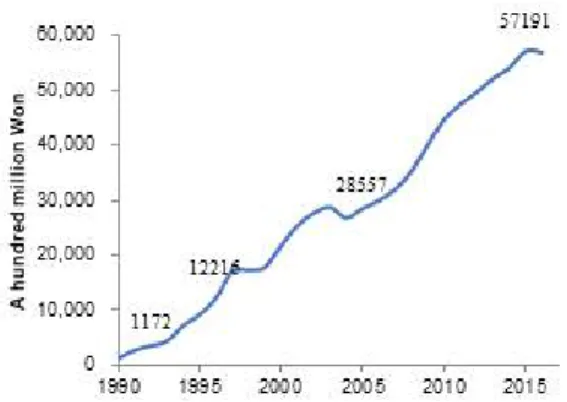
As the Ministry of Environment was being reorganized over the course of time, their budget was increasing. The environmental budget increased from 12 billion won in 1980 to 5.6976 trillion won in 2016, an increase of about 475 times.
Figure 1 shows a graph of the increase in the environmental budget from 1990 to 2016.
The environmental budget increased significantly following the transfer of sewage treatment plant work from the Ministry of Construction and Transportation (1991), reorganization of government organization and functions like the transfer of national park management functions from the Ministry of the Interior (1998) to Ministry of Environment, and the inclusion of the concession fund of the water conservation area in the Ministry of Environment's jurisdiction(2005).
The environmental budget in 2009 increased as the government carried out a major pending project. From the general account, 15% of the traffic energy environment tax (2009 budget increased 13.5% compared to the previous year) was allocated to this project. The budget grew a considerable amount within a short period of time and was invested heavily in the establishment of environmental infrastructure that would aid in air pollution prevention.
Table 1 lists annual investment changes by environmental budget segments. From 2010 to 2014, the government focused on water supply and water sections by investing their budget on projects such as sewage treatment plants and ecological streams, creating a "Water Environment with Life and Ecology."
In the air sector, the supply of eco-friendly vehicles was significantly expanded in 2015 to improve air quality and reduce greenhouse gas emissions. Since then, the budget has steadily increased to reduce air pollutants and fine dust by focusing on launching geostationary environmental satellites to first monitor and predict long-range air pollutants such as fine dust and climate change-induced materials. The government actively pursues the establishment of the National Environmental Satellite Center[19], which would receive and process large amounts of satellite data observed on environmental satellites. The center could ultimately enhance the accuracy of air quality forecasting system and secure a foothold to utilize the environmental monitoring capability using satellites.
Figure 2. Variation of the yearly environment budget of Korea (1990~2016)
2.4 Enforcement of emergency reduction measures for high concentration fine dust
The distribution of the physical size of dust is comparable to a chemical hazard. The size of dust is a key matter when evaluating the performance and the design of the protection device for treatment. For this reason, air environment regulations and emission regulations in developed countries have been rapidly changed from TSP(Total Suspended Particle) to PM10 and PM10 to PM2.5. Korea also established environmental standards for PM10 and TSP simultaneously after 1995, and only regulated PM10 after 2001 by removing TSP. It was in 2011 that PM2.5 was newly introduced, but it was not until 2015 that PM2.5 was implemented.
On March, 2018, the environmental standard concentration of PM2.5 was reinforced from 25 μg/m3 to 15μg/m3 per year. However, according to data from the Environment Ministry's Air Korea, Korea's PM2.5 concentration is around 22.8μg/m3 per year in 2018. Therefore, the Ministry of Environment will establish 'Guidelines for Implementing High-Concentration Fine Dust Emergency Reduction Measures'.
The guidelines are for when high concentrations of fine dust are expected to be above a certain level under section 18 of the Special Act on Fine Dust Reduction and Management. It includes conditions for issuing and releasing emergency reduction measures,
subject to application, roles and actions by agencies, and methods of implementation.
The guidelines were newly registered in December 2018 and were revised in February 2019 to reflect the modified requirements. The revisions included strengthening the recommended standards such as automobiles subject to the exclusion of restrictions on vehicle operation, air pollutant emission facilities subject to mandatory execution, reducing shutdown and class hours, and delegating authority to issue wide areas.
3. Atmospheric Environmental Policy in China
3.1 Development history of air pollution control policies in China
Since reform and opening up, China's air pollution prevention and control policy has constantly adjusted, in general, the policy for the control of air pollution in China, prevention and control of atmospheric pollution from the traditional industrial waste gas[13], smoke prevention and dust control to be gradually extended to the comprehensive, regional complex atmospheric pollution control, management center of gravity. Regional pollution control and air pollution treatment mainly depends on the legal and administrative means and use of a variety of market-oriented policy tools.
Although the problem of air pollution occurred from time to time in the early stages of Chinese development, it has not caused widespread concern in the society. With the process of industrialization and urbanization, in recent years, the government has begun to comprehensively use air pollution control policies and measures to establish air pollution control policy system. Strengthening legislation on air pollution control will vigorously promote economic governance, encourage the development of environmental protection industries, and pursue green GDP. The unified supervision and management should be combined with the supervision and management of different departments. A number of policies have been issued, from the proposal of the joint prevention and control mechanism of air
Sector 2009 2010 2011 2012 2013 2014 2015 2016
Total 40,100 44,677 47,517 49,642 52,206 54,121 57,191 56,976
Water 24,942 28,579 30,907 31,330 33,283 35,021 36,804 34,495
Waste 3,189 3,275 2,707 2,883 3,390 3,235 3,105 3,477
Atmos
phere 3,179 2,851 3,010 3,233 2,919 2,665 3,390 4,215 Nature 3,591 4,176 4,116 4,422 4,260 4,694 5,278 5,680
The
others 5,198 5,797 6,777 7,775 8,354 8,506 8,613 9,109 Table 1. Variation of the yearly Investment by Environmental Budget Sector of Korea(2009~2016)
* The unit is a hundred million won
pollution to the establishment of the emissions trading system. China's air pollution joint prevention and control system is gradually improving. Cross-regional and cross-sectoral cooperation mechanism of air pollution prevention and control can realize regional unified planning, supervision, evaluation and coordination, and is an effective way to improve regional air quality.
3.2 Distribution Mechanism between Central and Local Governments for Controlling Air Pollution
At present, china has not achieved the ideal effect in the aspect of air pollution control.
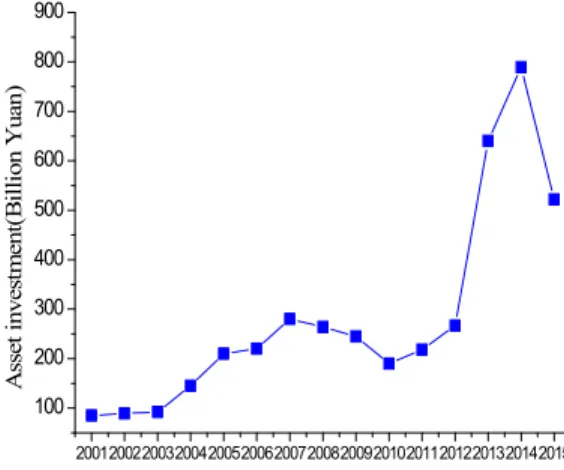
Almost all the laws and regulations on air pollution control in China give the power of air pollution control to local governments, but seldom mention the corresponding financial power of local governments. In September 2013, the state council issued the action plan for the prevention and control of air pollution, which is known as the "Air pollution ten". The central and local governments have provided special funds to fight smog, and the amount of funds has been greatly increased. Investment in atmospheric governance is also increasing, showed in Figure 2 come from Ministry of Ecology and Environment.
200120022003200420052006200720082009201020112012201320142015 100
200 300 400 500 600 700 800 900
Asset investment(Billion Yuan)
Particular Year
Figure 2. Investment Scale of Fixed Assets in Industrial Atmosphere Control over the Past Years in
China
Tax authorities should give full play to the role of tax regulation to disincentivize environmental pollution. According to the requirements of the action plan for air pollution prevention and control, air pollution control in China should be carried out in a regional and phased way[4]. The goal is to significantly improve air quality in the Beijing-Tianjin-Hebei region, the Yangtze River delta, the Pearl River delta and other regions. The goal should be to gradually eliminate heavy pollution weather, and significantly improve the national air quality over the next five years.
The air pollution control law of the People's Republic of China was amended on August 29, 2015 and came into force on January 1, 2016.
The air pollution control law emphasized source governance, civil participation, strengthening the pollution emissions and concentration control, increasing cooperative governance in key areas, such as coal, industrial, motor vehicle, dust and a more pollutants zone spreading special provision. The law also regulated the unlicensed, excessive discharge and monitored data regarding false reports of emissions, which were sanctioned with penalties. The air pollution prevention and control law defines the allocation of administrative and financial power between the central and local governments in air pollution control in China.
3.3 Air pollution control law development history
In 1979, the environmental protection law of the People's Republic of China (for trial implementation) was promulgated, which further stipulated the standards for the discharge of toxic gases, the elimination of smoke and dust, production equipment, production processes and other aspects concerning air pollution. In 1987, the first law on the prevention and control of air pollution was enacted, which laid down the general principles for the prevention and control of air pollution, supervision and management, prevention of pollution, and legal responsibilities. In 1995 and 2000, the 1987 pollution prevention and control law was amended to increase environmental management requirements such as pollution control.
The action plan in 2013 put forward the
prevention and control of atmospheric pollution, detailed governance blueprint for atmospheric pollution treatment goals to be achieved in the future, and the specific requirements to various provinces and cities to reduce concentrations of PM2.5[7], in view of the "law on the prevention and control of atmospheric pollution in 2018" by the competent department of environmental protection and environmental monitoring agency entrusted by the "changed to" ecological environment and its environment by the competent department of law enforcement agencies ", "quality supervision departments" changed to "market supervision and regulation department", "" by the competent department of environmental protection is modified to the department in charge of" ecological environment ".
3.4 Connection and development
Compared with Korea, China is a late starter in air pollution management. China's air pollution control starts from the main polluted areas, heavy industry pollution management to the current overall pollution control environment; Korean from the beginning of the overall governance to the present individual outstanding. In terms of management, China and Korea have adopted the policy of hierarchical management, with each department managing air, water, solid waste and other parts. In terms of investment, both countries have invested a lot of money and manpower in pollution control. Korea focuses on the government's pollution control, and China controls the generation of pollution by collecting pollution taxes.
4 . Direction toward the future 4.1 Strengthen urban environmental greening.
Plants are an important part of the purification of air pollution. Through photosynthesis and other conversions into oxygen, air pollution in cities can be effectively improved. As shown in Table 1, Korea has expanded investment for greening since 2015.(359.1 billion won in 2009→ 568 billion won in 2016) Therefore, it is necessary to
strengthen the greening of urban environment.
Paying attention to the greening process in urban planning and increasing the investment in the construction of greening forest can not only effectively absorb the harmful gas in the air, but also adsorb some suspended particles and dust, thus purifying the air.
4.2 Strengthen clean energy utilization Korea is sharply expanding the supply of eco-friendly vehicles in 2015 to improve air quality and reduce greenhouse gas emissions. At present, China has been widely using solar energy, wind energy, water energy and other clean energy; these various forms of energy will not produce pollution gas. Using other forms of energy will not only meet people's demand for energy, but also effectively reduce atmospheric environmental pollution. Today, there is a lack of technology, an obstacle in the development of new energy. New energy development demands a high cost; therefore, there needs to be an increased investment in the science and technology of new energy and for the environmental protection department for the development of new energy. With this investment there can be a shift from the use of traditional energy source to the use of new energy. Pollutants can be reduced and energy structure and atmospheric environment can be effectively improved in its quality.
4.3 Improve the urban environmental management mechanism
In order to implement the urban atmospheric pollution control work in environmental management, local government and relevant departments will be integrated with the actual environmental pollution reason and industrial production index and the protection system of the urban environmental management, to create economic benefits. At the same time, they will direct their attention to protecting the environment, including atmospheric pollution control in the urban development planning.
Korea enacted the "Special Act on the Improvement of the Air Quality in the Capital Region" which aimed at improving the area of
the capital, a major air-contaminated city. As a result, the supply of low-flying cars was activated and the control of motor vehicle emissions in operation was strengthened. We should establish a protective system for the environment, and use reasonable and effective means to reform polluting fuels and equipment, and use less polluting fuels and related equipment to prevent further environmental pollution.
4.4 Improve the awareness of urban environmental management
Korea has an air environment policy director and climate change policy director in the Living Environment Policy Office under the Ministry of Environment. In addition to this, Korea has the Korea Meteorological Administration, the Greenhouse Gases Information Center and the Seoul Metropolitan Office of Atmospheric Environment, all organically connected. The management of air pollution in urban environmental management is a systematic, comprehensive and difficult process, involving many departments and aspects. It is difficult to rely only one environmental protection department. It needs to be jointly managed by relevant departments. The combination of ecological environmental protection and social and economic development will gradually improve the air pollution control work system, and the responsibility of environmental management and protection exercised by individuals will fundamentally ensure the level and quality of urban environmental management work .
4.5 Improve the air pollution management laws and regulations system
Korea established the Special ‘Act on the Reduction and Management of Fine Dust’ in 2018 and reinforced the environmental standard concentration of ultrafine dust (PM2.5) from 25 μg/m3 to 15μg/m3. Nowadays, in order to control environmental pollution, China has formulated a series of laws and regulations, such as the environmental quality protection law and the energy conservation law of the
People's Republic of China. Unfortunately, China is unable to meet the needs of atmospheric environmental protection. China should strive to not only improve atmospheric pollution management regulations based on actual condition, but also improve the overall quality of supervisory law enforcement, clear responsibilities, establish punitive measures, and hold individuals responsible to their actions. The laws and regulations serve to increase the environmental protection work and improve people's living environment through legal preventive actions against atmospheric pollution.
4.6 Increase investment and management funds
Korea's environmental budget has also been increased as the Ministry of Environment reorganized. The environmental budget increased by about 475 times over the past 35 years. Urban air environment governance is key to the environmental protection project in China, therefore it must be included in the urban development planning. At the same time, local governments need to increase the capital investment in urban environmental management.
This will ensure research and development of air pollution prevention and control technology, urban environmental protection publicity and other works to be carried out smoothly.
Increasing funds for environmental protection management is an important way to strengthen air pollution control and improve the living quality of urban residents thus prevent the further deterioration of urban environment to a large extent.
Acknowledgments
This research were supported by Hefei Independent Innovation Policy "Borrowing and Subsidizing" Fund Project (J2018G22). Anhui Provincial Central Committee Guides Local Science and Technology Development Project (YDZX20183400004146). Financial Support Project for Top-notch Talents in the Universities of Anhui (gxgnfx2018030). National Special Item on Water Resource and Environment (2017ZX07603-003). Opening
Project of Anhui Key Laboratory (MJ-ZK201701). Talent Research Foundation of Hefei University(16-17RC04). Major Scientific and Technological Projects of Anhui Province (16030801119). Lab Construction Plan of the College Students’ Innovation in Anhui Province(2015ckjh067).
References
Yong Liang. Study on Measures to Strengthen Air Pollution Control in Urban Environmental Management. Farming Science &
Technology, 2017,(9):56-58.
Zhang lihong. Discussion on Strengthening Air Pollution Control in Urban Environmental Management. China Science and Technology, 2017,(21):23-36.
Xu Fengli. How to Strengthen Air Pollution Control in Urban Environmental Management. Science and Technology Innovation and Application, 2016,(5):160-160.
Li Haiying. Discussion on Strengthening Air Pollution Control in Urban Environmental Management. Agricultural Science and Information, 2016,(14):60-60.
Iveta Steinberga,Liene Sustere,Janis Bikse,Janis Bikse Jr,Janis Kleperis.Traffic Induced Air Pollution Modeling:Scenario Analysis for Air Quality Management in Street Canyon.
Procedia Computer Science,
2019,149:384-389.
Jorge Alejandro Silva Rodríguez de San Miguel.
Management of Air Pollution in Mexico.
Management of Environmental Quality, 2019,30(3):578-592.
Lu Na, Zhou Jingbo, Li Zhiguo, et al. Causes and Countermeasures of Haze in China.
Hebei Industrial Science and Technology, 2015,32(4):371-376.
Vítor João Pereira Domingues Martinho. Best Management Practices from Agricultural Economics: Mitigating Air, Soil and Water Pollution. Science of the Total Environment, 2019,688:346-360.
Wang Yunlong. Research on Haze Control and Air Pollution Control Measures. Henan Science and Technology, 2016(24) : 52-53.
Mayer Brian,Joshweseoma Lorencita,Sehongva Gregory. Environmental Risk Perceptions
and Community Health: Arsenic, Air Pollution, and Threats to Traditional Values of the Hopi Tribe. Journal of Community Health, 2019,44(5):896-902.
Xuying Ma,Ian Longley,Jay Gao,Ayushi Kachhara,Jennifer Salmond. A Site-Optimised Multi-Scale Gis Based Land Use Regression Model for Simulating Local Scale Patterns in Air Pollution. Science of the Total Environment, 2019,685:134-149.
Zhang Xingkun, Zhang Jiguang. Analysis of Causes Of Haze Weather and Research on Prevention and Control Measures.
Environmental Science and Management, 2016, 41(08):82-85.
Veronica Dal Sasso,Franklin Djeumou Fomeni,Guglielmo Lulli,Konstantinos G.
Zografos. Planning Efficient 4D Trajectories in Air Traffic Flow Management. European Journal of Operational Research, 2019,276(2):
676-687.
Pu Chengdun, Liu Guojun, Long Feng, et al.
Current Situation and Management Policies of Air Pollution in Korean. Environmental Science and Technology, 2013,36(6L):
382-385.
Dong-Sool Kim. Air Pollution History, Regulatory Changes, and Remedial Measures of the Current Regulatory Regimes in Koreans.
Journal of Koreann Society for Atmospheric Environment, 2013,29(4): 353-368
Georgeta-Madalina Meghisan,Dorin Toma. Public Health Management: Life Expectancy and Air Pollution. Proceedings of the International Conference on Business Excellence, 2017,11(1):111-120.
Jiayi Tang, Aonghus McNabola, Bruce Misstear, Brian Caulfield. An Evaluation of the Impact of the Dublin Port Tunnel and HGV Management Strategy on Air Pollution Emissions. Transportation Research Part D,2017,52:1-14.
Jiliang Zhen, GuoHe Huang, Wei Li, ChuanBao Wu, Zhengping Liu. An Optimization Model Design for Energy Systems Planning and Management under Considering Air Pollution Control in Tangshan City, China. Journal of Process Control, 2016, 47:58-77.
Riojas-Rodríguez Horacio, da Silva Agnes Soares, Texcalac-Sangrador José Luis, Moreno-Banda Grea Litai. Air Pollution
Management and Control in Latin America and the Caribbean: Implications for Climate Change. Revista Panamericana De Salud Publica = Pan American Journal of Public Health, 2016, 40(3):150-159.
Rolandas Bleizgys, Indre Bagdoniene. Control of Ammonia Air Pollution Through the Management of Thermal Processes in Cowsheds. Science of the Total Environment, 2016, 568:990-997.
郝 亮,王 毅,苏利阳,秦海波, 基于倡导联盟 视角的中国大气污染防治政策演变机理分析, J.
of China University of Geosciences(Social Science Edition) 2016, Vol.16, No.1, 34-43 张毅,孙洪坤, 城市大气污染防治法律体系建设, Journal of Guangdong Institute of Public
Administration, Jun. 2014. Vol.26, No.3 62-66
논문투고일 2020년 05월 10일 논문심사일 2020년 06월 05일 논문게재일 2020년 06월 30일