DOI 10.17480/psk.2018.62.1.39
Endotoxin tolerance 유도상태에서 리포폴리사카라이드로 유도된 염증성 매개 인자의 in vitro 생산에 있어서 저농도 corticosterone 전처리 효과
채병숙#
우석대학교 약학대학 약학과
(Received January 29, 2018; Revised February 23, 2018; Accepted February 23, 2018)
Effect of Low Dose Corticosterone Pretreatment on the Production of LPS-Induced Inflammatory Mediators in Endotoxin-Preexposed Cells
Byeong Suk Chae#
College of Pharmacy, Woosuk University, Wanju, Jeonbuk, 55338, Republic of Korea
Abstract — Low dose glucocorticoids (GCs) are known to have proinflammatory effects in the LPS-stimulated innate immune cells. To investigate whether preconditioning of low dose corticosterone enhances or not LPS-induced production of inflammatory mediators and heper T (Th) cytokines in endotoxin tolerant cells (ET), RAW 264.7 cells and EL4 cells were pretreated with low dose corticosterone (Cort: 50 and 100 ng/ml) and low dose LPS (50 ng/ml) in fresh complete medium once a day for 3 days and then cultured in fresh complete medium for 6 hr or 24 hr in the presence or absence of LPS (1~10μg/ml) or Con A. In the present study, the results demonstrated that Cort pretreatment strongly enhanced LPS- induced production of TNF-α, IL-6, IL-10, PGE2 and NO by RAW 264.7 cells in a dose-dependent manner in control, whereas Cort pretreatment didn’t affect LPS-induced production of TNF-α, IL-10, PGE2 but
significantly
enhanced LPS-induced pro- duction of IL-6 and NO in ET. Cort pretreatment strongly augmented Con A-induced- production of IFN-γ and IL-10 and ratios of IFN-γ/IL-10 by EL4 cells in a dose-dependent manner in control, whereas Cort 50 ng/ml pretreatment remarkably decreased Con A-induced production of IL-10 and ratios of IFN-γ/IL-10 in ET. Cort pretreatment strongly enhanced LPS- induced production of IFN-γ and IL-10 and attenuated ratios of IFN-γ/IL-10 by EL4 cells in control, whereas Cort pre- treatment didn’t affect LPS-induced production of IFN-γ and IL-10 and enhanced ratios of IFN-γ/IL-10 in ET. These findings suggest that preconditioning of low dose corticosterone may enhance production of IL-6 and NO with a shift in the Th1/Th2 balance toward Th1 to secondary infection in a state of endotoxin tolerance, which may lead to low grade inflammation.Keywords Endotoxin tolerance, Corticosterone pretreatment, TNF-α, IL-6, IL-10, IFN-γ, PGE2, NO
Endotoxin은 선천성 면역계의 자극에 의하여 Toll-like receptor (TLR) 4를 통한 TNF-α, IL-1, IL-6, IL-8, IFN-γ, PGE2 및 acute phase protein 등과 같은 pro-inflammatory mediator의 과생산을 유도하지만 동시에 IL-10 및 TGF-β와 같은 anti-inflammatory cytokine 생산을 유도하여 급성염증반응이 빠르게 회복되는 양 상을 보인다.1)그런데 낮은 용량의 LPS에 미리 노출시킨 후 유
도되는 endotoxin tolerance(ET) 상태에서는 연속적 고용량 endotoxin 처리 시 마크로파지와 같은 innate immune cell에 의 한 TNF-α, IL-1β, IL-6 및 PGE2 등 pro-inflammatory mediator 생산은 억제되고 IL-10과 같은 anti-inflammatory cytokine 생산 증가가 유도됨으로써 염증반응 유발이 억제됨을 보여주고 있으며, 이런 ET 상태는 이차 감염에 따른 endotoxin shock이나 사망으 로부터 innate immunity 억제에 따른 보호효과를 갖는 특징을 지 닌다.2,3)그런데 임상적으로는 장기간에 걸쳐 ET를 유지하는 sepsis 상태에서 오히려 이차 감염에 대한 치사율이 높은 것으로 나타났 는데, 이는 ET에서 pro-inflammatory cytokine의 생산 억제에 따 른 선천성면역 무반응상태가 관여할 것으로 보고있다.4,5)
Endotoxin tolerance 상태에서 이차감염에 따른 치사율은 스
#
Corresponding Author Byeong Suk Chae
College of Pharmacy, Woosuk University, Wanju, Jeonbuk, 55338, Republic of Korea
Tel.: 063-290-1426 Fax.: 063-290-1561 E-mail: [email protected]
Short Report
종설트레스 시스템의 하나인 시상하부-뇌하수체-부신(hypothalamic- pituitary-adrenal: HPA) 축의 활성화 및 glucocorticoids(GCs) 생 산 등과 관련성을 지닌다.6) ET의 특징을 보이는 sepsis에서 이 차 감염에 따른 높은 치사율은 부신의 불충분성 및 HPA 축의 무반응성 유발이 기여하는 것으로 보고되었다.7,8)특히 부신 기 능이 정상인 sepsis 환자에 비하여 부신 기능이 저하된 septic shock 및 sepsis 환자의 경우 사망률이 높았고, GCs가 저하된 sepsis에서 나타나는 이차 감염에 대한 면역능 저하는 조직 및 장 기손상, 더 나아가서는 높은 치사율과도 유관함이 관찰되었다.9,10) 따라서 sepsis의 미래 치료적 접근으로 neuroimmunomodulation이 중요한 역할을 차지할 것으로 보고있다.11)
Endotoxin은 HPA 축의 활성화 반응을 유도하며, 그에 따라 생 산된 GCs는 면역반응 및 염증반응 등의 억제를 매개하여 감염 에 대한 보호작용을 갖는다.12,13) GCs는 약리적 농도에서 in vivo 및 in vitro에서 LPS로 유도되는 monocyte의 CD14 활성 억제 효과를 가졌고 TNF-α, IL-1, IL-6, PGE2, COX2 및 NO 생산 등 의 억제작용이 관찰되었으며,14,15)임상에서는 GCs를 자가면역 및 염증반응 등을 억제하거나 장기이식 후 면역거부반응의 치료 목적으로 사용되어 왔다.16)또한 임상에서 항염증 작용을 지니 는 GCs는 약리적인 농도에서 endotoxemia 치료목적 및 septic shock을 개선시키기 위해 사용되어 왔지만, 일반적으로 septic shock 치료에 GCs 고용량이나 저용량이 효과적이지 못하며 그 효능에 대하여 아직 논란이 되고 있다.17-19)
그런데 GCs는 약리적 고농도의 항염증효과와는 반대로 생리 적 수준의 저농도의 전처리에서는 endotoxin에 의해 유도되는 면역반응이 증가되고 그에 따른 염증성 매개인자들의 생산이 증 가됨을 보였다. 저농도 GCs의 전처리는 in vivo 및 in vitro에서 LPS로 유도되는 면역반응 및 proinflammatory cytokine 생산 증 가에 따른 염증반응이 오히려 촉진되었다.20-22)또한 역으로 TNF- α, IL-6, IL-1β 및 NO 등과 같은 inflammatory mediator는 스트 레스 시스템의 주요 구성물질을 활성화시키고 HPA 축을 자극하 며 cortisol 혈중농도 증가 및 GCs 저항성 등을 유발하는데 관 여하였다.23)뿐만 아니라 육체적·정신적인 만성 스트레스에 의한 HPA 축의 만성 활성화는 GCs 혈중농도의 저수준 상승 상태를 유
도한다.24,25)우울증과 같은 반복된 만성스트레스나 염증성 질환은
HPA 축의 만성 활성화 유발, GCs의 생산증가, negative feedback inhibitory effect 저하 및 GCs 저항성 증가 등에 따른 낮은 수준 의 만성 hypercortisolemia와 관련성을 지닌다.26,27)따라서 내인 성 GCs는 감염에 따른 병원균의 과도한 면역반응 및 염증반응 을 제한하기 위한 보호작용의 하나로써 작용함에도 불구하고,20) 반복적인 만성스트레스에 따른 저수준 GCs preconditioning은 면역활성화 및 염증유발을 촉진할 가능성을 지닌다.
따라서 sepsis에서 나타나는 이차감염에 따른 조직손상 및 사 망률 증가에 있어서 저농도 GCs preconditioning이 하나의 risk
factor로서 작용할 수 있으나, ET 상태에서 저농도 GCs의 preconditioning이 LPS가 유도하는 면역생물학적 반응에 미치는 영향에 대해서는 불확실한 상태에 있다. 더구나 ET 상태 또는 GCs는 각각 Th1/Th2 ratio를 Th2 반응으로 향하게 하는 효과를 지님으로써 세포성 면역억제효과를 갖지만,28,29) ET상태에서 저 농도 GCs 전처리가 LPS 자극에 의한 T cell의 면역반응에 미치 는 영향에 대하여는 밝혀져있지 않다. 따라서 본 연구는 endotoxin tolerance 상태에서 생리적 저농도 수준의 GCs preconditioning 이 이차적 LPS 자극으로 유도되는 innate immune cell의 염증 반응 및 T cell 반응 등에 어떠한 변화를 유발하는지를 알아보기 위하여, 저농도의 LPS(50 ng/ml)로 반복 노출시켜 endotoxin tolerance를 유도한 RAW 264.7 cell 및 EL4 cell에서 저농도 corticosterone(Cort 50 and 100 ng/ml) 전처리가 고용량 endotoxin 으로 유도되는 염증성 매개인자 및 Th cytokine 생산에 미치는 영 향에 대하여 실험을 실시하였다.
실험방법 (Experimental Methods)
재료 및 시약
RAW 264.7 cell 및 EL4 cell은 한국세포주은행(Seoul, Korea) 에서 구매를 했다.
세포 배양
RAW 264.7 cell 및 EL4 cell은 10% fetal bovine serum (Sigma Chemical Co., St. Louis, MO, USA), penicillin 100 U/
ml, streptomycin 100 μg/ml(Invitrogen, Carlsbad, CA, USA) 및 antimycotic Amphotericin B(Invitrogen, Carlsbad, CA, USA)를 함유한 DMEM 배지(Invitrogen, Carlsbad, CA, USA)에 서 배양하였다. 그 RAW 264.7 cell 및 EL4 cell는 매일 새 배지 로 갈아주면서 LPS 50 ng/ml, corticosterone(Cort) 50 및 Cort 100 ng/ml로 3일 동안 하루 1번씩 일정시간에 처리하였다. 마지 막 처리 후 24 hr 후에 새 배지로 갈아준 다음 RAW 264.7 cell 은 LPS 1 μg/ml, EL4 cell은 LPS 10 μg/ml 또는 Con A 10 μg/
ml 존재 또는 부재하에서 5% CO2 incubator에서 37oC로 TNF- α 생산을 위해서는 6 hr, 그 나머지를 위해서는 24 hr 동안 배양 하였으며 그 후 세포배양액을 채취하여 cytokine, PGE2및 NO 측정을 위해 −70oC에 보관하였다.
Cytokine의 측정
RAW 264.7 cell 또는 EL4 cell의 보관된 세포배양액 중 TNF- α, IL-6, IL-10 및 IFN-γ 등 cytokine의 농도측정은 cytokine monoclonal antobodies(BD Biosciences Pharmingen, USA)를 이용하여 ELISA(enzyme-linked immunosorbent assay) 방법으 로 실시되었고, ELISA microplate reader(Molecular Devices
Co., Ltd., USA)를 사용하여 450 nm에서 흡광도를 측정하였다.
각 결과는 ml당 picogram 단위에서 정량하였으며 최저농도의 한 계는 5 pg/ml이상으로 하였다.
PGE2측정
RAW 264.7 cell 배양액에서의 PGE2 농도는 monoclonal antibody/enzyme immunoassay kit(Cayman Chemicals, MI, USA)를 사용하여 ELISA microplate reader를 사용하여 405 nm 에서 흡광도를 측정하여 정량하였고 최저농도의 한계는 5 pg/ml 이상으로 하였다.
NO 측정
RAW 264.7 cell로부터 얻어진 세포배양액 중 NO 농도 측정 은 96-well plate에 시료 100 μl에 Griess reagent 100 μl를 가한 후 10분에 ELISA microplate reader를 사용하여 540 nm에서 흡 광도를 측정하였다.
통계학적 분석
모든 자료는 means±standard error(S.E.)로 나타냈으며, 유의 성 검사는 Students’ t-test로 행하였다.
결과 및 고찰 (Results and Discussion)
Endotoxin을 반복 노출시킨 RAW 264.7 cell에 의한 cytokine 의 생산에 있어서 저농도 corticosterone의 전처리 효과
반복된 만성스트레스와 만성염증질환에서 그에 따른 HPA 축 의 만성 활성화는 GCs의 생산을 높이며, 여러 원인에 의해 GCs 의 negative feedback inhibitory effect가 저하되었을 때 만성적 저수준의 hypercortisolemia를 나타내게 된다.26,27)약리적 고농 도의 GCs의 면역억제 및 항염증효과와는 반대로 육체적·정신적 인 만성 스트레스에 따른 저수준 혈중농도의 GCs preconditioning 상태는 endotoxin에 의해 유도되는 면역활성화 및 염증성 매개 인자들 생산을 in vivo 및 in vitro에서 증가시킴을 보였다.21,22)본 연구는 저수준의 HPA 축의 활성화 및 GCs의 생산에 의한 preconditioning이 endotoxin tolerance에 의해 유도되는 염증관련 innate immune response나 T cell 반응에 있어서 어떠한 변화를 유도하는지를 알아보고자 하였다.
Endotoxin tolerance(ET)는 in vitro에서 저농도 LPS (>
10 ng/ml)에 의해 노출된 macrophage가 연속적인 2차 LPS 고농 도 처리 시 염증성 innate immune response의 무반응성 상태를 유도함으로써 감염이나 조직손상에 대하여 보호효과를 지니는 상태를 말한다.2,3) Chae30)의 이전 연구에 따르면, RAW 264.7 cell에서 LPS 50 ng/ml를 3일간 일정한 시간에 3번 반복 처리하 고 매일 배지를 갈아주었으며, 4일째 되는 날 새 배지에서 고용
량의 LPS를 투여하였을 때, TNF-α, IL-6 및 PGE2등의 생산 억제가 관찰됨으로써 저농도 LPS 50 ng/ml의 3번 반복된 전처 리가 ET를 유도시킴을 확인하였고, 본 연구에서 이와 동일한 방 법으로 ET를 유도하였다. 또한 Chae31)는 RAW 264.7 cell에서 corticosterone 50 및 100 ng/ml의 전처리가 LPS에 의한 TNF- α, IL-6 및 IL-1β 등의 생산을 증가시켜 염증유발효과를 나타냄 을 관찰하였다. 따라서 본 연구는 저농도 LPS(50 ng/ml)에 반복 노출된 ET 상태에서 저농도 Cort 50 및 Cort 100 ng/ml 전처리 가 고농도 LPS로 유도되는 마크로파지의 염증반응 및 T cell의
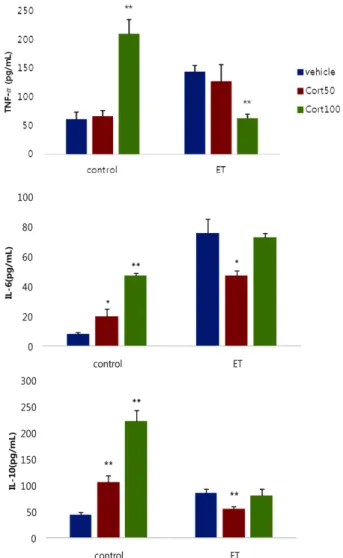
Fig. 1 − Pretreatment of low dose corticosterone on the production of cytokines in endotoxin-repeated exposed RAW 264.7 cells.
RAW 264.7 cells were pretreated with low dose corticosterone
(Cort50: corticosterone 50 ng/ml; Cort100: corticosterone
100 ng/ml) and low dose LPS (50 ng/ml) in fresh complete
medium once a day for 3 days and then cultured in fresh
complete medium for 6 hr for TNF-α or 24 hr for the other
cytokines in the absence of LPS. Concentration of cytokines
was measured using ELISA. Each value represents the
mean±S.E. * (p<0.05) and ** (p<0.01): Significantly different
from the value in each vehicle.
면역반응 등에 어떠한 변화를 유발할 수 있는지를 관찰하였다.
본 연구에서 RAW 264.7 cell은 저농도인 LPS 50 ng/ml 또는 저농도 corticosterone(Cort) 50 및 100 ng/ml를 3일간 일정한 시 간에 동시에 3번 반복 처리하면서 매일 새배지로 갈아주었고, 4 일째 되는 날은 새 배지에서 TNF-α 생산을 위해서는 6 hr, 그 나머지 inflammatory mediator를 위해서는 24 hr 배양하였으며, 그로부터 세포배양액을 채취하여 cytokine 농도를 측정하였다.
그 결과는 Fig. 1에서 보여주는 바와 같이, 반복된 저농도 Cort 전처리가 control에서 농도 의존적으로 TNF-α, IL-6 및 IL-10 등 의 생산을 증가시켰으며, 저농도의 GC가 pro-inflammatory effect 를 지닌다는 많은 증거들20,22)을 지지하고 있다. 또한 이는 육체 적·정신적인 만성 스트레스에 의한 HPA 축의 만성 활성화24,25) 는 GCs 혈중농도의 저수준 상승 상태를 유도하는데 이런 저수 준의 GCs preconditioning이 마크로파지의 면역 활성화 및 염증 성 매개인자들의 생산을 증가시켜 염증반응을 유도할 수 있음을 시사하고 있다. 한편 endotoxin tolerance(ET) 상태는 마크로파 지와 같은 pro-inflammatory mediator 생산 억제 등 innate immune cell의 면역활성 저하효과의 특징을 지니는데,2,3)임상적 으로는 ET의 특징을 보이는 sepsis에서 염증유발 및 장기손상에 대한 높은 위험성을 갖는다.32)본 연구에서, 저농도 LPS로 반복 처리하여 유발된 ET 특성을 지닌 RAW 264.7 cell에서는 반복된 저농도 Cort 전처리가 TNF-α, IL-6 및 IL-10 생산을 유의성 있 게 억제하였다. 이는 저농도의 반복된 Cort 전처리가 저농도 endotoxin 반복 투여로 이미 활성화된 마크로파지를 억제하여 TNF-α, IL-6 및 IL-10 등의 생산을 저하시켰을 것이다. 따라서 반 복적인 만성스트레스에 따른 저수준 GCs preconditioning26,27)는 이차감염이 없는 sepsis 상태에서 TNF-α, IL-6 및 IL-10 생산을 억제할 것으로 사료된다.
Endotoxin을 반복 노출시킨 RAW 264.7 cell에서 LPS에 의해 유도된 cytokine 생산에 있어서 저농도 corticosterone 의 전처리 효과
LPS는 마크로파지를 자극하여 염증성 매개인자들의 생산을 증 가시켜 강력한 염증반응을 촉진하지만,1) endotoxin tolerance 상 태에서는 이차 감염에 대해 innate immune cell의 LPS 대한 무 반응성을 나타냄으로서 보호효과를 지닌다.2,3)그런데 endotoxin tolerance의 무반응성은 임상적으로 sepsis에서 이차감염에 대한 장기손상 및 높은 치사율 등의 위험성을 높이는 것으로 알려져 있으나 그 위험성 인자에 대해서는 불명확하다.4,5)저용량의 GCs 치료가 무반응성 복부 septic shock의 치사율을 낮추었다는 보 고33)및 오히려 저용량GCs 치료가 septic shock에 치사율을 낮 추지 못했다는 보고34)등 저용량 GCs 치료 효과에 대해서 상반 된 결과를 나타내고있다. 또한 저농도 GCs의 전처리는 마크로 파지에서 cytokine 과생산 및 nuclear factor-kappaB 활성화를
유도하였고21) 사람에게 stress cortisol을 전처리하였을 때 endotoxin으로 유도되는 전신성 염증반응을 증가시키는 것으로 나타났다.22) 본 연구는 저농도 LPS에 의해 반복노출시켜 endotoxin tolerance가 유도된 마크로파지에서 만성 스트레스 상 태에서 관찰될 수 있는 저농도 GCs의 반복된 전처리가 고용량 LPS에 의한 cytokine 생산에 어떠한 영향을 주는지를 알아보았 다. 본 연구에서 RAW 264.7 cell에서의 세포배양은 Fig. 1과 같 은 방법으로 실시하였고, 다만 4일째 되는 날 새 배지로 갈아 준 다음 고용량 LPS 1 μg/ml 존재 하에서 TNF-α를 위해서는 6 hr,
Fig. 2 − Pretreatment of low dose corticosterone on the LPS- induced production of cytokines in endotoxin-toleranted RAW 264.7 cells.
RAW 264.7 cells were pretreated with low dose corticosterone (Cort50: 50 ng/ml; Cort100: 100 ng/ml) and low dose LPS (50 ng/ml) in fresh complete medium once a day for 3 days and then cultured in fresh complete medium for 6 hr for TNF-α or 24 hr for the other cytokines in the presence of LPS (1μg/ml).
Concentration of cytokines was measured using ELISA. Each value represents the mean± S.E. Other legends and methods are the same as in Fig. 1. * (p<0.05) and ** (p<0.01):
Significantly different from the value in each vehicle.
그 나머지 inflammatory mediator 생산을 위해서는 24 hr 배양 하였다. 그 결과, Fig. 2에서 보여주는 바와 같이, control에서 반 복된 저농도 Cort 전처리가 RAW 264.7 cell에서 LPS 자극으로 유도되는 TNF-α 생산을 5.13배, IL-6는 15.39배 및 IL-10는 87.60배까지 농도의존적으로 월등히 증가시켰는데, 이는 저농도 Cort 전처리가 macrophage의 활성을 높여 LPS에 의해 유도되 는 proinflammatory 및 anti-inflammatory cytokine 생산을 월등 히 증가시켜 염증유발효과를 지님을 시사하고 있고, 또한 이 연 구결과는 저농도 GCs의 전처리는 in vivo 및 in vitro에서 LPS 로 유도되는 면역반응 및 proinflammatory cytokine 생산 증가 에 따른 염증반응이 오히려 촉진되었다는 많은 연구결과들을 지 지하고 있다.20-22)
본 연구에서 ET 처리된 RAW 264.7 cell에서는 반복된 저농 도 Cort 전처리가 고용량 LPS에 유도된 TNF-α 및 IL-10의 생산 에는 영향을 미치지 못하였으나 IL-6 생산은 약간 증가시켰다. 이 는 sepsis와 같은 ET에서 반복된 저농도 Cort 전처리가 ET에 의해 면역활성이 저하된 마크로파지를 자극하여 LPS에 의해 유 도되는 IL-6의 생산을 약간 증가시킴으로써 낮은 수준의 염증 반응을 유도할 수 있으며, IL-6의 낮은수준의 만성적 혈중농도의 증가는 저수준 만성 전신성 염증성 질환과 유관할 수 있어 그에 대한 많은 연구가 요구된다.
Endotoxin을 반복 노출시킨 RAW 264.7 cell에서 LPS에 의해 유도된 PGE2 생산에 있어서 저농도 corticosterone의 전처리 효과
Endotoxin은 마크로파지에서 PGE2생산을 증가시키는 것으로 잘알려져 있지만, ET에서는 COX2 발현 및 PGE2와 같은 eicosanoids 생산 등이 억제됨을 보여준다.30,34) 한편 GCs는 약리 적 농도에서 LPS에 의해 유도되는 PGE2생산을 억제하지만,15) 만성적 스트레스나 반복된 우울증에 따른 저수준 GCs의 증가는 HPA 축의 negative feedback inhibition의 저하에 따른 HPA 활 성화를 유도하며 COX2 및 PGE2의 증가의 특징을 보인다.35,36) 그런데 저농도 GCs preconditioning이 ET에 의해 억제된 LPS 로 유도되는 PGE2생산에 미치는 영향에 대하여는 불확실하다.
본 연구에서, RAW 264.7 cell에서의 세포배양은 Fig. 1과 같은 방법으로 실시하였고, 다만 4일째 되는 날 새 배지로 갈아 준 다 음 고용량 LPS 1 μg/ml 존재 하에서 24 hr 배양하였다. 그 결과, Fig. 3A에서 보여주는 바와 같이, 반복된 저농도 Cort 전처리가 control에서는 고용량 LPS 부재 하에서 RAW 264.7 cell에 의한 PGE2 생산을 5.48배까지 농도 의존적으로 증가시켰으나, 반면에 ET에서는 1.21배 까지 미약하게 증가시켰다. 반복된 저농도 Cort 전처리가 control에서는 LPS로 유도되는 PGE2생산을 유의성 있 게 증가시켰으나, ET에서는 변화를 유도하지 못하였다(Fig. 3B).
이는 저농도 Cort precondionting이 마크로파지에서 LPS에 의한
PGE2생산증가를 유도하여 염증반응을 유발하지만 마크로파지 의 활성이 억제된 ET 상태에서는 LPS에 의해 PGE2생산증가 를 유도하지 못할 것으로 사료된다.
Endotoxin을 반복 노출시킨 RAW 264.7 cell에서 LPS에 의해 유도된 NO 생산에 있어서 저농도 corticosterone의 전처 리 효과
NO(nitric oxide)와 같은 reactive oxygen species(ROS)의 생산 은 염증유발은 물론 조직 손상을 유도하고 세포의 정상적 대사를 저해하는 효과를 지니는 inflammatory mediator로써 작용한다.37,38) NO는 우울증이나 반복된 스트레스 또는 inflammatory cytokine 에 의하여 유도될 수 있으며 뇌에서 신경전달물질로서 역할을 한 다.35,36)
본 연구는 RAW 264.7 cell에서의 세포배양은 Fig. 1과 같은 방법으로 실시하였고, 다만 4일째 되는 날 새 배지로 갈아 준 다 음 고용량 LPS 1 μg/ml 존재 하에서 24 hr 배양하였다. Chae30) 는 전 연구에서 본 연구와 같은 실험방법으로 ET를 유도한 RAW 264.7 cell에서 농도의존적으로 LPS에 의한 NO 생산이 증가됨
Fig. 3 − Pretreatment of low dose corticosterone on the LPS- induced production of PGE
2in endotoxin-toleranted RAW 264.7 cells.
A : in the absence of LPS (1 μg/ml); B : in the presence of LPS (1 μg/ml). RAW 264.7 cells were pretreated with low dose corticosterone (Cort50: 50 ng/ml; Cort100: 100 ng/
ml) and low dose LPS (50 ng/ml) in fresh complete medium once a day for 3 days and then cultured in fresh complete medium for 24 hr in the presence of LPS (1 μg/
ml). Concentration of cytokines was measured using
ELISA. Each value represents the mean±S.E. Other
legends and methods are the same as in Fig. 1. * (p<0.05)
and ** (p<0.01): Significantly different from the value in
each vehicle.
을 보여주었다. 본 연구 결과 Fig. 4에서 보여주는 바와 같이, 반 복된 저농도 Cort 전처리가 control에서 RAW 264.7 cell에서 고 용량 LPS 부재 하에서 NO생산을 2.16배까지, LPS 존재하에서 는 3.97배까지 유의성 있게 농도의존적으로 증가시켰다. 반면에 ET에서는 반복적 저농도 Cort로 전처리함으로서 LPS 자극 부재 하에서 1.30배까지 미약하게 증가시켰으며 LPS 존재하에서는 1.10 배 증가를 유도하였다. 따라서 이는 저농도 Cort precondionting 이 마크로파지에서 LPS 존재 및 부재 하에서 NO 생성을 농도의 존적으로 월등히 증가시키지만, ET 상태에서는 LPS에 의한 NO 생산능을 증가시켜 산화성 스트레스 및 그에 따른 염증반응을 유 도할 것이나 그 변화의 폭은 매우 미약할 것으로 사료된다. 또한 마크로파지에 의한 IL-6 및 NO 생산증가는 서로 양방향으로 영 향을 주어 시너지효과를 가질 것이다.
Endotoxin을 반복 노출시킨 EL4 cell에서 Con A에 의해 유 도된 cytokine 생산에 있어서 저농도 corticosterone의 전처리
효과
T cell의 면역반응은 antigen-presenting cell에 의한 선천성 면 역반응에 의해 조절되며, 특히 Th1 cell은 IFN-γ, IL-2 및 TNF- β를 생산하여 Th1 면역반응을 촉진하는데 비해 Th2 cell은 IL- 4, IL-10, IL-13를 생산하여 Th2 면역반응을 유발하는 것으로 잘 알려져있다. Endotoxin tolerance 상태의 adaptive immunity에 서는 regulatory T cell 활성 증가와 함께 IL-2 및 IFN-γ 생산은 억제되고 IL-4 및 IL-6 생산은 촉진되어 Th1/Th2 균형을 Th2로 향하게 함으로써 세포성면역반응 억제와 체액성면역반응 촉진을 유발하며 병적으로는 allergic inflammation 유발 가능성을 높이 는 특징을 지닌다.39-41)한편 GCs는 monocyte의 IL-12를 억제 하며 항염증성 IL-10 생산에는 영향을 주지 않으나, Th cell의 IL-10 및 IL-4 생산을 유도하고 특히 regulatory T cell 활성을 증가시켜 Th1/Th2 ratio를 Th2 반응으로 전환함으로써 ET와 유 사하게 세포성면역 억제효과를 나타낸다.28,42)그런데 저농도 GCs 의 획득면역에 대한 효과는 논란이 되고 있다. 만성스트레스를 가할 경우 증가된 corticosterone이 IL-2, IL-4 및 TGF-β1 혈중 농도 증가와 상관성을 지녔으며, 비장세포에서 Con A로 자극함 으로써 IFN-γ, IL-4 및 IL-10 생산을 높였다는 보고에 의하면,43) 저수준의 GCs가 Th1 및 Th2 cytokine 생산을 둘 다 높일 수 있음을 시사하고 있다. 몇몇 연구에서는 저수준의 GCs 상승과 유관한 만성스트레스가 Th1/Th2을 Th2 반응으로 전환하는 것 으로 나타났다.44,45)또한 GCs가 Th2 로 향한 체액성면역을 높 이는데 비해 GCs의 생리적 농도는 murine bone marrow B cell 의 항원반응을 억제시킨 것으로 나타났는데 이는 저농도 GCs가 체액성 면역을 억제시킬 수 있음을 시사하고 있다.46)
본 연구에서는 저농도 LPS에 의해 반복 노출된 EL4 cell에서 T cell 자극제인 Con A 10 μg/ml에 의한 cytokine 생산능에 있 어서 Cort 반복 전처리의 효과를 알아보고자 하였다. EL4 cell 에서 LPS 50 ng/ml 또는 Cort 50 및 100 ng/ml를 동시에 3일간 일정한 시간에 3번 반복 처리하였고 매일 배지를 갈아주었으며, 4일째 되는 날 새 배지로 갈아 준 다음 Con A 10 μg/ml 존재 하 에서 24 hr 배양하였다. 실험한 결과(Fig. 5), 반복된 저농도 Cort 전처리가 control에서는 Con A 자극으로 유도되는 IFN-γ 및 IL- 10 생산을 증가시켰으며, 그 IFN-γ/IL-10 ratio는 vehicle, Cort 50 및 Cort 100에서 각각 3.28, 4.19, 6.26으로 나타냄으로써 Cort 전처리에 의하여 특히 Th1/Th2 ratio에서 Th1 반응으로 더 욱 촉진될 수 있음을 보여주고 있다. 반면에 ET에서는 반복된 저농도 Cort 전처리가 IFN-γ 생산은 변화를 유도하지 못하였으 나 IL-10 생산은 Cort 50 ng/ml 전처리에서 억제되었고 Cort 100 ng/ml 처리 시는 월등히 증가됨을 보여주었으며, 그 IFN-γ/
IL-10 ratio는 vehicle, Cort 50 및 Cort 100에서 각각 2.71, 0.60 및 2.47 등을 나타냈다. 따라서 이는 반복된 저농도 Cort 전 처리가 Con A로 T cell를 자극하였을 때 Th1 및 Th2 cytokine
Fig. 4 − Pretreatment of low dose corticosterone on the LPS-
induced production of NO in endotoxin-toleranted RAW 264.7 cells.
A : in the absence of LPS (1 μg/ml); B : in the presence of LPS (1 μg/ml). RAW 264.7 cells were pretreated with low dose corticosterone (Cort50: 50 ng/ml; Cort100: 100 ng/
ml) and low dose LPS (50 ng/ml) in fresh complete medium once a day for 3 days and then cultured in fresh complete medium for 24 hr in the presence of LPS (1 μg/
ml). Concentration of cytokines was measured using
ELISA. Each value represents the mean ± S.E. Other
legends and methods are the same as in Fig. 1. * (p<0.05)
and ** (p<0.01): Significantly different from the value in
each vehicle.
생산을 유도하며 결국 Th1 반응 활성화로 향해 세포성면역 활 성화 효과를 가지지만, ET에서는 특히 Cort 50 전처리에서 Th1/
Th2 ratio가 Th2 반응활성화으로 향하여 결과적으로 세포성면역 이 억제되는 결과를 가져올 것이며 농도범위에 민감하게 작용할 것으로 사료된다.
저농도의 endotoxin을 반복 노출시킨 EL4 cell에서 LPS에 의해 유도된 cytokine 생산에 있어서 저농도 corticosterone 의 전처리 효과
LPS는 강력한 T-independent antigen으로써 Th1/Th2 균형을 Th2 로 기울게 하여 체액성면역 유발효과를 갖는 것으로 알려져 있다. Sepsis에서 ET로 유도되는 선천성 면역억제는 획득면역 억제로 인한 이차감염에 따른 장기손상 및 사망률을 높이는데, 이는 특히 Th1 반응 저하와 유관할 것으로 보고되었고47) ET는 endotoxin에 의한 반응에서 IFN-γ 생산 장애를 나타내는데,48) sepsis에서 선천성면역 무반응성은 recombinant IFN-γ 치료요법 으로 회복됨을 나타냈다.49) 이는 ET가 T세포의 면역억제와 체 액성 면역 증가 효과와 유관함을 보여준다.
본 연구에서 EL4 cell에서의 세포배양은 Fig. 4와 같은 방법 으로 실시하였고, 다만 4일째 되는 날 새 배지로 갈아 준 다음 LPS 10μg/ml 존재 하에서 24 hr 배양하여 세포배양액의 cytokine 농도를 측정하였다. 그 결과(Fig. 6)에 의하면, control 에서는 반복된 저농도 Cort 전처리가 고농도 LPS 자극으로 유 도되는 EL4 cell에 의한 IFN-γ 및 IL-10 생산을 증가시켰고 IFN- γ/IL-10 ratio는 vehicle, Cort 50 및 Cort 100에서 각각 5.61, 2.86 및 3.06으로 얻어졌는데, 이는 Cort 전처리에 의하여 특히 Th1/Th2 ratio에서 Th2 반응으로 더욱 촉진되어 세포성 면역은 억제되고 체액성 면역이 유도될 수 있음 보여준다 그런데 ET에 서는 반복된 저농도 Cort 전처리가 고농도 LPS에 의해 IFN-γ 및 IL-10 생산에 변화를 유도하지 못하였고 그 IFN-γ/IL-10 ratio 는 vehicle, Cort 50 및 Cort 100에서 각각 0.4, 3.24 및 2.8로 나타냈는데, 이는 ET에서 반복된 저농도 Cort 전처리가 Th1/
Th2 ratio에서 Th1 반응으로 향할 수 있음과 염증성 세포의 면 역활성화가 유도 될 수 있음을 나타낸다.
심한 sepsis 환자를 치료하기 위해 사용된 GCs는 생쥐의 bone marrow B cell의 항원반응을 억제하는 것으로 나타났는데,44)이 는 ET 상태에서 약리적 농도의 GCs가 체액성 면역을 억제시킴 을 보여준다. 이와 반대로 GCs가 생쥐의 endotoxin tolerance 확 립을 억제하고 LPS에 의해 억제된 humoral immune response 를 부분적으로 회복하는 것으로 관찰되었고6), 스트레스 하에서 Th1/Th2 패턴이 Th2로 향하였으며 질병에 대한 민감성을 나타냈 다고 보고하였는데28), 이는 저농도 GCs preconditioning이 LPS에 의한 자극으로 Th1/Th2 ratio에서 Th2 반응으로 향하게 할 가 능성을 지님을 보여주고 있다. 그런데 본 연구에서는 ET 상태에
Fig. 5 − Pretreatment of low dose corticosterone on the Con A-
induced production of cytokines in endotoxin-toleranted EL4 cells.
(1)A : control; (1)B : ET (2) : IFN-γ/IL-10 ratio. EL4 cells were pretreated with low dose corticosterone (Cort50:
50 ng/ml; Cort100: 100 ng/ml) and low dose LPS (50 ng/
ml) in fresh complete medium once a day for 3 days and then cultured in fresh complete medium for 24 hr in the presence of Con A (10 μg/ml). Concentration of cytokines was measured using ELISA. Each value represents the mean
± S.E. Other legends and methods are the same as in Fig. 1.
* (p<0.05) and ** (p<0.01): Significantly different from the
value in each vehicle.
서 반복된 저농도 Cort 전처리가 LPS 자극으로 IFN-γ/IL-10 ratio 증가를 유발하여 세포성 면역 증강효과를 가져올 것으로 사 료되며 이러한 세포성면역 증가는 무반응성 선천성면역을 회복 하고 동시에 염증성 면역세포 활성화에 따른 proinflammatory cytokine 생산을 과도하게 증가시킬 수 있어 지연형 염증반응을 유발할 가능성을 지닌다. 그러므로 이에 대한 명확한 기전연구 가 요구된다.
결 론 (Conclusion)
본 연구는 endotoxin tolerance 상태에서 생리적 저농도 수준 의 GCs preconditioning이 이차적 LPS 자극으로 유도되는 innate immune cell의 염증반응 및 T cell 면역반응 등에 어떠 한 변화를 유발하는지를 알아보기 위하여 실시하였다.
결론적으로 endotoxin tolerance 상태에서 저농도의 corticosterone preconditioning은 이차 감염에 따른 마크로파지에 의한 TNF-α, IL- 10 및 PGE2등 염증성 매개인자들의 생산을 유도하지 못했지만 IL- 6 및 NO 생산을 약간 증가시켰는데 이는 면역무반응성을 보이는 endotoxin tolerance 하에서 저농도의 corticosterone preconditioning 이 낮은 수준의 염증(low grade inflammation) 유발 가능성을 지 님을 시사하고 있다. 또한 endotoxin tolerance 상태에서 저농도 의 corticosterone preconditioning은 T cell의 IFN-γ 및 IL-10 생산능 상실을 유발하여 T 세포의 면역능 상실에 따른 2차 감염 에 대한 저항력 저하를 유발할 가능성을 지니며, IFN-γ/IL-10 ratio 증가에 따른 Th1/Th2 균형에서 Th1 반응으로 향하게 함 은 염증성 세포의 면역 활성화를 촉진하여 지연형 염증반응을 유 발 할수 있음을 보여주고 있다.
임상적으로는 sepsis에서 나타나는 이차감염에 따른 조직손상 및 사망률 증가에 있어서 저농도 GCs preconditioning이 하나의 risk factor로서 작용할 수 있음을 시사하고 있다. 뿐만 아니라 부 신 기능이 정상인 sepsis 환자에 비하여 부신 기능이 저하된 septic shock 및 sepsis 환자의 경우 불충분한 부신기능에 따른 GCs 생산 저하가 2차 괌염에 의한 높은 사망률과 유관할 수 있 음을 보여주고 있다. 따라서 우울증과 같은 반복된 만성스트레 스나 염증성 질환에서 HPA 축의 만성 활성화 및 GCs 저항성 등에 따른 저수준의 GCs preconditioning은 감염에 의한 낮은 수준의 염증유발 촉진 가능성을 지닐 것으로 사료된다.
References
1) Alexander, C. and Rietschel, E. T. : Bacterial lipopolysaccharides and innate immunity. J. Endotoxin Res., 7, 167 (2001).
2) Medvedev, A. E., Kopydlowski, K. M. and Vogel, S. N. : Inhibition of lipopolysaccharide-induced signal transduction in endotoxin-
Fig. 6 − Pretreatment of low dose corticosterone on the LPS-
induced production of cytokines in endotoxin-toleranted EL4 cells.
(1)A : control; (1)B : ET; (2) : IFN-γ/IL-10 ratio. EL4 cells
were pretreated with low dose corticosterone (Cort50: 50
ng/ml; Cort100: 100 ng/ml) and low dose LPS (50 ng/ml) in
fresh complete medium once a day for 3 days and then
cultured in fresh complete medium for 24 hr in the
presence of LPS (10 μg/ml). Concentration of cytokines
was measured using ELISA. Each value represents the
mean±S.E. Other legends and methods are the same as in
Fig. 1. * (p<0.05) and ** (p<0.01): Significantly different
from the value in each vehicle.
tolerized mouse macrophages: dysregulation of cytokine, chemokine, and toll-like receptor 2 and 4 gene expression. J.
Immunol. 164, 5564 (2000).
3) Seeley, J. J. and Ghosh, S. : Molecular mechanisms of innate memory and tolerance to LPS. J. Leukoc. Biol. 101, 107 (2017).
4) Cavaillon, J. M. and Adib-Conquy, M. : Bench-to-bedside review:
endotoxin tolerance as a model of leukocyte reprogramming in sepsis. Crit. Care 10, 233 (2006).
5) Castellheim, A., Brekke, O. L., Espevik, T., Harboe, M. and Mollnes, T. E. : Innate immune responses to danger signals in systemic inflammatory response syndrome and sepsis. Scand.
J. Immunol. 69, 479 (2009).
6) Rearte, B., Landoni, V., Laborde, E., Fernández, G. and Isturiz, M. : Differential effects of glucocorticoids in the establishment and maintenance of endotoxin tolerance. Clin. Exp. Immunol.
159, 208 (2010).
7) Liu, S., Zhu, X., Liu, Y., Wang, C., Wang, S., Tang, X. and Ni, X.: Endotoxin tolerance of adrenal gland: attenuation of corticosterone production in response to lipopolysaccharide and adrenocorticotropic hormone. Crit. Care Med. 39, 518 (2011).
8) Polito, A. and Annane, D. : Adrenocortical cell tolerance to lipopolysaccharide: a new mechanism for critical illness related corticosteroid insufficiency. Crit. Care Med. 39, 597 (2011).
9) Pizarro, C. F. and Troster, E. J. : Adrenal function in sepsis and septic shock. J. Pediatr. (Rio J), 83, S155 (2007).
10) Kanczkowski, W., Sue, M., Zacharowski, K., Reincke, M. and Bornstein, S. R. : The role of adrenal gland microenvironment in the HPA axis function and dysfunction during sepsis. Mol.
Cell. Endocrinol. S0303-7207, 00422 (2014).
11) Kumar, V. and Sharma, A. : Is neuroimmunomodulation a future therapeutic approach for sepsis? Int. Immunopharmacol. 10, 9 (2010).
12) Beishuizen, A. and Thijs, L. G.. : Endotoxin and the hypothalamo-pituitary-adrenal (HPA) axis. J. Endotoxin Res. 9, 3 (2003).
13) Webster, J. and Sternberg, E.M. : Role of the hypothalamic- pituitary-adrenal axis, glucocorticoids and glucocorticoid receptors in toxic sequelae of exposure to bacterial and viral products. J. Endocrinol. 181, 207 (2004).
14) Wilckens., T. : Glucocorticoids and immune function:
physiological relevance and pathogenic potential of hormonal dysfunction. Trends Pharmacol. Sci. 16, 193 (1995).
15) Nockher, W. A. and Scherberich, J. E. : Expression and release of the monocyte lipopolysaccharide receptor antigen CD14 are suppressed by glucocorticoids in vivo and in vitro. J. Immunol.
158, 1345 (1997).
16) Dubois-Camacho, K., Ottum, P. A., Franco-Muñoz, D., De la Fuente, M., Torres-Riquelme A1, Díaz-Jiménez D1, Olivares-
Morales M1, Astudillo G1, Quera, R. and Hermoso, M. A. : Glucocorticosteroid therapy in inflammatory bowel diseases:
From clinical practice to molecular biology. World J.
Gastroenterol. 23, 6628 (2017).
17) Annane, D., Bellissant, E. and Bollaert, P. E. : Corticosteroids in the treatment of severe sepsis and septic shock in adults: a systematic review. JAMA, 301, 2362 (2009).
18) Sprung, C. L., Annane, D., Keh, D., Moreno, R., Singer, M., Freivogel, K., Weiss YG, Benbenishty J, Kalenka A, Forst H, Laterre PF, Reinhart K, Cuthbertson, B. H., Payen, D. and Briegel, J. : CORTICUS Study Group. Hydrocortisone therapy for patients with septic shock. N. Engl. J. Med. 358, 111 (2008).
19) Deutschman, C. S. and Tracey, K. J. : Sepsis: current dogma and new perspectives. Immunity 40, 463 (2014).
20) McEwen, B. S., Biron, C. A., Brunson, K. W., Bulloch, K., Chambers, W. H., Dhabhar, F. S., Goldfarb, R. H., Kitson, R. P., Miller, A. H., Spencer, R. L. and Weiss, J. M. : The role of adrenocorticoids as modulators of immune function in health and disease: neural, endocrine and immune interactions. Brain Res. Brain Res. Rev. 23, 79 (1997).
21) Smyth, G. P., Stapleton, P. P., Freeman, T. A., Concannon, E.
M., Mestre, J. R., Duff, M., Maddali, S. and Daly, J. M. : Glucocorticoid pretreatment induces cytokine overexpression and nuclear factor-kappaB activation in macrophages. J. Surg.
Res. 116, 253. (2004).
22) Yeager, M. P., Rassias, A. J., Pioli, P. A., Beach, M. L., Wardwell, K., Collins, J.E., Lee, H. K. and Guyre, P. M. : Pretreatment with stress cortisol enhances the human systemic inflammatory response to bacterial endotoxin. Crit. Care Med.
37, 2727 (2009).
23) Hapgood, J. P., Avenant, C. and Moliki, J. M. : Glucocorticoid- independent modulation of GR activity: Implications for immunotherapy. Pharmacol. Ther. 165, 93 (2016).
24) Zhou, D., Kusnecov, A. W., Shurin, M. R., DePaoli, M. and Rabin, B. S. : Exposure to physical and psychological stressors elevates plasma interleukin 6: relationship to the activation of hypothalamic-pituitary-adrenal axis. Endocrinology 133, 2523 (1993).
25) LeMay, L. G., Vander, A. J. and Kluger, M. J. : The effects of psychological stress on plasma interleukin-6 activity in rats.
Physiol. Behav. 47, 957 (1990).
26) Pariante, C. M. : Why are depressed patients inflamed? A reflection on 20 years of research on depression, glucocorticoid resistance and inflammation. Eur. Neuropsychopharmacol. 27, 554 (2017).
27) De Iudicibus, S., Franca, R., Martelossi, S., Ventura, A. and Decorti, G. : Molecular mechanism of glucocorticoid resistance in inflammatory bowel disease. World J. Gastroenterol. 17, 1095
(2011).
28) Elenkov, I. J. and Chrousos, G. P. : Stress Hormones, Th1/Th2 patterns, Pro/Anti-inflammatory Cytokines and Susceptibility to Disease. Trends Endocrinol. Metab. 10, 359 (1999).
29) Matsushita, H., Ohta, S., Shiraishi, H., Suzuki, S., Arima, K., Toda, S., Tanaka, H., Nagai, H., Kimoto, M., Inokuchi, A. and Izuhara, K. : Endotoxin tolerance attenuates airway allergic inflammation in model mice by suppression of the T-cell stimulatory effect of dendritic cells. Int. Immunol. 22, 739 (2010).
30) Chae, B. S. : Pretreatment of low-dose and super-low-dose LPS on the production of in vitro LPS-induced inflammatory mediators. Toxicl. Res. 34, 65 (2018).
31) Chae, B. S. : Effect of corticosterone pretreatment on the production of LPS-induced inflammatory mediators in Raw 264.7 cells. Yakhak Hoeji 59, 215 (2015).
32) Maddux, A. B., Hiller, T. D., Overdier, K. H., Pyle, L. L. and Douglas, I. S. : Innate Immune Function and Organ Failure Recovery in Adults With Sepsis. J. Intensive Care Med. Jan 1 (2017).
33) Tagami, T., Matsui, H., Fushimi, K. and Yasunaga, H. : Low- dose corticosteroid treatment and mortality in refractory abdominal septic shock after emergency laparotomy. Ann.
Intensive Care 5, 32 (2015).
34) Funk, D., Doucette, S., Pisipati, A., Dodek, P., Marshall, J. C.
and Kumar, A. : Low-dose corticosteroid treatment in septic shock: a propensity-matching study. Crit. Care Med. 42, 2333 (2014).
35) Rettori, V., Fernandez-Solari, J., Mohn, C., Zorrilla Zubilete, M.
A., de la Cal, C., Prestifilippo, J. P., De Laurentiis, A. and Ann, N. Y. : Nitric oxide at the crossroad of immunoneuroendocrine interactions. Acad. Sci. 1153, 35 (2009).
36) G dek-Michalska, A., Tadeusz, J., Rachwalska, P., Spyrka, J. and Bugajski, J. : Brain nitric oxide synthases in the interleukin-1β- induced activation of hypothalamic-pituitary-adrenal axis.
Pharmacol. Rep. 64, 1455 (2012).
37) Ando, K. and Fujita, T. : Metabolic syndrome and oxidative stress. Free Radic. Biol. Med. 47, 213 (2009).
38) Hotamisligil, G. S. : Inflammation and metabolic disorders.
Nature 444, 860 (2006).
39) Chae, B. S. : Comparative study of the endotoxemia and endotoxin tolerance on the production of Th cytokines and macrophage interleukin-6: differential regulation of indomethacin. Arch. Pharm.
Res. 25, 910 (2002).
40) Kumar, S. and Adhikari, A. : Dose-dependent immunomodulating effects of endotoxin in allergic airway inflammation. Innate Immun. 23, 249 (2017).
41) Stieglitz, D., Schmid, T., Chhabra, N. F., Echtenacher, B., Männel, D. N. and Mostböck, S. : TNF and regulatory T cells are critical for sepsis-induced suppression of T cells. Immun.
Inflamm. Dis. 3, 374 (2015).
42) Chen, L., Jondal, M. and Yakimchuk, K. : Regulatory effects of dexamethasone on NK and T cell immunity. Inflammopharmacology Nov 20 (2017).
43) Viveros-Paredes, J. M., Puebla-Pérez, A. M., Gutiérrez-Coronado, O., Sandoval-Ramírez, L. and Villaseñor-García, M. M. : Dysregulation of the Th1/Th2 cytokine profile is associated with immunosuppression induced by hypothalamic-pituitary-adrenal axis activation in mice. Int. Immunopharmacol. 6, 774 (2006).
44) Blotta, M. H., DeKruyff, R. H. and Umetsu, D. T. : Corticosteroids inhibit IL-12 production in human monocytes and enhance their capacity to induce IL-4 synthesis in CD4+
lymphocytes. J. Immunol. 158, 5589 (1997).
45) Elenkov, I. J., Papanicolaou, D. A., Wilder, R. L. and Chrousos, G.
P. : Modulatory effects of glucocorticoids and catecholamines on human interleukin-12 and interleukin-10 production: clinical implications. Proc. Assoc. Am. Physicians 108, 374 (1996).
46) Garvy, B. A. and Fraker, P. J. : Suppression of the antigenic response of murine bone marrow B cells by physiological concentrations of glucocorticoids. Immunology 4, 519 (1991).
47) Oberholzer, A., Oberholzer, C. and Moldawer, L. L. : Sepsis syndromes: understanding the role of innate and acquired immunity. Shock 16, 83 (2001).
48) Heinzel, F. P. : The role of IFN-gamma in the pathology of experimental endotoxemia. J. Immunol. 145, 2920 (1990).
49) Kox, W. J., Volk, T., Kox, S. N. and Volk, H. D. Immunomodulatory therapies in sepsis. Intensive Care Med. 26, S124 (2000).
aç