사이프러스 에센셜 오일의 흡입이 전임상 실험동물의 손상된 학습능력과 기억력에 미치는 영향
이길용1#, 이찬2, 백정인1, 배근영3, 박찬익1*, 장정희2*
1 : 대구한의대학교 향산업전공, 대한민국, 2 : 계명대학교 의과대학 약리학교실, 대한민국 3 : 펜실베니아 대학교, 생명과학과 경영 복수 학위과정, 미국
Cypress Essential Oil Improves Scopolamine-induced Learning and Memory Deficit in C57BL/6 mice
Gil-Yong Lee
1#, Chan Lee
2, Jeong-In Baek
1, Keunyoung Bae
3Chan-Ik Park
1*, Jung-Hee Jang
2*1 : Department of Aroma-Applied Industry, Daegu Haany University, Republic of Korea 2 : Department of Pharmacology, School of Medicine, Keimyung University, Republic of Korea 3 : University of Pennsylvania's Roy and Diana Vagelos Program in Life Sciences and Management, PA, USA
ABSTRACT
Objectives : Increasing evidence supports the biological and pharmacological activities of essential oils on the central nervous system such as pain, anxiety, attention, arousal, relaxation, sedation and learning and memory. The purpose of present work is to investigate the protective effect and molecular mechanism of cypress essential oil (CEO) against scopolamine (SCO)-induced cognitive impairments in C57BL/6 mice.
Methods : A series of behavior tests such as Morris water maze, passive avoidance, and fear conditioning tests were conducted to monitor learning and memory functions. Immunoblotting and RT-PCR were also performed in the hippocampal tissue to determine the underlying mechanism of CEO.
Results : SCO induced cognitive impairments as assessed by decreased step-through latency in passive avoidance test, relatively low freezing time in fear conditioning test, and increased time spent to find the hidden platform in Morris water maze test. Conversely, CEO inhalation significantly reversed the SCO-induced cognitive impairments in C57BL/6 mice comparable to control levels. To elucidate the molecular mechanisms of memory enhancing effect of CEO we have examined the expression of brain-derived neurotrophic factor (BDNF) in the hippocampus. CEO effectively elevated the protein as well as mRNA expression of BDNF via activation of cAMP response element binding protein (CREB).
Conclusions : Our findings suggest that CEO inhalation effectively restored the SCO-impaired cognitive functions in C56BL/6 mice. This learning and memory enhancing effect of CEO was partly mediated by up-regulation of BDNF via activation of CREB.
1)Key words : brain-derived neurotrophic factor, cAMP response element binding protein, cypress essential oil, learning and memory impairment, scopolamine
*Corresponding author : Jung-Hee Jang, Department of Pharmacology, School of Medicine, Keimyung University.
·Tel : +82-53-580-3866 ·E-mail : [email protected]
Chan-Ik Park, Department of Aroma-Applied Industry, Daegu Haany University.
·Tel : +82-53-819-1491 ·E-mail : [email protected]
#First author : Gil-Yong Lee , Department of Aroma-Applied Industry, Daegu Haany University, Republic of Korea.
·Tel : +82-53-819-1491 ·E-mail : [email protected]
·Received : 26 March 2020 ·Revised : 08 September 2020 ·Accepted : 25 September 2020
Ⅰ. INTRODUCTION
Alzheimer's disease (AD) is a representative progressive neurodegenerative which is characterized by deposition of amyloid plaques, formation of neurofibrillary tangles, and the deficits in the cholinergic system
1). Cholinergic system has been reported to play a critical role in learning and memory functions and scopolamine (SCO), a muscarinic acetylcholine receptor (mAChR) antagonist has been widely used as a standard and/or reference drug for inducing cognitive deficits in diverse experimental models
2). Based on the cholinergic hypothesis in AD, inhibition of acetylcholine metabolizing enzymes such as acetylcholinesterase (AChE) and butrylcholinesterase (BuChE) have been regarded as a pivotal target for the management of AD
1). Therefore, cholinesterase inhibitors including tacrine, donepezil, galantamine, and rivastigmine were developed and used for the treatment of AD.
However, because of the limitation in current therapeutic approved for AD such as relatively low efficacy with adverse effects and ineffectiveness in the late stage of AD, there are great needs for development of new drug candidates from natural resources as well as synthetic derivatives
3). In this regard, natural essential oils with high efficacy and low side effects have been screened for the prevention and/or treatment of learning and memory loss and one candidate in this study is cypress essential oil (CEO). Plant-derived essential oils have been widely applied to numerous mental disorders and reported to exhibit diverse biological functions such as analgesic, anxiolytic, anti-stress, attention and arousal promoting, relaxing, sedative, hypnotic, anticonvulsive, and learning and memory improving effects
4).
Cypress is the common name of many plants in the cypress family Cupressus (Cupressaceae) comprising more than ten species distributed at high altitudes in North America, the Mediterranean region and subtropical Asia
5). Especially in South Korea, they are known to mainly inhabit in southern part and Jeju-island.
Phytopreparations obtained from
C. sempervirenswere reported to have antiseptic, antirheumatic, antihemorrhoidal, antidiarrheic, vasoconstrictive
6), antiviral
7), anticoagulant
8), and lipid-lowering
9)activities.
The methanol extract from leaves of this plant was shown to exert hepatoprotective and free radical scavenging effects
10). CEO was also known to exhibit antimicrobial and antifungal properties
11). However, the biological roles of CEO in the central nervous system (CNS) have not been identified and the underlying molecular mechanisms remain unclarified.
Based on these ideas, the purpose of the present work is to investigate the memory enhancing effect of CEO against the SCO-induced amnesia in C57BL/6 mice by conducting diverse behavior tests. Furthermore, to elucidate an underlying molecular mechanism, we have examined the activation of cAMP response element binding (CREB) protein and subsequent expression of brain-derived neurotrophic factor (BDNF) in the hippocampus.
Ⅱ. MATERIALS AND METHODS
1. Chemicals and reagents
Scopolamine (SCO) was purchased from Sigma-Aldrich (St. Louis, MO, USA). Cypress essential oil (CEO) was supplied by CPL Aromas (Bishop's Stortfod, UK).
Anti-BDNF antibody was the product of Santa Cruz Biotechnology (Santa Cruz, CA, USA). Anti- phospho- CREB (p-CREB) and anti-CREB antibodies were obtained from Cell Signaling Technology (Danvers, MA, USA).
2. GC/MS analysis for cypress essential oil
To analyze the composition of CEO, GC/MS was performed in a 7890A-5975C GC/MSD System (Agilent Technologies, California, USA) using a split ratio of 1:50. An HP-5 capillary column (30 m × 0.25 ㎜ ID, film thickness of 0.25 ㎛) was directly coupled to the mass spectrometry. The carrier gas was helium with a flow rate of 1 ㎖/min. Oven temperature was programmed initially kept at 70℃ for 1 min, then gradually increased to 200℃ at a rate of 5℃/min, and subsequently held isothermal for 14 min. The temperature of injector port was 280℃ and volume of injection was 0.1 ㎕. Components of CEO identified by GC/MS analysis were indicated in Table 1.
3. Experimental animals
Male C57BL/6 mice (8-week old, weighing 20-25 g) were supplied from the Dae Han Bio-Link. Co., Ltd.
(Eumseong-gun, Chungcheongbuk-do, South Korea).
The experimental animals were maintained with a regular
12 h light-12 h dark cycle under controlled temperature
(21 ± 2℃) and humidity (45-60%). They were allowed
to freely access to standard chow and tap water. All
the animal experiments were conducted in compliance
with the institutional guidelines of NIH and Daegu Haany
University for the Care and Use of Laboratory Animals.
Peak
Number Compounds Retention
Time (min) Relative %
1 α-Pinene 5.504 24.03
2 Bicyclo 5.806 1.15
3 Camphene 5.860 0.91
4 Sabinene 6.627 1.53
5 2-β-Pinene 6.774 1.44
6 β-Myrcene 7.317 2.19
7 δ-3-Carene 8.580 22.25
8 di-Limonene 9.471 5.88
9 γ-Terpinen 11.168 0.51
10 α-Terpinolene 13.671 3.65
11 α-Terpinolene 14.771 1.08
12 Cyclopentanone 19.079 1.06
13 Borneol 19.792 1.78
14 4-Terpineol 20.691 2.43
15 Cuminol 21.047 0.91
16 Fenchyl alcohol 21.598 0.91
17 endo-Bornyl acetate 27.308 2.43
18 Camphene 27.975 4.40
19 4-Carene 30.152 0.71
20 Camphenone 30.338 0.16
21 β-Caryophyllene 33.747 0.93
22 α-Humulene 35.258 0.32
23 γ-Muurolene 36.351 0.47
24 δ-Cadinene 38.342 0.85
25 Caryophyllene oxide 40.659 0.30
26 α-Cedrol 41.419 1.58
Total 83.86
Table 1. Chemical Composition of Cypress Essential Oil (CEO)
4. Experimental groups and drug administration
The experimental mice were divided into six groups (6-7 animals per group) as follows, Group 1 : sham control group, Group 2 : SCO-induced amnesia group, Croup 3 and 4 : SCO + CEO treatment groups, Group 5 and 6 : CEO alone-exposed groups (1 and 3 hours per day, respectively). The inhalation apparatus (Hyochang Science, Daegu, South Korea) was made of acrylic fiber capped with an air filter paper, which allowed minimum respiration air to pass. After pre-saturation of the inhalation cage for 30 min with CEO (an undiluted
original solution obtained from CPL Aromas), the mice were exposed to CEO by inhalation for 1 h/day or 3 h/day, 1 h before starting the behavior tests. Sham control mice were exposed to fresh air instead. SCO (1 ㎎/㎏) was intraperitoneally injected 30 min prior to conducting behavior tests.
5. Step-through passive avoidance test
The passive avoidance system (GEMINI
TM, San Diego, CA, USA) was composed of illuminated and non- illuminated compartments (25 × 20 × 20 ㎝) which were connected by an automatically operated guillotine door.
On the first day of trial, mice were released into the illuminated compartment and allowed to explore for 30 sec. When the light was on, the door between the two chambers was open and the mice entered the non- illuminated chamber. Then the door was automatically closed and an electrical foot shock (0.5 mA, 5 sec) was delivered through the stainless-steel rods. The time taken to enter the non-illuminated chamber was recorded as the step-through latency (acquisition trail). After 24 h, the mice were placed again in the illuminated chamber and without electric foot shock the time to enter the dark chamber was measured (retention trial). When the mice did not enter the dark chamber within 300 sec, the step- through latency was recorded as 300 sec. Both chambers were cleaned thoroughly with 70% ethanol before and after conducting each test to remove any confusing olfactory cues.
6. Morris water maze test
The Morris water maze test was conducted in a circular
pool (120 ㎝ in diameter and 45 cm in height) filled with
water (21 ± 2℃), which was made to be opaquely white
with non-fat milk powder. The maze was divided into
four quadrants containing visual external cues and an
escape platform (10 ㎝ in diameter and 30 ㎝ in height)
was located in one quadrant submerged 2 ㎝ below the
water surface. The location and swimming parameter
of each experimental mouse, from the start point to the
platform, was recorded and analyzed by a video tracking
system (Ethovision system, Noldus, Wageningen,
Netherlands). During five successive days of training
session, the mice were given three trials per day. Once
the mouse found and climbed onto the platform, the
escape latency was recorded, and it was allowed to
remain on it for additional 10 sec. If the mouse failed
to find the hidden platform within 120 sec, the trial
session was stopped, and it was gently guided to and placed on the platform for 10 sec. After the last acquisition trial, mice were subjected to a probe test.
In this test the hidden platform was removed from the maze and mice were allowed to swim for 60 sec to search for it and the time staying in the disappeared platform quadrant was recorded.
7. Contextual fear conditioning test
Fear conditioning studies were performed using an automated video acquisition based on Startle and Fear Combined System (Panlab, Barcelona, Spain). Contextual fear conditioning is an important behavioral paradigm for studying the neurobiology of learning and memory and the mnemonic function of the hippocampus
12). For training (conditioning session), mice were located in the conditioning chamber for a 1-min acclimation period, and then 85 dB auditory tone (conditioned stimulus, CS) stimuli was delivered for 15 sec, which was co- terminated with 0.5 mA electric foot shock for 1 sec (unconditioned stimuli, US). A total of two auditory tone and electric foot shock pairings were offered with 150-sec interval. Twenty-four hours later (retention session), mice were placed back into the original conditioning chamber and the freezing response was measured for 300 sec. The total freezing response during this session was monitored via video camera and automatically scored when there was no movement except respiration.
8. Immunoblotting
The hippocampal tissue was thoroughly homogenated with RIPA buffer [25 mM Tris·HCl, pH 7.6, 150 mM NaCl, 1% NP-40, 1% sodium deoxycholate, 0.1% SDS, Thermo Scientific, IL, USA] using automatic homogenizer (Precellys 24, Bertin Technologies, Montigny le Bretonneux, France) and centrifuged at 14,000
gfor 15 min on 4℃. The protein concentrations of the tissue lysates were determined by BCA protein assay (Pierce Biotechnology, IL, USA). The isolated proteins (30 ㎍) solubilized in SDS sample buffer were loaded to 10-12%
SDS-PAGE gel and separated proteins were transferred to polyvinylidene difluoride (PVDF) membrane (Roche diagnostics, IN, USA) at 300 mA for 3 h. Membranes were blocked with 5% non-fat dried milk in PBST (phosphate-buffered saline containing Tween-20) for 1 h at room temperature (RT) and then incubated with primary antibodies at 4℃ for overnight, followed by reaction with horseradish peroxidase (HRP)-conjugated
secondary antibodies at RT for 1 h. The signals were developed using the enhanced chemiluminescence (ECL) Western blotting detection reagent (Amersham Biosciences, Piscataway, NJ, USA) and the relative density of the bands were analyzed using the ImageQuant LAS 4000 Multi Gauge software (Fujifilm, Tokyo, Japan).
9. Reverse transcriptase-polymerase chain reaction (RT-PCR)
RNA was isolated with homogenation of hippocampus with TRI reagent (Molecular Research Center, OH, USA) and converted to cDNA by using M-MLV reverse transcriptase (Promega, WI, USA) in the presence of oligo dT and dNTP according to manufacturer’s instructions.
cDNA was further amplified by polymerase chain reaction (PCR) using Taq polymerase (SolGent, Daejeon, Korea) and synthetic primers specific to BDNF or glyceraldehydes-3-phosphate dehydrogenase (GAPDH).
The sequences of primers are as follows. BDNF : 5’-AGC CTC CTC TTC TCT TTC TGC TGG A-3’ (forward) and 5’-CTT TTG TCT ATG CCC CTG CAG CCT T-3’ (reverse), GAPDH : 5’-GCC AAG GTC ATC CAT GAC AAC-3’
(forward) and 5’-AGT GTA GCC CAG GAT GCC CTT-3’
(reverse). PCR was performed by denaturation at 95℃
for 30 sec, amplification at 58℃ for 30 sec and elongation at 72℃ for 60 sec with total 33 cycles. PCR products were resolved by 1.5% agarose gel containing ethidium bromide and visualized by UV light using a gel documentation system (TransLum SOLO, Life Sciences Pro, Richmond Hill, ON, Canada).
10. Statistical analysis
The data were calculated as mean values ± standard error of the mean (S.E.M.). For statistical analysis, one-way ANOVA followed by the Tukey’s test was conducted using SPSS software (SPSS 12.0 KO for windows) as multiple comparisons. When
pwas less than 0.05, the values were considered to be statistically significant.
Ⅲ. RESULTS AND DISCUSSION
The effect of CEO on the long-term memory was
examined by the passive avoidance test. Passive
avoidance test represents not only hippocampus-
dependent contextual memory but also amygdala-
dependent emotional memory of the fear in the dark
compartment. Under normal non-stimulated condition (acquisition trial), mice located in the illuminated compartment of passive avoidance apparatus quickly entered the non-illuminated compartment, however after stimulation with electrical foot shock (retention trial) the mice hesitated to enter the non-illuminated compartment. In the SCO-injected model group, time taken to enter into the dark compartment (step-through latency) was significantly lower than that of the sham control group (Fig. 1). Conversely, CEO-exposed groups for 1 h/day or 3 h/day exhibited higher step-through latency as compared to scopolamine-treated model group (p<0.05) (Fig. 1). The most effective exposure time to CEO was found to be 3 h/day, which was used in subsequent experiments. Furthermore, CEO alone- inhaled mice for 3 h/day have a tendency to perform better in the retention trial even compared with the sham control, although this result was not statistically significant. Under the same experimental condition, during the acquisition trial, the latency time was not significantly different among groups.
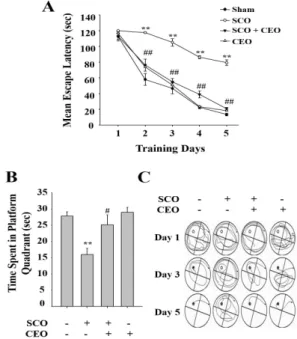
In the next experiment, Morris water maze test was conducted to examine the effect of CEO on the hippocampus-dependent spatial recognition and long- term memory. Spatial memory is hippocampus-mediated function that appears to be compromised in the elderly subjects and in patients suffering from AD. The mean escape latency time of the sham control group declined progressively during the training period of 5 consecutive days, which was shorter than that of the SCO-induced amnesic group (Fig. 2A).
Fig. 1. Effect of CEO against SCO-induced memory impairment in the acquisition and retention trials of passive avoidance test.
CEO was exposed for 1 h/day or 3 h/day and scopolamine (1
㎎/㎏) was intraperitonically injected 30 min before acquisition trial. Retention trial was conducted 24 h after acquisition trial. Data represent mean ± S.E.M (n=7). **p < 0.01 compared with the sham control group. #p < 0.05, ##p < 0.01 compared with the scopolamine-injected model group.
Fig. 2. Effect of CEO on SCO-induced learning and memory deficits as assessed by Morris water maze test. (A) Mean escape latency to find the hidden platform over 5 consecutive days of the training trials. (B) Swimming time spent in the target quadrant during probe trials without platform. Data are shown as ± S.E.M (n=6-7). **p < 0.01 vs. sham control group. #p < 0.05, ##p < 0.01 vs. scopolamine-induced model group. (C) Representative pathways of Morris water maze test on days 1, 3, and 5 from each group.
The SCO-injected model group exhibited significantly delayed escape latency time particularly on days from 2 to 5 indicating long-term memory impairment (Fig. 2A).
In contrast, the time spent to find the hidden platform was effectively reduced by inhalation of CEO for 3 h/day (Fig. 2A) suggesting that CEO effectively improves SCO -induced spatial cognitive deficits (p<0.05). On the last day of training, the platform was removed, and probe test was performed. During probe trials, the swimming time within the target quadrant without platform was greatly prolonged by CEO inhalation for 3 hr/day compared with the performance of SCO alone-treated mice (Fig. 2B).
In another experiment, hippocampus-dependent contextual fear conditioning test was conducted, which examine the ability of mice to associate the training environment with the aversive event. In this setting the mice learn to associate several features about the environment with the electric foot shock. Twenty-four hour after conditioning session, mice were returned to the conditioning chamber in order to measure contextual fear represented by freezing response. SCO-induced amnesia group showed decreased freezing time during retention session compared to sham control group (Fig.
3). However, the performance of scopolamine-injected
mice was completely restored by CEO inhalation for 3 h/day (p<0.01). CEO-treated alone groups did not exhibit any significant difference comparable to sham control.
Fig. 3. Effect of CEO against SCO-induced cognitive dysfunction in the retention session of contextual fear conditioning test. Mice were exposed to CEO for 1 h/day or 3 h/day and intraperitonically injected with scopolamine (1 ㎎/㎏) 30 min before starting the retention trial. Values are expressed as means ± S.E.M. (n=7).
**p < 0.01 compared with the sham control group. #p < 0.05, ##p <
0.01 compared with the scopolamine-treated model group.
Due to some limitations of FDA-approved AChE inhibitors such as moderate efficacy, short half-lives and severe side effects, novel alternative and complementary anti-dementia therapies are urgently needed to be developed. One of these promising candidates is essential oil with diverse pharmacological and medicinal properties in CNS. Components of lemon essential oils such as limonene and perillyl alcohol was reported to improve scopolamine-impaired learning and memory in Wistar rats possibly by stimulating dopaminergic neurons and inhibiting AChE activity
13). Essential oil extracted from
Acori gramineirhizoma was also known to enhance cognitive function in aged animals possibly by increasing relative levels of norepinephrine, dopamine and serotonin and by decreasing the activity of AChE
14).
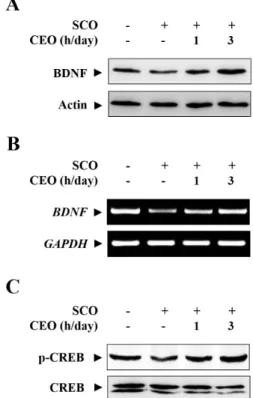
In order to further elucidate the underlying mechanism of CEO, we have assessed the expression of BDNF and the activation of CREB in the mice hippocampal tissues.
Protein and mRNA levels of BDNF were examined by Western blot analysis and RT-PCR, respectively. BDNF, a member of the neurotrophin family, is synthesized and stored in synaptic vesicles and released into synaptic clefts in response to endogenous or exogenous stimuli
15). BDNF is involved in various aspects of learning and memory processing-in and plays a pivotal role in the persistence and storage of memory
16). In this study, scopolamine treatment significantly decreased the protein (Fig. 4A) as well as mRNA (Fig. 4B) levels of BDNF in the hippocampus, which were effectively restored by
pre-treatment with CEO for 3 h/day. In another experiment, the activation of CREB via phosphorylation was decreased in the SCO alone-injected model group compared with the sham control, whereas hippocampal phosphorylation levels of CREB were substantially increased in the CEO-treated animals, particularly 3 h/day-exposure to CEO (Fig. 4C). Because CREB is a key transcription factor controlling the expression of BDNF, it might be a molecular trigger that leads to the increased levels of BDNF in the CEO inhalation groups.
Fig. 4. Effects of CEO on the expression of BDNF and activation of CREB in the hippocampus. The protein (A) and mRNA (B) expression of BDNF was determined by immunoblotting and RT- PCR using specific antibody and primers for BDNF. Actin and GAPDH levels were measured for the confirmation of equal amount of protein and mRNA loading, respectively. (C) The activation of CREB was determined by Western blot analysis using anti- phospho-CREB (upper panel) and anti-CREB (lower panel) antibodies.