Print ISSN: 2288-4637 / Online ISSN 2288-4645 doi:10.13106/jafeb.2021.vol8.no3.0561
Critical Factors of Reacquainting Consumer Trust in E-Commerce*
Mingyue FAN
1, Victoria AMMAH
2, Sarfraz Ahmed DAKHAN
3, Ran LIU
4, Moses NiiAkwei MINGLE
5, Zhengjia PU
6Received: November 20, 2020 Revised: January 25, 2021 Accepted: February 03, 2021
Abstract
Knowing how to build and maintain consumer trust is crucial for e-commerce. Despite the number of empirical studies that have explored the factors that influence consumer trust, none of them considers the relative importance of different antecedents and how they interact to influence consumer trust. Therefore, based on the integrated Decision Making Trial and Evaluation Laboratory (DEMATEL) and Interpretive Structural Modeling (ISM) approaches, we establish a hierarchical structural model, which not only demonstrates the intensity of the relationships but also identifies the interdependence among the drivers of consumer trust in E-commerce. The findings confirm that propensity to trust is the most important determinant of consumer trust. The brand-related factors and platform-related factors are prominent in the process of building trust as they influence consumer trust indirectly through propensity to trust. Geographic location, demographic variables, and high security are identified as the root causes that affect consumer trust through other trust antecedents.
Furthermore, the findings of this study offer valuable insights into an important element of e-commerce and provide a useful platform for future research. More represented samples and factors are encouraged for further research to ensure research fairness and minimize consumer distrust and uncertainty.
Keywords: E-Commerce, Consumer Trust, Ism, DEMATEL, Reacquaint JEL Classification Code: L81, D11, P46
(Khanh, 2020; Turban & King, 2009). However, many consumers are skeptical about e-commerce due to perceived high risks and uncertainty (Kim et al., 2008; Mou et al., 2017; Wiradendi et al., 2020). As a result, consumer trust has been recognized as one of the most crucial aspects of e-commerce participation (Castaldo et al., 2010). It acts as an effective mechanism to reduce uncertainty and complexity in transactions within the online environment (Cuong, 2020;
Luhmann & Colembiewski, 1981).
It has been proven that a lack of consumer trust is a major barrier to consumers’ acceptance of e-commerce irrespective of company size and type (Li et al., 2020). For this reason, factors affecting consumer trust have received great attention from both academic researchers and business practitioners, along with the rapid growth of e-commerce over the last two decades. These factors can be classified into three categories:
consumer/customer-related factors, e.g., online experience, propensity to trust, personality, age, and gender (Alarcon et al., 2018; Ali et al., 2020; Blank & Dutton, 2012; Elgheit, 2019; Samuel et al., 2015; Zeffane, 2018). Company/
brand-related factors, e.g., brand reputation, competence, benevolence, integrity (Chang et al., 2005; Ha, 2004;
1. Introduction
E-commerce offers consumers access to a wider range of products and services, brings more convenience
*Acknowledgements:
This research is supported by “Teaching Reform and Research Project of Jiangsu University (2017JGYB008)”
1 First Author and Corresponding Author. School of Management, Jiangsu University, Zhenjiang, P.R. China [Postal Address: 301 Xuefu Road Jinkou District, Zhenjiang, Jiangsu, China]
Email: [email protected]
2 School of Management, Jiangsu University, Zhenjiang, P.R. China.
Email: [email protected]
3 School of Business Administration, Sukkur IBA University, Sindh, Pakistan. Email: [email protected]
4 Newcastle Business School, Northumbria University, Newcastle Upon Tyne, United Kingdom. Email: [email protected]
5 School of Finance and Economics, Jiangsu University, Zhenjiang, P.R. China. Email: [email protected]
6 School of Management, Jiangsu University, Zhenjiang, P.R. China.
Email: [email protected]
© Copyright: The Author(s)
This is an Open Access article distributed under the terms of the Creative Commons Attribution Non-Commercial License (https://creativecommons.org/licenses/by-nc/4.0/) which permits unrestricted non-commercial use, distribution, and reproduction in any medium, provided the original work is properly cited.
Şahin et al., 2011; Schmitt et al., 2009) and context-related factors, such as website usability, content quality, technical adequacy, and presence of security assurances (Kim et al., 2015; Subramaniam & Andrew, 2016; Wingreen et al., 2019). It is clear that building consumer trust on the internet is a very challenging and complex task due to the multiple entities involved in the interaction process and the wide range of influential factors.
Hence, identifying the most important antecedents, exploring the relative relationships between these antecedents, and how they interact to influence consumer trust is fundamental to this paper. The study aims to analyze the interrelationships between the factors that influence consumer trust by using the Decision Making Trial and Evaluation Laboratory (DEMATEL) and Interpretive Structural Modeling (ISM) models. Therefore, the research focuses on the following objectives: (1) to identify the factors that influence consumer trust in the extant e-commerce literature; (2) to explore the interdependence among these factors, establish the hierarchical structure of their complex relationships, and rank their importance; (3) to provide suggestions on how to build consumer trust effectively in e-commerce.
The remaining part of the paper is structured as follows.
Section 2 reviews the literature on consumer trust and its antecedents in the context of e-commerce. Next, research models and methods are explained, and the results are presented. Finally, the findings are discussed, conclusions and implications are made, and research limitations are shown.
2. Literature Review
2.1. Consumer Trust in E-commerce
Varying definitions have been given to consumer trust (Anderson & Narus, 1990; Dwyer et al.,1987;
Moorman et al., 1993; Sirdeshmukh et al., 2002).
Scholars generally refer to the trust expressed by a buyer (consumer) in a commercial environment, as consumer trust. Consumer trust is described as an essential element in e-commerce(Ozturk et al., 2017). It reduces uncertainty and results in consumer loyalty Sirdeshmukh et al. (2002) and acceptance (García-Marzá ,2005). Unfortunately, most researchers have identified consumer trust as the main element lacking on e-commerce platforms and a barrier to consumers’ adoption of e-commerce (Ali Qalati et al., 2021;
Virgilio & Antonelli, 2017). Lack of trust creates doubt in consumers, negatively affecting their purchase intentions (Wei et al., 2018). Virgilio and Antonelli (2017) mentioned that the issue of a lack of consumer trust in e-commerce could be controlled, if not eliminated. This can be done by building up trust in the consumer. Therefore, consumer trust in e-commerce must be holistically analyzed, and the findings used to enable the development of building trust in the consumer.
2.2. Factors Influencing Consumer Trust in E-Commerce
Many researchers in the e-commerce discipline have studied consumer trust factors. These factors are usually placed in categories to facilitate better understanding and ease of examination. Some early studies suggested that trust antecedents can broadly be categorized as those which relate to the consumer (for example, trust propensity, age, gender, etc.) and those which relate to the e-commerce system (for example, security, privacy assurance, etc.) (Grabner-Kraeuter, 2002; Ha, 2004; Kim et al., 2008). However, more recent work suggests that this dual categorisation represents an over-simplification and greater precision is possible (Kim et al., 2008). Most recent works categorize consumer trust antecedents as personality-based, calculative-based, knowledge-based, and institution-based. For example, Ghoreishi (2015) categorized consumer trust factors into institution-based trust, personality- based trust, calculative-based trust, technology-based trust, and knowledge-based trust factors. They posited that the identification of subsequent antecedents would still represent subsets of their categorization. Another example is seen in Kim et al. (2008), where the authors classified trust antecedents into four categories; cognition (observation)-based, affect-based, experience-based, personality-oriented. They argued that these four categories were sufficient to aid the understanding of the antecedents of trust and to provide insight to business managers in building consumer trust.
In summary, it would appear that there is some consensus in the literature but no universal acceptance of any specific procedure to categorize trust factors. Categorization of trust has been influenced by the mode of creation of the trust (origin/
object), the position of the person who creates the trust (trustor), the person who manages the trust (trustee), the perspective of the study, the context of the examination, etc. In this instance, the classification was done from the consumer’s standpoint as the focus of this research is consumer trust. Bandara et al. (2019) also conclude that the consumers, business, and technology are three levers of e-commerce. Therefore, this study specifically considered factors relating to the person who cultivates the trust (consumer), factors relating to the person who manages the trust (business), and the technology in which the trust is supported, resulting in three main categories of factors that influence consumer trust. These three categories are believed to constitute the complete e-commerce system.
2.2.1. Consumer-Related Factors
The consumer-related factors are categorized into five sub-factors, as mentioned defined below:
(1) Propensity to trust: refers to one’s natural willing-
ness or tendency to believe in others (Awad & Ragowsky,
2008). A consumer’s propensity-to-trust is a genuine belief
that is associated with one’s personality.
(2) Demographic variables: It refers to the unique characteristics of a person, which includes age, gender, marital status, religion, level of education, income earned, family size (Simpson, 2004).
(3) Geographical location: in particular, focuses on the exact physical setting relating to the consumer. This is analyzed from two main perspectives. The first is the psychological distance or proximity of the seller to the consumer (Darke et al., 2016). Secondly, in terms of nations and economies, the policies present in an economy, the framework for the governance of commerce in a country, and the state of e-commerce in a particular locality have a strong tendency to directly influence a consumer’s trust (Leinbach, 2008).
(4) Internet experience: is based on the knowledge gained over time due to the frequency of use of the internet for online shopping. Blank and Dutton (2012) refer to internet experience as the comfort or ease of use gained from previous exposure to the internet.
(5) Use of technology: is one’s ability to navigate, conduct searches, and understand the content of technology.
A consumer’s inability to use the technologies adopted in an e-commerce system can cause an online shopper to lose confidence in a transaction (Chinomona, 2013).
2.2.2. Business Related Factors
Business-related factors consist of six sub-factors
(1) Familiarity: is the frequent encounter with a particular system. It produces a database of knowledge of what, how, and when something is happening and who/
what could be behind the occurrence (Salo & Karjaluoto, 2007). It helps predict outcomes and gives assurance, as there is knowledge of the persisting actions within the system.
(2) Brand experience: relates to the sensation induced by a consumer’s knowledge and previous affiliation to a brand. This knowledge arouses the consumer’s interest to continue to share in the activities of the brand as the consumer can identify with the brand’s name, design, and packaging, etc. (Şahin et al., 2011).
(3) Reputation: is the views or opinions consumers hold about an online vendor based on how well the vendor is believed to be honest, and concerned about its consumers (Yang et al., 2019). This perception formed about the vendor is a key inducer of trust.
(4) Recommendations: are the general opinions from other users (known or unknown to the consumer), given in the form of feedback and reviews, expressing approval of or support for a seller based on the consumer’s positive experience with the seller (Li et al., 2016).
(5) Word-of-mouth: This is a vivid endorsement given by a content consumer known by the potential customer.
It differs from recommendation in the sense that it is more emphatic, not a mere opinion. Where consumers (especially
new ones) are unfamiliar with a vendor or system, positive?
Word-of-mouth serves as a guarantee (Furner & Zinko, 2016; Mazhar et al., 2012).
(6) Perceived integrity: refers to consumers’ perception of the sincerity and transparency of e-commerce vendors, particularly whether the vendor’s actions are consistent with what it promises and its fairness in dealing with consumers (Cheung & Lee, 2003).
2.2.3. Technology-Related Factors
The third category of technology-related factors consist of four sub-factors
(1) Privacy assurance: is the guarantee of confiden- tiality and safety of a consumer’s private information by all privacy standards (Patton & Josang, 2004; Smith & Shao, 2007). It gives the consumer assurance that he/she would not suffer the loss of personal information in transacting through the system (Bandara et al., 2019).
(2) High-security measures: are precautions to protect consumers against internet malpractices (Mlelwa & Yonah, 2017). Security issues have been named as one of the components of e-commerce, which is particularly concerning to consumers (Riquelme & Román, 2014).
(3) Reliable system: One’s perception that the system relating to an e-commerce platform will always be accessible.
It should meet the required standards, suffer minimal inconsistencies, be secure from all forms of risk, and not encounter failures. On a rare occasion, this happens, it would be restored quickly to its normal capacity (Turban & King, 2009).
(4) Information quality: refers to the accuracy and genuineness of the information made available on a site regar- ding the products and the processes involved (Floridi, 2013).
3. Methodology 3.1. Research Methods
The DEMATEL and ISM methods are ideally to this study as they can reveal complex relationships between elements involved in complex systems, such as transportation Han and Wang, (2018); Wang et al. (2012), ecotourism Chuang et al. (2013), and industrial management (Chauhan et al., 2016; Rajput & Singh, 2018).
To achieve comprehensive results in e-commerce research, DEMATEL and ISM were integrated to generate a more specific set of factors responsible for influencing consumer- trust and establishing the conceptual relationship between the factors. ISM mainly employs a binary approach and considers the hierarchy of influence. At the same time, DEMATEL investigates the important factors by ranking their degree of influence and categorizing the factors into effect causers and effect receivers through the use of scores/scale figures.
The methodological flow of this study is portrayed in Figure 1.
These experts are knowledgeable and have been in active service in any form of electronic commerce for a period of over 5 years. Information was collected between December 2018 to February 2019.
4. Result from Analysis and Discussion 4.1. Identifying the Important Factors
by DEMATEL
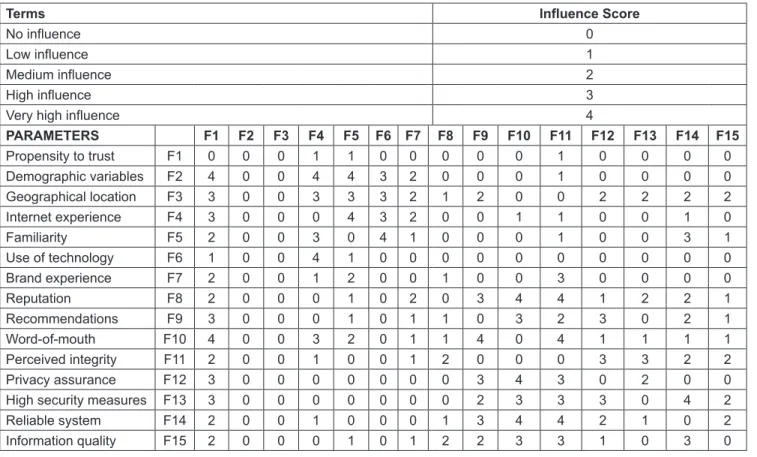
4.1.1. Initial-Direct-Relations Matrix
This is the foremost step in the DEMATEL analysis. A focus group discussion was carried out by a representative sample of the experts based on the business sector to develop the direct-relations matrix. This panel of 5 experts was made up of 2 e-commerce Entrepreneurs, 2 Marketers within the industry, and 1 Advisor. The experts assigned influencing scores using table 1 to create existing relationships amongst the factors. As per the “majority is superior to the minority” rule, the panel reached a consensus. The direct-relation matrix (shown as Table 1) was developed by assigning the corresponding scores based on relationships influencing terms.
Table 1: Direct-Relations Matrix Based on Relationship Influencing terms and their Corresponding Influencing Score
Terms Influence Score
No influence 0
Low influence 1
Medium influence 2
High influence 3
Very high influence 4
PARAMETERS F1 F2 F3 F4 F5 F6 F7 F8 F9 F10 F11 F12 F13 F14 F15
Propensity to trust F1 0 0 0 1 1 0 0 0 0 0 1 0 0 0 0
Demographic variables F2 4 0 0 4 4 3 2 0 0 0 1 0 0 0 0
Geographical location F3 3 0 0 3 3 3 2 1 2 0 0 2 2 2 2
Internet experience F4 3 0 0 0 4 3 2 0 0 1 1 0 0 1 0
Familiarity F5 2 0 0 3 0 4 1 0 0 0 1 0 0 3 1
Use of technology F6 1 0 0 4 1 0 0 0 0 0 0 0 0 0 0
Brand experience F7 2 0 0 1 2 0 0 1 0 0 3 0 0 0 0
Reputation F8 2 0 0 0 1 0 2 0 3 4 4 1 2 2 1
Recommendations F9 3 0 0 0 1 0 1 1 0 3 2 3 0 2 1
Word-of-mouth F10 4 0 0 3 2 0 1 1 4 0 4 1 1 1 1
Perceived integrity F11 2 0 0 1 0 0 1 2 0 0 0 3 3 2 2
Privacy assurance F12 3 0 0 0 0 0 0 0 3 4 3 0 2 0 0
High security measures F13 3 0 0 0 0 0 0 0 2 3 3 3 0 4 2
Reliable system F14 2 0 0 1 0 0 0 1 3 4 4 2 1 0 2
Information quality F15 2 0 0 0 1 0 1 2 2 3 3 1 0 3 0
Figure 1: Methodological Flow of the Study
3.2. Data Collection
Initially, a broad review of significant earlier contributions to the literature was reviewed to identify salient literatures. Subsequently, to enrich the data collected from the literature and fulfill the models’
requirements, online questionnaires were developed
and administered to experts in the e-commerce industry.
Table 2: Total Relation Matrix
F1 F2 F3 F4 F5 F6 F7 F8 F9 F10 F11 F12 F13 F14 F15 r
F1 0.0054 0.0000 0.0000 0.0228 0.0226 0.0032 0.0020 0.0011 0.0006 0.0012 0.0223 0.0017 0.0016 0.0031 0.0016 0.0892 F2 0.1331 0.0000 0.0000 0.0984 0.0962 0.0751 0.0477 0.0028 0.0015 0.0038 0.0320 0.0028 0.0025 0.0099 0.0039 0.5097 F3 0.1237 0.0000 0.0000 0.0786 0.0773 0.0723 0.0499 0.0275 0.0552 0.0224 0.0292 0.0533 0.0476 0.0591 0.0501 0.7462 F4 0.1019 0.0000 0.0000 0.0169 0.0896 0.0696 0.0449 0.0037 0.0046 0.0246 0.0331 0.0044 0.0034 0.0290 0.0052 0.4309 F5 0.0761 0.0000 0.0000 0.0738 0.0116 0.0871 0.0254 0.0047 0.0068 0.0101 0.0345 0.0064 0.0041 0.0674 0.0254 0.4334 F6 0.0378 0.0000 0.0000 0.0852 0.0286 0.0075 0.0042 0.0004 0.0005 0.0022 0.0040 0.0005 0.0004 0.0038 0.0010 0.1761 F7 0.0683 0.0000 0.0000 0.0270 0.0455 0.0054 0.0047 0.0238 0.0031 0.0045 0.0685 0.0057 0.0057 0.0081 0.0049 0.2752 F8 0.0994 0.0000 0.0000 0.0151 0.0325 0.0036 0.0493 0.0119 0.0800 0.1014 0.1129 0.0409 0.0532 0.0600 0.0342 0.6944 F9 0.1141 0.0000 0.0000 0.0121 0.0295 0.0031 0.0265 0.0278 0.0172 0.0773 0.0659 0.0718 0.0107 0.0516 0.0287 0.5363 F10 0.1494 0.0000 0.0000 0.0732 0.0552 0.0090 0.0308 0.0298 0.0923 0.0197 0.1064 0.0377 0.0309 0.0395 0.0316 0.7055 F11 0.0854 0.0000 0.0000 0.0264 0.0082 0.0023 0.0259 0.0463 0.0173 0.0230 0.0266 0.0728 0.0693 0.0547 0.0489 0.5071 F12 0.1131 0.0000 0.0000 0.0107 0.0091 0.0014 0.0062 0.0075 0.0734 0.0929 0.0812 0.0153 0.0489 0.0139 0.0096 0.4832 F13 0.1213 0.0000 0.0000 0.0123 0.0098 0.0016 0.0071 0.0109 0.0616 0.0843 0.0914 0.0783 0.0129 0.0952 0.0524 0.6391 F14 0.0969 0.0000 0.0000 0.0324 0.0125 0.0030 0.0098 0.0313 0.0796 0.1013 0.1095 0.0589 0.0332 0.0184 0.0520 0.6388 F15 0.0901 0.0000 0.0000 0.0127 0.0302 0.0032 0.0284 0.0498 0.0581 0.0796 0.0884 0.0360 0.0121 0.0747 0.0116 0.5749 C 1.4160 0.0000 0.0000 0.5976 0.5584 0.3474 0.3628 0.2793 0.5518 0.6483 0.9059 0.4865 0.3365 0.5884 0.3611
4.1.2. Total Relation Matrix (TRM)
The TRM, as shown in Table 2, is calculated by utilizing equation (1), of which the identity matrix (I) is n × n. The matrix T shows the overall relationship between the pairings made with each factor of the system. Where T
ijis a representation of the effects that factor i had on factor j.
T = lim
m→∞(D + D
2+ D
3… + D
m) (1) 4.1.3. The Significance of the Influencing Factors
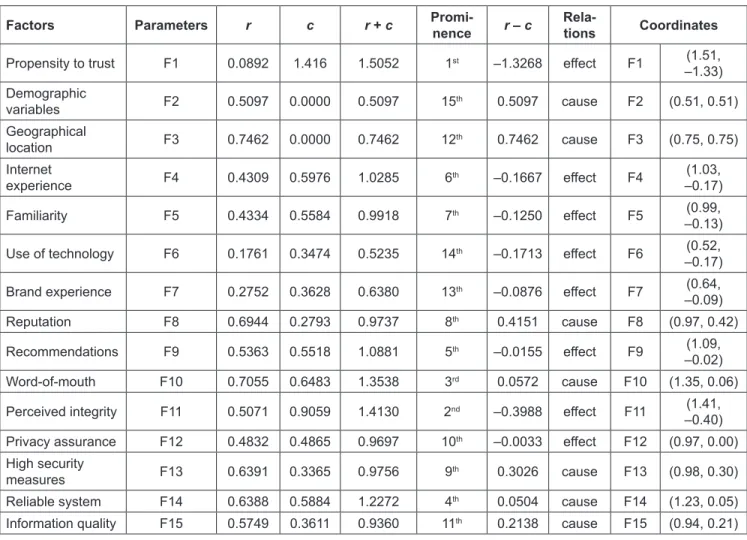
The cause–effect relationship and the importance of the factors have been duly established and depicted in table 3.
The sum (r + c) reflects the effects the factors have on each other and further discloses their prominence, whiles the difference (r – c) reflects the causal–relationship amongst the factors. When (r – c) is a positive value, then the factor has a cause–effect on others, and when (r – c) is negative, then the factor(s) is in turn affected by other factors.
4.2. Identifying the Hierarchy of Influence by ISM 4.2.1. Structural Self-Interaction Matrix (SSIM)
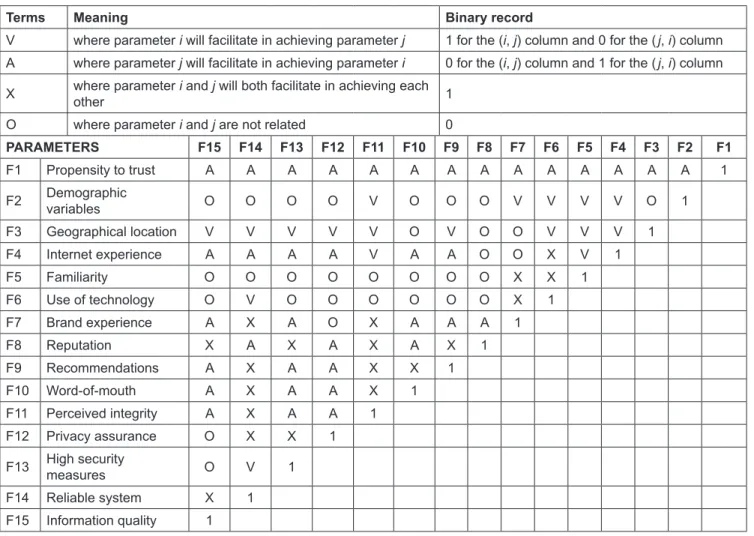
One basic requirement of ISM is the use of opinions from experts by any agreed technique such as
questionnaire-based survey, brainstorming, focus-group discussion, etc., to develop the underlying relationship amongst the factors. This panel of 5 experts was chosen randomly. The panel reached a consensus, and the structural self-interaction matrix (SSIM) was shown as in Table 4.
The factors were grouped under two parameters (i and j);
there after, variables were used to specify the extent to which one parameter led to the other based on relationships influencing terms and their corresponding scores:
4.2.2. Final Reachability Matrix (FRM)
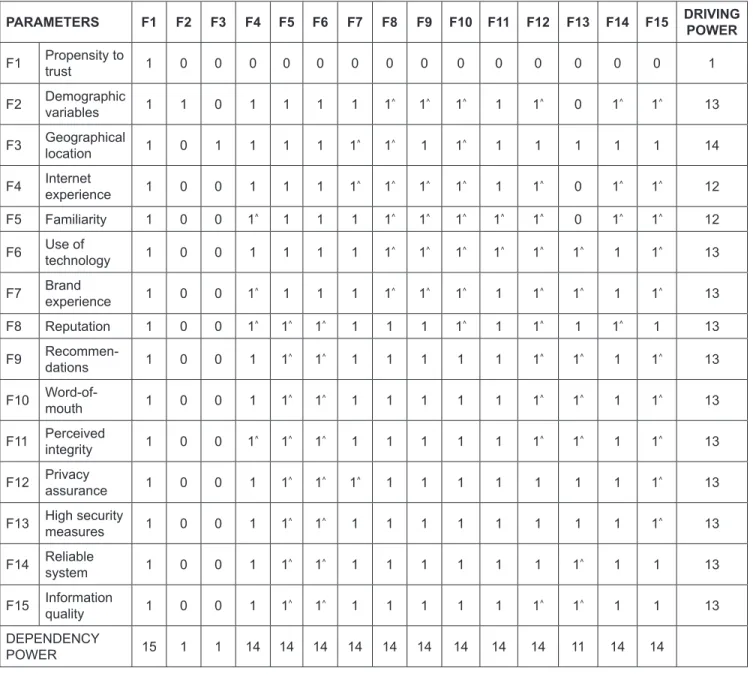
Based on transforming the SSIM from variables to binary, Initial Reachability Matrix (IRM) is obtained. In Table 5, the driving power and the dependence power of the factors are computed from the Initial Reachability Matrix (IRM) after it has been checked for transitivity (indicated by 1
^).
The dependence power (see equation (2)) is the summation of each factor’s value, which a factor may help achieving.
The driving power (see equation (3)) is the summation of the value of each factor which helped to achieve a factor, including itself. Mathematically, it is expressed as (using factor 1 as an example):
Driving power
i
1a
1j
15
(2)
Dependence power
j
1a
i1
15
(3)
Table 3: Results of DEMATEL Analysis
Factors Parameters r c r + c Promi-
nence r – c Rela-
tions Coordinates
Propensity to trust F1 0.0892 1.416 1.5052 1st –1.3268 effect F1 (1.51,
–1.33) Demographic
variables F2 0.5097 0.0000 0.5097 15th 0.5097 cause F2 (0.51, 0.51)
Geographical
location F3 0.7462 0.0000 0.7462 12th 0.7462 cause F3 (0.75, 0.75)
Internet
experience F4 0.4309 0.5976 1.0285 6th –0.1667 effect F4 (1.03,
–0.17)
Familiarity F5 0.4334 0.5584 0.9918 7th –0.1250 effect F5 (0.99,
–0.13)
Use of technology F6 0.1761 0.3474 0.5235 14th –0.1713 effect F6 (0.52,
–0.17)
Brand experience F7 0.2752 0.3628 0.6380 13th –0.0876 effect F7 (0.64,
–0.09)
Reputation F8 0.6944 0.2793 0.9737 8th 0.4151 cause F8 (0.97, 0.42)
Recommendations F9 0.5363 0.5518 1.0881 5th –0.0155 effect F9 (1.09,
–0.02)
Word-of-mouth F10 0.7055 0.6483 1.3538 3rd 0.0572 cause F10 (1.35, 0.06)
Perceived integrity F11 0.5071 0.9059 1.4130 2nd –0.3988 effect F11 (1.41,
–0.40) Privacy assurance F12 0.4832 0.4865 0.9697 10th –0.0033 effect F12 (0.97, 0.00) High security
measures F13 0.6391 0.3365 0.9756 9th 0.3026 cause F13 (0.98, 0.30)
Reliable system F14 0.6388 0.5884 1.2272 4th 0.0504 cause F14 (1.23, 0.05)
Information quality F15 0.5749 0.3611 0.9360 11th 0.2138 cause F15 (0.94, 0.21)
4.2.3. Level Identification
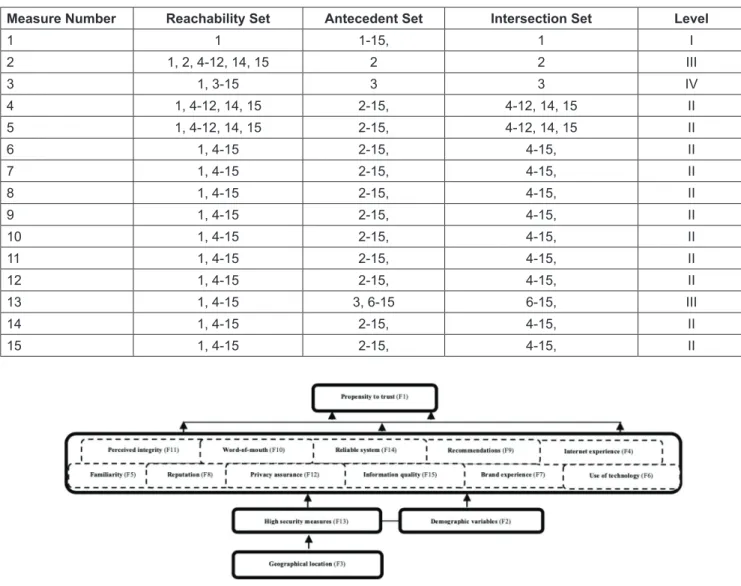
At this point, the reachability sets, antecedent sets, and intersection sets are deduced to obtain the various levels, as shown in Table 6. The reachability set is made of any element to which it may facilitate achievement, whiles the antecedent set is made of any element which may facilitate achieving it.
The intersection set is derived from the intersection elements of the reachability set and the antecedent set. The different levels are identified and assembled to develop the ISM model for the factors influencing a consumer’s trust in e-commerce.
This is shown in Figure 2.
4.3. Results
The result of the DEMATEL model ranked Propensity-to- Trust (F1) as the factor with the most direct and influencing capacity with a score of 1.5052, followed by Perceived integrity (F11) with a score of 1.4130. The third-ranked
factor, Word-of-Mouth (F10), scored 1.3538. The lowest three (3) ranked factors included Brand Experience (F7), Use of Technology (F6), and Demographic variables (F2), which recorded the lowest value of 0.5097.
The ISM model also ranked “Propensity to trust (F1)” as
the most influential trust factor. The next level of influence was
the combination of 11 factors with equal importance, which
are Perceived Integrity (F11), Word-of-Mouth (F10), Reliable
System (F14), Recommendations (F9), Internet Experience
(F4), Familiarity (F5), Reputation (F8), Privacy Assurance
(F12), Information Quality (F15), Brand Experience (F7)
and Use of technology (F6). The penultimate influence-level
included two (2) factors: High-Security Measures (F13)
and Demographic Variables (F2). The last level listed only
Geographical Location (F3) as its component, which eventually
influenced only High-Security Measures (F13). It was noticed
that Geographical location (F3) recorded the highest driving
power value of 14, while Propensity to trust (F1) was the chief
dependent factor with the value of 15 based on the FRM.
Table 4: Structural Self-Interaction Matrix (SSIM) based on Relationship Influencing Terms and their Corresponding Score
Terms Meaning Binary record
V where parameter i will facilitate in achieving parameter j 1 for the (i, j) column and 0 for the ( j, i) column A where parameter j will facilitate in achieving parameter i 0 for the (i, j) column and 1 for the ( j, i) column X where parameter i and j will both facilitate in achieving each
other 1
O where parameter i and j are not related 0
PARAMETERS F15 F14 F13 F12 F11 F10 F9 F8 F7 F6 F5 F4 F3 F2 F1
F1 Propensity to trust A A A A A A A A A A A A A A 1
F2 Demographic
variables O O O O V O O O V V V V O 1
F3 Geographical location V V V V V O V O O V V V 1
F4 Internet experience A A A A V A A O O X V 1
F5 Familiarity O O O O O O O O X X 1
F6 Use of technology O V O O O O O O X 1
F7 Brand experience A X A O X A A A 1
F8 Reputation X A X A X A X 1
F9 Recommendations A X A A X X 1
F10 Word-of-mouth A X A A X 1
F11 Perceived integrity A X A A 1
F12 Privacy assurance O X X 1
F13 High security measures O V 1
F14 Reliable system X 1
F15 Information quality 1
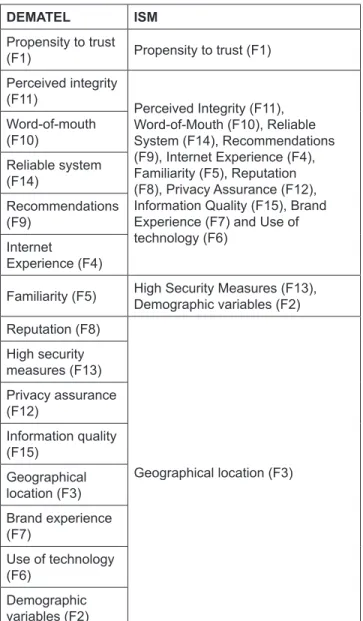
The integration of the results from both models produced a comprehensive understanding of the relationships among the factors. The separate results obtained from each of the two methods employed contained similarities, as displayed when comparing their results (see Figure 3).
The ISM validated the most important factor ranked by DEMATEL: the propensity to trust (F1). The DEMATEL, in turn, revealed that some factors in level II of the ISM hierarchy of influence had more weight of influence than others. Perceived Integrity (F11), Word-of-Mouth (F10), Reliable System (F14), and Recommendations (F9) were ranked the most influential factors by DEMATEL.
However, these factors were together with other factors classified in level II in ISM. The multi-level hierarchy of the ISM depicting dependence abilities and the cause-and- effect groupings of DEMATEL are distinctive features of the two models that come together to determine the most prominent factors influencing consumer trust in e-commerce.
Our findings reveal that propensity to trust is the most
important determinant of consumer trust compared to the
rest of the factors. It plays a significant role in the trust
process and thus should be given the highest priority. This
finding coincides with some empirical studies that suggest
a propensity to trust significantly influences consumer trust
in e-commerce. For example, Chen et al. (2015) suggested
that propensity to trust does directly lead to the build-up of
consumer trust. However, their study did not examine the
relative importance of trust propensity by comparing other
influential factors. In addition, conflicting results exist in
previous research. Some scholars argue that a consumer’s
decision to trust depends on his/her evaluation of benefits
versus risks associated with online shopping (Dai et al.,
2018). As Alarcon et al. (2018) point out, trust propensity
only has a significant impact on consumers’ initial trust,
and the effect tends to wane once they gain experience with
online shopping (Alarcon et al., 2016). The disparities in
results may be attributed to a static view of trust propensity.
Table 5: Final Reachability Matrix
PARAMETERS F1 F2 F3 F4 F5 F6 F7 F8 F9 F10 F11 F12 F13 F14 F15 DRIVING POWER F1 Propensity to
trust 1 0 0 0 0 0 0 0 0 0 0 0 0 0 0 1
F2 Demographic
variables 1 1 0 1 1 1 1 1^ 1^ 1^ 1 1^ 0 1^ 1^ 13
F3 Geographical
location 1 0 1 1 1 1 1^ 1^ 1 1^ 1 1 1 1 1 14
F4 Internet
experience 1 0 0 1 1 1 1^ 1^ 1^ 1^ 1 1^ 0 1^ 1^ 12
F5 Familiarity 1 0 0 1^ 1 1 1 1^ 1^ 1^ 1^ 1^ 0 1^ 1^ 12
F6 Use of
technology 1 0 0 1 1 1 1 1^ 1^ 1^ 1^ 1^ 1^ 1 1^ 13
F7 Brand
experience 1 0 0 1^ 1 1 1 1^ 1^ 1^ 1 1^ 1^ 1 1^ 13
F8 Reputation 1 0 0 1^ 1^ 1^ 1 1 1 1^ 1 1^ 1 1^ 1 13
F9 Recommen-
dations 1 0 0 1 1^ 1^ 1 1 1 1 1 1^ 1^ 1 1^ 13
F10 Word-of-mouth 1 0 0 1 1^ 1^ 1 1 1 1 1 1^ 1^ 1 1^ 13
F11 Perceived integrity 1 0 0 1^ 1^ 1^ 1 1 1 1 1 1^ 1^ 1 1^ 13
F12 Privacy assurance 1 0 0 1 1^ 1^ 1^ 1 1 1 1 1 1 1 1^ 13
F13 High security measures 1 0 0 1 1^ 1^ 1 1 1 1 1 1 1 1 1^ 13
F14 Reliable system 1 0 0 1 1^ 1^ 1 1 1 1 1 1 1^ 1 1 13
F15 Information quality 1 0 0 1 1^ 1^ 1 1 1 1 1 1^ 1^ 1 1 13
DEPENDENCY
POWER 15 1 1 14 14 14 14 14 14 14 14 14 11 14 14
It is perceived as an innate personality trait or formulated early in life, and thus difficult to change (Hofstede, 2006).
In contrast, our research reconciles conflicting findings by taking a dynamic and holistic approach. It shows that propensity to trust may evolve or change over time in a dynamic trust formation process along with the interaction between a consumer and the entities involved in e-commerce, such as an online retailer, brand, and other customers.
Perceived integrity is revealed to be the second most important driver of consumer trust, followed by
word-of-mouth, reliable system, recommendations, internet experience, familiarity, reputation, privacy assurance, information quality, brand experience, and use of technology.
These antecedents can be classified into two groups:
(1) brand-related factors (e.g., perceived integrity, familiarity,
brand experience, word-of-mouth, recommendations),
enhanced through the interaction between a consumer and
the brand; (2) platform-related factors (e.g., reliable system,
privacy assurance, information quality), strengthened through
the interaction between a consumer and the digital platform.
Table 6: Level Identification Summary
Measure Number Reachability Set Antecedent Set Intersection Set Level
1 1 1-15, 1 I
2 1, 2, 4-12, 14, 15 2 2 III
3 1, 3-15 3 3 IV
4 1, 4-12, 14, 15 2-15, 4-12, 14, 15 II
5 1, 4-12, 14, 15 2-15, 4-12, 14, 15 II
6 1, 4-15 2-15, 4-15, II
7 1, 4-15 2-15, 4-15, II
8 1, 4-15 2-15, 4-15, II
9 1, 4-15 2-15, 4-15, II
10 1, 4-15 2-15, 4-15, II
11 1, 4-15 2-15, 4-15, II
12 1, 4-15 2-15, 4-15, II
13 1, 4-15 3, 6-15 6-15, III
14 1, 4-15 2-15, 4-15, II
15 1, 4-15 2-15, 4-15, II
Figure 2: Interpretative Structural Model
Our results show that propensity to trust can be re-shaped
by the aforementioned factors, along with the interaction between a consumer and other entities involved in e-commerce. Specifically, the more consumers engage in online shopping, the more likely they would be to make judgments and develop their expectations according to the information obtained from prior experiences. Hence, positive consumer experiences will lead to a more favorable perception of e-commerce, which facilitates a higher level of propensity to trust. Although some scholars claim that trust propensity is an innate trait that is stable over time and consistent across situations, Alarcon et al. (2018); Frazier et al. (2013); Werff et al. (2019). Our findings support the social learning perspective of trust-building, which suggests that individuals develop different levels of trust across different interaction domains based on past experiences
(Chae & Byungtae, 2021; Schilke & Cook, 2013). Thus, the propensity to trust should be characterized as a dynamic rather than a static construct. Furthermore, in previous research, much attention has been devoted to supporting a direct link between the above driving factors and consumer trust (Kim et al., 2008; Lee & Turban, 2001). However, an indirect effect has been uncovered in this study, which means these drivers exert an impact on consumer trust through propensity to trust. The mediating role further emphasizes the prominence of trust propensity in the trust-building process.
Compared to the more essential antecedents discussed
above, geographic location, demographic variables, and
high-security measures are relatively less important in terms
of their predictive power. However, they are identified as
the root causes in the development of online consumer trust.
Table 7: Comparison of DEMATEL and ISM results
DEMATEL ISM
Propensity to trust
(F1) Propensity to trust (F1) Perceived integrity
(F11) Perceived Integrity (F11), Word-of-Mouth (F10), Reliable System (F14), Recommendations (F9), Internet Experience (F4), Familiarity (F5), Reputation (F8), Privacy Assurance (F12), Information Quality (F15), Brand Experience (F7) and Use of technology (F6)
Word-of-mouth (F10)
Reliable system (F14)
Recommendations (F9)
Internet Experience (F4)
Familiarity (F5) High Security Measures (F13), Demographic variables (F2) Reputation (F8)
Geographical location (F3) High security
measures (F13) Privacy assurance (F12)
Information quality (F15)
Geographical location (F3) Brand experience (F7)
Use of technology (F6)
Demographic variables (F2)
They are the most fundamental factors that directly influence other important antecedents, which drive consumer trust. Hence, their indirect rather than a direct effect on trust has been revealed in our study. This finding is more specific in comparison with previous literature. For example, the findings of research conducted earlier Kim et al. (2008); Kim et al. (2015); Subramaniam and Andrew (2016); Yoon and Occena (2015) only revealed that there is a positive relationship between geographic location and trust, demographic variables and trust, and subsequently, high-security measures and trust. However, the precise mode of influence and/or the direction of influence was never determined.
5. Conclusion
Our findings provide essential guidance for managers in the areas of e-commerce. Since propensity-to-trust is the most critical factor driving online trust, managers must identify effective ways to increase the level of consumer propensity to trust.
Firstly, e-vendors can improve customer experiences based on different touchpoints along the customer journey. It is found that consumer trust propensity is a dynamic measure and can change over time based on prior interactions or experiences.
E-vendors can gain an in-depth understanding of their customers by analyzing each touchpoint, e.g., how they interact with the brand, products, and services, how they perceive the website content, etc. The better online vendors, who become familiar with their customers, are more likely to be in a position to improve customer experiences and enhance satisfaction, which in turn increases the level of propensity to trust.
Secondly, e-vendors can foster a good reputation, positive Word-of-mouth (WOM), and high perceived integrity through corporate social responsibility (CSR) initiatives.
It is found that these factors play a prominent role in the trust-building process. E-vendors can engage in the CSR efforts such as public activities and green E-commerce, to develop the same values as consumers, which in turn, helps to enhance consumer perceived integrity (Servera-Francés
& Piqueras-Tomás, 2019), build brand reputation (Ke et al., 2016), generate customer goodwill and positive WOM, and counter negative publicity.
Thirdly, although demographic and geographic factors do not directly affect consumer trust, they are fundamental factors that indirectly influence trust through other important drivers such as perceived integrity and brand experience. Vendors can segment the market according to these demographic and geographic factors to facilitate differentiated strategies to satisfy each segment’s unique needs and thus enhance consumer trust.
The findings of this study offer valuable insights into an important element of e-commerce and provide a useful platform for future research. More represented samples and factors are encouraged to further research to ensure research fairness and minimize consumer distrust and uncertainty.
References
Abou Elgheit, E. (2019). Affect-based and personality-based trust and risk in social commerce. International Journal of Electronic Marketing and Retailing, 10(2), 1. https://doi.org/10.1504/
ijemr.2019.10010581
Alarcon, G. M., Lyons, J. B., & Christensen, J. C. (2016). The effect of propensity to trust and familiarity on perceptions of trustworthiness over time. Personality and Individual Differences, 94, 309–315. https://doi.org/10.1016/j.paid.2016.01.031
Alarcon, G., Lyons, J., Christensen, J., Bowers, M., Klosterman, S.,
& Capiola, A. (2018). The Role of Propensity to Trust and the Five Factor Model across the Trust Process. Journal of Research in Personality, 75, 69–82. https://doi.org/10.1016/j.
jrp.2018.05.006
Ali Qalati, S., Li, W., Ahmed, N., Ali Mirani, M., & Khan, A.
(2020). Examining the Factors Affecting SME Performance:
The Mediating Role of Social Media Adoption. Sustainability, 13(1), 75. https://doi.org/10.3390/su13010075
Anderson, J., & Narus, J. (1990). A Model of Distributor Firm and Manufacturer Firm Working Partnerships. Journal of Marketing, 54(1), 42–58. https://doi.org/10.1177/002224299005400103 Awad, N., & Ragowsky, A. (2008). Establishing Trust in Electronic
Commerce Through Online Word of Mouth: An Examination Across Genders. Journal of Management Information Systems, 24(4), 101–121. https://doi.org/10.2753/mis0742-1222240404 Bandara, R., Fernando, M., & Akter, S. (2019). Privacy concerns
in E-commerce: A taxonomy and a future research agenda.
Electronic Markets, 30(3), 629–647. https://doi.org/10.1007/
s12525-019-00375-6
Blank, G., & Dutton, W. (2011). Age and Trust in the Internet: The Centrality of Experience and Attitudes Toward Technology in Britain. Social Science Computer Review, 30(2), 135–151.
https://doi.org/10.1177/0894439310396186
Castaldo, S., Premazzi, K., & Zerbini, F. (2010). The Meaning(s) of Trust. A Content Analysis on the Diverse Conceptualizations of Trust in Scholarly Research on Business Relationships. Journal of Business Ethics, 96(4), 657–668. https://doi.org/10.1007/
s10551-010-0491-4
Chae, M., & Byungtae, L. E. E. (2004). Strategy for Building Initial Trust in Click-Only Online Fashion Stores. Journal of Electronic Science and Technology of China, 2(3), 39–46.
Chang, E., Dillon, T. S., & Hussain, F. K. (2005). Trust and reputation relationships in service-oriented environments.
Third International Conference on Information Technology and Applications (ICITA’05). https://doi.org/10.1109/icita.2005.168 Chauhan, Singh, & Jharkharia. (2018). An interpretive structural
modeling (ISM) and decision-making trail and evaluation laboratory (DEMATEL) method approach for the analysis of barriers of waste recycling in India. Journal of the Air & Waste Management Association, 68(2), 100–110. https://doi.org/10.1 080/10962247.2016.1249441
Chen, Y., Yan, X., Fan, W., & Gordon, M. (2015). The joint moderating role of trust propensity and gender on consumers’
online shopping behavior. Computers in Human Behavior, 43, 272–283. https://doi.org/10.1016/j.chb.2014.10.020
Cheung, C., & Lee, M. (2003). An integrative model of consumer trust in internet shopping. https://www.researchgate.net/
publication/221409195_An_integrative_model_of_consumer_
trust_in_internet_shopping
Chinomona, R. (2013). The influence of perceived ease of use and perceived usefulness on trust and intention to use mobile social
software. African Journal for Physical, Health Education, Recreation and Dance, 19, 258–273.
Chuang, H. M., Lin, C. K., Chen, D. R., & Chen, Y. S. (2013).
Evolving MCDM applications using hybrid expert-based ISM and DEMATEL models: An example of sustainable ecotourism. The Scientific World Journal, 2013, 1–18. https://
doi.org/10.1155/2013/751728
Dai, Y. N., Viken, G., Joo, E., & Bente, G. (2018). Risk Assessment in E-Commerce: How Sellers’ Photos, Reputation Scores, and the Stake of a Transaction Influence Buyers’ Purchase Behavior and Information Processing. Computers in Human Behavior, 84, 342–351. https://doi.org/10.1016/j.chb.2018.02.038 Darke, P., Brady, M., Benedicktus, R., & Wilson, A. (2016).
Feeling Close From Afar: The Role of Psychological Distance in Offsetting Distrust in Unfamiliar Online Retailers. Journal of Retailing, 92 (3), 287–299. https://doi.org/10.1016/j.
jretai.2016.02.001
Dwyer, F. R., Schurr, P., & Oh, S. (1987). Developing Buyer-Seller Relationship. Journal of Marketing, 51(2), 11. https://doi.
org/10.2307/1251126
Floridi, L. (2013). Information Quality. Philosophy & Technology, 26(1), 1–6. https://doi.org/10.1007/s13347-013-0101-3 Frazier, M., Johnson, P., & Fainshmidt, S. (2013). Development
and Validation of a Propensity to Trust Scale. Journal of Trust Research, 3(2), 76–97. https://doi.org/10.1080/21515581.2013 .820026
Furner, C., & Zinko, R. (2016). The influence of information overload on the development of trust and purchase intention based on online product reviews in a mobile vs.
web environment: an empirical investigation. Electronic Markets, 27(3), 211–224. https://doi.org/10.1007/s12525- 016-0233-2
García-Marzá, D. (2005). Trust and Dialogue: Theoretical Approaches to Ethics Auditing. Journal of Business Ethics, 57(3), 209–219. https://doi.org/10.1007/s10551-004-8202-7 Ghoreishi, S. (2015). Analysis of Factors Influence Online Trust:
A Unified Model. World of Computer Science & Information –media/pub/2015/vol.5.no.9/Analysis%20of%20Factors%20 Influence%20Online%20Trust.pdf
Grabner-Kraeuter, S. (2002). The Role of Consumers’ Trust in Online-Shopping. Journal of Business Ethics, 39(1/2), 43–50.
https://doi.org/10.1023/a:1016323815802
Golembiewski, R. T. (1981). Trust and Power Two Works.
American Political Science Review, 75(2), 480–481. https://doi.
org/10.2307/1961390
Ha, H. (2004). Factors influencing consumer perceptions of brand trust online. Journal of Product & Brand Management, 13(5), 329–342. https://doi.org/10.1108/10610420410554412
Han, Y., & Wang, L. (2018). Identifying barriers to off-site construction using grey dematel approach: case of China.
Journal of Civil Engineering and Management, 24(5), 364–377. https://doi.org/10.3846/jcem.2018.5181
Hao Suan Samuel, L., Balaji, M. S., & Kok Wei, K. (2015). An Investigation of Online Shopping Experience on Trust and Behavioral Intentions. Journal of Internet Commerce, 14(2), 233–254. https://doi.org/10.1080/15332861.2015.1028250 Hofstede, G. J. (2006). Intrinsic and Enforceable Trust:
A Research Agenda. In Trust and Risk in Business Networks (pp. 15–24). Universität Bonn-ILB Press. https://research.
wur.nl/en/publications/intrinsic-and-enforceable-trust-a- research-agenda
Ke, D., Chen, A., & Su, C. (2016). Online trust-building mechanisms for existing brands: the moderating role of the e-business platform certification system. Electronic Commerce Research, 16(2), 189–216. https://doi.org/10.1007/s10660-016-9217-8 Khanh, G. H. N. (2020). Customer Satisfaction at Tiki.vn
E-Commerce Platform. The Journal of Asian Finance, Economics, and Business, 7(4), 173–183. https://doi.
org/10.13106/jafeb.2020.vol7.no4.173
Kim, D., Ferrin, D., & Rao, R. (2008). A Trust-Based Consumer Decision-Making Model in Electronic Commerce: The Role of Trust, Perceived Risk, and Their Antecedents. Decision Support Systems, 44(2), 544–564. https://doi.org/10.1016/j.
dss.2007.07.001
Kim, D., Yim, M.-S., Sugumaran, V., & Rao, R. (2015). Web assurance seal services, trust and consumers’ concerns: An investigation of e-commerce transaction intentions across two nations. European Journal of Information Systems, 25(3), 252–273. https://doi.org/10.1057/ejis.2015.16
Lee, M. K. O., & Turban, E. (2001). A Trust Model for Consumer Internet Shopping. International Journal of Electronic Commerce, 6(1), 75–91. https://doi.org/10.1080/10864415.20 01.11044227
Leinbach, T. (2008). Global E-Commerce: Impacts of National Environment and Policy, edited by Kenneth L. Kraemer, Jason Dedrick, Nigel P. Melville, and Kevin Zhu. Cambridge:
Cambridge University Press, 2006. xxii + 444 pp. $75.00 cloth. ISBN 0-521-84822-9. Inf. Soc., 24, 123–125. https://doi.
org/10.1080/01972240701883989
Li, W., Qalati, S. A., Khan, M. A. S., Kwabena, G. Y., Erusalkina, D.,
& Anwar, F. (2020). Value Co-creation and Growth of Social Enterprises in Developing Countries: Moderating Role of Environmental Dynamics. Entrepreneurship Research Journal, 20190359. https://doi.org/10.1515/erj-2019-0359
Li, X., Liu, J., & Zhang, F. (2016). Different effects of provider recommendations and consumer reviews on consumers’
shopping efficiency for different product types. 13th International Conference on Service Systems and Service Management (ICSSSM), Kunming, 1–6. https://ieeexplore.ieee.
org/document/7538521
Longo, K., & O., Z. (2017). Requirement’s for Proposed Frameworks for Secure Ecommerce Transactions. Communications on Applied Electronics, 6(9), 1–15. https://doi.org/10.5120/
cae2017652498
Mazhar, F., Jam, F., & Anwar, F. (2012). Consumer trust in e-commerce: A study of consumer perceptions in Pakistan.
African Journal of Business Management, 6, 2516–2528.
Moorman, C., Deshpandé, R., & Zaltman, G. (1993). Factors Affecting Trust in Market Research Relationships. Journal of Marketing, 57(1), 81. https://doi.org/10.2307/1252059 Mou, J., Shin, D., & Cohen, J. (2017). Trust and risk in consumer
acceptance of e-services. Electronic Commerce Research, 16.
doi:10.1007/s10660-015-9205-4
Ozturk, A., Nusair, K., Okumus, F., & Singh, D. (2017).
Understanding mobile hotel booking loyalty: an integration of privacy calculus theory and trust-risk framework. Information Systems Frontiers, 19(4), 753–767. https://doi.org/10.1007/
s10796-017-9736-4
P. Riquelme, I., & Román, S. (2014). Is the influence of privacy and security on online trust the same for all type of consumers?
Electronic Markets, 24(2), 135–149. https://doi.org/10.1007/
s12525-013-0145-3
Patton, M. A., & Josang, A. (2004). Technologies for Trust in Electronic Commerce. Electronic Commerce Research, 4(1/2), 9–21. https://doi.org/10.1023/b:elec.0000009279.89570.27 Pham, H. C. (2020). Factors Affecting Consumer Goods Buyers’
Choice in E-Commerce Sites: Evidence from Vietnam. The Journal of Asian Finance, Economics and Business, 7(11), 947–953. https://doi.org/10.13106/jafeb.2020.vol7.no11.947 Qalati, S. A., Li, W., Vela, E. G., Bux, A., Barbosa, B., & Herzallah,
A. M. (2020). Effects of Technological, Organizational, and Environmental Factors on Social Media Adoption. The Journal of Asian Finance, Economics and Business, 7(10), 989–998.
https://doi.org/10.13106/jafeb.2020.vol7.no10.989
Rajput, S., & Singh, S. P. (2018). An Integrated Approach of PCA, ISM and DEMATEL to model IoT Enablers for Industry 4.0. Management Decision, 56(7), 1581–1597. https://www.
researchgate.net/publication/325781425_An_Integrated_
Approach_of_PCA_ISM_and_DEMATEL_to_model_IoT_
Enablers_for_Industry_40
Şahin, A., Zehir, C., & Kitapci, H. (2011). The Effects of Brand Experiences, Trust and Satisfaction on Building Brand Loyalty; An Empirical Research On Global Brands. Procedia - Social and Behavioral Sciences, 24, 1288–1301. https://doi.
org/10.1016/j.sbspro.2011.09.143
Salo, J., & Karjaluoto, H. (2007). A conceptual model of trust in the online environment. Online Information Review, 31(5), 604–621. https://doi.org/10.1108/14684520710832324
Schilke, O., & Cook, K. (2013). A cross-level process theory of trust development in interorganizational relationships.
Strategic Organization, 11(3), 281–303. https://doi.
org/10.1177/1476127012472096
Schmitt, B., Zarantonello, L., & Brakus, J. (2009). Brand experience: What Is It? How Is It Measured? Does It Affect Loyalty? Journal of Marketing, 73(3), 52–68. https://doi.
org/10.1509/jmkg.73.3.052
Servera-Francés, D., & Piqueras-Tomás, L. (2019). The effects of corporate social responsibility on consumer loyalty through consumer perceived value. Economic Research-Ekonomska Istraživanja, 32(1), 66–84. https://doi.org/10.1080/133167 7x.2018.1547202
Simpson, M. (2004). Small Business E-Commerce Management20041Ian Chaston. Small Business E-Commerce Management . Basingstoke: Palgrave Macmillan 2004. , ISBN:
1-4039-1232-7 (paperback). Journal of Small Business and Enterprise Development, 11(3), 415–416. https://doi.
org/10.1108/14626000410551672
Sirdeshmukh, D., Singh, J., & Sabol, B. (2002). Consumer Trust, Value, and Loyalty in Relational Exchanges. The Journal of Marketing, 66(1), 15–37. https://doi.org/10.1509/
jmkg.66.1.15.18449
Smith, R., & Shao, J. (2007). Privacy and e-commerce: a consumer- centric perspective. Electronic Commerce Research, 7(2), 89–116. https://doi.org/10.1007/s10660-007-9002-9
Subramaniam, B., & Andrew, A. (2016). Security and Privacy Perception on Online Brand Trust in E-Commerce Industry. 02, 180–190. https://www.researchgate.net/publication/319536626_
Security_and_Privacy_Perception_on_Online_Brand_Trust_
in_E-Commerce_Industry
Turban, E., & King, D. (2009). Introduction to E-commerce:
Springer Berlin Heidelberg. https://www.springer.com/gp/
book/9783319500904
Virgilio, F., & Antonelli, G. (2017). Consumer Behavior, Trust, and Electronic Word-of-Mouth Communication: Developing an Online Purchase Intention Model. https://doi.org/10.4018/978- 1-5225-2897-5.ch003
Wang, S., Wang, Y., & Du, C. (2012). Analysis of complex system accident causation network based on DEMATEL-ISM method.
International Journal of Digital Content Technology and its Applications, 6(17), 26–35. https://doi.org/10.4156/jdcta.vol6.
issue17.4
Wei, K., Li, Y., Zha, Y., & Ma, J. (2018). Trust, risk and transaction intention in consumer-to-consumer e-marketplaces:
An empirical comparison between buyers’ and sellers’
perspectives. Industrial Management & Data Systems, 119(2), 331–350. https://doi.org/10.1108/imds-10-2017-0489
Werff, L. V. D., Freeney, Y., Lance, C., & Buckley, F. (2019).
A Trait-State Model of Trust Propensity: Evidence From Two Career Transitions. Frontiers in Psychology, 10, 2490–. https://
doi.org/10.3389/fpsyg.2019.02490
Wingreen, S., Mazey, N., Baglione, S., & Storholm, G. (2019).
Transfer of electronic commerce trust between physical and virtual environments: experimental effects of structural assurance and situational normality. Electronic Commerce Research, 19(2), 339–371. https://doi.org/10.1007/s10660- 018-9305-z
Wiradendi, W. C., Solikhah, S., Fadillah, F. N., & Puji, L. D.
(2020). Effectiveness of E-Training, E-Leadership, and Work Life Balance on Employee Performance during COVID-19.
The Journal of Asian Finance, Economics, and Business, 7(10), 443–450. https://doi.org/10.13106/jafeb.2020.vol7.no10.443 Yang, L. X., Rahman, A., & Connie, G. (2019). Factor
Influencing Trust in Internet Shopping. Paper presented at the 1st International Digital Conference on Modern Business Management and Social Science.
Yoon, H., & Occena, L. (2015). Influencing factors of trust in consumer-to-consumer electronic commerce with gender and age. International Journal of Information Management, 35(3), 352–363. https://doi.org/10.1016/j.
ijinfomgt.2015.02.003
Zeffane, R. (2018). Do age, work experience and gender affect individuals’ propensity to trust others? An exploratory study in the United Arab Emirates. International Journal of Sociology and Social Policy, 38(3/4), 210–223. https://doi.org/10.1108/
ijssp-07-2017-0093