• 검색 결과가 없습니다.

The Impact of Product Consumption Strategy and Financial Autonomy on Competitiveness of Technology Firms in Vietnam

N/A
N/A
Protected

Academic year: 2021

Share "The Impact of Product Consumption Strategy and Financial Autonomy on Competitiveness of Technology Firms in Vietnam"

Copied!
8
0
0

로드 중.... (전체 텍스트 보기)

전체 글

(1)

Print ISSN: 2288-4637 / Online ISSN 2288-4645 doi:10.13106/jafeb.2021.vol8.no4.0819

The Impact of Product Consumption Strategy and Financial Autonomy on Competitiveness of Technology Firms in Vietnam

Van Thi Hong PHAM

1

, Quynh Thuy NGUYEN

2

Received: December 20, 2020 Revised: March 07, 2021 Accepted: March 15, 2021

Abstract

This study aims to determine the impact of product consumption strategy and financial autonomy on the competitiveness of technology firms in Vietnam. This study employs panel data of 27 technology firms collected from listed financial statements of the business for the period (2010–2019). The study also uses some indicators reflecting the macroeconomic situation of the economy collected from the World Bank.

Instead of Exploratory Factor Analysis which has been used before, the study uses the feasible generalized least squares (FGLS) estimation as the main method. The FGLS corrects the variance changes and autocorrelation on the dataset of these Vietnamese technology firms. The results reveal that the strategy of product consumption and financial autonomy positively affect the competitiveness of technology firms.

These are also two core factors of the technology industry, which have a strong impact on the increase in the competitiveness of firms. The findings of this study suggest that technology firms do not need to invest in many long-term assets, but mainly in short-term assets in order to quickly respond to the strategies for consuming new technology products of the business. In addition, the increase in Gross Domestic Product per capita also positively affects the increase in the competitiveness of technology firms.

Keywords: Product Consumption Strategy, Financial Autonomy, Competitiveness, Technology Firms JEL Classification Code: G32, O16, L21

become the driving force which leads to the development of the economy in new conditions. In Vietnam, the Minister of Information Technology affirms that 2021 is the year of promoting technological development according to the guiding direction of the Prime Minister Phuc Nguyen Xuan

2

.

Competitiveness determines the existence and development of the enterprise before its competitors.

Therefore, business owners and managers are always looking for ways to improve the competitiveness of their businesses.

Research on which factors affect the competitiveness of businesses has been conducted by researchers in many countries with the desire to best support businesses. By mainly using multi-factor analysis method, they have identified number of factors influencing the competitiveness of firms. Using financial data to evaluate the competitiveness of the businesses, however, has been under-explored.

Research work on the competitiveness of businesses in general or of the service sector in particular have also been conducted, and yet the competitiveness of technology firms has not been studied. The distinctive characteristics of the technology industry requires continuous investment and research (Dalibor et al., 2017; Chandra & MacPherson, 1994). Research and development in the technology industry

1

First Author and Corresponding Author. Lecturer, Faculty of Finance and Banking, Van Lang University, Ho Chi Minh City, Vietnam [Postal Address: 68/69 Dang Thuy Tram Street, Ward 13, Binh Thanh District, Ho Chi Minh City, 70000, Vietnam]

Email: [email protected]

2

Lecturer, Faculty of Finance and Banking, Van Lang University, Ho Chi Minh City, Vietnam. Email: [email protected]

© Copyright: The Author(s)

This is an Open Access article distributed under the terms of the Creative Commons Attribution Non-Commercial License (https://creativecommons.org/licenses/by-nc/4.0/) which permits unrestricted non-commercial use, distribution, and reproduction in any medium, provided the original work is properly cited.
1. Introduction

During the period when the world economy was falling into crisis due to the COVID pandemic, technology firms continuously made new contributions to help socio- economic activities operate in a world with limited social interaction

1

. They have also asserted their importance in the economy and society by continuously creating digital technologies to support the development and operation of the entire economy and social management (Evans, 2020).

Thus, the existence and development of the technology firms

(2)

are always under pressure of cybersecurity, intellectual property and innovation

3

, and therefore are often financed by businesses with equity to reduce risk. Due to the fact that technology firms have to introduce new products and technologies quickly to the market in order to form the market earlier than their competitors

4

, the effect of the product consumption strategy and the financial autonomy will be the core determinants of their competitiveness. The objective of this study is to determine the impact of two core factors of the technology industry, that are product consumption strategy and financial autonomy, on the firms’

competitiveness (compared to other factors).

2. Literature Review

The review results show that research on enterprise competitiveness has been conducted by many domestic and foreign researchers. Ambastha and Momaya (2004) focused on factors affecting competitiveness of firms, which include internal resources of firms, business processes and efficiency of exploiting those resources. Sauka (2014) who studied the competitiveness of firms in Latvia identified seven influencing factors, including: capacity to access resources, working capacity of employees, financial resources, business strategy, environmental impact, business capacity compared to competitors, use of communication networks. In research of Ho (2005), paying much attention to corporate governance activities will strongly affect the competitiveness of the businesses. The research studies done in the past have a common feature that they use multi-factor analysis method to explore and identify factors affecting the competitiveness of firms in a specific country. By doing that, the competitiveness is measured through groups of factors in which each group of factors is determined by the results of survey questions on the Likert scale. No studies have yet used data from corporate financial statements to estimate the impact of these factors on firm competitiveness.

In addition to the general studies on the competitiveness of firms, there are also some specialized studies on the competitiveness of firms in a certain industry group. Research work of Wilson (1988) and Robert (2003) both confirm that improving service quality and efficiency, investing in technology at the consumption stage, and improving management efficiency are the distinguishing features in the service sector, to which attention should be paid in order to increase the competitiveness of businesses. According to Park (2020), commodity and capital prices are the factors that create competitive strengths for petrochemical enterprises in Korea. Nguyen and Khoa (2020) identified eleven key factors affecting the competitiveness of seafood exporting enterprises, including (1) vision and strategy of leader;

(2) human resources management capability; (3) organization

capability; (4) customer-responsive marketing capability;

(5) relationship management capability; (6) technical capability; (7) competitors reaction capability; (8) business environment adoption capability; (9) financial capability;

(10) products and services innovation capability; and (11) branding management. Several other studies on tourism competitiveness also found differences in service quality, price and customer satisfaction (Long, 2020; Review et al., 2013; Williams & Hare, 2012; Tsai et al., 2009). According to the review results, we have not found any research on the competitiveness of technology firms.

In Vietnam, there have been numerous studies on competitiveness of businesses. In Long’s research (2017) on factors affecting competitiveness of tourism businesses in Ben Tre, there are 8 factors which has been identified which affect competitiveness: (1) human resources;

(2) product and service quality; (3) environmental conditions of destination; (4) price competition; (5) capacity of organization and management; (6) marketing capacity;

(7) brand name; and (8) social responsibility. In research study of Hung et al. (2015) on the competitiveness of securities firms, the results show that there are five factors:

(1) service quality, (2) network coverage, (3) brand, reputation;

(4) intellectual capital potential and (5) technological level affecting competitiveness. Khai (2016) researched Vietcombank’s competitiveness and confirmed that there are 4 main factors affecting the competitiveness of commercial banks: (1) service quality; (2) sales strategy; (3) technology;

and (4) selling price. Nha and Lien (2015) also identified factors such as: management capacity of business owners, financial capacity, product promotion, product research and development capacity that impact on competitiveness of Can Tho private enterprises. The common feature of these studies is the use of exploratory multi-factor analysis to identify factors affecting competitiveness through questionnaires by groups of factors. Thus, from the explored factors, there are no quantitative studies based on data collected from the financial statements of the business.

Competitiveness studies in the past have not been

conducted on technology firms. Technology is a very

successful field for developed countries when the government

focuses on investing very early

5

. However, in developing

countries like Vietnam, technology firms are in a period

of market affirmation

6

, so there will be a lot of pressure to

compete with foreign firms. The addition of new research

on quantitative factors affecting the competitiveness of

the technology industry is very useful for businesses. This

study will add new scientific evidence on the quantifiable

factors of financial statements and the macroeconomic

factors affecting industrial firms. In particular, the impact

of product consumption strategy and financial autonomy on

the competitiveness of the technology industry are specific

factors.

(3)

3. Methodology 3.1. Model and Data

Competitiveness of firms is understood as the ability to maintain, deploy and coordinate resources to help firms achieve their set goals (Sanchez & Heene, 1996; Sanchez &

Heene, 2004). Competitiveness of firms can be approached according to the traditional competitive theory point of view, value chain, or market orientation. According to the traditional competition theory with case studies of Chamberlin (1933), it has been confirmed that firms in the same industry will have the same competitive advantage in terms of technology characteristics, cost characteristics, investment characteristics, etc. and therefore, firms in the same industry do not create competitive advantages if they do not exercise monopoly. The biggest limitation of this approach is that it cannot explain the competitiveness among firms in the same industry. Porter (1985), a pioneer in understanding the competitiveness of the value chain approach, affirmed that 9 enterprise activities in the basic and complementary stages will form the competitiveness of the business. At the basic stage, these are activities from supplying raw materials, processing products, distributing products, to sales and after- sales services. These activities are related to the process of creating use value for the product and bringing the product to the user, so they are the core activities that make up the competitiveness of the business (Porter, 1985).

In addition, quality control activities during the process of storing raw materials to manufacturing products, investment and development (R&D), human resource management, organizing team activities and corporate culture are activities that contribute to the competitiveness of the businesses. Porter’s general value chain (1985) systematized the entire process of forming the competitiveness of firms and quantified through each stage, hence many firms and researchers have been using it to measure the impact level of factors. Moreover, according to market-oriented competitiveness, it affirms that when a business satisfies customers’ needs and creates better value for customers than competitors while ensuring results of doing business, the business enhances its competitiveness (Kohli & Jaworski, 1990; Day, 1994).

In this study on firm competitiveness, we use a combination of value chain and market-oriented approaches.

By this way the enterprise’s competitiveness is formed throughout, from the production stage of creating use value of product until the product is used by consumers to ensure customers’ trust in using the product in the future. This will help businesses achieve their business goals. The contributing factors in the product value chain creating competitive value are independent variables of the model, and the ultimate result of achieving business goals is the dependent variable,

reflecting the competitiveness of enterprise. Hence the research model takes the form:

y = f (Z

1

, Z

2

, Z

3

, Z

4

) In which:

y is the competitiveness of the business

Z

1

is the factor that creates the use value of the product, Z

2

is the factor that creates the circulation value of the product,

Z

3

is the factor belonging to the organization and management of the business

Z

4

is a group of factors that belong to macro factors affecting consumers as well as affecting businesses

(1) Competitiveness of a business (y) reflects that it can achieve its business goals, which means that the businesses must be profitable. That way, the target of operating profit reflects the profitable nature of the business and does not depend on the sponsorship policy of the business. Therefore, this study uses the basic rate of return (measured by operating profit divided by total assets - ebit_assets) as an indicator reflecting the competitiveness of the business.

(2) The group of factors that create the use value of the product (Z

1

) in this study is referred to in two phases. In the production stage, the creation of the use value for the product is crystallized in the cost of goods sold, so this research chooses the cost of goods sold targets over sales (gross sales). At the product consumption stage, there are selling expenses and administrative expenses that contribute to the use value of the product before and after using the product. Therefore, the study selects the criteria of selling expenses and business management over revenue (sebu_sales) as the representative indicator at the stage of product consumption.

(3) The group of factors creating the circulating value of a product (Z

2

) is reflected in the value of the consumable goods, which is reflected through the consumption sales target. To have the similarity of data, this indicator is taken the decimal logarithm of the revenue target in units of million dong (lg_sales).

(4) The group of factors belonging to the organization

and management of the business (Z

3

) is represented

by the way that assets are invested through the ratio of

long-term assets to total assets (long_assets) and the

efficiency of asset investment through assets turnover

(sales_assets). On the other hand, in industries that are

under high pressure of scientific and technological

progress, capital that meets the investment and

development needs of businesses comes from the

enterprise’s equity capital (Myers & Majluf, 1984).

(4)

Therefore, financial autonomy will determine the implementation of new research and development, contributing to increasing the competitiveness of businesses in the future. The indicator of financial autonomy is used as a motivational factor for the R&D activities of the business (equity assets).

(5) Finally, the group of macroeconomic factors (Z

4

) is considered to affect not only consumers but also businesses, such as Gross Domestic Product per capita (gdp_per) and inflation rate (inf).

Therefore, the research model of factors affecting competitiveness of firms is formulated under the symbol of independent variables as follows:

Y

i,t

= α

0

+ α

1

·goss_sales

i,t

+ α

2

·sebu_sales

i,t

+ α

3

·lg_sales

i,t

+ α

4

·sales_assets

i,t

+ α

5

·long_assets

i,t

+ α

6

·equity_assets

i,t

+ α

7

·gdp_per

i,t

+ α

8

·inf

i,t

+ μ

i,t

(1) Where i is the number of firms in the sample, and t is the study period. In which, the size of sales revenue (lg_sales) and asset turnover (sales_assets) both reflect the level of revenue generated in the period of the enterprise, showing the strategy of product consumption. Therefore, the research model of the impact of product consumption strategy and financial autonomy on the competitiveness of Vietnamese technology firms is proposed as follows:

Y

i,t

= β

0

+ β

1

·lg_sales

i,t

+ β

2

·sales_assets

i,t

+ β

3

·equity_assets

i,t

+ β

4

·goss_sales

i,t

+ β

5

·sebu_sales

i,t

+ β

6

·long_assets

i,t

+ β

7

·gdp_per

i,t

+ β

8

·inf

i,t

+ ε

i,t

(2) In which, in addition to the three independent variables corresponding to the coefficients β

1

, β

2

, β

3

, it reflects the strategic factors of product consumption and financial autonomy; the remaining variables acts as control variables to Table 1: Descriptive Statistics

Variable Obs Mean Std.Dev Min Max

y 268 0.0655 0.0860 -0.2535 0.5980

Lg_sale 268 5.2609 0.8976 1.7076 7.6300

Sales_Assets 268 1.0495 0.7512 0.0021 4.1912

Equity_Assets 268 0.5471 0.2287 0 0.9973

Goss_Sales 268 0.7925 0.1323 0.1241 1.6853

Sebu_Sales 268 0.3213 1.5313 0.0072 22.7890

Long_Assets 268 0.3095 0.2254 0.0013 0.9059

Gdp_per (USD/person) 270 6.3112 0.5950 5.2474 7.0758

Inf (%) 270 5.6487 2.5249 2.6682 9.2075

minimize the model’s error, and Ɛ is the model error. According to model (2) and research topic, there are two hypotheses:

H1: The strategy of product consumption has a positive impact on the competitiveness of technology firms.

H2: Financial autonomy has a positive impact on the competitiveness of technology businesses.

The research sample has 27 firms that are joint stock technology companies listed on the stock exchange in Vietnam during the period (2010–2019). Variables related to business are identified from the listed financial statements, macro policy variables such as GPD per capita and inflation taken from World Bank data.

3.2. Methods

The study mainly uses quantitative methods by selecting the appropriate estimate on the table data. Estimates selected include (1) Pooled Ordinary Least Square estimate (Pooled OLS), (2) estimated according to fixed effects (fixed effects model - FEM), (3) estimation by random effects (random effects model - REM). Then the study conducted to check the autocorrelation phenomenon and variance change. If there is correlation phenomenon and variance change, the study will use the Feasible Generalized Least Square (FGLS) method to minimize the sum of squared residues of the model (Weighted Least Square - WLS) to correct the defects of the model to give more reliable results.

4. Results

4.1. Descriptive Statistics and Correlation Coefficients

First, the descriptive statistical data in Table 1 shows the

number of observations, mean value, standard deviation,

(5)

maximum value, and minimum value of the research variables by model (2). On average, for every 1 VND of invested assets, it generates 1.05 VND of net revenue, equity structure meets 54.71% of the need to invest in assets of the business, long term assets account for 30.95% in the asset structure of technology businesses. The statistics in Table 1 show an overview of research data of Vietnamese technology firms in the period (2010–2019).

Next, the study provides correlation coefficients of variables according to model (2) in Table 2. The results show that the variables are highly correlated, most of the correlation coefficients are not over 0.6, indicating that the variable is not capable of multicollinearity (Evans, 1996).

Table 2: Correlation Analysis

Variable y Lg_sales Sales_

Assets Equity_

Assets Goss_

Sales Sebu_

Sales Long_

Assets GDP_per Lg_sales 0.3411

***

Sales_Assets 0.4823

***

0.5275

***

Equity_Assets 0.0940 -0.3662

***

-0.2693

***

Goss_Sales -0.4620

***

0.2144

***

0.0744 -0.2561

***

Sebu_Sales -0.0746 -0.3974

***

-0.1394

**

0.2185

***

-0.6133

***

Long_Assets -0.1249

*

-0.0568 -0.3677

***

0.4721

***

-0.0652 0.1116

*

GDP_per 0.0563 0.1146

*

0.0442 -0.0230 0.0666 -0.1101

*

-0.0204

Inf 0.0653 -0.1338

**

-0.0476 0.0185 -0.1552

**

0.0766 0.0225 -0.4380

***

Note:

***

,

**

and

*

Indicates Significant at 1%, 5% and 10% Level of Significance Based on t-Statistics.

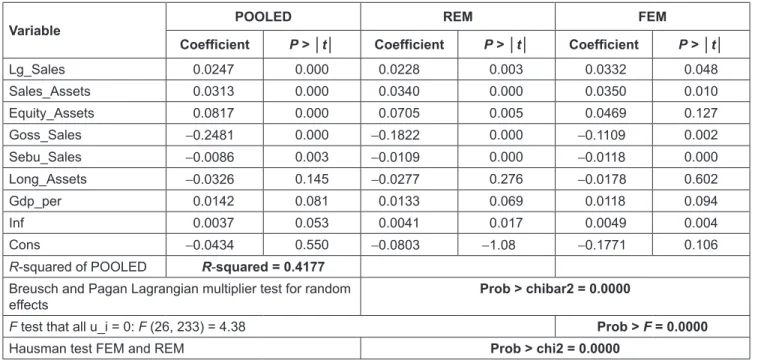
Table 3: Compare the Estimated Results According to Three Methods: POOLED, REM and FEM

Variable POOLED REM FEM

Coefficient P > │t│ Coefficient P > │t│ Coefficient P > │t│

Lg_Sales 0.0247 0.000 0.0228 0.003 0.0332 0.048

Sales_Assets 0.0313 0.000 0.0340 0.000 0.0350 0.010

Equity_Assets 0.0817 0.000 0.0705 0.005 0.0469 0.127

Goss_Sales -0.2481 0.000 -0.1822 0.000 -0.1109 0.002

Sebu_Sales -0.0086 0.003 -0.0109 0.000 -0.0118 0.000

Long_Assets -0.0326 0.145 -0.0277 0.276 -0.0178 0.602

Gdp_per 0.0142 0.081 0.0133 0.069 0.0118 0.094

Inf 0.0037 0.053 0.0041 0.017 0.0049 0.004

Cons -0.0434 0.550 -0.0803 -1.08 -0.1771 0.106

R-squared of POOLED R-squared = 0.4177 Breusch and Pagan Lagrangian multiplier test for random

effects Prob > chibar2 = 0.0000

F test that all u_i = 0: F (26, 233) = 4.38 Prob > F = 0.0000

Hausman test FEM and REM Prob > chi2 = 0.0000

4.2. Regression Results

The study compares the estimated results of the three methods Pooled OLS, REM and FEM shown in Table 3.

Pooled OLS model explains 41.77% of factors affecting competitiveness of technology firms (R

2

= 0.4177).

According to this method, the factors are statistically

significant, showing that they have an impact on the

competitiveness of technology firms (p-value < 5%), except

the structure of long-term asset investments. However, the

Pooled OLS methodology does not reflect the difference

between firms in the same industry. Therefore, the study

continues to consider random effects (REM) and fixed

(6)

effects (FEM) estimation methods. With the Breusch and Pagan test value with p-value < 5%, the REM estimate is more reliable than the Pooled OLS estimate, and the F-test value of the FEM estimate with p-value < 5% also confirms it is more appropriate than the Pooled OLS estimate. The study continues to compare the estimated value of REM and FEM through the Hausman test value. The test value has p-value < 5%, so the estimate of FEM is more appropriate for determining the factors affecting the competitiveness of Vietnamese technology firms.

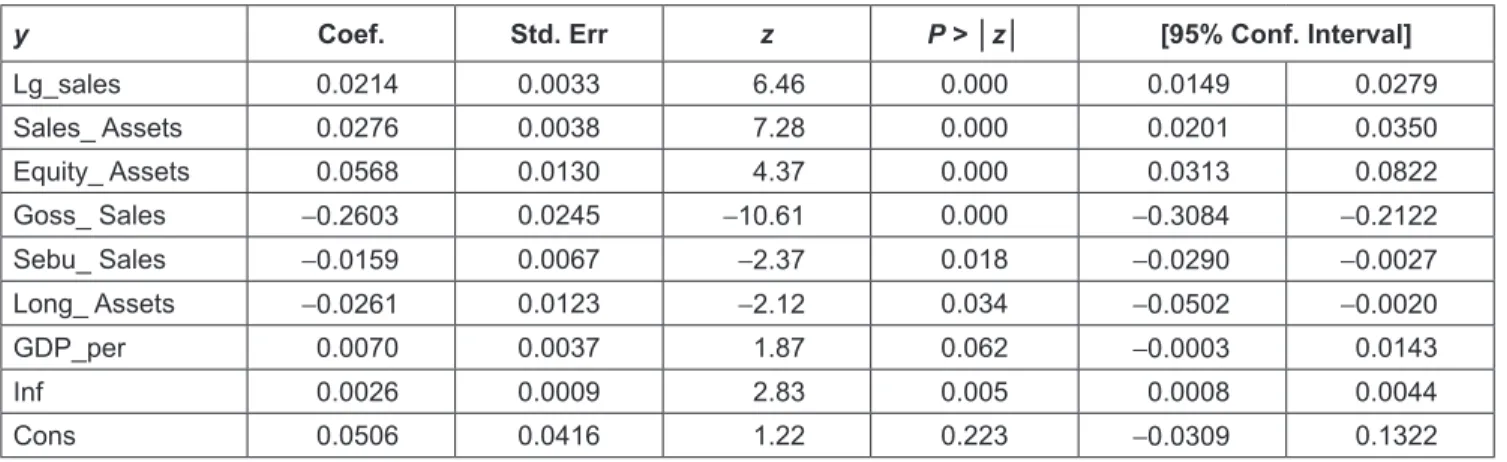
Next, the study examines whether there is a variance in the FEM estimation results by using the Wald test (Greene, 2000). Modified Wald for groupwise heteroskedasticity in FEM has p-value at 0.000 < 5% shows that the model has heteroskedasticity. Besides, the autocorrelation test in the model by Wooldridge test gives F (1, 26) = 67.018 and p-value = 0.000. This indicates that the model has auto- correlation. Since the model has autocorrelation and variance change, the study uses the Feasible Generalized Least Square (FGLS) method to minimize the sum of squared residues of the tissue Weighted Least Square (WLS) to correct the defects of the model and give more reliable results. Estimated results according to FGLS method to correct variance change and autocorrelation are shown in Table 4.

The estimation results from Table 4 show that all factors according to model (2) are statistically significant, i.e., all factors have impact on the competitiveness of technology firms. The group of factors belonging to the strategy of product consumption has a positive impact on the competitiveness of the business at the significance level of 1%, consistent with hypothesis H1. The more products firms have a strategy to consume, the higher increasing the competitiveness of businesses, which is similar to the research results of Sauka (2014), Roberts (2003), Review, Assistant and Dubrovnik (2013). The factor of financial autonomy also positively affects the competitiveness of the business at the significance

level of 5%, consistent with hypothesis H2. This indicates that the more autonomous technology firms have, the more active they are in investment and development (R&D), and hence the higher their competitiveness. This result is similar to the research of Nguyen and Khoa (2020), Sauka (2014), confirming that financial resources affect the competitiveness of firms.

In addition, the factors of cost of goods, cost of sale and enterprise management have limited impact on the competitiveness of firms. This shows that when the cost of products of the enterprise is high, forcing the selling price to increase accordingly, it will reduce the competitiveness of the business in the market. This research result is completely consistent with the reality of competition in the consumer market of products. The high structure of long-term asset investments in the total assets of technology companies also negatively affects their competitiveness. With a low structure of long-term assets (average 30.95%), the investment is mainly in short-term assets to serve the promotion and registration of copyright for new technology products that are continuously being invented. Therefore, the more long-term assets an enterprise invests, reducing the proportion of short-term assets, the more it will limit its competitiveness. Moreover, macro factors such as per capita income and inflation have a positive impact on the competitiveness of businesses.

In other words, when people’s income is higher, they have more money to equip with better technology products, which means that businesses can easily consume products.

Additionally, when comparing the regression coefficients of the independent variables that affect the competitiveness of technology firms in Table 4, the degree of positive impact of the product consumption strategy (variable Lg_

sales and variable Sales_Assets) and financial autonomy (Equity_Assets) are highest. This proves that these are the major determinants of the increasing competitiveness of technology firms in Vietnam.

Table 4: Results of FGLS for the Model (2)

y Coef. Std. Err z P > │z│ [95% Conf. Interval]

Lg_sales 0.0214 0.0033 6.46 0.000 0.0149 0.0279

Sales_ Assets 0.0276 0.0038 7.28 0.000 0.0201 0.0350

Equity_ Assets 0.0568 0.0130 4.37 0.000 0.0313 0.0822

Goss_ Sales -0.2603 0.0245 -10.61 0.000 -0.3084 -0.2122

Sebu_ Sales -0.0159 0.0067 -2.37 0.018 -0.0290 -0.0027

Long_ Assets -0.0261 0.0123 -2.12 0.034 -0.0502 -0.0020

GDP_per 0.0070 0.0037 1.87 0.062 -0.0003 0.0143

Inf 0.0026 0.0009 2.83 0.005 0.0008 0.0044

Cons 0.0506 0.0416 1.22 0.223 -0.0309 0.1322

(7)

5. Conclusion

The research results show that the strategy of product consumption and financial autonomy positively affects the competitiveness of technology firms in Vietnam. Activities related to product consumption strategies of technology companies can be covered by areas such as software, telecommunications and distribution. In the technology areas, the companies continue to promote software export activities to the US and Japan markets

7

. Firms need to promote research and development of intelligent solutions by industry and field, so that they produce new technology products to catch up with the trend. Regarding telecommunication, firms continue to upgrade fiber optic infrastructure to speed up transmission lines. In the distribution segment, the firms need to diversify channels to provide products for consumers in the shortest time. Besides, in order to increase the financial autonomy of technology businesses, firms should provide more information about the results of their production and business activities as well as opportunities and prospects in the future. With transparent financial information and attractive profit margins, it will definitely be a good opportunity to attract more investors to the firms for their investment and development needs in the present and future.

References

Ambastha, A., & Momaya, K. (2004). Competitiveness of Firms:

Review of Theory, Frameworks and Models. Singapore Management Review, 26(1), 45–61. https://www.researchgate.

net/publication/253539431

Chamberlin, E. (1933). The Theory of Monopolistic Competition:

A Re-orientation of the Theory of Value. Harvard University Press, 1

st

ed. https://doi.org/10.1108/eb002637

Chandra, B., & MacPherson, A.D. (1994). The characteristics of high-technology manufacturing firms in a declining industrial region: an empirical analysis from western New York.

Entrepreneurship and Regional Development, 6, 145–160.

https://doi.org/10.1080/08985629400000009

Dalibor, M., Anka, V., & Marko, V. (2017). The basic characteristics of the information technology sector in Serbia. SEER Journal for Labour and Social Affairs in Eastern Europe, 20(1), 5–20.

https://doi.org/10.5771/1435-2869-2017-1-5

Day, G. S. (1994). The Capabilities of Market-Driven Organization. Journal of Marketing, 58, 37–52. https://doi.

org/10.2307/1251915

Evans, C. (2020). The coronavirus crisis and the technology sector.

Business Economic, 55, 253–266. https://doi.org/10.1057/

s11369-020-00191-3

Evans, J. D. (1996). Straightforward statistics for the behavioral sciences. Pacific Grove, CA: Brooks/Cole Publishing.

Greene, W. H. (2000). Econometric Analysis (4

th

ed.). Prentice Hall, Englewood Cliffs.

Ho, C. (2005). Corporate Governance and Corporate Competitiveness: An International Analysis. Corporate Governance, 13(2), 211–253. https://doi.org/10.1111/j.1467- 8683.2005.00419.x

Hung, N. D., Thanh, N. D., & Long, P. (2015). Enhancing competitiveness for securities companies: An empirical study in Vietnam. Journal of Economic and Development, 214(11), 78–85.

Khai, H. N. (2016). Evaluate the competitiveness of Vietcombank commercial bank. Economy & Forecast Review, 2, 30–32.

Kohli, A. K., & Jaworski, B. J. (1990). Market Orientation:

The Construct, Research Propositions, and Managerial Implications. Journal of Marketing, 54(2), 1–18. https://doi.

org/10.2307/1251866

Long, N. T. (2017). Research on factors affecting competitiveness of tourism businesses in Ben Tre. Ho Chi Minh City Open University Journal of Science - Economics and Business Administration, 53(2), 90–109.

Long, N. T. (2020). The Competitiveness of Soc Trang Ecotourism Associated with Khmer Culture. The Journal of Asian Finance, Economics and Business, 7(10), 1107–1117. https://doi.

org/10.13106/jafeb.2020.vol7.no10.1107

Myers, S., & Majluf, N. (1984). Corporate financing and invest- ment decisions when firms have information that investors do not have. Journal of Financial Economics, 13, 187–221.

https://doi.org/10.1016/0304-405X(84)90023-0

Nguyen, M. T, & Khoa, B. T. (2020). Improving the Competitiveness of Exporting Enterprises: A case of Kien Giang Province in Vietnam. The Journal of Asian Finance, Economics and Business, 7(6), 495–508. https://doi.org/10.13106/jafeb.2020.

vol7.no6.495

Nha, H. T., & Lien, L. H. (2015). Internal factors affecting the competitiveness of private enterprises in Can Tho City. Can Tho University Journal of Science, 36, 72–80.

Park, H. (2020). An Analysis on the Competitiveness of the Oil Refinery Market in South Korea. The Journal of Asian Finance, Economics and Business, 7(6), 145–155. https://doi.

org/10.13106/jafeb.2020.vol7.no6.145

Porter, M. E. (1985). The Competitive Advantage: Creating and Sustaining Superior Performance. New York, Free Press.

Review, C. B., Assistant, S., & Dubrovnik, B. E. (2013).

Competitiveness of Travel Agencies in the European. Tourism Market, 12(4), 278–286.

Roberts, J. (2003). Competition in the Business Services Sector: Implications for the Competitiveness of the European Economy. The Journal of Global Business and Political Economy, 7(2–3), 127–146. https://doi.

org/10.1080/1024529032000146704

Sanchez, R., & Heene, A. (1996). Strategic learning and knowledge

management. Chichester, UK: John Wiley & Sons.

(8)

Sanchez, R., & Heene, A. (2004). The new strategic management.

Organization, competition and competence. Chichester, UK:

John Wiley & Sons.

Sauka, A. (2014). Measuring the competitiveness of Latvian companies. Baltic Journal of Economics, 14(1–2), 140–158.

https://doi.org/10.1080/1406099X.2014.995421

Tsai, H., Song, H., & Wong, K. K. F. (2009). Tourism and Hotel Competitiveness Research. Journal of Travel

& Tourism Marketing, 26(5–6), 522–546. https://doi.

org/10.1080/10548400903163079

Williams, D., & Hare, L. (2012). Competitiveness of Small Hotels in Jamaica: An Exploratory Analysis. Journal of Eastern Caribbean Studies, 37, 71–96.

Wilson, I. (1988). Competitive Strategies for Service Businesses. Long Range Planning, 21(6), 10–12. https://doi.

org/10.1016/0024-6301(88)90152-5

수치

Table 3:  Compare the Estimated Results According to Three Methods: POOLED, REM and FEM
Table 4:  Results of FGLS for the Model (2)

참조

관련 문서

Those autonomists with a less passive understanding of the future of the existing political system see the role of the autonomous movement as being to subvert current

Since the market competition and investment are the strategical decisions of firms, in order to scrutinize the effect of financial structure on the CEO's decision, I research

other new business models; welcomes, in particular, the development of commercial models that separate consumption from material ownership, in which the function of the

Common corporate digital crimes include piracy, financial fraud, espionage, and theft of services.. _______________________________________ such as

It considers the energy use of the different components that are involved in the distribution and viewing of video content: data centres and content delivery networks

1.. In 2018, the PCI remains a well-received tool for businesses in Vietnam. Specifically, the latest survey collected responses from 10,681 domestic private enterprises,

1 John Owen, Justification by Faith Alone, in The Works of John Owen, ed. John Bolt, trans. Scott Clark, &#34;Do This and Live: Christ's Active Obedience as the

In the simple frequency analysis, TF-IDF analysis, and Topic analysis results, the meaning and social impact of future transport technology are explored, and