Print ISSN: 1738-3110 / Online ISSN 2093-7717 JDS website: http://kodisa.jams.or.kr/
http://dx.doi.org/10.15722/jds.18.11.202011.91
Adaptive Supply Chain Management under Severe Supply Chain Disruption: Evidence from Indonesia
Gracia ONGKOWIJOYO
1, Timotius F.C.W. SUTRISNO
2, Teofilus TEOFILUS
3, Charly HONGDIYANTO
4Received: October 04, 2020. Revised: October 24, 2020. Accepted: November 05, 2020.
Abstract
The recent Covid-19 outbreak has caused severe disruption of the global supply chain, which tests firms’ ability to survive and build resilience. The concept of adaptive supply chain management (A-SCM) has never been tested against a severe supply chain disruption, such as a pandemic. Purpose: The aim of this study is to examine how firms in Indonesia develop resilience through the implementation of components of adaptive supply chain management, namely risk management, resource reconfiguration and supply chain flexibility, in order to survive severe supply chain disruption. Research design, data and methodology: A qualitative method and PLS-SEM were used to analyze 120 data collected from Indonesian manufacturing firms in various industries. Results: The findings show that risk management, resource reconfiguration, and supply chain flexibility are important components that make up A-SCM.
However, only risk management contributes to help build firm resilience in the presence of severe supply chain disruption.
Conclusions: The components of A-SCM have been empirically tested. The implication is that managers should carefully use RM to prepare firms for different scenarios to develop contingency strategies. This research contributes to the supply chain management body of knowledge in the context of pandemic-level disruption and broadens the dynamic capabilities perspective.
Keywords : Severe Supply Chain Disruption, Adaptive Supply Chain Management, Firm Resilience, Risk Management, Covid-19 JEL Classification Code M30, M31, Q55
1. Introduction
12Supply chain disruptions (SCD) are events from internal or external factors that disrupt the flow of goods and
1 First Author, Student, Doctoral Program, Graduate School,
Widya Mandala Catholic University Surabaya, Indonesia.Email: [email protected]
2 Corresponding Author, Head of Center Business Operation Strategy, Faculty of Management and Business, Universitas Ciputra, Indonesia. Email: [email protected] 3 Third Author, Lecturer, International Business Management,
Faculty of Management and Business, Universitas Ciputra, Indonesia. Email: [email protected]
4 Fourth Author, Lecturer, International Business Management, Faculty of Management and Business, Universitas Ciputra, Indonesia. Email: [email protected]
ⓒCopyright: The Author(s)
This is an Open Access article distributed under the terms of the Creative Commons Attribution Non-Commercial License (http://Creativecommons.org/licenses/by-nc/4.0/) which permits unrestricted noncommercial use, distribution, and reproduction in any medium, provided the original work is properly cited.
services in a supply chain (SC) (Cavinato, 2004), including uncertain market rate demands during crisis (Kim, 2019), disturbances in lead time and other daily operational activities leading to demand fluctuations (Ivanov, 2020).
Recently, the Covid-19 pandemic has spread worldwide (Camba & Jr, 2020; Wolor et al., 2020), testing and disrupting the global SC resilience as never been in the history. Although, several disruptions in the SC have occurred in recent decades, however, the current coronavirus pandemic (Covid-19) is unpredictable. With quarantine and lockdown policies for the human population, some firms experience a surge in demand for certain products, while others experience a dramatic demand decline (Haas, 2020; Pramana et al., 2020). Access to the supply of raw materials and labor throughout the world is severely disrupted.
Although “improvement systems and quality
management have fairly fast development to answer
consumer needs” (Sutrisno, 2019) and to improve
performance (Sutrisno & Ardyan, 2020), they are not enough to overcome severe SCD. To date, this has affected more than 200 countries, endangering global communities, ecosystems, SCs and the members within (Deyshappriya, 2020; Wakolbinger & Cruz, 2011).
SCD in the food and beverage industry has resulted consumer panic buying behavior, which this is likely to have longer lasting effects (Hobbs, 2020), suggesting the rise of a new normal. The reduction in production capacity is below the optimum level, retail closures, production failures due to the scarcity of imported raw materials are proofs that firm resilience is at stake during this pandemic.
Further, not all firms in developing countries are ready to face severe SCD (Agrawal et al., 2020), (Haas, 2020). For Indonesia, Covid-19 pandemic is stated as a national disaster (Mahy, 2020). Despite the improvements in infrastructure, human resources, and intensive marketing (Sumantri, 2020), the covid-19 has severely impacted the Indonesian economy, especially the tourism sector. Gradual restrictions on incoming flights, labor movement and business operations have been carried out in stages by the government. Thus, understanding how companies can manage SCDs has become an important topic for both academics and practitioners in the midst of a pandemic.
Taking the perspective of dynamic capabilities (DC) (Teece, 2007; Teece et al., 1997), in the face of turbulent environment, firms need to be agile and flexible enough to adapt to rapid change by exploiting existing internal and external resources and capabilities. In the presence of a pandemic, the level of environment turbulence has reached a higher level, while consumers have become more demanding due to health and safety concerns. The ability of firms to survive in the midst of covid-19 pandemic becomes questionable (Ivanov & Dolgui, 2020). Therefore, it is essential for firms to keep on the edge of gaining competitive advantage to survive.
However, resources and capabilities prior to the pandemic have no longer significance to keep up with the new normal. One way to survive this pandemic is to build resilience, which is the most effective way to recover from any SCDs (Ambulkar et al., 2015; Polyviou et al., 2019), through having an adaptive supply chain management (A- SCM). To the authors’ knowledge, the extent of the existing knowledge on A-SCM has not touched upon the threat of a severe SCD, such as a pandemic.
Further, firm resilience should be supported by implementing risk management, reconfiguring resources, and rearranging SC flexibility to achieve business continuity and survival ability (Liu et al., 2018). Resilience allows firms to manage SCDs and continue to deliver products and services (Polyviou et al., 2019). It is important for firms to build resilience to face the unforeseen and
unpredictable risks.
This study attempts to address this gap and identify the antecedent factors affecting firm resistance to SCDs. The aim of this study is to examine how firms in Indonesia develop resilience through the implementation of components of adaptive supply chain management, namely risk management, resource reconfiguration and supply chain flexibility, in order to survive severe SCD. This study provides several theoretical, which extends the knowledge of DC in the field of supply chain management, and enriches the knowledge of adaptive supply chain management in the context of SCD. In addition, a timely review of SCD in the event of a pandemic is discussed. This research also contributes to and practical contributions to firms’ decision support system by examining the mediating roles of risk management, resource reconfiguration and supply chain flexibility to build firm resilience for firms under severe disruption.
2. Literature Review 2.1. Firm Resilience
Resilience is defined as “the ability of a system to return to its original state, or move to a new, more desirable state after being disturbed”(Christopher & Peck, 2004). Based on the perspective of DC (Teece et al., 1997), adaptability, agility, flexibility and responsiveness are vital contributors in order for firms to achieve resilience in the face of a SCD (Kwak et al., 2018). For the firm’s perspective, resilience
“emphasizes important aspects of resilience such as adaptability, flexibility, maintenance, and recovery”
(Ponomarov & Holcomb, 2009). Resilient firms are able to reduce the disruption magnitude impacts through the ability to relatively quickly recover from disturbances, thus enabling fewer disruption duration (Kwak et al., 2018). The capacity to learn from disruptions to be better prepared for future events is a vital aspect of resilience (Ponomarov &
Holcomb, 2009).
2.2. Adaptive Supply Chain Management
The concept of adaptive supply chain management (A-
SCM) is still broadly and freely defined. A study by Day
(2013) found that a complex adaptive supply chain network
(CASN) framework is important to build SC resilience in
terms of natural disaster recovery. One study focused on
reducing the bullwhip effect as well as to address the need
for appropriate SC reconfiguration due to the advances in
technology and e-commerce (Emerson et al., 2009), another
study focused on adaptability, agility and alignment of SC
for competitiveness (Ishaq et al., 2012), whereas several studies focused on responsiveness, recovery, flexibility, and adaptability of SC resilience for disaster disruption (Chowdhury & Quaddus, 2016; Day, 2013; Wadhwa et al., 2008) and SC resilience to improve SC performance (Piprani et al., 2020).
Previous studies by Ivanov (2009) and Ivanov et al.
(2010) have focused on developing A-SCM framework in the form of mathematical model in efforts to increase SC decision making efficiency by building a more agile, responsive, and flexible SC to ensure long-term competitiveness as well as survival in the dynamic and rapidly changing environment. The A-SCM framework consists of (1) integrative, cooperative, and coordinative SCM; (2) agile virtual enterprises supported by their web services, responsiveness, and core competencies; (3) sustainable SCM through better product life-cycle, policy, and society; which results in (4) higher profitability through better competitiveness, effectiveness, sustainability, responsiveness, cost-efficiency, stability, quality, and flexibility (Ivanov & Sokolov, 2010).
In sum, there are some different versions and focus of A-SCM. There is one similarity: adaptiveness is the ability to respond to dynamic and uncertain environment changes.
However, there is a gap of building SC resilience in the presence of severe SCD, such as a pandemic, which calls for urgent investigation. Therefore, in this research A-SCM proposed is to address this gap, discussing the ability to manage risk, reconfigure resources, and develop flexible SC within the context of building SC resilience to combat severe SCD.
2.3. Supply Chain Disruption and Risk Manage ment
The Covid-19 pandemic has revealed many system failures in various countries and resulted deadly consequences disrupting the existing business processes (Haas, 2020). These failures and firms’ efforts to retaliate can be well understood in the field of risk management.
Past literatures have used the terms “risk”, “uncertainties”,
“vulnerabilities”, and “source of risk” interchangeably, however, risk is defined as “the expected outcome of an uncertain event, e.g. uncertain events lead to the existence of risks” (Manuj & Mentzer, 2008). Thus, risk management (RM) describes firm’s ability to manage risk and SCDs occurring at the moment and future disruptions. RM, as a part of organization, functions to increase firm resilience to overcome SCDs (Blackhurst et al., 2011) in which robustness of SC is the ultimate goal (Kwak et al., 2018).
RM enables firms to reduce work ambiguity, increase task specialization, have the ability to replicate learning, and increase information exchange (Bonner et al., 2002). At the
moment, firms are experiencing a disruption that is unpredictable. Therefore, a fast and precise response is crucially needed for fast recovery (Blackhurst et al., 2011).
Firms with the right resources can also use the experience of dealing with previous disturbances to manage similar disruptions efficiently in the future. When facing severe SCD, firms can respond using a risk mitigation approach to reduce the long-term impact in a structured manner (Ambulkar et al., 2015).
Firms with RM rooted as a culture are able to enhance RM performance, which influence the enhancement of firm performance (Christopher & Peck, 2004; Liu et al., 2018).
The DC perspective emphasizes firm adaptability and agility in the presence of turbulent environment (Teece et al., 1997). Firms with low RM capability have difficulties to respond appropriately in times of SCD, which timely reaction to disruption and the ability to mitigate disruption’s negative effects are vital (Liu et al., 2018). Despite previous researches that claim proactive measures and comprehensive RM process as preventive actions to build resilience (Scholten et al., 2014), those preventive actions cannot prepare and difficult to forecast SCDs (Peck, 2007), such as a pandemic. Therefore, firms need to develop the ability to continuously assess risks and coordinate efforts to their SC in order to be resilient (Scholten et al., 2014).
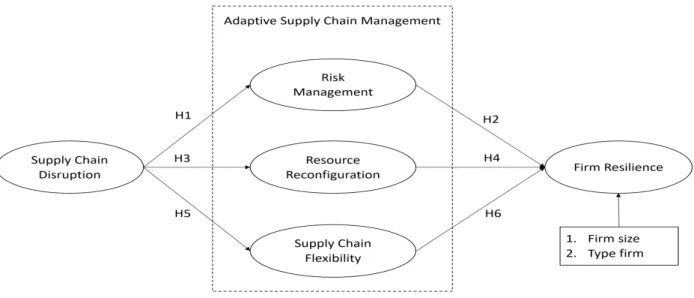
Firms experiencing SCDs need to use existing RM to manage severe disruptions, therefore, we propose the following hypotheses:
H1: There is a relationship between SCD and risk management.
H2: There is a relationship between risk management and firm resilience.
2.4. Supply Chain Disruption and Resource Reconfiguration
The Covid-19 pandemic has inflicted the economic growth, which calls for firms to focus on risk response readiness and resource reconfiguration (RR).
“Reconfigurability is the ability to reconfigure resources with timeliness and efficiency in order to deploy a new configuration that matches the new environment” (Wei &
Wang, 2010), which is very important for the survival of
any firm (Chan & Reiner, 2019). The high level of
uncertainty surrounding the SCDs (Son & Orchard, 2013)
creates ambiguity upon values and functions of available
resources for firm recovery. In this case, a firm need to
acquire, shed and reorganize its existing resource bases to
develop capabilities that enable adaptation to changing
environments (Sirmon et al., 2007), which contribute to
firm survival and resilience. Learning from the external
environment, firms are able to reconfigure and realign their
resources and processes to develop capabilities, providing them with sustainable benefits in the aftermath of a crisis (Helfat & Peteraf, 2003; Ramaswami et al., 2008) by proactively building capabilities, enabling them to respond effectively to SCDs happening at the moment (Polyviou et al., 2019).
The Covid-19 outbreak has forced many CEOs to respond to the pressure on how to protect their employees, ensure SC security, mitigate financial impacts, overcome reputation risks and navigate market uncertainties driving down product demand. This condition is experienced by more than 30 provinces in the Republic of Indonesia. Some government policies are implemented such as large-scale
social restrictions (similar to lockdown), causing a reduced in production flexibility and limited distribution access in certain areas. In this case, firms experiencing SCDs could use previous disruption experiences to be better prepared to deal with uncertainty. As such, firms need to invest in reconfiguring and mobilizing resources. Therefore, we propose the following hypotheses:
H3: There is a relationship between supply chain disruption and resource reconfiguration.
H4: There is a relationship between resource reconfiguration and firm resilience.
Figure 1: Conceptual framework
2.5. Supply Chain Disruption and Supply Chain Flexibility
The severe disruption has wager on firm resilience to overcome the disruption (Blackhurst et al., 2011), for instance, the lack of information and the depletion of supplies are causing worry upon fulfilling firms’ contractual obligations on time. Along with the increasing level of complexity and interdependence of the SC in general, disruption will increase the level of risk that occurs (Christopher & Lee, 2004). Several researchers suggest that firms with a higher degree of flexibility are able to respond to unexpected events, such as SCDs compared to those that are not flexible (Fredericks, 2005; Swafford et al., 2006).
Supply chain flexibility (SCF) acts as a firm’s strategy to reduce the disruption impacts.
The term flexibility is defined as firms’ adaptability towards unexpected events and the ability to focus on the ability to encounter, resolve, and appropriately exploit an
unexpected opportunity (Skipper & Hanna, 2009). Whereas, SCF is defined as “[SC that is] able to adapt effectively to disruptions in supply and changes in demand whilst maintaining customer service levels” (Stevenson & Spring, 2007). The scope of SCF extends beyond intra-firm level to inter-firm level. In order for firms to cope with high levels of environmental and operating uncertainty, such as a pandemic, flexibility is important to provide better coordination processes (Manuj & Mentzer, 2008). Risk exposure due to SCD can be minimized through flexibility as firms are able to respond better compared to non-flexible firms (Skipper & Hanna, 2009), and possess the “ability to change itself quickly, structurally and functionally depending on the current execution state and reaching SCM goals by a change in SC structures and behavior” (Ivanov &
Sokolov, 2010). Thus, this calls to move past the flexible factory towards a SCF (Stevenson & Spring, 2007).
The underlying logic of building a resilient SC would
need firm’s ability to possess sufficient flexibility to
maneuver and adapt to changes, which also increase competitive business performance (Hassan & Annabi, 2019;
Swafford et al., 2008; Wadhwa et al., 2008). Major trend for achieving SCF is to outsource (Hassan & Annabi, 2019), which it shows firms that outsource generates higher ROA and ROE (Khudadad et al., 2018).While major SCD such as pandemic cannot be forecasted, enhancing flexibility can provide appropriate strategic planning tools through the employment of strategic initiatives that improve firms’
capability to minimize the negative impacts of the disruption on the SC performance (Skipper & Hanna, 2009), as well as to build resilience. It is therefore important that organizations throughout any SC are involved in the planning process to reduce the impact of severe disruptions, thus dampen the disruption severity as well as to build firm resilience. On that note, we propose several hypotheses as follows:
H5: There is a relationship between supply chain disruption and supply chain flexibility.
H6: There is a relationship between supply chain flexibility and firm resilience.
3. Method
A quantitative research method is used in this research under a positivist paradigm in order to objectively study the object of research as well as to ensure research rigor and replicability (Sekaran & Bougie, 2016). Thus, deductive reasoning is put forward to understand the phenomena researched. The population of this research is Indonesian manufacturing firms that are affected by the covid-19 pandemic. Manufacturing firms are more heavily affected by the pandemic compared to service firms as manufacturing firms tend to have a greater number of employees, production and operational processes are heavily relying on capital intensive and the vitality of the SC networks, which SC partnerships are key to SC performance (Kim & Kim, 2019; Kim & Song, 2019).
The respondent criteria used is following the Malcolm Baldrige Assessment, which are firms that focus on strategic planning, especially examining strategic direction and decision-making of the firm. Therefore, this research focus on firms in the food and beverages; textile, leather and garment; wood, paper and printing; pharmaceutical;
automotive; computer and electronics; steel and machinery;
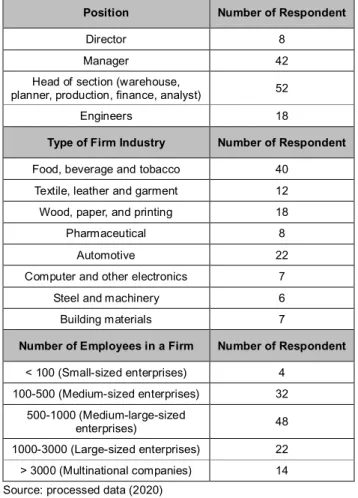
and building materials industry. This is shown in Table 1, which also shows that the research sample ranges from small-medium enterprises (SMEs) to multinational companies (MNCs).
Purposive sampling is used in this research to appropriately obtain information from samples that met the
criteria set (Sekaran & Bougie, 2016). The understanding of the relationship between variables in this study can be obtained by collecting data from firms experiencing SCDs during the Covid-19 crisis using online survey distributed to SC professionals, namely "Google Form" via email.
Therefore, the unit analysis of this research is key person in charge of SC, logistics and/or operational managers, who are frontlines in their respective operational processes and within direct contact with the phenomena.
Table 1: Sample Demography and Characteristics
Position Number of Respondent
Director 8
Manager 42
Head of section (warehouse,
planner, production, finance, analyst) 52
Engineers 18
Type of Firm Industry Number of Respondent
Food, beverage and tobacco 40
Textile, leather and garment 12
Wood, paper, and printing 18
Pharmaceutical 8
Automotive 22
Computer and other electronics 7
Steel and machinery 6
Building materials 7
Number of Employees in a Firm Number of Respondent
< 100 (Small-sized enterprises) 4 100-500 (Medium-sized enterprises) 32
500-1000 (Medium-large-sized
enterprises) 48
1000-3000 (Large-sized enterprises) 22
> 3000 (Multinational companies) 14 Source: processed data (2020)
Prior to developing the questionnaire, several focus
group discussions (FGD) were conducted to obtain initial
overview of the phenomena. The first FGD was done with
members from the Indonesian SC and Logistics Institute
(ISLI) to obtain deeper understanding on the impacts of
covid-19 in Indonesia at its earliest stage, and the second
FGD was done with members from Indonesian Production
and Operations Management Society to obtain deeper
understanding on the impacts of covid-19 in manufacturing
firms. Then, a pretest with three researchers was conducted,
who are experts in SC research, and two practioners.
Feedback from the pretest results is used to improve the survey questionnaire quality and then the questionnaire was distributed to a larger sample in the Indonesian context, thus, the questionnaire has been validated.
The questionnaire survey was sent to 232 potential respondents. 120 respondents completed the survey and the responds are useable, generating a 51.7% response rate.
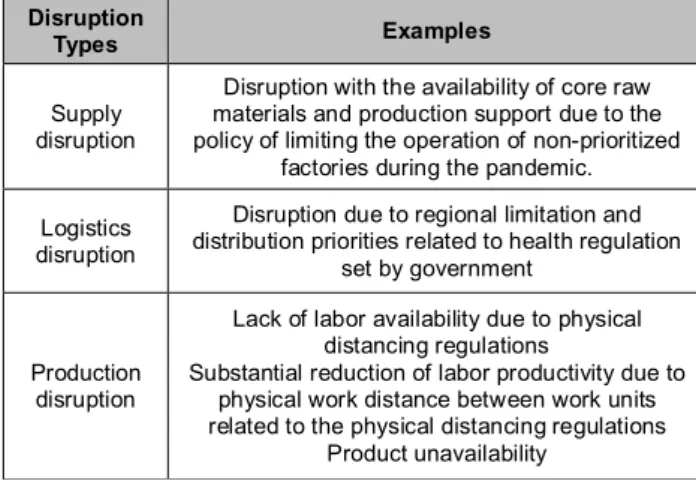
Table 1 describes the demographic characteristics of the sample. The majority of respondents were head of section (43.33%), manager (35%), engineers (15%) and directors (6.67%). The average experience held by the respondents is between five and ten years. The majority of respondents work in food and beverage manufacturing firms (33.33%) and a minority work in computer manufacturing firms (5.83%) and building material firms (5,583%). Most respondents work in companies with a number of employees between 500 and 1000 (40%) and the majority of area distribution is in the Eastern Province of Java. Out of the 120 reported disruptions, 32 were supply disruptions, 18 were logistics disruption, 48 were production disruption, and 22 were sales disruption. Table 2 shows the examples of four types of disruption reported by the respondents during the covid-19 pandemic.
Table 2: Types and Examples of Disruption
DisruptionTypes Examples
Supply disruption
Disruption with the availability of core raw materials and production support due to the policy of limiting the operation of non-prioritized
factories during the pandemic.
Logistics disruption
Disruption due to regional limitation and distribution priorities related to health regulation
set by government
Production disruption
Lack of labor availability due to physical distancing regulations
Substantial reduction of labor productivity due to physical work distance between work units related to the physical distancing regulations
Product unavailability
Measurement adopted for firm resilience is from Ambulkar et al. (2015), SCD is from (Bode et al., 2011), RM is from (Blackhurst et al., 2011), RR is from Wei and Wang (2010), and SCF is from Swafford et al. (2006). All variables are measured using 5-point Likert Scale (1 = strongly disagree to, 5 = strongly agree). The complete items can be seen in Appendix 1.
Then, a model is proposed and tested. This study focuses on examining the dimensions of A-SCM and how they contribute to FR in the midst of pandemic situation, thus the three dimensions are not examined as one integration in order to further investigate which dimension put forth most optimum contribution to FR. The analysis
technique used in this research is structural equation modeling (SEM) using AMOS, which is covariance-based to confirm a theory. The next section discusses the measurement model validity and reliability, goodness of fit (GOF) criteria evaluation, and hypothesis testing.
4. Results and Discussion 4.1. Result
Measurement model validity and reliability used are convergent validity shown by average variance extracted (AVE), discriminant validity shown by factor loading, and construct reliability.
Table 3: Measurement Model Validity and Reliability
Construct Indicator FactorLoading AVE Construct Reliability
Supply chain disruption
(SCD)
SD1 0.725
0.557 0.834
SD2 0.700
SD3 0.779
SD4 0.778
Risk Management
(RM)
RM1 0.683
0.561 0.833
RM2 0.586
RM3 0.848
RM4 0.845
Resource reconfigurati
on (RR)
RR1 0.919
0.654 0.787
RR2 0.681
Supply Chain Flexibility
(SCF)
FC1 0.833
0.673 0.860
FC2 0.832
FC3 0.796
Firm Resilience
(FR)
FR1 0.740
0.569 0.841
FR2 0.792
FR3 0.776
FR4 0.707
Source: processed data (2020)
As shown in Table 3, the result of factor loading for all variable indicators are > 0.5, thus, discriminant validity is supported (Hair et al., 2017). AVE for all variables are ≥ 0.5, thus convergent validity is supported (Hair et al., 2017).
The result of composite reliability for all variables are > 0.7, therefore, reliability is supported (Hair et al., 2017).
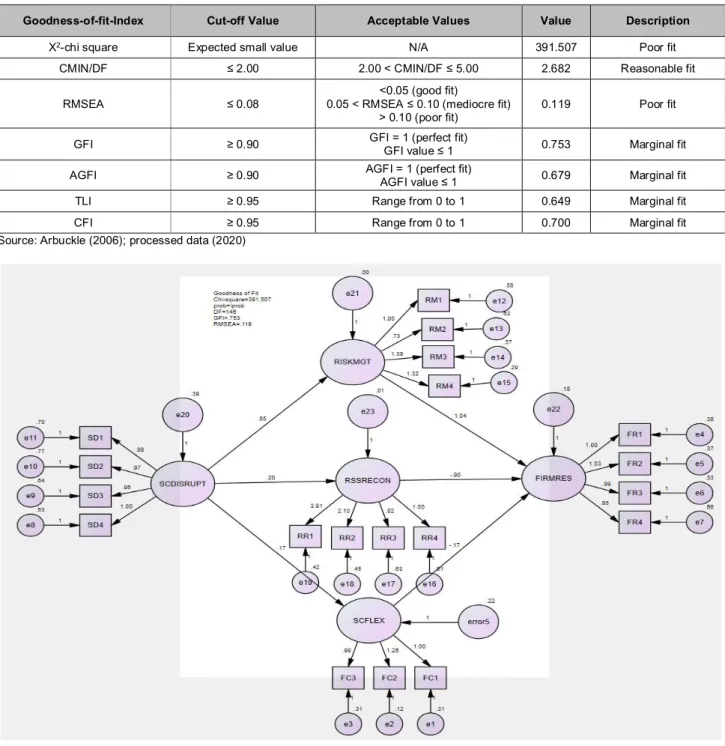
Table 4 shows the criteria and cut-off value and
acceptable criteria adopted from Arbuckle (2006), and
result of structural model GFI evaluation. The X
2-chi
square value is quite large, which indicates a poor fit.
However, the chi-square model is too restrictive due to its sensitivity to sample size and assumptions of multivariate normality and severe deviation from normality, CMIN/DF is an alternative model to assess model fit that can be used (Hooper et al., 2008). Based on Table 4, the result of CMIN/DF is within a reasonable fit; and GFI, AGFI, TLI,
and CFI results are within the acceptable values, thus considered as marginal fit. Despite, the result of RMSEA that is considered a poor fit, according to Utomo et al.
(2019) “if two or more of the entire GOF used have shown a fit, the model is considered good”, therefore, the model is accepted.
Table 4: Structural Model Goodness of Fit Evaluation
Goodness-of-fit-Index Cut-off Value Acceptable Values Value Description
X
2-chi square Expected small value N/A 391.507 Poor fit
CMIN/DF ≤ 2.00 2.00 < CMIN/DF ≤ 5.00 2.682 Reasonable fit
RMSEA ≤ 0.08 <0.05 (good fit)
0.05 < RMSEA ≤ 0.10 (mediocre fit)
> 0.10 (poor fit)
0.119 Poor fit
GFI ≥ 0.90 GFI = 1 (perfect fit)
GFI value ≤ 1 0.753 Marginal fit
AGFI ≥ 0.90 AGFI = 1 (perfect fit)
AGFI value ≤ 1 0.679 Marginal fit
TLI ≥ 0.95 Range from 0 to 1 0.649 Marginal fit
CFI ≥ 0.95 Range from 0 to 1 0.700 Marginal fit
Source: Arbuckle (2006); processed data (2020)
Figure 2: SEM AMOS Test Result for Direct Effects
Table 5: Hypothesis Testing
Hypothesis Estimate(Coef- ficient)
Critical Ratio
(CR) P
Value Result
RM <--SCD .850 5.285 *** Positive
significance RR <--SCD .204 1.958 .050 Positive
significance SCF <-SCD .166 1.902 .057 Positive
significance FR <--- RM 1.038 2.982 .003 Positive
significance FR <--- RR -.901 -.778 .437 Not significant FR <---SCF -.170 -1.336 .182 Not significant Source: Processed data (2020)
Critical ratio (CR) > 2, and p ≤ 0.05 show that null hypothesis is rejected and alternative hypothesis is accepted (Hair et al., 2017). Based on the result shown in Table 5, the CR value of SCD to RM, SCD to RR, SCD to
The indirect effect of SCD to FR is significant, with regression coefficient of 1.61. Since H5 and H6 are rejected, therefore, there is no mediation effect of RR and SCF from SCD to FR. While, H4 is accepted, therefore, there is partial mediation effect of RM from SCD to FR. In other words, SCD has direct effect and indirect effect to FR through RM, while SCD does not have indirect effect to FR through RR nor SCF. The indirect effect is shown in figure 3.
Figure 3: SEM AMOS Test Result for Indirect Effects
4.2. Discussion
A recent health crisis has swept many regions worldwide, namely the covid-19 pandemic leaving no single SC unaffected and unprepared. This study found that RM enhances firm’s ability to continuously assess risks and coordination efforts to be able to bounce back from the
negative effects of SCD, supporting sensing and seizing stage of DC (Teece, 2007). The more a firm is aware of the disruption impacting the SC, the higher the need for RM to devise new strategies to be able to survive the worst risks.
However, based on the indirect effect result, RM becomes
negatively significant towards FR, implying that due to the
pandemic-level uncertainty, RM become less effective and
efficient to build FR compared to firm with RM in a normal turbulent environment. Nonetheless, RM is still needed in any circumstances indicating regardless whether a firm is in a normal competitive environment, in a turbulent environment, or under a severe SCD, RM still has an important role in building FR. The abilities to manage risks, through risk identification, risk assessment, and risk mitigation (Kern et al., 2012; Kwak et al., 2018), enable firms to be agile and maneuver to overcome and adapt to the changes caused by severe disruptions. Thus, our result emphasizes that RM should be implemented as a culture in order to help firms to be able to mitigate the negative effects of SCD, consistent with previous studies (Liu et al., 2018; Scholten et al., 2014), which also help to enhance the speed to respond and recover from SCD. Therefore, this makes RM an important firm competence for A-SCM, especially in building FR.
This research highlights that regardless whether a firm is under a severe SCD or not, RR is needed to have an A- SCM. Adaptability in SCM requires a firm to be able to reconfigure its existing resources and processes in response to changes in the environment by restructuring, updating, redeploying and its resource base. This supports the findings by Wei and Wang (2010). Therefore, the more a firm is aware of the existence and negative impacts of SCD, the higher need for RR. Furthermore, this finding is aligned with the perspective of DC (Teece et al., 1997), which the exploitation of firm internal and external resources and competences address changing environment and the reconfiguring stage of DC (Teece, 2007).
Despite findings from previous studies that reconfigurability has been proven to have a positive impact on firm performance (Wei & Wang, 2010) and strong positive association with FR (Ambulkar et al., 2015; Parker
& Ameen, 2018), however, this study found that RR does not improve FR. Previous studies were conducted under normal (non-pandemic) turbulent environment, unlike this research context that is under a severe SCD (pandemic). A pandemic situation cannot be forecasted. Moreover, the extent to which the negative impacts and how long the pandemic will last are unpredictable, thus, difficult for firms to determine the contingency strategies as the future becomes too blurry, making efforts to reconfigure resources ineffective. As a result, in the midst of a pandemic-level SCD, RR does not help firms to build resilience.
The more a firm is aware of the existence and the impacts of a SCD, the higher need for SCF. Flexibility in the SC allows firms to have flexibility in the logistics processes through demand-driven decisions (Stevenson &
Spring, 2007) and adapt to changes, such as shipping, supplier capacity, production volume, and delivery schedules to meet changing customer needs due to the impact of a pandemic. SCF also allows better flow of
information sharing throughout the SC, reducing uncertainty and the bullwhip effect (Stevenson & Spring, 2007; Wadhwa et al., 2008). Thus, findings also highlight that regardless the severity of a SCD, SCF is still needed in order to achieve A-SCM.
Although, findings of previous studies showed the role of SCF in A-SCM can increase firm competitive advantage, which will increase firm performance (Swafford et al., 2008) and supports FR (Mandal et al., 2016), however, our study found that SCF does not help to build FR. As mentioned above, pandemic-level SCD, the stakes have dramatically changed, risks have multiplied and the level of uncertainty is as high as ever. From an Indonesian perspective, there are other factors to be taken into consideration during the covid-19 pandemic, such as uncertain demand pattern changes and government interference through the new normal policies. Quarantine and lockdown policies impose no office activities were allowed for a period of time. Malls, restaurants, and cafes were closed for almost two months. Several restaurants and cafes are allowed to serve drive thru or takeaway orders.
Citizens were encouraged to stay at home and optimize online shopping for household needs. Fortunately, this is an available option as online shopping, social network services and digital payment to support online shopping have been growing over the past years (Choi & Yang, 2018; Teofilus et al., 2020; Yucha et al., 2020). Manufacturing firms were also required to close down until the lockdown policy has been lifted. These policies were made and adjusted according to the daily updates on the rise and/or fall numbers of covid-19 cases. Moreover, citizens are difficult to be controlled, as they do not adhere to the government policies in efforts to battle the pandemic. Many citizens refuse to wear masks, during the lockdown period, there are still many social gatherings, and some regions do not implement the social/physical distancing policy. Therefore, firms must carefully reconsider the right strategies to overcome the pandemic crisis despite unpredictable future, thus makes SCF nonessential to FR.
In sum, this suggests that RM is the most important competence to be optimized in facing pandemic-level SCD prior to having other competences, such as RR and SCF.
5. Conclusions
In conclusion, our study has found interesting findings.
First, there is a relationship between SCD and RM, SCD
and RR, as well as SCD and SCF, highlighting that RM, RR
and SCF are important aspect of A-SCM. Second, this
supports the DC perspective, which adaptability is very
important for firms in order to be able to adjust to changes
in turbulent environment through sensing, seizing, and
reconfiguring stages (Teece, 2007; Teece et al., 1997). Third, RM mediates the relationship between SCD and FR, however, due to the pandemic-level uncertainty, RM become less effective and efficient to build FR compared to firm with RM in a normal turbulent environment. Fourth, in the midst of pandemic-level SCD where the future becomes too blurry and unforeseeable, RR and SCF do not contribute to build FR. Nonetheless, they are still important to firm’s A-SCM. Implications for managers should carefully use RM to prepare firms for different scenarios in which firms must develop contingency strategies. Overall, the findings of this research contribute to the SCM body of knowledge in the context of pandemic-level SCD and broaden the knowledge of DC perspective. Finally, the opportunities future studies are to explore other variables that may contribute to FR in pandemic-level SCD and explore other countries’ perspectives.
References
Agrawal, S., Jamwal, A., & Gupta, S. (2020). Effect of COVID-19 on the Indian Economy and Supply Chain.
https://doi.org/10.20944/preprints202005.0148.v1
Ambulkar, S., Blackhurst, J., & Grawe, S. (2015). Firm's resilience to supply chain disruptions: Scale development and empirical examination. Journal of Operations Management, 33-34(1), 111-122.
https://doi.org/https://doi.org/10.1016/j.jom.2014.11.002 Arbuckle, J. L. (2006). Amos 7.0 User's Guide. Amos
Development Corporation.
Blackhurst, J., Dunn, K. S., & Craighead, C. W. (2011). An Empirically Derived Framework of Global Supply Resiliency.
Journal of Business Logistics, 32(4), 374-391.
https://doi.org/https://doi.org/10.1111/j.00000000.2011.01032.x Bode, C., Wagner, S. M., Petersen, K. J., & Ellram, L. M. (2011).
Understanding Responses to Supply Chain Disruptions:
Insights from Information Processing and Resource Dependence Perspectives. Academy of Management Journal, 54(4), 833-856.
https://doi.org/https://doi.org/10.5465/amj.2011.64870145 Bonner, J. M., Ruekert, R. W., & Walker Jr., O. C. (2002). Upper
management control of new product development projects and project performance. The Journal of Product Innovation Management, 19, 233-245.
https://doi.org/https://doi.org/10.1016/S0737-6782(02)00139-X Camba, A. L., & Jr, A. C. C. (2020). The Effect of COVID-19
Pandemic on the Philippine Stock Exchange, Peso-Dollar Rate and Retail Price of Diesel. The Journal of Asian Finance, Economics and Business, 7(10), 543-553.
https://doi.org/10.13106/jafeb.2020.vol7.no10.543
Cavinato, J. L. (2004). Supply chain logistics risks. International Journal of Physical Distribution & Logistics Management, 34(5), 383-387.
https://doi.org/https://doi.org/10.1108/09600030410545427 Chan, J. H., & Reiner, D. (2019). “Dominance by birthright”?
Reconfiguration of firm boundaries to acquire new resources and capabilities. Industrial Management & Data Systems, 119(9), 1888-1907.
https://doi.org/https://doi.org/10.1108/09600030410545427 Choi, B.-N., & Yang, H.-C. (2018). A Study on Revitalization of
Revenue through Difference of Consumer Perception of Characteristics of Mobile Social Commerce. Journal of Business, Economics and Environmental Studies, 8(1), 31-38.
https://doi.org/10.13106/eajbm.2018.vol8.no1.31
Chowdhury, M. M. H., & Quaddus, M. (2016). Supply chain readiness, response and recovery for resilience. Supply Chain Management: An International Journal, 21(6), 709-731.
https://doi.org/https://doi.org/10.1108/SCM-12-2015-0463 Christopher, M., & Lee, H. (2004). Mitigating supply chain risk
through improved confidence. International Journal of Physical Distribution & Logistics Management, 34(5), 388- 396.
https://doi.org/https://doi.org/10.1108/09600030410545436 Christopher, M., & Peck, H. (2004). Building the Resilient Supply
Chain. The International Journal of Logistics Management, 15(2), 1-14.
https://doi.org/https://doi.org/10.1108/09574090410700275 Day, J. M. (2013). Fostering emergent resilience: the complex
adaptive supply network of disaster relief. International Journal of Production Research, 52(7), 1970-1988.
https://doi.org/https://doi.org/10.1080/00207543.2013.787496 Deyshappriya, N. P. R. (2020). Economic Impacts of COVID-19
Macro and Microeconomics Evidences from Sri Lanka. SSRN Electronic Journal.
https://doi.org/http://dx.doi.org/10.2139/ssrn.3597494
Emerson, D., Zhou, W., & Piramuthu, S. (2009). Goodwill, inventory penalty, and adaptive supply chain management.
European Journal of Operational Research, 199(1), 130-138.
https://doi.org/https://doi.org/10.1016/j.ejor.2008.11.007 Fredericks, E. (2005). Infusing flexibility into business-to-
business firms: A contingency theory and resource-based view perspective and practical implications. Industrial Marketing Management, 34(6), 555-565.
https://doi.org/https://doi.org/10.1016/j.indmarman.2004.09.022 Haas, C. (2020). Coronavirus and Risk Analysis. Risk Analysis,
40(4). https://doi.org/https://doi.org/10.1111/risa.13481 Hair, J. F., Jr., Hult, G. T. M., Ringle, C. M., & Sarstedt, M. (2017).
A Primer on Partial Least Squares Structural Equation Modeling (PLS-SEM). SAGE Publications, Inc.
Hassan, F., & Annabi, C. A. (2019). Come fly with ME: The Impact of 3PLs within the aircraft Manufacturing, Repair and Overhaul Industry in the United Arab Emirates. International Journal of Industrial Distribution & Business, 10(4), 13-24.
https://doi.org/10.13106/ijidb.2019.vol10.no4.13
Helfat, C. E., & Peteraf, M. A. (2003). The dynamic resource- based view: capability lifecycles. Strategic Management Journal, 24(10), 997-1010.
https://doi.org/https://doi.org/10.1002/smj.332
Hobbs, J. E. (2020). Food supply chains during the COVID-19 pandemic. Canadian Journal of Argicultural Economics.
https://doi.org/https://doi.org/10.1111/cjag.12237
Hooper, D., Coughlan, J., & Mullen, M. R. (2008). Structural Equation Modelling: Guidelines for Determining Model Fit.
The Electronic Journal of Business Research Methods, 6(1),
53-60.
Ishaq, M. I., Hussain, N., Khaliq, W., & Waqas, M. (2012). A Review on Triple-A Supply Chain Performance. Journal of Business Economics and Environmental Studies, 2(2), 35-39.
Ivanov, D. (2009). An adaptive framework for aligning (re)planning decisions on supply chain strategy, design, tactics, and operations. International Journal of Production Research, 48(13), 3999-4017.
https://doi.org/https://doi.org/10.1080/00207540902893417 Ivanov, D. (2020). Predicting the impacts of epidemic outbreaks
on global supply chains: A simulation-based analysis on the coronavirus outbreak (COVID-19/SARS-CoV-2) case. Transp Res E Logist Transp Rev, 136, 101922.
https://doi.org/https://doi.org/10.1016/j.tre.2020.101922 Ivanov, D., & Dolgui, A. (2020). Viability of intertwined supply
networks: extending the supply chain resilience angles towards survivability. A position paper motivated by COVID- 19 outbreak. International Journal of Production Research, 58(10), 2904-2915.
https://doi.org/https://doi.org/10.1080/00207543.2020.1750727 Ivanov, D., & Sokolov, B. (2010). Adaptive Supply Chain
Management. Springer-Verlag London Limited.
https://doi.org/10.1007/978-1-84882-952-7
Ivanov, D., Sokolov, B., & Kaeschel, J. (2010). A multi-structural framework for adaptive supply chain planning and operations control with structure dynamics considerations. European Journal of Operational Research, 200(2), 409-420.
https://doi.org/https://doi.org/10.1016/j.ejor.2009.01.002 Kern, D., Moser, R., Hartmann, E., & Moder, M. (2012). Supply
risk management: model development and empirical analysis.
International Journal of Physical Distribution & Logistics
Management, 42(1), 60-82.
https://doi.org/https://doi.org/10.1108/09600031211202472 Khudadad, S., Tahir, M., & Jan, G. (2018). The Comparative
Financial Performance of Outsourcing and Vertically Integrated Corporations. Journal of Business, Economics and
Environmental Studies, 8(3), 23-31.
https://doi.org/10.13106/eajbm.2018.vol8.no3.23
Kim, D.-Y., & Kim, J.-S. (2019). A Study on Collavorative SCM for O2O Startups. International Journal of Industrial Distribution & Business, 10(12), 43-55.
https://doi.org/10.13106/ijidb.2019.vol10.no12.43
Kim, J.-H. (2019). Studies on Supply and Demand Paradox in Shipping Market. International Journal of Industrial Distribution & Business, 10(1), 19-27.
https://doi.org/10.13106/ijidb.2019.vol10.no1.19
Kim, K.-H., & Song, S. H. (2019). A Study on the Effect of Win- win Growth Policies on Sustainable Supply Chain and Logistics Management in South Korea. International Journal of Industrial Distribution & Business, 10(12), 7-14.
https://doi.org/10.13106/ijidb.2019.vol10.no12.7
Kwak, D.-W., Seo, Y.-J., & Mason, R. (2018). Investigating the relationship between supply chain innovation, risk management capabilities and competitive advantage in global supply chains. International Journal of Operations &
Production Management, 38(1), 2-21.
https://doi.org/https://doi.org/10.1108/IJOPM-06-2015-0390 Liu, C.-L., Shang, K.-C., Lirn, T.-C., Lai, K.-H., & Lun, Y. H. V.
(2018). Supply chain resilience, firm performance, and
management policies in the liner shipping industry.
Transportation Research Part A: Policy and Practice, 110, 202-219.
https://doi.org/https://doi.org/10.1016/j.tra.2017.02.004 Mahy, P. (2020). COVID-19 and Labour Law:Indonesia. Italian
Labour Law e-Journal, 13(Special Issue 1).
https://doi.org/10.6092/issn.1561-8048/10937
Mandal, S., Sarathy, R., Korasiga, V. R., Bhattacharya, S., &
Dastidar, S. G. (2016). Achieving supply chain resilience: the contribution of logistics and supply chain capabilities.
International Journal of Disaster Resilience in the Built Environment, 7(5), 544-562.
https://doi.org/https://doi.org/10.1108/IJDRBE-04-2016-0010 Manuj, I., & Mentzer, J. T. (2008). Global supply chain risk
management strategies. International Journal of Physical Distribution & Logistics Management, 38(3), 192-223.
https://doi.org/https://doi.org/10.1108/09600030810866986 Parker, H., & Ameen, K. (2018). The role of resilience capabilities
in shaping how firms respond to disruptions. Journal of Business Research, 88, 535-541.
https://doi.org/10.1016/j.jbusres.2017.12.022
Peck, H. (2007). Reconciling supply chain vulnerability, risk and supply chain management. International Journal of Logistics Research and Applications, 9(2), 127-142.
https://doi.org/https://doi.org/10.1080/13675560600673578 Piprani, A. Z., Mohezar, S., & Jaafar, N. I. (2020). Supply Chain
Integration and Supply Chain Performance: The Mediating Role of Supply Chain Resilience. International Journal of Supply Chain Management, 9(3), 58-73.
Polyviou, M., Croxton, K. L., & Knemeyer, A. M. (2019).
Resilience of medium-sized firms to supply chain disruptions:
the role of internal social capital. International Journal of Operations & Production Management, 40(1), 68-91.
https://doi.org/https://doi.org/10.1108/IJOPM-09-2017-0530 Ponomarov, S. Y., & Holcomb, M. C. (2009). Understanding the
concept of supply chain resilience. The International Journal of Logistics Management, 20(1), 124-143.
https://doi.org/https://doi.org/10.1108/09574090910954873 Pramana, S., Paramartha, D. Y., Adhinugroho, Y., & Nurmalasari,
M. (2020). Air Pollution Changes of Jakarta, Banten, and West Java, Indonesia During the First Month of COVID-19 Pandemic. Journal of Business, Economics and Environmental Studies, 10(4), 15-19.
https://doi.org/10.13106/jbees.2020.vol10.no4.15
Ramaswami, S. N., Srivastava, R. K., & Bhargava, M. (2008).
Market-based capabilities and financial performance of firms:
insights into marketing’s contribution to firm value. Journal of the Academy of Marketing Science, 37(2), 97-116.
https://doi.org/10.1007/s11747-008-0120-2
Scholten, K., Sharkey Scott, P., & Fynes, B. (2014). Mitigation processes – antecedents for building supply chain resilience.
Supply Chain Management: An International Journal, 19(2), 211-228. https://doi.org/http://dx.doi.org/10.1108/SCM-06- 2013-0191
Sekaran, U., & Bougie, R. (2016). Research Methods For Business A Skill-Building Approach. John Wiley & Sons Ltd.
Sirmon, D. G., Hitt, M. A., & Ireland, R. D. (2007). Managing Firm Resources in Dynamic Environments to Create Value:
Looking Inside the Black Box. Academy of Management
Review, 32(1), 273-292.
https://doi.org/10.5465/amr.2007.23466005
Skipper, J. B., & Hanna, J. B. (2009). Minimizing supply chain disruption risk through enhanced flexibility. International Journal of Physical Distribution & Logistics Management, 39(5), 404-427. https://doi.org/10.1108/09600030910973742 Son, J. Y., & Orchard, R. K. (2013). Effectiveness of policies for
mitigating supply disruptions. International Journal of Physical Distribution & Logistics Management, 43(8), 684- 706. https://doi.org/10.1108/ijpdlm-04-2012-0109
Stevenson, M., & Spring, M. (2007). Flexibility from a supply chain perspective: definition and review. International Journal of Operations & Production Management, 27(7), 685-713.
https://doi.org/10.1108/01443570710756956
Sumantri, Y. (2020). Developing Strategy for Heritage Tourism Supply Chain Quality Management. The Journal of Asian Finance, Economics and Business, 7(10), 423-432.
https://doi.org/10.13106/jafeb.2020.vol7.no10.423
Sutrisno, T. F. C. W. (2019). Relationship between Total Quality Management Element, Operational Performance and Organizational Performance in Food Production SMEs. Jurnal
Aplikasi Manajemen, 17(2), 285-294.
https://doi.org/10.21776/ub.jam.2019.017.02.11
Sutrisno, T. F. C. W., & Ardyan, E. (2020). Achieving Organizational Performance in Food Companies: The Critical Role of Leadership and Continuous Improvement as Part of TQM Practice. QUALITY Access to Success, 21(177), 133-138.
Swafford, P. M., Ghosh, S., & Murthy, N. (2006). The antecedents of supply chain agility of a firm: Scale development and model testing. Journal of Operations Management, 24(2), 170-188. https://doi.org/10.1016/j.jom.2005.05.002
Swafford, P. M., Ghosh, S., & Murthy, N. (2008). Achieving supply chain agility through IT integration and flexibility.
International Journal of Production Economics, 116(2), 288- 297. https://doi.org/10.1016/j.ijpe.2008.09.002
Teece, D. J. (2007). Explicating Dynamic Capabilities: The Nature and Microfoundations of (Sustainable) Enterprise Performance. Strategic Management Journal, 28(13), 1319-
1350. https://doi.org/https://doi.org/10.1002/smj.640
Teece, D. J., Pisano, G., & Shuen, A. (1997). Dynamic Capabilities and Strategic Management. Strategic Management Journal,
18(7), 509-533.
https://doi.org/https://doi.org/10.1002/(SICI)1097- 0266(199708)18:7<509::AID-SMJ882>3.0.CO;2-Z
Teofilus, Sutrisno, T. F. C. W., Hongdiyanto, C., & Wananda, V.
(2020). A Study of Indonesian Online Marketplace:
Information Processing Theory Paradigm. Journal of
Distribution Science, 18(8), 75-87.
https://doi.org/http://dx.doi.org/10.15722/jds.18.8.202008.75 Utomo, H., Priyanto, S. H., Suharti, L., & Sasongko, G. (2019).
Developing social entrepreneurship: a study of community perception in Indonesia. Entrepreneurship and Sustainability Issues, 7(1), 233-246. https://doi.org/10.9770/jesi.2019.7.1(18) Wadhwa, S., Saxena, A., & Chan, F. T. S. (2008). Framework for flexibility in dynamic supply chain management. International Journal of Production Research, 46(6), 1373-1404.
https://doi.org/10.1080/00207540600570432
Wakolbinger, T., & Cruz, J. M. (2011). Supply chain disruption risk management through strategic information acquisition and sharing and risk-sharing contracts. International Journal of Production Research, 49(13), 4063-4084.
https://doi.org/10.1080/00207543.2010.501550
Wei, H.-L., & Wang, E. T. G. (2010). The strategic value of supply chain visibility: increasing the ability to reconfigure.
European Journal of Information Systems, 19(2), 238-249.
https://doi.org/10.1057/ejis.2010.10
Wolor, C. W., Solikhah, S., Fidhyallah, N. F., & Lestari, D. P.
(2020). Effectiveness of E-Training, E-Leadership, and Work Life Balance on Employee Performance during COVID-19.
The Journal of Asian Finance, Economics and Business, 7(10), 443-450. https://doi.org/10.13106/jafeb.2020.vol7.no10.443 Yucha, N., Setiawan, S., Muttaqiin, N., Ekasari, R., & Mauladi, K.
F. (2020). Digital Payment System Analysis of Buying Decision in Indonesia. The Journal of Asian Finance, Economics and Business, 7(10), 323-328.
https://doi.org/10.13106/jafeb.2020.vol7.n10.323
Appendix
Construct items (descriptive statistics and reliability)
Construct Mean Standard
deviation α