Vol. 21, No. 5, pp. 501-506, October 31, 2015, ISSN 1229-3431(Print) / ISSN 2287-3341(Online) http://dx.doi.org/10.7837/kosomes.2015.21.5.501
A Study on Maritime Traffic Characteristics according to Water Time(Multte)
Sang-Lok Yoo Cho-Young Jeong Jae-Yong Jeong
*, ** Graduate school of Mokpo National Maritime University, Mokpo 58628, Korea
*** Mokpo National Maritime University, Mokpo 58628, Korea
물때에 따른 해상교통특성에 관한 연구
유상록 정초영 정재용
*, ** 목포해양대학교 대학원, *** 목포해양대학교
Abstract : This study seeks to analyze ships traffic characteristics according to water time in order to provide the necessary data for efficient traffic management development. To analyze maritime traffic volume according to water time, 1 year amount of solar calendar data were converted into lunar calendar, and then applied the traditional water time system of West Sea by using AIS(Automatic Identification System) observation data gathered in Mokpo port for a year of 2013. As a result, it was found herein that the number of outbound ships was larger on the 2nd-3rd water times than the 7th water times by 23-24 %. And the number of inbound ships was higher on the 12th-13th water times than the 9th water time by 29-33 %. The hourly variation index of inbound and outbound ships according to time, in particular, was found to change in the form of sine function model. This study is expected to serve as a necessary basic material for development of maritime traffic management according to water time.
Key Words : Water time, Traffic characteristics, AIS, Traffic volume, Maritime traffic management
요 약 : 본 연구는 물때에 따른 교통특성을 분석하여 선박통항관리 개발에 필요한 자료를 제공하고자 한다. 목포항의 1년간 선박자동 식별장치 자료를 사용하였다. 물때에 따른 교통량을 분석하기 위해 목포항의 1년간의 선박자동식별장치의 양력 데이터를 음력으로 변환 한 후, 서해안의 구전 물때를 적용하였다. 연구 결과, 출항선박은 2-3물때 교통량이 7물때 보다 약 23-24 % 많고, 입항선박은 12-13물때 교 통량이 9물때 보다 약 29-33 % 많았다. 특히, 시간의 변화에 따른 물때별 변동지수는 sine 함수의 형태로 변화하였다. 본 연구는 물때에 따 른 선박통항관리 개발에 필요한 기초자료로 활용될 수 있을 것으로 판단된다.
핵심용어 : 물때, 교통특성, 선박자동식별장치, 교통량, 선박통항관리
1. Introduction
*The water time(multte) refers to the Korean traditional calendar system to count one lunar month with 15 days expressing tidal phenomenon according to tidal dynamics. The water time calendar system was structured in 15-day cycle in a lunar month with the ancient knowledge that tide changes regularly in line with the lunar synodic month and has been passed down by tradition so far.
The cycle includes the tidal phenomenon with two rounds of rising tide and two rounds of ebb tide. And neap tide with weak current and spring tide with strong current appear every 15 days in
* First Author : [email protected], 061-241-2750 Corresponding Author : [email protected], 061-240-7175
turn. In a month, two rounds of neap and spring tides appear respectively. And these phenomena is called water time in one month cycle. This traditional and conventional system of water time in Korea shows ancestors’, especially ancient fishermen’s wisdom of live by the sea(Park, 1985).
Regarding existing literature on water time, one preceding study organized and unified the names regarding water time, which had been passed down by tradition(Park, 1985). Another study also looked at the relationship between water time and ecosystem as well as water time and red tide(Jang, 2009). Study is also active in the marine product industry, examining differences in small octopus catch (Jung and Kim, 2001; Oh et al., 2012). Study on tidal phenomenon has also been active(Cho and Kang, 2012; Kim and Kim, 2013).
As shown in Figure 1, risk is imposed on navigators and vessel traffic services operators who manage many inbound and outbound ships in a specific water time. However, study has been insufficient regarding fishing activities and maritime traffic patterns according to water time.
In this recognition, this study seeks to analyze ships traffic characteristics according to water time in order to provide the necessary data for efficient traffic management development.
Fig. 1. Many fishing boats(3rd water time).
2. Method of research
2.1 Scope of study area
This study utilized the AIS(Automatic Identification System) actual measurement date for 365 days from January 1 to December 31, 2013. The analysis object region was Mokpogu where vessels navigating Mokpo Port pass through, as shown in the Figure 2(Gang et al., 2014).
2.2 Procedure of study
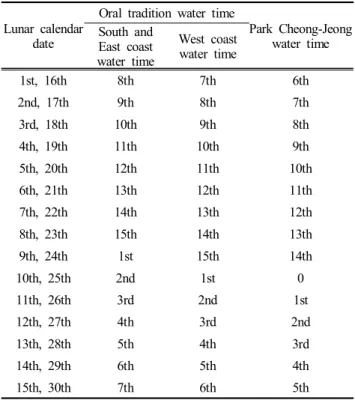
To analyze maritime traffic volume according to water time, 1 year amount of solar calendar data were converted into lunar calendar. Table 1 describes water time terms coming down by tradition in the East Sea area, South Sea area and West Sea area, respectively. Park(1985) analyzed the relation between water time and tidal phenomenon in a statistical manner and united the mutually different local water time names. Since local people are accustomed to live by following the orally-transmitted water time cycle, the traditional water time system of West Sea – 7 water time event system (day 1 and day 16 in lunar month) - was applied. If
the last date of a month is 29, 6 water times corresponding to day 30 in a lunar month was omitted to align the data.
126.27 126.28 126.29 126.3 126.31
34.75 34.76 34.77 34.78
Lon(°)
Lat(°)
study area
Fig. 2. Scope of study area (Mokpo port, Korea).
Lunar calendar date
Oral tradition water time
Park Cheong-Jeong water time South and
East coast water time
West coast water time
1st, 16th 8th 7th 6th
2nd, 17th 9th 8th 7th
3rd, 18th 10th 9th 8th
4th, 19th 11th 10th 9th
5th, 20th 12th 11th 10th
6th, 21th 13th 12th 11th
7th, 22th 14th 13th 12th
8th, 23th 15th 14th 13th
9th, 24th 1st 15th 14th
10th, 25th 2nd 1st 0
11th, 26th 3rd 2nd 1st
12th, 27th 4th 3rd 2nd
13th, 28th 5th 4th 3rd
14th, 29th 6th 5th 4th
15th, 30th 7th 6th 5th
Table 1. Water time by lunar calendar date
3. Current status
3.1 Fishing industry status
Table 2 shows the number of registered fishing boats according to fishing industry segment. Around the Mokpo coast, there are 44
ships for coastal stow net fishery; 29, for shore stow net fishery;
and 399, for shore mixed fishery, etc.
Type of fishery Number of vessels
Stow net offshore stow net 44
inshore stow net 29
Gill net offshore gill net 43
inshore gill net 169
Pot inshore pot 46
Mixed inshore mixed 399
etc. longline, cultivation of fish,
etc. 60
Total 790
Table 2. Number of vessels by type of fishery
3.2 Stow net wake
Stow net ships and gill net ships are the main part of fishing industry by following water time. Stow net, in particular, is to fix fishing fear firmly not to be drifted away in tide and rely on the tidal force to coercively push fish in the net. Thus, stow net ships is largely affected by water time compare to other types of fishing, stow net ships move in or out of ports by following water time.
Figure 3, 4 shows only stow net ships’ inbound and outbound wakes on the 2nd-3rd water time. It shows more outbound ships than inbound ships. Also Figure 5, 6 shows only stow net ships’
inbound and outbound wakes on the 12th-13th water time. It shows more inbound ships than outbound ships. Accordingly, these figures demonstrate the differentiated patterns of maritime traffic according to water time.
126.24 126.26 126.28 126.3 126.32 126.34 126.36 126.38 126.4 34.74
34.75 34.76 34.77 34.78 34.79 34.8
Lon(°)
Lat
(°)
outbound inbound
Fig. 3. Wakes of stow nets on 2nd water time.
126.24 126.26 126.28 126.3 126.32 126.34 126.36 126.38 126.4 34.74
34.75 34.76 34.77 34.78 34.79 34.8
Lon(°)
Lat(°)
outbound inbound
Fig. 4. Wakes of stow nets on 3rd water time.
126.24 126.26 126.28 126.3 126.32 126.34 126.36 126.38 126.4 34.74
34.75 34.76 34.77 34.78 34.79 34.8
Lon(°)
Lat(°)
outbound inbound
Fig. 5. Wakes of stow nets on 12th water time.
126.24 126.26 126.28 126.3 126.32 126.34 126.36 126.38 126.4 34.74
34.75 34.76 34.77 34.78 34.79 34.8
Lon(°)
Lat(°)
outbound inbound
Fig. 6. Wakes of stow nets on 13th water time.
4. Maritime traffic characteristics according to water time
4.1 Variation index according to water time
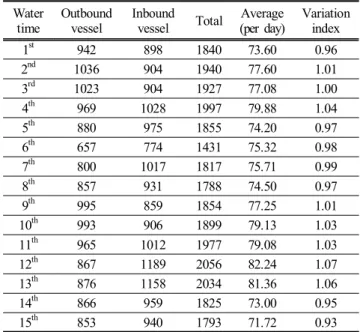
Table 3 shows the number of ships moving in and out of the Mokpo port according to water time for 1 year. Also the table shows the variation indexes(the average daily maritime traffic for each water time ÷ the annual average daily maritime traffic) during water time, which were 1.07 and 0.93 for the 12th and 15th water time. In turn, the maritime traffic for the 12th water is about 14.6 % higher than of the maritime traffic for the 15th water.
Water
time Outbound
vessel Inbound
vessel Total Average
(per day) Variation index
1st 942 898 1840 73.60 0.96
2nd 1036 904 1940 77.60 1.01
3rd 1023 904 1927 77.08 1.00
4th 969 1028 1997 79.88 1.04
5th 880 975 1855 74.20 0.97
6th 657 774 1431 75.32 0.98
7th 800 1017 1817 75.71 0.99
8th 857 931 1788 74.50 0.97
9th 995 859 1854 77.25 1.01
10th 993 906 1899 79.13 1.03
11th 965 1012 1977 79.08 1.03
12th 867 1189 2056 82.24 1.07
13th 876 1158 2034 81.36 1.06
14th 866 959 1825 73.00 0.95
15th 853 940 1793 71.72 0.93
Table 3. Number of passing vessel and variation index according to water time
Figure 7 shows the variation index of the numbers of outbound ships and inbound ships according to each water time. The trends of changes in ship inbound and outbound variation indexes move to the mutually opposite directions. While there were more outbound traffic on the 2nd-3rd water time than on other water time, inbound traffic was larger on the 12th-13th water time. Outbound traffic on the 2nd-3rd water times was larger than on the 7th water time by about 23-24 %. Inbound traffic on the 12th-13th water times was more often than on the 9th water time by approximate 29-33 %.
This seems the effect of ships moving in line with water time as in Figure 2-5, to show the mutually opposed trends in outbound and inbound variation indexes according to each water time.
1 2 3 4 5 6 7 8 9 10 11 12 13 14 15
0.7 0.8 0.9 1 1.1 1.2
water time
variation index
variation index (outbound) variation index (inbound)
Fig. 7. Variation index of outbound vessel by water time.
4.2 Hourly variation index according to water time Figure 8 shows hourly variation indexes (The average hourly maritime traffic for each water time ÷ the annual average hourly maritime traffic) of outbound ships according to water time. It can be noticed that there were more outbound ships at 6 than other timeslots. Especially at 6 on the 10th water time, there were 98.7 % more outbound ships than those on the 4th water time. Figure 9 shows inbound ships’ variation indexes of each timeslot according to water time. There were more inbound ships at around 17 than other time of a day. Especially at 17 on the 12th water time, the number of outbound ships is larger than on the 9th water time by 83.4 %.
Water time
Sum of sine Fourier series
R2 SSE R2 SSE
1st 0.9815 0.120 0.9734 0.172
2nd 0.9858 0.079 0.9478 0.292
3rd 0.9884 0.083 0.9837 0.116
4th 0.9991 0.005 0.9784 0.136
5th 0.9583 0.266 0.9571 0.274
6th 0.9741 0.214 0.9675 0.268
7th 0.9879 0.061 0.9839 0.082
8th 0.9988 0.006 0.9878 0.065
9th 0.9888 0.069 0.9847 0.095
10th 0.9988 0.008 0.9523 0.321
11th 0.9788 0.168 0.9686 0.248
12th 0.9914 0.086 0.9526 0.480
13th 0.9998 0.001 0.9202 0.643
14th 0.9989 0.008 0.9974 0.021
15th 0.9908 0.068 0.9669 0.245
Table 4. Comparison of GOF by water time(inbound)
0 1 2 3 4 5 6 7 8 9 10 11 12 13 14 15 16 17 18 19 20 21 22 23 0
0.5 1 1.5 2 2.5 3
Hour
variation index (outbound vessel)
1 water time 2 water time 3 water time 4 water time 5 water time 6 water time 7 water time 8 water time 9 water time 10 water time 11 water time 12 water time 13 water time 14 water time 15 water time
Fig. 8. Variation index by hour according to water time (outbound vessel).
0 1 2 3 4 5 6 7 8 9 10 11 12 13 14 15 16 17 18 19 20 21 22 23
0 0.5 1 1.5 2 2.5 3
Hour
variation index (inbound vessel)
1 water time 2 water time 3 water time 4 water time 5 water time 6 water time 7 water time 8 water time 9 water time 10 water time 11 water time 12 water time 13 water time 14 water time 15 water time
Fig. 9. Variation index by hour according to water time (inbound vessel).
The relationship of hourly variation index(v) according to time(h) was analyzed with the curve fitting. As a result, an appropriate model was found in terms of the sum of 8 sine functions as described in the equation (1). Table 4 shows the comparison of goodness of fit of fourier series model and sum of sine functions model. The coefficient of determination(R2) of the sine function model exceeded 0.95, indicating that the hourly variation index(v) according to time(h) was well explained by the sum of sine function.
fwatertime(h)=a1sin(b1h+c1) + a2sin(b2h+c2) +…+ a8sin(b8h+c8) (1)
It seems that this is because diverse sine functions worked together complicatedly, which represented the 2 rounds of ebbs and risings a day appearing in the intervals of 6 hours; the intensity of tides and the currents change accompanying neap and spring tides;
human daily bio-cycle of departing in the morning and returning in the evening, and many others.
5. Conclusion
In line with the changes in intensity of tide as shown in neap and spring tides according to water time, maritime activities including fishery are diversified. This study is significant in analyzing the maritime traffic characteristics quantitatively in the context of the traditional water time system.
In this study, the differences of maritime traffic volume in each water time were compared by applying the variation index. As a result, it was found herein that the number of outbound ships was larger on the 2nd-3rd water times than the 7th water times by 23-24 %.
And the number of inbound ships was higher on the 12th-13th water times than the 9th water time by 29-33 %. Such a result seems because of the effect of ships moving in line with specific water time. So the inbound and outbound variation indexes were found to move in mutually opposite directions according to water time.
It was also found that the number of outbound ships was higher at 6 on the 10th water time than the 4th water time by 98.7 % whereas the number of inbound ships was larger at 17 on the 12th water time than the 9th water time by 83.4 %. From these findings, it is noted that time hour and water time have an effect on ships’
inbound and outbound.
The hourly variation index of inbound and outbound ships according to time, in particular, was found to change in the form of sine function model. It is deemed necessary to understand the
ship traffic patterns according to water time for safe traffic management including especially large ships such as new ships and deep draft ships. This study is expected to serve as a necessary basic material for development of maritime traffic management according to water time.
Reference
[1] Cho, H. and J. W. Kang(2012), Probability Density Function of the Tidal Residuals in the Korean Coast, Journal of Korean Society of Coastal and Ocean Engineers, Vol. 24, No.
1, pp. 1-9.
[2] Gang, S. G., J. Y. Jeong and J. B. Yim(2014), Applications of vessel Domain Theory to Identify Risky Sector in VTS Area, Journal of the Korean Society of Marine Environment
& Safety, Vol. 20, No. 3, pp. 277-284.
[3] Jang, Y. C.(2009), Interpretation of Korean Traditional Tidal Calendar System Multte for Integrated Coastal Management, Graduate school of Kyungnam University, Master thesis, pp.
30-37.
[4] Jung, J. M. and D. S. Kim(2001), Influence of Sea Condition on Catch Fluctuation of Long Line for Common Octopus, Octopus Variddilis, in the Coastal Waters of Yosu(2), Journal of the Korean society of fisheries technology, Vol. 37, No. 3, pp. 159-162.
[5] Kim, H. G. and Y. T. Kim(2013), Characteristics of Spatio-temporal Variability of Daily averaged Tidal Residuals in Koeran Coasts, Journal of the Korean Society of Marine Environment & Safety, Vol. 19, No. 6, pp. 561-569.
[6] Oh, T. Y., J. I. Kim, Y. I. Seo, S. K. Lee and M. S.
Choi(2012), Distribution characteristic of Octopus minor in the Tando Bay on the southwest coast of Korea, Journal of the Korean society of fisheries technology, Vol. 48, No. 4, pp. 370-378.
[7] Park, C. J.(1985), A Study on the Use of the Lunar Principle of MULDAE as a Predictor of Tidal Phenomenon, Journal of Korean institute of navigation, Vol. 9, No. 1, pp. 41-81.
Received : 2015. 07. 08.
Revised : 2015. 08. 16.
Accepted : 2015. 10. 27.