• 검색 결과가 없습니다.

Impacts of Organizational Factors on Work Motivation and Job Performance: Evidence from SMEs in Vietnam

N/A
N/A
Protected

Academic year: 2021

Share "Impacts of Organizational Factors on Work Motivation and Job Performance: Evidence from SMEs in Vietnam"

Copied!
11
0
0

로드 중.... (전체 텍스트 보기)

전체 글

(1)

Print ISSN: 2288-4637 / Online ISSN 2288-4645 doi:10.13106/jafeb.2021.vol8.no10.0285

Impacts of Organizational Factors on Work Motivation and Job Performance: Evidence from SMEs in Vietnam

Thanh Huong NGUYEN

1

, Nguyen Danh NGUYEN

2

, Binh Van TRAN

3

Received: June 15, 2021 Revised: August 29, 2021 Accepted: September 17, 2021

Abstract

This study estimates the influence of organizational-level factors on work motivation and job performance of middle managers of small and medium enterprises (SMEs) in Vietnam. A 5-point-Likert-scale structural questionnaire consisting of 36 observation variables was used to survey middle managers of Vietnamese SMEs. 425 out of 500 responses collected were valid for multivariate data analysis. The results of confirmatory factor analysis and structural equation modeling reveal three main findings. First, philosophy and policy, compensation and benefits, goal system, and leadership have positively significant impacts on the work motivation of middle managers under investigation.

Second, there is a significantly positive influence of work motivation on job performance. However, there is no indication that growth opportunities, work environment, evaluation system have significant impacts on the work motivation of respondents. Based on the findings, the study suggests four recommendations for Vietnamese SMEs to improve motivation and job performance of middle managers, which are (1) ensuring the clarity and soundness of the organizational policies and philosophies, especially human resources policy that boosts employees’ work motivation; (2) building a comprehensive compensation and benefit system to attract and retain talented employees;

(3) developing a clear and adequate goal system; (4) enhancing top-level managers’ leadership abilities.

Keywords: Motivation, Performance, Organizational Factors, Middle Managers, SMEs JEL Classification Code: J24, J28, M12, M54

As for the economy, it fosters economic growth and prosperity of the country (Chughtai & Alam, 2014). Efficient enterprises generate more productivity, produce more goods, boost GDP per capita, and increases tax revenue (Syverson, 2011).

Employee motivation is one of the important factors promoting the performance of the organization. While work motivation is a way to utilize human resources, resources utilization is a way to increase productivity, reduce operating costs, and improve overall efficiency. Previous studies show that highly motivated employees are more productive and creative in accomplishing organizational goals (Shaban et al., 2017; Manuti & Giancaspro, 2019). On the other hand, less motivated employees are less productive and tend to deviate from achieving organizational goals (Sabri et al., 2019). Motivation encourages employees to develop compe- tencies and use those competencies to increase work performance (Jayaweera, 2015).

Work motivation can come from individuals, groups, or organizations. Factors at the organizational level are those that the organization can directly, immediately, and on a large scale. Many previous studies have likely shown that the factors of policy and philosophy, compensation and benefits,

1

First Author and Corresponding Author. Lecturer, Department of Management and Law, School of Economics and Management, Hanoi University of Science and Technology, Vietnam [Postal Address: Dai Co Viet Street, Bach Khoa Ward, Hai Ba Trung District, Hanoi, 11615, Vietnam] Email: [email protected]

2

Dean, School of Economics and Management, Hanoi University of Science and Technology, Hanoi, Vietnam.

Email: [email protected]

3

Lecturer, Department of Industrial Economics, School of Economics and Management, Hanoi University of Science and Technology, Vietnam. Email: [email protected]

© Copyright: The Author(s)

This is an Open Access article distributed under the terms of the Creative Commons Attribution Non-Commercial License (https://creativecommons.org/licenses/by-nc/4.0/) which permits unrestricted non-commercial use, distribution, and reproduction in any medium, provided the original work is properly cited.
1. Introduction

The improvement of operational efficiency brings various

benefits to both enterprises and the whole economy. For

enterprises, better operational efficiency means lower costs

and higher profits. This not only enhances the competitiveness

of enterprises but also helps them grow and upscale.

(2)

growth opportunities, working environment, leadership, goal, and evaluation have an impact on employee motivation (DuBrin, 2012; Alshmemr et al., 2017; Hadi & Tola, 2019).

Small and medium enterprises (SMEs) play an impor- tant role in job creation and global economic development.

They represent 90% of businesses, 60–70% of employment, and about 55% of GDP in developed countries (WTO, 2019). In Vietnam, SMEs are the backbone of economic development, accounting for 98% of all enterprises, and approximately 47% of the country’s GDP (GSO of Vietnam, 2020). However, there have not been many studies on work motivation and performance in SMEs.

Therefore, this study was conducted to determine the main factors and their influence on the work motivation and job performance of SMEs in Vietnam. The rest of this paper is structured as follows: the next section presents the theoretical basis and research hypotheses of the paper.

Section three presents the research methodology, including measures, samples and data, and methodology. The results of the data analysis are presented in section 4. Section 5 is the discussion. The final section is the conclusion and recommendation.

2. Theoretical Background and Hypotheses 2.1. Work Motivation

Work motivation has always been an attractive topic that grabs the attention of many scholars around the world.

Work motivation plays a crucial role for the organization because it promotes positivity at work, the desire to devote and contribute to the organization of employees, which furthers promote productivity and improve the work performance of employees and organizations. However, there is no unifying definition among researchers due to the complexity of this concept.

Herzberg (1987), using the needed-based approach, described motivation as the driving force that encourages achievements, recognition, responsibility, and development and progress of employees in the workplace. Herzberg’s descriptions consider work motivation as an intrinsic motivator. Agreeing with Herzberg’s point of view, Amabile (1997) argued that work motivation is the intrinsic motivation inside employees, originating from the interest and ability to participate in work due to the stimulation by curiosity, excitement, or a sense of self-challenge. Amabile (1997) added that work motivation is also influenced by external factors when employees are affected by the desire to achieve goals such as achieving rewards, winning competitions, or simply completing tasks to challenge themselves. Similarly, Pinder (1998) defined motivation as a set of energetic forces (both internal and external) which initiate work-related behavior and determine its form, direction, intensity, and duration.

Despite differences in way of expression, there seems to be a consensus that work motivation, both internal and external, activates the energy of people; it is a force that drives people to try to satisfy their needs; all human behavior is motivated to some extent. Therefore, in this study, work motivation is considered as the factor motivating and encouraging the working ability of employees to increase productivity and performance.

2.2. The Relationship Between Organizational Factors and Work Motivation

Work motivation (MOV) can be created at different levels, such as individual-level, group-level, organizational- level (Erez & Eden, 2001). At the organizational level, factors that are often mentioned as determinants of work motivation includes policy and philosophy (Ganesh & Indradevi, 2015), compensation and benefits (Eisenhardt, 1989; Ghazanfar et al., 2011), growth opportunities (Alshmemri et al., 2017), working environment (Porter et al., 2016), leadership (Hadi

& Tola, 2019), goal system (Greenberg, 2011; DuBrin, 2012; Jiang et al., 2016), and evaluation systems (Mathew

& Johnson, 2015). The improvement of those factors is considered as one of the ways to promote employees’ work motivation in organizations.

2.2.1. Philosophy and Policy

Philosophy and policy (PP) refer to the clarity and soundness of the organization’s philosophy and policy that are implemented across the entire organization. An organization’s policy is the established rules and procedures that govern an organization’s day-to-day operations. Meanwhile, philosophy provides an organization’s norms and values, which guide the thinking and actions of organizational members in implementing policies and practices, and identifies the appropriate types of behavior in the organization environment (Katz & Kahn, 1978). When the employees’ expectation of work matches the company policy, they feel more sense of engagement and are more willing to contribute to the company. A well-implemented company philosophy increases motivation levels. A clear understanding of company philosophy and policies leads to increased motivation, morale, and productivity of employees (Ganesh & Indradevi, 2015).

Therefore, the study proposes the hypothesis:

H1: There is a significant relationship between philosophy and policy and work motivation.

2.2.2. Compensation and Benefits

Compensation and benefits (CB) refer to the reasonable

remuneration the employees received for their work.

(3)

Compensation is all extrinsic rewards that employees received in exchange for time, effort, and skills they contribute (Byars

& Rue, 2006), including both fixed and variable pay tied to levels of their performance. Benefits are programs an employer uses to supplement the base compensation that employees receive (Christofferson & Bob, 2006). Benefits can be both monetary and non-monetary, such as health insurance, paid leave, retirement programs, or flexible work arrangements and well-being programs in terms of increasing employee morale, satisfaction, and commitment (Nankervis et al., 2008). Fair pay treatment leads to higher motivation among employees (Taylor, 1911; Bakhtawar, 2016). Employees will hardly do the task if the remuneration does not justify it, regardless of the outcome. Employees who are given a monetary incentive will perform better in their jobs than those who are not. Incentives and bonuses motivate employees to apply more effort in their work, resulting in improved performance (Eisenhardt, 1989;

Ghazanfar et al., 2011; Tran & Do, 2020). Hence, we proposed the following hypothesis:

H2: There is a significant relationship between compensation and benefits and work motivation.

2.2.3. Growth Opportunities

Growth opportunities (GO) refer to the development opportunities employees can get while in the company, including both self-growth such as the employees’

development in skills, knowledge, and job advancement such as promotions. Employees are more motivated by the growth and development opportunities provided by the company (Raval et al., 2014). Growth opportunity is considered a motivating factor according to the theory of Herzberg (1987). Improving the training and promotion opportunities of employees can increase their motivation to work. Previous studies also show that training and promotion opportunities have a close relationship with work motivation. Employees will feel more excited and motivated to work if their jobs provide them with opportunities to improve their skills and advance in their careers. The impact of growth opportunities on work motivation has been proven in various recent studies (Alshmemri et al., 2017). Thus, we hypothesize the following:

H3: There is a significant relationship between growth opportunities and work motivation.

2.2.4. Working Environment

Working environment (WE) refers to the physical con- dition of the employees’ workplace, in terms of convenience, safety, provision of proper work equipment, etc. Lighting, noise, hygiene, temperature, ventilation, and resources are all parts of the working environment. The working environment

positively impacts employees’ motivation (Clark, 2003).

A comfortable working environment provides an extra optimistic level of motivation. On the contrary, employees will perform poorly if they are uncomfortable or unhappy with their workspace (Hafeez & Panatik, 2018). Several studies indicated the influence of the working environment on employees’ motivation (Porter et al., 2016). Hence, we proposed the following hypothesis:

H4: There is a significant relationship between working environment and work motivation.

2.2.5. Leadership

Leadership (LS) is the process that influences existing activities and primarily conducts organizations in groups to achieve goals set from the beginning (Mitchell & Scott, 1987). Leaders can have a powerful impact on the outcomes of individuals, groups, and organizations (Pancasila et al., 2020).

An organization needs a leader figure to be an example for its other internal members (Paais & Pattiruhu, 2020). He/

she is the one influencing others to understand and accept what needs to be done and how to do it. In another word, he/she manages to facilitate and motivate their subordinates, move individuals and groups to achieve shared objectives.

Between leaders and followers are win-win relationships, each party raises one another to higher levels of morality and motivation (Burns, 1978). Appropriate and effective applied leadership styles give employees a sense of empowerment, which can lead to the improvement of employees’ performance (Guterresa et al., 2020). Numerous studies have demonstrated the positive impact of leadership on employees’ motivation (Hadi & Tola, 2019). Hence, we proposed the following hypothesis:

H5: There is a significant relationship between leadership and work motivation.

2.2.6. Goal system

A goal system (GS) refers to a clear and adequate set of goals for employees. Goals have motivational impacts.

They direct attention and action (Locke & Latham, 2002).

When goals are set, employees are motivated to develop strategies that enable them to achieve those goals. Employees provided with specific, difficult but attainable goals perform better than those given easy, nonspecific, or no goals at all (Lunenburg, 2015). The accomplishment of goals can lead to satisfaction and further motivation, and vice versa.

According to goal setting theory, goals need to be specific,

difficult but attainable, be accepted, and feedback must be

provided on goal attainment. The relationship between goals

system and work motivation has been tested in serval studies

(4)

(DuBrin, 2012; Greenberg, 2011; Newstrom, 2011, Jiang et al., 2016). Hence, we proposed the following hypothesis:

H6: There is a significant relationship between goal system and work motivation.

2.2.7. Evaluation System

An evaluation system (ES) is a structure established to fairly evaluate the employees based on the established performance and evaluation standards, regardless of race, gender, age, and other discriminatory parameters. Well- designed and well-executed performance appraisals have a strong motivational impact on employees (Mehta, 2014).

They are a kind of formal, significant, and enduring recognition from supervisors, underlying a message that the evaluated individuals are important and valuable.

Performance evaluation is also motivational for employees who are seeking personal learning, growth, and development.

When performance evaluation meets the employees’ needs such as gaining recognition, sensing achievement and competence, experiencing growth, and meeting objectives, it brings satisfaction to employees (Mehta, 2014). Previous studies have shown the relationship between the evaluation system and work motivation (Mathew & Johnson, 2015).

Hence, we proposed the following hypothesis:

H7: There is a significant relationship between the evaluation system and work motivation.

2.3. Work Motivation and Job Performance

Job performance (JP) refers to the degree to which employees meet job requirements. Job performance is a means to reach a goal or set of goals within a job, role, or organization, but not the actual consequences of the acts performed within a job. Job performance is measured based on employee self-assessment. Employees’ performance is affected by work motivation. Better work motivation leads to better performance of employees (Robescu & Iancu, 2016). Highly motivated employees will be more active at work and more devoted to their jobs, which will result in the improvement of the overall performance. Effectively increasing performance by motivation is an effective policy adopted by many managers (Dien & Duyen, 2021). Previous studies have found the impact of motivation on employees’

performance (Nabi et al., 2017; Dien & Duyen, 2021).

Jayaweera (2015) indicated that improving motivation will boost employees’ performance in the hotel industry.

Motivation has a significant impact on job performance;

increasing the level of motivation for employees will lead to an increase in the level of job performance (Veliu et al., 2017). Therefore, the study proposes the hypothesis:

H8: There is a significant relationship between work motivation and employee performance.

3. Research Methods 3.1. Measures

We used a structured questionnaire to collect data by survey method. The MOV construct was measured by four items derived from Inceoglu et al. (2012). The PP construct was evaluated by three items, the WE construct was measured by seven items, and the LS construct was evaluated by three items, adapted from Victor and Cullen (1988). The CB construct was assessed by four items based upon Williams et al. (2008). The GO construct was measured by seven items derived from Takahashi (2006).

The ES construct was evaluated by four items, and the GS construct was assessed by three items, adapted from Najafi et al. (2011). The JP construct was measured by four items adapted from Koopmans et al. (2014). Respondents assessed all items on five-point Likert scales ranging from “strongly disagree” (1) to “strongly agree” (5). The final items of each construct are shown in Appendix 1.

3.2. Sample and Data

The back-translation method was adopted to ensure the validity of the questionnaire’s translation. First, we deve- loped the questionnaire in English by adapting constructs and items from literature. Then, the English questionnaire was translated into Vietnamese by an experienced human resources researcher. The Vietnamese version was then translated back to English by another expert in human resources. This English version was checked against the original one to avoid discrepancies. A pilot test was also conducted to ensure the rationality and effectiveness of items in the questionnaires.

The subjects of the survey were middle managers of SMEs in Vietnam. The determined minimum sample size was 400 respondents, which is good for quantitative research (Comrey & Lee, 1992). Data was collected between 2018 and 2019 with the support of the Department of Industry and Trade, and the Department of Planning and Investment.

Finally, there were 425 valid responses out of 500 distributed questionnaires (Table 1).

3.3. Data Analysis Methods

This study used the multivariate data analysis method to analyze collected data and test the proposed hypotheses.

Particularly, we used exploratory factor analysis (EFA)

to assess discriminant validity among constructs. The chosen

criteria for EFA were Kaiser-Meyer-Olkin (KMO) is greater

(5)

than 0.5, the p-value of Bartlett’s test is smaller than 0.05, the factor loadings of each item are smaller than 0.5, and the total variance explained (TVE) is greater than 50% (Hair et al., 2010).

Next, we use confirmatory factor analysis (CFA) to evaluate the model fit and the validity of each construct.

The research model reaches the overall fit index if Chi-square/

df is smaller than 3, CFI, PPI, and IFI are greater than 0.9, and RMSEA is smaller than 0.08 (Kline, 2011). The constructs

achieved convergent validity if the factor loadings of their items in CFA are greater than 0.6 (Hair et al., 2010).

The discriminant validity of each construct was assessed by comparing the correlations among the constructs with the value of 1. If the value of 1 does not include in the 95%

confidence interval, the constructs reach the discriminant validity (Anderson & Gerbing, 1988). The composite coefficients and AVEs were used to assess construct reliability, with composite reliability coefficients greater than 0.6 and AVEs greater than 0.5 being the criteria (Hair et al., 2010).

Finally, the proposed hypotheses were tested by a structural equation model (SEM) at the significance level of 5%.

4. Results

4.1. Reliability and Validity Exploratory Factor Analysis

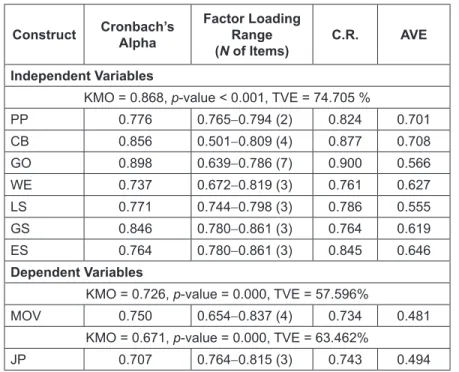
The EFA results after deleting unsatisfactory items met the criteria for ensuring the proposed model’s scales’

reliability. The KMO value was 0.5 and the p-value of Bartlett’s test was smaller than 0.05, the variance explained was larger than 50% and all factor loadings were greater than 0.5. Hence, there was internal consistency within each construct (Table 2).

Confirmatory Factor Analysis

The CFA results after deleting unsatisfactory items showed that the model had a good overall fit with the data:

Chi-square/df = 2.891, CFI = 0.951, PPI = 0.932, IFI = 0.951, and RMSEA = 0.051. The factor loadings of items in each construct were greater than 0.6 showing that the items used in the constructs reached convergent validity. The composite reliability coefficients were greater than 0.6, and the average variance was greater than 50% showing that the constructs in the model were reliable (Table 2).

4.2. Discriminant Validity

The 95% confidence interval of the correlation coefficients did not contain the value of 1, which indicated that the constructs reached discriminant validity

4.3. Structural Model and Hypothesis Test

The SEM estimation results met the selected criteria (Chi-square/df = 2.421; CFI = 0.916, PPI = 0.912, IFI = 0.916l; RMSEA = 0.068). Thus, the proposed model was fit with actual data.

The findings showed that there are four factors that positively impact work motivation which are philosophy and policy, salary and benefits, leadership, and goal system; and Table 1: Demographic Profile of Respondents (N = 425)

Catergories Frequency (%)

Gender Male 213 (50.1%)

Female 212 (49.9%)

Age 18–22 29 (6.8%)

23–30 89 (20.9%)

31–40 227 (53.4%)

41–50 73 (17.2%)

50 or more 7 (1.6%)

Education Bachelor 290 (68.2%)

Master 118 (27.8%)

Doctoral 5 (1.2%)

Others 12 (2.8%)

Senirority <3 years 82 (19.3%)

3–5 years 100 (23.5%)

5–10 years 143 (33.6%)

>10 years 100 (23.5%)

Managerial

position Head of the department 234 (55.1 %) Deputy of department 94 (22.1%)

Team leader 47 (11.1%)

Others 50 (11.8%)

Types of ownership structures

100% State-owned

enterprises 18 (4.2%)

State-owned

enterprises 8 (1.9%)

Private 393 (92.5%)

Others 6 (1.4%)

Industry Agriculture, Forestry,

Fishing 2 (0.5%)

Industry and

Construction 140 (32.9%)

Trade and Services 230 (54.1 %)

Others 53 (12.5%)

(6)

work motivation has a positive influence on job performance (β > 0, p-value < 0.05). Meanwhile, the impact of growth opportunities, working environment, and evaluation system on work motivation was insignificant at the significant level of 0.05 (p-value > 0.05). Thus, we accepted hypotheses H1, H2, H5, H6, H8, and rejected H3, H4, and H7 (Table 3).

5. Discussion

Although work motivation is a rather familiar topic, there has not been much research on work motivation in SMEs. In this regard, our study examined organizational factors that improve work motivation and the impact of work motivation on job performance at SMEs in Vietnam.

There were 4 out of 7 proposed organizational factors that positively impact work motivation, which are (1) philosophy and policy, (2) compensation and benefits, (3) goal system, and (4) leadership. Philosophy and policy had the strongest effect of 4 factors. This is the factor that has the widest and most common impact in an organization, a guideline for every behavior of organizational members. A good, detail, and complete set of philosophies and policies are easier to understand and implement. If employees are clear that their company policy and philosophy are in line with their values, they might feel more engaged and motivated in their work.

The second important factor is compensation and benefits.

A well-paid job with attractive payment policies will make employees feel satisfied and want to keep the job and put Table 3: The SEM Analysis Result

Hypotheses

Code Relationships Std. Beta S.E. C.R. p-value Supported

H1 PP → MOV 0.593 0.094 4.934 <0.001 Accept

H2 CB → MOV 0.378 0.058 4.141 <0.001 Accept

H3 GO → MOV 0.184 0.100 1.634 0.102 Reject

H4 WE → MOV -0.045 0.040 -0.884 0.377 Reject

H5 LS → MOV 0.256 0.113 2.785 0.005 Accept

H6 GS → MOV 0.337 0.084 3.841 <0.001 Accept

H7 ES → MOV 0.102 0.040 1.458 0.145 Reject

H8 MOV → JP 0.929 0.065 11.472 <0.001 Accept

Table 2: Reliability and Validity Test Results Construct Cronbach’s

Alpha

Factor Loading Range

(N of Items) C.R. AVE Independent Variables

KMO = 0.868, p-value < 0.001, TVE = 74.705 %

PP 0.776 0.765-0.794 (2) 0.824 0.701

CB 0.856 0.501-0.809 (4) 0.877 0.708

GO 0.898 0.639-0.786 (7) 0.900 0.566

WE 0.737 0.672-0.819 (3) 0.761 0.627

LS 0.771 0.744-0.798 (3) 0.786 0.555

GS 0.846 0.780-0.861 (3) 0.764 0.619

ES 0.764 0.780-0.861 (3) 0.845 0.646

Dependent Variables

KMO = 0.726, p-value = 0.000, TVE = 57.596%

MOV 0.750 0.654-0.837 (4) 0.734 0.481

KMO = 0.671, p-value = 0.000, TVE = 63.462%

JP 0.707 0.764-0.815 (3) 0.743 0.494

(7)

more effort into their work. The third important factor is the goal system. A clear set of goals let employees know what they should complete to get reward and urge them to attain the goals. The last is leadership. A suitable leadership fosters a positive working environment for employees and brings them together to accomplish mutual goals, allowing them to contribute more. These results pointed out that clear and sound philosophy and policy, reasonable remuneration, appropriate and effective leadership, and a clear goal system are significant to employees’ work motivation in SMEs.

The findings are consistent with those of previous studies showing an association between work motivation and philosophy and policy (Ganesh & Indradevi, 2015), salary and benefits (Ghazanfar et al., 2011), leadership (Hadi &

Tola, 2019), and goal system (DuBrin, 2012; Greenberg, 2011; Jiang et al., 2016).

The study also found the strong influence of work motivation on job performance. This finding is similar to Veliu et al. (2017), who reported a significant relationship between work motivation and job performance in SMEs.

These findings imply that work motivation indeed influences job performance: the more motivated employees are, the higher they perform, and vice versa.

However, we found no significant impact of growth opportunities, work environment, and evaluation system on employees’ work motivation. This may be because, in Vietnamese SMEs employees’ perception, these are must-have characteristics of jobs, like in the Kano model (Kano et al., 1984). These characteristics are the requirements that the employees expect and are taken for granted. If done well, employees are just neutral, but if done poorly, employees will feel demotivated. In another word, a job must provide good growth opportunities, adequate working conditions, and a reasonable evaluation system.

6. Conclusion

This study makes several contributions to understanding the organizational factors that influence employees’ work motivation. We proposed and tested a theoretical model that includes antecedents of motivation from the aspect of an organization. We found positive impacts of philosophy and policy, compensation and benefits, goal system, and leadership on the work motivation of employees SMEs in Vietnam.

In addition, the powerful impact of motivation on job perfor- mance was also confirmed, which enhances the previous study.

Based on the findings of this study, we suggest the following recommendations for top-level managers of SMEs to improve the work motivation of the employees.

First, SMEs should develop and maintain a clear policy and philosophy, especially human resources policy that boosts employees’ work motivation. Second, enterprises should build comprehensive compensation and benefit system to

attract and retain talented employees. Third, enterprises should ensure a clear and adequate goal system. Last, top-level managers should work on improving their leadership skills so that they can use appropriate leadership styles to motivate their subordinates.

Our study has some limitations that may provide opportunities for future research. First, the data set for this study was collected in Vietnam only; thus, future studies can extend the scope to various markets. Second, convenience sampling is likely to be vulnerable to selection bias and influence beyond the control of researchers, which may not produce representative results.

References

Alshmemri, M., Shahwan-Akl, L., & Maude, P. (2017). Herzberg’s two-factor theory. Life Science Journal, 14(1), 12–16.

https://www.lifesciencesite.com/lsj/life140517/03_32120l sj140517_12_16.pdf

Amabile, T. M. (1997). Motivating creativity in organizations:

On doing what you love and loving what you do. California Management Review, 40(1), 39–58. https://doi.org/10.2307/

41165921

Anderson, J. C., & Gerbing, D. W. (1988). Structural equation modeling in practice: A review and recommended two-step approach. Psychological Bulletin, 103(3), 411. https://doi.org/

10.1037/0033-2909.103.3.411

Bakhtawar, S. (2019). Impact of motivation on job satisfaction:

A case study of NGOs in Karachi, SSRN Journal, 56, 146–163.

https://doi.org/ssrn.abstract_id=2910857

Burns, J. M. (1978). Leadership. New York: Harper & Row.

Byars, A., & Rue, E. (2006). Human resource management:

Contemporary issues, challenges, and opportunities.

New Jersey: IAP.

Chughtai, M. W., & Alam, I. (2014). Small and medium enterprise as an engine in the economic growth of Pakistan: An empirical analysis. Research Journal of Economics and Business Studies, 3(10), 45–51. https://www.nti.edu.pk/wp-content/

uploads/Research-Paper-by-Israr-Alam.pdf

Clark, R. E. (2003). Fostering the work motivation of teams and individuals. Performance Improvement, 42(3), 21–29. https://

doi.org/10.1002/pfi.4930420305

Comrey, A. L., & Lee, H. B. (1992). The first course in factor analysis (2

nd

ed.). Hillsdale, NJ: Lawrence Erlbaum Associates.

Dien, N. X., & Duyen, D. T. T. (2021). Factors affecting employee’s performance: An empirical study in Vietnam. The Journal of Asian Finance, Economics, and Business, 8(7), 295–302.

https://doi.org/10.13106/jafeb.2021.vol8.no7.0295

DuBrin, A. J. (2012). Essentials of management. Mason, OH:

Cengage South-Western.

Eisenhardt, K. (1989). Building theory from case study research.

Academy of Management Review, 14(4), 532–550. https://

doi.org/10.2307/258557

(8)

Erez, M., & Eden, D. (2001). Introduction: Trends reflected in work motivation. In: Erez, M., Kleinbeck, U., & Thierry, H. (Eds.), Work motivation in the context of globalization economy (pp. 1–8). London, UK: Lawrence Erlbaum Associates.

GSO of Vietnam. (2020). Press release of the white book on Vietnamese businesses 2020. https://gso.gov.vn/default.aspx?

tabid=382& idmid=2& ItemID=19594

Ganesh, M., & Indradevi, R. (2015). Importance and effectiveness of training and development. Mediterranean Journal of Social Sciences, 6(2), 334–338. https://doi.org/10.5901/mjss.2015.

v6n1p334

Ghazanfar, F., Chuanmin, S., Khan, M. M., & Bashir, M. (2011).

A study of the relationship between satisfaction with compen- sation and work motivation. International Journal of Business and Social Science, 2(1), 120–131. http://www.ijbssnet.com/

journals/Vol._2_No._1%3B_January_2011/11.pdf

Greenberg, J. (2011). Behavior in organizations (10

th

ed.). Upper Saddle River, NJ: Prentice-Hall.

Guterresa, L. F., Armanu, & Rofiaty. (2019). The role of work motivation as a mediator on the influence of education training and leadership style on employee performance. Management Science Letters, 10(7), 1497–1054. https://doi.org/10.5267/

j.msl.2019.12.017

Hadi, T. P., Tola, B., & Akbar, M. (2019). The effect of transformational leadership and work motivation on innovative behavior. International Journal of Human Capital Management, 3(2), 100–108. https://doi.org/10.21009/IJHCM.

03.02.09

Hafeez, M., & Panatik S. A. (2018). Self-efficacy and job satisfaction: the moderating effect of abusive supervision.

Arabian Journal of Business and Management Review (Kuwait Chapter), 7(4), 102–106. https://doi.org/10.12816/0052247 Hair, J. F., Anderson, R. E., Babin, B. J., & Black, W. C.

(2010). Multivariate data analysis: A global perspective (7

th

ed). Upper Saddle River. NJ: Prentice-Hall.

Herzberg, F. (1987). One more time: How do you motivate employees?. Harvard Business Review, 65(5), 1–15. https://hbr.

org/2003/01/one-more-time-how-do-you-motivate-employees.

Inceoglu, I., Segers, J., & Bartram, D. (2012). Age-related differences in work motivation. Journal of Occupational and Organizational Psychology, 85, 300–329. https://doi.

org/10.1111/j.2044-8325.2011.02035.x

Jayaweera, T. (2015), Impact of work environmental factors on job performance, the mediating role of work motivation:

A study of the hotel sector in England. International Journal of Business and Management, 10(3), 56–67. https://doi.

org/10.5539/ijbm.v10n3p271

Jiang, L., Zhang, L. J., & May, S. (2016). Implementing English- medium instruction (EMI) in China: Teachers’ practices and perceptions, and students’ learning motivation and needs.

International Journal of Bilingual Education and Bilingualism, 5(11), 23–39. https://doi.org/10.1080/13670050.2016.1231166

Kano, N., Seraku, N., Takahashi, F., & Tsuji, S. (1984). Attractive quality and must-be quality. The Journal of the Japanese Society for Quality Control, 14(2), 39–48. https://ci.nii.ac.jp/

naid/10025070768/

Koopmans, L., Bernaards, C. M., Hildebrandt, V. H., de Vet, H. C. W.,

& van der Beek, A. J. (2014). Construct validity of the indivi- dual work performance questionnaire. Journal of Occupational and Environmental Medicine, 56(3), 154–167. https://doi.

org/10.1097/JOM.0000000000000113

Katz, D., and Kahn, R. L. (1978). The social psychology of organizations. New York: Wiley.

Kline, R. B. (2011). Principles and practice of structural equation modeling (3

rd

ed.). New York, NY: Guilford Press.

Locke, E. A., & Latham, G. P. (1990). Building a practically useful theory of goal setting and task motivation: A 35-year odyssey.

American Psychologist Association, 57(9), 705–717. https://

doi.org/10.1037/0003-066X.57.9.705

Lunenburg, F. C. (2011). Expectancy Theory of motivation:

Motivating by altering expectations. International Journal of Management, Business, and Administration, 15(1), 1–6.

Mathew, U., & Johnson, J. (2015). Impact of performance appraisal system on employee motivation: With special reference to a multi-specialty hospital in Kerala. Journal of Business and Management, 17(6), 21–24. https://doi.org/10.9790/487X Manuti, A., & Giancaspro, M. (2019). People make the difference:

An explorative study on the relationship between organiza- tional practices, employees’ resources, and organizational behavior enhancing the psychology of sustainability and sus- tainable development. Sustainability, 11(5), 1–17. https://doi.

org/10.3390/su11051499

Mehta, A. K. (2014). Impact of performance appraisal system on employee motivation. Journal of Research in Management and Technology, 3(6), 1–5. https://doi.org/10.1.1.994.4022 Mitchell, T. R., & Scott, W. G. (1987). Leadership failures, the

distrusting public, and prospects of the administrative state.

Public Administration Review, 47, 445–452. https://doi.org/

10.2307/975885

Nabi, M. N., Islam, M. M., Dip, T. M., & Hasain, M. A. (2017).

Impact of motivation on employee performance: A case study of Karmasangthan Bank Limited, Bangladesh. Arabian Journal of Business Management Review, 7(1), 293–301. https://

doi.org/10.4172/2223-5833.1000293

Najafi, L., Hamidi, Y., Ghiasi, M., Shahhoseini, R., & Emami, H.

(2011). Performance evaluation and its effects on employees’ job motivation in Hamedan city health centers. Australian Journal of Basic and Applied Sciences, 5(12), 1761–1765. http://www.

ajbasweb.com/old/ajbas/2011/December-2011/1761-1765.pdf Nankervis, A., Compton, R., & Baird, M. (2008). Evolution of

human resource management. Human Resource Management:

Strategies & Processes, 11, 2–40. https://www.lkouniv.ac.in/

site/writereaddata/siteContent/202004070951126599shaile_

Evolution_of_Human_Resource_Management.pdf

(9)

Newstrom, J. W. (2011). Organizational behavior (13

th

ed.).

New York, NY: McGraw-Hill.

Paais, M., & Pattiruhu, J. R. (2020). Effect of motivation, leadership, and organizational culture on satisfaction and employee performance.

The Journal of Asian Finance, Economics, and Business, 7(8), 577–588. https://doi.org/10.13106/jafeb.2020.vol7.no8.577 Pancasila I., Haryono S., & Sulistyo B. A. (2020). Effects of

work motivation and leadership toward work satisfaction and employee performance: Evidence from Indonesia. Journal of Asian Finance, Economics, and Business, 7(6), 387–397.

https://doi.org/10.13106/jafeb.2020.vol7.no6.387

Pinder, C. (1998). Work motivation in organizational behavior.

Englewood Cliffs, NJ: Prentice-Hall.

Porter, T. H., Riesenmy, K. D., & Fields, D. (2016). Work environ- ment and employee motivation to lead: Moderating effects of personal characteristics. American Journal of Business, 31, 66–84. http://doi.org/ 10.1108/AJB-05-2015-0017

Raval, Z., Tanna, D., & Raval, D. (2014). Employee motivation:

A tool for organizational success. International Journal of Software & Hardware in Engineering, 2(9), 9–17.

Robescu, O., & Iancu, A.G. (2016). The effects of motivation on employees’ performance in organizations. Valahian Journal of Economic Studies, 7(21), 49–56. https://doi.org/10.1515/vjes- 2016-0006

Sabri, S. M., Mutalib, H. A., & Hasan, N. A. (2019). Exploring the elements of employees motivation in the hospitality industry. Journal of Tourism, 4(14), 13–23. https://doi.org/

10.2314jot.414131

Shaban, O. S., Zubi, A. Z., Nafez, A., & Atalla, A. (2017). The effect of low morale and motivation on employees’ productivity

& competitiveness in Jordanian industrial companies.

International Business Research, 10(7), 1–7. https://doi.org/

10.5539/ibr.v10n7p1

Syverson C. (2011). What determines productivity? Journal of Economic Literature, 49(2), 326–65. https://doi.org/10.1257/

jel.49.2.326

Takahashi, K. (2006). Effects of wage and promotion incentives on the motivation levels of Japanese employees, Career Development International, 11(3), 193–203. https://doi.org/

10.1108/13620430610661722

Taylor, F. (1911). Scientific management. New York: Harper.

Tran, T. T., & Do, Q. H. (2020). Factors affecting job motivation among faculty members: Evidence from Vietnamese public universities. The Journal of Asian Finance, Economics, and Business, 7(9), 603–611. https://doi.org/10.13106/JAFEB.

2020.VOL7.NO9.603

Veliu, L., Manxhari, M., Demiri, V., & Jahaj, L. (2017). The influence of leadership styles on employees’ performance.

Vadyba Journal of Management, 31(2), 59–69. https://www.

ltvk.lt/file/zurnalai/08.pdf

Victor, B., & Cullen, J.B. (1988). The organizational bases of ethical work climates. Administrative Science Quarterly, 33(1), 57–87. https://doi.org//10.2307/2392857

Williams, M. L., Brower, H. H., Ford, L. R., Williams, L. J., &

Carraher, S. M. (2008). A comprehensive model and measure of compensation satisfaction. Journal of Occupational and Organizational Psychology, 81, 639–688. https://doi.org/

10.1348/096317907X248851

WTO. (2019). World trade statistical review 2019. https://www.

wto.org/english/res_e/statis_e/wts2019_e/wts19_toc_e.htm

(10)

Appendix 1: The Items of Each Construct in the Research Model

Constructs/Items Statements References

Motivation

MOV1 I always try my best to complete my work toward the organizational goals Inceoglu et al. (2012) MOV2 I’m always excited about the work I’m doing

MOV6 I always prioritize common work over personal matters

MOV4 I always try my best to complete my work regardless of difficulties Philosophy & Policy

PP1 The business philosophy of my enterprise is concerned with human

resource development Victor and Cullen (1988)

PP2 My enterprise always has policies to encourage, increase the creativity and commitment of middle managers (MMs) and employees.

PP3 My enterprise cares about the self-esteem of each individual through treatment policies with middle managers and employees.

Compensation & Benefits

CB1 In my enterprise, the income level of MMs is commensurate with their

qualifications and work performance. Williams et al. (2008)

CB2 The income level of MMs in the enterprise can meet their personal financial needs

CB3 When successfully completing (reaching the target) the work they undertake, middle managers receive timely bonuses from the enterprise.

CB4 Welfare regimes show the company’s interest in MMs Growth Opportunities

GO1 The company has a good training plan that provides me the opportunity

to develop my personal career Takahashi (2006)

GO2 I have many opportunities to be trained in the specialized knowledge and skills needed for the job

GO3 Training programs that are useful and relevant to my expertise GO4 The assignment is relevant and helps my professional development GO5 Opportunities for advancement in the company are based on ability, not

on seniority or relationships

GO6 I can express my views and attitudes in the staff appointment process GO7 The appointment process is open and transparent

Evaluation System

ES1 The performance evaluation objectives are clear and easy to understand Najafi et al. (2011) ES2 Managers in charge of supervising and evaluating the work performance

of MMs always support and coordinate in a timely manner to achieve goals.

ES3 The standards for performance evaluation for MMs are clear and specific ES4 The standards for performance evaluation for employees are clear and

specific

(11)

Constructs/Items Statements References Working Environment

WE1 I feel that I always work in safe and healthy conditions Victor and Cullen (1988) WE2 I get to work in a space with a comfortable and convenient design

WE3 I am equipped with a complete, up-to-date working facility

WE4 Necessary information is provided in a timely manner in the course of performing the work

Leadership

LS1 Top-level managers are always looking for new opportunities for middle

managers Victor and Cullen (1988)

LS2 Top-level managers always select, train MMs based on their understanding of the object and the job.

LS3 Top-level managers always respect MMs and employees Goal System

GS1 The system of goals and tasks for each department is set out clearly and

specifically Najafi et al. (2011)

GS2 The system of goals and tasks for each department is established based on the absorption of opinions of the management team

GS3 There is always a close connection between the goals of the business and the goals of each department

Job Performance

JP1 I always do my job well as an employee of the company Koopmans et al. (2014) JP2 I always receive good reviews from my superiors about my work results

JP3 I always get good reviews about my work results from my subordinates

JP4 My workload is more than others

수치

Table 2:  Reliability and Validity Test Results Construct Cronbach’s  Alpha Factor Loading Range (N of Items) C.R

참조

관련 문서

1 John Owen, Justification by Faith Alone, in The Works of John Owen, ed. John Bolt, trans. Scott Clark, &#34;Do This and Live: Christ's Active Obedience as the

The above-mentioned findings suggested that the learning motivation program had a good effect on enhancing the children's learning attitude and their pursuit

Based on the results, a study model was developed and a hypothesis that transformational and transactional leadership would significantly affect organizational

Purpose: The study was to investigate the organizational culture of middle and small sized hospital workers on organizational effectiveness and controlling effect of

And, it also verified that there are positive moderating effects of internal situational factors on the relationship of entrepreneurship and the performance

In this regard, this study analyzes the effect of the job characteristics and work environment of workers with physical disabilities on job satisfaction

This research further enriches the previous research on the influencing factors of employee organizational commitment and OCB, which help Chinese companies

Objectives: The present study was conducted to determine the relationship between degree of work performance and job satisfaction in NICU nurses.. Methods: The subjects of