Korean J. Environ. Biol. 35(4) : 533~544(2017) https://doi.org/10.11626/KJEB.2017.35.4.533
서 론
서해로 유입되는 독립하천은 다른 강과 합류되지 않는 독 립적인 구조를 지니며, 대형 하천에 비해 하천의 길이가 짧 고 유역이 좁은 지형적 특성을 가지고 있다(Kim and Han
2008; Jung et al. 2014). 이러한 까닭에 독립하천은 하천개발, 오염물질 유입 등 인위적 제한 요소에 비교적 큰 변화를 나 타내며, 자연적 제한 요소에 해당되는 갈수기와 홍수기에 따 라 유량변화가 극심하여 일반 하천에서 나타나는 자연정화 기능과 이곳에 서식하는 생물 종의 자연 복원력이 저하되거 나 상실되는 등의 특성을 가진다(Park et al. 2005; Bae and An 2006; Ministry of Environment 2007). 독립하천은 접하 고 있는 연안과 기수역에 영양염류 및 먹이 등을 전달하는
* Corresponding author: Hyun-Soo Joo, Tel. 063-620-0382, Fax. 063-620-0301, E-mail. [email protected]
ⓒ2017. Korean Society of Environmental Biology.
서해로 유입되는 독립하천의 어류상과 수생태계 건강성 평가 : 전남과 전북을 대상으로
김 진 재 · 주 현 수1,*
국립공원관리공단 가야 산 국립공원사무소, 1서남대학교 의과대학
Fish Fauna and the Health Assessment of
Independent Streams Flowing into the Yellow Sea in Korea:
a Case of the Jeonnam and Jeonbuk Provinces
Jin-Jae Kim and Hyun-Soo Joo1,*
Gayasan National Park Office, Korea National Park Service, Hapcheon 50201, Republic of Korea
1College of Medicine, Seonam University, Namwon 55724, Republic of Korea
Abstract - In this study, the fauna of freshwater fish were investigated from March until October of 2016 in 24 independent streams in the Jeonnam and Jeonbuk provinces, which were flowing into the Yellow Sea. The health of the aquatic ecosystem in those streams was assessed through the biological and abiological character index(BAc index). During the surveyed period, a total of 4,127 individuals were collected; they belonged to 59 species of 44 genera in 18 families. The most dominant species identified was Zacco platypus, and 12 species were endemic species of Korea, including Rhodeus uyekii. The BAc index indicated a statistically significant correlation(p<0.01 or 0.05). The stage distribution of the aquatic ecosystem health assessment showed the highest rating of 41.7% at the “Fair” stage. The “Good” and “Poor” stages accounted for 20.8% while the “Excellent” stage took up 16.7%. It has been confirmed that the aquatic ecosystem health of independent streams is influenced more by the abiological character index as a consequence of geographical characteristics and artificial/natural limiting factors, than by the biological character index.
Key words : fish fauna, health assessment, BAc index, independent stream
<Original article>
중요한 매개체로 알려져 있다(Kim and Han 2008). 그러므로 독립하천의 기능이 단절될 경우 이와 연결된 수역의 생물상 에도 적지 않은 영향을 미치기 때문에 독립하천의 수생태계 건강성 평가를 통한 생태적 이해를 하는 것은 수생태계 관 리에 있어 중요성을 갖는다.
서해로 유입되는 독립하천의 어류상에 대한 연구는 Choi (1988)와 Choi(1989)의 과거 연구 결과가 있을 뿐, 전무한 실정이다. 현재까지의 수생태계 건강성 평가는 주로 대형 하 천을 대상으로 실시되었고 독립하천을 연구 대상으로 실시 한 연구 결과는 매우 제한적이다(Song et al. 2005; Bae and An 2006; Choi et al. 2008; Choi and An 2013; Han et al.
2013). 또한, 해당 하천에 서식하는 주요 생물 분류군을 활용 한 군집분석 방법에 부분적 이화학적 평가요소와 함께 소수 의 비생물학적 평가요소를 추가한 수생태계 건강성 평가 방 식이 주로 실시되었다(Karr 1981; Plafkin et al. 1989; Cho et al. 1998; An et al. 2001a, b; Kang et al. 2001; An and Kim 2005; An and Lee 2006; Choi and An 2008; Jo et al. 2015).
하천의 자연정화 기능과 생물종 복원력이 대형 하천에 비하 여 현저히 낮은 독립하천은 생물학적 평가지수뿐만 아니라 비생물학적 평가요소인 환경적 평가지수를 동일한 가중치로 적용하여 수생태계 건강성을 평가해야 할 것으로 판단된다.
따라서 본 연구는 서해로 유입되는 전남과 전북지역에 속 한 24개 독립하천을 대상으로 어류상을 정밀 조사하고 어류 상에 따른 생물학적 요소와 하천의 환경적 요소를 등가 적 용하여 생물 및 비생물 평가지수(Biological and Abiological character index; BAc index)를 개발하고 본 연구지역인 24 개 독립하천의 수생태계 건강성을 평가하였다.
재료 및 방법
1. 조사 방법
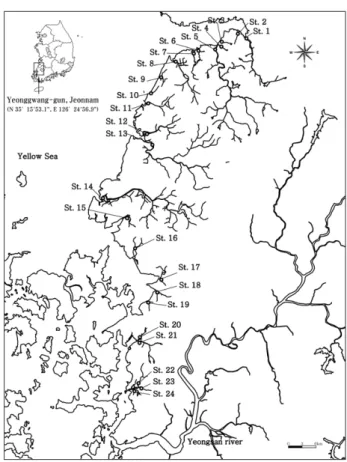
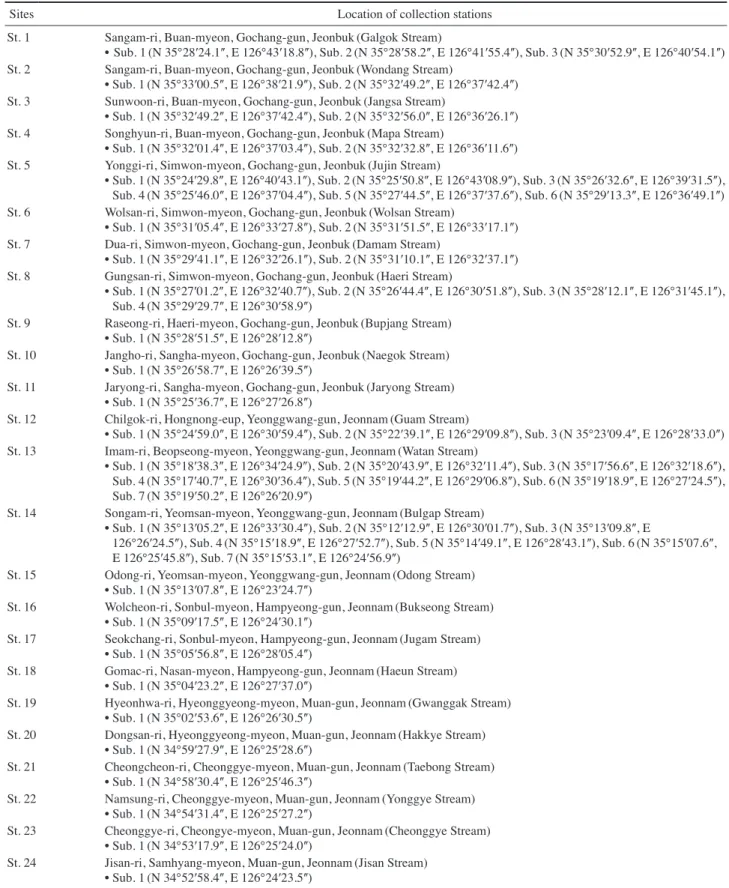
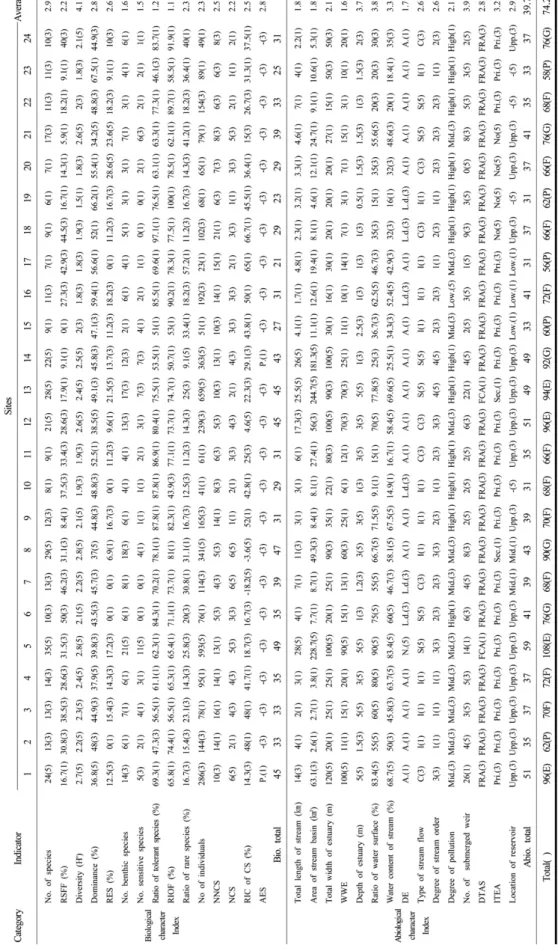
전라북도 고창군 부안면부터 전라남도 무안군 삼향면 에 이르기까지 서해로 유입되는 24개 독립하천을 대상으로 2016년 3월부터 10월까지 현지조사를 실시하였다. 하천 길이 가 10km 미만인 독립하천은 1~2개 조사지점을, 10~20km 인 독립하천은 3~4개 조사지점을, 20km 이상의 독립하천 은 5~7개의 조사지점을 선정하여 조사를 실시하였고(Table 1, Fig. 1), 그 출현 결과를 합산하였다(Table 2).
어류의 채집은 투망(망목, 5×5mm, 20회), 족대(4×4mm, 30분)를 이용하여 조사하였다. 채집된 어류는 현지에서 동 정, 분류하고 종과 개체수를 확인 후 즉시 방류하였다. 표본 의 분류 및 동정은 Kim(1997)과 Youn(2002)에 의하여 실
시하였다. 분류 체계는 Nelson(2006)에 따랐다. 각 독립하천 에서 확인된 출현종과 출현 개체수의 결과를 근거로 종다양 성 지수(Shannon and Weaver 1963)를 산출하였다. 생물상 조사와 더불어 하구둑, 수중보 존재 여부 및 하천 현황 등의 지형적 특성을 동시에 조사하였다.
2. 수생태계 건강성 평가
본 연구 대상 지역의 독립하천에 대한 수생태계 건강성 평 가를 실시하기 위하여 생물 및 비생물 평가지수(Biological and Abiological character index; BAc index)를 새롭게 작성 하여 연구결과에 활용하였다(Table 3). 생물 평가지수(Bio- logical character index)는 Karr(1981)와 An et al.(2001a) 이 제시한 생물보전지수(IBI) 모델에 기초하였고 추가적으 로 과거 어류상의 출현 결과(Choi 1988; Choi 1989)와 비 교한 어류상 출현 결과 등 총 15개의 평가지수를 선정하였 다(Table 3). 비생물 평가지수(Abiological character index) 는 정량적 서식처 평가지수(QHEI), 하천 자연도 평가 및 연 안 생태계 건강성 평가 방법을 기초로 하여 총 15개의 평가 지수를 선정하였다(Plafkin et al. 1989; Barbour et al. 1999;
Fig. 1. Map showing the sampling sites for this study. See the Ta- ble 1 for Site number.
Table 1. Sampling sites for this study
Sites Location of collection stations
St. 1 Sangam-ri, Buan-myeon, Gochang-gun, Jeonbuk(Galgok Stream)
• Sub. 1(N 35°28ʹ24.1ʺ, E 126°43ʹ18.8ʺ), Sub. 2(N 35°28ʹ58.2ʺ, E 126°41ʹ55.4ʺ), Sub. 3(N 35°30ʹ52.9ʺ, E 126°40ʹ54.1ʺ) St. 2 Sangam-ri, Buan-myeon, Gochang-gun, Jeonbuk(Wondang Stream)
• Sub. 1(N 35°33ʹ00.5ʺ, E 126°38ʹ21.9ʺ), Sub. 2(N 35°32ʹ49.2ʺ, E 126°37ʹ42.4ʺ) St. 3 Sunwoon-ri, Buan-myeon, Gochang-gun, Jeonbuk(Jangsa Stream)
• Sub. 1(N 35°32ʹ49.2ʺ, E 126°37ʹ42.4ʺ), Sub. 2(N 35°32ʹ56.0ʺ, E 126°36ʹ26.1ʺ) St. 4 Songhyun-ri, Buan-myeon, Gochang-gun, Jeonbuk(Mapa Stream)
• Sub. 1(N 35°32ʹ01.4ʺ, E 126°37ʹ03.4ʺ), Sub. 2(N 35°32ʹ32.8ʺ, E 126°36ʹ11.6ʺ) St. 5 Yonggi-ri, Simwon-myeon, Gochang-gun, Jeonbuk(Jujin Stream)
• Sub. 1(N 35°24ʹ29.8ʺ, E 126°40ʹ43.1ʺ), Sub. 2(N 35°25ʹ50.8ʺ, E 126°43ʹ08.9ʺ), Sub. 3(N 35°26ʹ32.6ʺ, E 126°39ʹ31.5ʺ), Sub. 4(N 35°25ʹ46.0ʺ, E 126°37ʹ04.4ʺ), Sub. 5(N 35°27ʹ44.5ʺ, E 126°37ʹ37.6ʺ), Sub. 6(N 35°29ʹ13.3ʺ, E 126°36ʹ49.1ʺ) St. 6 Wolsan-ri, Simwon-myeon, Gochang-gun, Jeonbuk(Wolsan Stream)
• Sub. 1(N 35°31ʹ05.4ʺ, E 126°33ʹ27.8ʺ), Sub. 2(N 35°31ʹ51.5ʺ, E 126°33ʹ17.1ʺ) St. 7 Dua-ri, Simwon-myeon, Gochang-gun, Jeonbuk(Damam Stream)
• Sub. 1(N 35°29ʹ41.1ʺ, E 126°32ʹ26.1ʺ), Sub. 2(N 35°31ʹ10.1ʺ, E 126°32ʹ37.1ʺ) St. 8 Gungsan-ri, Simwon-myeon, Gochang-gun, Jeonbuk(Haeri Stream)
• Sub. 1(N 35°27ʹ01.2ʺ, E 126°32ʹ40.7ʺ), Sub. 2(N 35°26ʹ44.4ʺ, E 126°30ʹ51.8ʺ), Sub. 3(N 35°28ʹ12.1ʺ, E 126°31ʹ45.1ʺ), Sub. 4(N 35°29ʹ29.7ʺ, E 126°30ʹ58.9ʺ)
St. 9 Raseong-ri, Haeri-myeon, Gochang-gun, Jeonbuk(Bupjang Stream)
• Sub. 1(N 35°28ʹ51.5ʺ, E 126°28ʹ12.8ʺ)
St. 10 Jangho-ri, Sangha-myeon, Gochang-gun, Jeonbuk(Naegok Stream)
• Sub. 1(N 35°26ʹ58.7ʺ, E 126°26ʹ39.5ʺ)
St. 11 Jaryong-ri, Sangha-myeon, Gochang-gun, Jeonbuk(Jaryong Stream)
• Sub. 1(N 35°25ʹ36.7ʺ, E 126°27ʹ26.8ʺ)
St. 12 Chilgok-ri, Hongnong-eup, Yeonggwang-gun, Jeonnam(Guam Stream)
• Sub. 1(N 35°24ʹ59.0ʺ, E 126°30ʹ59.4ʺ), Sub. 2(N 35°22ʹ39.1ʺ, E 126°29ʹ09.8ʺ), Sub. 3(N 35°23ʹ09.4ʺ, E 126°28ʹ33.0ʺ) St. 13 Imam-ri, Beopseong-myeon, Yeonggwang-gun, Jeonnam(Watan Stream)
• Sub. 1(N 35°18ʹ38.3ʺ, E 126°34ʹ24.9ʺ), Sub. 2(N 35°20ʹ43.9ʺ, E 126°32ʹ11.4ʺ), Sub. 3(N 35°17ʹ56.6ʺ, E 126°32ʹ18.6ʺ), Sub. 4(N 35°17ʹ40.7ʺ, E 126°30ʹ36.4ʺ), Sub. 5(N 35°19ʹ44.2ʺ, E 126°29ʹ06.8ʺ), Sub. 6(N 35°19ʹ18.9ʺ, E 126°27ʹ24.5ʺ), Sub. 7(N 35°19ʹ50.2ʺ, E 126°26ʹ20.9ʺ)
St. 14 Songam-ri, Yeomsan-myeon, Yeonggwang-gun, Jeonnam(Bulgap Stream)
• Sub. 1(N 35°13ʹ05.2ʺ, E 126°33ʹ30.4ʺ), Sub. 2(N 35°12ʹ12.9ʺ, E 126°30ʹ01.7ʺ), Sub. 3(N 35°13ʹ09.8ʺ, E
126°26ʹ24.5ʺ), Sub. 4(N 35°15ʹ18.9ʺ, E 126°27ʹ52.7ʺ), Sub. 5(N 35°14ʹ49.1ʺ, E 126°28ʹ43.1ʺ), Sub. 6(N 35°15ʹ07.6ʺ, E 126°25ʹ45.8ʺ), Sub. 7(N 35°15ʹ53.1ʺ, E 126°24ʹ56.9ʺ)
St. 15 Odong-ri, Yeomsan-myeon, Yeonggwang-gun, Jeonnam(Odong Stream)
• Sub. 1(N 35°13ʹ07.8ʺ, E 126°23ʹ24.7ʺ)
St. 16 Wolcheon-ri, Sonbul-myeon, Hampyeong-gun, Jeonnam(Bukseong Stream)
• Sub. 1(N 35°09ʹ17.5ʺ, E 126°24ʹ30.1ʺ)
St. 17 Seokchang-ri, Sonbul-myeon, Hampyeong-gun, Jeonnam(Jugam Stream)
• Sub. 1(N 35°05ʹ56.8ʺ, E 126°28ʹ05.4ʺ)
St. 18 Gomac-ri, Nasan-myeon, Hampyeong-gun, Jeonnam(Haeun Stream)
• Sub. 1(N 35°04ʹ23.2ʺ, E 126°27ʹ37.0ʺ)
St. 19 Hyeonhwa-ri, Hyeonggyeong-myeon, Muan-gun, Jeonnam(Gwanggak Stream)
• Sub. 1(N 35°02ʹ53.6ʺ, E 126°26ʹ30.5ʺ)
St. 20 Dongsan-ri, Hyeonggyeong-myeon, Muan-gun, Jeonnam(Hakkye Stream)
• Sub. 1(N 34°59ʹ27.9ʺ, E 126°25ʹ28.6ʺ)
St. 21 Cheongcheon-ri, Cheonggye-myeon, Muan-gun, Jeonnam(Taebong Stream)
• Sub. 1(N 34°58ʹ30.4ʺ, E 126°25ʹ46.3ʺ)
St. 22 Namsung-ri, Cheonggye-myeon, Muan-gun, Jeonnam(Yonggye Stream)
• Sub. 1(N 34°54ʹ31.4ʺ, E 126°25ʹ27.2ʺ)
St. 23 Cheonggye-ri, Cheongye-myeon, Muan-gun, Jeonnam(Cheonggye Stream)
• Sub. 1(N 34°53ʹ17.9ʺ, E 126°25ʹ24.0ʺ)
St. 24 Jisan-ri, Samhyang-myeon, Muan-gun, Jeonnam(Jisan Stream)
• Sub. 1(N 34°52ʹ58.4ʺ, E 126°24ʹ23.5ʺ) Sub.: Subordinate sites.
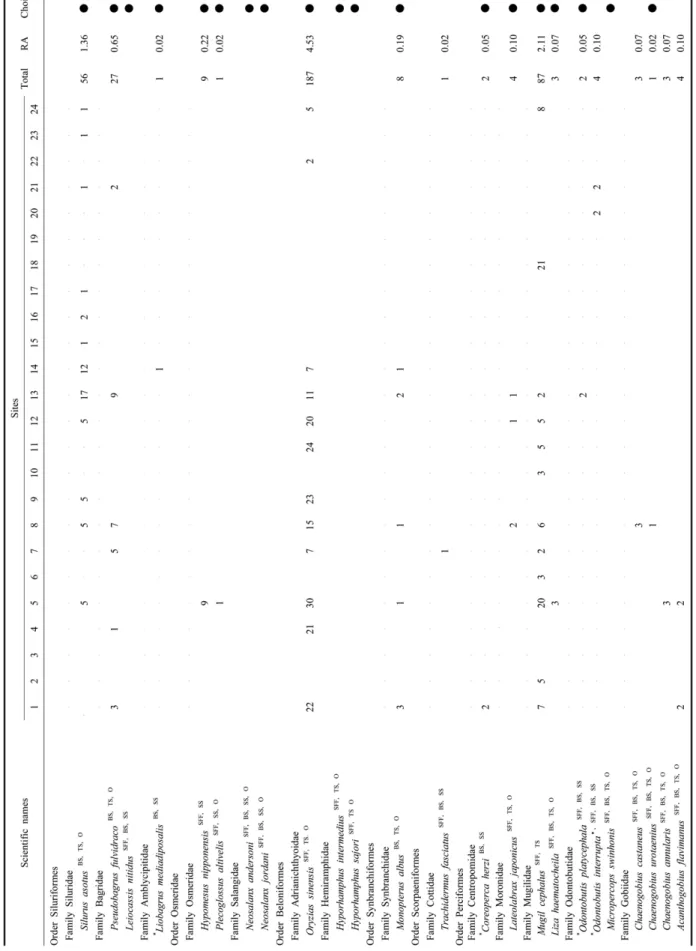
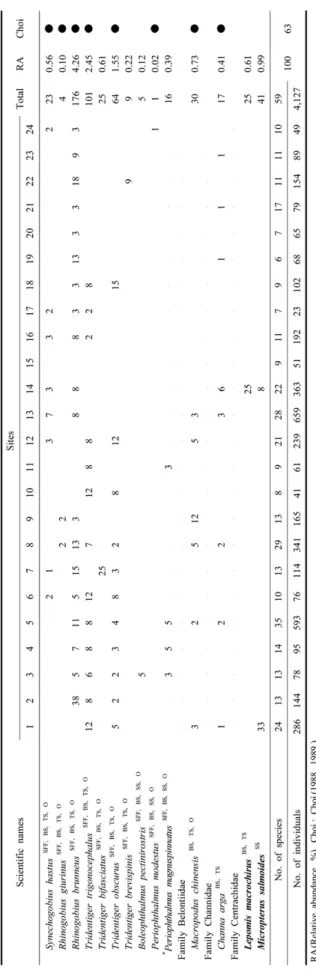
Table 2. List of the fishes collected in the independent streams flowing into the Yellow Sea in Jeonnam and Jeonbuk, Korea
Table 2. Continued
An et al. 2001b; Park et al. 2005; Kim et al. 2007). 총 30개 평가지수에 대한 기준은 Karr(1981)와 An et al.(2001a)이 제시한 방법을 소규모 독립하천의 특성에 맞게 변경 적용하 였으며, 가중치는 각 평가지수마다 “5”, “3”, “1”로 적용하였 다(Table 3). 수생태계 건강성 평가 단계는 An et al.(2001a) 의 등급 기준에 의거하였으며, 본 연구에서는 30개 평가지 수의 결과를 종합하여 4단계로 수정하여 구분하였다(Han et al. 2013). BAc index 값이 148~94의 범위는 최적 단계 (Excellent), 93~76은 양호 단계(Good), 75~65는 보통 단 계(Fair), 64~30은 불량 단계(Poor)로 대별하여 평가하였다.
생물 평가지수와 비생물 평가지수의 상관관계 분석을 위해 통계분석(SPSS 20.0)을 실시하였다.
결과 및 고찰
1. 어류상
본 연구를 통하여 확인된 어류는 총 8목 18과 44속 59종 4,127개체로 확인되었다(Table 2). 채집된 어류 중에서 잉어 목(Cypriniformes)이 26종(RA: 44.1%)으로 가장 많았다. 다 음은 농어목(Perciformes)이 24종(40.7%)으로 확인되었다.
잉어과(Cyprinidae) 어류가 많이 출현하여 우리나라 서해와 남해로 흐르는 하천의 특성과 일치하였다(Na 1994; Byeon and Lee 2006; Choi and An 2008; Baek et al. 2013; Park and Joo 2015). 일차 담수어류는 피라미(Zacco platypus), 붕어 (Carassius auratus) 및 참붕어(Pseudorasbora parva) 등의 35종(59.3%)이 출현하였고 이차 담수어류는 밀어(Rhinogo- bius brunneus), 두줄망둑(Tridentiger trigonocephalus) 및 숭 어(Mugil cephalus) 등의 24종(40.7%)이 확인되었다(Table 2). 우점종은 피라미(Z. platypus)(RA: 25.2%), 아우점종은 붕어(C. auratus)(RA: 11.1%)로 확인되었다. 이들 종은 하 천 중·하류에서 흔히 출현하며 수질오염에 대한 내성이 강 한 어종이다(Kim et al. 2014). 희소종은 참종개(Iksookimia koreensis), 자가사리(Liobagrus mediadiposalis) 및 은어 (Plecoglossus altivelis) 등 6종으로 전체 조사를 통하여 1개 체씩(RA: 0.02%) 출현하였다. 종합하면 정수성 담수어류가 우점하여 출현하는 양상을 나타내었다(Table 2). 이러한 종 조성을 나타낸 것은 본 연구지역이 하류는 기수역에 포함되 며 상류는 과거 수십 년 동안 이·치수를 위해 설치된 수중 보와 제방, 농경지 개발 등의 인위적 간섭에 의해 유수역에 서 정수역으로의 변화에 따른 결과로 사료된다(An and Kim 2005; Choi and An 2008; Park and Joo 2015).
47속 63종의 서식을 확인한 선행연구결과와 비교하여
Table 2. Continued
본 연구에서 출현하지 않은 어류는 칠성장어(Lampetra japonica), 다묵장어(L. reissneri) 및 웅어(Coilia nasus) 등의 16종이었다(Choi 1988; Choi 1989). 칠성장어(L. japonica) 는 동해의 독립하천에서 서식하는 종으로, 선행기록은 오동 정으로 사료된다(Shim 1992). 다묵장어(L. reissneri)는 물 이 맑고 소와 여울이 잘 발달되어 있으며, 중상류 지역의 하 상이 펄과 모래로 이루어진 하천에서 서식한다고 알려져 있다(Shim 1992; Yamazaki and Goto 2000; Sugiyama and Goto 2002; Takayama 2002). 지난 30년간 산업화 및 도시 화에 따른 수환경 변화로 본 연구에서는 출현하지 않는 것 으로 사료된다. 웅어(C. nasus), 싱어(C. mystus) 및 도화뱅 어(Neosalanx andersoni) 등의 회유성 어종은 대부분 3~4 월 산란회유를 위하여 하천의 하구나 상류로 이동하는데, 하 천에 설치된 수중보와 하구에 설치된 방조제 등이 어류의 이동을 방해하여 출현하지 않는 것으로 판단된다(Poff and
Hart 2002; Poulet 2007; Mins and Olden 2013). 과거 연구 결과와 비교하여 새롭게 확인된 어류는 끄리(Opsariichthys bidens), 꺽정이(Trachidermus fasciatus) 및 얼록동사리 (Odontobutis interrupta) 등의 12종이었다(Table 2).
한국고유종은 각시붕어(Rhodeus uyekii), 가시납지리 (Acanthorhodeus gracilis) 및 긴몰개(Squalidus gracilis majimae) 등 12종(출현율: 20.3%)으로 확인되었다(Table 2).
이는 우리나라 하천의 고유화 비율인 28.8%보다 낮은 것으 로 비교되며(Lee et al. 2008), 유로연장이 짧고 바다로 직접 유입되는 하천의 특성으로 사료된다(Choi et al. 1992; Hong et al. 1999; Lee et al. 2004). 외래종으로 확인된 배스(Microp- terus salmoides)는 갈곡천(St. 1, 33개체), 불갑천(St. 14, 8개체)에서 총 41개체가 출현하였고, 블루길(Lepomis macrochirus)은 불갑천(St. 14)에서 25개체가 출현하였다.
외래종 출현은 독립하천에 조성된 인공저수지에서 일어난 Table 3. The biological and abiological characters index(BAc index) of matrix for this study
Category Indicators Scoring criteria
5 3 1
Biological character Index
B1: No. of species B2: RSFF(%) B3: Diversity(Hʹ) B4: Dominance(%) B5: RES(%)
B6: No. benthic species B7: No. sensitive species B8: Ratio of tolerant species(%) B9: RIOF(%)
B10: Ratio of rare species(%) B11: No of individuals B12: NNCS
B13: NCS B14: RIC of CS(%) B15: AES
>19
>51
>2.0 20-39
>20
>20
>10
<20
<20
<10
>299
<0
>3
<10 -
10-19 50-20 1.99-1.49
40-50 10-20 10-20 5-10 20-50 20-50 10-30 100-299
0-10 10-302-3 Absent
<10
<20
<1.5
<20, >50
<10
<10
<5
>50
>50
>30
<100
>10
<2
>30 Present
Abiological character Index
Ab1: Total length of stream(km) Ab2: Area of stream basin(km2) Ab3: Total width of estuary(m) Ab4: WWE
Ab5: Depth of estuary(m) Ab6: Ratio of water surface(%) Ab7: Water content of stream(%) Ab8: DE
Ab9: Type of stream flow Ab10: Degree of stream order
Ab11: Degree of pollution(Water color, odor) Ab12: No. of submerged weir
Ab13: DTAS Ab14: ITEA
Ab15: Location of reservoir
>19
>79
>99
>79
>2.9
>50
>50 Natural
S type
>4 Low(Clean)
<5 Natural
NoNo
10-19 40-79 50-99 30-79 1.0-2.9
20-50 30-50 Low development
Curve type Middle(Yellowish brown)4-3
5-10 PrimaryFRA
Upper
<10
<40
<50
<30
<1.0
<20
<30 Artifical Line type
<3
High(Greenish brown, stink)
>10 Secondary or moreFCA
Mid/lower
RSFF: Ratio of Secondary freshwater fish, RES: Ratio of Endemic species, RIOF: Ratio of individuals of omnivore fish, NNCS: No. of no confirmed species with Choi(1988, 1989), NCS: No. of new confirmed species with Choi(1988, 1989), RIC of CS: Ratio of increase and decrease in confirmed species, AES:
Appearance of Exotic species, WWE: Water width of estuary, DE: Development type of estuary, DTAS: Development type around stream, FRA: Farm and residental area, FCA: Farm and city area, ITEA: Industrial type of estuary around.
Table 4. Results analyzed of the BAc index for this study
인위적 방류의 결과로 추측된다(Ross 1991; Martinez et al.
1994; Hong and Son 2003; Ko et al. 2008; Lee et al. 2009).
학계천(St. 20)과 태봉천(St. 21)에서 출현한 얼록동사리 (Odontobutis interrupta)는 인위적으로 이입되어 분포하는 것으로 확인되었다(Park and Joo 2015).
2. BAc index의 상관관계와 수생태계 건강성 평가 본 연구지역에 해당되는 24개 독립하천의 수생태계 건 강성 평가는 생물 및 비생물의 30개 평가지수(BAc Index) 를 선정하여 시행하였다(Tables 3, 4). 일반적으로 상관관계 는 두 변수 간의 상관 여부를 파악하는 통계적인 선형적 상 관도를 의미하며, 상관계수의 절대값이 ‘1’에 가까울수록 강 한 선형관계를 나타낸다(Lee and Im 2008). 총 30개 평가지 수 가운데, 14개 평가지수에서 통계적으로 유의한(p<0.01 또는 0.05) 상관관계가 확인되었다(Table 5). 희소종 빈도는 출현 종수 변화율과 비교하여 -0.830으로 뚜렷한 음의 상 관관계로 희소종 빈도가 감소함에 따라 출현 종수 변화율이 증가하는 일반적인 경향을 보였다. 외래종 출현은 출현 종수 (0.332), 유역 면적(0.349) 및 오염도(0.495) 등과 비교적 뚜 렷한 양의 상관관계를 보여 다양한 어종과 넓은 서식 면적 이 외래종 출현에 영향을 주는 것으로 확인되었다. 이차 담 수어 빈도는 고유종 빈도와 -0.607의 높은 음의 상관관계 를 보인 반면, 수중보 수와는 0.082의 낮은 양의 상관관계를 보였다. 이러한 결과는 이차 담수어의 서식지가 바다와 인접 한 하류지역에 집중된 결과로 사료된다. 본 연구 결과로 확 인된 출현 종수는 유역 면적, 수면폭 비, 오염도 및 수중보 수와 각각 0.804, 0.665, 0.747, 0.263으로 양의 상관관계를 보였지만, 우점도와 저서종 수는 모두 음의 상관관계를 보여 생물 평가지수가 비생물 평가지수에 영향을 받는 것으로 확 인되었다. 또한, 출현 종수 변화율, 고유종 빈도 및 출현 종 수의 결과는 환경적 요소에 해당되는 유역 면적, 수면폭 비, 오염도, 수중보 수와 상대적으로 높은 양의 상관관계를 보 여 생물 평가지수와 비생물 평가지수를 활용한 BAc Index 가 국내 독립하천 평가에 필요한 지표임을 나타내고 있다 (Table 5). 나머지 16개 평가지수는 통계적으로 유의하지는 않았으나(p>0.05) 포괄적인 독립하천 평가를 위한 상호 보 완적인 필요 평가지수로 사료된다.
본 연구 대상 지역인 전체 독립하천들의 수생태계 건강 성 평가지수는 이론적으로 최고 148BAc Index와 최저 30 BAc Index이다. 수생태계 건강성 평가에 대한 본 연구결과 를 종합해보면, 전체 24개 독립하천들의 BAc Index는 4단계 (Excellent·Good·Fair·Poor)로 구분된다(Table 6, Fig. 2).
총 30개 평가지수의 합산 점수가 94~108BAc Index를 보 Table 5.
The correlation coefficients of 14 variables among BAc index B14B10B15B2B5B1B4B6B12Ab2Ab6Ab11Ab12Ab15 B14 B10 B15 B2 B5 B1 B4 B6 B12 Ab2 Ab6 Ab11 Ab12 Ab15
1 -.830**
.281** -.161
.279 .899** -.294 -.050**
.075** .926** .588** .797** .84 -.530**
1 .091** .032* -.288 -.666** .115**
.050** -.109** -.848** -.570** -.495** .022** .357*
1 -.287 .046 .332 -.228 -.312 .109* .349 .154 .495* -.022 -.051
1 -.607** -.121 -.074 .158 .098* -.182 -.083 -.231 .082 -.121
1 .178 .019 .184 .089 .279 .271 .295 -.072 .305
1 -.576** -.191** -.006** .804** .665** .747** .263 -.518**
1 .298 .007 -.222 -.479* -.415** -.295 .261
1 -.125** -.206** -.218** -.043** -.057 .112**
1 .095** .150** -.106** .216 .138
1 .507** .783** -.054 -.401
1 .395** .216 -.467*
1 -.044** -.388
1 -.1591 **: p0.01, *: p0.05, B: Ratio of increase and decrease in confirmed species, B: Ratio of rare species, B: Appearance of Exotic species, B: Ratio of Secondary freshwater fish, B: Ratio of Endemic<<14101525 species, B: No. of species, B: Dominance B: No. of benthic species, B: No. of no confirmed species with Choi(1988, 1989), Ab: Area of stream basin, Ab: Ratio of water surface, Ab: Degree of pollution, 146122611 Ab12: No. of submerged weir, Ab15: Location of reservoir
인 갈곡천(St. 1), 주진천(St. 5) 및 구암천(St. 12) 등의 4개 독립하천은 최적 단계(Excellent)를 나타냈다. 최적 단계인 94 이상의 BAc Index로 평가된 독립하천들은 하천 길이가 14km보다 길며, 유역 면적이 56km2 이상으로 하천 규모가 발달되는 환경적 요소를 갖추었을 뿐만 아니라 어류 서식에 영향을 미치는 다양한 미세 서식처가 형성되어 있기 때문인 것으로 사료된다. 76~92BAc Index를 나타내어 양호 단계 (Good)로 평가된 독립하천은 월산천(St. 6), 담암천(St. 7) 및 해리천(St. 8) 등의 5개 독립하천으로 확인되었다. 이들 독 립하천 가운데, 해리천(St. 8)은 생물 평가지수가 비생물 평 가지수보다 높게 나타나 다른 독립하천들과 차이를 보였다 (Fig. 2). 해리천(St. 8)은 하천 중류에 넓게 조성된 궁산저수 지의 환경적 요소에 의하여 생물 평가지수에 포함되는 출현 종수, 다양도, 고유종 빈도, 저서 종수, 민감 종수 및 전체 출 현 개체수의 6개 평가지수가 큰 값을 나타냈다. 66~72BAc Index를 나타내어 보통 단계(Fair)로 평가된 독립하천은 원 당천(St. 2), 장사천(St. 3) 및 마파천(St. 4) 등의 10개 독립 하천으로 확인되었다. 보통 단계(Fair)로 평가된 독립하천들
의 생물 평가지수와 비생물 평가지수는 대칭되는 출현 양상 을 나타냈다(Fig. 2). 60BAc Index 이하로 확인되어 불량 단 계(Poor)의 수생태계 건강성 평가 결과를 나타낸 내곡천(St.
10), 오동천(St. 15) 및 죽암천(St. 17) 등의 5개 독립하천들 의 경우 하천 길이가 매우 짧고 하천 유역 면적이 협소한 환 경적 요소로 인하여 생물 평가지수와 비생물 평가지수가 현 저히 낮게 나타난 것으로 사료된다(Table 6, Fig. 2).
본 수생태계 건강성 평가 결과에서 확인된 평가 단계가 보통 단계(Fair)에서 불량 단계(Poor)로 낮아질수록 각 평 가 단계로 분류되는 독립하천들의 생물 평가지수 결과는 비 생물 평가지수 결과에 비해서 불량 단계(Poor)로 확인된 독 립하천들에서 급격히 낮아지는 경향이 나타났다(Fig. 2). 보 통~불량 단계(Fair~Poor)로 평가된 독립하천들은 하천 길 이가 7km 미만인 지형적 특성을 나타내고 있다. 따라서 현 재 보통 단계(Fair)로 평가된 독립하천은 오염원 노출, 하천 개발 및 하천 훼손 등의 영향을 받을 경우 불량 단계(Poor) 로 변화될 가능성이 상대적으로 클 것으로 사료된다. 이 러한 수생태계 건강성 평가 결과의 하락현상은 최적 단계 Table 6. A summary of the results analyzed of the BAc index for this study
Integrity class Excellent Good Fair Poor
Stie no.
Total score Bio. score(B) Abio. score(A) B-A: ▲ B-A: ▼
1085 4959 -10
961 4551 -6
1296 4551 -6
1394 4549 -4
1492 4349 -6
908 4743 4
2180 3941 -2
787 3939
766 3541 -6
724 3537 -2
1672 3141 -10
703 3337 -4
709 3139 -8
682 3335 -2
2268 3335 -2
2468 3137 -6
1166 3135 -4
1866 2937 -8
2066 2937 -8
1060 2931 -2
1560 2733 -6
2358 2533 -8
1754 2331 -8
1952 2131
-10 See the Table 1 for Site number
Fig. 2. Comparison of results analyzed of the BAc index for this study. See the Table 1 for Site number.
65 60 55 50 45 40 35 30 25 20
Biological character index
Abiological character index
Excellent Good Fair Poor
Score
St.5 St.1 St.12 St.13 St.14 St.8 St.21 St.7 St.6 St.4 St.16 St.3 St.9 St.2 St.22 St.24 St.11 St.18 St.20 St.10 St.15 St.23 St.19 St.17
(Excellent)로 평가된 독립하천들을 포함하여 모든 독립하천 에서 잠재적 가능성을 배제할 수 없으며, 이에 향후 예상되 는 하천 오염원의 억제 및 차단이 절실히 요구될 뿐만 아니 라 보통~불량 단계(Fair~Poor)로 평가된 독립하천들에 대 해 복원 대책이 필요할 것으로 사료된다.
적 요
본 연구는 서해로 유입되는 전남과 전북의 24개 독립하 천들을 대상으로 2016년 3월부터 10월까지 어류상을 조사 하고, 생물 및 비생물 평가지수(BAc index)를 선정하여 수 생태계 건강성 평가를 실시하였다. 출현 어류는 총 18과 44 속 59종 4,127개체가 확인되었다. 우점종은 피라미(Zacco platypus)로 확인되었다. 한국고유종은 각시붕어(Rhodeus uyekii) 등 12종이었다. BAc index는 통계적으로 유의한(p<
0.01 또는 0.05) 상관관계가 확인되었다. 수생태계 건강성 평가의 단계별 분포는 보통 단계(Fair)가 41.7%로 가장 높 은 비율을 나타냈다. 양호 단계(Good)와 불량 단계(Poor)는 20.8%, 최적 단계(Excellent)는 16.7%로 각각 나타났다. 독 립하천의 수생태계 건강성은 생물학적 평가지수보다 지형적 특성, 인위적·자연적 제한 요소에 따른 비생물학적 평가지 수의 영향을 더 받는 것으로 확인되었다.
REFERENCES
An KG, DH Yeom and SK Lee. 2001a. Rapid bioassessments of Kap stream using the index of biological integrity. Kore- an J. Environ. Biol. 19:261-269.
An KG, SH Jung and SS Choi. 2001b. An evaluation on health conditions of Pyong-Chang river using the index of biolog- ical integrity(IBI) and qualitative habitat evaluation index (QHEI). Korean J. Limnol. 34:153-165.
An KG and JH Kim. 2005. A diagnosis of ecological health using a physical habitat assessment and multimetric fish model in Daejeon stream. Korean J. Limnol. 38:367-371.
An KG and EH Lee. 2006. Ecological health assessment of Yoogu stream using a fish community metric model. Kore- an J. Limnol. 39:310-319.
Bae DY and KG An. 2006. Stream ecosystem assessments, based on a biological multimetric parameter model and water chemistry analysis. Korean J. Limnol. 39:198-208.
Baek SH, JD Yoon, JH Kim, HJ Lee, KR Choi and MH Jang.
2013. Characteristics of fish community in the Seomjin riv- er and brackish area. Korean J. Environ. Biol. 31:402-410.
Barbour MT, J Gerritsen, BD Snyder and Jb Stribling. 1999.
Rapid bioassessment protocols for use in streams and wadeable rovers: Periphyton, benthic macroinvertebrates and fish. EPA 841-B-99-002(2nd ed.). Office of Water, US EPA, Washington, DC, USA.
Byeon HK and WO Lee. 2006. The ichthyofauna and fish community in the lower course of the Imjin river. Korean J.
Limnol. 39:32-40.
Cho KJ, JK Shin, SK Kwak and OH Lee. 1998. Diatom Genus Stephanodiscus as eutrophicatlon for water quallity assess- ment. Korean J. Limnol. 31:204-210.
Choi JW and KG An. 2008. Characteristics of fish compositions and longitudinal distribution in Yeongsan river watershed.
Korean J. Limnol. 41:301-310.
Choi JW and KG An. 2013. Ecological health assessments on stream order in Southern Han River watershed and physi- cal habitat assessments. Korean J. Environ. Biol. 31:440- 447.
Choi JK, HS Shin, O Mitamura and SJ Kim. 2008. Health as- sessment of aquatic ecosystem for Wonju stream using the composition of aquatic insects. Korean J. Environ. Eco.
22:544-550.
Choi KC. 1988. Nature of Jeonbuk(Freshwater Fishes). Jeolla- buk-do Education Committee. p. 386.
Choi KC. 1989. Nature of Jeonnam(Freshwater Fishes). Jeolla- nam-do Education Committee. p. 399.
Choi CG, JB Lee and YJ Hwang. 1992. On the ichthyofauna of Paikchon streams, Puan, Cholla-bukdo, Korea. Korean J.
Ichthyol. 4:63-71.
Han JH, HM Kim and KG An. 2013. Chemical water quality and multi-metric eco-health model assessments in Baekma river. Korean J. Environ. Biol. 31:96-104.
Hong YP and YM Son. 2003. Studies on the interspecific as- sociation of community including Micropterus salmoides population, introduced fish in Korea. Korean J. Ichthyol.
15:61-68.
Hong YP, MH Chang, H Kang and SS Choi. 1999. The fish community of the Ungchon stream around the new dam intended area. Korean J. Environ. Biol. 17:79-88.
Jo MH, JS Sim, JA Lee and SH Jang. 2015. Health assessment of the Nakdong river basin aquatic ecosystems utilizing GIS and spatial statistics. Korean J. Geo. Info. 18:174-189.
Jung HY, HK Kyeong, YS Mi and WO Lee. 2014. Character- istics of fish fauna and community structure in Ungcheon stream due to the environmental changes. Korean J. Envi- ron. Eco. 28:314-325.
Kang YH, BS Chae and HJ Yang. 2001. Evaluation of water quality in the Keumho river system according to the fresh- water fishes. J. Environ. Sci. Int. 10:225-231.
Karr JR. 1981. Assessment of biotic integrity using fish com- munities. Fisheries 6:21-27.
Kim IJ and DH Han. 2008. A small stream management plan to protect the aquatic ecosystem. Korea Institute of Policy Evaluations. p. 167.
Kim IS. 1997. Illustrated encyclopedia of fauna & flora of Ko- rea. 37(Freshwater Fishes). Ministry of Education. p. 629.
Kim JS, SM An and WS Gwak. 2014. Ichthyofauna of stream on Goseong in Gyeongsangnam-do, Korea. Korean J. Ich- thyol. 26:322-330.
Kim YO, HW Choi, MC Jang, PK Jang, WJ Lee, K Shin and M Jang. 2007. A brief review of approaches using plank- tonic organisms to assess marine ecosystem health. Ocean Polar Res. 29:327-337.
Kim YO, WJ Shin and KD Yum. 2007. Implications for coastal ecosystem health assessments and their applications in Ko- rea. Ocean Polar Res. 29:319-326.
Ko MH, JY Park and YJ Lee. 2008. Feeding habits of an in- troduced largemouth bass, Micropterus salmoides(Perci- formes; Centrachidae) and its influence on ichthyofauna in the lake Okjeong, Korea. Korean J. Ichthyol. 20:36-44.
Lee HS and JH IM. 2008. Statistical package for the social sci- ences. p. 561.
Lee JH, KH Han, WI Seo, SM Yoon, CC Kim, SY Hwang and KS Kim. 2004. Ichthyofauna and fish community of Sora Stream in Yeosu, Korea. Korean J. Ichthyol. 16:348-365.
Lee Wo, H Yang, SW Yoon and JY Park. 2009. Study on the feeding habits of Bass(Micropterus salmoides) in Paldang and Togyoji. Autumn academic presentation of Korean J.
Ichthyol. p. 128.
Lee WO, KH Kim, JH Kim and KE Hong. 2008. Study of freshwater fish fauna and distribution of introduced species of Mankyeong river, Korea. Korean J. Ichthyol. 20:198- 209.
Martinez PJ, TE Chart, MA Trammell, JG Wullschleger and EP Bergersen. 1994. Fish species composition before and after construction of a main stem reservoir on the White river, Colorado. Environ. Biol. Fish. 40:227-239.
Mins MC and JD Olden. 2013. Fish assemblages respond to altered flow regimes via ecological filtering of life history strategies. Freshw. Biol. 58:50-62.
Ministry of Environment. 2007. A final report on river resto- ration models and standards for recovering aquatic ecolog- ical health. Ministry of Environment. p. 145.
Nelson JS. 2006. Fishes of the world(4th ed.). John Wiley &
Sone. New York. p. 601.
Na CS. 1994. Fish fauna in the Tamjin river, Korea. Korean J.
Ichthyol. 6:244-250.
Plafkin JL, MT Barbour, KD Porter, SK Gross and RM Hughes.
1989. Rapid assessment protocols for use in streams and rivers: benthic macroinvertebrates and fish, EPA/444/4-89- 001, Office of Water, US EPA, Washington, DC, USA.
Park BJ, JI Shin and KS Jung. 2005. The evaluation of river naturalness for biological habitat restoration: Ⅰ. Proposal of evaluation method. J. Korea Water Resour. Assoc. 38:37- 48.
Park SK and HS Joo. 2015. Fish fauna in the Seomjin river, Korea. Korean J. Environ. Biol. 33:314-329.
Poff NL and DD Hart. 2002. How dams vary and why it mat- ters for the emerging science of dam removal. Bioscience 52:659-668.
Poulet N. 2007. Impact of weirs on fish communities in a pied- mont stream. River Res. Applic. 23:1038-1047.
Ross ST. 1991. Mechanisms structuring stream fish assem- blages: are there lessons from introduced species. Environ.
Biol. Fish. 30:359-368.
Shannon CE and W Weaver. 1963. The mathematical theory of communication. University of Illinois press, Urbana. p.
Shim JH. 1992. A Systematic Study on the genus Lampetra177.
(Agnatha, Petromyzonidae) from Korea. Chonbuk National University. Doctoral Thesis. p. 150.
Song HB, HM Baek and CW Lee. 2005. Water environmental assessment by the species biotic index of freshwater fish in the Namdaecheon, Gangneung city. J. Environ. Impact Assess. 14:237-245.
Sugiyama H and A Goto. 2002. Habitat selection by larvae of afluvial lamprey, Lethenteron reissneri, in a small stream and an experimental aquarium. Ichthyol. Res. 49:62-68.
Takayama M. 2002. Spawning activities and physical charac- teristics of the spawning ground of Lethenteron reissneri at the headstream of the Himekawa river, central Japan.
Ichthyol. Res. 49:165-170.
Yamazaki Y and A Goto. 2000. Breeding season and nesting assemblages in two forms of Lethenteron reissneri, with reference to reproductive isolating mechanisms. Ichthyol.
Res. 47:271-276.
Youn CH. 2002. Fishes of Korea with pictorial key and sys- tematic list. Academy-book. p. 747.
Received: 7 September 2017 Revised: 23 November 2017 Revision accepted: 23 November 2017