Print ISSN: 2288-4637 / Online ISSN 2288-4645 doi:10.13106/jafeb.2021.vol8.no1.451
The Impact of Service Quality on Customer Satisfaction: The Role of Price
Sri Lestari PRASILOWATI
1, Suyanto SUYANTO
2, Julia SAFITRI
3, Mursida Kusuma WARDANI
4Received: September 30, 2020 Revised: November 22, 2020 Accepted: December 05, 2020
Abstract
This research seeks to find out how to provide satisfaction to consumers. The aim is to analyze and test empirically the effect of price and sales promotion on customer satisfaction that is mediated by service quality. This study uses primary data; questionnaires are distributed to 100 consumers at the Jingga Project boutique. The sampling technique uses simple random sampling. The data were collected using a questionnaire measured by a Likert scale with analysis tools using Warp PLS 7.0. The results showed that the variables price and sales promotion have a positive effect on customer satisfaction. Furthermore, the mediating variable, namely, service quality, is proven to be able to indirectly mediate the effect of price and sales promotion on customer satisfaction. In line with the marketing theory, which states that customer satisfaction is the feeling of pleasure or disappointment of someone who appears after comparing the performance (results) of the product against the expected performance. From the results of this study, it is clear that the variables price and sales promotion significantly affect customer satisfaction, as well as service quality, which is the mediating variable in this study. Service quality indirectly or partially mediate the effect of price on customer satisfaction.
Keywords: Service Quality, Marketing Mix, Price, Customer Satisfaction JEL Classification Code: G21, G24, G29
assessment on the minds of consumers so that consumers’
assessments of product promotion directly or indirectly will create an image for a product (Ryu & Han, 2010). Malik, Ghafoor, and Iqbal (2012) stated that price is the only element in the various elements of the retail marketing mix that will bring profit to retailers. In terms of price strategy, price is one of the elements that influence the activities of the company, which operated to create a competitive advantage. However, it often clashes with pricing policies. Pricing by companies must be adjusted to the environmental situation and changes that occur, especially when competition is getting tighter and demand is getting limited. In the current climate of intense competition, companies must pay attention to the price factor, because the level of the price set will greatly affect the company’s ability to compete and also be able to influence consumers to buy its products. To be more competitive in the market, companies can consider competitors’ pricing as a guide in determining the selling price of their products.
According to Singh and Sirdeshmukh (2000), service quality is a form of consumer assessment of the level of service received (perceived service) with the level of service expected (service). The positive impact of good service will increase customer satisfaction and loyalty as well as the desire to repurchase, which of course will increase the income received from products that have been sold (Fornell, Johnson, Anderson, Cha, & Bryant, 1996).
1
First Author and Corresponding Author. Lecturer, Sekolah Tinggi Ilmu Ekonomi IPWI Jakarta, Indonesia [Postal Address: RT.6/RW.4, Tebet Bar., Kec. Tebet, Kota Jakarta Selatan, Daerah Khusus Ibukota Jakarta 12810, Indonesia] Email: [email protected]
2
Lecturer, Sekolah Tinggi Ilmu Ekonomi IPWI Jakarta, Indonesia.
Email: [email protected]
3
Lecturer, Sekolah Tinggi Ilmu Ekonomi IPWI Jakarta, Indonesia.
Email: [email protected]
4
Lecturer, Sekolah Tinggi Ilmu Ekonomi IPWI Jakarta, Indonesia.
Email: [email protected]
© Copyright: The Author(s)
This is an Open Access article distributed under the terms of the Creative Commons Attribution Non-Commercial License (https://creativecommons.org/licenses/by-nc/4.0/) which permits unrestricted non-commercial use, distribution, and reproduction in any medium, provided the original work is properly cited.
1. Introduction
Actors in each type of business are required to be sensitive to any ongoing changes and are orientated toward customer satisfaction as the goal. In providing satisfaction to customers, companies must first study the wants and needs of current and future consumers. Anderson (1996) explains that customer satisfaction is a feeling of pleasure or disappointment for someone, which comes after comparing their perceptions or impressions of the results of a product from the company.
Promotion carried out by the company will create a separate
In order to compete, survive, and develop, companies are required to be able to meet the needs and desires of customers by providing the best quality service, so that customers will feel satisfied and feel appreciated so that they are happy and willing to become regular customers.
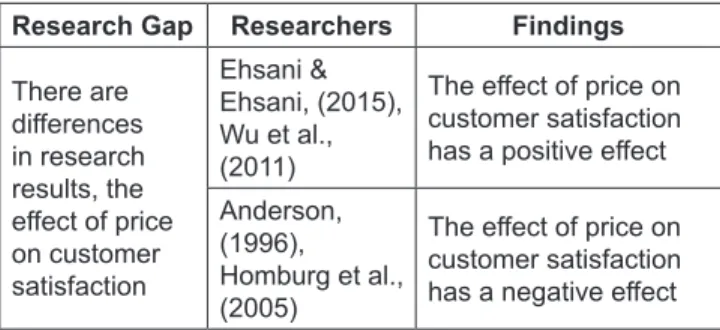
There are gaps in the results of previous research on the effect of price on satisfaction. The gap on the effect or impact of price on satisfaction is summarized in Table 1.
2. Literature Review and Hypotheses
This study uses the marketing theory of consumer satisfaction as a grand theory from Kotler (1994) that states that customer satisfaction is the feeling of pleasure or disappointment of a person that emerges after comparing the actual performance of the product against the expected performance. Consumer satisfaction is the extent to which the benefits of a product are perceived in accordance with what customers expect (Hassan, Hassan, Nawaz, & Aksel, 2013). Consumer satisfaction or dissatisfaction is a response to evaluating the discrepancy or disconfirmation that is felt between previous expectations and the actual performance of the product experienced after use (Homburg, Hoyer, & Koschate, 2005). The general objective of this research is to build a basic theoretical model and an empirical research model where the quality of service mediates the effect of price on customer satisfaction.
Based on the general objectives, the specific objectives to be achieved in this study are as follows:
1. Analyze and test empirically the effect of price on customer satisfaction
2. Analyze and test empirically the effect of sales promotions on customer satisfaction
3. Analyze and test empirically the effect of price on service quality
4. Analyze and test empirically the effect of sales promotions on service quality. 5. Analyze and test empirically the effect of service quality on customer satisfaction.
2.1. The Effect of Price to Customer Satisfaction Price is the unit value assigned to a commodity as information on the counter-performance of the producer/
owner of the commodity. In economic theory, it is stated that, in a competitive market, the price of a good or service is determined through supply and demand (Kotler, 2011). If the seller and the buyer interact, there will be buying and selling activities. When there is a buying and selling activity in the market, the seller and the buyer will bargain to reach an agreed price. Buyers always want low prices, so that with the money they have, they can purchase a lot of goods.
Conversely, the seller wants a high price, in the hope that he can make a large profit. The difference is what can lead to price bargaining. The price that has been agreed by both parties is called the market price (Wu, Liao, Chen, & Hsu, 2011). At that price, the number of goods offered is the same as the quantity of goods requested. Thus, the market price is also called the equilibrium price. The most important factor in price formation is the power of supply and demand. The demand and supply will be in equilibrium at the market price if the quantity demanded is the same as the quantity supplied.
H
1: Price has a positive effect on customer satisfaction.
2.2. Effect of Sales Promotion to Customer Satisfaction
The main purpose of promotion is to inform, influence and persuade, and remind target customers about the company and its marketing mix (Rahman & Sitio, 2020); companies carry out promotional activities with the main objective to seek profit. Suryana and Haryadi (2019) explain that consumer satisfaction is an important element in improving marketing performance of a company. The satisfaction felt by customers can increase their intensity to buy. By creating an optimal level of customer satisfaction, it encourages the creation of loyalty in the minds of the satisfied customer.
Satisfaction is measured by how well customer expectations are met. Meanwhile, customer loyalty is a measure of how much the customer wants to buy again.
H
2: Sales promotion has a positive effect on customer satisfaction.
2.3. Effect of Price to Service Quality
The definition of service quality is centered on fulfilling the needs and desires of customers and the delivery provisions to balance customer expectations. Kaura, Prasad, and Sharma (2015) define service quality in simple terms, namely, a measure of how well the level of service provided is in accordance with customer expectations.
Table 1: Price Effect Research Gap Towards Consumer Satisfaction
Research Gap Researchers Findings There are
differences in research results, the effect of price on customer satisfaction
Ehsani &
Ehsani, (2015), Wu et al., (2011)
The effect of price on customer satisfaction has a positive effect Anderson,
(1996), Homburg et al., (2005)
The effect of price on
customer satisfaction
has a negative effect
This means that the quality of service is determined by the ability of a particular company or institution to meet needs in accordance with what is expected or desired based on the needs of customers/visitors. According to Tran and Le, (2020) service quality easily attracts more customers.
Meanwhile, according to Nguyen, Pham, Tran, and Pham (2020), if the quality of service is good, consumers will recommend the product to others. However, for Tabash, Albugami, Salim, and Akhtar (2019), service quality has a positive impact on consumer satisfaction.
H
3: Price has a positive effect on service quality.
Based on hypotheses 1, 2, 3, hypotheses 4 and 5 can then be submitted as follows:
H
4: Sales promotion has a positive service quality H
5: Service quality has a positive effect on customer satisfaction
3. Research Method
The population in this study is the Jingga Project Boutique. The sample uses nonprobability sampling, namely, sampling that does not provide equal opportunities for each element or member of the population to be selected as samples, whereas purposive sampling sets certain criteria.
The sampling criterion in this study was: each respondent is a customer who has bought a product at the Jingga Project Boutique. The data analysis technique used Partial Least Squares (PLS) - Structural Equation Modeling (SEM) with the WarpPLS 7.0 application. Based on these, the research is predictive and exploratory. The use of PLS-SEM offers several advantages: SEM PLS can work efficiently with small sample sizes and complex models, and the assumption of data distribution in SEM-PLS is relatively looser than with other methods such as CB (Covariance-based) SEM.
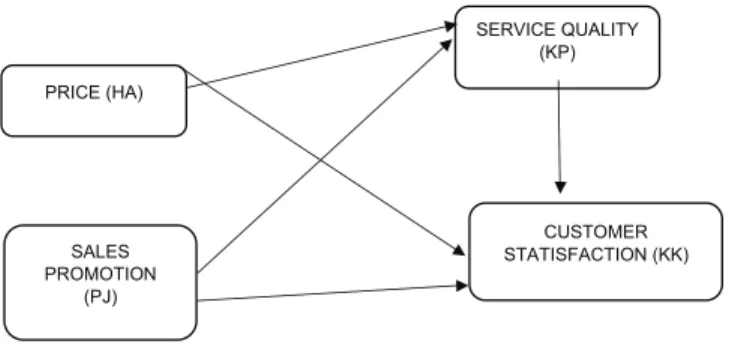
To test hypotheses 1 to hypothesis 5, the following model equation is designed:
KK = α1 + β
1HAt + β
2PJ + β
3KP + ϵ
1(1) KP = α2 + β
5HA + β
6PJ + ϵ
2(2)
Where,
KK = Customer Satisfaction, HA = Price, PJ = Sales Promotion, and KP = Service Quality
4. Results
The analysis of the research model includes two stages, namely, evaluation of the measurement model and evaluation of the structural model. Model evaluation analysis using the PLS SEM method with the WarpPLS version 7.0 application.
The algorithm method in this study for the outer model uses PLS mode A because all constructs in this study use reflective indicators; for the inner model, it uses linear because it is assumed that all the relationships between the constructs in the model are linear. The resampling method uses Stable, based on the resampling method results in the stability of the estimated path coefficient or produces a smaller P value compared to other methods.
4.1. Structural Model Evaluation
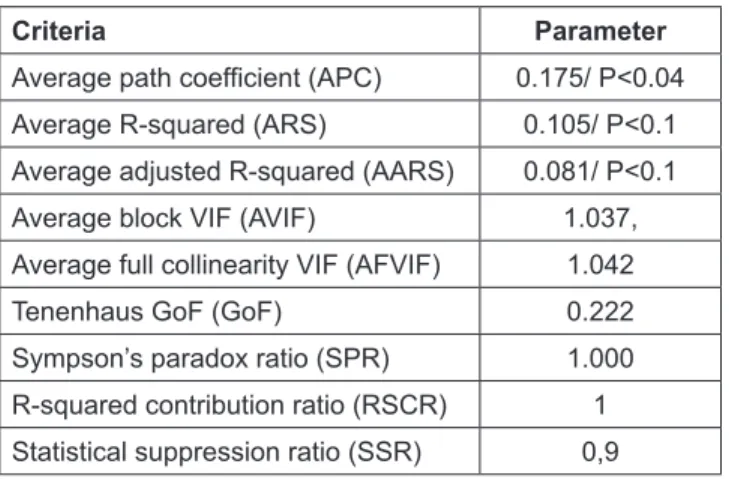
The evaluation of the structural model (inner model) aims to predict the relationship between variables by seeing how much the variance can be explained and knowing the significant P-value (Latan & Ghozali, 2016). Thus, the evaluation of the structural model can test hypotheses 1, 2 and 3. As for hypothesis 4 (the effect of mediation) will be tested through mediation testing in the next analysis.
Based on Table 2, it can be seen that this research model has a good fit, where the P value for APC <0.04, ARS and AAR <0.1, with an APC value = 0.175, ARS value = 0.105 and AARS value = 0.81. Likewise, the resulting AVIF and AFVIF values are <3.3, which means that there is no multicollinearity problem between indicators and between exogenous variables. The resulting GoF is 0.222> 0.1 means that the fit model is very good. For SPR and RSCR, it produces a value equal to 1, while SSR is with a value of 0.9> 0.7, which means there is no causality problem in the model. The mediation test used the Variance Accounted For (VAF) method (Hair et al., 2013). The mediation testing procedure with the VAF method is as follows:
1. Testing the direct effect of exogenous variables on endogenous without including the mediating variable.
2. If the direct effect above is significant, then test the indirect effect of exogenous variables on endogenous by including the mediating variable.
3. If the indirect effect above is significant, then calculate the value of the VAF and determine the mediation effect with the following criteria:
PRICE (HA)
SALES PROMOTION
(PJ)
SERVICE QUALITY (KP)
CUSTOMER STATISFACTION (KK)