가축분퇴비가 연용된 밭 토양에서 잠재적 질소 무기화량 추정
윤홍배·이연·유창연1·양재의1·이상민2·신재훈2·김석철**·이용복*
국립농업과학원, 1강원대학교, 2농촌진흥청
Soil Nitrogen Mineralization Influenced by Continuous Application of Livestock Manure Composts
Hong-Bae Yun, Youn Lee, Chang-Yeon Yu1, Jae-E Yang1, Sang-Min Lee2, Jae-Hun Shin2, Suk-Chul Kim**, and Yong-Bok Lee*
National Academy of Agricultural Science, Suwon, 441-707, Korea,
1Kangwon National University, Chunchon, 200-710, Korea, 2Rural Development Administration, Suwon, 441-707, Korea
The characteristics of nitrogen mineralization in upland soil was studied with 27-week incubation at 25℃. The used soils in this experiment were received six kinds of livestock manure compost each year for four years. Six different composts, which were chicken (CHM), pig (PIM), and cow (COM) manure composted without bulking agent, and chicken (CHMS), pig (PIMS), and cow (COMS) manure composted with sawdust as a bulking agent, were selected for this study. The first-order model was fit to the observed mineral nitrogen (N) vs incubation days using a non-linear regression procedure. The soil potential for N mineralization (No) of manure compost (CHM, PIM, and COM) treated soils were higher than those of the manure-sawdust compost (CHMS, PIMS, and COMS) treated soils. The No value of PIM applied soil was 15.0 mg 100 g-1, which was the highest value among the treatments. The amount of N mineralized in compost applied soils ranged from 8.1% to 11.9% of the total N content in soils and increased with increasing total N content in soils. The organic matter content in compost applied soils were negatively correlated with No value (r = - 0.69*). Therefore, our result indicated that determination of N application rate in livestock manure compost applied soil should be based on total nitrogen content better than soil organic matter content.
Key words: Nitrogen mineralization, Livestock manure compost, Upland soil
접수 : 2010. 4. 12 수리 : 2010. 5. 22
*연락저자 : Phone: +82312900321 E-mail: [email protected]
**공동연락저자 : Phone: +82312900314 E-mail: [email protected]
서 언
토양 내 존재하는 질소는 크게 유기태와 무기태로 나 뉘고, 대부분은 유기태 형태로 존재한다. 유기태 질소는 무기화작용에 의해서 식물 생육에 필요한 질소를 지속 적으로 공급하고 있다. 따라서 토양내에서 유기물 함량 의 약 5%를 차지하고 있는 유기태 질소는 식물의 질소 공급원으로 중요한 위치를 차지하고 있다 (Koopman and Goldstein, 2001). 토양 중에서 질소 무기화율은 토성, 기후, 유기물의 특성 및 토양관리 방법 등 여러 요 인의 영향을 받는다 (Barbarika et al., 1985; Bernal and Kirchmann, 1992; Douglas and Magdoff, 1991).
Miller et al. (1990)의 연구결과에 의하면 질소가 1.6
~2.2% 함유된 가축분 퇴비의 질소 무기화율은 시용 1 년차에 40~50%, 2년차에 10~20%, 그리고, 3년차에 5%로 퇴비의 특성과 시간에 따라서 큰 차이를 보인다고 하였다. Eghball (2000)은 퇴비화과정을 거치지 않은 가축분을 시용한 경우 1작기 동안 전체 유기태질소의 약 21%가 무기화되었으며, 가축분 퇴비를 시용한 경우 는 11%가 무기화되었다고 하였다. 이는 퇴비화 과정에 서 유기태질소가 안정화되었기 때문이라고 하였다.
한편, 유기태 질소의 무기화율은 토양의 질소 공급력 을 결정하는 인자로서 이를 정확하게 예측하는 기술은 시비 효율 향상과 질소 과잉 시비에 의한 환경부하량을 최소화 하는데 큰 기여를 할 것이다. 따라서 연구자들은 토양 유기태질소의 무기화율을 정확하게 예측하는 방법 으로 재배포장에서 보다 항온실험을 수행하고 있다 (Mengel and Kirkby, 1987). 그리고 항온실험에서 얻 어진 데이터를 통하여 질소무기화 포텐셜 (No)과 속도
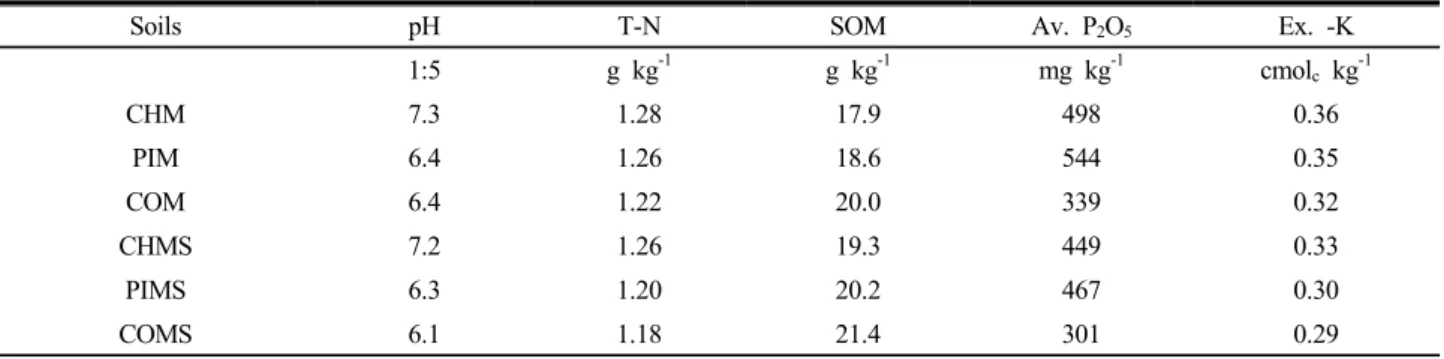
Table 1. The chemical properties of used soil in this experiment.
Soils pH T-N SOM Av. P2O5 Ex. -K
1:5 g kg-1 g kg-1 mg kg-1 cmolc kg-1
CHM 7.3 1.28 17.9 498 0.36
PIM 6.4 1.26 18.6 544 0.35
COM 6.4 1.22 20.0 339 0.32
CHMS 7.2 1.26 19.3 449 0.33
PIMS 6.3 1.20 20.2 467 0.30
COMS 6.1 1.18 21.4 301 0.29
상수 (k)를 구하여, 이를 1차 반응속도식 (first-order kinetics)에 적용하여 질소 무기화량을 추정하고 있다 (Campbell et al., 1984; Lindemann and Caldenas 1984; Molina et al., 1980; Smith et al., 1980;
Talpaz and Bar-Yosef, 1981; Wang et al., 2004).
우리나라 농경지 유기물의 주된 공급원은 가축분 퇴 비이다. 이들 가축분 퇴비는 톱밥, 수피, 왕겨 등 부재 료와 혼합하여 제조되고 있으며, 가축분퇴비의 분해특성 은 유기물 구성성분의 차이에 의해서 상이한 결과를 보 인다 (Yun et al., 2007). 한편, 지금까지 국내의 가축 분 퇴비 관련 연구는 양분 이용율, 토양의 무기태 질소 경시적 변화 등 화학성 변화 및 작물의 수량성 조사가 대부분이었다 (Kim et al., 1997; Kim et al., 1999;
Min et al., 1995). 특히 가축분 퇴비가 연용된 토양에 있어서 시비량 결정에 중요한 양분 공급특성을 정량적 으로 평가한 결과는 거의 없는 실정이다.
따라서 본 연구에서는 계분, 돈분 및 우분 등 종류가 상이한 가축분 퇴비가 각각 연속 시용된 밭 토양에서 잠재적 질소 무기화량을 추정하여 질소 시용량 결정을 위한 기초 자료를 제공코자 수행하였다.
재료 및 방법
시험토양 본 연구에 사용된 토양은 경기도 수원시 소재 국립농업과학원 밭 작물재배 포장에서 채토하여 음건 후 이용하였으며, 토양의 화학성은 Table 1에 나 타내었다. 시험 토양의 이화학적 특성은 농촌진흥청 토 양 및 식물체 표준 분석법 (NIAST, 2000) 에 준하여 분석하였다. 본 항온시험에 이용된 밭 토양의 이력을 요 약하면, 4년 동안 가축분 퇴비 6종을 각각 10 Mg ha-1 year-1 (dry weight) 해당량을 매년 시용하고, 고추- 배추-청예옥수수-고추를 윤작재배 한 곳이다. 포장에 시용되었던 6종의 가축분 퇴비는 ① 계분퇴비 (Chicken Manure : CHM), ② 돈분퇴비 (Pig Manure : PIM),
③ 우분퇴비 (Cow Manure : COM) ④ 계분톱밥퇴비
(Chicken Manure + Sawdust : CHMS) ⑤ 돈분톱밥 퇴비 (Pig Manure+Sawdust : PIMS) 및 ⑥ 우분톱밥 퇴비 (Cow Manure+Sawdust : COMS)로 모두 자가제 조한 것이며, 매년 동일한 퇴비가 시용되었다.
항온실험 질소 무기화율 측정을 위한 항온 실험은 Stanford and Smith (1972)가 제시한 방법에 준하여 실시하였으며, 요약하면 다음과 같다. 토양체 (2 mm) 를 통과한 건조 토양 100 g을 해사 20 g과 잘 혼합한 후 포장용수량의 70%로 수분을 조절하였다. 그리고 0.45 ㎛ cellulose acetate membrane 필터가 부착되 어있는 150 mL 용기 (Corning, USA)에 넣고, 25℃에 서 27주간 항온 정치하였다. 질소 무기화량은 항온 후 1, 2, 4, 6, 8, 12, 16, 20, 24, 그리고 27주에 각각 분석하였다. 그리고 시기별 질소 무기화량은 다음과 같 은 방법에 의하여 무기태 질소를 추출한 후 계산하였다.
항온 용기에 0.01M-CaCl2 100 mL를 5-10 mL 씩 가 하면서 진공 (60 cm Hg) 펌프를 이용하여 무기태 질소 분석을 위한 용액을 추출하였다. 무기태 질소분석용 용 액 추출 후 질소가 없는 영양액 (0.002M-CaSO4․ 2H2O, 0.002M-MgSO4, 0.005M- Ca(H2PO4)2․ H2O, 0.0025M- K2SO4)을 25 mL를 항온용기에 가하였으며, 이때 토양수분은 포장용수량의 약 70%내외가 되도록 진 공펌프를 이용하여 잉여수분을 제거하고 항온정치 하였 다. 한편, 무기태 질소 측정은 추출여액을 800 mL 켈 달 플라스크에 넣고 300 mL 이 되도록 증류수를 가한 후 Devarda`s alloy (0.5 g)와 10N-NaOH 2 mL를 넣고 증류시켜 H2SO4로 적정하였다.
질소무기화 포텐셜과 속도상수 추정 질소 무기화 속도상수 (k)와 포텐셜 (No)은 항온시험의 시기별 질소 무기화량을 이용하여 다음과 같은 식에 적용하여 계산 하였다.
dN/dt = k(No - N) (식 1)
N = N0 [(1-exp(-kt )]
N0 = 12.71 k = 0.01722 t 1/2 = 40.2
C H M Soil
0 2 4 6 8 10 12 14 16
0 50 100 150 200
Time(day) N mineralized(mg N 100g-1)
N = N0 [(1-ex p(-kt )]
N0 = 15.01 k = 0.01367 t 1/2 = 50.7
P I M Soil
0 2 4 6 8 10 12 14 16
0 50 100 150 200
Time(day) N mineralized(mg N 100g-1)
N = N0[(1-exp(-kt )]
N0 = 12.50 k = 0.01228 t 1/2 = 56.4
C O M Soil
0 2 4 6 8 10 12 14 16
0 50 100 150 200
Time(day) N mineralized(mg N 100g-1)
N = N0[(1-exp(-kt )]
N0 = 11.84 k = 0.01567 t 1/2 = 44.2
C H M S Soil
0 2 4 6 8 10 12 14 16
0 50 100 150 200
Time(day) N mineralized(mg N 100g-1)
N = N0[(1-exp(-kt )]
N0 = 13.41 k = 0.01609 t 1/2 = 43.1
P I M S Soil
0 2 4 6 8 10 12 14 16
0 50 100 150 200
Time(day) N mineralized(mg N 100g-1)
N = N0 [(1-ex p(-kt )]
N0 = 9.54 k = 0.01171 t 1/ 2 = 59.2
C O M S Soil
0 2 4 6 8 10 12 14 16
0 50 100 150 200
Time(day) N mineralized(mg N 100g-1)
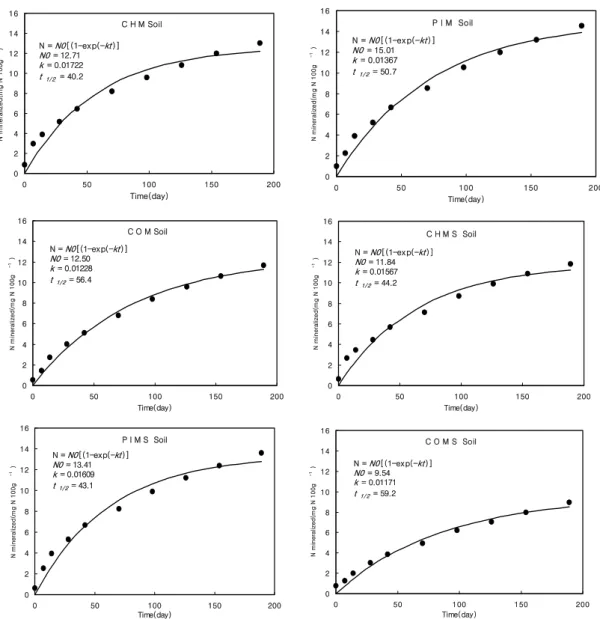
Fig. 1. Cumulative N mineralization from the soils that were annually received the livestock manure composts during 4 years at a rate of 10 Mg ha-1.
N : t 시간 무기태질소량, No: 질소무기화 포텐셜, k: 상수, t: 시간
(식 1)을 적분해서, t= 0, N= 0 값을 부여하여 (식 2)를 얻는다.
N = No [1- exp(-k․t)] (식 2) t 1/2 는 반감기 즉 No값이 1/2이 되는 일수를 나타 내며, 다음 (식 3)에 의해서 구하였다.
t 1/2 = 0.693/k (식 3)
위 모델식에서 각각의 파라메터는 SAS Proc. pro- cedure를 이용하여 구하였다.
결과 및 고찰
질소 무기화량 추정 가축분 퇴비를 4년간 연용한 밭 토양의 질소무기화 항온시험 결과를 N = No [1- exp (-k․t)] 식에 적용하여 질소 무기화 속도상수 및 포텐셜 (No)을 계산한 결과는 Fig. 1과 같다. 가축분만 으로 제조된 퇴비 처리구, PIM, CHM, COM 의 No 값 은 각각 15.0 , 12.7, 12.5 mg 100 g-1 이었고, 가축 분-톱밥으로 제조된 퇴비 처리구, PIMS, CHMS, COMS 의 No 값은 각각 13.4, 11.8, 9.5 mg 100 g-1 이었다. 따라서 가축분만으로 제조된 퇴비 처리구의 질 소 무기화량이 가축분-톱밥으로 제조된 퇴비 처리구보 다 높았다. 이와 같은 현상은 가축분-톱밥으로 제조된 퇴비가 가축분 만으로 제조된 퇴비 보다 C/N 율이 높 아서 유기태 질소의 분해율이 낮았고 (Yun et al.,
T-N content (g kg soil-1)
0.0 1.0 1.2 1.4
SOM content (g kg soil-1)
0 16 18 20 22
N0 value (mg 100g soil-1 ) 0 8 10 12 14 16 18
r = - 0.69* r = 0.52ns
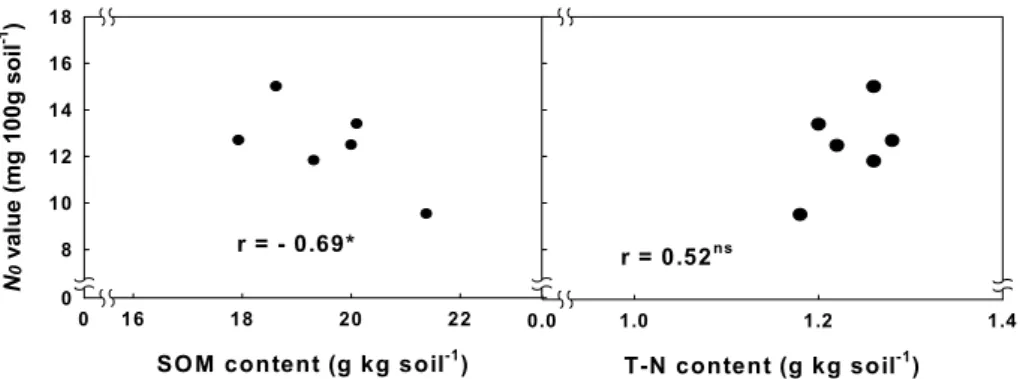
Fig. 2. Relationship between potential mineralized N (N0) , and soil organic matter (left) and T-N content (right).
2007), 동시에 토양 중 전질소 함량이 낮았기 때문이라 고 판단된다. Janssen (1996) 은 토양 중 질소 무기화 량은 시용되는 유기물원의 전질소, 전탄소 함량과도 깊 은 연관이 있지만 C/N율과 가장 높은 상관관계가 있다 고 보고 하였다. 가축분 퇴비가 4년 연용된 토양의 질 소 무기화량 추정치인 No 값은 27주 동안 실제 질소 무기화량의 97-107%에 해당 되었다. 이 결과는 가축분 을 주원료로 제조된 퇴비 시용 농경지의 무기화 될 수 있는 유기태 질소는 27주 후에는 거의 남아 있지 않는 다는 것을 의미 한다 (Hseu and Huang, 2005). 그리 고 본 연구에서 적용한 질소 무기화량 추정 모델인 (식 2)는 초기 4주 동안의 “air-drying effect”
(Kazuyuki et al., 1985)에 의한 급격한 유기태 질소 무기화 현상은 잘 반영하지 못하였다.
가축분 퇴비를 4년간 연용한 밭토양의 항온시험 결과 를 모델 (식 2)에 적용하여 잠재적 질소 무기화 속도 (k)를 추정한 결과, CHM 0.017 > PIMS 0.0160 >
CHMS 0.0156 > PIM 0.0136 > COM 0.0122 >
COMS 0.0117 mg 100g-1 day-1 순으로 나타났다. 이 는 Hseu and Huang (2005)과 Hernandez et al.
(2002)이 발표한 하수 슬러지 퇴비가 시용된 토양에 비 해 높은 값으로 가축분 퇴비가 하수슬러지 퇴비보다 질 소 무기화 속도가 빠른 것으로 나타났다. 그리고 본 연 구에서 k 값과 No 값 사이의 유의한 상관관계는 보이 지 않았으며, 이는 Chae and Tabatabai (1986)가 발 표한 결과와 같다.
토양 유기물 및 전 질소함량과 No 값의 관계 가 축분 퇴비가 시용된 농경지의 잠재적 질소 무기화량 (No)과 토양 전질소 그리고 토양 유기물 함량과의 관계 는 지금까지 다수의 연구결과와 다른 결과를 보였다. 일 반적으로 농경지 질소 무기화량은 토양 중 전질소 , 전 탄소, 및 microbial-N 함량과 정의 상관관계를 보인다 (Marion et al., 1981; Kafkafi et al., 1983; Ireneo et al., 1996; Antonopoulos, 1999). 그리고 Stanford
and Smith (1972) 그리고 Hseu and Huang (2005) 는 여러 가지 토양의 특성 중 전질소 함량이 질소 무기 화량과 가장 깊은 관계가 있다고 하였다. 그러나 본 연 구에서는 토양 중 전질소 함량은 CHM > PIM >
CHMS > COM > PIMS > COMS 순이었지만 (Table 1), 전질소 대비 질소무기화량은 CHM, PIM, COM, CHMS, PIMS 및 COMS 처리구에서 각각 9.9, 11.9, 10.2, 9.3, 11.1 및 8.1% 로 토양 중 전질소 함량 순서 와 일치하지 않았다. 이상과 같은 결과에 따라서 6종의 가축분 퇴비가 시용된 토양의 No 값은 토양 중 전 질소 함량이 증가함에 따라 증가되는 경향은 나타났지만 통 계적 유의성은 없었다 (Fig. 2 Right).
한편, 지금까지 다수의 연구자들은 토양 질소 무기화 량은 토양 유기물함량과 깊은 관계가 있으며, 그에 따라 유기태 질소 무기화량 추정에 관한 연구보고를 하여왔 다 (Honeycutt, 1999; Qian and Schoennau, 1995).
특히, 서언에서 언급한 바와 같이 토양 중 유기태 질소 함량은 유기물 함량의 약 5%를 차지하고 있으므로 유기 물함량이 증가함에 따라서 토양 중 전 질소 함량은 증 가한다. 그러나 본 연구에서 가축분과 톱밥으로 제조된 퇴비를 4년간 연용한 토양의 유기물 함량과 전 질소 함 량은 부의 상관관계 (r = - 0.95**)를 보였다 (data not shown). 그리고 토양 유기물함량과 잠재적 질소 무기화량과는 부의 상관관계 (r = - 0.69*)를 보였다 (Fig. 2 Left). 이상의 결과는 톱밥이 다량 포함되어 탄 질율이 높은 퇴비를 시용함에 따라 탄소 함량에 비해 질소 집적량이 상대적으로 낮았기 때문이라고 추정된다.
그리고 동시에 톱밥은 난분해성 물질인 Lignin 함량이 높아서 토양 중에서 분해가 느린 것도 한 가지 요인이 라 판단된다 (Yun et al., 2007). 이와 같은 현상은 우 분톱밥퇴비가 연용된 토양에서 가장 크게 나타났다.
현재 우리나라 노지작물의 질소 시비량은 토양 유기물 함량을 기준으로 결정하고 있다. 본 연구의 결과로 볼 때, 톱밥이 혼용된 가축분 퇴비를 수년 동안 연용한 토 양의 질소 시비량을 토양 유기물함량에 근거하여 산출할
경우 실제 필요량보다 낮게 평가될 수 있다. 따라서 금 후 농경지 질소 시비량 결정은 토양 중 전 질소함량 등 새로운 접근방법을 모색할 필요가 있다고 사료된다.
요 약
가축분 퇴비 시용이 토양 중 질소 무기화 특성에 미 치는 영향을 구명하기 위해 계분 (CHM), 돈분 (PIM), 우분 (COM), 계분톱밥 (CHMS), 돈분톱밥 (PIMS), 및 우분톱밥 (COMS) 퇴비를 4년간 연용한 밭 토양을 대상 으로 27주간 항온시험을 실시하였다. 항온기간 동안 누 적 질소 무기화량을 1차 반응 속도식 (first-order kinetics)에 적용하여 잠재적 질소무기화량 (No)을 평 가한 결과, PIM 처리구에서 15.0 mg 100 g-1으로 가 장 높았으며, COMS 처리구에서 9.5 mg 100 g-1로 가 장 낮았다. 그리고 질소 무기화 속도상수, k는 CHM 0.017 > PIMS 0.016 ≥ CHMS 0.016 > PIM 0.014 >
COM 0.012 ≥ COMS 0.012 순으로 나타났다. 특히, No 값은 토양 중 전질소 함량이 증가함에 따라 증가하 는 경향을 보였고, 이는 토양 중 전질소 함량의 8.1-11.9% 이었다. 그리고 No 값은 토양 유기물 함량 과는 음의 상관관계를 보였다. 따라서 톱밥이 혼용된 가 축분 퇴비가 장기 연용된 토양에서 유기물 함량을 근거 로 산출하는 현재의 질소 시비량 결정 방법은 개선이 필요하다고 판단된다.
인 용 문 헌
Antonopoulos, V.Z. 1999. Comparison of different models to simulate sil temperature and moisture effects on nitrogen mineralization in the soil. J. Plant Nutr. Soil Sci. 162:667-675.
Barbarika, A., L.P. Sikola, and D. Colacicco. 1985.
Factors affecting the mineralization of nitrogen in sewage sludge applied to soils. Soil Sci. Soc. Am. J.
64:184-189.
Bernal, M.P. and H. Kirchmann. 1992. Carbon and nitrogen mineralization and ammonia volatilization from fresh, aerobically and anaerobically treated pig manure during incubation with soil. Biol. Fertil. Soils.
13:135-141.
Campbell, C.A., Y.W. Jame, and G,E. Winkleman. 1984.
Mineralization rate constnats and their use for estimating nitrogen mineralization in some Canadina prairie soils.
Can. J. Soil Sci. 64:333-343.
Chae, Y.M. and M.A. Tabatabai. 1986. Mineralization of nitrogen in soils amended with organic wastes. J. En-
viron. Qual. 15:193-198.
Douglas, B.F. and F.R. Magdoff. 1991. An evaluation of nitrogen mineralization induce for organic residues. J.
Environ. Qual. 20:368-372.
Eghball, B. 2000. Nitrogen mineralization from field- applied beef cattle feedlot manure or compost. Soil Sci.
Soc. Am. J. 64:2024-2030
Hernandez, T., R. Moral, A. Perez-Espinosa, J. Moreno- Caselles, M.D. Perez-Murcia, and C. Garcia. 2002.
Nitrogen mineralization potential in calcareous soils amended with sewage sludge. Bioresour. Technol. 83:
213-219.
Honeycutt, C.W. 1999. Nitrogen mineralization from soil organic matter and crop residues : Field validation of laboratory predictions. Soil Sci. Soc. Am. J. 63:134-141.
Hseu, Z.Y. and C.C. Huang. 2005. Nitrogen mineralization potentials in three tropical soils treated with biosolids.
Chemosphere. 59:447-454.
Ireneo, J.M., W. Iwao, B.M. Grace, and G.T. Jasper. 1996.
Nitrogen mineralization in tropical wetland rice soils. I.
Rclationship with temperature and soil properties. Soil Sci. Plant Nutr. 42:229-238.
Janssen, B.H. 1996. Nitrogen mineralization in relation to C/N ratio and decomposability of organic matters. Plant Soil 181:39-45.
Kafkafi, U., B. Baryosef, and H. Aviva. 1983. Fetilization decision model-a synthesis of soil and plant parameters in a computerized program. Soil Sci. 125:261-268.
Kazuyuki, I., W. Hidenori, and T. Yosuo. 1985. Easily decomposable organic matter in paddy soil: VI. Kinetics of nitrogen mineralization in submerged soils. Soil Sci.
Plant. Nutr. 31:563-572
Kim J.G., K.B. Lee, S.B. Lee, D.B. Lee, and S.J. Kim.
1999. The effect of long-term application of different organic material sources on chemical properties of upland soil. J. Kor. Soil Sci. Fert. 32:239-253.
Kim, P.J., D.Y. Chung, K.W. Chang, and B.L. Lee. 1997.
Mineralization of cattle manure compost at various soil moisture content. Kor. J. Environ. Agri. 16:295-303.
Koopman C. and W. Goldstein. 2001. Soil organic matter budgeting in sustainable farming with applications to southeastern Wisconsin and northern Illinois. Bulletin No. 7. Michael Fields Agricultural Institute. p. 39.
Lindemann, W.C. and M. Caldenas. 1984. Nitrogen mineralization potential and nitrogen transformation of sludge-amended soil. Soil Sci. Soc. Am. J. 48:1072- 1077.
Marion, G.M., J. Kummerow, and P.C. Miller. 1981.
Predicting nitrogen mineralization in chaparral soils. Soil Sci. Soc. Am. J. 45:956-961.
Mengel, K. and E.A. Kirkby. 1987. Principles of plant nutrition. 4th edition. International potash institute. Bern.
Switzerland. p. 347-446.
Miller, R.W., R.L. Donahu, and J.U. Miller. 1990. Soils.
An introduction to soils and plant growth. 6th edition.
Prentice-Hall International. p. 192-278.
Min, K.B., H.S. Cho. J.I. Lee, and Y.K. Nam. 1995.
Effects of fermented pig manure-sawdust compost of the yield and mineral nutrition of tomato in the plastic film house. J. Kor. Soil Sci. Fert. 28:88-94.
Molina, J.A.E., C.E. Clapp, and W.E. Larson. 1980.
Potentially mineralizable nitrogen in soil : The simple exponential model does not apply for the first 12weeks of incubation. Soil Sci. Soc. Am. J. 44:442-443.
NIAST. 2000. Methods of Soil and Crop Plant Analysis.
National Institute of Agricultural Science and Tech- nology, RDA.
Qian, P. and J.J. Schoennau. 1995. Assessing nitrogen mineralization from soil organic matter using anion exchange membranes. Fertil. Res. 40:143-148.
Smith, J.G., R.R. Schnabel, B.L. McNeal, and G.S.
Campbell. 1980. Potential errors in the first-order model for estimating soil nitrogen mineralization potentials.
Soil. Sci. Am, J. 44:996-1000.
Stanford, G. and S.J. Smith. 1972. Nitrogen mineralization potentials of soils. Soil. Sci. Amer. Proc. 36:465-472.
Talpaz, H., P. and B. Bar-Yosef. 1981. On the estimation of N-mineralization parameters from incubation experi- ments. Soil Sci. Am, J. 45:993-996.
Wang, W.J., C.J. Smith, and D. Chen. 2004. Prediction soil nitrogen mineralization dynamics with a modified double exponential model. Soil Sci. Soc. Am. J.
68:1256-1265.
Yun, H.B., Y. Lee, C.H. Yu, S.M. Lee, B.K. Hyun, and Y.B. Lee. 2007. Effects of crude carbohydrate content in livestock manure compost on organic matter decom- position rate in upland soil. J. Kor. Soil Sci. Fert.
40:364-368.