Radar-based Security System: Implementation for Cluttered Environment
Tae-Yun Lee*, Vladimir Skvortsov*, Min-Ho Ka*★
Abstract
We present an experimental implementation of the inexpensive microwave security sensor that can detect both static and slowly moving objects in cluttered environment. The prototype consists of a frequency-modulated continuous wave radar sensor, control board or computer and software. The prototype was tested in a cluttered indoor environment. In case of intrusion or change of environment the sensor will give an alarm, determine the location of new object, change in its location and can detect a slowly moving target. To make a low-cost unit we use commercially available automotive radar and own signal processing techniques for object detection and tracking. The intruder detection is based on a comparison between current ‘image’ in memory and ‘no-intrusion’
reference image. The main challenge is to develop a reliable technique for detection of a relatively low-magnitude object signals hidden in multipath clutter echo signals. Various experimental measurements and computations have shown the feasibility and performance of the system.
Key words: radar, security, clutter, Doppler, FMCW
* School of Integrated Technology,
Yonsei Institute of Convergence Technology, Yonsei University
★Corresponding author
([email protected], 032-749-5840)
※ Acknowledgment
This research was supported by the MSIP(Ministry of Science, ICT and Future Planning), Korea, under the “IT Consilience Creative Program”
(IITP-2015-R0346-15-1008) supervised by the IITP(Institute for Information & Communications Technology Promotion)
Manuscript received Feb. 10, 2015; revised April. 26, 2015 ; accepted April. 27. 2015
This is an Open-Access article distributed under the terms of the Creative Commons Attribution Non-Commercial License(http://creativecommons.org/licenses/by-nc/3.0) which permits unrestricted non-commercial use, distribution, and reproduction in any medium, provided the original work is properly cited.
I. Introduction
The use of the security applications increases daily because losses of enterprises due to theft, damage
reach the high numbers. In majority of applications, security systems are deployed for the protection of people, property or structural health monitoring.
Protection of people and areas has been traditionally done with help of the installation of perimeter fencing, cameras, and security personnel watching monitors and walking the perimeter. Optical cameras become less informative in snow, rain, smoke, and fog. The security systems are typically quite xpensive and they not always provide the reliable protection considering their performance versus cost value. A radar-based security sensor can give an effective solution to the problems. It has several advantages over traditional one because it can operate 24 hours a day in various environments, different times of day and weather conditions.
The recent radar technology advances have made possible to produce relatively inexpensive frequency-modulated continuous wave (FMCW) radars [1, 2]. They are also popular in pedestrian safety systems [3, 4, 5] with pedestrian recognition capability like in [3]. The FMCW radars have some advantages over traditional pulse Doppler radars [6].
The accuracy of FMCW radar range measurement
38 j.inst.Korean.electr.electron.eng.Vol.19,No.2,160∼167,June 2015
is dependent on a frequency sweep bandwidth and number of samples however there are many methods to improve the range accuracy by interpolation.
The one of the major problems in radar sensing is to detect an object in a clutter environment. In various environments clutter echo signals are generated from different multiple sources and can exceed the object reflection signal levels, making the object detection very difficult. In order to address this problem, many different clutter rejection algorithms have been created and tested by various researchers, for example in [7] and [8].
The one-channel FMCW radar unit has its control unit and single antenna, and typically operates in a continuous mode. Any change in the environment of secured area modifies the data of radar output. The intruder detection principle is based on finding of changes between two snapshots: a stored
‘no-intrusion’ reference (background) snapshot and a current measured one. Using the difference, we can detect a newly appeared object and find its other parameters [9]. If we work with binary signals, the binary distance becomes a measure of difference between signals. There are many algorithms to find the distance as in [10]. There are extra questions how to maximize the differences which are discussed later.
This paper evaluates a microwave (radar-based) security sensor design and performance that can be used for building an inexpensive system. The proposed clutter rejection algorithm is based on experimental measurements in indoor environment.
II. Background
In our previous work [9] we have reported a radar-based surveillance system development, where the radar is based on a frequency modulated continuous wave (FMCW) principle.
For detecting a motion, it is common to use a Doppler radar. However the Doppler radar cannot detect newly appeared static or slowly moving objects. One of the goals of this work is to demonstrate such a method that makes a static or slowly moving target detection possible using proposed algorithm by rejection of clutter signals
and finding a true target signal. As slowly moving object we consider a human intruder. This method can find an extra application in detection of environment changes.
To reduce a cost of proposed security system, we are going to use a mass-production radar, open hardware and free software components for control board. In spite of mass-production origin, the radar is a medium-cost one and will still be a major contributor to the overall cost.
Before we focused on a continuous measurement mode as crucial operating principle, and created the data acquisition and analysis software. This work is the evolution of previous ideas and concept of an inexpensive security sensor. In this paper we investigate the radar-based security sensor design and performance in a cluttered indoor environment relating to object detection and ranging techniques.
The FMCW radar has its control unit and single antenna, and typically operates in a continuous mode. If there is any change in the environment of surveillance area, it modifies a signal profile, and then we compare a memorized ‘no-intrusion’ signal with a current one. From the difference between the signals, we can detect an object and find its parameters. The goal is to provide such a signal processing method that allows memorizing a state of secure area and then periodically and continuously checking the secure area for intruders by comparing current state with the original reference state.
In [9], the storage of a memorized reference and a current ‘image’ was proposed using a digital perceptual hash. In contrast with commonly used hash which value is always changed for different input, the perceptual hash is expected to change the hash value only if the input is perceptually changed [11]. The perceptual hash algorithm was shown in [9, 12].
III. Experimental Setup
In our experiments, we use an automotive one-channel K-band FMCW radar front-end with 24 GHz center frequency, 1500 MHz bandwidth and horn-type antenna. A radar security system consists of the following modules: communication (serial
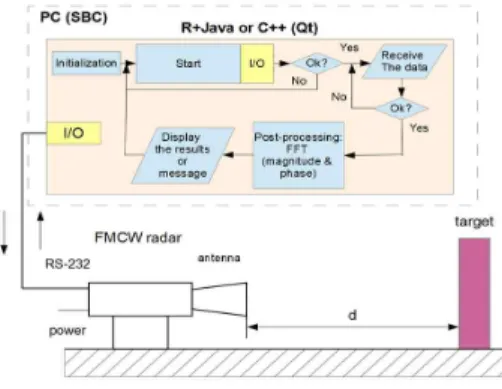
Fig. 1. Test setup Fig. 2. Measurement setup and block diagram of control module (SBC – single board computer)
port), measurement, post-processing and visualization (GUI for displaying results). In this work to focus on clutter rejection algorithms, the stationary or slow moving objects are only taken into account.
The experimental setup (Fig. 1) has been made to test the radar performance of object detection within a typical cluttered indoor environment of an office building.
The radar was connected with a PC control unit (laptop) by RS-232 serial interface (Fig. 2). The maximum number of points/samples collected per single measurement was variable and up to 1501.
The object was a rectangular thin metal plate that is placed at distance d. The test environment was a typical office building with long hall having the nominal width: 206 cm). Targets were visible from a radar's point-of-view. The experiment with clutter rejection was repeated many times using the rectangular metal plates from size of 16×19 cm to 59×98 cm at the following distances of 9, 15, 21, 33, 39, 45, 57, and 69 m. The ranges were verified by extra range measuring instruments.
For security applications, we created software with continuous measurement and post-processing flow using both R+Java and C++(Qt) cross-platform application framework to implement the data acquisition and analysis routines. Our experiments require a frequent change of setting up for making many trials, to meet that requirement a new
interface was developed using high-level programming languages such as R and Java. R script is used as a quick test routine for all algorithms, which, in the case of successful result, then can be ported to C++ for higher execution speed on hardware. The implementation is based on Sweave (R+LaTeX) that is a text file which includes data, codes and description on how the code is applied to the data.
IV. Procedure
We follow our previously developed processing algorithm with more details and some changes for improvements and optimization. There are two working modes of the security system. The first mode is detection with localization of the intruder;
the second one is alarm mode where radar output is digitized for convenience and speed of the data processing. We begin with the first mode.
Our procedure of data processing workflow representing one measurement cycle is shown in Fig. 3. The initialization is done using parameters in Table 1.
The data from radar are collected into two arrays:
the clutter measurements (no target) are stored into
array in advance; regular data are in when there is a target. The and are same size. The typical data are shown in Fig. 4. After post-processing we save the FFT magnitudes in and arrays and find the difference
40 j.inst.Korean.electr.electron.eng.Vol.19,No.2,160∼167,June 2015
Table 1. Radar parameters
Parameter Value
Center frequency of sweep 24.7GHz
Sweep bandwidth 1.5GHz
Waveform Sawtooth
Number of frequency points 1501
Frequency step 1MHz
Samplinig frequency 20kHz Nyquist frequency 10000Hz Frequency resolution 13.32Hz
Fig. 3 Flow chart of single measurement cycle
and the signal to clutter ratio
for .
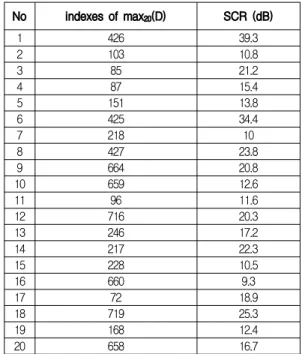
Then we find the first n (e.g. = 20) maximum values in and save their indexes to new array
to identify the corresponding values and create new data table (Table 2). For further
calculations we select the element where the is maximum that is 39.3 dB at 426th index).
Fig. 4. Radar mixer data output (1501 points): (a) with intruder/target, (b) reference or clutter (no intruder/target)
Table 2. Preselected 20 points with maximums of No indexes of max20(D) SCR (dB)
1 426 39.3
2 103 10.8
3 85 21.2
4 87 15.4
5 151 13.8
6 425 34.4
7 218 10
8 427 23.8
9 664 20.8
10 659 12.6
11 96 11.6
12 716 20.3
13 246 17.2
14 217 22.3
15 228 10.5
16 660 9.3
17 72 18.9
18 719 25.3
19 168 12.4
20 658 16.7
Next step is to determine a beat frequency as fb = f[index] and calculate the distance to the target(s):
·m od ·
,
where m od - the period of sweep in , - the speed of light in m/s, - the bandwidth of
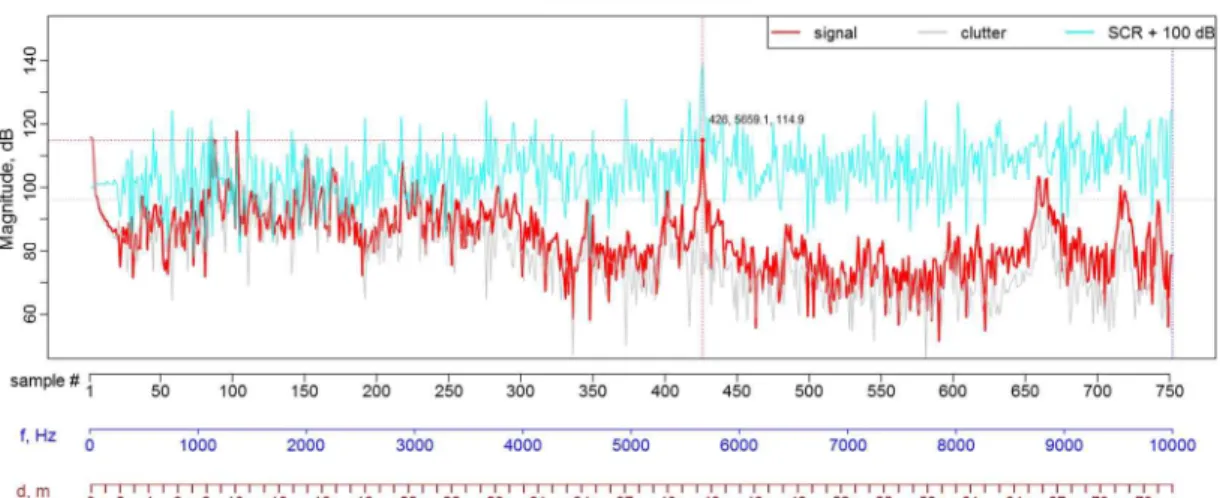
Fig. 5. The object detection and localization example at range of 42.4 m sweep in Hz.
As seen above, the feature of our method is to create a list of the first of maximums, and then find the target using the maximum value.
V. Analysis
The distance to different objects in FMCW radar measurements is traditionally extracted using a Fourier Transform of the sampled signals.
The challenge of an indoor radar operation is the detection of a target in a cluttered indoor environment where multiple reflections from the clutter may exceed the level of target reflections. In this context the clutter rejection technique becomes the most essential part of the data acquisition and analysis module.
If any intruder crosses the virtual fence or radar beam, it changes the signal profile, then if we compare a memorized ‘no-intrusion’ signal with a current one, we can find a difference and give an alarm, the location of a target and its relative speed.
In order to display all required information, a new plot layout template was created to combine the plots (Fig. 5). The plot displays an object detection and localization analysis.
Figure 5 shows one of the object detection experiments with the fixed radar and the object
placed at d ≈ 42.4 m. The collected data include two measurements, where the clutter measurement representing a reference signal was made without the target. The plot is customized and has 3 x-axes, where each one with own unit of measurement: sample number – all samples are collected at the equal time intervals, beat frequency f in Hz, distance d to the target in meters. The dashed line represents a signal to clutter ratio (SCR) in dB shown to be plus 100 dB to an actual value to display it for comparison.
Let us consider the second mode of operation – alarm mode. For digitizing the radar signals we use the cubic spline approximation in whole sample. The hash bits are set to 0 or 1 depending on whether each of the FFT magnitude values is above or below the approximation value (Fig. 6). The result will not vary as long as the overall structure of the radar data remains the same.
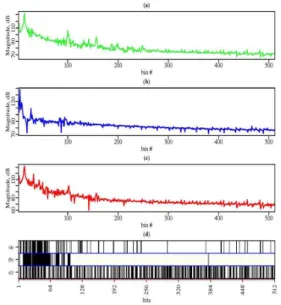
In Fig. 7, plot (a) is average of several snapshots when no intruder (object) is presented. Plot (b) is a radar output with an existing intruder - the movable target – a vertical metal plate that imitates the intruder is located at d = 16 cm from the radar, Fig. 1. Plot (c) is the reference signal, a sample number or frequency versus magnitude curve after FFT analysis.
The perceptual hash values can be compared using the Hamming distance (dH) algorithm which is one
42 j.inst.Korean.electr.electron.eng.Vol.19,No.2,160∼167,June 2015
Fig. 6. Digitizing the radar signal
Fig. 7. FFT analysis of 3 radar snapshots for 512 points, where (a) - average of several signals without intrusion, (b) - signal with intruder and (c) - reference signal
of the most popular methods, comparing each bit position and counting the number of differences. To detect an intrusion, various binary distance algorithms are used. The intrusion influenced signal should have a bigger distance value between the signal and the reference signal. The distance is also dependent on what algorithm is in use for averaging or approximation to find the hash bits.
After constructing the hash e.g. 512-bit integer, the binary view of hashes for all 3 snapshots is shown in Fig. 7d (the white bit is 0, the black bit is 1). The heatmap function of R stats package was used for the visualization of a ‘binary’ signal output.
The binary distances for two non-reference signals are:
Table 3. Comparison of binary distances algorithms Between snapshots: (a) & (c) (b) & (c) Diff., %
Distances
Hamming 230 266 13.53
Jaccard 0.76 0.84 9.52 Hellinger 1.47 1.63 9.81 AreaRatioDiff 3.91 4.78 18.2
In this example the hash bits are generated using cubic spline approximation of the reference data. In addition to well-known algorithms for binary distances we add our own which is called as
‘AreaRatioDiff’ () – the difference of 0-to-1 bit ratios. The main idea behind the algorithm is as follows:
where is current snapshot and is the reference.
If we look at Hamming distance that is calculated between (b) and (c) snapshots it gives higher value indicating the intruder according to the condition of our test. Setting the range for allowable values, one can specify the sensitivity for the system using an upper threshold level, e.g. the tolerable (no-intrusion) range of dH values which are dependent on algorithm of binary distance calculation. However, using our data the
‘AreaRatioDiff’ gives the biggest difference comparing to other algorithms (Table 3).
By setting the range of the system sensitivity, an alarm can be properly produced.
VI. Conclusion
In our experimental measurements the radar demonstrates an expected performance according to the specification. Target detection within an indoor environment is challenging due to the presence of multipath echoes from various objects, and requires a highly-efficient clutter rejection processing. We successfully tested our relatively simple clutter rejection algorithm with some known various targets. However, it is evident that more tests with various size targets are required. Several tests with smaller sized plates placed near floor level have shown some instability in the results.
Digitizing radar signals by perceptual hash can help storing the radar images in a compact form that is easy to retrieve and process.
There is a need to improve the data transfer rate of serial interface using new hardware.
In spite of various complexities and difficulties, our experimental measurements confirm the validity of applied techniques and feasibility of effective security operations.
For further developments, various enhancements of the developed algorithms and improvements of system performance are required. In the future experiments the moving targets will be investigated.
References
[1] T. Klein, M. Faassen and A. Lauer, "Radar-based surveillance of persons from an elevated, tilted position using a two channel 24 GHz FMCW radar system," in Radar Symposium (IRS), 2011 Proceedings International, 2011.
[2] M. Morinaga, T. Nagasaku, H. Shinoda and H.
Kondoh, "24GHz Intruder Detection Radar with Beam-switched Area Coverage," in Microwave Symposium, 2007. IEEE/MTT-S International, 2007.
[3] A. Bartsch, F. Fitzek and R. H. Rasshofer,
"Pedestrian recognition using automotive radar sensors," Advances in Radio Science, vol. 10, pp.
45-55, 2012.
[4] S. Heuel and H. Rohling, "Pedestrian Recognition Based on 24 GHz Radar Sensors," in Ultra-Wideband Radio Technologies for Communications, Localization and Sensor Applications, R. Thomä, R. H. Knöchel, J. Sachs, I. Willms and T.
Zwick, Eds., InTech, 2013.
[5] F. Fölster, H. Rohling and H. Ritter, "Observation of a walking pedestrian with a 24GHz automotive radar sensor," in German Microwave Conference - GeMiC 2006, Karlsruhe, Germany, 2006.
[6] W. Butler, P. Poitevin and J. Bjomholt, "Benefits of Wide Area Intrusion Detection Systems using FMCW Radar," in Security Technology, 2007 41st Annual IEEE International Carnahan Conference on, 2007.
[7] A. Cepni, D. Stancil, B. Henty, Y. Jiang, Y. Jin, J.
Moura and J.-G. Zhu, "Experimental results on single antenna target detection using time-reversal techniques," in Antennas and Propagation Society International Symposium 2006, IEEE, 2006.
[8] D. Kandar, A. Guchhait, A. Adhikari, S. Padma Prasanna, R. Kalpana, J. Revathy and B. Maji,
"Clutter Rejection In Outdoor Radar Operation By Correlation Method For Known Target," Journal of Information Systems and Communication, vol. 3, no.
1, p. 332, 2012.
[9] V. Skvortsov, K. M. Lee and S. E. Yang,
"Inexpensive radar-based surveillance: Experimental study," in Emerging Technologies for a Smarter World (CEWIT), 2012 9th International Conference Expo on, 2012.
[10] S.-s. Choi, S.-h. Cha and C. C. Tappert, "A survey of binary similarity and distance measures,"
Journal of Systemics, Cybernetics and Informatics, vol. 8, no. 1, pp. 43-48, 2010.
[11] H. Özer, B. Sankur, N. Memon and E. Anarim,
"Perceptual Audio Hashing Functions," EURASIP J.
Appl. Signal Process., vol. 2005, pp. 1780-1793, jan 2005.
[12] V. Skvortsov and K. M. Lee, "Radar network node: Performance analysis and visualization in indoor environment," in Emerging Technologies for a Smarter World (CEWIT), 2013 10th International Conference and Expo on, 2013.
44 j.inst.Korean.electr.electron.eng.Vol.19,No.2,160∼167,June 2015
Skvortsov Vladimir (Member)
2000 : BS degree in Robotics, St Petersburg State Polytechnical University.
2005 : MS degree in Robotics, St Petersburg State Polytechnical University.
2006 : PhD degree in Robotics, St Petersburg State Polytechnical University.
2014~ : Principal Research Engineer, Yonsei University
Ka Min-Ho (Member)
1989 : BS degree in Electronic Engineering, Yonsei University.
1991 : MS degree in Electronic Engineering, Yonsei University.
2000 : PhD degree in Radio Engineering, Moscow Power Engineering Institute (MPEI).
1997~2000 : Agency for Defense Development (ADD) 2000~2010 : Professor, Department of Electronic Engineering, Korea Polytechnic University
2011~ : Professor, School of Integrated Technology, Yonsei University.
BIOGRAPHY
Lee Tae-Yun (Member)
2010 : BS degree in Earth System Science, Yonsei University.
2012~ : PhD degree in School of Integrated Technology, Yonsei University.