소나무와 굴참나무 임분의 토양 환경요인과 토양 이산화탄소 방출의 계절적 변화
백경원⋅조창규⋅김춘식*1) 경남과학기술대학교
(2016년 8월 9일 접수; 2016년 9월 13일 수정; 2016년 9월 22일 수락)
Seasonal Variations of Soil CO
2Efflux Rates and Soil Environmental Factors in Pinus densiflora and Quercus variabilis Stands
Gyeongwon Baek, Chang Gyu Jo and Choonsig Kim* Gyeongnam National University of Science and Technology, Jinju 52725, Korea (Received August 9, 2016; Revised September 13, 2016; Accepted September 22, 2016)
ABSTRACT
This study was carried out to examine the relationships between seasonal variations of soil CO2 efflux rates and soil environmental factors in matured Pinus densiflora and Quercus variabilis stands in the Wola national experimental forests, southern Korea. Soil CO2 efflux rates were measured monthly from March 2015 to February 2016. Mean soil CO2 efflux rates during the study period were significantly higher in the Q. variabilis (mean±standard error; 2.27±0.22 μmol m-2 s-1) than in the P.
densiflora (1.63±0.12 μmol m-2 s-1) stands. Mean soil water content and pH were also significantly higher in the Q. variabilis (26.96±0.93%, pH 5.19) than in the P. densiflora (21.32±0.89%, pH 4.87) stands, while soil temperature was not significantly different between the P. densiflora (13.92±0.67°C) and in the Q. variabilis (13.52±0.70°C) stands. Q10 values were higher in the Q.
variabilis (3.35) than in the P. densiflora (2.72) stands. The results indicate that soil CO2 efflux rates in Q. variabilis stand could be more sensitive by the change of soil temperature compared with P.
densiflora stand under a similar site environmental condition.
Key words: Carbon cycling, Carbon dynamic, Q10 value, Soil respiration, Soil temperature
I. 서 론
산림토양에서 발생하는 온실가스 중 지구온난화에 가장 크게 기여하는 온실가스로 알려진 이산화탄소 (CO2) 경우 주로 미생물 호흡이나 살아있는 식물 뿌리 호 흡으로부터 발생하며 산림생태계의 여러 가지 대사활동 을 나타내는 지표로 의미가 있다. 토양 CO2 방출량의 계 절적인 변동과 연 방출량의 정량화는 산림생태계의 탄 소순환 이해와 지구탄소수지 관점에서 중요하다.
산림을 통한 토양 CO2 방출에 관여하는 일련의 과정 들은 인간의 활동이나 자연 재해로부터 영향을 받으며 (Jandl et al., 2007; Peng et al., 2008), 이러한 반응에 가 장 크게 기여하는 요인은 토양 온도, 토양 수분 및 양분 유 효도 같은 입지환경요인과 토양 내 유기탄소 같은 기질 (substrate quality)의 차가 원인으로 알려져 있다(Dong et al., 1998; Deng et al., 2010). 한편, 산림토양에서 발생 하는 CO2 방출은 시⋅공간적으로 상당한 변이가 발생 하며(Konda et al., 2010), 토양 수분 및 양분 유효도 같은
* Corresponding Author : Choonsig Kim ([email protected])
DOI: 10.5532/KJAFM.2016.18.3.120
ⓒ Author(s) 2016. CC Attribution 3.0 License.
산림환경 요인과 산림생태계가 위치한 지리적 위치 및 계절 변화에 민감하게 반응하였다(Konda et al., 2010).
이러한 산림토양으로부터 CO2 방출의 시⋅공간적인 변 이의 불확실성은 산림이 가지는 CO2 흡수 및 저장 능력 추정에 불확실성의 원인으로 제공되고 있으며, 이를 감 소하기 위한 방안으로 임분 형태 별(Ullah et al., 2009), 임분 연령 별(Peichl et al., 2010), 산림경영 활동 (Yashiro et al., 2008) 등과 관련한 다양한 연구가 실시되 었다.
산림생태계에서 발생하는 토양 CO2는 임분 종류에 따라 다양한 방출 동태를 보이는 것으로 알려져 있으며, 이는 임목의 생육 특성, 미생물 활동, 임목의 뿌리 활력, 세근 분해속도, 낙엽낙지량, 토양 호흡량, 양분 유효도, 토양 이화학적 특성 등이 임분 발달 동안 다르게 나타나 토양 CO2 방출 동태를 결정하기 때문이다(Kim and Jeong, 2016). 국내에서 수행된 임분 별 산림토양의 CO2 방출동태에 관한 연구로 강원도 춘천지역 신갈나무와 굴참나무 임분의 토양호흡량 비교(Yi, 2003), 광주광역 시 소나무와 굴참나무의 토양호흡 특성(Kim et al., 2009b), 경남 함양지역 소나무, 리기테다소나무, 낙엽송 조림지의 토양호흡과 토양 환경요인과의 관계(Kim and
Jeong, 2016) 등 이 있다. 한편 임분 간 산림토양으로부 터 발생한 CO2 방출의 경우 입지유형에 따른 시⋅공간 적 변이 때문에 정확한 정량화를 위해서는 입지선정이 중요하다. 본 연구는 유사한 입지환경과 서로 인접한 지역 에서 생육한 성숙한 소나무(Pinus densiflora S. et Z.)와 굴참나무(Quercus variabilis Blume) 임분을 대상으로 산림토양으로부터 방출되는 CO2가 임분 종류에 따라 어떠한 차이를 보이는 지를 비교하고, CO2 방출의 계절 적 변화와 토양 환경요인 사이에 관계를 구명하기 위한 목적으로 수행하였다.
II. 재료 및 방법
2.1. 조사지 개황
본 연구를 위한 조사지는 경상남도 진주시 국립산림 과학원 “월아시험림”내 위치하였다. 최근 30년 동안 (1981∼2010년) 이 지역의 연 평균 강수량은 1,513mm, 연 평균 기온은 13.1°C이다. 선정된 조사지는 표고 160∼
180m 내 산복의 서향에 위치하며, 사면 경사는 15∼25°
이다. 하층 식생으로 산초나무(Zanthoxylum schinifolium S. et Z.), 찔레꽃(Rosa multiflora Thunb.), 청미래덩굴
P1 P2
P3
Q1 Q2
Q3
4
50m
N (a)
(b)
(c)
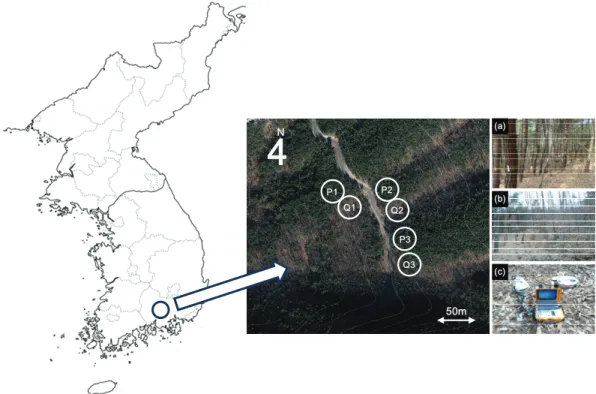
Fig. 1. Location of the study site . P: Pinus densiflora (a); Q: Quercus variabilis (b); LI-8100 A(c).
(Smilax china L.), 졸참나무(Quercus serrata Murray), 굴참나무(Q. variabilis Blume), 개옻나무(Toxcodendron trichocarpum Kuntze), 산딸기(Rubus crataegifolius Bunge) 등이 분포하나 하층 목본식생의 피도는 높지 않 다. 조사지의 모암은 퇴적암인 사암이나 혈암이 전 지역 에 우세하고, 우리나라 산림토양분류에 따르면 암적갈 색약건산림토양형(DRb2)이 분포하였다. 조사구는 유 사한 입지환경에 서로 인접하며 정상적으로 생육하고 있는 V영급 이상의 성숙하고 건전한 소나무와 굴참나무 임분을 대상으로 선정하였다(Fig. 1). 조사구는 위반복 (pseudoreplication)을 피하기 위해 3블록(block)으로 구성되었고 각 블록은 2개의 10m × 10m의 조사구를 구 획하여 총 12개 조사구[2수종(소나무, 굴참나무) × 3 블록
× 2반복]를 설치하였다. 평균 임분 밀도의 경우 소나무 임 분은 1,450±187본 ha-1(평균±표준오차)로 굴참나무 임분 1,000±163본 ha-1에 비해 높았다. 평균 흉고직경은 소나 무 임분 16.63±0.87cm, 굴참나무 임분 17.73±1.32cm로 두 임분 사이에 큰 차이는 없으나, 임분흉고단면적 합은 소나무 임분이 33.80±4.59m2 ha-1로, 굴참나무 임분 25.38±3.68m2 ha-1에 비해 높았으나 유의적인 차이는 없 었다.
2.2. 토양 CO2 방출량 조사
조사구로 선정된 소나무와 굴참나무 임분을 대상으 로 토양 CO2 방출량 측정을 위해 각 조사구내 임으로 선 정된 2지점에 내부직경 20cm, 높이 11cm 원통형 폴리 염화비닐(PVC collar)을 광물질 토양층 2∼3cm 깊이까 지 매설하였다. 토양 CO2 방출량은 LI-8100A (LICOR Bioscience, USA)에 20cm survey chamber인 closed opaque chamber (soil respiration chamber)를 연결한 후, 매설된 폴리염화비닐 원통 상부에 LI-8100A을 부착하 고 Infrared gas analyzer (IRGA) 방법에 의해 매월 총 12 회[2 임분(소나무, 굴참나무) × 3 반복구 × 반복구 별 2회 측정]씩 2015년 3월부터 2016년 2월까지 오전 10시부 터 12시 사이에 측정하였다. 토양 환경요인 중 토양 온도 의 경우, 토양 CO2 방출량이 측정되는 지점에 K-type 디 지털 온도계(SDT 25, Summit, Korea)를 이용하여 지표 면 8cm 깊이의 온도를 측정하였다. 토양 pH와 토양 수 분함량은 직경 5cm와 깊이 5cm 크기를 가지는 원통형 토양채취기를 이용하여 토심 0∼5cm 깊이의 토양시료 를 채취하고 지퍼 백에 밀봉한 후 실험실로 운반하였으 며, 운반된 시료는 토양 pH (Model 735P, istec, Korea) 와 전기전도도(Orion 3 star, Thermo Scientific, Singapore)
를 측정하였고, 토양 수분함량은 건조기에서 105°C로 24 시간 이상 건조 후 계산하였다. 토양 유기탄소 농도의 경 우 105°C 건조한 토양을 550°C 회화한 후 얻어진 유기 물 함량(Hoogsteen et al., 2015)으로부터 계산하였다.
2.3. 자료분석
매월 수집된 자료의 임분 간 유의성 검정(P<0.05)은 SAS의 PROC TTEST, 1년 동안 계속적으로 반복 측정 된 자료의 경우 반복측정 분산분석(repeated measure ANOVA)을 위해 SAS MIXED의 repeated를 이용하였 다(SAS Inc., 2003). 각 임분 별 토양 CO2 방출량과 토양 온도 변화와의 관계는 지수 함수모델을(B0eB₁*ST, B0, B1: 회귀계수)개발하였다. 각 임분 별 토양 CO2 방출량의 토 양 온도 민감도는 Q10 값(Q10=e10*B₁)을 계산하였으며 (Saiz et al., 2006), 토양 수분함량, 토양 pH, 전기전도도, 유기탄소 농도와 토양 CO2 방출량의 변동은 상관분석 (SAS Inc., 2003)을 실시하였다.
III. 결과 및 고찰
3.1. 임분 별 토양 CO2 방출의 계절적 변동
토양 CO2 방출량의 월별 변화는 6월과 7월 굴참나무 임분이 소나무 임분에 비해 유의적으로(P<0.05) 높게 나타났다(Fig. 2). 6월과 7월의 토양 온도가 두 임분 사 이에 차이가 없어(Fig. 2), 이 기간 동안 토양 CO2 방출량 은 타 환경요인에 의해 영향을 받고 있는 것으로 사료된 다. 예를 들면 미생물 활성이나 뿌리 활력에 영향을 미칠 수 있는 토양 pH 및 토양수분 함량은 굴참나무 임분이 소 나무 임분에 비해 높게 나타났다(Fig. 2). 토양 CO2 방출 량의 계절적 변동은 두 임분 모두 7월이 가장 높은 값을 보였으며, 이 기간 동안 굴참나무 임분 5.38 μmol m-2 s-1, 소나무 임분 2.95 μmol m-2 s-1 로 가장 방출량이 적었던 굴참나무 임분의 1월 0.42 μmol m-2 s-1나, 소나무 임분 의 3월 0.49 μmol m-2 s-1에 비해 굴참나무 임분은 약 13 배, 소나무 임분은 약 6배 정도 높아 굴참나무 임분의 계 절적 변동이 소나무 임분에 비해 크게 나타났다.
온대지역 산림생태계의 토양 온도는 토양 CO2 방출 의 계절적 변동에 가장 크게 기여하는 환경요인(Borken et al., 2002; Vincent et al., 2006; Kim and Jeong, 2016) 으로, 이는 토양 온도 변화가 식물 뿌리 호흡이나 토양 미 생물 호흡에 영향을 미치고 그 결과 계절적 변동으로 나 타나는 것으로 알려져 있다. 본 연구에서도 두 임분 모두 토양 온도가 낮은 동절기는 낮고, 토양 온도가 높았던 하
절기 동안은 높게 나타났다. 그러나 토양 온도가 25°C 정도로 가장 높았던 8월의 경우, 7월에 비해 낮은 토양 CO2 방출량을 보이고 있다. 이는 8월의 경우, 토양 수분 함량이 약 12%정도로 타 조사기간에 비해 예외적으로 낮게 나타나 토양 CO2 방출에 영향을 미치고 있기 때문 으로 사료된다. 유사한 결과로 토양 수분함량이 15%이 하일 경우 토양 CO2 방출에 영향을 미치게 되며(Deng et al., 2010), 이는 토양 수분함량이 낮을 경우, 토양 미생물
이나 뿌리 활성 저하로 인하여 토양 CO2 방출량이 감소 하는 것으로 알려져 있다(Epron et al., 1999; Borken et al., 2002; Vincent et al., 2006). 토양 유기탄소 농도, 전 기전도도의 경우, 조사기간 동안 두 임분 모두 계절적 차 이가 뚜렷하지 않아 토양 CO2 방출량의 계절적 변동에 기여도가 낮은 것으로 나타났다.
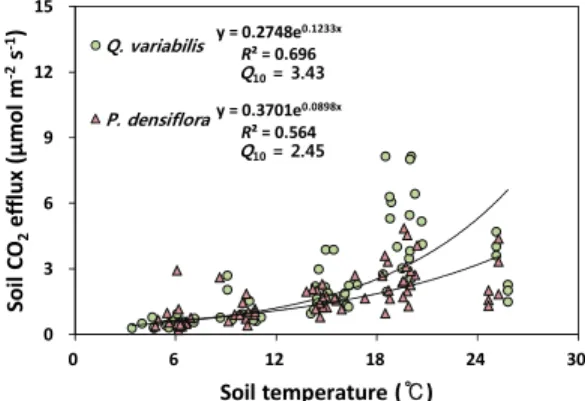
3.2. 임분 별 토양 CO2 방출량과 토양 환경요인과 관계 토양 CO2 방출량과 토양온도는 소나무와 굴참나무 임분 모두 유의적인 지수함수 관계(P<0.05)가 있었다 (Fig. 3). 결정계수(R2) 값은 굴참나무 임분 0.70, 소나무 임분 0.56으로 굴참나무 임분의 결정계수가 높았다. 토 양 CO2 방출량과 토양 온도 사이 지수함수 모델의 결정 계수 값은 조사구와 인접한 소나무재선충병 피해 소나 무 임분 0.82∼0.94(Jeong et al., 2013), 광주광역시에 서 조사된 소나무와 굴참나무 임분의 결정계수 값 0.91
∼0.96(Kim et al., 2009b)에 비해 낮게 나타났다. 이는 본 연구의 경우 조사기간동안 토양 온도가 가장 높았던 8월에 토양 CO2 방출량이 낮게 나타나 지수함수모델의 결정계수가 타 연구 결과에 비해 낮게 나타난 것으로 사 료된다. Q10 값은 굴참나무 임분 3.43, 소나무 임분 2.45 로 굴참나무 임분이 토양 온도 상승에 따른 CO2 방출량 이 소나무 임분에 비해 큰 것으로 나타났다(Fig. 3). 이와 같이 굴참나무 임분의 Q10 값이 높은 것은 토양 pH가 높 은 굴참나무 임분이 소나무 임분에 비해 토양호흡에 관 계되는 미생물이나 뿌리 활력의 차이가 영향을 미치고 있기 때문으로 사료된다. 국내에서 수행된 소나무 임분 의 Q10 값 2.9∼3.5(Noh et al., 2010; Kim et al., 2012;
Choi et al., 2015)와 비교할 때, 본 조사구 소나무 임분의
0 10 20 30 40 50 60
Soil water content (%) Q. variabilis
P. densiflora 0
7 14 21 28 35
Soil temperature (℃)
Month
Q. variabilis P. densiflora
0 3 6 9 12
Soil organic carbon (%) Q. variabilis
P. densiflora 0
2 4 6 8
SoilCO2efflux (µmolm-2s-1)
Month
Q. variabilis P. densiflora
50 100 150 200 250 300 350
Mar. Apr. May Jun. Jul. Aug. Sep. Oct. Nov. Dec. Jan. Feb.
Electrical conductivity (µS cm-1)
Month
Q. variabilis P. densiflora 0
3 5 8 10
Soil pH
Q. variabilis P. densiflora
2015 2016
* *
* *
* *
* * *
* *
Q. variabilis P. densiflora Q. variabilis P. densiflora
Q. variabilis P. densiflora
Q. variabilis P. densiflora
Q. variabilis P. densiflora Q. variabilis P. densiflora
Fig. 2. Monthly variation of soil CO2 efflux, soil temperature, soil water content, soil organic carbon content, soil pH and electrical conductivity in Quercus variabilis and Pinus densiflora stands. Vertical bars indicate standard error. Asterisks represent a significant difference between Quercus variabilis and Pinus densiflora stands at P<0.05.
y = 0.2748e0.1233x R² = 0.696
y = 0.3701e0.0898x R² = 0.564
0 3 6 9 12 15
0 6 12 18 24 30
Soil CO2efflux (µmolm-2s-1)
Soil temperature (℃)
Q. variabilis
P. densiflora
Q10= 3.43 Q10= 2.45 Q. variabilis
P. densiflora
Fig. 3. Exponential relationships between soil CO2 efflux and soil temperature in Quercus variabilis and Pinus densiflora stands.
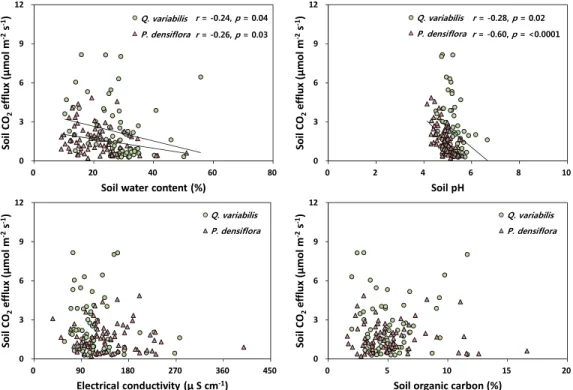
Q10 값은 국내에서 조사된 범위에 비해 낮은 편이다. 토양 pH와 토양 CO2 방출량의 경우, 굴참나무와 소 나무 임분 모두 토양 pH 감소에 따라 토양 CO2 방출량이 증가하는 관계를 보이고 있다(Fig. 4). 이는 토양 pH의 계절적 변동이 토양 온도 변화와 관계가 있기 때문으로 우리나라 산림토양의 경우 토양 온도가 높아 토양 CO2
방출량이 가장 많은 하절기에 토양 pH가 낮게 나타나며, 본 연구에서도 동절기(12월-2월)의 토양 pH는 굴참나 무 임분 pH 5.25-5.40, 소나무 임분 pH 5.14-5.15로 하절 기(6월-8월) 굴참나무 임분 5.05-5.13, 소나무 4.40-4.90 에 비해 높았으며, 이러한 관계는 국내에서 수행된 타 연 구에서도 관찰되는 현상이다(Kim et al., 2009a; Choi et al., 2016; Kim and Jeong, 2016). 토양 수분함량의 경우, 토양 CO2 방출량과 약한 음의 상관관계(r = –0.24와 r = –0.26)를 보이고 있으며 이는 토양 공극 내 수분함량 이 높을 경우 가스 확산 등(Bray and Weil, 2010)에 영향 을 받기 때문으로 사료된다. 본 연구 결과와는 대조적으 로 국내에서 조사된 소나무나 곰솔 임분의 토양 수분함 량은 계절적인 변동이 크지 않기 때문에 토양 이산화탄 소 방출과 유의적인 상관관계에 상관관계가 나타나지
않는 것으로 보고된바 있다(Kim et al., 2009a; Choi et al., 2016).
두 임분 모두 전기전도도와 토양 유기탄소 농도는 토 양 CO2 방출량과 유의적인 상관관계가 나타나지 않았 으며 이는 이들 요인의 월 변동이 크지 않기 때문으로 국 내에서 수행된 타 연구에서도 유사한 결과가 관찰된 바 있다(Kim et al., 2009a; Choi et al., 2016; Kim and Jeong, 2016). 특히 토양 유기탄소 농도의 경우, 토양 CO2 방출에 영향을 미칠 수 있는 기질로 작용할 수 있으 나, 토양 CO2 방출량을 결정하는 요인은 아닌 것으로 보 고되고 있다(Lai et al., 2012).
3.3. 임분 별 연 평균 토양 CO2 방출량
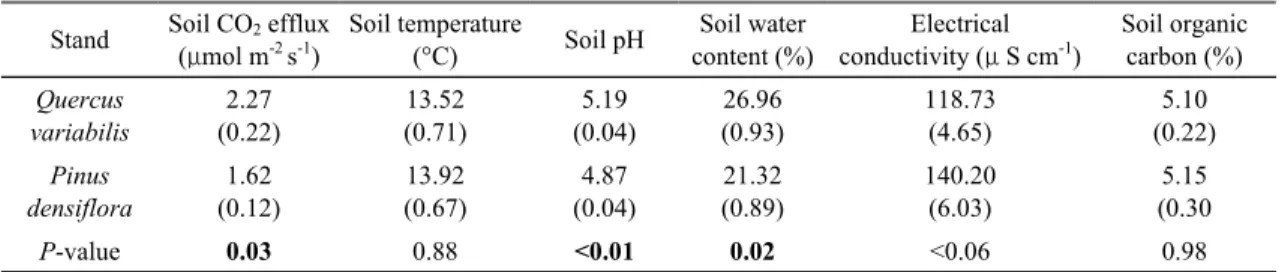
연 평균 토양 CO2 방출량은 굴참나무 임분이 2.27 μmol m-2 s-1 로, 소나무 임분 1.63 μmol m-2 s-1에 비해 유 의적으로 높게 나타났다(Table 1). 토양 환경요인 중 토 양 CO2 방출과 밀접한 관련이 있는 연 평균 토양 온도의 경우, 두 임분 사이에 유의적인 차이가 없었으나, 토양수 분 함량과 토양 pH의 경우, 굴참나무 임분이 소나무 임 분에 비해 높아(Table 1), 두 임분 사이 토양 CO2 방출량
0 3 6 9 12
0 20 40 60 80
Soil CO2efflux (µmolm-2s-1)
Soil water content (%) Q. variabilis P. densiflora
0 3 6 9 12
0 2 4 6 8 10
Soil CO2efflux (µmolm-2s-1)
Soil pH Q. variabilis P. densiflora
0 3 6 9 12
0 90 180 270 360 450
Soil CO2efflux (µmolm-2s-1)
Electrical conductivity (µ S cm-1) Q. variabilis P. densiflora
0 3 6 9 12
0 5 10 15 20
Soil CO2efflux (µmolm-2s-1)
Soil organic carbon (%) Q. variabilis P. densiflora r = -0.24, p = 0.04
r = -0.26, p = 0.03
r = -0.28, p = 0.02 r = -0.60, p = <0.0001 Q. variabilis
P. densiflora
Q. variabilis P. densiflora
Q. variabilis P. densiflora
Q. variabilis P. densiflora
Fig. 4. Relationships between soil CO2 efflux and soil pH, soil water content, electrical conductivity or soil organic carbon content in Quercus variabilis and Pinus densiflora stands.
의 차이는 이들 요인의 누적 결과로 사료된다. 본 연구에 서 조사된 연 평균 토양 CO2 방출량은 본 조사구와 인접 한 곰솔 임분의 연 평균 토양 CO2 방출량 2.84μmol m-2 s-1(Choi et al., 2016)나 소나무 임분 3.18 μmol m-2 s-1(Kim et al., 2012), 광주지역 굴참나무 임분 2.90 μmol m-2 s-1, 소나무 임분 2.33 μmol m-2 s-1(Kim et al., 2009b) 에 비해 낮게 나타났다. 본 조사 임분의 토양 CO2 방출량 이 타 연구에 비해 낮은 것은 1) 임분 종류나 입지요인 등 의 차이가 기여할 수 있으나, 2) 토양 온도가 가장 높았던 8월의 토양 CO2 방출량이 타 연구에 비해 낮게 나타난 것이 원인 일 수 있다.
IV. 결 론
유사한 입지에서 생육한 성숙한 소나무 임분과 굴참 나무 임분의 토양 CO2 방출량은 하절기인 6월과 7월에 유의적인 차이가 있었으며, 최대 방출량과 최소 방출량 의 차는 굴참나무 임분이 소나무 임분에 비해 크게 나타 났다. 연 평균 토양 CO2 방출량은 굴참나무 임분이 소나 무 임분에 비해 높았으며, 주로 토양 pH 나 토양 수분함 량 등이 기여하고 있는 것으로 사료된다. 소나무 임분과 굴참나무 임분 모두 토양 CO2 방출량은 토양 온도 증가 와 지수함수 관계가 있었으며, Q10 값의 경우 굴참나무 임분이 소나무 임분에 비해 크게 나타나 토양 온도 상승 시 굴참나무 임분의 토양 CO2 방출량이 소나무 임분에 비해 증가할 것으로 나타났다.
적 요
본 연구는 유사한 입지에서 생육한 소나무와 굴참나 무 임분의 토양 이산화탄소(CO2)와 이들 방출에 영향을 미치는 환경요인인 토양 온도, 토양 수분, 토양 pH, 전기
전도도, 토양 유기탄소 농도 등을 2015년 3월부터 2016 년 2월까지 1년 동안 조사하였다. 토양 CO2 방출량의 월별 변화는 두 임분 사이에 차이가 있어 하절기인 6월과 7월의 경우, 굴참나무 임분이 소나무 임분에 비해 유의적 으로 높았으나, 타 계절은 차이가 없었다. 연 평균 토양 CO2 방출량의 경우, 굴참나무 임분이 2.27±0.22 μmol m-2 s-1로 소나무 임분의 1.63±0.12 μmol m-2 s-1 에 비해 높게 나타났으며, 연 평균 토양 온도와 토양 수분함량도 굴참나무 임분이 소나무 임분에 비해 높았다. 토양 환경 요인 중 토양 온도와 토양 CO2 방출량은 지수함수 관계 (P<0.05)가 있었으며, Q10 값의 경우, 굴참나무 임분이 3.35로 소나무 임분 2.72에 비해 높아 토양 온도 상승 시, 굴참나무 임분의 토양 CO2 방출량이 소나무 임분에 비 해 더 크게 증가하는 것으로 나타났다.
감사의 글
이 논문은 2014년도 정부(교육부)의 재원으로 한국 연구재단의 지원을 받아 수행된 기초연구사업임(No.
2014R1A1A2054994). 본 논문의 세심한 심사를 해주 신 심사자 분에게 감사함을 전합니다.
REFERENCES
Borken, W., Xu, Y. J., Davidson, E. A., and F. Beese, 2002: Site and temporal variation of soil respiration in European beech, Norway spruce, and Scot pine forests. Global Change Biology 8(12), 1205-1216.
Choi, E. J., Seo, H., Lee, K. S., Yoo, B. O., Kim, C. and H. S. Cho, 2016: Soil CO2 efflux by thinning treatments of black pine (Pinus thubergii Parl.) stand disturbed by pine wilt disease. Journal of Korean Forest Society 105(1), 12-18. (in Korean with English abstract)
Stand Soil CO2 efflux (μmol m-2 s-1)
Soil temperature
(°C) Soil pH Soil water content (%)
Electrical conductivity (μ S cm-1)
Soil organic carbon (%) Quercus
variabilis
2.27 (0.22)
13.52 (0.71)
5.19 (0.04)
26.96 (0.93)
118.73 (4.65)
5.10 (0.22) Pinus
densiflora
1.62 (0.12)
13.92 (0.67)
4.87 (0.04)
21.32 (0.89)
140.20 (6.03)
5.15 (0.30
P-value 0.03 0.88 <0.01 0.02 <0.06 0.98
Values in parentheses are standard errors. Bold letters represent a significant difference at P<0.05.
Table 1. Mean soil CO2 efflux, soil temperature, soil pH, soil water content, electrical conductivity and soil organic carbon in Quercus variabilis and Pinus densiflora stands
Deng, Q., Zhou, G., Liu, J., Liu, S., Duan, H., and D.
Zhang, 2010: Responses of soil respiration to elevated carbon dioxide and nitrogen addition in young subtropical forest ecosystems in China.
Biogeosciences 7, 315-328.
Dong, Y., D. Scharffe, J. M. Lobert, P. J. Crutzen, and E.
Sanhueza, 1998: Fluxes of CO2, CH4 and N2O from a temperate forest soil: the effects of leaves and humus layers. Tellus 50(3), 243-252.
Epron, D., L. Farque, È. Lucot, and Badot P. M., 1999:
Soil CO2 efflux in a beech forest: dependence on soil temperature and soil water content. Annals of Forest Science 56, 221-226.
Hoogsteen, M. J., E.A. Lantinga, E. J. Bakker, J.C.J.
Groot, and P.A. Tittonell, 2015: Estimating soil organic carbon through loss on ignition: effects of ignition conditions and structural water loss. European Journal of Soil Science 66, 320-328.
Jandl, R., M. Linder, L. Vesterdal, B. Bauwens, R.
Baritz, F. Hagedorn, D. W. Johnson, K. Minkkinen, and K. A. Byrne, 2007: How strongly can forest management influence soil carbon sequestration?
Geoderma 137(3-4), 253-268.
Jeong, J., C. Kim, K. S. Lee, N. S. Bolan, and R. Naidu, 2013: Carbon storage and soil CO2 efflux rates at varying degrees of damage from pine wilt disease in red pine stands. Science of the Total Environment 465, 273-278.
Kim, C., Son, Y., Lee, W. K., Jeong, J., and N. J. Noh, 2009a: Influence of forest tending works on carbon distribution and cycling in a Pinus densiflora S. et. Z.
stand in Korea. Forest Ecology and Management 257(5), 1420-1426.
Kim, S. B., N. C. Jung, and K. H. Lee, 2009b: Soil CO2
efflux and leaf-litter decomposition of Quercus variabilis and Pinus densiflora stands in the southern region of Korean Peninsular. Journal of Korean Forest Society 98(2), 183-188.
Kim, C., J. Jeong, N. S. Bolan, and Naidu R., 2012:
Short-term effects of fertilizer application on soil respiration in red pine stands. Journal of Ecology and Environment 35(4), 307-311.
Kim, C., and J. Jeong, 2016: Factors affecting soil CO2
efflux rates in Larix leptolepis, Pinus densiflora and P.
rigitaeda plantations in southern Korea. Dendrobiology 76, 51-60.
Konda, R., S. Ohta, S. Ishizuka, J. Heriyanto, and A.
Wicaksono, 2010: Seasonal changes in the spatial structure of N2O, CO2, and CH4 fluxes from Acacia mangium plantation soils in Indonesia. Soil Biology and Biochemistry 42(9), 1512-1522.
Lai, L., X. Zhao, L. Jiang, Y. Wang, L. Luo, Y. Zheng, X. Chen, and G. M. Rimmington, 2012: Soil respiration in different agricultural and natural ecosystems in an arid region. PLoS ONE 7(10), e48011.
Noh, N. J., Y. Son, S. K. Lee, T. K. Yoon, K. W. Seo, C.
Kim, W. K. Lee, S. W. Bae, and J. Hwang, 2010:
Influence of stand density on soil CO2 efflux for a Pinus densiflora forest in Korea. Journal of Plant Research 123(4), 411-419.
Peichl, M., M. A. Arain, S. Ullah, and T. R. Moore, 2010: Carbon dioxide, methane, and nitrous oxide exchanges in an age-sequence of temperate pine forests. Global Change Biology 16(8), 2198-2212.
Peng, Y., S. C. Thomas, and D. Tian, 2008: Forest management and soil respiration: Implication for carbon sequestration. Environmental Reviews 16, 93-111.
Saiz, G., K. A. Byrne, K. Butterbach-bahl, R. Kiese, V.
Blujdea, and E. P. Farrell, 2006: Stand age-related effects on soil respiration in a first rotation Sitka spruce chronosequence in central Ireland. Global Change Biology 12(6), 1007-1020.
SAS Institute Inc, 2003: SAS/STAT Statistical Software.
Version 9.1. SAS publishing, Cary, NC. USA.
Ullah, S., R. Frasier, L. Pelletier, and T. R. Moore, 2009:
Greenhouse gas fluxes from boreal forest soils during the snow-free period in Quebec, Canada. Canadian Journal of Forest Research 39(3), 666-680.
Vincent, G., A. R. Shahriari, E. Lucot, P. M. Badot, and D. Epron, 2006: Spatial and seasonal variations in soil respiration in a temperate deciduous forest with fluctuating water table. Soil biology and Biochemistry 38(9), 2527-2535.
Yashiro, Y., W. R. Kadir, T. Okuda, and H. Koizumi, 2008: The effects of logging on soil greenhouse gas (CO2, CH4, N2O) flux in a tropical rain forest, Peninsular Malaysia. Agricultural and Forest Meteorology 148(5), 799-806.
Yi, M. J., 2003: Soil CO2 evolution in Quercus variabilis and Q. mongolica forests in Chunchon, Kwangwon Province. Journal of Korean Forest Society 92(3), 263-269. (in Korean with English abstract)