DOI: 10.5532/KJAFM.2013.15.3.186
ⓒ Author(s) 2013. CC Attribution 3.0 License.
Annual Variation of Soil CO
2Efflux in a Broadleaved Deciduous Forest of the Geumsan (Mt.) Long-Term Ecological Research Site
Choonsig Kim1*, Im Kyun Lee2, Jong Hwan Lim2, Byung Bae Park2 and Jung Hwa Chun2
1Department of Forest Resources, Gyeongnam National University of Science and Technology, Jinju 660-758, Korea
2Korea Forest Research Institute, Seoul 130-012, Korea
(Received August 27, 2013; Revised September 15, 2013; Accepted September 24, 2013)
금산장기생태조사지 낙엽활엽수림내 토양이산화탄소 방출량의 연변동
김춘식1*·이임균2·임종환2·박병배2·천정화2
1경남과학기술대학교 산림자원학과, 2국립산림과학원
(2013년 8월 27일 접수; 2013년 9월 15일 수정; 2013년 9월 24일 수락)
ABSTRACT
Soil respiration in forest ecosystems play an important role in global carbon cycle. This study was carried out to determine the annual variation of soil CO2 efflux for 4 years in a broadleaved deciduous forest of the Geumsan (Mt.) Long-Term Ecological Research (GLTER) site in Southern Korea. The soil CO2 efflux in the GLTER site showed annual variations with the fluctuations of annual mean soil temperature, but not with those of soil water content. The annual mean soil CO2 efflux except for winter season was 0.32 g CO2 m−2 h−1 for 2008, 0.40 g CO2 m−2 h−1 for 2009, 0.41 g CO2 m−2 h−1 for 2007, and 0.54 g CO2 m−2 h−1 for 2010. The lowest soil CO2 effluxin 2008 was associated with the lowest soil temperature (12.0oC) in comparison with those of other years (13.0-13.5oC). The exponential relationships between monthly soil CO2 efflux and the corresponding soil temperature at the soil depth of 20 cm were significant (R2= 0.31 -0.75, P < 0.05). The results indicate that the annual variation of soil CO2 efflux was attributed to the variations of soil temperature rather than soil water content in the GLTER site.
Key words: Carbon cycle, LTER, Soil CO2 efflux, Soil respiration
I. INTRODUCTION
The quantitative evaluation of soil CO2 efflux is a key process for understanding carbon dynamics in for- est ecosystems. However, soil CO2 efflux can vary annually because the rates respond differently to chang- ing environmental variables such as nutrient availabil- ity, soil water content, and soil temperature (Davidson et al., 1998; Raich and Tufekcioglu, 2000; Samuelson et al., 2009; Noh et al., 2010). Long-Term Ecological Research (LTER) program in forest ecosystems is designed to understand the structure and function of
forest ecosystems by long-term monitoring. In addi- tion, understanding of soil CO2 efflux is an important component to analyze the carbon cycle in the LTER program. Despite the progress made in quantifying the carbon balance of many forest ecosystems in Korea (Kim 2008; Lee et al., 2010; Noh et al., 2010), little is known about underlying annual variation of soil CO2 effluxes in the Korea LTER sites. The objective of this study was to quantify annual variation of soil CO2 efflux at the LTER site of the Geumsan (Mt.) broadle- aved deciduous hardwood forest which is composed of some important hardwood tree species of Korean forest
* Corresponding Author : Choonsig Kim ([email protected])
lands.
II. MATERIALS AND METHODS
The study was conducted at the LTER site (34°45'N;
127°59'E, 400m) in Geumsan (Mt.), Namhae-gun, Gyeongsangnam-do, Korea, which is administered by the Korea Forest Research Institute. This area has been designated as a Korea LTER site since 2000. Annual precipitation and temperature of Namhae weather sta- tion near the study site average 1,674mm and 14.4oC during the study period (from 2007 to 2010), respec- tively. This area was classified as the warm temperate forest area in Korea. Dominant tree species of the study site were Quercus serrata, Styrax japonica, Acer pseudo-sieboldianum, Carpinus tschonoskii, Stewertia pseudo-camellia, and Chamaecyparis obtusa. Soil was classified as a brown forest soil developed on granite.
In 2011, tree density over 2 cm in DBH was 3,009 trees ha−1 and stand basal area was 32.6 m2 ha−1.
Soil CO2 efflux was measured monthly in situ using an infrared gas analyzer system (Model EGM-4, PP systems, Hitchin, UK) equipped with a flow-through
closed chamber (Model SRC-2, the same manufac- turer) from April 2007 through December 2010, except for winter season (January and February, March for 2007) because of frozen soil layer. The measurements were performed at fifteen randomly selected locations between 14:00 and 17:00 P.M. Soil temperature was measured at 20 cm depth adjacent to the soil respiration chamber using a soil temperature probe (Model STP-1, the same manufacturer) attached with EGM-4. Volu- metric soil water content was also measured at 12 cm depth using a HydroSenceTM soil moisture meter (Model CS 620 and CD 620, Campbell Scientifics, Inc. Austra- lia). The annul variations of the soil CO2 efflux were tested using the general linear model procedure of SAS (SAS institute, 2003). When significant differences occurred, the means among the years were compared using Tukey’s test at P = 0.05.
III. RESULTS AND DISCUSSION
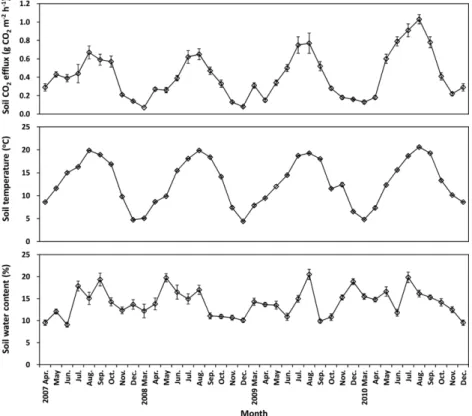
Soil CO2 efflux showed a clear seasonal variation for 4 years, in which the rates increased during spring and summer, and reached maximum values in July and
Fig. 1. Monthly variations of soil CO2 efflux, soil temperature and volumetric soil water content in the Guemsan LTER site.
August (Fig. 1). During September and October, soil CO2 efflux declined, reaching values close to those in April and May. In addition, a temporal variation in soil CO2 efflux rates had a similar seasonal pattern to soil temperature regardless of the variation of soil water content (Fig. 1). Many studies in forest ecosystems have reported that monthly CO2 efflux was correlated strongly with monthly fluctuations of the soil tempera- ture and weakly with the soil that of water content (Kim et al., 2009; Noh et al., 2010).
The annual mean soil CO2 efflux except for winter season were 0.32 g CO2 m−2 h−1 for 2008, followed by 0.40 g CO2 m−2 h−1 for 2009, 0.41 g CO2 m−2 h−1 for 2007, and 0.54 g CO2 m−2 h−1 for 2010 (Fig. 2). The soil CO2 efflux rates and temperature were significantly lower (P < 0.05) in the 2008 than in the other years (Fig. 2). Soil CO2 efflux can be directly affected by the
change in microclimate and microbial activity, since the rates result from two main sources, (1) root respi- ration and (2) microbial decomposition of organic mat- ter (Lee and Jose, 2003; Lee et al., 2010). The lowest soil CO2 efflux in 2008 were associated with the lowest soil temperature (12.0°C) compared with other years (13.0-13.5°C) and the lowest annual total precipitation (Fig. 3) because the decreases in soil temperature and precipitation could induce the reduced microbial biom- ass (Lee and Jose, 2003) and root activity and produc- tion (Haynes and Gower, 1995; Davidson et al., 1998;
Phillip and Fahey, 2007). In addition, the highest soil CO2 efflux in 2010 can be due to high soil temperature (from June to September) which was related to the high soil CO2 efflux (Fig. 1) and the highest annual total precipitation (Fig. 3). The mean soil temperature dur- ing this period was highest with 18.5°C in 2010, fol- lowed by 18.0°C in 2008, 17.6°C for 2009, and 17.5°C in 2007 (Fig. 1).
An exponential regression has been widely used to describe the relationship between soil CO2 efflux rates and temperature (Bowden et al., 2004; Kim, 2008). The exponential relationships between monthly soil CO2 efflux and the corresponding soil temperature at the depth of 20 cm (Fig. 4) were highly significant (R2= 0.31- 0.75, P < 0.05). An exponential increase in the soil CO2
efflux with respect to the soil temperature was observed in other forest ecosystems (Raich and Tufek- cioglu, 2000; Kim et al., 2009; Noh et al., 2010) because heterotrophic soil respiration is related to the
Fig. 2. Annual variations of soil CO2 efflux rates, soil tem- perature, and volumetric soil water content in the Guemsan LTER site. Vertical bars indicate one standard error. Mean (n=15) with the different letter indicate significant differ- ences among years (P < 0.05). The data of 2007 were aver- aged from April to December, but other years were from March to December.
Fig. 3. Annual mean air temperature and total precipitation of the Namhae weather station near the Guemsan LTER site.
temperature dependency of the microbial decay of soil organic matter in forest ecosystems (Davidson and Jan- ssens, 2006). However, the correlation coefficient of the soil CO2 efflux with the soil water content was not signif- icant (Fig. 4).
Sensitivity of soil CO2 efflux to soil temperature was
commonly expressed by the Q10 factor (Borken et al., 2002). The Q10 values for soil CO2 efflux ranged from 2.41 in the 2007 to 3.75 in the 2010 (Fig. 4). The Q10
values in this study were comparable to those reported for Korea forest ecosystems, with a range from 3.45 to 3.77 at a 12 cm soil depth in red pine stands (Noh et Fig. 4. The relationship between soil CO2 efflux rates and soil temperature or soil water content in the Guemsan LTER site.
al., 2010), and were lower than 5.1 at a 20 cm soil depth in a 36-year-old larch plantation (Kim, 2008).
The range of Q10 values may have partly resulted from tree species to the differences in the soil depth at which the temperature was measured (Borken et al., 2002).
적 요
산림생태계 토양 호흡량은 지구탄소순환에 중요한 역 할을 한다. 본 연구는 금산 장기생태 연구 조사지 낙 엽활엽수림을 대상으로 4년 동안 토양 이산화탄소 방 출량의 연 변동을 조사하였다. 금산 장기생태 연구 조 사지 월별 토양 이산화탄소 방출량은 토양온도 변화와 밀접한 관계가 있었으며 토양수분함량과는 뚜렷한 경 향을 보이지 않았다(P > 0.05). 동절기(1월과 2월, 2007년의 경우 1월부터 3월)를 제외한 평균 토양 이 산화탄소 방출량은 2008년 0.32 g CO2 m−2 h−1, 2009년 0.40g CO2 m−2 h−1, 2007년 0.41g CO2 m−2 h−1, 2010 년 0.54 g CO2 m−2 h−1 순이었으며, 2008년의 연 평균 토양온도는 12.0°C로 다른 연도의 토양 온도 13.0- 13.5°C에 비해 유의적으로(P<0.05) 낮았다. 토양 이산 화탄소 방출량과 토양 20cm 깊이의 토양온도는 지수 함수 관계가 있었으며 (R2= 0.31-0.75, P < 0.05), 토 양수분함량은 토양 이산화탄소 방출량과 유의적인 관 계가 없었다(P > 0.05). 본 연구 결과에 따르면 금산 장기생태연구 조사지 토양 이산화탄소 방출량의 연 변 동은 토양수분보다는 토양온도 변화와 관계가 있었다.
ACKNOWLEDGMENTS
This work was partially supported by the Korea For- est Research Institute and by Basic Science Research Program through the National Research Foundation of Korea (NRF) funded by the Ministry of Education (NRF-2010-0022193).
REFERENCES
Borken, W., Y. J. Xu, E. A. Davidson, and F. Beese, 2002:
Site and temporal variation of soil respiration in Euro- pean beech, Norway spruce, and Scots pine forests. Glo- bal Change Biology 8(12), 1205-1216. doi: 10.1046/
j.1365-2486.2002.00547
Bowden, R. D., E. Davidson, K. Savage, C. Arabia, and P.
Steudler, 2004: Chronic nitrogen additions reduce total soil respiration and microbial respiration in temperate
forest soils at the Harvard Forest. Forest Ecology and Management 196(1), 43-56.
Davidson, E. A., E. Belk, and R. D. Boone, 1998: Soil water content and temperature as independent or confounded factors controlling soil respiration in temperate mixed hardwood forest. Global Change Biology 4(2), 217-227.
Davidson, E. A., and I. A. Janssens, 2006: Temperature sensitivity of soil carbon decomposition and feedbacks to climate change. Nature 440, 165-173. doi:10.1038/
nature04514
Haynes, B. E., and S. T. Gower, 1995: Belowground carbon allocation in unfertilized and fertilized red pine planta- tions in northern Wisconsin. Tree Physiology 15(5), 317- 325.
Kim, C., 2008: Soil carbon storage, litterfall and CO2 efflux in fertilized and unfertilized larch (Larix leptole- pis) plantations. Ecological Research 23(4), 757-763.
doi: 10.1007/ s11284-007-0436-2
Kim, C., Y. Son, W. K. Lee, J. Jeong, and N. J. Noh, 2009:
Influences of forest tending works on carbon distribu- tion and cycling in a Pinus densiflora S. et Z. stand in Korea. Forest Ecology and Management 257(5), 1420- 1426. doi: 10.1016/j.foreco.2008.12.015
Lee, K. H., and S. Jose, 2003: Soil respiration, fine root production, and microbial biomass in cottonwood and loblolly pine plantations along a nitrogen fertilization gradient. Forest Ecology and Management 185(3), 263- 273.
Lee, N. Y., J. W. Koo, N. J. Noh, J. Kim, and Y. Son, 2010:
Autotrophic and heterotrophic respiration in needle fir and Quercus-dominated stands in a cool-temperate for- est, central Korea. Journal of Plant Research 123(4), 485-495. doi: 10.1007/s10265-010-0316-7
Noh, N. J., Y. Son, S. K. Lee, T. K. Yoon, K. W. Seo, C.
Kim, W. K. Lee, S. W. Bae, and J. Hwang, 2010: Influ- ence of stand density on soil CO2 efflux for a Pinus den- siflora forest in Korea. Journal of Plant Research 123(4), 411-419. doi: 10.1007/s10265-010-0331-8 Phillips, R. P., and T. J. Fahey, 2007: Fertilization effects
on fineroot biomass, rhizosphere microbes and respira- tory fluxes in hardwood forest soils. New Phytologist 176(3), 655-664.
Raich, J. W., and A. Tufekcioglu, 2000: Vegetation and soil respiration: Correlations and controls. Biogeochemistry 48, 71-90.
Samuelson, L., R. Mathew, T. Stoke, Y. Feng, D. Aubrey, and M. Coleman, 2009: Soil and microbial respiration in a loblolly pine plantation in response to seven years of irrigation and fertilization. Forest Ecology and Manage- ment 258(11), 2431-2438.
SAS Institute Inc., 2003. SAS/STAT Statistical Software.
Version 9.1. North Carolina, Cary, USA.