DOI: 10.5532/KJAFM.2010.13.2.048
ⓒ Author(s) 2011. CC Attribution 3.0 License.
Properties of Solar Radiation Components Reflected by the Sea Surface:
− A Case of Jeju Island, South Korea −
Uno Fumichika
1*, Yousay Hayashi
1, Soo-Jin Hwang
2and Hae-Dong Kim
31
Graduate School of Life and Environmental Science, University of Tsukuba, Tsukuba 305-0001, Japan
2
Department of Earth Science Education, Pusan National University, Pusan 609-735, Korea
3
Department of Global Environment, Keimyung University, Daegu 704-701, Korea
(Received May 24, 2011; Revised June 15, 2011; Accepted June 24, 2011)
해수면에 의해 반사된 태양복사 성분의 특성: 남한의 제주도 사례 Uno Fumichika
1*·Yousay Hayashi
1·황수진2·김해동31
일본 쓰쿠바대학교 생명환경과학대학원,
2부산대학교 지구과학교육과,
3계명대학교 지구환경학과 (2011년 5월 24일 접수; 2011년 6월 15일 수정; 2011년 6월 24일 수락)
ABSTRACT
Solar radiation components reflected by the sea surface ( R
ss↑ ) are additional energy sources comprising the solar radiation regime. Previous studies, based on observational approaches, indicated that R
ss↑ is an available climatological resource. However, an estimation process for R
ss↑ has not been established. In this case study over Jeju Island in South Korea, we applied a new estimation process to solar radiation modeling and discussed the spatial distribution of R
ss↑ and its seasonal variation. Our results showed that the illuminated area and the intensity of R
ss↑ became greatest at the winter solstice and least at the summer solstice. We estimated the illuminated area of R
ss↑ as it expanded over the southern slope of Jeju Island. At the winter solstice, on a daily basis, the area and intensity of illumination by R
ss↑ were 182.3 km
2and 0.41 MJ m
−2day
−1, respectively. Comparing the daily accumulative and instantaneous values of
R
ss↑ intensity, the difference was about 20 times greater in daily cases than in instantaneous cases. On the other hand, for instantaneous values, the R
ss↑ intensity accounted for up to 33% of the three components, i.e., direct, diffuse and reflected radiation in winter solstice. In addition, it was estimated that the sea surface reflectance depended on the wind speed. Therefore, in a practical use of this revised model, wind conditions should be considered as a critical factor in estimating R
ss↑ .
Key words : Solar radiation, Reflection by the sea, Topographic shading, Jeju Island
1. INTRODUCTION
Over complex terrain, global solar radiation (i.e., the sum of direct and diffuse components) varies intrinsi- cally with the relative position between the sun and the exposed sloping surface. The primary energy used for plant growth is restricted by global solar radiation and the capacity of the effective energy (which relates to topographic properties) is defined as climatic resources.
Many researchers have focused their attentions mostly on the spatial distribution of solar radiation.
Many studies have attempted to evaluate the sun orbit and the slope geometry (e.g., slope, altitude, and angle direction) for calculating solar radiation over complex terrain (e.g., Boyer and Feldhake, 1991; Dubayah and Loechel, 1996; Wang
et al.,2006). Garnter and Ohm- ura (1968) used not only the sun orbit and the slope geometry but also atmospheric transmissivity and the
* Corresponding Author : Uno Fumichika
([email protected])
optical air mass. Additionally, Swift (1976) took the seasonal variation of the sun’s orbit into account.
In addition to the complexity of the distribution of surface solar radiation intensity over a steep mountain- side, it is important to estimate and discuss the shading effects generated by the surrounding topography. Var- ley
et al.(1996) indicated that the surface global solar radiation at a valley floor is 10% less than those in open areas that are not under the shading effect. There- fore, the shading effect causes the heterogeneous distri- bution of solar radiation. The characteristics of spatially heterogeneous solar radiation influence meteorological elements. Muller and Scherer (2005) showed the impact of the shading effect on surface temperature. Surface temperature along the valleys decreased about 1.5K when the shading effect process was applied to mesos- cale weather forecast models.
In addition to direct and diffuse solar radiation, reflected radiation from south-facing areas along the coast is an important component. Wakiyama and Ohba (1997) reported that large amounts of photosynthetically active radiation (PAR) and near infrared radiation (NIR) were observed over the mountain slopes at lower elevation angle of the sun in comparison to the case with the high elevation. They argued that the larger amount of observed radiation was caused by specular reflection from the sea surface.
In relation to this phenomenon, we have an empirical knowledge that reflected components of the solar radi- ation (
Rss↑) provide a supplementary energy source for quality fruit production. There are many previous studies addressing direct and diffuse solar radiation.
However, radiation components caused by reflection from the water surface have not been discussed much.
In the present research, we propose the development of a practical model for estimating solar radiation inten- sity over complex terrain and its
Rss↑.
2. STUDY AREA AND DATA The study area of the present research is Jeju Island, South Korea, located about 90 km from the southern end of the Korean Peninsula. It is an isolated island with Mt. Halra (which has the elevation of 1950 m above m.s.l.). The latitude of Jeju Island (33.5°N) is almost identical to that of Fukuoka Prefecture, Kyushu, Japan (33.6°N). Over the foothills of the south side of Jeju Island are areas favorable for orchard production.
To describe the climatic basis, which is required to
determine the background condition of solar radiation fields in the model, hourly data for global, direct, and diffuse solar radiation at Fukuoka prefecture were applied. This was done due to a lack of long-term solar radiation observations around Jeju Island and a lack of sufficient representations of the solar radiation regime covering Jeju Island and Fukuoka Prefecture. The radi- ation data from 1974 to 2005 were provided from the Japan Meteorological Agency (JMA).
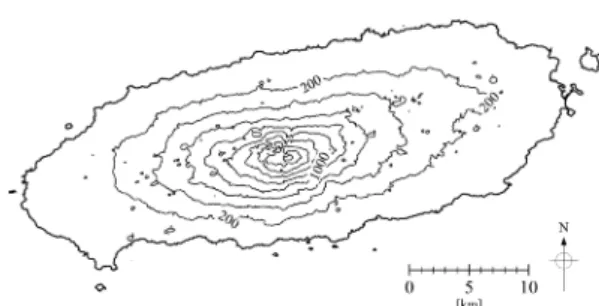
Digital Elevation Model (DEM) with a 50 m grid of spatial resolution was used to calculate the slope geom- etry, shade effect, and incident angles of all radiation components in a unit area of the surface. The topo- graphical map of Jeju Island with indices to be men- tioned later is shown in Fig. 1. The geomorphological characteristics of Jeju Island indicate volcanic topogra- phy. The major and minor axes of the island’s spindle shape are 73 and 41 km, respectively.
3. METHODOLOGY
3.1. The model framework
To calculate all solar radiation components over com- plex terrain, we modified a previous model proposed by Kurose (1991) and Hayashi and Kurose (1997) and appended the calculation process for the reflected com- ponent of the solar radiation. The basic framework of the model is described below.
The primary function of the model is to calculate the sun’s orbit at arbitrarily preset intervals of time. Since the global solar radiation is defined instantaneously, an interval time of 3 minutes is used. In the present study, it is important to take the shading effect of the sur- rounding topography into account. First, to calculate the direct component of solar radiation, the angles of elevation of the surrounding ridgelines were computed.
Then a resolving angle over the horizontal surface was
Fig. 1. Topographic map in Jeju Island with contours from 0
to 1800 m with 200 m interval.
set at 3 degree to detect the corresponding ridgeline.
The subsequent step in the model addresses whether or not the target grid is shaded from direct solar radia- tion. In this process, it is essential to distinguish the ele- vation of surrounding ridgelines from the orbital position of the sun because higher ridgelines shade direct solar radiation on the target grid. Furthermore, a parameter for the sky view factor (SVF) is introduced for the computation of the ratio of incoming diffuse to solar radiation. The SVF indicates the ratio of the amount of the sky hemisphere subtended by a horizontal surface.
Prior to the practical estimation for the direct and dif- fuse solar radiation components on the ground surface, this model requires the proportions of direct and diffuse components to global solar radiation on an open ground surface, as a background over the extent of Jeju Island and Fukuoka stations.
3.2. Calculations of Rss↑
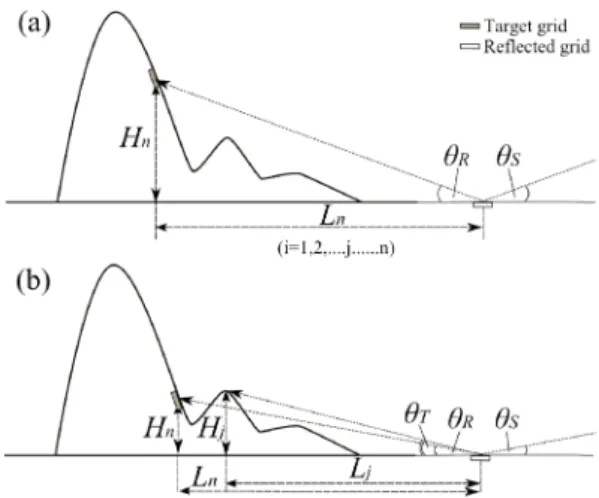
The area facing the sea receives the reflected compo- nent as supplementary energy on the ground. The inci- dent angle of the reflected ray illuminates below the horizon into the ground. Here we assume that the reflected ray is defined only under a process of specular reflection at the sea surface. Thus, the incident angle of the reflected component (
θR) is uniquely determined by the solar incidence angle (
θS). Naturally, azimuth angle of reflected ray is same as solar azimuth angle. The total energy received by such surfaces depends on the
slope angle and direction, solar zenith angle, and inci- dence angle from the sea in addition to the shading effect around the ridgeline (see Fig. 2).
The required conditions for calculating the
Rss↑on sloped surfaces are as follows.
(1) and
(2) where
iis a grid number between the target and reflected grids (water surface only). And,
nis the number of grids.
θiTis the elevation angle of the ridgeline, and
Hiis the height of
ith grid to reflected grid.
Liis the dis- tance between the
ith grid and the reflected grid. If
θRhas the following condition,
(3) then this condition represents that higher terrain than target grid height exists between target grid and reflected grid (Fig. 2b). Reflected components are scattered by the ridgeline terrain. Furthermore, if the identified reflected grid is located beyond the celestial horizon, the reflected component does not reach the target grid. The distance of the celestial horizon (
Lcel) is described as:
(4) Here
rEis the earth radius (~ 6371 km). Because the energy of the reflected component from the ground is negligibly small in comparison to that from the water surface, we eliminated the reflected component from the ground surface in the computations of the
Rss↑process.
4. RESULTS AND DISCUSSION
4.1. Distribution of the total radiation energy and Rss↑
The distributions of the estimated total radiation energy (
Rtotal) (i.e., the sum of direct and diffuse com- ponents and
Rss↑) and
Rss↑under clear sky condi- tions over Jeju Island are shown in Fig. 3 for both solstices and the autumn equinox. Regarding the distri- bution characteristics of solar radiation, we omitted the spring equinox because the sun’s orbit at this time is almost identical to that of the autumn equinox.
The illuminated
Rtotalshowed obvious spatial differ- ences between the northern and southern ground sur-
θR
=
θiT (i= 1 2
, , ,… n)θiT
tan
–1HLi---
i=
(i= 1 2
, , ,… n)θR<
Max
( )θiT (i= 1 2
, , ,… n)Lcel
=
rE⋅cos
–1{rE⁄(rE+
Hi)}Fig. 2. The processes of R
ss↑ calculation for (a) directly
illuminated case and (b) shaded case for a target slope. The
valued of H is the height from target grid to the reflected
grid and L is the horizontal distance between target grid and
reflected grid.
face. At the winter solstice, the difference between north and south was four times greater (Fig. 3a). The north-south difference in the illuminated
Rtotalwas observed throughout the year although the difference decreased as the summer approached (see Figs. 3b and 3c). The spatial difference and its seasonal variability resulted from the shading effect of the Mt. Halla, which scattered the direct component of global solar radiation.
Such an effect becomes prominent in high-elevation areas. Additionally, the areas affected and the scattering of energy by the shading effect depend on the solar zenith angle. Therefore, spatial distribution of
Rtotalshows seasonal variation.
The spatial distribution of
Rss↑was different from that of
Rtotal. The spatial and seasonal variations of
Rss↑are shown in Fig. 3 (right side). The
Rss↑intensity was lower than that of
Rtotalbecause the illumination time of
Rss↑
was less than 1 hour in all seasons. Almost all of the areas illuminated by
Rss↑were extending over the zones of middle and higher altitudes facing the south- ern slope. At the winter solstice, reddish colorations indicate the area being illuminated by greater energy even though the values were estimated at approxi- mately 0.41 MJ m
−2day
−1(Fig. 3d). The illuminated areas of
Rss↑extended widely over the east and west portions of the slopes because the direction of rays at sunrise/sunset is extended by 62°/-62° (in this case,
zero degrees corresponds to the south). At the equinox (Fig. 3f), the direction shifts more easterly and westerly at sunrise and sunset, respectively. Thus, the illumi- nated areas are limited to higher altitude slopes because the sun orbit shifts the zenith as summer approaches.
Figure 4 shows the
Rss↑intensity at the winter sol- stice and autumn equinox along a north-south cross section of the mountain’s summit. As the incidence angle at the
Rss↑on a steeply sloped surface approached perpendicular, the
Rss↑intensity became relatively large at high altitude zones compared to that at low alti- tude. In addition, at the equinox, certain
Rss↑is appearing on the northern side of the summit. The
Rss↑Fig. 3. Spatial distributions of clear sky R
total(a, b, c) and R
ss↑ (d, e, f) (MJ m
−2day
−1) in winter (upper panels) and summer sol- stice (middle panels), and autumn equinox (lower panels). Contour is same as Fig. 1.
Fig. 4. R
ss↑ intensity on the north-south cross section at
winter solstice (solid line) and autumn equinox (dashed
line). Gray shade shows topography. In abscissa axis, loca-
tion of the summit is referenced at 0 km (south: positive,
north: negative) .
distribution difference between the winter solstice and autumn equinox is caused by the difference in directions at sunrise and sunset. Thus,
Rss↑intensity and distribution depend on the sun’s orbit.
Durations of the illuminated time by
Rss↑are distinguished for a period before noon and for a period of afternoon. The illuminated areas are shown using three categories in Fig. 5. Blue dots represent the areas affected by
Rss↑in the morning (from 07:45 to 08:15 in LST), green dots in the evening (from 17:20 to 17:45 in LST), and red dots for the overlapping periods in the morning and evening in winter solstice. As shown by the red dots, there is significant
Rss↑exposure in the middle to high altitude zones of the slope facing the sea (see Fig. 3d). On the other hand, the green dots show that it is only in the afternoon that the
Rss↑pours its radiation energy into the periphery zone of the southern foothills extending lower than 200 m in altitude.
4.2. Seasonal change of Rss↑
We estimated the seasonal variation of solar radiation by the model using climatological background (Fig. 6) of direct and diffuse radiation observed under clear sky conditions from 1974 to 2005. The solar radiation proper- ties of this island are shown in Table 1. Daily global solar radiation reaches 28.24 MJ m
−2day
−1at the sum- mer solstice and reduces to 11.41 MJ m
−2day
−1at the winter solstice. Contrary to the seasonality of global
solar radiation, the
Rss↑intensity showed 0.04 and 0.41 MJ m
−2day
−1at the summer and winter solstices, respectively. There is a major difference between
Rss↑and global solar radiation intensity.
However, from an instantaneous point of view, the
Rss↑
accounts for 10~30% of the global solar radiation (see Table 1). Fig. 7 shows the distribution of the max- imum values of the
Rss↑ratio ((
Rss↑/
Rtotal)
max) through- out the day. It must be noted that the timing of (
Rss↑/
Rtotal
)
maxdiffers on each grid. The percentage of the (
Rss↑/
Rtotal)
maxreaches 33% at the winter solstice. Also, the coverage area spreads as winter approaches.
4.3. The effect of wind speed on Rss↑
It is noted that solar reflectance from the sea surface depends on wind speed. In the primary process for cal- culation of
Rss↑, additional discussion is needed regarding the role of wave conditions on the solar reflectance ratio under windy conditions. Generally, strong wind generates lower reflectance because of the
Fig. 5. Time zones of R
ss↑ illuminated slope through a day at winter solstices, Blue: morning (from 7:46 to 8:15 in LST), Green: evening (from 17:20 to 17:45 in LST), Red:
overlapped (from morning (blue) and evening (green)). Con- tour is same as Fig. 1.
Fig. 6. Seasonal variation of global solar radiation (solid line) and diffuse component (property of diffuse radiation in glo- bal solar radiation) (dashed line) for model input data.
Fig. 7. Distribution of ( R
ss↑ / R
total)max at winter solstice.
Contour is same as Fig. 1.
Table 1. Seasonal variation of concerning properties in this island Global radiation
(MJ m
−2day
−1) (MJ R m
ss−2↑ day
−1) ( R
ss↑ / R
total)max
(%) Area*
(km
2)
Winter solstice 11.41 0.41 33.4 182.3
Summer solstice 28.24 0.04 22.5 4.5
Equinox 23.00 0.12 7.0 88.3
emergence of foam, and whitecaps over the sea surface (Hwang, 1997). Here, we adopted an algorithm pro- posed by Haltrin (2002) to estimate the effective reflected solar radiation subject to wave generation under strong wind speeds, which accompanies Fresnel’s optical reflec- tion coefficient. Haltrin’s function indicates a positive relationship between the solar zenith angle and Fresnel’s reflection coefficient.
Figure 8 indicates the wind speed dependence of the sea surface’s reflectance. Reflectance at larger solar zenith angle varied with wind speed. However, the dif- ference became smaller when the solar zenith angle was around 85 degrees. Reflectance decreased as the solar zenith angle decreased, but the rate of decrease is less than that under windy conditions. For example, reflectance under 10 m s
−1wind speed was smaller than those under calm conditions at large solar zenith angle.
This indicates that the
Rss↑will be reinforced under relatively strong wind conditions when the solar zenith angle is smaller than approximately 85 degrees.
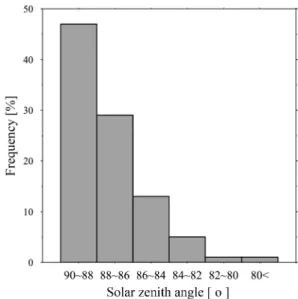
Inversely, reflectance at solar zenith angle greater than 85 degrees weakens under this condition. Fig. 9 shows the frequency of the solar zenith angle when
Rss↑illu- minates the slope through a day at two solstices and at autumn equinox. The frequency about solar zenith angle greater than 85 degree accounts for 80% of the total. Therefore, the wind speed factor was not negligi- ble when calculating
Rss↑intensity.
To focus on the properties of
Rss↑intensity over
complex terrain, the first half of this study is simplified to ignore the effective reflectance of the sea surface under windy conditions.
5. SUMMARY AND CONCLUSION In this study, we presented a method of estimating
Rss↑. Then we applied this new
Rss↑estimation process to a solar radiation estimation model including the solar radiation scattering effect around terrain. The particu- lars of the method are: 1) assumption of specular reflection from the sea surface, 2) consideration of the scattering effect between the sea surface and the slope, and 3) exception of
Rss↑from beyond the celestial horizon.
Our results show that the spatial distribution of
Rss↑intensity expanded over the southern slope, and high altitude slopes received more
Rss↑. The intensity of
Rss↑became weakest with least amount of receiving area around the summer solstice and then increased as the winter solstice approached. The peak
Rss↑intensity appeared on the southern slope at the center of the mountain because the slope received
Rss↑at both sun- rise and sunset. Daily
Rss↑intensity accounted for only 4% of the daily global solar radiation. However, instantaneous values of
Rss↑intensity accounted for 33% of the global solar radiation.
Considering
Rss↑from the southeast to southwest
Fig. 8. Relationships between solar zenith angle and reflec-
tance on water surface with wind speed variability. Fig. 9. The frequency of solar zenith angle which R
ss↑ illu-
minated the slopes surface in two solstices and autumn equi-
nox.
slopes, the
Rss↑receiving area and intensity thereof were greatest around the winter solstice. Daily
Rss↑intensity had little effect on daily global solar radiation intensity. However, the instantaneous value of
Rss↑had a strong impact on instantaneous global solar radiation intensity at sunrise and sunset.
Wind speed was an important factor influencing the variation of
Rss↑, which affect the strength of ocean waves and foams. At large solar zenith angle, the reflec- tance became smaller with a stronger wind condition.
The effect of wind conditions on reflectance increased when the solar zenith angle was greater than 85°, which accounted for more than 80% of the total over the island.
We investigated the spatial and temporal variability of
Rss↑over complex terrains. The characteristic spa- tial distribution of
Rss↑manifested over the slopes around the top of mountain at sunrise and sunset in winter solstice. In comparison to the magnitude of
Rtotal, that of the daily accumulated
Rss↑was very small because its duration of the illumination was restricted to only several tens of minutes at sunrise and sunset.
However, the instantaneous value of
Rss↑accounted for 10 to 30% of
Rtotal, indicating an important role of
Rss↑