• 검색 결과가 없습니다.

A Study on Taekwondo Training System using Hybrid Sensing Technique

N/A
N/A
Protected

Academic year: 2021

Share "A Study on Taekwondo Training System using Hybrid Sensing Technique"

Copied!
7
0
0

로드 중.... (전체 텍스트 보기)

전체 글

(1)

A Study on Taekwondo Training System using Hybrid Sensing Technique

Doo Young Kwon

ABSTRACT

We present a Taekwondo training system using a hybrid sensing technique of a body sensor and a visual sensor. Using a body sensor (accelerometer), rotational and inertial motion data are captured which are important for Taekwondo motion detection and evaluation. A visual sensor (camera) captures and records the sequential images of the performance. Motion chunk is proposed to structuralize Taekwondo motions and design HMM (Hidden Markov Model) for motion recognition. Trainees can evaluates their trial motions numerically by computing the distance to the standard motion performed by a trainer. For motion training video, the real-time video images captured by a camera is overlayed with a visualized body sensor data so that users can see how the rotational and inertial motion data flow.

Key words: Taekwondo Training System, Motion Processing, Motion Training Video

※ Corresponding Author : Doo Young Kwon , Address : (157-030) 661 Deungchon, Gangsuh, Seoul, TEL : +82-10-5003-514, FAX : +82-2-6393-3280, E-mail : [email protected]

Receipt date : Sep. 17, 2013, Approval date : Oct. 19, 2013

Korean German Institute of Technology, Dept. of New Media, Associate Professor

1. INTRODUCTION

Watching and following motions performed by a trainer has been considered a fundamental prin- ciple for motion training. Beyond the conventional books and video, there have been plenty of inter- active CD-ROMs with multimedia contents.

Moreover, to provide a bidirectional motion based interaction, Virtual Reality (VR) systems have also been employed to check how a trainee fol- lows an avatar [1,2]. Along this line, motion training environments have been investigated fo- cusing on the interactivity based on human mo- tion and feedback type. However, most of the current systems use only visual sensors to re- construct the user’s postures and check how the trainee imitates the trainer’s motion. These ap- proaches are limited in sensing and evaluating

detailed movements which can be critical in the practical motion training. Particularly, it is diffi- cult for visual sensors to capture the rotary mo- tions which are particularly important for Taek- wondo movements. Furthermore, the previous systems have been developed only for trainees and not for trainers. Generally, traditional motion training is performed between trainers and trainees. A motion training system should be a medium where trainees practice following expert motions and trainers also perform motions to cre- ate instructive material which the trainees refer to. Thus providing functionality for both trainees and trainers is required.

In this paper, we describe our approach to build

a Taekwondo training system for both trainers

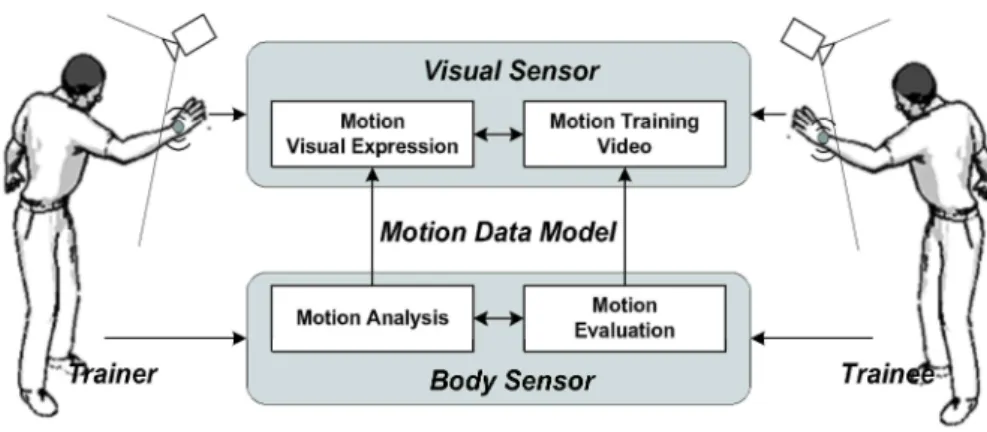
and trainees. As illustrated in Figure 1, Our goal

is twofold. Firstly, we aim to combine body sen-

sor and visual sensor data to provide an unique

Taekwondo training method which improves the

traditional motion training. Secondly, we provide

intelligent functionalities of a Taekwondo training

system that are important for trainers and train-

ees, including motion evaluation and motion

(2)

Fig. 1. Concept diagram. Body sensors and visual sensors are combined to develop a motion training system for both a trainer and a trainee.

training videos.

The body sensor precisely measures the tilt detection, movement, and vibration of the body parts. On the other hand, like a mirror in conven- tional training places, the visual sensor provides the images of the users in real-time. Combining these heterogeneous sensor types, we improve the required tasks for motion training. For exam- ple, the accelerometer on a trainer’s wrist pro- vides precise tilt angles of the hand and amount of speed changes which are not visible to the naked eyes. Users can observe the sensor data of the performed motions and correct their motions by comparing them with another user’s data such as a trainer.

We developed the motion chunk as a flexible segment unit to store a piece of Taekwondo mo- tion information. Motion chunk allows us to make a computational motion model out of unstructured Taekwondo motions. With this model, we can ap- ply motion detection and evaluation for motion training. We developed various functionalities for both trainers and trainees. Trainers and trainees can analyze their motion performances by watch- ing a hybrid representation of visual and body sensor data and by generating a motion training video automatically. Thus, they do not have to manually record and edit the video for editing im- age frames.

2. RELATED WORK

A number of applications have been proposed for motion training systems. Davis developed a vision-based motion training system, called Virtual PAT (Personal Aerobics - Trainer) using IR light sources providing manually pre- recorded in- structive videos and audio feedback [2]. Becker described a system for teaching Tai Chi gestures based on head and hand tracking by using a pair of stereo cameras [3]. Yang developed the ”Just Follow Me” system using an optical motion cap- ture system [2]. From this, Baek proposed evalu- ation methods by retargeting trainees’ motion to the pre-generated avatar [4]. Chua developed a wireless VR system for Tai Chi training using a light-weight HMD display and optical motion capture device [1]. The trainees’ motions are evaluated based on skeleton matching to measure how they mimic avatar motions. Takahata pre- sented a martial art training method using sound generators and accelerometers without providing motion recognition and visual feedback [5].

Our system combines visual and body sensor

data to develop a motion training system. While

most of the previous training systems have been

developed for trainees, ours supports both train-

ers and trainees. Using the machine learning

techniques, we structuralize and label human mo-

tions in real time and automatically generate an

(3)

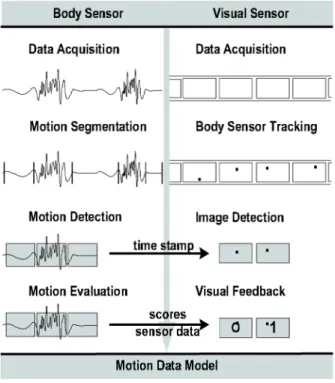
Fig. 2. The procedure to evaluate human motions and to generate visual feedback combining visual and body sensor data.

instructive motion training video. Thus, we ach- ieved full automation while supporting motion training functionalities.

3. SYSTEM ARCHITECTURE

The system consists of a visual sensor (camera), a body sensor (wireless sensor net- work) and a display device (a projector or a mon- itor). The system is operated with a series of software components that constructs a motion data model by combining body and visual sensor data. Figure 2 describes the sequential data-flow between the components. During data acquisition, we collect signals from both the body sensor and the visual sensor. Wireless accelerometers trans- fer signals to the sensor base station which is connected to the main PC. We read the data with a sample rate of 10 Hz and transmit each packet 10 readings in size, so that the update frequency is overall 100 Hz. Synchronously, a webcam cap- tures images and transmits the data to the host

PC.

The host PC accomplishes several steps to an- alyze the Taekwondo motion in real time. First, signal segmentation is performed to divide sig- nals based on the structure of a motion chunk. To recognize reference motions from the segmented motion chunks, motion detection is performed based on HMMs [6]. Afterwards, the input mo- tion is evaluated and assigned a score by com- paring with reference data. For processing visual sensor data, first the acquired image data is proc- essed in real-time to track the body position.

Visual and body sensor data are synchronized by time-stamp. We generate visual feedback in the images incorporating the body sensor data.

4. MOTION PROCESSING

We developed various methods for motion processing which supports Taekwondo training functionalities in real-time. We explain how to decompose and analyze human motion. Then, we process the sensor data following the techniques outlined.

Fig. 3. Euler coordinate system of our body sensor.

a posture with roll average 67 and pitch average 93, and a posture with roll average 80 and pitch average 17.

4.1 Motion Sensing

The motion is sensed through accelerometer as

a body sensor. For the accelerometer we use an

Euler coordinate system. The orientation is rep-

resented by three different angular values: yaw,

(4)

pitch and roll. These values are commonly used to describe the movement of a ship or a plane. To measure these values, the accelerometer is the most suitable because it enables the detection of tilt, movement, and vibration. The small size of such sensors is also appropriate for the human body. For example, we can attach the sensor to the wrist like a watch Figure 3. Then, the roll axis of the sensor is parallel to the forearm, and the pitch axis is horizontal and perpendicular to the roll axis. Yaw values point out the up- right position of the hand. Unlike the other two angles, yaw values are changed depending on the abso- lute orientation of the attached body part. In our setting, we utilize only 2-axes of the accel- erometer providing pitch and roll. Using pitch and roll, we can measure the posture of the body part it is attached to, i.e. the forearm. We can infer other, adjacent body parts as well. For example, since the sensor is located on the forearm near the hand, it is also indicative for the orientation of the hand. That is, we can estimate whether the palm is facing back or front, or facing up and down.

4.2 Motion Chunk

We divide the body sensor information into two categories: postures and gestures. Postures are static expressions described orientation, whereas gestures are dynamic movements essen- tially defined by velocity and by the changes thereof. For instance, if the forearm rests in a certain position, it provides constant values for roll and pitch, i.e. a posture. The basic idea at the motion chunk is to decompose complex, sequen- tial human motions into atomic units to simplify analysis. These units, called motion chunks, are similar in spirit to phonemes in speech recognition.

Following the definitions of postures and ges- tures we create two types of motion chunks:

static chunks and dynamic chunks. We now de- fine the motion chunk of one single motion as a

combination of three chunks: start-static chunk+

dynamic chunk+end-static chunk. This is in- tuitively clear as it combines the start posture, the gesture, and the end posture. Figure 4 illus- trates that a single step motion consists of two static chunks denoted by C and one dynamic chunk denoted by D. Likewise, two step motions are combined sharing one in-between static chunk and so forth.

Fig. 4. Structure of a motion chunk. A recognized single motion consists of two static chunks and one dynamic chunk.

4.3 Motion Detection

We apply the concept of a motion chunk to

represent the hidden states. The topology of each

motion is represented as two distinct states which

can be regarded as a two-state machine. We use

the start-static chunk and the end-static chunk

only, because the in-between dynamic chunk fea-

tures a highly variant signal heavily depending on

speed and power. Each HMM is created with the

performance of two static postures (start and

end). Using the signals as the observation se-

quences, we train the HMM parameters of each

motion. We employ an iterative procedure called

Baum- Welch method widely used to find a local

maximum of the probability. Once the HMM

model is trained, the system is able to detect the

newly performed motion. For this, we employ the

probability of the observations using a Viterbi

algorithm. If the probability is high enough given

(5)

a HMM model of a motion type, we detect the in- put motion and generate a motion chunk with re-sampled data. The re-sampling is necessary to evaluate the quality of the motion. Then, the fur- ther processes, such as motion evaluation and motion training video generation, are executed.

4.4 Motion Evaluation

The gesture evaluation measures the similarity between two gestures using the similar techni- ques used in gesture recognition. The main task is to compare an input gesture to a template ges- ture that is performed by the same or different user, and determine how both performances are different. The result is used to improve user per- formance or to correct wrong gestures.

The evaluation process in our framework con- sists of both posture evaluation and gesture evaluation. We make the gesture instruction process similar to the practical motion training where users learn postures then perform gestures by connecting individual postures. Since posture and gesture co-occur, the coordination between postures is important for improving the efficiency of the gesture. The separation of postures and gestures helps users learn a complicated motion in a systematic way.

We compute three distinct scores for the start static chunk, the dynamic chunk, and the end static chunk each. The evaluation of two static chunks measures how the start and end postures have been performed respectively. The evaluation of the dynamic chunk expresses how the gesture is performed, with respect to power and speed.

Currently, the result of evaluation is a simple nu- merical score. We compare the input gesture with multiple reference templates stored in our data- base and take the minimum distance as the final score. In practice, the minimum distance is better suited to measure quality than mean or median.

The scores are normalized to a maximum value of 100 and displayed on the screen in real-time.

5. MOTION TRAINING VIDEO

A motion training video is necessary for train- ees and trainers as a reference to follow and ana- lyze preferred motions. However, producing such a video usually takes a lot of time. First, it re- quires simultaneous video recording during the trainer’s performance. Also, the captured videos should be edited for the purpose of motion train- ing such as selecting video frames and adding explanatory information. We provide a method for automatic generation of visual feedback. As soon as the input motion is detected, we save both the relevant video frames and the body sensor data.

Then we generate a video displaying body sensor data along the tracked sensor positions.

5.1 Body Sensor Tracking

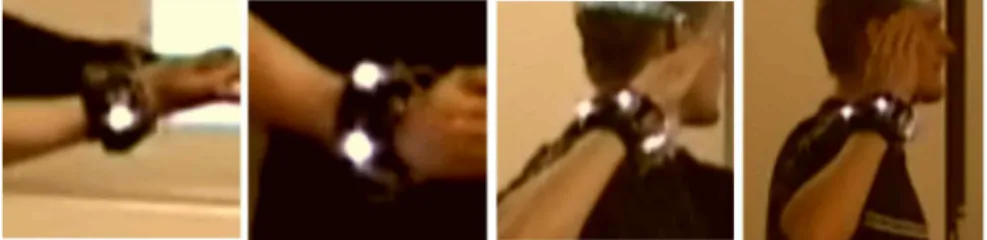
We extract sensor positions from the captured images and use the positions to generate visual feedback. We made various experiments to find suitable tracking solution for our purpose. First, the color band tracking highly depends on the training environment condition such as lighting and color. We also tested IR light sources, but they omit color information which is required. We found that color LED markers are most suitable for our purpose. Their brightness provides rela- tively robust tracking results in indoor training environments. We developed a simple vision tracking algorithm to find the pixel positions within a certain color and brightness range. The number and position of LEDs are designed de- pending on the sensor position. In our tests, we attached four LEDs at the four sides of the wrist bend Figure 5. This installation allows us to de- tect at least one point reliably even when the hand is rotated in different directions.

5.2 Visual Feedback

Visual feedback helps trainers and trainees to

explain and improve their motion practice. Visual

(6)

Fig. 5. Observations for body sensor tracking with LED markers on the wrist body sensor.

Fig. 6. A visual feedback of accelerometer sensor data in video images.

feedback for body sensor data is useful to show how the body sensor data is changing with the appearance of the posture. Especially for the trainees, visualizing motion path helps sig- nificantly to understand a dynamic gesture be- tween two static postures. Thus we focus on vis- ualizing body sensor data on the images along the motion path. We use the tracked sensor positions and design a simple template to display a moving circle along the path changing its size as a func- tion of the magnitude of the acceleration Figure 6.

There are various design alternatives, of course, varying the shape and its transformation rules.

6. CONCLUSION AND FUTURE WORK

We presented an approach to build a Taek- wondo training system combining body and visu- al sensor data. We described a motion decom- position procedure called motion chunk for re- al-time motion analysis. Based on the motion chunk, we detect and evaluate a specific motion using Hidden Markov Models. We also presented an automatic video editing method to generate a motion training video including visualization of

body sensor data. The system helps both trainers and trainees to improve fine static postures and dynamic gestures. So far, our research has main- ly focused on analyzing single motions. Future work will be devoted to the analysis of longer se- quences of motions. From this, users can even- tually practice combinations of multiple motions.

REFERENCES

[ 1 ] C. Chua, N.H. Daly, V. Schaaf, and H.P.

Camill, “Training for Physical Tasks in Virtual Environments: Tai chi,” Proc. IEEE Virtual Reality 2003 Conference , pp. 87, 2003.

[ 2 ] U. Yang. G. Kim, “Implementation and eval- uation of "just follow me": an immersive, VR-based, motion-training system,” Journal Presence: Teleoperators and Virtual Environments , Vol. 11 Issue 3, pp. 304-323, 2002.

[ 3 ] D. Becker. Sensei, A Real-time Recognition,

Feedback, and Training System for T’ai Chi

Gestures , Master’s thesis of Massachusetts

Institute of Technology, 1997.

(7)

[ 4 ] S. Baek, S. Lee, and G. Kim, “Motion Retar- geting and Evaluation for VR-based Training of Free Motions,” The Visual Computer , Vol.

19, No. 4, pp. 222-242, 2003.

[ 5 ] M. Takahata, K. Shiraki, Y. Sakane, and Y.

Takebayashi, “Sound Feedback for Powerful Karate Training,” Proc. International Conference on New Interfaces for Musical Expression , pp. 13-18, 2004.

[ 6 ] D.H. Song, D.M. Kim, and C.W. Lee, “The Chinese Characters Learning Contents Based on Gesture Recognition using HMM Algor- ithm,” Journal of Korea Multimedia Society Vol. 15, No. 8, pp. 1067-1074, 2012

Doo-Young Kwon

Mar. 2002~Feb. 2004: University of Washington, Dept. of Archi- tecture, MS

Mar. 2004~July. 2007: ETH Zurich, Dept. of Computer Science, PhD

Feb. 2009∼Current: KGIT. Dept. of New Media, Associate Professor

Research Interests: Media Art, Media Design, HCI,

Virtual/Mixed Reality

수치

Fig. 1. Concept diagram. Body sensors and visual sensors are combined to develop a motion training system for both a trainer and a trainee.
Fig. 2. The procedure to evaluate human motions and to generate visual feedback combining visual and body sensor data.
Fig. 4. Structure of a motion chunk. A recognized single motion consists of two static chunks and one dynamic chunk.
Fig. 5. Observations for body sensor tracking with LED markers on the wrist body sensor.

참조

관련 문서