Interference Resolving Radio Resource Allocation Scheme in a TDD-OFDMA/FDD-CDMA
Hierarchical Overlay Cellular System
Yeonwoo Lee
†, Kyung-Ho Kim
††ABSTRACT
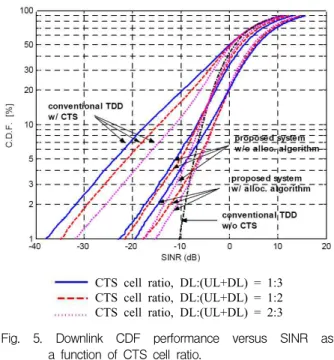
In order to support a cell-independent traffic asymmetry, the conventional TDD system cannot avoid crossed time slot (CTS) interference. Moreover, the TDD/FDD hierarchical overlay cellular systems is taken into account as a generally accepted cell model in a heterogeneous radio environment. In this paper, we propose an interference resolving radio resource allocation technique in a TDD-OFDMA cellular sys- tem that overlays a FDD-CDMA cell. In our proposed scheme, we exploit under-used FDD-CDMA uplink resource by TDD mobile abiding by a region based time slot(TS) allocation which in turn mitigates CTS interference considerably. It is demonstrated that combined with under-used resource utilization scheme based on mobile’s location, the proposed technique can reduce CTS interference considerably and support the asymmetric traffic in TDD system.
Key words: Hierarchical overlay cellular, interference, TDD-OFDMA, FDD-CDMA, radio resource allocation
※ Corresponding Author : Yeonwoo Lee, Address : (534- 729) Mokpo National Univ. Dept. of Inform. & Comm.
Eng., 61, Dorim-Ri, Chunggye-Myon, Mjuan-Gun, Chonnam, TEL : +82-61-450-2745, FAX : +82-61-450- 6470, E-mail : [email protected]
Receipt date : Apr. 1, 2013, Revision date : May 14, 2013 Approval date : June 4, 3012
††
Dept. of Inform. & Comm. Eng., Mokpo National Univ.
(E-mail: [email protected])
††
Dept. of Inform. & Comm. Eng., Mokpo National Univ.
(E-mail: [email protected])
※ This research was supported by Basic Science Re- search Program through the National Research Founda- tion of Korea(NRF) funded by the Ministry of Education, Science and Technology (Grant No.: KRF-2008-313- D00648).
1. INTRODUCTION
In the latest mobile communication systems, the demand for multimedia services to support a high data rate and asymmetric traffic service has accel- erated the need for interference robust trans- mission technique and resource management algorithm. Thus, an efficient and flexible resource allocation technique is key enabling technologies as
regards enabling the flexible management of the various traffic requirements and maximal uti- lization of the radio resources in a system. Such technologies are very relevant to duplexing meth- ods, i.e. time division duplex (TDD) and frequency division duplex (FDD) in 3G or 4G systems.
In TDD-based systems, the uplink (UL) and
downlink (DL) signals are transmitted over the
same frequency band, yet separate (multiple) time
slots are assigned for the UL and DL trans-
missions, respectively. By adjusting the number of
time slots assigned to each link, the TDD scheme
can support asymmetric traffic demand between
the UL and DL. Another major feature of the TDD
system is channel reciprocity, which allows the
system to adopt adaptive modulation and coding
(AMC) and multi-input multi-output (MIMO)
technology without an increase in the feedback
information. In general, the TDD system can pro-
vide a higher trunk efficiency since the system uti-
lizes entire bandwidth. In the TDD scheme, how-
ever, a guard time is required between the UL and
DL intervals to prevent interference caused by the different round-trip delays among users dis- tributed throughout the cell. In fact, more guard time is required as the cell size increases, reducing bandwidth efficiency. Therefore, the TDD system is more suited to data services in the short-range communication systems (micro or pico cell).
Meanwhile, with the frequency division duplex (FDD) scheme, the UL and DL signals are trans- mitted using the different frequency bands sepa- rated by a guard band. However, since the fre- quency bandwidth is fixed, the FDD system is ba- sically unable to support the traffic asymmetry be- tween UL and DL. Nonetheless, the FDD scheme has no round-trip delay problem, in contrast to the TDD scheme. For these reasons, it would seem evident that the FDD should cover the macro-cell range, while the TDD should cover the pico-/mi- cro-cell range, which was discussed as a topical issue in the 3G, LTE-advanced, 4G hierarchical or overlay cellular networks [1-4].
A widely-used hierarchical TDD/FDD cell structure consists of an FDD underlay macro-cell and a TDD overlay micro-cell. In such a system, most of previous works focused on adjacent chan- nel interference (ACI) effect and its trade-off de- pending on the optimal location deployment of TDD BS and FDD BS of the universal mobile tele- communications system (UMTS) [5]. Another in- teresting proposed work is a TDD/FDD underlay system proposed by [6] which exploits underused FDD-CDMA resource for TDD-CDMA pico-cel- lular users, increasing the flexibility of CDMA based TDD/FDD hierarchical cell structure. How- ever, these previous works are constrained to CDMA based system with careful positioning of TDD-BS and FDD-BS.
Combined with the TDD providing a cell in- dependent traffic asymmetry of uplink and down- link, OFDMA system that can support high-speed data rate service gains momentum for a future multimedia mobile communication system. How-
ever, when the TDD scheme is used for a mul- ti-cell environment, it suffers from severe co- channel interferences (CCIs) between mobile sta- tions (MSs) and base stations (BSs) when the frames are not synchronized with one another and/or each cell has a different UL/DL trans- mission timing. Such co-channel interference ap- pears in crossed time slots (CTS) where some cells are active in the downlink and other cells are in the uplink [5], especially at the cell boundary.
Clearly, this CTS interference turns out major per- formance degradation factor has to be solved for achieving the full benefit of the TDD based system, i.e. traffic asymmetry.
Therefore, in order to fully exploit TDD sys- tem’s feature and efficient spectrum utilization functionality in a TDD-OFDMA cellular system overlaid a FDD-CDMA cellular system, we pro- pose an efficient resource utilization technique us- ing a region based TS allocation algorithm. Thus, we partition a cell into two regions (i.e. inner- and outer-cell region) where TDD-OFDMA system is utilized overlaying FDD-CDMA system. In partic- ular, the outer-region users located at cell bounda- ries use both FDD-CDMA uplink and TDD- OFDMA downlink. Moreover, we exploit under- used FDD-CDMA uplink resource by TDD mobile abiding by a region based TS allocation which in turn mitigates CTS interference considerably. As such, the CTS interference is dramatically reduced and the outage performance significantly is im- proved with a simple TS allocation algorithm, which in result, providing asymmetric traffic service. This paper is organizes as follows. Section II describes the proposed interference resolving ra- dio resource allocation scheme in a TDD-OFDMA/
FDD-CDMA hierarchical overlay cellular system.
System level simulation with interference scenar-
ios and discussion are presented in Section III, fol-
lowing by conclusion.
MS
kMS
0BS
kBS
0BS
0BS
kMS
0MS
kTx Rx
Tx Tx
Tx
Rx
Rx Rx
interference
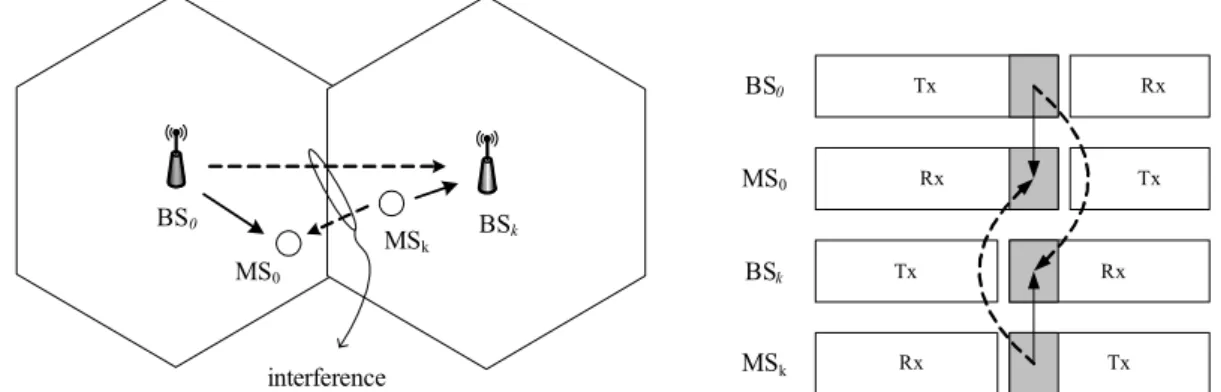
Fig. 1. Cross time slot (CTS) interference in a TDD based cellular system.
2. Proposed Interference Resolving Radio Resource Allocation Scheme
2.1 Interference Scenario in a Time Division Duplex(TDD) based Cellular System
While the merits of a TDD based cellular sys- tem, i.e. an asymmetric traffic service supported by adopting different UL/DL time slot ratios be- tween neighbor cells, should be fully utilized, this inherently entails TDD interferences. Fig. 1 depicts how these interferences occur in the TDD system.
When cell 1 is in the downlink transmission period while the adjacent cell 2 is in the uplink period, each cell must transmit and receive the signal through an asynchronous time slot, i.e. crossed time slot (CTS). In such a case, a major interfer- ence can occur in the TDD system, i.e. a CTS in- terference, such as an MS-to-MS interference, BS-to-BS interference (i.e., same entity interfer- ence), or MS-to-BS interference (i.e., other entity interference), that degrade the system perfor- mance. As one of the solutions to mitigate its ef- fect, the dynamic allocation of time-slots can be employed in a centralized or a distributed manner.
2.2 Proposed Interference Resolving Time Slot Allocation Scheme
The aim of the proposed radio resource alloca- tion scheme for a TDD-OFDMA overlay cellular system is to provide asymmetric traffic services with resolving TDD inherent interference problem,
i.e. CTS interference as shown in Figure 1, and thus, it provides more radio resources to mobile users. In order to resolve this CTS interference and utilize radio resource as well, we proposed the radio resource allocation scheme which is based on a mobile user’s location in a TDD-OFDMA cell and a pre-defined frequency-time planning of a overall hierarchical cellular model. The proposed scheme is to prevent major interference-makers located at the cell boundary from using the same frequency band (TDD). That is, the proposed system se- lectively allocates under-used FDD-CDMA uplink resource (codes) to users located at the cell boun- dary based on FDD-CDMA uplink codes avail- ability, simultaneously accomplishing cell in- dependent asymmetry in the TDD system. Note that it is assumed that a TDD-OFDMA mobile station set has dual-mode operation in a TDD/FDD overlay cellular system.
The idea of exploiting under-used FDD resource by TDD users is the same as in [5]. However, the main difference of the proposed system is to allow asynchronous TS overlap and to utilize cell in- dependent traffic asymmetry, achieving the full flexibility of TDD feature. Note that ref. [5] does not allow asynchronous TS overlap and may not provide the full traffic asymmetry capability.
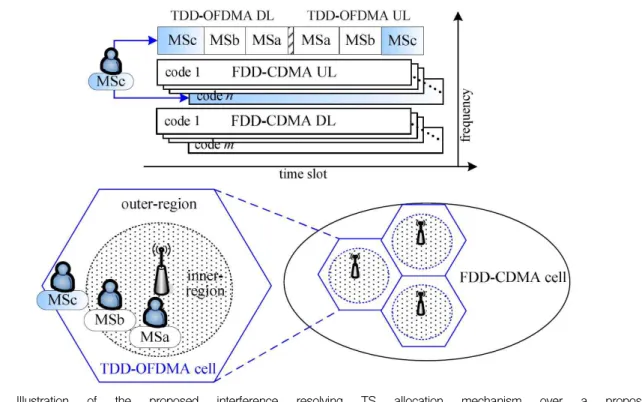
In the proposed overlay cellular system as
shown in Fig. 2, cell coverage in the TDD-OFDMA
system is partitioned into two (inner-and outer-
region). For users at outer-region near cell boun-
daries, FDD-CDMA system and TDD-OFDMA
Fig. 2. Illustration of the proposed interference resolving TS allocation mechanism over a proposed TDD-OFDMA/FDD-CDMA hierarchical overlay cellular system.
system is used for uplink and downlink, re- spectively. Combined with the TS allocation algo- rithm based on region, this proposed system can achieve better performance improvement. This mitigates the severe cell-boundary inter-cell inter- ference by combining the time slot allocation mechanism with the frequency allocation and the cell structure.
Although the proposed interference resolving TS allocation scheme over TDD/FDD overlay cel- lular system can also experience the same types of interference as in the TDD system, the amount of interference is different. In the proposed cellular system, the MS-to-MS interferences can be con- siderably reduced by employing FDD-UL codes at TDD outer zone, which enables most of the CTS interference victims to be isolated from interfer- ence coming from the MSs in the adjacent cells.
As shown in Fig. 2, for downlink of MS_a, MS_b at inner-region and MS_c at outer-region (in the order of closest to BS), TDD time slots closest to TS switching point are allocated to mobile users located at closer to BS, i.e. MS_a and MS_b. With
this approach, the probability of CTS interference can be reduced since MS_c (which causes most of CTS interference) are not allocated into crossed time slots. For the uplink the algorithm follows the same principle, but it is applied only to MS_a and MS_b since MS_c located at outer-region are allo- cated to use FDD-CDMA uplink codes. Therefore, the proposed TS allocation algorithm can reduce inter-cell interferences and achieve the TDD flexibility. As shown in Fig. 2, TDD-OFDMA MS_c user can exploit FDD-CDMA uplink codes if these code-resources are available for borrowing.
This simple procedure can resolve CTS interfer- ence caused by these TDD-OFDMA MS_c user.
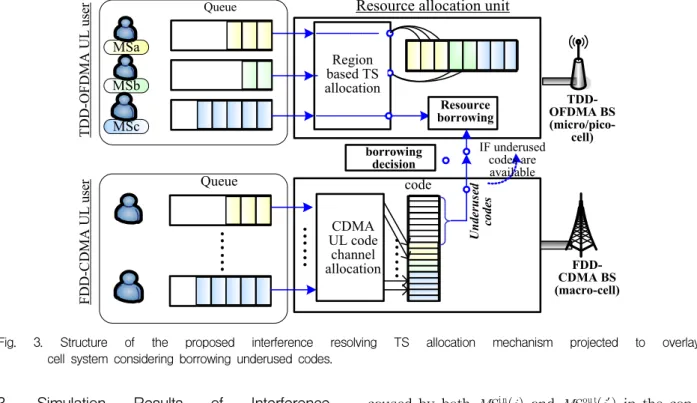
More detailed structure of the proposed in-
ference resolving TS allocation mechanism is
shown in Fig. 3, where TDD-OFDMA MS_c user
(i.e. TDD mobile user locating at TDD cell boun-
dary) decided by a region based TS allocation is
allowed to borrow a resource from FDD-CDMA
UL resource (i.e. codes) if these codes are not oc-
cupied by other FDD users.
TDD- OFDMA BS (micro/pico-
cell)
Resource allocation unit
FDD- CDMA BS (macro-cell)
MSa
Queue
MSb
T D D -O F D M A U L u se r F D D -C D M A U L u se r MSc Queue
… … … … CDMA UL code
channel allocation
Resource borrowing
code Region
based TS allocation
… …
Underused codesborrowing decision
IF underused codes are available
Fig. 3. Structure of the proposed interference resolving TS allocation mechanism projected to overlay cell system considering borrowing underused codes.
Cell 1 Cell 2
BS
kBS
0MS
0outMS
in0out
MSk in
MSk
BS
0BS
kMS
0inTx Rx
Tx Tx
Tx
Rx
Rx Rx
Tx Rx
Tx Rx
MS
0outMS
kinMS
koutTDD operating zone
Avoided interference by using FDD-UL of f-band
Fig. 4. Illustration of CTS interference in the considered overlay cellular system model.
3. Simulation Results of Interference and Outage Probability Performance
3.1 CTS Interference Model and Interference Resolving Mechanism
In Fig. 4(b),
i n
,
ou t
ou t′ ,
i n
and
ou t
′ denote the i
thMS in the inner zone and the outer zone of the reference cell and the j
thMS in the inner zone and the outer zone of k
thcell, respectively. In the DL from BS
0to MS
0s during the CTS period, MS
0suffer from interference
caused by both
i n
and
ou t
′ in the con- ventional TDD scheme. In the proposed TDD- OFDMA/FDD-CDMA overlay cellular scheme, however,
i n
only suffers interference caused by
i n