Journal of Internet Computing and Services(JICS) 2020. Oct.: 21(5): 67-73 67
CNN-based Gesture Recognition using Motion History Image ☆
Youjin Koh
1Taewon Kim
1Min Hong
2Yoo-Joo Choi
1*ABSTRACT
In this paper, we present a CNN-based gesture recognition approach which reduces the memory burden of input data. Most of the neural network-based gesture recognition methods have used a sequence of frame images as input data, which cause a memory burden problem. We use a motion history image in order to define a meaningful gesture. The motion history image is a grayscale image into which the temporal motion information is collapsed by synthesizing silhouette images of a user during the period of one meaningful gesture. In this paper, we first summarize the previous traditional approaches and neural network-based approaches for gesture recognition. Then we explain the data preprocessing procedure for making the motion history image and the neural network architecture with three convolution layers for recognizing the meaningful gestures. In the experiments, we trained five types of gestures, namely those for charging power, shooting left,shooting right, kicking left, and kicking right. The accuracy of gesture recognition was measured by adjusting the number of filters in each layer in the proposed network. We use a grayscale image with 240 x 320 resolution which defines one meaningful gesture and achieved a gesture recognition accuracy of 98.24%.
☞
keyword : Gesture recognition, neural network, convolutional neural network, motion history image1. Introduction
Gestures are expressive, meaningful body motions involving physical movements of the fingers, hands, arms, head, face, or body[1]. Gesture recognition approaches have been studied for a long time in the field of computer vision and pattern recognition[1]. Recently, this research field has been evolved rapidly by neural network technology.
Approaches based on deep neural network have outperformed “non-deep” state-of-the-art approaches[2] and been applied to various application domains[3,4].
In the gesture recognition approaches based on the neural network, one gesture is usually represented by 20~30 frame
1
Department of Media Technology and AI Software Engineering, Seoul Media Institute of Technology, Seoul, 07590, South Korea
2Department of Computer Software Engineering, Soonchunhyang
University, Asan, 31538, South Korea
* Corresponding author: Yoo-Joo Choi
[Received 6 June 2020, Reviewed 15 June 2020(R2 30 July 2020), Accepted 21 August 2020]
☆ This research was supported by Basic Science Research Program through the National Research Foundation of Korea(NRF-2017R1D1A1B03035718) funded by the Ministry of Education.
☆ A preliminary version of this paper was presented at ICONI 2019.
images which make mobile computing impossible due to the large memory burden. We can consider two points to develop a neural network model for gesture recognition which can be executed on the low-capacity system. First, we should design a lightweight neural network model that is not too wide or deep. However, in this case, the recognition accuracy can be deteriorated due to the shallow model structure if the meaningful data preprocessing is not provided. The second point is to reduce the size of the input data while minimizing the impact on recognition accuracy.
In this paper, we propose a novel method to reduce the size of the input data of a neural network model for gesture recognition. In the proposed method, a series of frame images representing one gesture are processed into one grayscale image called a motion history image and used as input data for learning meaningful gestures using the neural network. Moreover, we present the neural network model with just three convolutional layers and two fully connected layers. Then we conduct the experiments that adjust the number of filters and nodes in each layer of the proposed CNN model to determine the optimal model that shows the best recognition accuracy. As a result, we achieved a gesture recognition accuracy of 98.24% without high memory capacity through the proposed neural network model and the ISSN 1598-0170 (Print) / ISSN 2287-1136 (Online)
http://www.jics.or.kr
Copyright ⓒ 2020 KSII
data preprocessing for the motion history image.
2. Related works
In this section, we briefly summarize the previous gesture recognition approaches based on non-neural network and neural network. And the input data formats for previous neural network models are analyzed.
Typically, the meaning of a gesture can depend on the spatial information(where it occurs), pathic infor mation(the path it takes), symbolic information(the sign it makes), and affective information (its emotional quality)[1]. A lot of approaches have been studied to extract the spatial, pathic, symbolic, and affective information from the sensor or image data for gesture recognition.
2.1 Non-neural network approaches for gesture recognition
There are various non-neural network approaches for gesture recognition ranging from statistical recognition, such as HMM(Hidden Markov Models)[5,6] and PCA(Principal Component Analysis)[7], Kalman filterings[8], particle filtering[9,10] and condensation algorithms[11].
The HMM is a double stochastic process governed by an underlying Markov chain with a finite number of states (X) and a set of random functions(Y), each associated with one state[1]. The goal is to learn about X by observing Y.
PCA is mostly used as a tool in exploratory data analysis and for making predictive models. Principal components means basis vectors that are uncorrelated into different individual dimensions. PCA is either done by singular value decomposition of a design matrix or by calculating the data covariance matrix of the original data and performing eigenvalue decomposition on the covariance matrix[12].
In statiscs and control theory, Kalman filtering is an algorithm that uses a series of measurements observed over time, containing statistical noise and other inaccuracies, and produces estimates of unknown variables that tend to be more accurate than those based on a single measurement alone, by estimating a joint probability distribution over the variables for each timeframe[13].
Particle filters have been very effective in estimating the
state of dynamic systems. The key idea is to represent probability densities by set of samples. It has the ability to represent a wide range of probability densities, allowing real-time estimation of nonlinear, non-Gaussian dynamic systems[1].
The condensation algorithms have been proposed[11, 14]
to automatically switch between various prediction motion models by using multiple models to predict different types of motion of the objects. They significantly improved the performance of the tracker. In addition, studies are being conducted to overcome the limitations of the existing methods[15].
2.2 Neural network approaches for gesture recognition
An artificial neural network is composed of artificial neurons or nodes for solving artificial intelligence problems.
In general, the neural network which is composed only of the fully connected layers, is likely to cause spatial information loss. Therefore, Convolutional Neural Network (CNN) has been proposed to solve the problem of loss of spatial information of data by maintaining the shape of input/output data of each layer. CNN effectively recognizes and extracts features from each frame image in the learning process. The CNN usually includes the convolution layer, pooling layer and fully-connected layer. The convolutional layer is a core component of the CNN, and the set of learnable filters varies according to the type and depth of each layer, and accordingly, the result of learning also varies[16]. Through the pooling layer, it is possible to prevent an excessive increase in the amount of processed data. The fully connected layer is the same as the traditional multi-layer perceptron neural network. The CNN has been widely applied to object classification and static gesture (pose) recognition.
The temporal dimension in sequences typically causes gesture recognition to be a challenging problem in terms of both amounts of data to be processed and model complexity[2]. 3D CNN approaches have been proposed for spatio-temporal feature extraction[17]. Molchanov et al.
extended a 3D CNN with a recurrent mechanism for
detection and classification of dynamic hand gestures[18]. In
[18], A 3D CNN for spatio-temporal feature extraction is followed by a recurrent layer for global temporal modeling and a softmax layer for predicting class-conditional gesture probabilities.
The long short-term memory(LSTM)[19] cells for RNN(Recurrent Neural Networks) was introduced by Hochreiter et al. in 1997. LSTMs are an important part of deep models for image sequence modeling for gesture recognition[2, 20].
The new approaches that utilize a double flow structure has emerged for more efficient gesture recognition. J. Duan et al. proposed a convolutional two stream consensus voting network(2SCVN) which explicity models both the short-term and long-term structure of the RGB sequences[21]. In their approaches, a 3D depth-saliency ConvNet stream (3DDSN) was aggregated in parallel to identify subtle motion characteristics. These two components in an unified framework significantly improve the recognition accuracy.
Weinzaepfel et al. [22] proposed a novel approach in which dense optical flow maps or iDTs detects frame proposals and scores them with a combination of static and motion CNN features for action localization. Simonyan et al. [23]
proposed another two-stream convolutional network. In their approach, to complement the dynamic information along to the temporal flow in addition to static information along to the spatial flow of the input data, optical flow processed data was used as learning input data. Then, the feature map output from each neural network was fused to improve recognition accuracy.
2.3 Input data format for deep learning based approaches
Input data preprocessing is also important to achieve good results in gesture recognition research. There are various image datasets for each gesture recognition study.
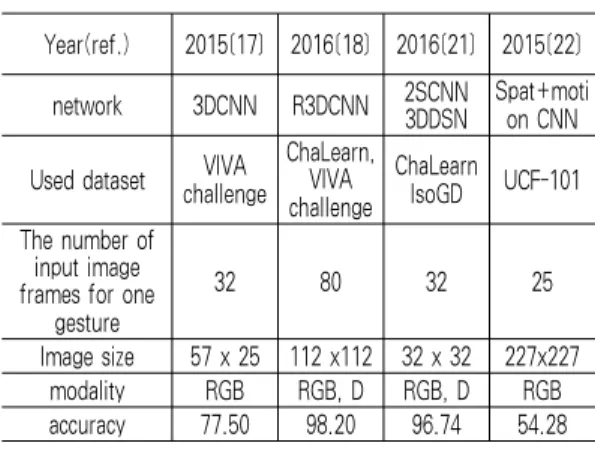
Among them, ChaLearn LAP, VIVA Challenge Dataset, and UCF-101, UCF-Sports which are based on YouTube videos, are continuously used as the original dataset for research on gesture recognition. These data sets include a large amount of raw data and data preprocessing is required for each learning approach. Table 1 depicts the datasets and the input data format that previous gesture recognition methods
[17,18,21,22] have used. These methods used 25-80 images for an input gesture data.
(Table 1) The input datasets of previous gesture recognition methods
Year(ref.) 2015[17] 2016[18] 2016[21] 2015[22]
network 3DCNN R3DCNN 2SCNN
3DDSN
Spat+moti on CNN Used dataset VIVA
challenge
ChaLearn, VIVA challenge
ChaLearn IsoGD UCF-101 The number of
input image frames for one
gesture
32 80 32 25
Image size 57 x 25 112 x112 32 x 32 227x227
modality RGB RGB, D RGB, D RGB
accuracy 77.50 98.20 96.74 54.28
3. Proposal Method
3.1 Motion history image
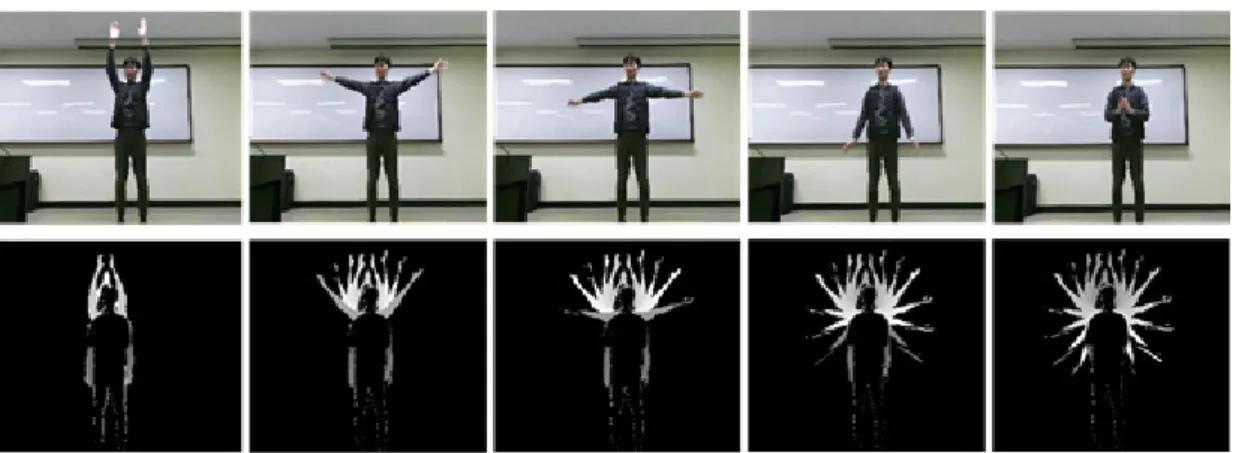
In general, a single gesture is represented by dozens of frame images. However, our method uses a motion history image to represent a gesture. A motion history image is a static image that includes the body moving path for the representation of a gesture. It can be used to effectively represent a single gesture in a small memory. A sequence of body silhouettes for a gesture is compressed into a gray scale image in which the main motion information is preserved. It can be used to more effectively represent the flow or sequence of motion than a color images. The proposed method classifies the types of gestures using single motion history image as input to the CNN. Figure 1 sequentially illustrates a series of motion history images for the power-charging gesture. All motion history images in the sequence are used for training the gesture.
3.2 Three-layered CNN
Figure 2 depicts the structure of the proposed CNN. The
model has a simple structure including just three convolution
layers with two max pooling layers, and two fully connected
layers. In each convolution layer, 5x5 filter is applied. A
(Figure 1) A sequence of motion history images for a power-charging gesture
(Figure 2) Three-layered Convolutional Neural Network
grayscale image with 320 x 240 resolution is used as input data for the gesture. And we measured the recognition accuracy by adjusting the number of filters in each convolution layer and the number of nodes in the fully connected layers to determine the optimal CNN. Eight gestures including five meaningful gestures and three meaningless movements have been trained using the proposed network.
4. Experiment
4.1 Experiment environment
We asked seven participants to perform five different dynamic gestures. Figure 3 shows a color image and the selected motion history image for ‘shooting left’ gesture.
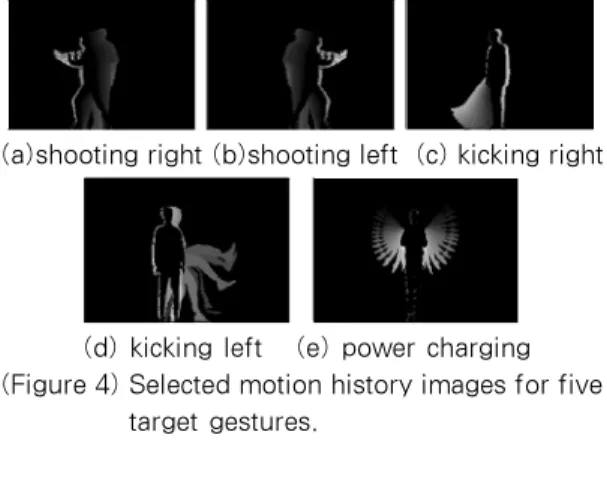
Figure 4 shows the motion history images for five gestures:
‘power charging’, ‘shooting left’, ‘shooting right’, ‘kicking left’, ‘kicking right’. Figure 5 depicts the motion history images of three error types. The error types mean the motion history images for abnormal user movement, not target gestures. The first error type is that the motion history image is completely black because there is no user’s movement. The second error type is that most area of the motion history image is defined as a user area due to the user’s movement at a distance close to the camera. The third error type is that the motion history image contains a small white area that looks like noise due to the user’s fine movements before the target gesture.
We obtained 3644 motion history images for training and
1723 motion history images for test data from seven
participants. Training data and test data are in a ratio 7:3.
Name of layer
Conv1 (X1)
Conv2 (X2)
Conv3 (X3)
FC1 (X4) FC2 Number
of filters
32 32 32 32 8
16 16 16 16 8
8 8 8 8 8
Table 2 shows the dataset for each gesture used in our gesture learning experiments. The gesture learning and inferring were conducted in the experimental environment shown in Table 3.
(Figure 3) A color image and a motion history image of the ‘shooting left’ gesture
(a)shooting right (b)shooting left (c) kicking right
(d) kicking left (e) power charging (Figure 4) Selected motion history images for five
target gestures.
(a)shooting right (b)shooting left (c) kicking right (Figure 5) The motion history images of three error
types.
(Table 2) Number of motion history images used in gesture learning and inferring
Gesture type Training TestPower- charging 611 261
Shooting left 613 333
Shooting right 613 333
Kicking left 555 253
Kicking right 554 246
Error-Black 241 102
Error-Etc 318 136
Error-Ready 139 59
Total 3644 1723
(Table 3) Number of filters in Convolution Layer and Fully connected layer nodes
OS Windows10
CPU intel Core i7-6700K @ 4.0GHz RAM 64.0GB GPU NVIDIA GeForce GTX 1080 Ti
4.2 Experimental results
We conducted a gray-scale MHI-based gesture recognition experiment using the proposed CNN and motion history image datasets. The experiment was repeated with the different number of filters of the convolution layers and with the different number of nodes of the fully connected layer.
(Table 4) Number of filters in convolution layers and number of nodes in fully connected layers
*X1-X3: Number of filters in conv1, conv2 and conv3 layers
*X4 : Number of nodes in fully connected layer
Table 4 shows the number of filters and nodes of the proposed CNN. In the experiments, the learning rate was set to 0.001 and the number of epochs was set to 300. We also applied the learning rate decay to improve the accuracy. Table 5 shows the recognition accuracy according to application of decay. In the gesture learning, the application of learning rate decay showed higher accuracy, and the runtime was almost identical in both cases. Finally, we achieved a gesture recognition accuracy of 98.24% with eight filters in each convolution layer and 8 nodes in the fully connected layer.
(Table 5) Difference of recognition accuracy according to application of learning rate decay
Application ofDecay
Number of filters
(X1, X2, X3) Accuracy Applied from 250
epoch
32 94.73
16 96.49
8 98.24
none
32 92.98
16 94.73
8 96.49