Hand Gesture Recognition using Optical Flow Field Segmentation and Boundary Complexity Comparison
based on Hidden Markov Models
Sang-Yun Park†, Eung-Joo Lee††
ABSTRACT
In this paper, we will present a method to detect human hand and recognize hand gesture. For detecting the hand region, we use the feature of human skin color and hand feature (with boundary complexity) to detect the hand region from the input image; and use algorithm of optical flow to track the hand movement. Hand gesture recognition is composed of two parts: 1. Posture recognition and 2. Motion recognition, for describing the hand posture feature, we employ the Fourier descriptor method because it’s rotation invariant. And we employ PCA method to extract the feature among gesture frames sequences. The HMM method will finally be used to recognize these feature to make a final decision of a hand gesture. Through the experiment, we can see that our proposed method can achieve 99%
recognition rate at environment with simple background and no face region together, and reduce to 89.5%
at the environment with complex background and with face region. These results can illustrate that the proposed algorithm can be applied as a production.
Key words: Hand Gesture Recognition, Posture Recognition, Optical Flow, Boundary Complexity, Fourier Descriptor, PCA, HMM
※ Corresponding Author : Sang-Yun Park, Address : (617-736) 100 silladaehak-gil Sasang-gu, Busan, Korea, TEL : +82-51-999-5355, FAX : +82-51-999-5184, E-mail : [email protected]
Receipt date : Oct. 6, 2010, Revision date : Jan. 11, 2011 Approval date : Mar. 2, 2011
†††Department of Information Communication Engineering, TongMyong University, Korea
†††Department of Information Communication Engineering, TongMyong University, Korea (E-mail: [email protected])
※ This research was supported by the MKE(Ministry of Knowledge and Economy), Korea, under the ITRC (Information Technology Research Center) support program supervised by the NIPA(National IT Industry Promotion Agency)(NIPA-2011-(C-1090-1121-0006))
1. INTRODUCTION
With the development of ubiquitous computing, computer is becoming more and more important in our daily life. Computer applications require more and more unrestricted interaction between human and computers, which is great challenge to tradi- tional input devices such as mouse, keyboard or
pen etc. Hand gesture is frequently used in people’s daily life. It’s also an important component of body languages in linguistics. Compared with those de- vices mentioned above, hand gestures are more natural in interaction. The use of hand as a device for human-computer interaction (HCI) makes HCI easy [1,2].
The key problem in gesture interaction is how to make hand gestures understood by computers.
Extra sensors and instruments, such as data gloves, may be easy to collect hand configuration and movement. However, these equipments are usually expensive and bring much cumbersome experience to users. Vision based gesture inter- action have many appealing characteristics. The prominent one is that it realizes a natural inter- action between human and computers independent of external dedicated devices. In general, the liter- atures of hand gesture recognition fall into two categories: learning based and model based method.
Learning based method get classifier or detector with machine learning from the training data which is constructed by multi-cue features with plenty of sample images. One and Bowden [3] dis- tinguished hand shapes with boosted classifier tree and obtained fairly good results. However, their method is time consuming and unpractical for in- teractive interfaces. Kolsch [4] used fanned boost- ing detection for classification and got nearly real time results, while the detector’s training is com- putational expensive. What’s more, the detector makes constraints on the resolution and aspect ra- tio of gesture template. As for the model based method, there are some researchers who have ach- ieved satisfactory accuracy in hand gesture recognition. Lars and Lindberg used scale-space color features to recognize hand gestures [5]. In their method, gesture recognition is based on a sta- ble hand gesture representation generated by a hi- erarchy of feature detection. This hand gesture representation is effective in recognition. Although the authors show nearly real-time application on a dual-processor computer, the computation costs expensively as feature detector and descriptor in- volve a great deal of large-scale Gaussian con- volution.
In this paper, we will develop a real-time hand tracking and gesture recognition method which is robust and reliable in complex background. The tracking method is based on optical flow, the rec- ognition method is based on HMM. The excellent feature of hand detection based on optical flow is that the algorithm is insensitivity to the static background but only sensitive to the moving object region. But if there are more than one object mov- ing in the scene, we can’t judge the hand part just based on the optical flow, but the boundary com- plexity can represent the shape edge feature, it is immune to shape rotation. The approach of our al- gorithm can be listed in detail as following:
1. Calculate the optical flow of input video flow- ing
2. Detect the skin region in regions which cre- ated the optical flow
3. Scanning the region with the maximum boundary complexity. (The region can be considered as the open hand region) 4. Then for recording the gesture sequence, the
Fourier descriptor will be used to describe the shape of hand, and the PCA method will be employed to extract the principle component of hand optical flow field.
5. Finally, the HMM method will be used to rec- ognize the feature vector. The output of these hidden models is the gesture that we want to recognize.
Our paper is organized as following: Section 2 will discuss the optical flow calculation method for detecting the moving object; Section 3 will discuss the color based skin region segmentation; Section 4 will discuss the boundary complexity calculation for confirming the hand region. Section 5 will dis- cuss the hand gesture feature extracting method.
Section 6 will discuss the hand gesture recognition method based on HMM. Finally, we give the ex- periment results and conclusion.
2. OPTICAL FLOW CALCULATION FOR DETECTING MOVING OBJECT
2.1 Optical Flow Field Calculation
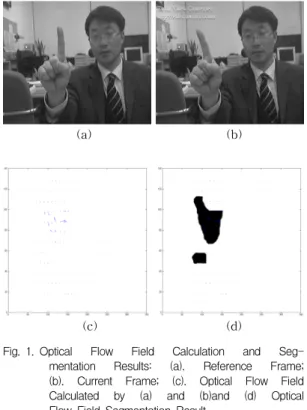
In our system, the motion of the object provides important and useful information for object local- ization and extraction. To find the movement in- formation, we assume that the input gesture is non-stationary. When objects move in the spa- tial-time space (an image sequence), we use the motion detector to detect the optical flow field of object. And for calculating the optical flow, we use the method which is proposed by Nagel [6,7] to cal- culate the flow velocity (displacement vector be- tween frames). According to the method, the flow velocity of perpendicular direction to gray scale conversion line should change in small steps. This
means that, we can set a pattern smoothing restrict to the basic of optical flow equation, so this can reduce the over smoothed to the edge of image when using the optical flow calculation equation [8, 9]. We define the two adjacent frames illumination energy as:E(x, y, t1) and E(x, y, t2), in the paper, we use E(x, y, t1) and E(x, y, t2) as E1(X) and E2(X), and here X=(x,y). The basic of optical flow equation is as following:
0 )
(Ñ · + t=
T E
E m (1)
Here,ÑE=(Ex,Ey)T, Ex, Ey, Et is partial de- rivative in point (x, y), and m=(u ),vT, u, v is dis- placement between time Dt=t2-t1in x, y direc- tions respectively. According to the "pattern smoothing restrict", Nagel suggest that constraint condition can be applied tou and v as following:
min )) ( )
((Ñu W Ñv =
trace T (2)
And here, W is weighted matrix,W =F/trace(F), it compensates the changed in moving field ac- cording to the changed of gray value in the video image. And F is as following:
T
xx xy xy yy xx
xy xy yy T
x y x y
E E E E E
E E b E E E E F E
1 1 1 1 1
1 1 1 1
1 1
1 2 -
- - + -
-
= -
(3) So based on Equation (1) and (3), the calculation of optical flow field can be converted to solving the equation as following:
min ))) ( ) ((
)) ( 1 ) ( 2
(( - - 2+ 2 Ñ Ñ =
òò
dxdy E x E x u a trace uTW v(4) αis used to control the smoothing level, accord- ing solving the equation, we can get the BSOR re- sult for each point in the image.
2.2 Optical Flow Field Segmentation based on C-Mean Cluster Method
C-mean cluster method is method for calculat- ing dynamic cluster by using error sum of squares.
It is defined as following:
åå
= =
-
=
c
j n
k
j k c
j
m x J
1
2
1
(5)
c j
n x m
nj
k k j
j 1 1,2,...,
1
=
=
å
=
(6)
Here,xkis the sample in set X ={x1,x2,...,xn}, the sample set will be converged to c separated subspace, they include n1,…,nc samples. mjis the sample mean value of jth subspace.
For separating the optical flow field, we define the sample is the point position in the optical flow field. The error sum of squares will use the Euclidean distance. The C-Means method will op- timize the cluster result by iterative procedures. It will make the criterion functionJcto get the mini- mal value and getc classes. Then we will compare the sample number in each class, if the sample number is too few, it can be removed. If there are more than one classes, we can consider that there are several moving objects, and they can be separated.
(a) (b)
(c) (d)
Fig. 1. Optical Flow Field Calculation and Seg- mentation Results: (a). Reference Frame;
(b). Current Frame; (c). Optical Flow Field Calculated by (a) and (b)and (d) Optical Flow Field Segmentation Result.
3. SKIN REGION SEGMENTATION
We know that in the world, there exist three races of human: Whites, Negro and Yellow race, each race has a different skin color. In order to sep- arate them, we should select a suitable color space which can linearly describe them. And in the color space, each skin color pixel can be strongly clus- tered together for the purpose of separating them early. So which color space will be the suitable for this will be the first problem we must solve.
Through observing skin color feature, we can find that the RGB color space is not adequate for cate- gorizing skin color because it has the three ele- ments (R, G, B) that involve both chroma and luminance. The color component of different skin colors was found to be categorized in a small area of the chromatic color space. Although skin color varies extremely, they differ much less in chroma than in luminance.
Through the front comparison, we can convert the regular RGB image into YCbCr color model.
And before the converting, to remove luminance from the RGB color space, we adapt the normalized RGB [10] representation that is obtained by a sim- ple process:
) (
) (
) (
BLUE GREEN RED
blue BLUE
BLUE GREEN RED
GREEN green
BLUE GREEN RED
red RED
+
= +
+
= +
+
= +
(7)
The advantage of this representation is that it can avoid the change of surface orientation rela- tively to the light source. Then the output result of the normalization process will be translated into YCbCr color space by using equation 8~10.
B G
R
Y=-0.299* +0.587* +0.114* (8) delta
Y R
Cr=( - )*0.713+ (9)
delta Y
B
Cb=( - )*0.564+ (10)
The threshold value can be computed by using
the Cr image, which we can apply the equation 4 to the image,
å
==
255
1
) (
*
i
Th w Histi
Cr (11)
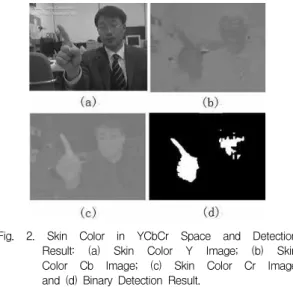
Then according to the threshold, we will get the binary image of skin region, as result shown in Fig 2.
Fig. 2. Skin Color in YCbCr Space and Detection Result: (a) Skin Color Y Image; (b) Skin Color Cb Image; (c) Skin Color Cr Image and (d) Binary Detection Result.
By combining the optical flow field segmentation result and the skin region information, we can get the moving object with skin color, in other words the human motion can be tracked by using the logic
‘AND’ to combine the two types of information, that is:
) , ( )^
, ( ) ,
(x y OF x y S x y
Hmi = i i (12)
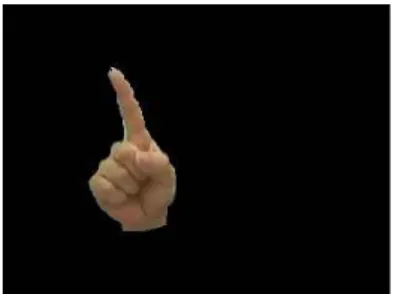
HereOFi(x, y), Si(x,y), indicate the optical flow, and skin color region. The Hmi(x, y) as human motion features can be extracted. The results shows in Fig 3.
Fig. 3. The Combined RegionHmi(x, y).
4. REGION BOUNDARY COMPLEXITY CALCULATION
The combined skin regions usually include face region and other parts of body. In the hand gesture recognition system, what we needed is the hand region, so in this part we will utilize the boundary complexity method [11] to separate the hand region from other parts. As we know that, hand is com- posed of 5 spindling fingers. The hand region will have a more complex edge compare with other skin regions when it is open. The feature can make hand region separation more possible. Considering this, we propose the boundary energy estimation meth- od which can measure the object edge boundary energy in an image. The basic foundation of the boundary energy estimation theory will be de- scribed in section 4.1.
4.1 Foundation of Edge Boundary Energy Estimation Method
Area and perimeters are two important attribute of geometric form, the one can not fill the needs for separating the geometric forms. Such that usu- ally some geometric forms with the same area, but do not have the same perimeter or opposite. For separating this, a feature using to describe geo- metric form is called circularity. It has the mini- mum value when the geometric form is a circle.
The value of circularity describes the complexity of edge.A common form of the circularity is de- scribed as following:
A P
C= 2/ (13)
P is perimeter, and A is area of object region, it will be 4π if the object is a circle and will be larger if the object is with more complex edge. The circularity (C) and edge complexity contain some relationships. One of them is the boundary energy [12]. We assume that an object with the perimeter of P, p is distance from one edge point to a start point. At any point, the edge will have an instanta-
neous curvature radiusr(p). It is radius of the cir- cle which is tangent to the edge. So the curvature function at point p is as following:
) ( / 1 ) (p r p
K = (14)
K(p) is a periodic function with a period of P . We can calculate the average energy of a unit length of boundary by using the following equa- tion:
ò
= pK p dp E P
0
)2
1 (
(15) For a given area, a circle will have the minimum boundary energy.
2 2
0 1)
( 2 )
( P R
E = p =
(16) Here,R is radius of the circle. The boundary en- ergy can describe the complexity of edge more similar with human perception.
4.2 Applying on Hand Region Classification
As analysis above, hand region is an object with a considerable region and complex edge. So we can enhance both of the two features by using the fol- lowing equation:
) 1 ( >
=aE*A a
w (17)
Here,a is the enhancing coefficient, we can use it to adjust the result. Thus for each candidate skin region, we will calculate the ω value. The result is as shown in Fig 4. And finally we select the MAX region which can be considered as the hand region.
Fig. 4. Detected Hand Region.
5. HAND GESTURE FEATURE SE- QUENCE EXTRACTION
5.1 Feature Selection for Hand Posture Description
For the posture of hand, they will be further converted to symbols which are the basic elements of the HMM. Effective and accurate feature vectors play a crucial role in model generation of the HMM.
For selecting good features, the following criteria are considered useful: (1) Features should be pref- erably independent on rotation, translation and scaling. (2) Features should be easily computable.
(3) Features should be chosen so that they do not replicate each other. This criterion ensures efficient utilization of information content of the feature vector. The features obtainable from the image of hand posture are spatial and temporal. To extract the shape features, we choose the FD to describe the hand shape. To associate with the hand motion, we can extract all the features to describe a hand gesture.
5.1.1 Fourier Descriptor
We may describe the hand shape by their fea- tures in the frequency domain, rather than those in the spatial domain. The local feature property of the node is represented by its Fourier Descrip- tors (FD) [13-15]. To assume the hand-shape is described by external boundary points, {x(m), (m)}, then we may use the FD representation for boundary description. To represent the boundary points, we may find the Fourier series ofx(m) and y(m), which are defined as a(n) and b(n). For a closed boundary, this representation is called FD.
The elements of the vector are derived as )
1 ( / ) ( ) (n r n r
S = where, r(n)=[(a(n))2+(b(n))2]1/2, n=1,2,… Using of FD vectors of dimension 10 for hand written digit recognition is sufficient [14].
Here we assume that the local variation of hand- shape is smooth so that the high order terms of its FD are not necessary. So using 22 harmonics
of the FD’s is enough to describe the macroscopic information of the hand figures.
The advantage of using the FD is due to its size-invariant properties. For different scaled ob- jects, only the magnitudes of their FD coefficients are changed by the same factor.
(a)
(b)
(c)
(d)
Fig. 5. Illustration the Invariant Properties of Fourier Descriptor: (a). Original Image and Fourier Descriptor (b). Rotation 90 and Fourier Descriptor (c). Zoom in 12:10 and Fourier Descriptor (d). Zoom out 8:10 and Fourier Descriptor.
5.1.2 Motion Analysis
For the moving hand, we will analyze the optical flow field formed by hand gesture. Through ana- lyzing the optical flow field, we can extract the fea- ture of hand gesture and recognize it. But the di- mension of optical flow field is too high to calculate. Also, the noise signal is mixed within the optical flow field data, so we can’t use the extracted data directly, we should firstly reduce the di- mension and remove the noise by using the PCA method. The steps are as following:
1. For each hand gesture, totally within 2 sec- onds, 60 frames, we will get the optical flow feature as 32 * 20, because it has two compo- nents x and y. So for each frame, there will be 32 * 20 * 2 dimension as a column vector, for each hand gesture, there will be 60 optical flow field sequences, 60 column vectors.
2. We will apply the PCA method to extract the frontal 40 dimension eigen vectors.
3. In the recognition stage, we will project each optical flow into feature space to get the fea- ture coefficient as the observation vector.
6. HAND GESTURE RECOGNITION USING HMMS
HMMs have been widely and successfully used in speech recognition and hand writing recognition [16]. Consequently, they seem to be effective for visual recognition of complex, structured hand gestures such as sign language recognition [17, 18]. A hidden Markov model (HMM) is a statistical model in which the being modeled is assumed to be a Markov process with unknown parameters, and the challenge is to determine the hidden pa- rameters from the observable parameters. The ex- tracted model parameters can then be used to per- form further analysis, for example, pattern recog- nition applications. An HMM can be considered as the simplest dynamic Bayesian network. Hidden Markov models are especially known for their ap-
plication in temporal pattern recognition such as speech, handwriting, gesture recognition part-of- speech tagging, musical score following, partial discharges and bio-informatics.
We use HMMs to recognize different gestures because of their simplicity and reliability. The HMM use only three parameters: the initial state probability vector, the state-transition probability matrix, and the observable symbol probability matrix. Analysis of dynamic images naturally will yield more accurate recognition than that of a sin- gle static image. Gestures are recognized in the context of entire image sequences of non constant lengths. Using an HMM for gesture recognition is advantageous because it is analogous to human performance which is a doubly stochastic process, involving a hidden immeasurable human mental state and a measurable, observable human action.
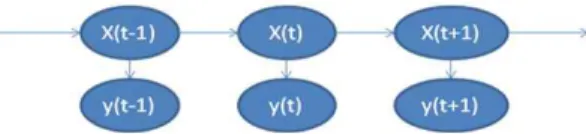
Fig. 6 shows the architecture of Hidden Markov Model:
Fig. 6. Hidden Markov Model Architecture.
The diagram above shows the general archi- tecture of a Hidden Markov Model (HMM). Each oval shape represents a random variable that can adopt a number of values. The random variable x(t) is the hidden state at time t. The random vari- able y(t) is the observation at time t. The arrow in the diagram denotes conditional dependencies.
The gesture recognition model designed in the work is a circular network of isolated gesture HMMs. Basically the network models the entire sequence of human subject motion. Non-gesture patterns are explained by the filler or garbage model denoted by "F" in the picture. There is only one type of non-gesture and thus only one filler HMM currently. The structure of the network can be described by the following generative rule:
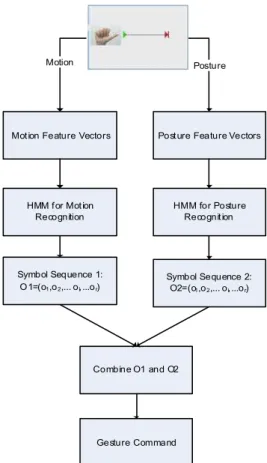
Mot ion Feature Vectors Post ure Feature Vectors
HMM f or Mot ion Recognition
HMM for Posture Recognit ion
Motion Posture
Symbol Sequence 1:
O 1=(o1,o2,… oi, ...or)
Symbol Sequence 2:
O2=(o1,o2,… oi, ...or)
Combine O1 and O2
Gesture Command
Fig. 8. HMM Model for Hand Gesture Recognition.
1. <Gesture Motion> := <F> (<G><F>)*
2. <G> : = <G0>‖<G1>‖<G2>‖……. ‖<G9>
3. <F> : = <F1>‖……‖<Fk>
Where <Gi> represents a gesture model for hand i and <Fi> represents a filler model where i=1, ….,k and k is the number of filler models.
According to the above definition, we can build a network of HMMs as following:
Fig. 7. HMM network for gesture recognition Based on the features which are extracted from hand region and tracking process, we create a vec- tor and use it as the input data of Hidden Markov Model. The output of these hidden models is the gesture that we want to recognize. The symbol generation process is illustrated in Fig. 8.
7. EXPERIMENT RESULTS
In the Experiment, we use a single hand to make hand gesture. And for evaluating the hand gesture tracking and recognition algorithm, we build the hand gesture database which contains 8 kinds of hand gesture performed 3 times by 20 different individuals. So there are 60 different image se- quences capture for each hand gesture, and totally 480 image sequences are used for training. The size of each gray-level image frame is 320*240, its frame rate is 30 frames/sec, and each ges- ture-making takes about one second. Each gesture
is standing before any stationary background with normal lighting. The proposed real-time tracking system can track and identify the moving objects in front of a stationary background.
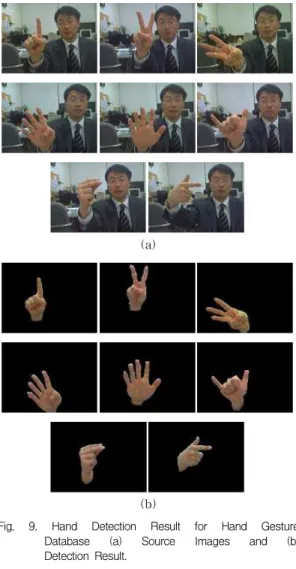
Hand region detection will be disturbed by the regions with similar skin color. Such as face re- gion, or any region closed to red. A correct de- tection can be considered as that the result with a correct palm center position, accurate hand edge information and accurate finger detection. The de- tection result can be shown in Fig. 9.
And a testing result in the hand posture data- base is concluded in Table 1. CD and MD denote the correct and missed detections respectively, while DR is the detection rate.
The same gesture made by different individuals may look different because of different hand- shapes and gesture speed. To design a robust rec-
(a)
(b)
Fig. 9. Hand Detection Result for Hand Gesture Database (a) Source Images and (b) Detection Result.
Table 1. Hand Region Detection Result Analysis Background
Complexity Test
Image CD MD DR
Simple without Face
Region 200 198 2 99%
Simple with Face
Region 200 192 8 96%
Complex without Face
Region 200 186 14 93%
Complex with Face
Region 200 179 21 89.5%
(a)
(b)
Fig. 10. Experiment results of recognizing the gesture from a sequence of frames: (a).
Observation Symbols Sequences and (b) the Matching Result.
ognition system, the training data are selected to cover all possible hand-shapes for each individual.
Before using HMMs for training or recognition
process, vector sequence is preprocessed to an ob- servable symbol sequence O. The codebooks are created based on their corresponding training data.
The codebook sizeM, which is power of 2, is chos- en by experiments.
Totally 480 images sequences are collected for 8 different gestures, thus each kind of gesture with 60 sequences in average, in training phase and oth- er 480 sequences are collected for test as shown in Table 1. The hand posture recognition rate of using training data for testing is 98%. The recog- nition rate of using testing data is 90.5%. And for hand motion, we extract the PCA feature of optical flow field for getting a precise description of motion. The recognition rate for hand gesture is about 93% in real-time. So the final hand gesture recognition rate is 84.16%.
Fig. 10 shows the results of the gesture recog- nition of the 1stgesture in our vocabulary. Fig. 10(a) shows the sequence of observation symbols which is input to the hmm. Fig. 10(b) shows the output of the maximum likelihood of each HMM applied to the testing sequence. There are totally 8 HMMs in the recognition system of which first HMM gen- erates the largest maximum likelihood. In our ex-
Fig. 11. Using Hand Gesture to Control MP3 Player.
Fig. 12. Using Hand Gesture to Control Keyboard.
(a) (b) (c)
Fig. 15. Hand Posture in HandVu System periments, we have tested 8 different gestures from
different signers, some gestures are not precise, and the recognition rate drops to 70%. We find that our recognition system is insensitive to size and rotation, for small objects and for large objects, it can still effectively identify the correct gesture.
However, the system can even make error recog- nition result because we don’t have enough train- ing data to make a good estimate of the HMM model parameters.
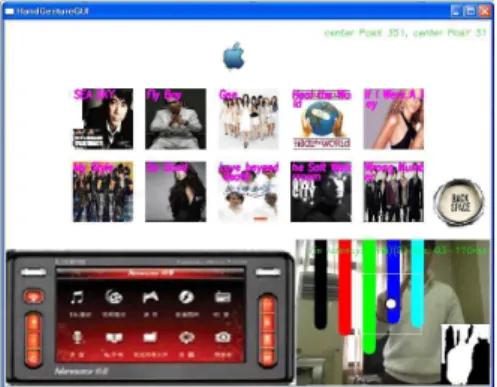
We have integrated the algorithm to a system.
The system is composed of 3 parts:
1. MP3 player: in this part, one can use her/his hand to select the music which we want to listen, and use open hand posture to start the player. As seen at Fig. 11.
2. Hand gesture keyboard: in this part, one can use her/his hand to type the key in the screen, the figure can be shown as Fig. 12.
3. Hand gesture game: in this part, we have de- veloped a Bonga game which is based on hand gesture. As shown in Fig. 13.
Fig. 13. Using Hand Gesture to Control Bonga game.
The main page is shown as Fig. 14.
Fig. 14 Main Page of Hand Gesture Control System.
In order to evaluate the performance of our pro- posed algorithm, we use the classical method in OpenCv (HandVu) for comparison.
The handVu hand gesture detection and recog- nition system which is used in OpenCV. The sys- tem use the pyramid L-K Optical flow algorithm
to track the hand, and use the Template based method to recognize the hand posture. In the sys- tem, it defines three kinds of hand posture: open hand, close hand and victory posture show as fol- lowing:
The hand gesture is started when user with hand open posture, and stopped when user with hand close posture. The victory posture is used to make confirm command.
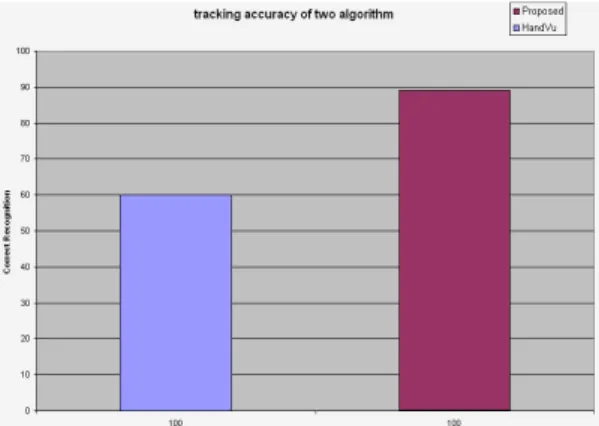
The following figure shows the tracking accu- racy of two kinds of system testing in 100 hand moving videos.
Fig. 16. Tracking Test in 100 Hand Moving Videos.
And the following figure shows the recognition rate of hand posture in histogram. The testing da- tabase contains 3 kinds of hand posture: open, close, victory, each posture with 100 testing images.
Fig. 17. Histogram of Hand Posture Recognition Rate.
From the results, we can conclude that for both hand detection and hand gesture recognition method. Our methods performed much better than the HandVu algorithm. That because HandVu gives a better hand detection algorithm which is based on optical flow method, but the method for extracting hand feature is so lack. It just use the skin color. So this may make some confused with face region, but in our method, we utilize both the skin color and the hand geometric information (hand region boundary energy) to avoiding the problem. And for recognizing hand posture, the HandVu method just use the mask pattern for each hand posture, it is very lack. But in our method, we use the feature based on FFT which can de- scribe shape feature very strongly, and it is vali- dated to shape rotation and transposition. Also for recognizing the hand posture, we use the artificial neural network to recognize the hand posture. All of these combination make the performance of our algorithm very strongly. But in Figure 17 we can also see that, the correct recognition number of hand close posture is down much than the other algorithm, that because the closing hand does not have complex boundary, so that make the feature based on boundary energy very weak. So it makes the recognition of closing hand leak. In our future recognition, it is a main field to be improved.
8. CONCLUSION
In this paper, we have presented a method to track and recognize the hand gesture by using op- tical flow and HMM algorithm. Since the moving hand can make an optical flow field, so based on the optical flow field and hand feature, we can de- tect the moving hand region. we use the region boundary complexity calculation to confirm the hand feature because of the complexity of hand boundary. And for describing the hand shape fea- ture, we use the Fourier descriptor, for describing the hand motion we use PCA to compress the di-
mension of optical flow feature. We apply this sys- tem to recognize the single gesture to control IPTV controller panel. In the experiments, we test in dif- ferent environment with different complex back- ground. The experiment result shows that the sys- tem can get an accurate result with 96%. If we want to add a new gesture into the system, we only need to re-train a HMM for the new gesture.
REFERENCES
[ 1 ] Bai yu and Eung-Joo Lee, “The hand mouse:
Hand detection and hand tracking,” Interna- tional Conference on Multimedia, Information Technology and its Application 2009(MITA 2009), pp. 244-245, 19-21 Aug. 2009.
[ 2 ] Bai yu, Sang-Yun Park, and Eung-Joo Lee,
“Hand Posture Recognition Based on SVM Using on Mobile Phone,” Conference on Korea Multimedia Society 2009, Vol.12, No.2, pp.
619-620, Nov. 2009.
[ 3 ] Eng-Jon Ong and Richard Bowden, “A boost- ed classifier tree for hand shape detection,” in Proceedings of Int. Conf. on Automatic Face and Gesture Recognition. Seoul, Korea, pp.
889-894, May 2004.
[ 4 ] Mathias Kolsch and Matthew Turk, “Robust hand detection,” in Proceedings of Int. Conf.
on Automatic Face and Gesture Recognition.
Seoul, Korea, pp. 614-619, May 2004.
[ 5 ] Lars Bretzner, Ivan Laptev, and Tony Linde- berg, “Hand gesture recognition using mul- ti-scale colour features, hierarchical models and particle filtering,” in Proceedings of Int.
Conference on Automatic Face and Gesture Recognition. Washington D.C., pp. 423-428, May 2002.
[ 6 ] P. Viola and M Jones, “Rapid object detection using a boosted cascade of simple features,”
Proceedings of Computer Vision and Pattern Recognition. Hawaii, U.S. pp. 511-518, 2001.
[ 7 ] Nagel H.H, “Displacement Vectors Derived
from Second-order Intensity Variations in Image Sequences,” [J]. Computer Vision Graph Image Process, pp. 85-117, 1983.
[ 8 ] Nagel H.H and Enkermann W, “An Investiga- tion of Smoothness Constraints for the Estimation of Displacement Vector Fields from Image Sequences,” [J]. IEEE Trans, PAMI-5, pp. 565-593, 1986.
[ 9 ] HornB K.P and Schunck B.G, “Determining Optical Flow,” [J]. Artificial Intelligence, No.17, pp. 185-203, 1981.
[10] P. Peer, J. Kovac, and F. Solina, “Human skin color clustering for face detection,” In sub- mitted to EUROCON 2003-International Con- ference on Computer as a Tool, 2003.
[11] Sang-Yun Park and Eung-Joo Lee, “Hand Gesture Recognition Algorithm Robust to Complex Image,”Journal of Korea Multime- dia Society 2010, Vol.13, No.7, pp. 1000-1015, July. 2010.
[12] W. Sharbek and A. Koshan, “Color Image Segmentation–a survey-.” Tech. Rep. Institute for Technical Informatics. Technical University of Berlin, October, 1994.
[13] E. Person and K.S. Fu, “Shape Discrimination using Fourier Descriptor,” IEEE Transactions SMC, Vol. No.3, pp. 170-179, 1977.
[14] D. Shridhar and A. Badreldin, “High-Accuracy Character Recognition Algorithm using Fourier and Topology Descriptor,”Pattern Recognition Vol.17 pp. 515-524, 1984.
[15] Li wei and Eung-Joo Lee, “An IP-TV Remote Controller Based on Hand Posture Recognition Using Fourier Descriptor,” Conference on Korea Multimedia Society 2009, Vol.12, No.2, pp. 510-511, Nov. 2009.
[16] A. Kundu and Y. He, P. Bahl, “Recognition of Handwritten Word: First and Second Order Hidden Markov Model Based Approach,”
Pattern Recognition Vol.22, No.3, pp. 283-301, 1989.
[17] Y. Yamato, J. Ohya. and K. Ishii, “Recognizing
Human Action in Time-Sequential Images Using Hidden Markov Models,” Proceedings IEEE Conference on Computer Vision and Pattern Recognition, pp. 379-385, 1992.
[18] J. Schlenzig, E. Hunter. and R. Jain, “Recursive Identification of Gesture Inputs Using Hidden Markov Models,” Proceedings Second Annual Conference on Applications of Computer Vision, pp. 184-194, 1994.
Sang-Yun Park
received his B.S. in Physics, M.S. in multimedia Application from Kyungsung University, Korea, in 1992, 1998, respectively.
And now(2006-2011) he is a Ph.D student of Tongmyoung University in Korea.
His main research interests include in computer vision and biometrics.
Eung-Joo Lee
received his B.S., M.S. and Ph.D in Electronic Engineering from Kyungpook National University, Korea, in 1990, 1992, 1996, respectively.
In March 1997, he joined the Department of Information Com- munication Engineering of Tongmyoung University, Busan, Korea, as a professor. From 2005 to July 2006, he was a visiting professor in the Department of Computer and Information Engineering, Dalian Polytech University, China.
His main research interests are in image processing, computer vision, and Biometrics.