• 검색 결과가 없습니다.

Efficiency Evaluation of Different Processes in Drinking Water Treatment

N/A
N/A
Protected

Academic year: 2021

Share "Efficiency Evaluation of Different Processes in Drinking Water Treatment"

Copied!
8
0
0

로드 중.... (전체 텍스트 보기)

전체 글

(1)

정수처리에서 서로 다른 공정의 처리효율에 대한 비교분석연구

Efficiency Evaluation of Different Processes in Drinking Water Treatment

김형석․이병호

Hyung Suk Kim․Byoung Ho Lee

Department of Civil and Environmental Engineering, University of Ulsan

2011년 5월 23일 접수 ; 2011년 8월 8일 수정 ; 2011년 8월 12일 채택)

Abstract

This study was performed to compare finished water quality among three different processes. A detailed assessment of performance was carried out duringthe five months of operation. Finished water quality was evaluated on the basis of parameters such as Dissolved organic carbon (DOC), UV

254

absorbance, haloacetic acid formation potential (HAAFP), geosmin, 2-methylisoborneol (2-MIB), heterotrophic bacteria and total coliform bacteria. The treatment processes were Process 1 (coagulation-flocculation-sedimentation-sand filtration-ozone-GAC), Process 2 (coagulation-flocculation-sedimentation -microfiltration-ozone-GAC), and Process 3 (coagulation-flocculation-sedimentation- sand filtration-GAC), compared side by side in the pilot testing. Process 2 was found to have better removal efficiency of DOC, UV

254

absorbance, HAAFP and heterotrophic bacteria in comparison with process 1 and process 3 under identical conditions. Geosmin, 2-MIB and total coliform bacteria were not detected in finished water from each process.

Key words : DOC sand filtration, GAC, microfiltration, ozone 주제어 : 용존유기탄소 사여과, 활성탄, 정밀여과, 오존

*Corresponding author Tel:+82-52-259-2279, Fax:+82-52-259-2629, E-mail: [email protected](Lee, B.H.)

1. Introduction

Numerous compounds existing in natural waters should be removed in the processes of drinking water treatment. Due to pollution of surface water and stricter drinking water standards, water quality produced by the conventional water treatment processes may no longer be satisfactory.

Employment of membrane technology has been

considered as an alternative to the sand filtration of the conventional drinking water treatment for effective removal of the target materials such as residual floc and DBP (Disinfection by-Products) precursors [Bottinoa et al. 2001, Fiksdal et al. 2006].

In particular, microfitration (MF) and ultrafitration

(UF) technologies are receiving more attention due

to their lower energy consumption, economic, and

easy operation than nanofiltration (NF) and RO

(2)

(Reverse Osmosis) filtration (Kim et al. 2007, Xia et al. 2007). Ozone is a very strong oxidant, and it is used as a disinfectant in drinking water treatment.

Ozone also oxidizes unsaturated bonds in organic compounds by direct or indirect pathways. It has many benefits such as removal of natural and synthetic organic compounds (i.e. taste and odor compounds, pesticides), avoidance of halogenated disinfection-by-products (DBPs) formation, and improved flocculation. [Bao et al. 1999]

Activated carbon adsorption process has been employed to remove DBPs. Ozone is applied to oxidize refractory organic matter, which increases biodegradability of substances before activated carbon process. Small organic compounds and DBPs are adsorbed in GAC bed following ozonation process.

GAC has a large interfacial area that adsorbs precursors of THMs and HAAs, phenolic compounds, dyes, toxic metals, and substances which may cause biological after growth in water distribution system [Zhao et al. 2006].

Drinking water is supplied from the Cheon-Sang water treatment plant in city of Ulsan which has a population of over 1 million, and in which major industrial complexes exist. Raw water of Cheon-Sang is drawn from the nearby reservoir. The reservoir is becoming polluted due to agricultural and small industrial wastewater discharge, resulting in eutrophication of the lake. Currently, Cheong-Sang water treatment plant employs conventional treatment processes, including prechlorination, coagulation, sedimentation, rapid sand filtration, and disinfection. Because the water quality paramerts are not removed at the required level by conventional processes in Cheon-Sang water treatment plant, advanced treatment processes are to be built to improve removal of the parameters such as taste, odor, and DBPs in satisfactory level, which include ozone and activated carbon processes. A pilot plant was built to get design parameters within the Cheon-Sang plant. The performances of the three different treatment processes were compared side by side on the basis of water quality parameters like

DOC, UV

254

absorbance, HAAFP, geosmin, 2-MIB, heterotrophic bacteria, and total coliform bacteria.

2. Experimental Methods

2.1. Pilot plant

The pilot scale plant was set up at the Cheon-Sang

water treatment plant. Three treatment processes

were operated in this investigation, and detailed

assessment of performance was carried out during

the five months of operation. Cheon-Sang water

treatment plant needs to be renovated due to

deterioration of its source water. In order to decide

a possible process three different processes were

considered. Fig 1 shows the schematic diagram of the

pilot plant used in this study. The raw water used in

this treatment was taken from the reservoir, and

divided into three processes. These three processes

were composed of coagulation-flocculation-

sedimentation-sand filtration-ozone-GAC (process 1),

coagulation-flocculation-sedimentation-membrane

filtration-ozone-GAC (process 2), and coagulation

-flocculation-sedimentation-sand filtration-GAC

(process 3). A general advanced water treatment

process (process 1) was compared to a emerging

membrane technology (process 2). Effect of ozone in

advanced water treatment was evaluated by

comparing process 1 and process 3. Flow rate of the

influent for each process was 30m

3

/day. Poly

aluminum chloride (10%) diluted 20 times was used

as a coagulant with 30mg/l of concentration, and the

feed rate was 2.5mL/min Flocculation was done with

an effective capacity of 0.76 m

3

, and retention time

of 36.4 min. Sand filters with a 300 mm depth of

gravel laying over 1,100 mm of sand with the loading

rate of 120 m/day (Effective Size of 0.45-0.7 mm)

were used in process 1 and 3 with filtration rate of

30 m

3

/day. Backwashing of the sand filter was

practiced every other day and GAC column

backwashing was also done twice a week. The MF

membrane used in process 2 was produced by

KOLON, Korea with membrane surface area of 20 m

2

,

and pore size of 0.1 µm (CLEANFIL –S20HP). The

membrane was operated at the feed rate of 20.83

(3)

Fig. 1. Shematic diagram of the pilot plant.

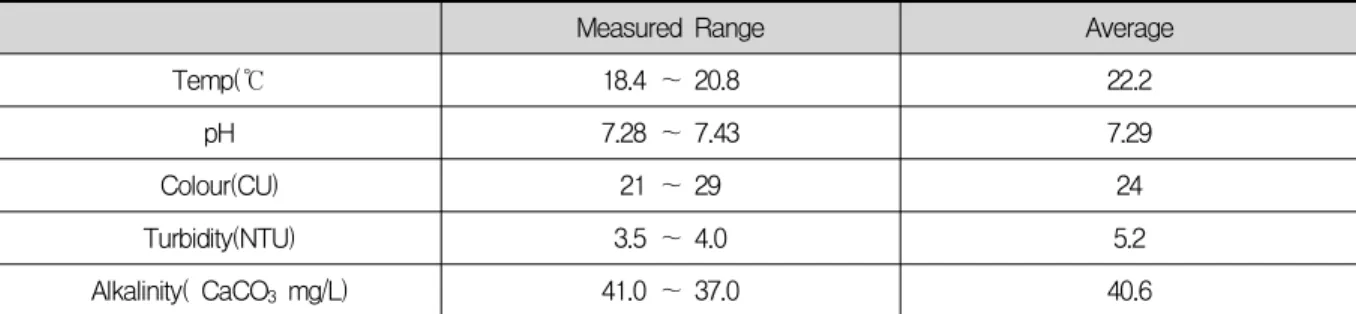
Measured Range Average

Temp(℃ 18.4 ~ 20.8 22.2

pH 7.28 ~ 7.43 7.29

Colour(CU) 21 ~ 29 24

Turbidity(NTU) 3.5 ~ 4.0 5.2

Alkalinity( CaCO

3

mg/L) 41.0 ~ 37.0 40.6

Table 1. Characteristics of raw water quality

L/min, Permeate 18.75 L/min and Trans Membrane Pressure of 0.03 MPa. Backwashing and chemical cleaning of MF was practiced regularly for preventing fouling. The GAC column of each processes was filled with 2,500 mm (Shin Ki Chemicals, Korea), with an empty bed contact time (EBCT) of 4.3 min.

Ozone was produced by ozone generator (WEDECO, Series GSO/SWO, Germany), and it was applied in 0.5~2.0mg/l of concentrations.

2.2 Analysis

Raw water and samples from each process were collected weekly. The samples were taken simultaneously from all the processes. pH and temperature were measured using pH meter (Horiba D51, Japan) and turbidity was measured using portable analyzer (Hach 2001AN, USA). These parameters were measured at the sampling sites itself. Samples were carried to the laboratory,

pre-filtered with a 0.45μm filter to remove particles and were stored in a refrigerator at 4°C for the analysis. Alkalinity, color, heterotrophic and coliform bacteria were analyzed according to standard methods [Standard Methods, 21th ed. 2005].

Dissolved organic carbon (DOC) concentration was analyzed using TOC analyzer (TOC-5310C, Sievers, USA) after filtering raw water with CF/G filter. UV

254

absorbance was measured with a Shimadzu UV-1240 ultraviolet-visible (UV/VIS) spectrophotometer (Shimadzu, Japan). Prior to measuring UV

254

absorbance, the water sample was filtered using a 0.45㎛ membrane.

HAAFP was analyzed using a head space gas chromatograph (6890N, Agilent, USA) coupled with a micro-electron capture detector (ECD). The make-up gas used was high purity nitrogen, and the specifiation of the capillary column was 30.0m×

0.53mm I.D.×3.0m (DB-1, Agilent,USA). The samples were analyzed as described in US EPA for drinking water [USEPA PB92-207703, 1992].

MIB and geosmin analyses were conducted using solid phase microextraction and gas chromatography -mass spectrometry using GC/MS-QP2010 (SHIMADZU, Japan). The procedure for the analysis of geosmin and 2-MIB was the same as prescribed by Standard Methods [Standard Methods, 21th ed.

2005].

3. Results and Discussion

3.1 Water characteristics

The characteristics of raw water quality are

presented in Table 1.

(4)

Fig. 2. Measured values of DOC in raw water, and waters from process 1, 2, and 3.

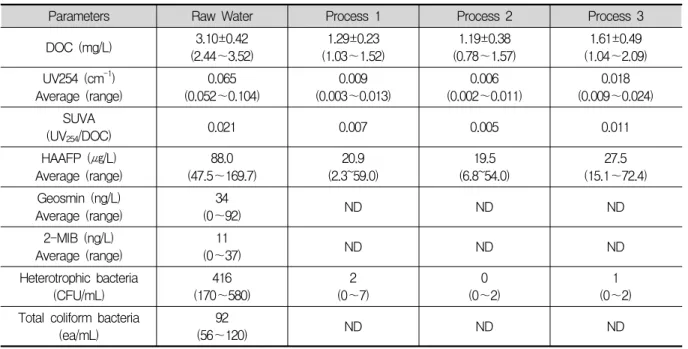
Parameters Raw Water Process 1 Process 2 Process 3

DOC (mg/L) 3.10±0.42 (2.44~3.52)

1.29±0.23 (1.03~1.52)

1.19±0.38 (0.78~1.57)

1.61±0.49 (1.04~2.09) UV254 (cm

-1

)

Average (range)

0.065 (0.052~0.104)

0.009 (0.003~0.013)

0.006 (0.002~0.011)

0.018 (0.009~0.024) SUVA

(UV

254

/DOC) 0.021 0.007 0.005 0.011

HAAFP (㎍/L) Average (range)

88.0 (47.5~169.7)

20.9 (2.3~59.0)

19.5 (6.8~54.0)

27.5 (15.1~72.4) Geosmin (ng/L)

Average (range)

34

(0~92) ND ND ND

2-MIB (ng/L) Average (range)

11

(0~37) ND ND ND

Heterotrophic bacteria (CFU/mL)

416 (170~580)

2 (0~7)

0 (0~2)

1 (0~2) Total coliform bacteria

(ea/mL)

92

(56~120) ND ND ND

Table 2. Average concentrations of raw water, and finished waters from process 1, process 2, and process 3

3.2 DOC, UV

254

absorbance AND HAAFP

As water quality parameters DOC, UV

254

absorbance, SUVA, and HAAFP were selected. DOC is a good indicator of the given process for removing organic in water. UV

254

absorbance was chosen to evaluate especially ozone effect in breaking down of higher molecular weight organic into lower one. SUVA was measured to evaluate relative amount of aromatic compounds in each process. HAAFFP was measured to evaluate possible hazardous by- products.

Fig. 2 shows the concentration variation of DOC for raw water and treated waters from process 1, process 2 and process 3. Results are summarized in Table 2. Up to 61.5 % removal of DOC was achieved for process 2 followed by process 1 with DOC removal rate of 58.4 %. While, only 48.2 % reduction of DOC occurred in process 3. It may be attributed to the fact that the incorporation of microfiltration with GAC in process 2 enables the process to better retain high molecular weight organic compounds from water than the adsorption in sand filtration in process 1. The removal efficiency was low due to absence of ozonation in process 3. Straining effect is higher in membrane than in sand filtration. It may also be

realized that ozone oxidation enhanced removal of DOC by comparing process 1 and process 3.

UV

254

absorbance is a measure of aromacity of

dissolved organic material, which was measured as an

indicator of THMs precursors in DOM fractions [Her

et al. 2003, Leenheer et al. 2003]. The results of

UV

254

for three treatment processes are presented in

Table 2 and Fig 3. In process 1, the UV

254

absorbance

(5)

Fig. 3. Measured values of UV

254

absorbance in raw water and finished water of process 1, 2, and 3.

Fig. 4. Measured values of HAAFP in raw water, process 1, process 2 and process 3.

was reduced with removal rate of 88 %. The process 2 had the removal rate of 90 %, while 73 % removal rate was observed in process 3. The order of removal rate of UV

254

absorbance was found as process 2 >

process 1 > process 3. The higher removal rate in process 2 may be attributed to the fact that the pores are smaller in membrane than in sand bed, smaller particulates and/or smaller flocs may have been separated more in membrane. Processes employing ozone oxidation (process 1 and process 2) showed higher removal efficiencies of UV

254

absorbance than that without ozone oxidation (process 3). This indicates that ozone breaks down aromatic compounds.

SUVA values of the three processes were clearly differentiated by the different processes as shown in Table 2. Process 2 that employed membrane showed the smallest value of 0.005 in SUVA. This illustrates that membrane may separate aromatic organic material more effectively than sand filtration, and thus the finished water of the Process 2 contains aromatic material at lowest level. Comparing Process 1 and Process 3, Process 1 shows lower value of SUVA which was attributed by ozonation of Process 1. This implies ozone dissociates aromatic organic materials into aliphatic ones.

As indicated by many studies, ozonation of NOM does not result in complete oxidation of organic matter [Kanokkantapong et al. 2006]. NOM oxidation

by ozone yields organic fractions with low molecular weights in water. After ozonation, chlorination of low molecular organic fraction yields HAA in water. The values of HAAFP in raw water and finished waters from three processes were presented in Table 2 and Fig. 4. It was observed under comparable conditions that process 2 had a higher removal rate than process 1 and process 3. Removal efficiencies of process 1, process 2 and process 3 were 71.9%, 72.4% and 64.1% respectively. In process 2, higher removal efficiency of HAAFP was found than other processes due to incorporation of microfiltration which may retain large organic molecules.

3.3 Geosmin and 2-MIB

Tastes and odors have long been of concern for

drinking water as they account for many consumer

complaints. MIB (2-methylisoborneol) and geosmin

(trans-1,10-dimethyl-trans-9-decalol) are two of

the most common tastes and odors. Both compounds

are volatile saturated tertiary alcohols and impart an

earthy/musty odor that can be detected at extremely

low concentrations of between 10 and 20ng/L

[Lalezary et al. 1986, Suffet et al. 1996]. Neither MIB

nor geosmin is readily removed by conventional

water treatment thus advanced treatment processes

such as ozonation are required. Removal of algal cells

by conventional treatment can be very effective when

the process is optimized, but is ineffective for

(6)

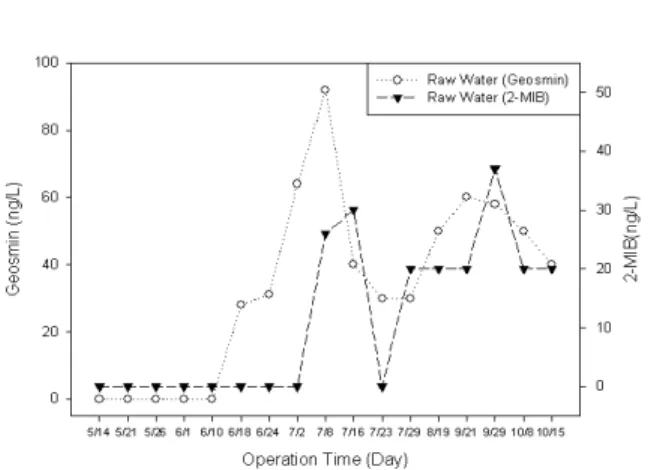
Fig. 5. Measured concentrations of geosmin and MIB in raw water.

Fig. 6. Monthly variation of chlorophyll-a concentration in the reservoir.

removal of dissolved algal metabolites released from these cells [Chow et al. 1998]. Additional processes incorporating oxidation or adsorption are generally required to remove these dissolved metabolites.

Activated carbon has been shown to be an effective adsorbent for the removal of MIB and geosmin [Cook et al. 2001]. Fig. 5 shows the concentrations variation of geosmin and MIB in raw water. MIB and geosmin are produced by algal cells, which are normally monitored by chlorophyll-a. Monthly average concentrations of chlorophyll-a were measured in the reservoir where raw water has been taken.

Monthly variation of the chlorophyll-a is shown in Fig. 6. Concentrations of Chlorophyll-a were increased from May, and continued increasing until September. It was lowered in October, but gradually increased again until the end of the year. Even though it was not shown that concentration of chlorophyll-a was closely related with concentrations of geosmin and MIB, those taste and odor causing materials began to appear when concentration of chlorophyll-a began to increase in the end of May. The average and measured concentrations of geosmin and MIB in raw water and finished water from each process are presented in Table 2. The average raw water concentration of geosmin and MIB were 34 ng/L and 11 ng/L respectively. However MIB and geosmin were not detected (<10 ng/L) in the finished water in all of process 1, process 2 or process 3, which indicates that ozonation and/oractivated carbon with other conventional processes could remove these compounds within the measured range.

3.4 Heterotrophic Bacteria and Total Coliform Bacteria

Coliform bacteria are the indicators of faecal contamination by human and warm-blooded animals and if these are absent, only then can water be considered safe for drinking purpose. Generally not all bacteria are harmful but other microbes along with these bacteria can cause short-term effects like diarrhea, cramps, nausea, headaches, or other symptoms [Jerzy et al. 1999]. Typically, the compliance control for checking microbiological

waterquality in distribution system is carried out by

monitoring indicator microorganisms. However,

injured bacteria are incapable of growth and colony

formation under standard conditions because of

structural and metabolic damage; as a result a

significant portion of bacteria may not be detected

leading to erroneous assessment of microbial water

quality [McFeters et al. 1986]. Removal of bacteria

is extremely important in the drinking water

production. The removal of bacteria from water

sources is the main priority for drinking water

companies. Fig. 7 shows measured value and Table

2 shows average values. Heterotrophic bacteria and

total coliform countvalue of the raw water ranged

(7)

Fig. 7. Heterotrophic bacteria and total coliform bacteria counts in raw water.

from 170 to 580 CFU and 56 to 120, with an average value of 416±164 CFU and 92±28 respectively. The average heterotrophic bacteria counts for the finished water from process 1, process 2 and process 3 were 2 CFU, 0 CFU and 1 CFU respectively. The total coliform counts were zero in the finished water of process 1, process 2 and process 3. Therefore adding ozonation, microfiltration and GAC to the conventional process could significantly enhance the removal efficiency.

4. Conclusion

This investigation was performed to evaluate the removal efficiencies of different advanced treatment processes for the removal of DOC, UV

254

absorbance, HAAFP, geosmin, 2-MIB, heterotrophic bacteria and total coliform bacteria for drinking water purposes.

Microfiltration had the highest efficiency of DOC, UV

254

absorbance and HAAFP with removal rate of 62%, 90%, and 79% respectively. Geosmin, 2-MIB and total coliform bacteria had not been detected in finished water of each process, even when they were measured in considerable concentrations in raw water. Microfiltration was found to remove DOC more effectively than sand filtration which attribute to higher removal rate of SUVA, and HAAFP. It was also found that ozone oxidizes higher molecular weight of organic into smaller one, which leads to higher

removal rates of water quality parameters such as DOC, UV

254

absorbance, and HAAFP than without ozone. Even though membrane (process 2) showed little bit higher performance in removing the selected water quality parameters, economic effect must be considered. Rejected water from membrane should also be additionally treated.

References

A. Bottinoa, C. Capannelli, A.D. Borghi, M. Colombino, and O. Conio, Water treatment for drinking purpose:

ceramic microfiltration application, Desalination 141 (2001), pp. 75–79.

L. Fiksdal, and T. Leiknes, The effect of coagulation with MF/UF membrane filtration for the removal of virus in drinking water, J. Membr. Sci. 279 (2006), pp. 364–

371.

H.S. Kim, S. Takizawa, and S. Ohgaki, Application of microfiltration systems coupled with powdered activated carbon to river water treatment, Desalination 202 (2007), pp. 271–277.

S. J. Xia, X. Li, Q.L. Zhang, B. Xu, and G.B. Li, Ultrafiltration of surface water with coagulation pretreatment by streaming current control, Desalination 204 (2007), pp. 351–358.

M.L. Bao, O. Griffni, D. Santianni, K. Barbieri, D. Brunni, and F. Patani, Removal of bromated ion from water using granular activated carbon, Water Res. 33 (1999), pp.

2959-2970.

Z.Y. Zhao, J.D. Gu, X.J. Fan, and H.B. Li, Molecular size distribution of dissolved organic matter in water of the Pearl River and trihalomethane formation characteristics with chlorine and chlorine dioxide treatments, J. Hazard. Mater. 134 (2006), pp. 60–66.

APHA-AWWA-WPCF, Standard Methods for the Examination of Water and Waste Water. 21th ed., Washington, DC, 2005.

US Environmental Protection Agency, Methods for the Determination of Organic Compounds in Drinking Water, PB92-207703, Washington, DC, 1992.

N. Her, G. Amy, D. McKnight, J.S. Sohn, and Y.M. Yoon,

Characterization of DOM as a function of MW by fl

orescence EEM and HPLC-SEC using UVA, DOC, and

(8)

florescence detection, Water Res. 37(2003), pp. 4295–

4303.

J.A. Leenheer, and J.P. Croue, Characterizing dissolved aquatic organic matter, Environ. Sci.Technol.

37(2003), pp. 18–26.

V. Kanokkantapong, T.F. Marhaba, P. Pavasant, and B.

Panyapinyophol, Charactersation of haloacetic acid precursors in source water, J. Environ. Manage. 80 (2006), pp. 214–421.

S. Lalezary, M. Pirbazari, and M.J. McGuire, Evaluating activated carbons for removing low concentrations of taste and odour producing organics, J. Am. Water Works Assoc. 78 (1986), pp. 76–82.

I.H. Suffet, A. Corado, D. Chou, M.J. McGuire, and S.

Butterworth, AWWA taste and odor survey, J. Am.

Water Works Assoc. 88 (1996), pp. 168–180.

C.W.K. Chow, J. House, R.M.A. Velzeboer, M. Drikas, M.D.

Burch, and D.A. Steffensen, The effect of ferric chloride flocculation on cyanobacterial cells, Water Res. 32 (1998), pp. 808–814.

D. Cook, G. Newcombe, and P. Sztajnbok, The application of powdered activated carbon for MIB and geosmin removal: predicting PAC doses in four raw waters, Water Res 35 (2001), pp. 1325–1333.

L. Jerzy, F.C. Yueh, L. Fuhua, T. Mark, and R.F. Samuel, Removal of micro organisms from waterby columns containing sand coated with ferric and aluminium hydroxides, Water Res. 33 (1999), pp. 769–777.

G.A. McFeters, J.S. Kippin and and M.W. LeChevallier, Injured coliforms in drinking water, Appl. Environ.

Microb. 51 (1986), pp. 1–5.

수치

Table  1.  Characteristics  of  raw  water  quality
Table  2.  Average  concentrations  of  raw  water,  and  finished  waters  from  process  1,  process  2,  and  process  3
Fig.  3.    Measured  values  of  UV 254   absorbance  in  raw  water  and  finished  water  of  process  1,  2,  and  3.
Fig.  5.  Measured  concentrations  of  geosmin    and  MIB  in  raw  water.
+2

참조

관련 문서

At present, the caterpillar-type Fe electrode electrolysis system is known for its high phosphorous removal rate in sewage treatment, and in this study,

Concentration of soil residual endosulfan-sulfate with days after treatment of endosulfan in different soils

A laboratory experiment was performed to investigate the removal of nitrogen and phosphorus from plating factory effluent using the soil column.. Soil,

ƒ Precision forging(정밀단조), flashless forging(밀폐단조) : the part formed is close to the final dimensions, high forging load &amp; capacity equipment needed..

The purpose of this study is to evaluate the marginal and internal fit of coping made by CAD/CAM using different scanning methods.. Zirconia coping was made

The purpose of this study was to provide primary material in discussing methods to activate the treatment effects of diabetes and reduce the rate of

Direct potable reuse (DPR): The introduction of reclaimed water (with or without retention in an engineered storage buffer) directly into a drinking water treatment

To achieve the purpose of educational processes, 'expansion of self-leading instructional ability', the research and the development for the methods