• 검색 결과가 없습니다.

Does Quantitative Tibial Ultrasound Predict Low Bone Mineral Density Defined by Dual Energy X-Ray Absorptiometry?

N/A
N/A
Protected

Academic year: 2022

Share "Does Quantitative Tibial Ultrasound Predict Low Bone Mineral Density Defined by Dual Energy X-Ray Absorptiometry?"

Copied!
7
0
0

로드 중.... (전체 텍스트 보기)

전체 글

(1)

Does Quantitative Tibial Ultrasound Predict Low Bone Mineral Density Defined by Dual Energy X-Ray Absorptiometry?

Hakan Tuna,

1

Murat Birtane,

1

Galip Ekuklu,

2

Fikret Cermik,

3

Filiz Tuna,

1

and Siranus Kokino

1

Departments of

1

Physical Medicine and Rehabilitation,

2

Public Health,

3

Nuclear Medicine, Trakya University Hospital, Edirne, Turkey.

Received December 13, 2003 Accepted June 1, 2004

Reprint address: requests to Dr. Hakan Tuna, Trakya Univer- sitesi Tıp Fakultesi Fiziksel Tıp ve Rehabilitasyon AD, 22030, Edirne, Turkey. Tel: 902-84-2356904, Fax: 90-284-2359187, E- mail: [email protected]

Purpose: Efforts for the early detection of bone loss and subsequent fracture risk by quantitative ultrasound (QUS), which is a non-invasive, radiation free, and cheaper method, seem rational to reduce the management costs. We aimed in this study to assess the probable correlation of speed of sound (SOS) values obtained by QUS with bone mineral density (BMD) as measured by the gold standard method, dual energy X-ray absorptiometry (DEXA), and to investigate the diagnostic value of QUS to define low BMD. Materials and Methods: One hundred twenty-two postmenopausal women having prior standard DEXA measurements were included in the study. Spine and proximal femur (neck, trochanter and Ward's triangle) BMD were assessed in a standard protocol by DEXA. The middle point of the right tibia was chosen for SOS measurement by tibial QUS.

Results: The SOS values were observed to be significantly higher in the normal BMD (t score > - 1) group at all measurement sites except for the lumbar region, when compared with the low BMD group (t score < - 1). SOS was negatively correlated with age (r = - 0.66) and month since menopause (r = - 0.57). The sensitivity, specificity, and positive and negative predictive values for QUS t score to diagnose low BMD did not seem to be satisfactory at either of the measurement sites. Conclusion: Tibial SOS was cor- related weakly with BMD values of femur and lumbar spine as measured by DEXA and its diagnostic value did not seem to be high for discriminating between normal and low BMD, at these sites.

Key Words: Quantitative tibial ultrasound, low bone mineral density

INTRODUCTION

The diagnosis and management of osteoporosis

and especially related fractures cause a great

economic burden on society.

1

Thus efforts for

early detection of bone loss seem rational to

predict future fractures and thereby reduce the

management costs.

2

Despite recent advances on

the effect of bone quality to predict fractures, the

routine simple practice to assess bone quality

seems not as established and the bone mineral

density (BMD) measurement still preserves its

leading popularity among factors predicting the

risk of fracture.

3

Dual energy X-ray absorptio-

metry (DEXA) has been accepted to be the gold

standard method of BMD measurement, discrimi-

nating the osteopenic and osteoporotic patients

from patients with normal BMD and it has also

been demonstrated to predict osteoporotic frac-

tures in postmenopausal women.

4

However the

expense of the method makes it difficult to apply

DEXA to a wide range of subjects within the

postmenopausal population.

5

There is a growing

interest in the use of quantitative ultrasound

(QUS) measurement which is portable, non- inva-

sive, cheaper and which allows radiation free

assessment of bone status and fracture risk.

6,7

Ultrasound consists of acoustic waves above the

audible frequency range. It provides information

about bone mass and micro-architecture according

to the ultrasound broadband attenuation (BUA)

and speed of sound (SOS) by showing the velocity

of transmission of sound waves through soft

tissues and bones. It has been reported that BUA

and SOS, which can be determined at various

measurement sites like distal radius, os calcis,

(2)

tibia and phalanges, have the potential to predict future osteoporotic fractures.

8

However the corre- lation between QUS and BMD as measured by DEXA has been observed to vary considerably in previous studies.

9,10

This correlation seemed to be lower when QUS was applied at the tibia region.

8,11

We aimed in this study firstly to assess the cor- relation of SOS values obtained from tibia bones with spine and femur BMD values as measured by DEXA. Our second purpose was to determine the diagnostic value of QUS and to find a cut-off point for SOS to define low BMD (osteopenia and osteoporosis). These will help us define the potential role of tibial QUS in diagnosing regional low BMD as a screening method.

MATERIALS AND METHODS Patient selection

Two hundred postmenopausal women having prior standard DEXA measurements within the previous 3 months in the Nuclear Medicine Department were invited by phone call to un- dergo a tibial QUS investigation. The following exclusion criteria were applied to the subjects: 1) Prior DEXA evaluation performed more than 3 preceding months, 2) secondary osteoporosis, 3) lumbar vertebra osteoarthritis with prominent osteophytes, and 4) presence of calf pathologies especially around the tibia region such as oedema, acute traumatic conditions, osteomyelitis, Paget's disease and any painful skin problem. Age, height, weight, body mass index (BMI) and month since menopause (MSM) of all patients were recorded.

Bone mineral density measurement

Areal BMD was measured using a DEXA device (Norland XR36, Norland Medical Systems Inc., Fort Atkinson, WI, USA). Lumbar spine (anteroposterior, L2 - L4) and right proximal femur (neck, trochanter, Ward's triangle) scans were performed according to the manufacturer's procedures. All scans were reviewed by experienced physicians to ensure that analyses

were correct and that measurements did not include areas of vessel calcification, degenerative arthritis, or overlap with the iliac crest or ribs. To obtain t scores, BMD values were compared with normative data for lumbar spine and proximal femur. Patients with t scores lower than - 1 formed the osteopenic-osteoporotic group (low BMD group) while the ones with t scores higher than -1 constituted the normal BMD group according to the osteoporosis definition regarding t score for DEXA measurements.

12

Tibial QUS measurement

The middle point of the right tibia was chosen as the application area for site matched scans because this region consists of a small amount of soft tissue. SOS values were measured by tibial QUS (Soundscan 2000, Myriad Ultrasound Sys- tem) at the inner anterior site of the horizontally extended tibia. This device measures SOS along a 5 cm fixed longitudinal distance with pulse trans- mission at a frequency of 250 kHz.

Statistical analysis

Statistical analysis was performed by using MINITAB version 13.1. First, the demographic factors, DEXA and QUS parameters of all patients were summarised. Then the number of patients with normal and low BMD at every skeleton region was identified. Independent samples t test was used to compare the means of demographic parameters, such as age, BMI and MSM (month), and QUS parameters, such as t score and SOS, between the patients with normal and low BMD at lumbar and femoral regions, taking a t score of - 1 as the cut off point of discrimination. After- wards, the probable correlation of demographic properties and QUS parameters was assessed with DEXA parameters by using Spearman rank cor- relation analysis, at lumbar and femoral regions.

The diagnostic value of QUS t score, which also

was determined as normal if its t value was above

- 1 and low if it was under - 1, in assessing the

existence of DEXA-defined low BMD at the same

skeletal regions was evaluated by identifying the

sensitivity, specificity, and positive and negative

predictive values. Receiver operating character-

(3)

Table 1. The Demographic, Dual Energy X-Ray Absorptiometry and Tibial Quantitative Ultrasound Findings of All Patients

Parameters Patients (n = 122)

Age (yrs) 56.3 ± 8.7

Month since menopause (months) 136.4 ± 121.6

Body mass index (kg/m

2

) 27.8 ± 4.1

L2-4 BMD (gr/cm

2

) 0.971 ± 0.194

L2-4 t score - 1.0 ± 1.7

Femur neck BMD (gr/cm

2

) 0.811 ± 0.145

Femur neck t score - 0.7 ± 1.2

Femur trochanter trokanter BMD (gr/cm

2

) 0.637 ± 0.345

Femur trochanter trokanter t score - 0.9 ± 1.1

F. Ward's triangle BMD (gr/cm

2

) 0.597 ± 0.154

F. Ward's triangle t score - 1.7 ± 1.1

QUS t score - 1.7 ± 1.1

QUS SOS (m/sn) 3787.8 ± 123.4

BMD, bone mineral density; F. Ward's triangle, Femur Ward's triangle; SOS, speed of sound.

Data presented are mean ± SD.

istic (ROC) analysis was performed to assess the ability of SOS in identifying patients with low BMD. Any probable contributions of certain vari- ables, such as age, weight, BMI, MSM and SOS, to BMD estimation was evaluated by linear re- gression analysis.

RESULTS

Of 200 postmenopausal women with prior DEXA investigations who were invited by phone call, 138 applied to our clinic for quantitative tibial ultrasound investigation. Sixteen patients could not be included in the study either because they did not accept the tibial QUS investigation or they fell within the exclusion criteria. The demographic findings of all the patients are summarised in Table 1, together with average BMD and t score values measured at 4 sites in lumbar and femur regions by DEXA. The tibial QUS parameters, average t score and SOS values of all patients can also be seen in the same table.

According to the osteoporosis definition regar- ding t score, 55 patients had normal BMD status

with t scores higher than -1, 45 were osteopenic with t scores between -1 and -2.5, while 22 were osteoporotic with t scores less than -2.5 for the lumbar spine region. The patient numbers in the same groups were 68, 49, and 5 for the femur neck region, 65, 49, and 8 for the femur trochanter, and 33, 60, and 29 for the femur Ward's triangle, respectively. The numbers of normal, osteopenic and osteoporotic patients were 33, 59, and 30, respectively, according to tibial QUS t score findings.

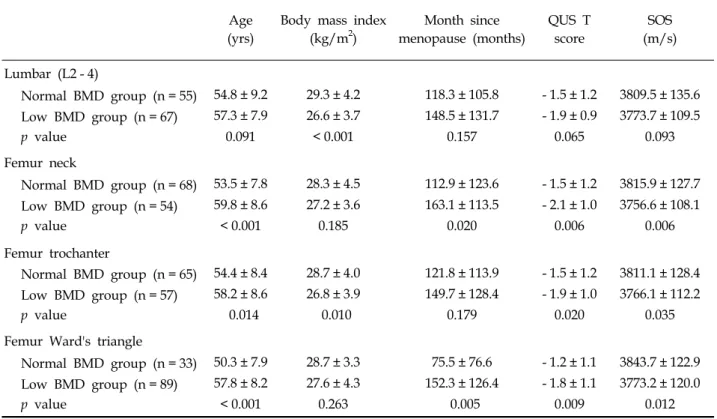
The patients with t scores lower than - 1 (the sum of osteopenic and osteoporotic patients) formed the low BMD group while the ones with t scores higher than -1 constituted the normal BMD group. On this basis, the tibial QUS t score and SOS values were significantly higher in the normal BMD group at all measurement sites ex- cept for the lumbar region (Table 2).

A negative correlation was found between SOS

and age (r = - 0.66), and between SOS and MSM

(r = - 0.57). However no correlation was found

between SOS and BMI. QUS t score and SOS

parameters were observed to be correlated posi-

tively with all BMD parameters at all sites (Table 3).

(4)

Table 3. Correlation Coefficients Between Demographic-Quantitative Ultrasound and Dual Energy X-Ray Absorp- tiometry Parameters

L2-4 BMD

L2-4 t score

F neck BMD

F neck t score

F trochk BMD

F trochk t score

F Ward BMD

F Ward t score

Age (yrs) 0.30 0.30 0.38 0.36 0.37 0.34 0.42 0.41

BMI (kg/m

2

) 0.30 0.30 NS NS 0.25 0.24 NS NS

Month since menopause

(months) - 0.20 - 0.20 - 0.34 - 0.34 - 0.25 - 0.25 - 0.42 - 0.41

QUS t score 0.30 0.30 0.37 0.36 0.35 0.34 0.36 0.42

SOS (m/s) 0.29 0.29 0.36 0.36 0.34 0.33 0.41 0.40

BMI, body mass index; QUS, quantitative ultrasound; SOS, speed of sound; BMD, bone mineral density; F, femur; NS, not significant.

Table 2. The Demographic and Quantitative Ultrasound Values Between Patients with Normal and Low Bone Mineral Density, According to All Measurement Sites

Age (yrs)

Body mass index (kg/m

2

)

Month since menopause (months)

QUS T score

SOS (m/s) Lumbar (L2 - 4)

Normal BMD group (n = 55) Low BMD group (n = 67) p value

54.8 ± 9.2 57.3 ± 7.9 0.091

29.3 ± 4.2 26.6 ± 3.7

< 0.001

118.3 ± 105.8 148.5 ± 131.7

0.157

- 1.5 ± 1.2 - 1.9 ± 0.9

0.065

3809.5 ± 135.6 3773.7 ± 109.5

0.093 Femur neck

Normal BMD group (n = 68) Low BMD group (n = 54) p value

53.5 ± 7.8 59.8 ± 8.6

< 0.001

28.3 ± 4.5 27.2 ± 3.6 0.185

112.9 ± 123.6 163.1 ± 113.5

0.020

- 1.5 ± 1.2 - 2.1 ± 1.0

0.006

3815.9 ± 127.7 3756.6 ± 108.1

0.006 Femur trochanter

Normal BMD group (n = 65) Low BMD group (n = 57) p value

54.4 ± 8.4 58.2 ± 8.6 0.014

28.7 ± 4.0 26.8 ± 3.9 0.010

121.8 ± 113.9 149.7 ± 128.4

0.179

- 1.5 ± 1.2 - 1.9 ± 1.0

0.020

3811.1 ± 128.4 3766.1 ± 112.2

0.035 Femur Ward's triangle

Normal BMD group (n = 33) Low BMD group (n = 89) p value

50.3 ± 7.9 57.8 ± 8.2

< 0.001

28.7 ± 3.3 27.6 ± 4.3 0.263

75.5 ± 76.6 152.3 ± 126.4

0.005

- 1.2 ± 1.1 - 1.8 ± 1.1

0.009

3843.7 ± 122.9 3773.2 ± 120.0

0.012 BMD, bone mineral density; QUS, quantitative ultrasound; SOS, speed of sound.

Data presented are mean ± SD

The number of patients with normal BMD according to QUS of tibia was 33, while the number with low BMD was 89. The sensitivity, specificity, and positive and negative predictive values for QUS t score to diagnose low BMD were not observed to be satisfactory at either of the measurement sites (Table 4).

The ROC curves plotted for SOS, using the

DEXA t scores as the standard method to diag-

nose low BMD, were not satisfactory and the

areas under the curve for the lumbar spine, femur

neck, femur trochanter and femur ward's triangle

were 0.43, 0.36, 0.39, and 0.32, respectively. The

curve for the lumbar region can be seen in Fig. 1.

(5)

Table 4. The Diagnostic Value of Quantitative Ultrasound t Score to Diagnose Low Bone Mineral Density at All Measurement Sites

L2 - 4 Femur neck Femur trochanter F. Ward's triangle

Sensitivity 0.50 0.60 0.83 0.52

Specificity 0.81 0.65 0.38 0.73

+ predictive value 0.91 0.87 0.83 0.88

- predictive value 0.30 0.31 0.38 0.29

F. Ward's triangle, Femur Ward's triangle.

Fig. 1. ROC curves for SOS in diagnosing low BMD using L 2 - 4 DEXA t scores as the standard. ROC, receiver operating characteristic; SOS, speed of sound; BMD, bone mineral density; DEXA, dual energy x-ray absorptiometry.

The equation below was obtained after linear regression analysis performance demonstrating the contribution of an independent variable that is BMI to SOS in estimating BMD at the lumbar region. The most convenient regression equation was found at the lumbar region at the end of regression trials:

L2 - 4 BMD = - 1.329 + (5.05 × 10

-4

× SOS) + (1.40 ×10

-2

× BMI).

This significant contribution was not obtained for other skeletal regions.

DISCUSSION

Cortical bone has attracted less attention in

BMD research due to a common belief that trabecular bone is likely to be more sensitive to disease-induced changes as it is metabolically more active.

13,14

Thus QUS assessment of tibia has not been a focus of research. Although there are several QUS devices used routinely in clinical practice, no criteria for diagnostic decisions have yet been established.

6

In this study we selected tibia bone to assess the capability of a cortical bone QUS to a reveal threshold value for discri- minating between normal and low BMD in dif- ferent skeletal sites, such as the femur and spine, that consist prominently of trabecular bone and that are more prone to osteoporotic future frac- tures.

In general it has been observed that QUS

parameters, such as BUA and SOS, of a local bone

correlated well with the BMD of the same local

areas investigated with DEXA.

15

A study by Pre-

vrhal et al. demonstrated that SOS of tibia was

significantly correlated with BMD of tibia.

14

How-

ever the more important aspect of the question is

whether these QUS parameters are able to predict

the BMD of the skeletal sites which are classically

prone to fractures. The correlation between QUS

parameters and BMD at various sites has been

determined to vary considerably with r values

between 0.29 and 0.89.

9,10

According to a review

of the parallel studies on this point, the weakest

correlation, in the range of 0.31 and 0.47, was

between femur neck BMD and tibial SOS.

8

The

correlation coefficients that we found, ranging

between 0.29 and 0.41 for tibial SOS and BMD

detected in various regions of femur and lumbar

regions, were similar to this data. Many questions

arise from the considerably variable differences of

predictive ability of QUS between the studies and

(6)

from the low predictive value for tibial region QUS. The variability of results may be due to methodological and technological differences and perhaps errors.

16

The calibration of the QUS and DEXA devices also seems to be very important.

On the other hand QUS has been introduced not only for detecting the bone density of the related region but also for the structural quality that may conflict with the correlation values with BMD.

15,17

Perhaps this additional beneficial effect of QUS may explain the reason why QUS predicted frac- ture risk partially independently of BMD, as shown in a recent large study.

18

The favourable correlation found between QUS parameters of the calcaneus, and spinal or femur BMD, rather than the tibial region, seems to be related with the structural content of the assessed bones.

8,15

The calcaneus may have the advantage as it is a trabe- cular bone like the lumbar spine and femur, con- trary to the tibial bone which is mainly a cortical bone. However data exists on the importance of the detection of cortical bone status in predicting the future trabecular bone fractures because 80%

of the whole skeleton is cortical bone.

19

Our major aim in this study was not to find out the predic- tive ability of tibial QUS evaluation for future fractures, but rather the indirect relation of its ability to predict BMD, along with its ability to detect structural properties that may provide useful information. Although some studies have reported the ability of calcaneal QUS to predict osteoporotic fractures,

2,20,21

not much data exist about the tibial region and future studies are needed.

A study reported that the SOS value declined with age after 40 years of age, with a rate of de- crease of 9.68 ms per year.

22

Our finding of a negative correlation between age, MSM and SOS of tibia is not surprising as it is known that bone resorption accelerates during menopause and ageing.

Although some researchers did not accept using the WHO definition of osteoporosis regarding DEXA, for QUS t scores,

6

many of them applied this definition to QUS.

23

In this study, we also used t scores obtained from QUS evaluation for discriminating normal BMD from osteopenic and osteoporotic to determine the diagnostic value of QUS for BMD detection of various skeletal

regions. We not only found that the diagnostic sensitivity and specificity of QUS for discrimi- nating between normal and low BMD was unsat- isfactory, we also could not find a cut-off value for SOS, independent from t score arguments. Simi- larly, Cetin et al. reported a very low sensitivity and specificity of QUS for predicting BMD-de- fined osteoporosis.

23

Furthermore, we investigated the potential contributions of independent vari- ables, such as demographic factors, using linear regression analysis and showed that BMI can give additional benefit in predicting low BMD in the lumbar region.

In conclusion, tibial SOS was correlated weakly with BMD values of the femur and lumbar spine as measured by DEXA and its diagnostic value did not seem to be high for discriminating between normal and low BMD at these sites.

However the integration of independent risk factors such as BMI can contribute to this analysis.

Perhaps future studies using both calcaneal and tibial QUS will have the advantage of investi- gating both trabecular and cortical bone simulta- neously and this will provide more accurate infor- mation about the BMD and structural quality of bone. This will help identify the place of QUS, as a cheaper and more practical method, in pre- dicting fracture risk.

REFERENCES

1. Dolan P, Torgerson DJ. The cost of treating osteoporotic fractures in the United Kingdom female population.

Osteoporos Int 1998;8:611-7.

2. Stewart A, Reid DM. Quantitative ultrasound or clinical risk factors - which best identifies women at risk of osteoporosis? Br J Radiol 2000;73:165-71.

3. Marshall D, Johnell O, Wedel H. Meta-analysis of how well measures of bone mineral density predict occur- rence of osteoporotic fractures. BMJ 1996;312:1254-9.

4. Lochmüller EM, Zeller JB, Kaiser D, Eckstein F, Landgraf J, Putz R, et al. Correlation of femoral and lumbar DXA and calcaneal ultrasound, measured in situ with intact soft tissues, with the in vitro failure loads of proximal femur. Osteoporos Int 1998;8:591-8.

5. Adami S, Giannini S, Giorgino R, Isaia G, Maggi S, Sinigaglia L, et al. The effect of age, weight, and life- style factors on calcaneal quantitative ultrasound: the ESOPO study. Osteoporos Int 2003;14:198-207.

6. Hans D, Hartl F, Krieg MA. Device-specific weighted

T-score for two quantitative ultrasounds: operational

(7)

propositions for the management of osteoporosis for 65 years and older women in Switzerland. Osteoporos Int 2003;14:251-8.

7. Kanis JA, Glüer CC. An update on the diagnosis and assessment of osteoporosis with densitometry. Com- mittee of Scientific Advisors, International Osteoporosis Foundation. Osteoporos Int 2000;11:192-202.

8. Prins SH, Jørgensen HL, Jørgensen LV, Hassager C. The role of quantitative ultrasound in the assessment of bone: a review. Clin Physiol 1998;18:3-17.

9. Baran DT, McCarthy CK, Leahey D, Lew R. Broadband ultrasound attenuation of the calcaneus predicts lumbar and femoral neck density in Caucasian women: a preli- minary study. Osteoporos Int 1991;1:110-3.

10. Kröger H, Jurvelin J, Arnala I, Penttilä K, Rask A, Vainio P, et al. Ultrasound attenuation of the calcaneus in normal subjects and in patients with wrist fracture.

Acta Orthop Scand 1995;66:47-52.

11. Tromp AM, Smit JH, Deeg DJ, Lips P. Quantitative ultrasound measurements of the tibia and calcaneus in comparison with DXA measurements at various skele- tal sites. Osteoporos Int 1999;9:230-5.

12. Kanis JA, Melton LJ 3rd, Christiansen C, Johnston CC, Khaltaev N. The diagnosis of osteoporosis. J Bone Miner Res 1994;9:1137-41.

13. Kovac D, Lindic J, Kandus A, Bren FA. Quantitative ultrasound of the calcaneus and dual X-ray absorptio- metry of the lumbar spine in assessment and follow-up of skeletal status in patients after kidney transplan- tation. Osteoporos Int 2003;14:166-70.

14. Prevrhal S, Fuerst T, Fan B, Njeh C, Hans D, Uffmann M, et al. Quantitative ultrasound of the tibia depends on both cortical density and thickness. Osteoporos Int

2001;12:28-34.

15. Njeh CF, Fuerst T, Diessel E, Genant HK. Is quantita- tive ultrasound dependent on bone structure? A Reflec- tion. Osteoporos Int 2001;12:1-15.

16. Cheng S, Njeh CF, Fan B, Cheng X, Hans D, Wang L, et al. Influence of region of interest and bone size on calcaneal BMD: implications for the accuracy of quanti- tative ultrasound assessments at the calcaneus. Br J Radiol 2002;75:59-68.

17. Glüer CC, Wu CY, Jergas M, Goldstein SA, Genant HK.

Three quantitative ultrasound parameters reflect bone structure. Calcif Tissue Int 1994;55:46-52.

18. Hans D, Dargent-Molina P, Schott AM, Sebert JL, Cormier C, Kotzki PO, et al. Ultrasonographic heel measurements to predict hip fracture in elderly women:

the EPIDOS prospective study. Lancet 1996;348:511-4.

19. Kanis JA. Osteoporosis. Revised edition. Hong Kong:

Blackwell Healthcare Communications; 1998.

20. Drozdzowska B, Pluskiewicz W. Quantitative ultra- sound at the calcaneus in premenopausal women and their postmenopausal mothers. Bone 2001;29:79-83.

21. Kang C, Speller R. Comparison of ultrasound and dual energy X-ray absorptiometry measurements in the calcaneus. Br J Radiol 1998;71:861-7.

22. Wu XP, Liao EY, Luo XH, Dai RC, Zhang H, Peng J.

Age-related variation in quantitative ultrasound at the tibia and prevalence of osteoporosis in native Chinese women. Br J Radiol 2003;76:605-10.

23. Cetin A, Ertürk H, Celiker R, Sivri A, Hasçelik Z. The role of quantitative ultrasound in predicting osteoporosis defined by dual X-ray absorptiometry.

Rheumatol Int 2001;20:55-9.

수치

Table 1. The Demographic, Dual Energy X-Ray Absorptiometry and Tibial Quantitative Ultrasound Findings of All  Patients
Table 3. Correlation Coefficients Between Demographic-Quantitative Ultrasound and Dual Energy X-Ray Absorp- Absorp-tiometry Parameters  L2-4  BMD L2-4  t score F neckBMD F neck t score F trochkBMD F trochkt score F WardBMD F Wardt score Age (yrs) 0.30 0.30
Table 4. The Diagnostic Value of Quantitative Ultrasound t Score to Diagnose Low Bone Mineral Density at All  Measurement Sites

참조

관련 문서

In this paper, we extend approximation method of conic section by Bezier curve to sphere case by polynomial surfaces and we analyze the Hausdorff

Bone mineral content (BMC) and bone mineral density (BMD) of the lumbar spine, total hip, and proximal femur were measured before and after exercise... Results : 1) Body

The purpose of this study was to collect the traffic flow characteristics(volume, spot speed, headway, occupancy, and density, etc.) at the basic segments

The purpose of this study was to collect the traffic flow characteristics (volume, speed, occupancy, and density, etc.) in expressway basic segments, analyze

Keywords: Trabecular bone score, End stage renal disease, Hemodialysis, Chronic kidney disease-mineral and bone disorder, Fracture, Cardiovascular

Background: As the genetic variants of trabecular bone microarchitecture are not well-understood, we performed a genome-wide association study to identify genetic determinants

최대정수함수가 극댓값을 갖는 점과 극솟값을 갖는 점을 모두 구하고, 그 점에서 극값을 구하 시오.. 함수가 미분 가능하면 극값을

그러므로 이러한 표현은 함수의 이름과 미분계수를 구하는 점이 명확하여 혼동할 염려가 없을