http://e-nrp.org
Association between fish and shellfish, and omega-3 PUFAs intake and CVD risk factors in middle-aged female patients with type 2 diabetes
Hyesook Kim
1*, Seokyung Park
2*, Hyesu Yang
1, Young Ju Choi
3, Kap Bum Huh
3and Namsoo Chang
1§1Department of Nutritional Science and Food Management, Ewha Womans University, 52, Ewhayeodae-gil, Seodaemun-gu, Seoul 120-750, Korea
2Department of Clinical Nutrition Science, The Graduate School of Clinical Health Sciences, Ewha Womans University, Seoul 120-750, Korea
3Huh’s Diabetes Clinic & the 21C Diabetes and Vascular Research Institute, Seoul 121-806, Korea
BACKGROUND/OBJECTIVES: This study was performed to investigate the association between the dietary intake of fish and shellfish, and omega-3 polyunsaturated fatty acids (PUFAs) and cardiovascular disease (CVD) risk factors in the middle-aged Korean female patients with Type 2 diabetes (T2D).
SUBJECTS/METHODS: A cross-sectional analysis was performed with 356 female patients (means age: 55.5 years), who were recruited from the Huh’s Diabetes Clinic in Seoul, Korea between 2005 and 2011. The dietary intake was assessed by a validated semi-quantitative food frequency questionnaire and analyzed using the Computer Aided Nutritional Analysis program (CAN-Pro) version 4.0 software.
RESULTS: In a multiple regression analysis after the adjustment for confounding factors such as age, BMI, duration of diagnosed T2D, alcohol consumption, fiber intake, sodium intake, and total energy intake, fish and shellfish intake of the subjects was negatively associated with triglyceride and pulse wave velocity (PWV). Omega-3 PUFAs intake was negatively associated with triglyceride, systolic blood pressures, diastolic blood pressures, and PWV. The multiple logistic regression analysis with the covariates showed a significant inverse relationship between the omega-3 PUFAs consumption and prevalence of hypertriglyceridemia [OR (95% CI) for greater than the median compared to less than the median: 0.395 (0.207-0.753)].
CONCLUSIONS: These results suggest that the consumption of fish and shellfish, good sources of omega-3 PUFAs, may reduce the risk factors for CVD in the middle-aged female patients with T2D.
Nutrition Research and Practice 2015;9(5):496-502; doi:10.4162/nrp.2015.9.5.496; pISSN 1976-1457 eISSN 2005-6168
Keywords: Fish intake, Omega-3 PUFAs, CVD factors, Type 2 diabetes
INTRODUCTION
7)The prevalence of diabetes in the adults aged ≥ 30 years in South Korea has increased from 7.2% in 1990s to 11% (12.8%
for males and 9.1% for females) in 2013, and the diabetic complications such as dyslipidemia, vascular stiffness, macro- vascular diseases have become leading causes of morbidity and death [1,2]. Despite decreased prevalence in females for Type 2 diabetes (T2D), female diabetics are reported to suffer from a higher risk of diabetic vascular complications than male patients in various populations in the world [3] including those in S. Korea [4].
Numerous observational studies and clinical trials have shown that a healthy diet including vegetables and fruits, whole grains and legumes, low-fat dairy products, lean meat, poultry, and
fish is essential not only for the glycemic control but also for cardiovascular disease (CVD) risk factor management in T2D.
Among various components of diet, considerable evidence indicates that the fish consumption has beneficial effects on the lipid profiles, blood pressure, and vascular stiffness, and it is also protective against vascular complications [5-11]. As to the mechanism, omega-3-polyunsaturated fatty acids (PUFAs) in the fish decrease the synthesis of hepatic very low-density lipoprotein (VLDL) and triglyceride and also promote triglyceride clearance from chylomicrons and VLDL particles [12-16]. Protective role of fish against CVD has been reported in various popula- tions in the world including Asia such as Japan and coastal China [5,9,10] whose fish consumption is relatively high compared to the Western countries. However, to the best of our knowledge, no such study has been performed in S. Korea where the fish
This research was supported by Basic Science Research Program through the National Research Foundation of Korea (NRF) funded by the Ministry of Education (NRF-2013R1A1A2011544) and Brain Korea 21 Plus.
§Corresponding Author: Namsoo Chang, Tel. 82-2-3277-3468, Fax. 82-2-3277-2862, Email. [email protected] Received: February 3, 2015, Revised: March 10, 2015, Accepted: April 13, 2015
* These authors contributed to this article equally.
This is an Open Access article distributed under the terms of the Creative Commons Attribution Non-Commercial License (http://creativecommons.org/licenses/by-nc/3.0/) which permits unrestricted non-commercial use, distribution, and reproduction in any medium, provided the original work is properly cited.
and shellfish consumption is considerably high [1].
Therefore, the aim of this study was to determine the relationship between fish and shellfish, and omega-3 PUFAs intake and CVD risk factors in the middle-aged Korean female patients with T2D.
SUBJECTS AND METHODS
Study subjectsThe participants were female patients with T2D who visited Huh’s Diabetes Clinic in Seoul, Korea. Among a total 854 patients from September 2005 to February 2011, 358 patients aged 40−65 years with a diagnosis of T2D were selected and interviewed for a baseline investigation; all the 358 patients had anthropometric data as well as dietary data. From the baseline samples, the data for two patients administering estrogen were excluded. The remaining 356 subjects had sufficient data for the blood profiles. Thus, a total of 356 female patients with T2D were ultimately eligible for this study. The research protocol was approved by the Institutional Review Board (IRB) of Yonsei University Medical Center (3-2006-0004), and all the subjects provided their written informed consent to participate.
General characteristics and anthropometric parameters
All the female patients were individually interviewed at the first visit to obtain information about their general characte- ristics and lifestyle behaviors. Age, duration of diagnosed T2D, family history of diabetes, medical information for diabetes, hypertension and dyslipidemia treatment were obtained from the medical records. Life-style behaviors such as alcohol drinking status, smoking, exercise, and nutritional supplement use were also obtained from the patients by the individual interviews. The standing height was measured using a standiometer (Seca Inc., Hamburg, Germany). The body weight and body composition such as skeletal muscle mass, fat mass, fat free mass, and percentage of body fat were measured using an In-body 4.0 (Biospace Co., Ltd, Seoul, Korea), and the body mass index (BMI, kg/m
2) was calculated as well.
Clinical parameters
Blood samples were drawn after a minimum 12-h overnight fast, collected in EDTA-containing tubes, and centrifuged at 3,000 rpm for 20 min at 4°C (Hanil Science Industrial Co., Ltd, Seoul, Korea). Fasting plasma levels of glucose, total cholesterol, triglyceride, and high-density lipoprotein (HDL)-cholesterol were assessed using an autoanalyzer (Cobas Mira Roche Autoanal- yzer, Hoffmann-La Roche Ltd., Basel, Switzerland). The low- density lipoprotein (LDL)-cholesterol and atherogenic index (AI) were calculated using the following Equations described by Friedwald [17] and Lauer [18], respectively.
LDL-cholesterol
= Total cholesterol - HDL-cholesterol - (Triglyceride/5) AI = (Total cholesterol - HDL-cholesterol)/HDL-cholesterol Systolic and diastolic blood pressures were taken in the sitting position after a 10-min rest, using an automatic blood-pressure monitor (Biospace Co., Seoul, Korea). Brachial-ankle pulse wave velocity (baPWV) was calculated by measuring the moving velocity of pulse wave between the two different points (the
brachial and ankles) of the artery using an automated analyzer (VP-1000; Colin Co. Ltd., Komaki, Japan). The transmission distance was measured by the subjects’ height, and each side baPWV was calculated using the following Equation [19].
baPWV = transmission distance/transmission time
The average value of the right and left side baPWV was used for the analysis.
Dietary assessment
Dietary intake information was collected by trained dietitians using a validated semi-quantitative food frequency questionnaire (FFQ) designed to assess the average food intake over the previous year [20]. The FFQ consists of 144 food items with standard intake amount (below-standard, standard and over- standard) and a selection of nine frequency categories (such as never or less than once a month, once a month, 2-3 times a month, 1-2 times a week, 3-4 times a week, 5-6 times a week, once a day, twice a day and three times a day). Thirteen food items were selected as fish and shellfish sources including yellow croaker, pollack, mackerel, tuna, eel, mudfish, squid, anchovy, clam, shrimp, crab, Korean fishcake, and salted seafood. Participants were asked to report their frequency of consumption of each food item during the last 1 year. The dietary intake data was analyzed using the Computer Aided Nutritional Analysis program (CAN-Pro) version 4.0 software [21].
To increase coverage for fatty acid intake, fatty acids data from USDA [22], National Fisheries Research, and Development Institute [23] were applied to Can-Pro 4.0 database. We covered 83% of total fatty acid intake of the subjects.
Statistical analysis
Continuous values were expressed as means with standard deviation (SD), and categorical values were represented by the frequency and percentage. The blood profiles data were log-transformed to normalize their distributions before the analysis. A multiple regression analysis was used to investigate the relationship between fish and shellfish, and omega-3 PUFAs intake and CVD risk factors. The patients were divided into two groups based on their fish and shellfish (less than the median, 0.7-48.3 g/d; greater than the median, 48.6-498.8 g/d), and omega-3 PUFAs consumption (less than the median, 0.02-1.2 g/d; greater than the median, 1.2-13.6 g/d). The association among the risk for dyslipidemia, hypertension, and high PWV and their fish and shellfish, and omega-3 PUFAs intake level were identified using the multiple logistic regression analysis and expressed as odds ratios (ORs) with 95% confidence intervals (CIs). Potential confounders were included in a multiple regression and multiple logistic regression as covariates (age, BMI, duration of diagnosed T2D, alcohol consumption, fiber intake, sodium intake, and total energy intake). All the statistical analyses were performed using the SAS statistical package (SAS 9.2, SAS Institute Inc., Cary, NC, USA), and the level of significance was set at P < 0.05.
RESULTS
General, anthropometric, and clinical characteristics
As shown in Table 1, the average age of the subjects was
Mean ± SD
or n (%) Range
General characteristics
Age (year) 55.5 ± 5.9 40-64
Duration of type 2 diabetes (year) 7.8 ± 6.6 0-36 Family history of type 2 diabetes [n (%)] 241 (67.7)
Medication usage
Diabetes medication users [n (%)] 242 (71.2) Hypertension medication users [n (%)] 113 (33.2) Cholesterol medication useres [n (%)] 95 (27.9) Health behavior
Current smokers [n (%)] 12 (3.5)
Current alcohol drinker [n (%)] 49 (13.9)
Regular exercise [n (%)] 231 (66.0)
Nutritional supplement user [n (%)] 164 (48.7) Athropometric characteristics
Height (cm) 156.6 ± 4.8 143.0-171.0
Weight (kg) 59.3 ± 9.1 35.4-105.0
Body mass index (kg/m2) 24.2 ± 3.4 16.4-39.0 Clinical characteristics
Triglyceride (mg/dl) 145.0 ± 91.1 25.0-553.0
Total cholesterol (mg/dl) 197.9 ± 45.2 64.0-432.0 HDL-cholesterol (mg/dl) 51.1 ± 11.8 15.0-94.0 LDL-cholesterol (mg/dl) 117.9 ± 39.0 36.6-318.0
Atherogenic index 3.0 ± 1.1 0.7-6.9
SBP (mmHg) 135.2 ± 18.2 88.0-200.0
DBP (mmHg) 83.3 ± 11.1 50.0-122.0
baPWV (cm/sec)* 1,568.1 ± 269.4 1046.5-2338.0
Abbreviations: SD, standard deviation; HDL-cholesterol, high density lipoprotein cholesterol; LDL-cholesterol, low density lipoprotein cholesterol; AI, atherogenic index; SBP, systolic blood pressure; DBP, diastolic blood pressure; baPWV, brachial-ankle pulse wave velocity
* Data were available for 166 women
Table 1. General, anthropometric, and clinical characteristics of subjects (n = 356)
Amount Range
Food group intakes (g/d)
Fish and shellfish 63.9 ± 60.7 0.7-498.8
Total animal food 297.9 ± 227.1 4.9-2242.6
Total food intakes 1,492.4 ± 68.2 271.4-4743.4
Nutrients intakes
Energy (kcal/d) 1,847.9 ± 750.1 508.0-4912.5
Carbohydrate (g/d) 283.9 ± 99.3 77.8-687.2
Protein (g/d) 77.8 ± 40.8 14.3-360.0
Fat (g/d) 46.9 ± 31.7 2.1-265.5
SFAs 12.3 ± 9.5 0.2-63.6
MUFAs 15.1 ± 12.2 0.3-88.7
PUFAs 12.0 ± 9.2 0.4-70.2
Omega-3 1.7 ± 1.5 0.1-13.6
Omega-6 9.5 ± 6.9 0.4-52.7
Fiber (g/d) 28.8 ± 13.1 5.6-87.3
Sodium (mg/d) 5,280.1 ± 2,848.5 738.4-21629.1
Values are mean ± SD, which were calculated by Can-pro 4.0
Abbreviations: SFAs, Saturated fatty acids; MUFAs, Monounsaturated fatty acids;
PUFAs, polyunsaturated fatty acids
Table 2. Daily foods and nutrients intakes of subjects (n = 356)
55.5 years, and the average number of years with T2D was 7.8 years. The proportion of the patients with a family history of T2D was 67.7%. With regard to health behavior, the proportion of current smoker, current alcohol drinker, regular exercise and nutritional supplement user among the patients were 3.5%, 13.9%, 66.0%, and 48.7%, respectively. The mean BMI of the subjects was 24.2 kg/m
2. The average plasma concentrations of triglyceride, total cholesterol, HDL-cholesterol, LDL-cholesterol, AI, and baPWV were 145.0, 197.9, 51.1, 117.9 mg/dL, 3.0, and 1568.1 cm/s, respectively.
Dietary intake
The average daily intakes of fish and shellfish were 63.9 g (Table 2). Total energy and fat intakes of the subjects were 1847.9 kcal and 46.9 g, respectively. The average intakes of saturated fatty acids (SFAs), monounsaturated fatty acids (MUFAs), and polyunsaturated fatty acids (PUFAs) were 12.3, 15.1, and 12.0 g, respectively. Omega-3 and omega-6 PUFAs intakes were 1.7 and 9.5 g, respectively.
Association between fish and shellfish, and omega-3 PUFAs intakes and CVD risk factors
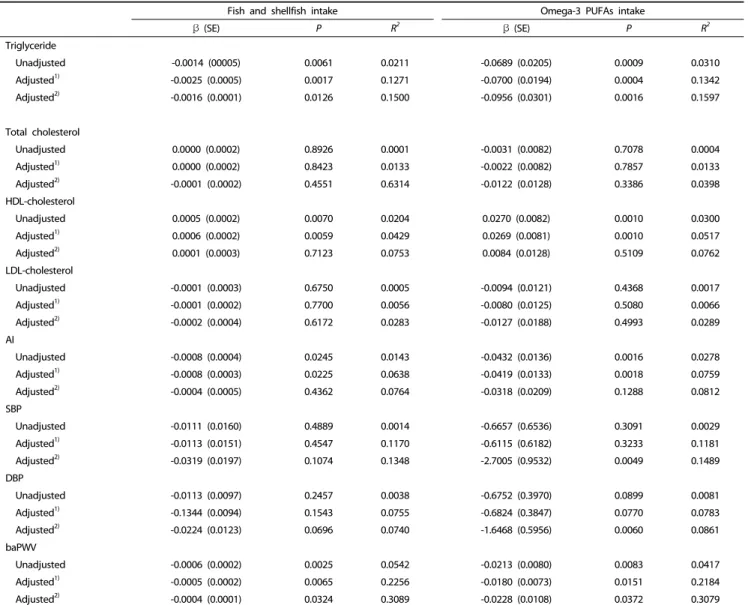
In a multiple regression analysis, significant association between fish and shellfish, and omega-3 PUFAs intakes and CVD risk factors was found after the adjustment for confounding factors (Table 3). The fish and shellfish intake of the subjects was negatively associated with triglyceride (P = 0.0126) and baPWV (P = 0.0324). Similar results were also observed in the Omega-3 PUFAs intake. Omega-3 PUFAs intake was negatively associated with triglyceride (P = 0.0016), SBP (P = 0.0049), DBP (P = 0.0060), and baPWV (P = 0.0372).
The multiple logistic regression analysis (Table 4) with covariates showed a significant inverse relationship between the omega-3 PUFAs consumption and prevalence of hypertrig- lyceridemia [OR (95% CI) for the greater than the median compared to the less than the median: 0.395 (0.207-0.753)].
DISCUSSION
The intake of fish and shellfish was found to be negatively associated with plasma triglyceride levels and PWV in the middle-aged female patients with T2D. The omega-3 PUFAs intake was negatively associated with plasma triglyceride levels, SBP, DBP, and PWV. The women whose intakes of omega-3 PUFAs were greater than the median were at lower risk for hypertriglyceridemia than those with intakes less than the median.
The results of this study indicate an inverse association between fish and shellfish, and omega-3 PUFAs intake and dyslipidemia reported among the healthy non-T2D subjects in several countries by other investigators [24,25]. Dewailly et al.
[24] showed that the concentrations of EPA and DHA in plasma
phospholipids were reflected by fish consumption (average fish
intake = 95 g/wk), and EPA was positively associated to the
plasma HDL-cholesterol concentration. Another cross-sectional
study by Okud et al. [25] revealed that Japanese women with
a higher intake of fish products than their Hawaiian counterpart
had lower serum TG levels and similar HDL-cholesterol levels
Fish and shellfish intake Omega-3 PUFAs intake
β (SE) P R2 β (SE) P R2
Triglyceride
Unadjusted -0.0014 (00005) 0.0061 0.0211 -0.0689 (0.0205) 0.0009 0.0310
Adjusted1) -0.0025 (0.0005) 0.0017 0.1271 -0.0700 (0.0194) 0.0004 0.1342
Adjusted2) -0.0016 (0.0001) 0.0126 0.1500 -0.0956 (0.0301) 0.0016 0.1597
Total cholesterol
Unadjusted 0.0000 (0.0002) 0.8926 0.0001 -0.0031 (0.0082) 0.7078 0.0004
Adjusted1) 0.0000 (0.0002) 0.8423 0.0133 -0.0022 (0.0082) 0.7857 0.0133
Adjusted2) -0.0001 (0.0002) 0.4551 0.6314 -0.0122 (0.0128) 0.3386 0.0398
HDL-cholesterol
Unadjusted 0.0005 (0.0002) 0.0070 0.0204 0.0270 (0.0082) 0.0010 0.0300
Adjusted1) 0.0006 (0.0002) 0.0059 0.0429 0.0269 (0.0081) 0.0010 0.0517
Adjusted2) 0.0001 (0.0003) 0.7123 0.0753 0.0084 (0.0128) 0.5109 0.0762
LDL-cholesterol
Unadjusted -0.0001 (0.0003) 0.6750 0.0005 -0.0094 (0.0121) 0.4368 0.0017
Adjusted1) -0.0001 (0.0002) 0.7700 0.0056 -0.0080 (0.0125) 0.5080 0.0066
Adjusted2) -0.0002 (0.0004) 0.6172 0.0283 -0.0127 (0.0188) 0.4993 0.0289
AI
Unadjusted -0.0008 (0.0004) 0.0245 0.0143 -0.0432 (0.0136) 0.0016 0.0278
Adjusted1) -0.0008 (0.0003) 0.0225 0.0638 -0.0419 (0.0133) 0.0018 0.0759
Adjusted2) -0.0004 (0.0005) 0.4362 0.0764 -0.0318 (0.0209) 0.1288 0.0812
SBP
Unadjusted -0.0111 (0.0160) 0.4889 0.0014 -0.6657 (0.6536) 0.3091 0.0029
Adjusted1) -0.0113 (0.0151) 0.4547 0.1170 -0.6115 (0.6182) 0.3233 0.1181
Adjusted2) -0.0319 (0.0197) 0.1074 0.1348 -2.7005 (0.9532) 0.0049 0.1489
DBP
Unadjusted -0.0113 (0.0097) 0.2457 0.0038 -0.6752 (0.3970) 0.0899 0.0081
Adjusted1) -0.1344 (0.0094) 0.1543 0.0755 -0.6824 (0.3847) 0.0770 0.0783
Adjusted2) -0.0224 (0.0123) 0.0696 0.0740 -1.6468 (0.5956) 0.0060 0.0861
baPWV
Unadjusted -0.0006 (0.0002) 0.0025 0.0542 -0.0213 (0.0080) 0.0083 0.0417
Adjusted1) -0.0005 (0.0002) 0.0065 0.2256 -0.0180 (0.0073) 0.0151 0.2184
Adjusted2) -0.0004 (0.0001) 0.0324 0.3089 -0.0228 (0.0108) 0.0372 0.3079
From multiple regression analysisof log transformed CVD risk factors
Abbreviations: PUFAs, polyunsaturated fatty acids; CVD, cardiovascular disease; HDL-cholesterol, high density lipoprotein cholesterol; LDL-cholesterol, low density lipoprotein cholesterol; AI, atherogenic index; SBP, systolic blood pressure; DBP, diastolic blood pressure; baPWV, brachial-ankle pulse wave velocity
1)Adjusted for age, and BMI
2)Adjusted for age, BMI, duration of diagnosed T2D, alcohol consumption, fiber intake, sodium intake, and total energy intake
Table 3. Coefficients from multiple regression analysis between fish and shellfish, and omega-3 PUFAs intakes and CVD risk factors (n = 356)
Fish and shellfish intake Omega-3 PUFAs intake
Below the median Above the median Below the median Above the median
Median intake (g/d) 28.5 (0.7-48.3) 99.0 (48.6-498.8) 0.77 (0.02-1.2) 2.53 (1.2-13.6)
OR (95% CI) for triglyceride ≥ 150 mg/dl
Unadjusted 1 (ref) 0.688 (0.443-1.067) 1 (ref) 0.507 (0.325-0.791)
Adjusted1) 1 (ref) 0.626 (0.392-1.000) 1 (ref) 0.467 (0.292-0.746)
Adjusted2) 1 (ref) 0.621 (0.343-1.127) 1 (ref) 0.395 (0.207-0.753)
OR (95% CI) for HDL-cholesterol < 40 mg/dl
Unadjusted 1 (ref) 0.950 (0.509-1.776) 1 (ref) 0.775 (0.413-1.453)
Adjusted1) 1 (ref) 1.029 (0.543-1.948) 1 (ref) 0.783 (0.415-1.476)
Adjusted2) 1 (ref) 1.164 (0.524-2.583) 1 (ref) 0.859 (0.367-2.012)
OR (95% CI) for AI > 2.87 (median)
Unadjusted 1 (ref) 0.854 (0.564-1.295) 1 (ref) 0.651 (0.429-0.989)
Table 4. Odds ratio (OR) and 95% confidence interval (CI) of CVD risk factors according to the intakes of fish and shellfish, and omega-3 PUFAs (n = 356)
Fish and shellfish intake Omega-3 PUFAs intake
Below the median Above the median Below the median Above the median
Adjusted1) 1 (ref) 0.885 (0.577-1.356) 1 (ref) 0.659 (0.432-1.006)
Adjusted2) 1 (ref) 1.091 (0.644-1.848) 1 (ref) 0.756 (0.433-1.320)
OR (95% CI) for SBP ≥ 140 mmHg
Unadjusted 1 (ref) 1.156 (0.751-1.777) 1 (ref) 1.156 (0.751-1.777)
Adjusted1) 1 (ref) 1.188 (0.756-1.867) 1 (ref) 1.165 (0.745-1.821)
Adjusted2) 1 (ref) 0.892 (0.508-1.566) 1 (ref) 0.744 (0.408-1.357)
OR (95% CI) for DBP ≥ 90 mmHg
Unadjusted 1 (ref) 0.895 (0.563-1.421) 1 (ref) 0.715 (0.449-1.139)
Adjusted1) 1 (ref) 0.834 (0.516-1.346) 1 (ref) 0.691 (0.429-1.111)
Adjusted2) 1 (ref) 0.787 (0.435-1.423) 1 (ref) 0.520 (0.274-0.988)
OR (95% CI) for baPWV > 1532.5 cm/sec (median)
Unadjusted 1 (ref) 0.604 (0.368-0.993) 1 (ref) 0.883 (0.541-1.441)
Adjusted1) 1 (ref) 0.705 (0.422-1.179) 1 (ref) 0.928 (0.560-1.537)
Adjusted2) 1 (ref) 0.749 (0.402-1.395) 1 (ref) 1.146 (0.596-2.204)
Abbreviations: PUFAs, polyunsaturated fatty acids; CVD, cardiovascular disease; HDL-cholesterol, high density lipoprotein cholesterol; AI, atherogenic index; SBP, systolic blood pressure; DBP, diastolic blood pressure; baPWV, brachial-ankle pulse wave velocity
1)Adjusted for age, and BMI
2)Adjusted for age, BMI, duration of diagnosed T2D, alcohol consumption, fiber intake, sodium intake, and total energy intake Table 4. continued
than the Hawaiian women. In Iranian female adults without T2D (average fish intake = 14.4 g/d), the adjusted ORs for hypertri- glyceridemia and low HDL-cholesterol were lower in the 3
rdtertile than the 1
sttertile of fish intake [26].
Although the cross-sectional study data on the fish oil consumption and lipid profiles among the T2D subjects are limited, several randomized-controlled studies revealed that the fish oil supplementation improve lipid profiles in the T2D subjects in several western countries [5,27-30]. After consuming 8 g of daily omega-3 PUFAs supplementation for eight weeks, the serum TG level showed a consistent decrease of 42% among the US patients with T2D [27]. The plasma TG concentration decreased after the consumption of fish oil supplement for six months in the T2D patients in Italy and Australia [28].
The possible mechanisms of protective CVD by fish and shellfish and omega-3 PUFAs intake are as follows. Omega-3 PUFAs in the fish is known to decrease the serum TG concen- tration by accelerating chylomicron TG clearance [12,31]. EPA and DHA supplementations lower the half-lives and particle size of chylomicron TG and enhance preheparin lipoprotein lipase activities [32]. Omega-3 PUFAs (EPA) are also known to inhibit hepatic synthesis of TG by decreasing the diacylglycerol acyltransferase [33]. Further, various studies showed convincing evidences that EPA and DHA lower the synthesis of hepatic very-low-density-cholesterol (VLDL) and TG and promote the TG clearance from chylomicrons and VLDL particles [12-16].
Hypertension is widely known as an important CVD risk factor.
The intake of omega-3 PUFAs was negatively associated to SBP and DBP, confirming the results of the earlier studies by other investigators [24,34]. Although the study subjects were non- T2D, increased consumption of omega-3 PUFAs was associated with decreased SBP [34], and EPA and DHA were inversely associated to SBP and DHA, respectively [24]. For T2D [35] and hypertensive subjects [36,37], several randomized- controlled studies reported a reduction in the SBP and DBP with the omega-3 PUFAs fish oil supplementation. Omega-3 PUFAs
stimulate the release of nitric oxide (NO), ADP, and vasoactive prostanoids such as thromboxane A2 and prostacyclin I2, and possibly an endothelium-derived hyperpolarizing factor; all of which play a significant role in endothelial dysfunction and blood pressure [38,39]. They are often incorporated into the plasma and cellular membranes, leading to physiochemical changes in the membrane structure associated with less reactive platelets and a decreased response to hormones that increase blood pressure [39-41].
In our study, intakes of fish and shellfish and omega-3 PUFAs were negatively associated with PWV. Similar results showing a benefit of high fish or omega-3 PUFA consumption on PWV have been reported by other investigators, though the subjects were non-T2D. A cross-sectional study on Japanese women indicated that the PWV of the aorta was significantly slower in fishing villages than in the farming villages where people usually eat less fish [42]. The serum levels of total marine omega-3 PUFAs, EPA, and DHA were higher in the Korean middle-aged men than in the Caucasians and Japanese American counterparts, and that total marine omega-3 PUFAs had a significant inverse association with carotid-femoral PWV in Korean men only [43]. Among the Japanese patients with a CVD risk factor, a fish-based diet (> 1.0 g/d omega-3 PUFAs derived from fish) was effective against increased baPWV only in the patients with a low CVD risk [44].
There are several possible mechanisms in which omega-3 PUFAs from fish and shellfish protect against aortic stiffness.
It is widely known that stiffer collagen plays a significant role in the formation of aortic stiffness along with the degradation of elastin fibers [45], whereas healthy collagen production is associated with the preservation of the structure of the aorta.
Omega-3 PUFAs have been linked to the nuclear factor-kappa-B
pathway, ultimately leading to the stimulation of healthy
collagen production [46]. Further, aortic calcification is known
to be associated with aortic stiffness [47]. Omega-3 PUFAs
directly inhibit vascular calcification by activating the p-38-
mitogen-activated-protein kinase and peroxisome proliferator- activated receptor-γ pathway [48].
Our study has the following limitations. The cross-sectional study design mades it impossible to determine whether the intake of fish and shellfish, and omega-3 PUFAs is a cause or consequence of the improvement of CVD risk factors. The recall bias in the FFQ may have affected the dietary assessment, although the FFQ is a more powerful method for assessing a typical intake than other dietary assessment methods. Moreover, FFQ is limited to analyze the accurate omega-3 PUFAs content, depending on the species of fish and shellfish. Finally, although menopausal status has an association with CVD risk factor, this study did not apply the effect of menopause because of the cause of deficient menopause information. However, this disadvantage is likely to be reduced because ~16% of the subjects were younger than 49 years (the mean age at menopause in Korea [49]). Despite these limitations, to the best of our knowledge, this is the first study investigating the relationship of fish and omega-3 PUFAs intake and CVD risk factor in the Korean female patients with T2D. The results of this study may be helpful for the female patients with T2D with a need to lower their blood pressure and PWV including serum lipid levels to prevent diabetic CVD complications.
In conclusion, the intake of fish and shellfish, and omega-3 PUFAs among the middle-aged Korean female patients with T2D may be protective against CVD risk factors. Therefore, a moderately high intake of fish and shellfish should be recommended for the middle-aged Korean females with T2D to prevent CVD, which are serious diabetic complications.
REFERENCES
1. Ministry of Health and Welfare, Korea Centers for Disease Control and Prevention. Korea Health Statistics 2010: Korea National Health and Nutrition Examination Survey (KNHANES V-1). Cheongwon:
Korea Centers for Disease Control and Prevention; 2011.
2. Statistics Korea. Annual Report on the Cause of Death Statistics.
Daejeon: Statistics Korea; 2012.
3. Huxley R, Barzi F, Woodward M. Excess risk of fatal coronary heart disease associated with diabetes in men and women: meta-analysis of 37 prospective cohort studies. BMJ 2006;332:73-8.
4. Kim HK, Kim CH, Kim EH, Bae SJ, Choe J, Park JY, Park SW, Yun YD, Baek SJ, Mok Y, Jee SH. Impaired fasting glucose and risk of cardiovascular disease in Korean men and women: the Korean Heart Study. Diabetes Care 2013;36:328-35.
5. Zhang J, Wang C, Li L, Man Q, Meng L, Song P, Frøyland L, Du ZY. Dietary inclusion of salmon, herring and pompano as oily fish reduces CVD risk markers in dyslipidaemic middle-aged and elderly Chinese women. Br J Nutr 2012;108:1455-65.
6. Mozaffarian D, Rimm EB. Fish intake, contaminants, and human health: evaluating the risks and the benefits. JAMA 2006;296:
1885-99.
7. Saravanan P, Davidson NC, Schmidt EB, Calder PC. Cardiovascular effects of marine omega-3 fatty acids. Lancet 2010;376:540-50.
8. Siscovick DS, Raghunathan T, King I, Weinmann S, Bovbjerg VE, Kushi L, Cobb LA, Copass MK, Psaty BM, Lemaitre R, Retzlaff B, Knopp RH. Dietary intake of long-chain n-3 polyunsaturated fatty acids and the risk of primary cardiac arrest. Am J Clin Nutr
2000;71:208S-212S.
9. Mizushima S, Moriguchi EH, Ishikawa P, Hekman P, Nara Y, Mimura G, Moriguchi Y, Yamori Y. Fish intake and cardiovascular risk among middle-aged Japanese in Japan and Brazil. J Cardiovasc Risk 1997;4:191-9.
10. Iso H, Kobayashi M, Ishihara J, Sasaki S, Okada K, Kita Y, Kokubo Y, Tsugane S; JPHC Study Group. Intake of fish and n3 fatty acids and risk of coronary heart disease among Japanese: the Japan Public Health Center-Based (JPHC) Study Cohort I. Circulation 2006;
113:195-202.
11. Hu FB, Cho E, Rexrode KM, Albert CM, Manson JE. Fish and long-chain omega-3 fatty acid intake and risk of coronary heart disease and total mortality in diabetic women. Circulation 2003;107:
1852-7.
12. Moore CS, Bryant SP, Mishra GD, Krebs JD, Browning LM, Miller GJ, Jebb SA. Oily fish reduces plasma triacylglycerols: a primary prevention study in overweight men and women. Nutrition 2006;22:
1012-24.
13. Kris-Etherton PM, Harris WS, Appel LJ; American Heart Association.
Nutrition Committee. Fish consumption, fish oil, omega-3 fatty acids, and cardiovascular disease. Circulation 2002;106:2747-57.
14. Harris WS, Miller M, Tighe AP, Davidson MH, Schaefer EJ. Omega-3 fatty acids and coronary heart disease risk: clinical and mechanistic perspectives. Atherosclerosis 2008;197:12-24.
15. Harris WS, Ginsberg HN, Arunakul N, Shachter NS, Windsor SL, Adams M, Berglund L, Osmundsen K. Safety and efficacy of Omacor in severe hypertriglyceridemia. J Cardiovasc Risk 1997;4:385-91.
16. Maas AH, Franke HR. Women's health in menopause with a focus on hypertension. Neth Heart J 2009;17:68-72.
17. Friedewald WT, Levy RI, Fredrickson DS. Estimation of the concent- ration of low-density lipoprotein cholesterol in plasma, without use of the preparative ultracentrifuge. Clin Chem 1972;18:499-502.
18. Lauer RM, Lee J, Clarke WR. Factors affecting the relationship between childhood and adult cholesterol levels: the Muscatine Study. Pediatrics 1988;82:309-18.
19. Yamashina A, Tomiyama H, Takeda K, Tsuda H, Arai T, Hirose K, Koji Y, Hori S, Yamamoto Y. Validity, reproducibility, and clinical significance of noninvasive brachial-ankle pulse wave velocity measurement. Hypertens Res 2002;25:359-64.
20. Oh SY, Kim EM, Shin MH, Lee SH, Kim JE, Lee HS, Jo JS, Kim WY.
Development and validation of food frequency questionnaire for adults. Proceedings of the Korean Society of Health Promotion Annual Spring Conference; 2007 May 19; Seoul. Seoul: Korean Society of Health Promotion; 2007.
21. The Korean Nutrition Society. Nutritional assessment program 'CAN-Pro 4.0' [CD-ROM]. Seoul: The Korean Nutrition Society; 2011.
22. United State Department of Agriculture, Agricultural Research Service. USDA National Nutrient Database for Standard Reference, Release 26 [Internet]. Washington, D.C.: Agricultural Research Service; 2013. Available from: http://www.ars.usda.gov/Services/
docs.htm?docid=24936.
23. National Fisheries Research & Development Institute (KR). Fatty acid composition of fisheries products in Korea. Busan: National Fisheries Research & Development Institute; 2012.
24. Dewailly E E, Blanchet C, Gingras S, Lemieux S, Sauvé L, Bergeron J, Holub BJ. Relations between n-3 fatty acid status and cardiova- scular disease risk factors among Quebecers. Am J Clin Nutr 2001;74:603-11.
25. Okuda N, Ueshima H, Okayama A, Saitoh S, Nakagawa H, Rodriguez BL, Sakata K, Choudhury SR, Curb JD, Stamler J; INTERLIPID Research Group. Relation of long chain n-3 polyunsaturated fatty acid intake to serum high density lipoprotein cholesterol among Japanese men in Japan and Japanese-American men in Hawaii: the INTERLIPID study. Atherosclerosis 2005;178:371-9.
26. Friday KE, Childs MT, Tsunehara CH, Fujimoto WY, Bierman EL, Ensinck JW. Elevated plasma glucose and lowered triglyceride levels from omega-3 fatty acid supplementation in type II diabetes.
Diabetes Care 1989;12:276-81.
27. Rivellese AA, Maffettone A, Iovine C, Di Marino L, Annuzzi G, Mancini M, Riccardi G. Long-term effects of fish oil on insulin resistance and plasma lipoproteins in NIDDM patients with hypertriglyceri- demia. Diabetes Care 1996;19:1207-13.
28. Woodman RJ, Mori TA, Burke V, Puddey IB, Watts GF, Beilin LJ.
Effects of purified eicosapentaenoic and docosahexaenoic acids on glycemic control, blood pressure, and serum lipids in type 2 diabetic patients with treated hypertension. Am J Clin Nutr 2002;76:1007-15.
29. Lankinen M, Kolehmainen M, Jääskeläinen T, Paananen J, Joukamo L, Kangas AJ, Soininen P, Poutanen K, Mykkänen H, Gylling H, Orešič M, Jauhiainen M, Ala-Korpela M, Uusitupa M, Schwab U. Effects of whole grain, fish and bilberries on serum metabolic profile and lipid transfer protein activities: a randomized trial (Sysdimet). PLoS One 2014;9:e90352.
30. Nilsen DW, Albrektsen G, Landmark K, Moen S, Aarsland T, Woie L. Effects of a high-dose concentrate of n-3 fatty acids or corn oil introduced early after an acute myocardial infarction on serum triacylglycerol and HDL cholesterol. Am J Clin Nutr 2001;74:50-6.
31. Harris WS. n-3 fatty acids and serum lipoproteins: human studies.
Am J Clin Nutr 1997;65:1645S-1654S.
32. Park Y, Harris WS. Omega-3 fatty acid supplementation accelerates chylomicron triglyceride clearance. J Lipid Res 2003;44:455-63.
33. Rustan AC, Nossen JO, Christiansen EN, Drevon CA. Eicosapen- taenoic acid reduces hepatic synthesis and secretion of triacylgl- ycerol by decreasing the activity of acyl-coenzyme A:1,2-diacylglycerol acyltransferase. J Lipid Res 1988;29:1417-26.
34. Morris MC, Sacks F, Rosner B. Does fish oil lower blood pressure?
A meta-analysis of controlled trials. Circulation 1993;88:523-33.
35. Kasim SE, Stern B, Khilnani S, McLin P, Baciorowski S, Jen KL. Effects of omega-3 fish oils on lipid metabolism, glycemic control, and blood pressure in type II diabetic patients. J Clin Endocrinol Metab 1988;67:1-5.
36. Margolin G, Huster G, Glueck CJ, Speirs J, Vandegrift J, Illig E, Wu J, Streicher P, Tracy T. Blood pressure lowering in elderly subjects:
a double-blind crossover study of omega-3 and omega-6 fatty acids.
Am J Clin Nutr 1991;53:562-72.
37. Bønaa KH, Bjerve KS, Straume B, Gram IT, Thelle D. Effect of eicosapentaenoic and docosahexaenoic acids on blood pressure in
hypertension. A population-based intervention trial from the Tromsø study. N Engl J Med 1990;322:795-801.
38. Needleman P, Raz A, Minkes MS, Ferrendelli JA, Sprecher H. Triene prostaglandins: prostacyclin and thromboxane biosynthesis and unique biological properties. Proc Natl Acad Sci U S A 1979;76:944-8.
39. Yin K, Chu ZM, Beilin LJ. Blood pressure and vascular reactivity changes in spontaneously hypertensive rats fed fish oil. Br J Pharmacol 1991;102:991-7.
40. Hashimoto M, Hossain S, Yamasaki H, Yazawa K, Masumura S. Effects of eicosapentaenoic acid and docosahexaenoic acid on plasma membrane fluidity of aortic endothelial cells. Lipids 1999;34:
1297-304.
41. Lund EK, Harvey LJ, Ladha S, Clark DC, Johnson IT. Effects of dietary fish oil supplementation on the phospholipid composition and fluidity of cell membranes from human volunteers. Ann Nutr Metab 1999;43:290-300.
42. Hamazaki T, Urakaze M, Sawazaki S, Yamazaki K, Taki H, Yano S.
Comparison of pulse wave velocity of the aorta between inhabi- tants of fishing and farming villages in Japan. Atherosclerosis 1988;73:157-60.
43. Sekikawa A, Shin C, Masaki KH, Barinas-Mitchell EJ, Hirooka N, Willcox BJ, Choo J, White J, Evans RW, Fujiyoshi A, Okamura T, Miura K, Muldoon MF, Ueshima H, Kuller LH, Sutton-Tyrrell K; ERA JUMP Study Group. Association of total marine fatty acids, eicosapen- taenoic and docosahexaenoic acids, with aortic stiffness in Koreans, Whites, and Japanese Americans. Am J Hypertens 2013;26:1321-7.
44. Fukuoka Y, Nuruki N, Amiya S, Tofuku K, Aosaki S, Tsubouchi H.
Effects of a fish-based diet and administration of pure eicosapen- taenoic acid on brachial-ankle pulse wave velocity in patients with cardiovascular risk factors. J Cardiol 2014;63:211-7.
45. Payne RA, Wilkinson IB, Webb DJ. Arterial stiffness and hypertension:
emerging concepts. Hypertension 2010;55:9-14.
46. Jia Y, Turek JJ. Altered NF-kappaB gene expression and collagen formation induced by polyunsaturated fatty acids. J Nutr Biochem 2005;16:500-6.
47. McEniery CM, McDonnell BJ, So A, Aitken S, Bolton CE, Munnery M, Hickson SS, Yasmin, Maki-Petaja KM, Cockcroft JR, Dixon AK, Wilkinson IB; Anglo-Cardiff Collaboration Trial Investigators. Aortic calcification is associated with aortic stiffness and isolated systolic hypertension in healthy individuals. Hypertension 2009;53:524-31.
48. Abedin M, Lim J, Tang TB, Park D, Demer LL, Tintut Y. N-3 fatty acids inhibit vascular calcification via the p38-mitogen-activated protein kinase and peroxisome proliferator-activated receptor- gamma pathways. Circ Res 2006;98:727-9.
49. Health Insurance Review & Assessment Service; National Health Insurance Service. National Health Insurance Statistical Yearbook 2011. Seoul: National Health Insurance Service; 2012.