서 론 .
Ⅰ
감각통합은 자신의 신체와 환경으로부터 주어지는
감각들을 조직화하고 그 환경 속에서 신체를 효과적, 으로 사용할 수 있도록 하는 신경학적 과정(neurologi-
이다 중추신경계 기능의 문제
cal process) (Ayres, 1989).
이 연구는2009년도 대한감각통합치료학회 연구 지원에 의해 이루어졌음. 교신저자 김경미: (E-mail: [email protected])
접수일: 2009.11.24 /심사일: (1 : 2009.12.09 / 2 : 2009.12.18) /차 차 게재확정일: 2009.12.19
감각통합중재 효과에 관한 체계적 고찰
김경미*
인제대학교 의생명공학대학 작업치료학과
*
목 적 감각통합중재의 효과에 대한 체계적인 고찰을 통하여 감각통합중재의 객관적인 근거기반을 제시하 기 위하여 감각통합중재가 어떤 효과가 있는지 알아보고 중재 결과 측정에 사용된 평가도구에 관, 하여 알아보고자 한다.
연구방법
연구방법으로 체계적 고찰을 사용하였다 사용된 데이터베이스는. MEDLINE/PubMed, PsycINFO, 이었고 검색어는
CINAHL, Cochrane Library, OTSeeker , “effects of sensory integration”,
“sensory integration therapy”와 “sensory integration intervention”이었다 최종적으로 분석. 에 사용된 논문은 개로 근거의 질적 수준은 수준 과 수준11 , Ⅰ Ⅱ Ⅳ, 이었다 분석내용으로는 감각. 통합중재의 대상군과 중재방법 중재결과 측정 영역에 따라 중재결과를 측정하는 도구 및 중재효, 과를 분석하였다.
결 과
1. 감각통합중재 대상으로는 자폐스펙트럼장애가 30.7%로 가장 많았으며 전반적발달장애와 조산, 아가 각각 15.4%이었다.
2. 감각통합중재 방법으로는 J. Ayres에 의해 제시된 전통적인 방법이 36.4%로 가장 많이 사용 되었고 감각통합 중재의 효과를 알아보기 위하여 사용된 결과측정 영역은 행동의 문제를 해결, 하기 위한 영역이 40.63%로 가장 많았으며 운동수행결과를 보기 위한 것이, 28.13%, 감각기 초 결과를 보기 위한 것이 25.0%이었다.
3. 감각통합중재 효과는 운동수행기술의 중재결과(66.7%)가 가장 많았으며 그 다음으로는 감각기, 초를 위한 중재결과가 62.5%, 그리고 행동 문제 해결에 효과적인 경우가 61.5% 순으로 분석 되었다 학습과 관련하여 쓰기기술에는 효과적이지 않은 것으로 나타났다. .
결 론
감각통합중재는 운동수행기술과 감각기초능력 향상 그리고 행동문제의 해결에 도움을 제공할 수, 있는 치료적 접근방법이었으나 학습에 관하여는 효과적이지 않았다 앞으로 감각통합중재의 일차. 적인 효과가 지속되어학습이나 일상생활에까지 영향을 미칠 수 있는가에 대한 연구문제를 가지고 연구방법 및 평가도구 중재방법 등에 관한 연구가 필요할 것으로 생각된다, .
주제어 감각통합 감각통합중재의 효과 근거기초 임상 체계적 고찰, , ,
는 발달과정에서 감각들이 충분히 입력되고 통합되는 것을 방해한다 이러한 문제는 아동의 운동수행 행동. , , 자아조절 사회성 발달에 어려움을 가지게 하며 그, , 결과 놀이 일상생활활동 및 학습 능력에 영향을 미친, 다(Ayres, 1979). 그러므로 감각통합장애의 초기 증상 을 발견하여 증상을 완화시켜 줌으로써 아동의 작업, 수행 발달에 필요한 기초를 마련하는 것은 중요하다 (Roley, Blanche, & Schaaf, 2001).
감각통합중재는 아동중심의 활동과 놀이 치료적, , 환경 내에서 조절된 감각경험들을 제공해 주는 것이 다(Bundy, Lane, & Murray, 2002). 중재결과 일상생활 활동 놀이 학습과 같은 생활기술과 사회적 참여의, , 향상에 있어 기초가 되는 감각처리와 실행능력의 촉 진을 가져올 수 있다(Parham & Mailloux, 1996).
학습장애 과잉행동집중력장애 자폐증 그리고 감, , , 각처리와 조직화의 문제로 인한 행동의 문제를 가진 아동들이 점차적으로 증가하고 있다 이러한 아동들. 은 생활에서 기능적인 어려움을 가지고 있어 치료적 인 중재가 절실히 필요하다 그러나 이러한 문제들을. 해결하기 위한 다양한 중재방법들 가운데 효과적인 방법을 찾기는 쉽지 않다. Parham 등(2007)은 감각통 합 중재 결과 50%가량은 긍정적인 효과가 있었다고 보고하였다 그러나. 1972년 이후 감각통합의 효과를 검정하기 위해 수행된 개의 연구를 분석한 결과 감27 각통합 중재효과에 대한 근거를 제시하기에는 부족함 이 있었다 그 이유는 대부분의 연구에서 근거수준이. 낮았으며 의도되지 않은 모집단을 중재의 대상으로, 하였거나 중재 및 결과 측정방법이 감각통합 치료적, 원리와 일치하지 않았다(May-Benson & Koomar, 2009).
근거는 클라이언트의 가치와 우선순위를 결정하는 것뿐 아니라 중재 목표와 작업수행의 관점에서 가치 있는 중재결과를 이끄는데 중요하며 치료사들의 임, 상적 의사결정에 도움을 제공한다(Lee & Miller, 2003;
임상에서 근거를 중심으로 감각통합치료 Yano, 2008).
를 하는 것은 그 결과를 객관적으로 제시할 수 있으 며 감각통합치료분야의 질적인 발전을 가져오는데, 밑거름이 된다.
감각통합중재 효과를 제시하기 위하여 사용된 연구 방법으로는 단일그룹 전후 연구(Quasi-experimental 와 같이 중재 전후의 차이 one group pre and post test)
를 비교하는 방법과 단일대상 사례연구(Single Subject 가 가장 많이 사용되었다
Design) .
감각통합에서 근거를 제시하기 위해서는 실험연구 와 같은 잘 준비된 연구디자 (Randomized Control Trial)
인을 통해 보다 높은 수준의 근거를 제시하는 것이 필 요하다 그러나 사람을 대상으로 연구하는데 있어 많. 은 제한이 있으며 윤리적인 측면에서도 문제가 야기, 될 수 있다 현재 근거를 제시하기 위해 가장 많이 사. 용되고 있는 방법으로는 연구된 문헌을 대상으로 체 계적 고찰을 통하여 임상적 질문에 답을 제시하는 것 이다(Barras, 2005),
본 연구는 감각통합중재를 통해 제시된 결과와 그 내용들에 대한 체계적인 고찰을 통하여 감각통합중재 의 객관적인 근거기반을 제시하고자 하였다 구체적. 으로 감각통합 중재가 어떤 영역에 효과가 있는지 알 아보고 중재 결과를 측정하기 위해 사용된 평가도구, 에 관하여 알아보고자 하였다.
연구방법 .
Ⅱ
연구대상 1.
검색에 사용된 데이터베이스는 MEDLINE/PubMed, 이었다 PsycINFO, CINAHL, Cochrane Library, OTSeeker .
대상논문의 범위는2000년 월부터1 2009년 월까지8 로 하였다 포함조건은 중재를 다른 그룹과 비교한. 의 경우 감각통합중재를 사용한 경우
controlled trial , ,
대상 아동이 세 이하의 아동에 해당하는 경우 전문12 , 가 집단에 의해 검토된 경우 작업치료 임상에서 제시, 된 중재 논문의 전문을 얻을 수 있는 경우 영어로 쓰, , 여 진 경우로 하였다 컨퍼런스 또는 프리젠테이션 논. 문 학위논문 작업치료 분야 밖의 논문 성인을 대상, , , 으로 중재한 논문 사례보고와 체계적 고찰은 배제 하, 였다.
검색어는 “effects of sensory integration”, “sensory in-
와 으
tegration therapy”, “sensory integration intervention”
로 하였다 검색과정은 각 데이터베이스에서. advanced 를 통해 검색어와 년도 대상연령 영어로 쓰여
search , ,
진 논문 연구논문 사람을 대상으로 한 논문을 검색, , 하여 30개의 논문이 검색되었다 그 후. Citation과 를 검토하여 기타 포함조건과 배제조건의 논 Abstract
문을 분석하여 14개의 논문이 연구주제에 적합하게 포함되었다 논문의 전문은 차적으로 인제대학교 도. 1
서관, Virginia Commonwealth University 도서관,
도서관의 을 사용하여
University of Virginia e-journal
찾았으며 차적으로, 2 google academy 검색엔진을 사용 하여 찾았다. 14개의 논문 중 개의 논문은 전문을 찾3 지 못하여 분석에서 제외되었으며 최종적으로, 11개 의 논문이 분석되었다 표( 1). 전문을 찾지 못한 개의3 논문 중 개는 중국저널2 (Zhongguo Linchuang Kangfu) 이었으며, 1개는 이란저널(Iranian Journal of Child
이었다 Neurology) .
Published
year Authors Study title Level of
evidence 2009 Vaivre-Douret L, Oriot D, Blossier P,
Py, A, Kasolter-Para M, Zwang J.
The effect of multimodal stimulation and cutaneous application of vegetable oils on neonatal development in preterm infants: A randomized controlled trial.
Ⅰ
2008 Fazlioglu Y, Baran G A sensory integration therapy program on sensory problems for children with autism
Ⅰ
2007 Roberts JE, King-Thomas L,Boccia ML
Behavioral indexes of the efficacy of sensory integration therapy
Ⅳ
2007 Watling RL; Dietz J Immediate effect of Ayre's sensory integration-based occupational therapy intervention on children with autism spectrum disorders
Ⅳ
2007 Sandler, Allen G.; McLain, Susan C. Use of noncontingent tactile and vestibular stimulation in the treatment of self-injury: An interdisciplinary study
Ⅳ
2006 Jung KE, Lee HJ, Lee YS, Cheong SS, Choi MY, Suh DS, Oah S, Lee SH, Lee JH.
The Application of a Sensory Integration Treatment Based on Virtual Reality-Tangible Interaction for Children with Autistic Spectrum Disorder
Ⅱ
2006 Denton PL, Cope S, Moser C. The effects of sensorimotor-based intervention versus therapeutic practice on improving handwriting performance in 6- to 11-year-old children.
Ⅰ
2005 Smith SA; Press B; Koenig KP;
Kinnealey M
Effects of sensory integration intervention on self-stimulating and self-injurious behaviors
Ⅱ
2004 Kane A, Luiselli JK, Dearborn S, Young N.
Wearing a Weighted Vest as Intervention for Children with Autism/Pervasive Developmental Disorder: Behavioral Assessment of Stereotypy and Attention to Task
Ⅳ
2001 Nelson M, White Traut R, Vasan U, Silvestri J, Comiskey E, Meleedy Rey P, Littau S, Gu G, and Patel M.
One-year outcome of auditory-tactile-visual-vestibular intervention in the neonatal intensive care unit: effects of severe prematurity and central nervous system injury
Ⅰ
2000 Leemrijse C, Meijer OG, Vermeer A, Ad r HJ, Diemel S.è
The efficacy of Le Bon D part and Sensory Integrationé treatment for children with developmental coordination disorder: a randomized study with six single cases
Ⅳ 표 1. 연구 분석 대상논문
연구방법 2.
감각통합중재의 근거를 제시하기 위하여 감각통“ 합장애를 가진 아동들에게 감각통합중재가 무엇에 효 과적인가 라는 연구문제를 가지고 체계적 고찰방법?”
을 사용하였다 작업치료분야와 감각통합치료 분야에. 서 많이 사용되고 있는 데이터베이스를 통해 대상논 문을 검색하였다 사용된 검색어는. “effects of sensory
와
integration”, “sensory integration therapy” “sensory in- 이었다
tegration intervention” .
대상논문은 차적으로 포함기준과 배제기준을 가1 지고 citation과 abstract를 가지고 분석 하였으며 차, 2
적으로 최종 분석대상에 포함된 논문의 전문을 가지 고 연구 근거의 질적 수준과 연구목적에 따라 중재결 과를 운동수행능력 행동 그리고 작업수행으로 나누, , 어 분석하였다.
연구근거의 질적 수준 1)
분석 대상 논문의 연구의 질적 수준을 평가하기 위 하여 Sackett, Rosenberg, Gray, Haynes, & Richardson
의 근거수준 의 내용을 사용
(1986) (Levels of Evidence)
하였다 표( 2). 근거의 질적 수준은11개 중 가장 높은 수준 은 개Ⅰ 4 (36.36%)이었고 수준 는 개, Ⅱ 2 (18.18%), 그리고 수준 가 가장 많은 개Ⅳ 5 (45.46%)이었다.
근거 수준 연구 설계 및 방법 논문 수(%)
Ⅰ 체계적 고찰 메타분석 무작위 임상실험 설계, , (randomized controled trials) 4(36.36)
Ⅱ 두 그룹 비교연구 무작위 임상실험이 아님 예 코호트 환자 대조군 실험 설계, ( ; , - ) 2(18.18)
Ⅲ 단일 그룹 전후비교 연구 무작위 임상실험이 아님 예 중재 전과 중재 후 측정, ( ; ) 0
Ⅳ 결과 분석을 포함한 설명적 연구 예 단일사례연구 사례 시리즈( ; , ) 5(45.46)
Ⅴ 사례보고와 전문가 의견 구술적 문헌연구( ) 0
질적연구(qualitative studies) 0
Total 11(100.00)
표 2. 대상 논문의 근거에 대한 질적 수준
Diagnosis of subject Age N(%)
preterm infants 23-26, 31-34
wks(GA) 2(15.4)
autism spectrum disorders 3-12 yr. 4(30.7)
sensory modulation disorder(SMD) and delayed communication 3 yr. 5 mo. 1(07.7)
handwriting dysfunction 6-11 yr. 1(07.7)
pervasive developmental disorder and/or severe or profound mental retardation 8-19 yr. 2(15.4) central nervous system injury; periventricular leukomalacia, intraventricular hemorrhage 23-32 wks(GA) 1(07.7)
developmental coordination disorder 6-8 yr. 1mo. 1(07.7)
profound mental retardation and cerebral palsy 9 yr. 1(07.7)
Total 13(100.0)
GA: gestational age 표 3. 감각통합중재 대상 진단군
중재 방법 2)
감각통합 중재에 사용된 중재방법 독립변인 은 각( ) 논문에서 제시된 내용을 기준으로 하여 제시하였다
표 ( 4).
중재 결과 측정 영역 및 도구 3)
감각통합중재 영역은 AOTA의 근거기초 문헌연구 과제인Critically Appraised Topics and Papers Series중 감각처리장애 감각통합장애 아동 및 청소년에서 제시/ 한 방법(AOTA, 2009)에 따라 감각기초 운동수행 행, , 동 그리고 학습으로 분류하였다 중재결과, . (outcome) 측정도구는 대상자 선정 또는 진단을 위해 사용된 도 구는 배제 하였으며 감각통합중재 효과를 알아보기, 위하여 사용된 측정 내용 종속변인 과 도구에 대하여( )
사용빈도를 제시하였다 한 논문에 다양한 도구가 사. 용된 경우 모두를 제시하였다 표( 5).
중재 효과 4)
감각통합중재에 따른 결과는 각 영역에서 사용한 평가도구별로Polatajko & Cantin (2006)의 분류기준에 따라 제시하였다 한 도구 내에서 실험군과 대조군의. 차이가 통계학적으로 명확한 경우 SIG(treatment of in- terest yielded significantly better results than contrast
차이가 나타나지 않은 경우
group), NS(no significant 하위영역별 결과가 differences found between groups),
통계적으로 유의미하게 달라 다양한 결과가 나온 경우 결론을 내릴 수 없는 결과 VAR(variable results found),
가 나온 경우INC(inclusive results)로 분류하였다 표( 5).
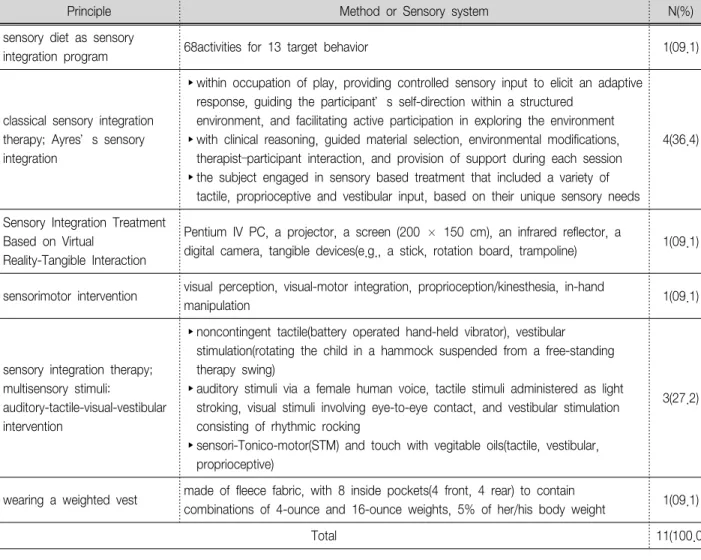
Principle Method or Sensory system N(%)
sensory diet as sensory
integration program 68activities for 13 target behavior 1(09.1)
classical sensory integration therapy; Ayres’s sensory integration
within occupation of play, providing controlled sensory input to elicit an adaptive
▸
response, guiding the participant’s self-direction within a structured environment, and facilitating active participation in exploring the environment with clinical reasoning, guided material selection, environmental modifications,
▸
therapist participant interaction, and provision of support during each session– the subject engaged in sensory based treatment that included a variety of
▸
tactile, proprioceptive and vestibular input, based on their unique sensory needs
4(36.4)
Sensory Integration Treatment Based on Virtual
Reality-Tangible Interaction
Pentium IV PC, a projector, a screen (200 × 150 cm), an infrared reflector, a
digital camera, tangible devices(e.g., a stick, rotation board, trampoline) 1(09.1) sensorimotor intervention visual perception, visual-motor integration, proprioception/kinesthesia, in-hand
manipulation 1(09.1)
sensory integration therapy;
multisensory stimuli:
auditory-tactile-visual-vestibular intervention
noncontingent tactile(battery operated hand-held vibrator), vestibular
▸
stimulation(rotating the child in a hammock suspended from a free-standing therapy swing)
auditory stimuli via a female human voice, tactile stimuli administered as light
▸
stroking, visual stimuli involving eye-to-eye contact, and vestibular stimulation consisting of rhythmic rocking
sensori-Tonico-motor(STM) and touch with vegitable oils(tactile, vestibular,
▸
proprioceptive)
3(27.2)
wearing a weighted vest made of fleece fabric, with 8 inside pockets(4 front, 4 rear) to contain
combinations of 4-ounce and 16-ounce weights, 5% of her/his body weight 1(09.1)
Total 11(100.0)
표 4. 감각통합중재 방법
Outcome area
Outcome
category Outcome measurement tool N(%) Effect of intervention
sensory- based
biological
sample of blood; insulin, glucose measurements
▸ 3
(9.36)
VAR weight gain
▸ NS
linear growth
▸ SIG
physiological
scope from Space Labs Medical, Inc., USA; heart rate, respiratory rate, oxygen saturation (SpO2) and body temperature
1
(3.13) SIG
dermatological electrical conductance 1
(3.13) NS
neurosensori
oculomotor tracking of a target and visual/auditory
▸
orientation of the examiner’s face and verbal
stimulation 2
(6.25) SIG Test of Manual Pointing (TMP) for proprioception
▸ SIG
neurological neurological maturity score 1
(3.13) SIG
subtotal 8
(25.0) 5 (62.5) 2
(25.0) 1 (12.5)
motor performance
neuromotor &
mental development
the revised Bayley Scales of Infant Development 1
(3.13) NS
neuro- psychomotor
neuropsychomotor assessment protocole using behavioral observation
1
(3.13) SIG
sensory motor skill
spontaneous organization of movements
▸
7 (21.87)
SIG Developmental Test of Visual Perception (DTVP-2)
▸ SIG
visual-motor integration
▸ NS
The Movement ABC
▸ SIG
Praxis Tests of the SIPT; the translation of
▸
verbal commands into action, three-dimensional construction, imitating movements and positions
SIG a rhythm test(computer package Rhythm Integrated)
▸ NS
visual analogue scales(concerning the motor
▸
functioning of their child) SIG
subtotal 9
(28.13) 6 (66.7)
3 (33.3) 표 5. 감각통합중재 역에 따른 결과측정을 위한 도구 및 중재효과
behavior
behavioral regulation
The Sensory Evaluation Form for Children with Autism
▸
8 (25.0)
SIG The Sensory Integration Inventory Revised For
▸
Individuals With Developmental Disabilities SIG child’s maladaptive behaviors (throwing, verbal
▸
aggression, physical aggression, touching other children’s materials, mouthing objects)
SIG undesired behavior
▸ NS
self-injurious behavior (SIB); included head hitting,
▸
head banging, and head rubbing SIG
self-stimulating or self-injurious behaviors(repetitive,
▸
frequent, nonfunctional actions, harmful, chewing objects, tapping them on teeth, head banging, repetitious vocal sounds), behavioral observation
SIG behaviors suggestive of sensory needs(tactile,
▸
vestibular, proprioception, and general reactions) SIG
targeted stereotypic behavior NS
adaptability
adaptive behavior(time spent in purposeful
▸
engagement, teacher time spent redirecting his behavior, and intensity of teacher input to manage his
behavior) 2
(6.25) SIG engagement; participant behaviors, videotaped,
▸
observation with data collection forms, the adaptation ability
SIG
attention attention to task; participant engaging in purposeful manipulation of objects
1
(3.13) NS
mother-Infant interaction
Dyadic Mutuality Code; Mother-Infant Interaction
▸
(measure levels of synchrony in infant-adult interaction) 2 (6.25)
NS the Nursing Child Assessment Feeding
▸
Scale(interactional behaviors between infants and parents during the first year)
NS
subtotal 13
(40.63) 8 (61.5)
5 (38.5) academic handwriting
performance
Test of Handwriting Skills
▸ 2
(6.25)
NS in-hand manipulation skill
▸ NS
subtotal 2
(6.25)
2 (100)
total 32
(100) 19 (59.4)
12 (37.5)
1 (3.1) SIG: significantly better results than contrast group
NS: no significant differences found between groups VAR: variable results found
연구결과 .
Ⅲ
감각통합 중재 대상 진단군 1.
감각통합 중재 대상 진단군은 표 과 같다 연구논3 . 문에 제시된 대상군은 모두 제시하였다 하나의 대상. 군으로 연구를 수행한 논문은 개이었고 개의 대상9 , 2 군을 포함한 연구는 개이었다 감각통합중재 대상으2 . 로 가장 많은 진단군은 자폐스펙트럼장애(autism spec-
로 이었으며 그 다음은 조산아
trum disorders) 30.7% , 와 전반적발달장애
(preterm infants) (pervasive devel-
가 각각 를 차지하였다 감각
opmental disorder) 15.4% . 통합중재 대상의 연령군의 범위는 태내 연령 23주부 터 19세까지로 광범위 하였으나 세 세 연령의 범, 3 -12 위가 62.5%로 가장 많았다.
감각통합 중재방법 2.
감각통합중재 방법으로 사용된 내용은 표 와 같다4 . 가장 많이 사용된 감각통합중재 방법으로는 J. Ayres 에 의해 제시된 전통적인 방법으로 조절된 감각을 제 공하여 적응반응을 이끌어내는 것으로 놀이 환경 내 에서 치료사가 역동적으로 아동과 상호작용하며 임, 상적 추론을 사용하는 방법이36.4%(4개 사용되었다) . 그 다음으로는 부분적으로 특정 감각자극을 제공하는 다감각 자극방법이27.3%(3개 사용되었다 그 밖에도) . 감각식이 프로그램과 가상환경을 기초로 한 감각통합 중재 감각운동 중재 무게조끼를 이용한 중재가 사용, , 되었다 표( 4).
감각통합중재 영역에 따른 결과측정을 위한 도구 3.
감각통합 중재의 효과를 알아보기 위하여 사용된 결과측정 도구는 행동의 문제를 해결하기 위한 영역 에서 40.63%로 가장 많았으며 운동수행결과를 보기, 위한 영역에서28.13%,감각기초 결과를 보기 위한 영 역에서25.0%이었으며 그리고 학습과 관련된 영역에, 서 6.35%이었다.
행동영역에서는 행동조절(behavior regulation)능력 을 보기 위한 도구들이 가장 많이 사용되었으며 대부, 분은 기대되지 않는 문제행동들(undesired behavior)의 정도를 측정하는 것으로 표준화된 도구를 사용하기보 다는 비디오 촬영 후 관찰하는 방법을 사용하여 분석 하였으며 이러한 행동에는 자기위해행동 자기자극, , 행동 그리고 습관적 반복 행동 등이 있었다, .
운동수행결과 측정에 사용된 도구들 중 감각운동기 술(sensory motor skill) 능 력의 변화를 측정하기 위한 도구가 개 중 개 사용되어 가장 많았다 도구특성에9 7 . 서도 표준화된 객관적인 도구의 사용이 개로 이 영5 역에서 가장 많았고 그 내용으로는 운동실행 시운동, , 통합 시지각 움직임의 조직화 능 력 등이 포함되었다, , . 감각기초영역의 능력을 평가하기 위해 사용된 도구 는 생물학적 생리학적 피부학적 신경학적 신경감각, , , , 적 영역의 지표들이 사용되었으며 대부분 골고루 사, 용된 것으로 나타났다 표( 5).
감각통합중재 효과 4.
감각통합중재 영역에 따른 중재효과를 살펴본 결과 는 표 와 같다 감각통합중재 결과를 제시한 전체5 . 32 개 중 효과가 유의하게 나타난 경우가19개(59.4%)이 었고 유의하지 않은 경우가 개, 12 (37.5%)이었으며 그, 결과가 다양한 경우가 개1 (3.1%)이었다 중재 결과 행. 동의 문제를 해결하는데 있어 통계학적으로 의미 있 는 효과를 가진 경우가 개 중 개13 9 (61.5%)이었고 효, 과적이지 않은 경우가 개4 (38.5%)이었다 운동수행기. 술 향상을 위한 중재 결과 효과적인 경우가 개 중9 6 개(66.7%)이었으며 효과적이지 않았던 경우가 개, 3 로 운동수행기술 향상을 위해 감각통합중재가 (33.3%)
효과적으로 사용되었음을 알 수 있다 감각기초를 위. 한 중재결과 효과적인 결과는 개 중 개8 5 (62.5%)이었 고 효과적이지 않은 경우가 개, 2 (25.0)%,그리고 그 결 과가 다양한 경우가 개1 (12.5)%로 나타났다 학습과. 관련하여 쓰기기술의 효과를 본 경우 개에서 감각통2 합중재 보다 운동기술훈련이 더 효과적인 결과를 제 시하여 유의하지 않은 것으로 나타났다 이러한 결과.
를 가지고 볼 때 감각통합중재는 운동수행기술 향상 과 감각기초 행동의 문제를 해결하는데, 60%이상의 효과를 보이지만 학습능력을 향상시키기에는 어려움, 이 있음을 보여준다.
고 찰 .
Ⅳ
작업치료에서 아동치료를 위한 치료적 접근방법으 로 가장 많이 사용되고 있는 것은 감각통합이다 (Storch & Eskow, 1996; Brown, Rodcer, Brown, &
이러한 감각통합중재의 효과는 연구대 Roever, 2005).
상자 연구방법 중재방법 및 결과측정도구 등에 따라, , 차이가 있어 객관적인 근거를 찾기가 쉽지 않다 근거. 중심치료(evidence-based practice)는 환자의 관리에 대 하여 결정을 내릴 때 세심하게 명백한 최신의 근거를 적용하는 것으로 정의되고(Sackett, Rosenberg, Gray, 임상경험과 체계적 고찰 Haynes, & Richardson, 1996),
그리고 대상자의 선호와 목표를 통 (systematic review)
합하여 대상자에게 적용하는 것이다(Sackett, Straus, 체계적 고찰 Richardson, Rosenberg, & Haynes, 2000).
은 기존의 서술적 고찰
(systematic review) (narrative re- 과는 달리 문헌검색을 통해 관련 자료들을 취합 view)
하고 이들 취합된 결과들을 다시 분석하여 근거 있는, 결론을 제시하는 과정을 말한다 백용현 박동석과 강( , 성일, 2002).
감각통합중재에 관한 대상 논문을 검색할 때 중재 군을 대조군과 비교할 수 있는 군 이상의 그룹비교2 논문 또는 개별사례실험연구로 기초선과 중재 시의 효과를 비교분석할 수 있는 연구를 포함하였다 그 결. 과 근거의 질적 수준을 보았을 때 수준 과 에 해Ⅰ Ⅱ 당하는 그룹비교연구가54.5%에 해당하였고 수준, Ⅳ 에 해당하는 개별사례실험연구가 45.46%에 해당하였 다 이는 감각통합중재 효과를 분석할 때 분석자의 주. 관이 개입될 가능성을 줄여 주며 중재 효과를 보다, 객관적으로 제시할 수 있다 그러나 감각통합중재의. 전후 효과를 비교한 그룹 내 비교연구를 포함하지 않 아 감각통합중재 효과의 전체를 제시하기에는 어려운
점이 있다 감각통합중재 효과에 관한 연구 중. 2000년 이후부터 2009년 현재까지로 제한하였는데 이는 본, 연구의 목적이 감각통합중재의 현황을 제시하는 것 보다는 최근의 자료를 가지고 근거를 제시하고자하였 기 때문이며, 2000년 이후 감각통합중재 효과를 검증 하기 위한 연구들이 활발하게 이루어지고 있고 그 밖, 에도 1972년부터 2007년의 35년간의 연구를 분석한 결과(AOTA, 2009)과거의 자료들에서 근거를 판단하 기 어려운 연구방법적인 오류들이 많음을 제시하였 다 검색을 통해 연구대상에 포함된 문헌. 14개 중 전 문을 찾은 것이 11개로 78.6%에 해당하는 것으로 중 재효과의 결과를 지지하는데 큰 어려움이 없는 것으 로 판단된다.
감각통합중재 영역은 보다 객관적으로 제시하기 위 하여 AOTA의 근거기초 문헌연구 과제인 Critically 중 감각처리장애 감 Appraised Topics and Papers Series / 각통합장애 아동 및 청소년에서 제시한 방법(AOTA,
을 사용하였으며 중재효과의 판단은
2009) , Polatajko &
의 분류기준에 따라 한 도구 내에서 실험 Cantin (2006)
군과 대조군의 차이가 통계학적으로 명확한 경우 SIG(treatment of interest yielded significantly better re- 차이가 나타나지 않은 경우 sults than contrast group),
하 NS(no significant differences found between groups), 위영역별 결과가 통계적으로 유의미하게 달라 다양한 결과가 나온 경우 VAR(variable results found), 결론을 내릴 수 없는 결과가 나온 경우 INC(inclusive results) 로 분석하였다.
감각통합중재 대상군으로 자폐스펙트럼이30.8%로 가장 많았고 전반적발달장애와 조산아 등이 포함되, 었다 이 결과는. Green 등 (2006)이 제시한 조사에서 감각통합 중재 대상으로 가장 많은 진단군이 자폐로 에 해당한다고 한 결과와 일치한다 그 밖의 대
38.2% .
상군으로는 학습장애 뇌성마비 과잉행동집중력장애, , , 의사소통장애 지적장애 등이 포함된다고 하였다, (Densem, Nuthall, Bushnell, & Horn, 1989; Mauer, 1999;
그러나 본 연구에서는 조산 Olson & Moulton, 2004).
으로 인한 미성숙한 아동이 포함되어 앞으로 이 진단 군에 대한 연구가 필요함을 제시한다.
감각통합중재 방법으로 가장 많이 사용된 것은 J.
가 제시한 전통적인 감각통합 원리를 사용한 것 Ayres
으로 주당3∼5회 정도의 집중치료를 제시하였다 반. 면 다양한 감각을 치료적으로 적용하는 것은 조산아 또는 행동의 문제로 어려움을 가진 중증의 아동들에 게 적용하는 경향을 보였으며 부모의 참여를 포함하, 는 감각식이 프로그램 등 다양한 방법이 사용되고 있 었다.
본 연구에서 중재의 결과를 보기 위해 가장 많이 사 용된 평가도구의 영역은 행동적인 문제를 측정하기 위한 부분이었다 이는 감각통합중재 대상군이 가지. 고 있는 문제의 대부분이 일상생활에서 자해 자기자, 극 그리고 의미없는 반복 행동을 가지기 때문이며, , 이를 위한 평가방법은 모든 연구가 동일한 방법을 사 용한 것이 아니며 각 대상 아동의 문제에 따라 문제, 행동을 정의하고 그 행동들을 비디오를 사용하여 관, 찰 측정하는 방법을 사용하였다 이러한 경우 관찰자. 간의 신뢰도를 대부분 제시하였으며 신뢰계수는, .90 을 모두 넘어 객관적인 평가가 이루어졌음을 시사하 고 있다 객관적인 평가도구의 사용은 대부분 운동수. 행정도를 평가하기 위한 것이 대부분이었으며 발달, 평가도구와 행동지표를 분석하기 위하여 행동척도가 사용되었다.
감각통합중재 효과에서 Humphries, Snider, &
는 감각통합중재가 치료를 받지 않은 McDougall(1993)
그룹과 비교할 때 지각운동 및 운동기술에 향상을 보 였다고 하였으며, Wilson & Kaplan(1994)은 개월 간6 감각통합중재를 받은 학습장애아동들의 대운동기술 향상을 보고 하였다 이는 본 연구에서 효과를 보고한. 시 지각 실행 운동기능의 향상과 일치한다고 할 수, , 있다 감각통합중재 연구에서 볼 수 있는 감각기초의. 변화는 촉각기능의 변화 안구진탕의 기간 변화 전반, , 적인 감각처리능력의 변화 또는 촉각방어의 감소 등 이 있다(Carte, Morrison, Sublett, Uemura, & Setrakian, 1984; Miller, Coll, & Schoen, 2007; Miller, Scheon, 그러나 본 연구에서는 신경학 James, & Schaaf, 2007).
적 신경감각적 생리학적 변화를 지지하고 있다 이는, , . 중재의 결과를 측정하는 도구에 차이가 있으며 최근,
의 문헌인 경우 생리학적인 측정방법을 사용하고 있 다는 것을 알 수 있다 촉각적인 변화는 과거의 문헌. 들과 본 고찰의 결과를 통해 가장 많은 변화를 가져온 것으로 나타났다 감각통합중재를 통한 행동적인 효. 과는 행동조절 집중 자존감을 통한 사회 감정구조, , - 등의 결과를 가질 수 있다(Polatajko, Law, Mill, Schaffer, & MacNab, 1991; Miller, Coll, & Schoen, 그러나 본 연구결과는 행동조절과 적응력에서 2007).
는 긍정적인 효과를 보였으나 집중이나 상호작용에, 서는 효과가 없는 것으로 나타났다. Miller, Coll, &
은 감각통합과 작업치료 중재를 병행한 Schoen(2007)
경우 치료를 받지 않은 그룹보다 집중력과 인지 사회/ 기술에 효과적이라고 하였으나, Nelson등(2001)은 정 상아동군과 신경학적인 손상을 가진 조산아에게 감각 자극 프로그램을 적용한 결과 정상 조산아에게서 부 모 아동의 상호작용이 좋아졌음을 보고하였다 이는- . 대상군이 다르고 치료적 중재방법에 차이가 있어 직 접적으로 비교하기에는 어려움이 있다 감각통합중재. 를 통해 아동의 작업수행 영역의 하나인 학습에 관한 연구결과를 제시한 경우는 그리 많지 않다. 1980년대 와 그 이전에 제시된 연구에서는 읽기와 수학에서 효 과적이라고 하였다(White, 1979; Carte, Morrison, 년대 이후 제 Sublett, Uemure, & Setrakian, 1984). 2000
시된 결과로는 학습 전 기술로 글쓰기와 손안동작의 효과를 알아본 연구 하나만이 제시되었다 학습 전 기. 술은 감각통합중재군군과 운동기술 훈련군에서 모두 효과적이었으나 운동기술 훈련을 사용한 군에서 더 효과적이라는 결과를 가져 학습영역에서는 효과적이 지 않다는 결론을 제시하였다 이는 앞으로 이 영역에. 대한 연구가 더 필요할 것이라 생각되어진다.
감각통합중재가 어떤 영역에 효과적인가라는 연구 문제에 관하여 본 체계적 고찰 결과 운동수행 감각기, 초 그리고 행동 문제를 위하여 사용할 수 있는 중재, 방법임을 제시할 수 있다 또한 국내의 임상에서 감각. 통합중재를 실시 할 때 이를 근거로 치료적 접근이 가 능할 것이다.
연구의 제한점으로는 감각통합중재 전후의 비교를 제시한 연구가 배제되었으며 검색어 사용을 가지로, 3
제한하여 체계적 고찰에 포함된 대상 연구 수가 부족 하였다는 것이다 앞으로의 연구를 위해 제안할 수 있. 는 것은 감각통합중재의 근거를 제시할 수 있는 연구 방법으로 연구디자인을 하거나 임상의 효과를 분석하 는 연구가 필요하며 특히 감각통합중재의 일차적인, 효과가 지속되어 학습이나 일상생활에까지 영향을 미 칠 수 있는가에 대한 연구문제를 가지고 연구방법 및 평가도구 중재방법 등에 관한 연구가 필요할 것으로, 생각된다.
결 론 .
Ⅴ
본 체계적 고찰은 감각통합의 근거를 제시하기 위 하여 감각통합중재가 어느 영역에 효과적인지와 어떤 평가도구를 사용하여 중재효과를 평가하였는지를 제 시하고자 하였다 문헌분석에 사용된 연구는. 2000년1 월부터 2009년 월까지로 총 개였으며 근거의 질적8 11 , 수준은 수준 과1 2, 4로 이루어졌다 분석결과는 다음. 과 같다.
1. 감각통합중재 대상으로는 자폐스펙트럼장애
가 이었으며 그
(autism spectrum disorders) 30.7% , 다음은 전반적발달장애(pervasive developmental
와 조산아 가 각각
disorder) (preterm infants)
이었다 감각통합중재 대상의 연령군은
15.4% . 3
세 세 연령의 범위가-12 62.5%로 가장 많았다. 2. 감각통합중재 방법으로는 J. Ayres에 의해 제시
된 전통적인 방법으로 조절된 감각을 제공하여 적응반응을 이끌어내는 것으로 놀이 환경 내에 서 치료사가 역동적으로 아동과 상호작용하며, 임상적 추론을 사용하는 방법이36.4%사용되었 다 그 다음으로는 부분적으로 특정 감각자극을. 제공하는 다감각 자극방법이27.3%(3개 사용되) 었으며 그 밖에 감각식이 프로그램과 가상환경, 을 기초로 한 감각통합중재 감각운동 중재 무, , 게조끼를 이용한 중재가 사용되었다.
3. 감각통합 중재의 효과를 알아보기 위하여 사용 된 결과측정 영역에서 행동의 문제를 해결하기
위한 영역이40.63%로 가장 많았으며 운동수행, 결과를 보기위한 것이28.13%,감각기초 결과를 보기 위한 것이 25.0%이었으며 그리고 학습에, 관련된 영역은6.35%이었다 각 영역에 따라 사. 용된 도구에 차이가 있었으나 운동수행기술과 학습전 기술을 평가하기 위하여 객관적인 도구 가 가장 많이 사용되었으며 행동의 문제를 위해, 서는 비디오 또는 행동관찰이 주로 사용되었고, 감각기초를 평가하기 위해서는 신경학적 생물, 학적 피부학적 신경감각적 생리학적 지표들이, , , 사용되었다.
4. 감각통합중재 영역에 따른 중재효과는 결과를 제시한 전체 32개 중 유의하게 효과적이었다고 한 경우가 19개(59.4%)이었고 효과적이지 않은, 경우가 12개(37.5%)이었으며 그 결과가 다양한, 경우가 개1 (3.1%)이었다 운동수행기술의 효과. 가 가장 많았으며 그 다음으로는 감각기
(66.7%) ,
초를 위한 중재결과가62.5%,그리고 행동 문제 해결에 효과적인 경우가61.5%순으로 분석되었 다 학습과 관련하여 쓰기기술에는 효과적이지. 않은 것으로 나타났다.
감각통합중재는 운동수행기술과 감각기초능력 향 상 그리고 행동문제의 해결에 도움을 제공할 수 있는, 치료적 접근방법이며 학습에 관하여는 효과적이지, 않았다.
참고문헌
백용현 박동석 강성길, , . (2002).침의 근거중심적 연구 동향에 관한 고찰. 대한침구학회지, 19(3), 138-155.
American Occupational Therapy Association. (2009).
AOTA Critically appraised topics and papers ser- ies: Children and adolescents with sensory proc- essing disorders/sensory integrative dysfunction.
American Occupational Therapy Association's
Evidence-Based Literature Review Project, 1-15.
Ayres, A. J. (1979). Sensory integration and child. LA, Western Psychological Services.
Ayres, A. J. (1989). Sensory Integration and Praxis Tests. Los Angeles: Western Psychological Service
Barras, S. (2005). A systematic and critical review of the literature: The effectiveness of occupational ther- apy home assessment on a range of outcome measures. Australian Occupational Therapy Journal, 52, 326 336.–
Brown, G. T., Rodcer, S., Brown, A., & Roever, C.
(2005). A comparison of Canadian and Australian paediatric occupational therapists. Occupational Therapy International, 12(3), 137-161
Bundy, A. C., Lane, S. J., & Murray, E. A. (2002).
Sensory integration: Theory and practice.
Philadelphia: F. A. Davis.
Carte, E., Morrison, D., Sublett, Uemure, A., &
Setrakian, W. (1984). Sensory integration therapy:
a trial of a specific neurodevelopmental therapy for the remediation of learning disabilities.
Developmental and Behavioral Pediatrics, 54, 189-194.
Densem, J. F., Nuthall, G. A., Bushnell, J., & Horn, J.
(1989). effectiveness of a sensory integrative ther- apy program for children with perceptual-motor deficits. Journal of Learning Disabilities, 22, 221 –229.
Denton, P. L., Cope, S., & Moser, C. (2006). The effects of sensorimotor-based intervention versus ther- apeutic practice on improving handwriting per- formance in 6- to 11-year-old children. American Journal of Occupational Therapy, 60, 16 27.– Fazlioglu, Y., & Baran, G. (2008). A sensory integration
therapy program on sensory problems for children with autism. Perceptual and Motor Skills, 106, 415-422.
Green, V. A., Pituch, K. A., Itchon, J., Choi, A., O’'Reilly, M., & Sigafoos, J. (2006). Internet sur- vey of treatments used by parents of children with autism. Research in Developmental Disabilities, 27, 70-84.
Humphries, T. W., Snider, L., & McDougall, B. (1993).
Clinical evaluation of the effectiveness of sensory integrative and perceptual motor therapy in im- proving sensory integrative function in children with learning disabilities. Occupational Therapy Journal of Research, 13, 163-182.
Jung, K. E., Lee, H. J., Lee, Y. S., Cheong, S. S., Choi, M. Y., Suh, D. S., Oah, S., Lee, S. H., & Lee, J. H. (2006). The Application of a Sensory Integration Treatment Based on Virtual Reality-Tangible Interaction for Children with Autistic Spectrum Disorder. PsychNology Journal, 4(2), 145-159.
Kane, A., Luiselli, J. K., Dearborn, S., & Young, N.
(2004). Wearing a Weighted Vest as Intervention for Children with Autism/Pervasive Develop- mental Disorder: Behavioral Assessment of Stereotypy and Attention to Task. The Scientific Review of Mental Health Practice, 3(2), 19-24.
Lee, C. J., & Miller, L. T. (2003). The Process of Evidence-Based Clinical Decision Making in Occupational Therapy. American Journal of Occupational Therapy, 57, 473-477.
Leemrijse, C., Meijer, O. G., Vermeer, A., Adèr, H. J.,
& Diemel, S. (2000). The efficacy of Le Bon Départ and Sensory Integration treatment for chil- dren with developmental coordination disorder: a randomize study with six single cases. Clinical Rehabilitation, 14, 247 259.–
Mauer, D. M. (1999). Issues and applications of sensory integration theory and treatment with children with language disorders. Language, Speech, and Hearing Services in Schools, 30, 383 392.–
May-Benson, T. A., Koomar, J. A., & Teasdale, A.
(2009). Incidence of pre-, peri-, and post-natal birth and developmental problems of children with sensory processing disorder and children with autism spectrum disorder. Front Integr Neurosci, 3(31), 1-12.
Miller, L. J., Coll, J. R., Schoen, S. A. (2007). A randomized controlled study of the effectiveness of occupational therapy for children with sensory modulation disorder. American Journal of Occupational Therapy, 61, 228-238.
Miller, L. J., Schoen, S. A., James, K., & Schaaf, R. C.
(2007). Lessons learned: A pilot study on occupa- tional therapy effectiveness for children with sen- sory modulation disorder. American Journal of Occupational Therapy, 61, 161-169.
Nelson, M., White, T. R., Vasan, U., Silvestri, J., Comiskey, E., Meleedy, R. P., et al. (2001).
One-year outcome of auditory-tactile-visu- al-vestibular intervention in the neonatal intensive care unit: effects of severe prematurity and cen- tral nervous system injury. J Child Neurol, 16, 493-498.
Olson, L. J., & Moulton, H. J. (2004). Occupational therapists’' reported experiences using weighted vests with children with specific developmental disorders. Occupational Therapy International, 11, 52 66.–
Parham, L. D., & Mailloux, Z. (1996). Sensory integration. In: Case - Smith, J., Allen, A. S., &
Pratt, P. N. Occupational Therapy for Children.
Mosby.
Parham, L. D., Cohn, E. S., Spitzer, S., Koomar, J. A., Miller, L. J., Burke, J. P., et al. (2007). Fidelity in sensory integration intervention research.
American Journal of Occupational Therapy, 61, 216-227.
Polatajko, H. J., & Cantin, N. (2006). Developmental
Coordination Disorder(Dyspraxia); An Overview of the State of the Art. Seminar Pediatric Neurology, 12, 250-258.
Polatajko, H. J., Law, M., Miller, J., Schaffer, R.,
&Macnab, J. (1991). The effect of a sensory in- tegration program on academic achievement, mo- tor performance, and self-esteem in children iden- tified as learning disabled: Results of a clinical trial. Occupational Therapy Journal of Research, 11, 155 176.–
Roberts, J. E., King-Thomas, L., & Boccia, M. L.
(2007). Behavioral indexes of the efficacy of sen- sory integration therapy. American Journal of Occupational Therapy, 61, 555 562.–
Roley, S. S., Blanche, E. I., & Schaaf, R. C, (2001).
Understanding the nature of sensory integration with diverse populations. San ontonio, Therapy Skill Builders.
Sackett, D. L., Rosenberg, W. M., Gray, J. A., Haynes, R. B., & Richardson, W. S. (1996). Evidence based medicine: what it is and what it isn't.
British Medical Journal, 312(7023), 71-72.
Sackett, D. L., Straus, S. E., Richardson, W. S., Rosenberg, W. M., & Haynes, R. B. (2000).
Evidence based Medicine: How to practice and teach EBM(2nd ed.). London: Churchill Livingstone.
Sandler, A. G., & McLain, S. C. (2007). Use of non- contingent tactile and vestibular stimulation in the treatment of self-injury: An interdisciplinary study. J Dev Phys Disabil, 19, 543 555.– Smith, S. A., Press, B., Koenig, K. P., & Kinnealey, M.
(2005). Effects of sensory integration intervention on self-stimulating and self-injurious behaviors.
American Journal of Occupational Therapy, 59, 418 425.–
Storch, B. A., & Eskow, K. G. (1996). Theory applica- tion by school-based occupational therapists.
American Journal of Occupational Therapy, 50(8), 662-668
Vaivre-Douret, L., Oriot, D., Blossier, P., Py, A., Kasolter-Para, M., & Wang, J., (2009). The effect of multimodal stimulation and cutaneous applica- tion of vegetable oils on neonatal development in preterm infants: A randomized controlled trial.
Child: care, health and development, 35(1), 96– 105.
Watling, R. L., & Dietz, J. (2007). Immediate effect of Ayre's sensory integration-based occupational therapy intervention on children with autism
spectrum disorders. American Journal of Occupational Therapy, 61, 574 583.–
White, M. (1979). A first grade intervention program for children at risk for reading failure. Journal of Learning Disabilities, 12, 26-32.
Wilson, B. N., Kaplan, B. J. (1994). Follow-up assess- ment of children receiving sensory integration treatment. Occupational Therapy Journal of Research, 14, 244-267.
Yano, E. M. (2008). The role of organizational research in implementing evidence-based practice: QUERI Series. Implementation Science, 3, 1-15.
Abstract
The Effectiveness of Sensory Integrative Intervention: A Systematic Review
Kim, Kyeong-Mi*, Ph.D., O.T.
*Dept. of Occupational Therapy, College of Biomedical Science and Engineering, Inje University
Objective : The purpose of this study was to provide evidence for the effectiveness of Sensory Integrative Intervention (SII) through a systematic review.
Method : The systematic review was executed using MEDLINE/PubMed, PsycINFO, CINAHL, Cochrane Library, OTSeeker. The key words for search was “effects of sensory integration”, “sensory integration therapy”, and “sensory integration intervention”. 11 studies were used for data analysis, and the level of evidence were level Ⅰ, levelⅡ and levelⅣ. The substances of review were subject (population), meth- od (intervention type), effect of the intervention, outcome parameter, and outcome measurement.
Results : 1. The subjects of SII were autism spectrum disorders (30.7%), pervasive developmental disorder (15.4%) and preterm infants (15.4%). 2. Most frequently used method was the traditional intervention of J. Ayres (36.5%). The outcome parameters of SII were behavioral outcome (40.63%), motor perform- ance outcome (28.13%), sensory-based outcome (25.0%), and academic outcome (6.35%). 3. The effects of SII were improvement of motor performance (66.7%), sensory-based (62.5%), and behavior problems (61.5%). In most studies, however, academic skill such as writing skill was not a positive outcome pa- rameter in terms of effectiveness of SII.
Conclusions : The results implied that the sensory integrative intervention is effective on motor performance, sensory-based and behavioral change, but not on the academic skill. It is suggested that the future re- search need to be done to examine whether and how the effect of sensory integration intervention can be long-lasting and contribute any academic skill and activities of daily living performance.
Key Words : Effectiveness of sensory integration, Evidence based practice, Sensory integrative intervention, Systematic review.