신경재활치료과학 제 7 권 제 4 호
Therapeutic Science for Neurorehabilitation Vol. 7. No. 4. 2018.
https://doi.org/10.22683/tsnr.2018.7.4.031
Development of Computerized Screening Test Items for Mild Cognitive Impairment
Park, Jin-Hyuck*, Park, Ji-Hyuk**
*Dept. of Bio and Brain Engineering, Korea Advanced Institute of Science and Technology
**Dept. of Occupational Therapy, College of Health and Science, Yonsei University
Abstract
Objective: This study was to develop computerized screening test items for mild cognitive impairment.
Methods: Through literature reviews, items from computerized tests for screening mild cognitive impairment were extracted. A panel of professional experts validated that the items were important and fit to screen for mild cognitive impairment.
Results: A total 37 items were extracted from 12 computerized tests and 11 new items were added through the first panel review. After that, 18 items were removed via the second panel review. Finally, 16 items were selected by analyzing content validity ratio. 16 items consisted of memory, attention, and executive function areas.
Conclusions: A total of 16 computerized test items were developed. It is urgent to validate them to screen mild cognitive impairment. Moreover, standardization studies for this test are required in the future.
Key words: Cognitive testing, Item development, Mild cognitive impairment, Screening
교신저자 : 박지혁([email protected]) || 접수일: 2018.09.06. || 심사일: 2018.10.30.
|| 게재승인일: 2018.11.03.
Ⅰ. Introduction
The importance of the early detection of Alzheimer’s disease (AD) has been emphasized, since it may be possi- ble to slow down the progress of AD or improve the symptoms(Cummings, Vinter, Cole, & Khachaturian, 1998). Thus, there has been a growing interest in screening for mild cognitive impairment (MCI), which is the prodromal stage of AD (Roberts, Clare,
& Woods, 2009).
The commonly used paper-based screening tests for MCI, including the Mini-Mental Status Examination and the Montreal Cognitive Assessment (MoCA) only use a total score. Although they do not measure the reaction time of respondents, these tests can still be used to screen for MCI (Phillips, Rogers, Haworth, Bayer, & Tales, 2013). It should also be noted that these tests can be influenced by the degree of train- ing the administrator has received or the test envi- ronment (Wouter et al., 2014).
To overcome these limitations, computerized screening tests were developed since the early 2000s.
These tests include the Cognitive Assessment and Reference Diagnoses System (CARDS), CogState, and MicroCog tests (Zygouris & Tsolaki, 2015). Most computerized screening tests, however, focus on de- tecting dementia. Some studies indicated that in comparison to paper-based tests, computerized tests are less sensitive for MCI screening (De Lepeleire, Heyrman, Baro, & Buntinx, 2005). This is because MCI and dementia show different characteristics of cognitive decline (Silveri, Reali, Jenner, & Piopolo, 2007). In addition, existing computerized cognitive function test systems do not give more weight to memory scores, and some of the items that are in-
cluded do not reflect the cognitive characteristics of elderly adults with MCI (Park & Park, 2016). Thus, there is a need to develop and validate a compu- terized screening test, which focuses on the cogni- tive characteristics of MCI.
Ⅱ. Method
This study was approved by the institutional re- view board of Yonsei University (1041849-201611- BM-060-01). Three subsequent stages of the study had to be conducted successfully to develop the computerized screening test. In the first stage, the items currently used in computerized screening test were extracted through a literature review. During the second stage, preliminary items were selected through an expert panel review. Finally, a feasibility study was conducted to select final items for the test in the third stage.
1. Item extraction
1) Literature review
During the month of June 2016, we first conducted a literature search on items that are currently used in test to screen for MCI, with using PubMed, Google scholar, Embase, PsyINFO, and the Cochrane Library database. The search terms were: (“computerized”
OR “computer-based”) AND (cognitive assessment”
OR “screening test”) AND (“mild cognitive impair-
ment”). From this search, we set up a list of all the
existing items that are currently used in compu-
terized tests to screen for MCI.
2) Item selection
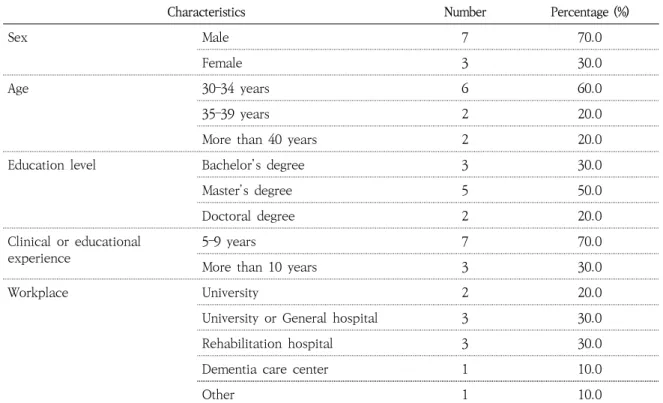
An expert panel consisting of eight occupational therapists and two occupational therapy professors reviewed the computerized screening test items dur- ing July and August 2016, to select the preliminary items. The general characteristics of the expert pan- el are outline in Table 1.
(1) First panel review
An expert panel review was conducted to inves- tigate the opinions of the experts regarding the sup- plementation of the candidate items using open questions.
(2) Second panel review
Using the following exclusion criteria, the expert panel deleted items selected in the previous step that
were: (1) not suitable for computerization, (2) too simple to reflect the level of cognitive function of MCI, (3) too complicated to understand, and (4) du- plicate or combined items that were similar in nature.
(3) Third panel review
A third panel review was conducted to further re- fine the items selected in the previous steps. In this panel review, the items were assessed for the follow- ing: (1) fitness of MCI screening items and (2) im- portance of the items. Fitness and importance of the items were rated on a 5-point Likert scale as follows: 5 = strongly agree; 4 = agree; 3 = neither/nor agree; 2 = disagree; and 1 = strongly disagree.
The results of fitness and importance of the items were analyzed using the content validity ratio (CVR).
Characteristics Number Percentage (%)
Sex Male 7 70.0
Female 3 30.0
Age 30–34 years 6 60.0
35–39 years 2 20.0
More than 40 years 2 20.0
Education level Bachelor’s degree 3 30.0
Master’s degree 5 50.0
Doctoral degree 2 20.0
Clinical or educational experience
5–9 years 7 70.0
More than 10 years 3 30.0
Workplace University 2 20.0
University or General hospital 3 30.0
Rehabilitation hospital 3 30.0
Dementia care center 1 10.0
Other 1 10.0
Table 1. Demographic characteristics of the expert panel (N=10)
Based on the criteria presented by Lawshe (1975), the items with a CVR of less than 0.62 were deleted.
3. Data analysis
Descriptive statistics, regarding the general char- acteristics of the expert panel and verification of the items’ content validity, were generated using SPSS 20.0.
Ⅲ. Results
1. Item extraction
1) Literature review
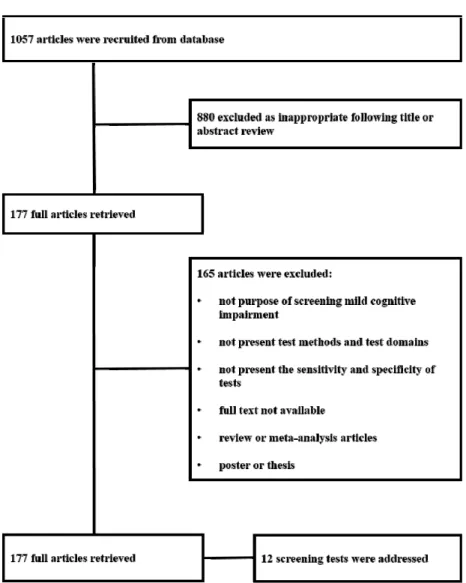
A total of 1057 studies were identified, 12 of which were selected after the exclusion of 1045 stud- ies (Figure 1). The following selection criteria were used: (1) studies using computerized screening tests for MCI, (2) studies investigating test methods and
Figure 1. The literature search process used in the current study
test domains, (3) studies reporting on the sensitivity and specificity of tests, and (4) studies written en- tirely in English or Korean. The exclusion criteria were as follows: (1) review and meta-analysis studies, (2) academic theses, posters, contribution pieces, and meeting minutes, and (3) studies missing the main body. There were 10 computerized screening tests addressed in the 12 studies, with a total of 37 test items, excluding duplicated tests.
2. Item selection
1) First panel review
A panel with 10 experts generated 11 new items, excluding duplicated items. Thus, a total of 48 screening test items were collected, including 37 test items listed in current computerized screening tests and 11 items generated from the survey at the first panel review.
2) Second panel review
Based on a second set of criteria, 18 items of the potential 48 test items were removed, yielding an initial item set of 30 screening test items.
3) Third panel review
Based on the third set of criteria and the CVR analysis, 14 items of the 30 remaining items were eliminated because they had fitness or importance CVR of 0.62 or less(Table 2). A total of 16 compu- terized screening test items for MCI, including 8 items for memory, 4 items for attention, and 4 items for executive function(Table 3), were finally selected.
The necessary number of panel reviews was de- termined through the stability of panel review.
Generally, a stability of less than 0.5 indicates that a high level of consensus has been reached (Choi
& Suh, 2011). In the current study, the stability of fitness and importance during the third panel review were less than 0.5, indicating that no additional pan- el reviews were required.
Memory
No. Item contents Fitness
CVR
Fitness stability
Importance CVR
Importance stability
1
Remember the nine pictures on the screen and indicate where on the screen the pictures were presented
a0.00 0.29 0.60 0.14
2 After you remember the picture, identify the content
of the picture 0.80 0.23 0.80 0.15
3
Remember the 10 words on the screen and indicate the words you remember in the 20 words presented next
a-0.40 0.23 -1.00 0.20
4 Remember the three pictures and indicate what they
represented 0.80 0.15 0.80 0.15
Table 2. Results from the third expert review
Memory
No. Item contents Fitness
CVR
Fitness stability
Importance CVR
Importance stability
5 Indicate what the three pictures you remembered 3
min ago represented 0.80 0.15 0.80 0.15
6 Listen to these three sounds and remember what they
sound like 0.80 0.15 0.80 0.15
7 Remember the numbers you hear in exact order 0.80 0.14 0.80 0.14
8 Remember the numbers you hear in reverse order 0.80 0.21 0.80 0.21
9 Recall as many of the 10 words you heard 3 min ago
as possible
a0.00 0.29 0.00 0.29
10 Remember the order in which the shape was drawn,
and draw it in order
a-0.40 0.30 0.00 0.29
11 After remembering the faces on the screen, find the
faces you remember
a-0.40 0.14 0.20 0.14
12 Listen to the story then indicate what you heard in
the story 0.80 0.21 0.80 0.15
13 Find the location where the painting has changed 0.80 0.15 0.80 0.15
14 Press the keyboard arrow buttons according to the
direction of the arrow on the screena -0.40 0.27 0.40 0.12
15 Press the keyboard button as soon as you see two
different pictures overlappinga 0.60 0.18 0.20 0.20
16 Find where the moving object is hidden 0.80 0.15 1.00 0.11
17 Press the keyboard button as soon as a number or a
picture appears on the screena 0.00 0.21 0.00 0.21
18 Match the shapes of the two different objects and
draw them as they move 1.00 0.11 0.80 0.15
19 Make a path in numerical order from 1 to 15 0.80 0.20 1.00 0.10
20 Find all objects with shapes that are different from
those shown in the example 0.80 0.15 0.80 0.15
Executive function
21 Solve the Hanoi Tower puzzle according to the rulesa 0.20 0.17 0.20 0.17
22
When the blue circle appears on the screen, press the keyboard button as soon as possible. Note that a red circle may appear instead of a blue circle
0.80 0.15 1.00 0.11
23 Ignore the meaning of the letter and indicate the
color of the letter as soon as possiblea 1.00 0.11 0.00 0.14
24 Indicate whether the shape matches the example
when you rotate ita -0.40 0.23 -0.20 0.30
Table 2. Results from the third expert review
No. Item contents Memory
1 After you remember the picture, identify the content of the picture.
2 Find the location where the painting has changed 3 Remember the numbers you hear in exact order 4 Remember the numbers you hear in reverse order
5 Listen to these three sounds and remember what they sound like 6 Listen to the story then indicate what you heard in the story 7 Remember the three pictures and indicate what they represented
8 Indicate what the three pictures you remembered 3 minutes ago represented Attention
9 Find where the moving object is hidden
10 Match the shapes of the two different objects and draw them as they move 11 Make a path in numerical order from 1 to 15
12 Find all objects with shapes that are different from those shown in the example Executive function
13 Arrange the pictures on the screen in the correct order of time.
14 Observe the order of the figures listed according to a certain rule, and choose the on that should come next.
15 Make categories of the most similar objects and explain.
16 When the blue circle appears on the screen, press the keyboard button as soon as possible.
Note that a red circle may appear instead of a blue circle.
Table 3. Preliminary computerized screening items for mild cognitive impairment Executive function
25
Observe the order of the figures listed according to a certain rule, and choose the on that should come next
0.80 0.15 0.80 0.14
26 Make categories of the most similar objects and
explain 1.00 0.10 0.80 0.21
27 Arrange the pictures on the screen in the correct
order of time 0.80 0.15 0.80 0.11
28 Complete the ladder so that it reaches its destinationa 0.20 0.20 0.20 0.19
29 Provide as many words as possible starting with the
letter that will be presented nexta 0.20 0.17 -0.20 0.14
30 Imitate what you see in the picture on the screena 0.00 0.14 0.60 0.11
a Item that was removed due to a low content validity ratio (CVR)
Ⅳ. Discussion
This study generated and validated computerized screening test items that focus on MCI, in prepara- tion to develop a valid test for MCI. Potential compu- terized screening test items relevant to MCI were identified through a literature review. Using pre-es- tablished criteria, an expert panel review, in addi- tion to calculating the content validity ratio, yielded a final list of 16 computerized screening test items.
This selection approach is valid and reliable, and is like the approach used to develop the paper-based screening test tools (Cho, Lee, Kim, & Cha, 2016).
Potential items that were too easy (several ori- entation items), were duplicates (memory items), or deems too difficult (several executive function items) were deleted. The experts also suggested eliminating items that simply tested the orientation of time, place, and person, since the cognitive characteristics of MCI do not include orientation impairment (Petersen, 2004).
In addition, items evaluating visuospatial and lin- guistic ability were also removed. Visuospatial ability items that evaluate form consistency through visual stimulation presented on the screen were removed because it is impossible to assess visuospatial ability by simply looking at visual stimuli and selecting cor- rect answer using a computerized method. A pre- vious study suggested drawing a picture with a pencil or using a direct object to construct a model for testing visuospatial ability (Lindsay et al., 2002).
Linguistic ability items were deleted because the pa- tient’s performance on these items could be influ- enced by academic ability (Roselli, Tartaqlione, Federico, Lepore, Defazio, & Livrea, 2009). Therefore,
it seemed appropriate to remove linguistic ability items to minimize the influence of academic background.
The proportion of items in the memory domain was high. The most prominent feature of elderly adults with MCI is that they do not completely recall events that have recently happened (Petersen, 2004).
Therefore, screening tests for MCI should include items for testing episodic memory (Albert, Moss, Tanz, & Jone, 2001). However, in the MoCA-K, which is most commonly used to test for MCI, episodic memory items only represent 5 out of 30 possible points. Moreover, in existing computerized screen- ing tests, the proportion of memory items does not differ from the proportion items from other cogni- tive domains, which makes these tests inadequate for screening MCI (Ahmed, Arnold, Thompson, Graham, & Hodge, 2009).
Further, the items in the attention domain in- cluded items to measure reaction time. Measuring the reaction time introduced a difference to pa- per-based screening test items for MCI (Park and Park, 2016). The ability to accurately measure re- action times is one of the advantages of computerized tests. Moreover, several studies reported that reaction time is an important factor in screening for MCI (De Jager, Schriinemaekers, Honey, & Budge, 2009;
Memoria, Yassuda, Nakano, & Forlenza, 2014). Thus, the items presented here will be well suited for in- clusion in a screening test for MCI.
This study, however, had a few limitations that
must be noted. First, the number of the items could
be limited, since articles published in other lan-
guages, besides English and Korean, were not in-
cluded in this study. Second, the characteristics that
affect content validity may be present when the items are computerized. Therefore, in the future, a feasibility study on computerized screening test, consisting of the items presented here, is required to validate the clinical usefulness of this test to screen for MCI.
Ⅴ. Conclusion
In this study, the 16 computerized screening items for mild cognitive impairment were developed. Even though a feasibility study with the items was not implemented yet, the items weighted in memory could reflect cognitive characteristics of mild cogni- tive impairment compared with existing pa- per-based items for screening mild cognitive impair- ment, which would be more sensitive in screening mild cognitive impairment. In the future, the com- puterized screening test with the items need to be conducted to validate sensitivity and specificity of the test.
Reference
Ahmed, S., Arnold, R., Thompson, S. A., Graham, K. S.,
& Hodges, J. R. (2008). Naming of objects, faces and buildings in mild cognitive impairment. Cortex, 44, 746-752. doi: 10.1016/j.cortex.2007.02.002.
Albert, M. S., Moss, M. B., Tanz, R., & Jones, K. (2001).
Preclinical prediction of AD using neuropsychological tests. Journal of the International Neuropsychological Society, 7, 631-639. doi: 10.1017/S1355617701755105.
Cho, B-H., Lee, J-S., Kim, S-K., & Cha, T-H. (2016).
Development of screening test items for geriatric mild cognitive impairment. The Journal of Korean Society of
Occupational Therapy, 23, 57-71. doi: 10.14519/jksot.
2016.23.2.05.
Choi, H., & Suh, C-J. (2011). Study on R&D manpower requirements for the field of pharmaceutical - An application of delphi method. Journal of Korea Academia-Industrial Cooperation Society, 12, 1270-1277.
Cummings, J. L., Vinters, H. V., Cole, G. M., &
Khachaturian, Z. S. (1998). Alzheimer's disease:
Etiologies, pathophysiology, cognitive reserve, and treatment opportunities. Neurology, 51, S2-S17. doi:
10.1212/WNL.51.1_Suppl_1.S2.
De Jager, C. A., Schrijnemaekers, A. C., Honey, T. E., &
Budge, M. M. (2009). Detection of MCI in the clinic:
Evaluation of the sensitivity and specificity of a computerised test battery, the hopkins verbal learning test and the MMSE. Age and Ageing, 38, 455-460. doi:
10.1093/ageing/afp068.
De Lepeleire, J., Heyrman, J., Baro, F., & Buntinx, F. (2005).
A combination of tests for the diagnosis of dementia had a significant diagnostic value. Journal of Clinical Epidemiology, 58, 217-225. doi: 10.1016/j,jclinepi.2004.
07.005.
Lawshe, C. H. (1975). A quantitative approach to content validity. Personnel Psychology, 29, 563-575.
Lindsay, J., Laurin, D., Verreault, R., Hebert, R., Helliwell, B., Hill, G. B., ... & McDowell, I. (2002). Risk factors for Alzheimer’s disease: A prospective analysis from the Canadian study of health and aging. American Journal of Epidemiology, 156, 445-453. doi: 10.1093/aje /kwf074.
Memoria, C. M., Yassuda, M. S., Nakano, E. Y., & Forlenza, O. V. (2014). Contributions of the computer-administered neuropsychological screen for mild cognitive impairment (CANS-MCI) for the diagnosis of MCI in Brazil.
International Psychogeriatrics, 26, 1483-1491. doi:
10.1017/S104161024000726.
Park, J. H., & Park, J. H. (2016). A systematic review on computerized cognitive function test for screening mild cognitive impairment. The Journal of Korean Society of Occupational Therapy, 24, 19-31. doi: 10.14519/jksot.2016 .24.2.02.
Petersen, R. C. (2004). Mild cognitive impairment as a
diagnostic entity. Journal of Internal Medicine, 256,
183-194. doi: 10.1111/j.1365-2796.2004.01388.x.
Phillips, M., Rogers, P., Haworth, J., Bayer, A., & Tales, A. (2013). Intra-individual reaction time variability in mild cognitive impairment and Alzheimer's disease:
Gender, processing load and speed factors. PloS One, 8, e65712. doi: 10.1371/journal.pone.0065712.
Roberts, J. L., Clare, L., & Woods, R. T. (2009). Subjective memory complaints and awareness of memory functioning in mild cognitive impairment: A systematic review. Dementia and Geriatric Cognitive Disorders, 28, 95-109. doi: 10.1159/000234911.
Roselli, F., Tartaqlione, B., Federico, F., Lepore, V., Defazio, G., & Livrea, P. (2009). Rate of MMSE score change in Alzheimer’s disease: Influence of education and vascular risk factors. Clinical Neurology and Neurosurgery, 114,
27-330. doi: 10.1016/j.clineuro.2008. 10.006.
Silveri, M. C., Reali, G., Jenner, C., & Piopolo, M. (2007).
Attention and memory in the preclinical stage of dementia. Journal of Geriatric Psychiatry and Neurology, 20, 67-75. doi: 10.1177/0891988706297469.
Wouters, H., van Campen, J., Appels, B., Lindeboom, R., Buiter, M., de Hann, R. J., & Schmand, B. (2014). Does adaptive cognitive testing combine efficiency with precision? Prospective findings. Journal of Alzheimer's Disease, 25, 595-603. doi: 10.3233/JAD-2011-101743.
Zygouris, S., & Tsolaki, M. (2015). Computerized cognitive testing for older adults: A review. American Journal of Alzheimer’s Disease & Other Dementia, 30, 13-28. doi:
10.1177/1533317514522852
국문초록
경도인지장애 선별을 위한 전산화 평가 항목 개발
박진혁*, 박지혁**
*한국과학기술원 바이오및뇌공학과
**연세대학교 보건과학대학 작업치료학과