• 검색 결과가 없습니다.

Production vs. Perception in Loanword Adaptation: A Reassessment of English Word-final Stops in Korean

N/A
N/A
Protected

Academic year: 2021

Share "Production vs. Perception in Loanword Adaptation: A Reassessment of English Word-final Stops in Korean"

Copied!
14
0
0

로드 중.... (전체 텍스트 보기)

전체 글

(1)

Production vs. Perception in Loanword Adaptation:

A Reassessment of English Word-final Stops in Korean

Jungyeon Kim (Kookmin University)

Kim, Jungyeon. (2020). Production vs. perception in loanword adaptation: A reassessment of English word-final stops in Korean. The Linguistic Association of Korea Journal , 28 (1), 51-64. This study focuses on unnecessary adaptation, where a source language structure is repaired even when the foreign form would have been faithful to the structure of a borrowing language. One example of this sort of accommodation is found in Korean loanword adaptation; Korean speakers tend to adapt English words ending in stops with vowel insertion even though Korean phonotactics allows word-final stops. This study considers two possible hypotheses to explain this vowel insertion, i.e., adaptation-in-production vs. adaptation-in-perception, and reports on a perception experiment designed to decide between the two approaches. In a categorization task, Korean participants categorized English stop-final and vowel-final nonce forms in a forced choice task where they were asked whether the form ended in a consonant. The experimental result showed that the Korean participants were more likely to identify a final English stop as stop-vowel when the stop was released than when it was unreleased. This finding was consistent with the adaptation-in-perception approach, indicating that the apparently unmotivated vowel insertion in Korean listeners results from their misperception of the English words rather than a production grammar maintaining perceptual similarity between English and Korean forms, and that the illusory vowel perception is correlated with the audible release bursts of the English final stops.

Key Words: categorization, identification, stop release, stop place, speech perception, speech production, unnecessary repair

1. Introduction

When words are borrowed from one language to another, they frequently undergo adaptations to comply with the phonological structure of the borrowing language (BL). However, some loanword patterns cannot easily be explained by BL phonological grammar. One of those patterns involves what has been referred to as unnecessary repair by Peperkamp (2005), where a foreign structure is changed even when the original structure would have been legal in the BL (Golston

& Yang, 2001; Peperkamp, 2005; Y. Kang, 2003). 1) This study considers the basis of one example of apparently unnecessary repair by investigating the tendency to insert a vowel following a word-final stop in English words borrowed into Korean (e.g., knit→[nit

h

ɨ]). This vowel insertion is apparently unmotivated because a native Korean word may end in a stop (e.g., /kot/ →[kot˺] ‘soon’) and thus an English word-final stop would be pronounceable in Korean.

The present study considers two possible approaches to account for this vowel epenthesis: adaptation-in- production vs. adaptation-in- perception . First, the adaptation-in- production approach generally assumes that loanword adapters store the surface form of the source language and the production grammar performs the adaptation to the BL native phonology (Fleischhacker, 2005; Jacob & Gussenhoven, 2000; Kang, 2003; Kang et al., 2008; Kawahara, 2006;

Kenstowicz, 2003; LaCharité & Paradis, 2005; Miao, 2006; Paradis & LaCharité, 1997, 2008; Paradis & Tremblay, 2009; Shinohara, 2006; Steriade, 2001; Yip, 2002; among others). That is, the phonetic form of the original structure is faithfully taken as the abstract underlying representation and loan adaptations are then transformations produced by the phonological process in production.

To account for why even accurately perceived forms are sometimes transformed, some researchers appeal to perceptual

1) Other puzzling patterns in loanword adaptation include differential faithfulness (Broselow, 2009), retreat to the unmarked (Kenstowicz &

Suchato, 2006), and ranking reversals (Peperkamp et al., 2008).

(2)

factors and subphonemic details in explaining adaptation patterns using the production grammar (Fleischhacker, 2005;

Kang, 2003; Kang et al., 2008; Kawahara, 2006; Kenstowicz, 2003; Miao, 2006; Shinohara, 2006; Steriade, 2001; Yip, 2002). On the perceptual similarity approach, originally proposed by Steriade (2001), speakers possess knowledge of perceptual similarity (P-map) between foreign and native sounds, and perceptual factors are incorporated into grammatical constraints that can be ranked with respect to other grammatical constraints. This approach assumes that loanword adaptation is conducted by a sophisticated adapter who has the ability to correctly perceive non-native sounds and choose the most similar native language structure by means of a P-map which exists as a component of their grammar.

An alternative approach to accounting for unnecessary vowel insertion is the adaptation-in- perception approach. This view believes that loanword adaptation does not take place in the production grammar but rather happens during the perception of foreign sounds (Boersma & Hamann, 2009; Broselow, 2009; Calabrese, 2009; Daland et al., 2019; de Jong

& Park, 2012; Dupoux et al., 1999; Kabak & Idsardi, 2007; Kwon, 2017; Padgett, 2010; Peperkamp, 2005; Peperkamp et al., 2008; Peperkamp & Dupoux, 2003; Silverman, 1992; Vendelin & Peperkamp, 2004; among others). The adaptation-in-perception approach, like the perceptual similarity approach, argues that loanword mapping is inherently perceptually based and the acoustic details crucially play a role in perceptually matching foreign forms with native forms.

However, this approach differs from the perceptual similarity approach in that the set of adaptations includes not only a mapping to native segments and tones but also a mapping to native syllables, which allows vowel insertion in perception (Boersma & Hamann, 2009; Peperkamp, 2005; Peperkamp et al., 2008).

The present study examines the tendency to have a word-final vowel in English words borrowed into Korean, which is a case of unnecessary repair. One explanation, along the lines of the perceptual similarity hypothesis, proposed by Kang (2003), supposes that Koreans correctly perceive the English words but they epenthesize a final vowel to preserve perceptual similarity between the English and Korean forms. Kang discusses the release of the final stop as one of the perceptual factors promoting the vowel insertion since word-final stops in Korean are never released (Chung, 1986; Huh, 1965; Kim, 1971) while English word-final stops are variably released (Byrd, 1992; Crystal & House, 1988; Gimson, 1980). Kang claims that because stop release in English is acoustically similar to the epenthetic vowel inserted after an English final stop in Korean, vowel insertion serves to make the Korean output of final stop-vowel perceptually close to English final released stops.

In addition to the factor of stop release, Kang finds that the place of the final stop also affects the frequency of vowel epenthesis in Korean loanwords from English as well as the frequency of release by English speakers. The greater frequency of insertion after dorsal than labial stops in loanwords is consistent with her finding that in the TIMIT corpus English final dorsal stops had a release frequency of 83% but labial stops had a release frequency of only 51% (Kang, 2003, p. 250). 2) Thus, the corpus results support her claim that the more likely a final stop is to be released by English speakers, the more likely it is to undergo vowel insertion by Korean speakers. 3)

The two approaches that the present study considers, i.e., the adaptation-in-production view and the adaptation-in-perception view, are compatible with the unnecessary vowel insertion shown in Korean loanword adaptations since both approaches predict that Korean speakers will mispronounce an English word ending in a stop.

Thus, the only way to tease the two hypotheses apart is to test whether Korean speakers actually do perceive a final released stop as stop-vowel. Previous studies focused mostly on the patterns of the vowel epenthesis, i.e., vowel insertion, no vowel insertion, and variable vowel insertion. Some of the studies have simply provided several factors affecting the possibility of vowel insertion while others have made an attempt to explain the vowel insertion in terms of an

2) Kang (2003) conducted a survey of the TIMIT corpus to examine the release pattern of postvocalic word-final stops. The TIMIT corpus contained recordings of 2342 different sentences read by 630 speakers from 8 major dialects of American English, resulting in a total of 6300 sentences (Garofolo et al., 1993).

3) The discussion of coronal final stops is excluded from this study since the correlation between the likelihood of release and vowel

insertion was not supported for coronals in Kang’s corpus study; although the frequency of vowel insertion in loanwords was highest for

coronals, final coronal stops in the TIMIT corpus were the least likely to be released (Kang, 2003). She claims that the surprisingly high

frequency of vowel insertion after coronals arises from a factor that is related to morphological alternation, which is not a direct

perceptual factor, but where vowel insertion can make the relationship between underlying and surface representations consistent with

Korean phonology. I will investigate this kind of other factor that could affect the unnecessary vowel insertion in future research.

(3)

Optimality-theoretic account (Boersma & Hamann, 2009; Hirano, 1994; H. Kang, 1996; Jun, 2002; Ku, 1999; O. Kang, 1996; Rhee & Choi, 2001). None of these studies directly investigated the perception of English word-final stops by Korean listeners although Kang (2003) provided evidence that phonetic details of the native language are relevant in the process of loan adaptation.

In this study I report on a perception experiment designed to decide between the adaptation-in-perception vs.

adaptation-in-production, i.e., whether Korean speakers’ vowel insertion derives from their perception of an illusory vowel or it results from their desire to maintain perceptual similarity between an accurately perceived form in English and the adapted form in Korean. In the categorization task Korean participants categorized English stop-final and vowel-final forms in a forced choice task where they were asked whether the form ended in a consonant. 4) This experiment was designed to test the effects of release and place of the final stop and to examine participants’ ability to accurately perceive English stop-final forms.

2. Method

2.1. Participants

The participants in the categorization task were 30 native speakers of Korean who were students at a university in Seoul, Korea. 11 participants were male and 19 were female. Participants ranged in age from 21 to 38, with an average age of 27.6 at the time of participation (SD = 5.4). Their average age at first contact with English was 10.1 years old (SD = 2.0). No participants majored in English or had lived in a country where English was an official language. None reported any speech or hearing impairments. All participants were given a monetary compensation after completing the experiment.

2.2. Stimuli

The 30 Korean participants each listened to 18 pseudo-English target items including nonce words ending in a consonant as well as nonce words ending in a vowel. The number of consonant-final English non-words was 12 and that of vowel-final English non-words was 6. In the categorization experiment, consonant-final nonce words ended in stops and vowel-final nonce words always ended in the barred i [ɨ]. All the nonce words were recorded by a balanced Korean-English bilingual female speaker who was able to properly produce the vowel [ɨ] while otherwise keeping English pronunciation.

The 12 consonant-final English nonce forms consisted of 4 monosyllabic, 4 disyllabic, and 4 trisyllabic words. English nonce words comprised forms with a pre-final vowel [ɛ]. The shape of the 1-syllable words was CVC; that of 2-syllable words was C

1

V

1

C

2

V

2

C; and that of 3-syllable forms was C

1

V

1

C

2

V

2

C

3

V

3

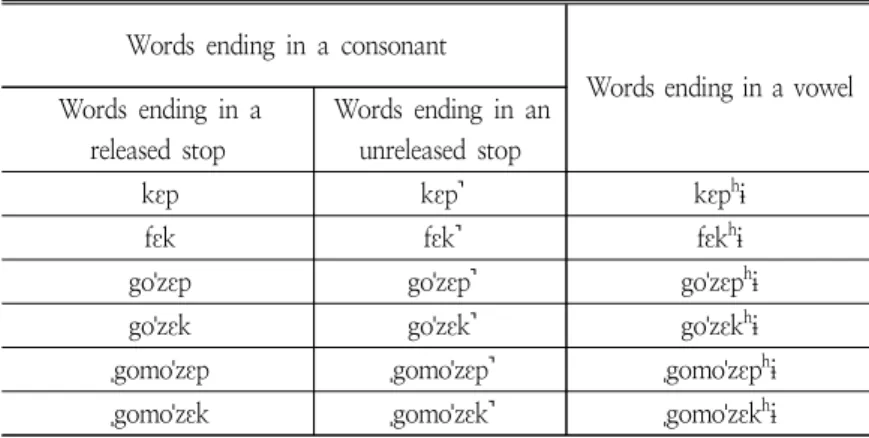
C. Disyllabic and trisyllabic words had a final stressed syllable (e.g., goˈzɛk˺, ˌgomoˈzɛk˺). Forms varied in terms of two different linguistic features: (i) release of the final stop, i.e., 6 items ending in an unreleased stop (e.g., kɛp˺) and 6 items ending in a released stop (e.g., kɛp); and (ii) place of the final stop, i.e., 6 ending in a labial stop (e.g., kɛp, kɛp˺) and 6 ending in a dorsal stop (e.g., fɛk, fɛk˺). The set of stimuli employed in the task is shown in Table 1. Since the primary goal of this study was to examine if stop release and stop place of English words would affect the perception of Korean listeners, other variable was controlled in the stimuli of the task. For example, every stimulus item ending in a stop has a voiceless final stop to exclude the possible voicing effect of the final stop. A voiceless labial/dorsal stop is legitimate and permitted in Korean phonology (e.g., [pap˺]

4) Categorization has a long history in different areas of study as a basic psychological process where items are recognized and differentiated

from one another. This method is importantly used in the field of phonetics/cognitive linguistics to investigate how listeners perceive and

categorize/identify auditory stimuli (Daland et al. , 2019; de Jong & Park, 2012; Peperkamp, 2015; Peperkamp et al., 2008; Shinohara et

al., 2011; among others).

(4)

'rice', [mok˺] 'neck') and thus Korean listeners may perceive forms ending in a voiceless labial/dorsal stop with no difficulty. 5)

Table 1. Test items for the categorization task

Words ending in a consonant

Words ending in a vowel Words ending in a

released stop

Words ending in an unreleased stop

kɛp kɛp˺ kɛp

h

ɨ

fɛk fɛk˺ fɛk

h

ɨ

goˈzɛp goˈzɛp˺ goˈzɛp

h

ɨ

goˈzɛk goˈzɛk˺ goˈzɛk

h

ɨ

ˌgomoˈzɛp ˌgomoˈzɛp˺ ˌgomoˈzɛp

h

ɨ

ˌgomoˈzɛk ˌgomoˈzɛk˺ ˌgomoˈzɛk

h

ɨ

To create the auditory stimuli, the bilingual speaker recorded the stimulus items in a soundproof room using a Shure SM57 unidirectional dynamic microphone and a Zoom H4n recorded at 44.1 kHz sampling rate (16 bits per sample).

Praat (Boersma & Weenink, 2019) was used to check the presence or absence of release for the items ending in a consonant. Each auditory stimulus classified as having a final released stop included noticeable release on the waveform and spectrogram, and no release was seen for final stops labelled as unreleased. Figures 1 through 3 illustrate waveforms and spectrograms for the representative samples [kɛp], [kɛp˺], and [kɛp

h

ɨ] produced by the speaker.

Figure 1. Waveform and spectrogram of [kɛp]

ending in released [p] produced by bilingual speaker

5) In addition to the voicing of the final stop, regarding the number of syllables for the stimuli, it was logically possible that word size

might interact with the phenomenon of interest since the stimuli included forms consisting of three different sizes. However, the primary

purpose of this experiment was not to examine size effects, and previous studies reported that there was no significant difference

between disyllabic and trisyllabic words (Kang, 2003; Rhee & Choi, 2001). I will investigate a possible size effect that could be found

between monosyllabic and polysyllabic words in future research.

(5)

Figure 2. Waveform and spectrogram of [kɛp ˺ ] ending in unreleased [p ˺ ] produced by bilingual speaker

Figure 3. Waveform and spectrogram of [kɛp

h

ɨ]

ending in aspirated [p

h

] plus vowel [ɨ] produced by bilingual speaker

2.3. Procedure

Participants were directed to listen to the auditory stimuli and to answer the following question for each stimulus: Do you think that the word ends in a consonant? A coda consonant is called pachim in Korean; thus, before the start of the task, the experimenter explained to participants that the question of “Does the word end in a consonant?” would mean the same as that of “Does the final syllable of the word have a pachim ?” and that they should choose answer “Yes” if they thought that the word had a pachim or answer “No” if they thought that the word did not have a pachim . Participants were told that they would be hearing English nonce forms that would sound just like English words but would not be found in an English dictionary. Directions were given in Korean by the experimenter (the author), and the test question was given in English on a computer monitor as indicated in Figure 4.

Participants were provided no spelling or other information but only auditory information through a laptop computer.

They listened to stimuli using a headphone in a soundproof booth. Participants had a short practice round before the

(6)

actual task. Praat’s MFC (Multiple Forced Choice) Experiment protocol was used in this experiment where the stimuli were sounds and the responses were categories (Yes or No) whose labels appeared on buttons, as shown in Figure 4.

Participants were asked to click on one of choices which were shown as labelled rectangles.

Figure 4. Response screen for categorization task

Participants needed to click on their choice in order to hear the next stimulus. That is, a new stimulus arrived when participants made their choice. They heard the stimulus only once; they could not go back to hear an item again even if they wanted to. The order of the stimuli was randomized for each subject.

2.4. Predictions

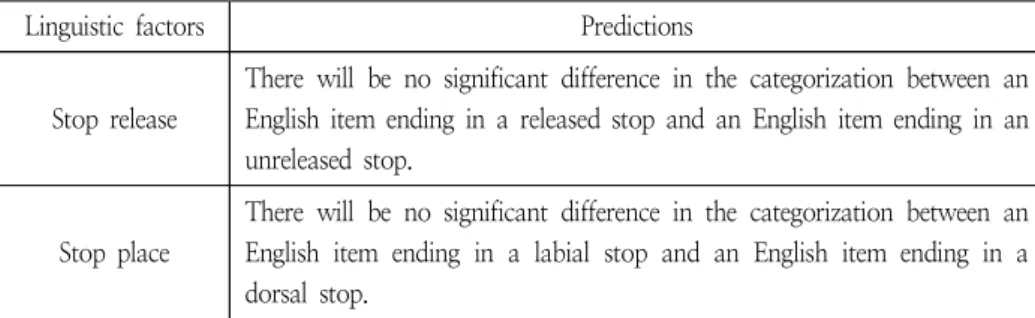
Recall that the two alternatives, adaptation-in-production approach vs. adaptation-in-perception approach, do not predict the same thing. As shown in Table 2, the adaptation-in-production approach would predict that since Korean listeners accurately perceive an English final stop as a final stop consonant, they will categorize English CVC as CVC even if stop release creates a structure that is acoustically similar to the Korean vowel. Thus, according to this hypothesis, there should be no significant effects of the two given factors.

Table 2. Predictions of adaptation-in-production approach for categorization task

Linguistic factors Predictions

Stop release

There will be no significant difference in the categorization between an English item ending in a released stop and an English item ending in an unreleased stop.

Stop place

There will be no significant difference in the categorization between an English item ending in a labial stop and an English item ending in a dorsal stop.

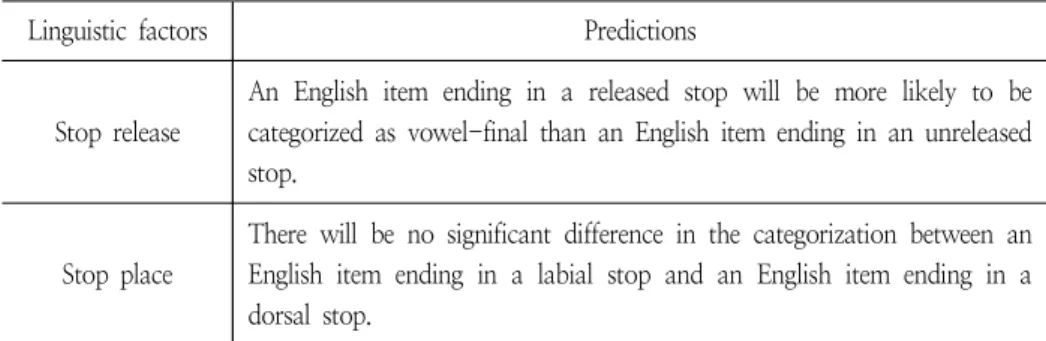
The adaptation-in-perception approach, however, would predict that Korean listeners will categorize English CVC as

CVCV because they misperceive the English final released stop as being CV (Table 3). That is, release will cause the

perception of an illusory vowel since it creates a structure that is phonetically similar to the inserted vowel. On the other

hand, this hypothesis will not predict a significant effect in stop place because release was strictly balanced across each

category of place in the categorization task.

(7)

Table 3. Predictions of adaptation-in-perception approach for categorization task

Linguistic factors Predictions

Stop release

An English item ending in a released stop will be more likely to be categorized as vowel-final than an English item ending in an unreleased stop.

Stop place

There will be no significant difference in the categorization between an English item ending in a labial stop and an English item ending in a dorsal stop.

2.5. Results

There was a total of 540 responses (18 stimuli × 30 participants). For all stimuli, 57% of consonant-final English nonce words were identified as consonant-final, as opposed to 10% of vowel-final English nonce words (Table 4). Here, 57% was calculated on the number of ‘word ends in consonant’ responses for consonant-final words out of the total number of responses for consonant-final words, and 10% was calculated on the number of ‘word ends in vowel’

responses for vowel-final words out of the total number of responses for vowel-final words.

Table 4. Consonant-final vs. vowel-final responses

Final Consonant-final responses Vowel-final responses

Consonant-final words 206 (57%) 154 (43%)

Vowel-final words 18 (10%) 162 (90%)

Korean speakers were significantly more likely to categorize consonant-final English nonce words as consonant-final than vowel-final English nonce words (57% vs. 10%, p < 0.001); yet many of them still categorized consonant-final forms as vowel-final (43%), as shown in Table 4. This result is particularly connected to my predictions given in Table 3.

The results from the categorization experiment showed that Korean participants were more likely to categorize an

English final stop as a stop plus vowel when the final stop was released than when it was unreleased. Figure 5 illustrates

the release effect of the final stop, which was found in a statistical model set up for the study.

(8)

Figure 5. Categorization choices by place and release (Error bars indicate 95% confidence intervals)

The presence/absence of an epenthetic vowel reflected in the choice of responses was modeled using a mixed effects logistics regression model, implemented in the lme4 package (Bates et al., 2015) in R 3.6.2 (R Development Core Team, 2019). I built a model for the two phonetic factors (release and place), where the dependent variable was participants’

responses (whether participants’ answer was consonant-final or vowel-final), and it was coded as 0 for answers of

‘English word ends in consonant’ and 1 for answers of ‘English word ends in vowel’.

Fixed effects included two linguistic factors, stop release (unreleased or released) and stop place (labial or dorsal) 6) ; these two-level factors were deviation-coded. Interactions of the acoustic factors (release and place) were also included in the model. The regression model included the adjustments of by-subject and by-item to the intercept and slopes as random effects. The codes are provided in (1) and the output from the model is summarized in Table 5.

(1) Korean speakers’ perception model

glmer (Response ~ R ELEASE * P LACE + (R ELEASE *P LACE | subject) + (R ELEASE *P LACE | item), data = categorization, family = “binomial“)

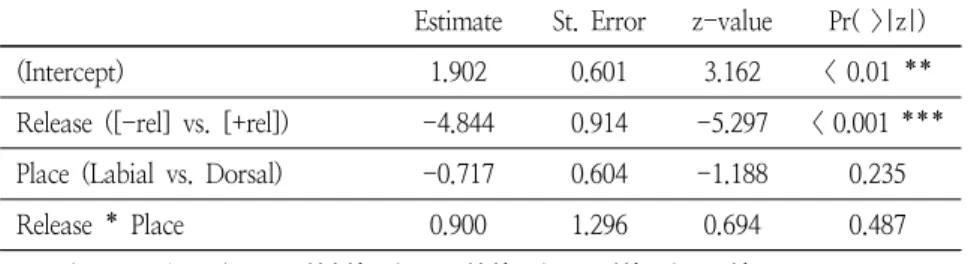
As shown in the table, a main effect of Release was significant (z = -5.297, p < 0.001), indicating that Korean listeners were more likely to categorize an English final stop as stop-vowel when the final stop was released than when it was not released. This result was consistent with the prediction of the adaptation-in-perception approach, but inconsistent with the adaptation-in-production approach which predicted no significant release effect in the task.

Table 5. The output of logistic mixed effects model of Korean participants’ categorization choice

Estimate St. Error z-value Pr( >|z|)

(Intercept) 1.902 0.601 3.162 < 0.01 **

Release ([-rel] vs. [+rel]) -4.844 0.914 -5.297 < 0.001 ***

Place (Labial vs. Dorsal) -0.717 0.604 -1.188 0.235

Release * Place 0.900 1.296 0.694 0.487

Significant codes: < 0.001 ‘***’; < 0.01 ‘**’; < 0.05 ‘*’; < 0.1 ‘.’

6) This study only includes a discussion of labial vs. dorsal stops since previous research showed that the status of coronal final stops was

ambiguous, i.e., they sometimes patterned with labials; other times they patterned with dorsals (Hwang, 2011; Kang, 2003). I leave the

unique behavior of Korean coronal stops for future research.

(9)

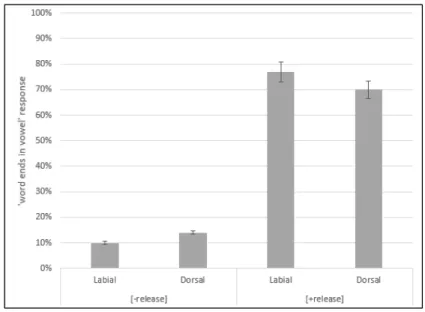
The logistic mixed effects model showed that Place did not have a significant main effect (p = 0.235), which is consistent with the prediction of both the adaptation-in-production and the adaptation-in-perception approaches. The interaction of Release * Place was not also significant in the categorization task (p = 0.487). Figure 6 shows categorization choices based on release and place of the English final stop. As shown in the figure, there is no significant difference between labial vs. dorsal final stops in both unreleased and released conditions, while more CV response was induced when the final stop was released than when it was not released.

Figure 6. Categorization choices by release and place (Error bars indicate 95% confidence intervals)

In sum, the statistical analysis of the experimental result showed that the main effect of stop release was highly significant, while there were no significant effects of stop place as well as the interaction of stop release and stop place in the categorization task.

3. Discussion

In this study, we looked at categorization choices in terms of two linguistic factors (release and place of word-final stops) and the predictions of the two approaches (adaptation-in- perception and adaptation-in- production approaches).

The adaptation-in-perception approach predicted that Korean participants would categorize English CVC as CVCV since they inaccurately hear an English final stop as being CV when the final stop is released than when it is unreleased. This approach predicted no significant effect in stop place because release of the final stop was controlled across each category of place in the stimuli. On the other hand, the adaptation-in-production approach predicted that Korean participants would categorize English CVC as CVC since they accurately hear an English final stop as consonant-final. Thus, this approach predicted no significant effect of the two given factors.

First of all, we found in the categorization study that final stop release had a significant effect: a greater possibility of vowel-final answers was more likely following released stops than unreleased stops. The effect of release is consistent with the adaptation-in-perception approach, while it is not compatible with what the opposing approach predicted. This result suggests that Korean listeners were more likely to perceive an illusory vowel when they heard an English form ending in a released stop than when they heard a form ending in an unreleased stop —for example, interpreting [fɛk]

containing a released final stop [k] as [fɛk

h

ɨ]. Then, the effect of release raises the question of why the release factor

should be important in Korean loanword phonology. Coda segments in Korean are obligatorily unreleased (Shin, 2011;

(10)

Sohn, 1999), whereas English postvocalic release has typically been assumed to be optional; that is, English stops may or may not be released word-finally (Byrd, 1992; Crystal & House, 1988; Gimson, 1980). Gimson (1962, p. 151) mentions that the non-release of final stops is a feature of colloquial RP (Received Pronunciation), while release of final stops tends to be realized by rather careful speakers in more formal contexts. 7)

Many researchers have investigated stop release in English (Daland et al., 2019; Jongman et al., 1985; Jun &

Beckman, 1994; Kang, 2003; Parker, 1977; Repp & Lin, 1989; Song, 2002). Parker (1977) observes that an English released voiced stop often consists of a stop followed by a vocalic sound, while a voiceless counterpart is composed of release burst followed by aspiration noise. These phonetic events in English are very similar to those observed in Korean CV sequences including a voiceless consonant plus a high vowel, in which high vowels are devoiced following a voiceless consonant. Jun and Beckman (1994) inspected a corpus consisting of CVCV words in which the first vowel was high and two consonants were voiceless; they found that the Korean high vowels [i, u, ɨ] were mostly devoiced following aspirated stops in both phrase-initial and phrase-medial position. As Kang (2003) points out, we can suppose that vowels in phrase-final position would be even more devoiced than those in other positions, based on the fact that the amplitude of vowels in phrase-final position is weak in general. Song (2002) found a similar devoicing by examining Korean spontaneous speech based on recordings of speakers from TV programs. Her results confirm that the high vowels tend to be devoiced when they follow aspirated stop or affricate consonants. Her dataset also suggests that Korean vowels are significantly shorter when they follow an aspirated stop than when they follow a lax or a tense stop. Daland et al., (2019) have recently added to this discussion that high vowel devoicing in Korean following aspirated stops implies that an epenthetic vowel inserted after an English word-final stop could provide a good acoustic match; that is, [fɛk

h

ɨ] is a good acoustic match to [fɛk] containing a final released stop [k] to Korean listeners.

There have been several studies suggesting that audible stop release bursts may be correlated with the presence of an epenthetic vowel in loanword adaptation. For example, Kang (2003) proposed that the audible release burst in coda positions contributed to the perception of an illusory vowel by Korean listeners since a coda segment in Korean is never released. That is, for Korean speakers, the presence of an audible stop release burst can be an important cue for being an onset segment. In addition, de Jong and Park (2012) conducted a perception task with Korean learners of English where they were asked to identify whether VC syllables containing a stop burst ended in a C or V. Their results showed that the Korean participants were more likely to identify an illusory vowel for those VC stimuli. Related results have also been found for other languages. Peperkamp et al., (2008) noted that word-final nasal consonants in English and French are differently adapted into Japanese; French final nasals are adapted with vowel insertion, while English ones are borrowed with no insertion. Their study confirmed that the difference between the two languages arises due to the presence/absence of audible release in the nasal consonant, i.e., the spectral energy within the consonantal release best predicted the presence of an epenthetic vowel in Japanese speakers’ responses.

Second of all, regarding the final stop place, it turns out that there was no place effect found in the categorization task, which is consistent with both the adaptation-in-perception approach and the adaptation-in-production approach.

According to Kang (2003), the more likely a final stop is to be released by English speakers, the more likely it is to undergo vowel insertion by Korean speakers. For example, vowel insertion is more likely after a dorsal final stop than a labial final stop because Korean speakers tend to hear a released pronunciation of a dorsal final stop than that of a labial final stop. That is, there is nothing about dorsality itself that can contribute to vowel insertion. The only reason labial vs.

dorsal stops matters is that it affects the likelihood of release in English pronunciation. However, here in the categorization task, participants were not hearing naturalistic spoken English. They were hearing stimuli where stop release was strictly balanced across places of articulations; participants listened to the same numbers of released and unreleased stops for each category of place (6 items ending in released stops and 6 items ending in unreleased stops). Thus, unlike in naturalistic English, stop place was completely independent of stop release in the current experiment. For this reason, neither approach

7) Gimson (1962) describes the stylistic feature of word-final release on the basis of standard British English pronunciation. Yavas (2006)

mentions that the final stops of American English also have a similar feature of release: word-final stops are normally unreleased in

American English, but a speaker may pronounce them with a release burst. That is, in different speakers’ pronunciations, we can find the

released and unreleased allophones in an overlapping distribution (Yavas, 2006, p. 46).

(11)

predicted a greater likelihood of vowel-final responses as a consequence of final consonant place, and this prediction was confirmed in the task; both nonreleased and released stops found no significant effect of stop place in the categorization experiment.

All in all, from the result of the perception task conducted in this study, we found a significant effect of stop release and no stop place effect: Korean listeners were more likely to identify an English final stop as stop-vowel when the stop was released than when it was unreleased, while there was no significant difference in categorization choices between an English item ending in a labial vs. dorsal stop. These results were consistent with the predictions of the adaptation-in-perception approach since this approach predicted a greater likelihood of an epenthetic vowel following a released stop and no significant effect of stop place. On the other hand, the adaptation-in-production approach made the correct prediction only for the stop place since this approach predicted no significant effect of release and place in the word-final stop. Therefore, the present results clearly support the hypothesis of the adaptation-in-perception that Korean speakers’ vowel insertion derives from their perception of an illusory vowel. The present perception data also reinforce the previous claim that the perception of an illusory vowel is strongly correlated with the audible release bursts of the relevant stop consonants. Further research will concentrate on attempting to integrate production and perception as well as investigating whether other linguistic factors concerning this unnecessary vowel insertion have similar results.

References

Bates, D., Maechler, M., Bolker, B., & Walker, S. (2015). Fitting linear mixed-effects models using lme4. Journal of Statistical Software , 67 (1), 1-48.

Boersma, P., & Hamann, S. (2009). Loanword adaptation as first-language phonological perception. In A.

Calabrese & W. L. Wetzels (Eds.), Loanword phonology (pp. 11-58). Amsterdam/Philadelphia: John Benjamins Publishing Company.

Broselow, E. (2009). Stress adaptation in loanword phonology: perception and learnability. In P. Boersma & S.

Hamann (Eds.), Phonology in perception (pp. 191-234). Berlin and New York: Mouton de Gruyter.

Byrd, D. (1992). A note on English sentence-final stops. UCLA Working Papers in Phonetics , 81 , 37-38.

Calabrese. A. (2009). Perception, production and acoustic inputs in loanword phonology. In A. Calabrese & W.

L. Wetzels (Eds.), Loanword phonology (pp. 59-114). Amsterdam/Philadelphia: John Benjamins Publishing Company.

Chung, K. (1986). The role of [release] and CV-constraints in phonology: Evidence from Korean. In the Linguistic Society of Korea (Eds.), Linguistics in the Morning Calm, 2 (pp. 317-336). Seoul: Hanshin.

Crystal, T., & House, A. (1988). The duration of American-English stop consonants: An overview. Journal of Phonetics , 16 , 285-294.

Daland, R., Oh, M., & Davidson, L. (2019). On the relation between speech perception and loanword adaptation: Cross-linguistic perception of Korean-illicit word-medial clusters. Natural Language and Linguistic Theory , 37 , 825-868.

de Jong, K., & Park, H. (2012). Vowel epenthesis and segment identity in Korean learners of English. Studies in Second Language Acquisition , 34 , 127-155.

Dupoux, E., Kakehi, K., Hirose, Y., Pallier, C., & Mehler, J. (1999). Epenthetic vowels in Japanese: A perceptual illusion? Journal of Experimental Psychology: Human Perception and Performance , 25 , 1568-1578.

Fleischhacker, H. (2005). Similarity in phonology: Evidence from reduplication and loan adaptation . Doctoral dissertation, University of California, Los Angeles.

Garofolo, J., Lamel, L., Fisher, W., Fiscus, J., Pallett, D., Dahlgren, N., & Zue, V. (1993). TIMIT acoustic-phonetic continuous speech corpus LDC93S1 . Philadelphia: Linguistic Data Consortium.

Gimson, A. (1962). An introduction to the pronunciation of English . London: Edward Arnold.

Gimson, A. (1980). An introduction to the pronunciation of English (3

rd

ed.). London: Arnold.

(12)

Golston, C., & Yang, P. (2001). White Hmong loanword phonology. In C. Féry, A. D. Green, & R. van de Vijver (Eds.), Proceedings of HILP 5 (pp. 40-57). Postsdam: University of Potsdam.

Hirano, H. (1994). A constraint-based approach to Korean loanwords. Language Research, 30 , 707-739.

Hothorn, T., Bretz, R., & Westfall, P. (2008). Simultaneous inference in general parametric models. Biometrical Journal , 50 (3), 346-363.

Huh, W. (1965). Gugeoumunhak (‘Korean phonology’) . Seoul: Cengumsa.

Hwang, J. (2011). Non-native perception and production of foreign sequences . PhD dissertation, Stony Brook University, Stony Brook, New York.

Jacobs, H., & Gussenhoven, C. (2000). Loan phonology: Perception, salience, the lexicon and OT. In J. Dekkers, F. van der Leeuw, & J. van de Weijer (Eds.), Optimality Theory: Phonology, syntax, and acquisition (pp.

193-210). Oxford: Oxford University Press.

Jongman, A., Blumstein, S. E., & Lahiri, A. (1985). Acoustic properties for dental and alveolar stop consonants:

A cross-language study. Journal of Phonetics, 13 , 235-251.

Jun, E. (2002). Yeongeo chayongeo eumjeol mal pyeswaeeumui payeol yeobuwa moeum sabibe gwanhan silheomjeok yeongu (‘An experimental study of the effect of release of English syllable final stops on vowel epenthesis in English loanwords’). Studies in Phonetics, Phonology and Morphology , 8 , 117-134.

Jun, S., & Beckman, M. (1994). Distribution of devoiced high vowels in Korean. Proceedings of the International Conference on Spoken Language Processing , Volume 2 , 479-482.

Kabak, B., & Idsardi, W. (2007). Perceptual distortions in the adaptation of English consonant clusters: Syllable structure or consonantal contact constraints? Language and Speech, 50 , 23-52.

Kang, H. (1996). English loanwords in Korean. Studies in Phonetics, Phonology and Morphology, 2 , 21-47.

Kang, O. (1996). Hangugeo chayong umunrone dehan choijeoksungiron bunseok (‘An optimality-theoretic analysis of Korean loanword phonology’). Korean Linguistics, 28 , 113-158.

Kang, Y. (2003). Perceptual similarity in loanword adaptation: English postvocalic word-final stops in Korean.

Phonology , 20 , 219-273.

Kang, Y., Kenstowicz, M., & Ito, C. (2008). Hybrid loans: A study of English loanwords transmitted to Korean via Japanese. Journal of East Asian Linguistics , 17 , 299-316.

Kawahara, S. (2006). A faithfulness ranking projected from a perceptibility scale: The case of [±voice] in Japanese. Language , 82 , 536-574.

Kenstowicz, M. (2003). The role of perception in loanword phonology: A review of Les emprunts lingustiques d’origine européenne en Fon. Studies in African Linguistics , 32 , 95-112.

Kenstowicz, M., & Suchato, A. (2006). Issues in loanword adaptation: A case study from Thai. Lingua, 116 , 921-949.

Kim, C. (1971). Two phonological notes: A-sharp and B-flat. In M. Brame (Eds.), Contributions to generative phonology (pp. 155-170). Austin: University of Texas Press.

Ku, P. (1999). Choyceksengiloneyseuy yenge chayongewa mounmsapip (‘English loanwords and vowel insertion in Optimality Theory’). Studies in Phonetics, Phonology and Morphology, 5 , 59-77.

Kwon, H. (2017). Language experience, speech perception and loanword adaptation: Variable adaptation of English word-final plosives into Korean. Journal of Phonetics , 60 , 1-19.

LaCharité, D., & Paradis, C. (2005). Category preservation and proximity versus phonetic approximation in loanword adaptation. Linguistic Inquiry , 36 , 223-258.

Miao, R. (2006). Loanword adaptation in Mandarin Chinese: Perceptual, phonological and sociolinguistic factors . Doctoral dissertation, Stony Brook University, Stony Brook, New York.

Padgett, J. (2010). Systemic contrast and Catalan rhotics. The Linguistic Review, 26 (4), 431-463.

Paradis, C., & LaCharité, D. (1997). Preservation and minimality in loanword adaptation. Journal of Linguistics , 33 , 379-430.

Paradis, C., & LaCharité, D. (2008). Apparent phonetic approximation: English loanwords in old Quebec

(13)

French. Journal of Linguistics , 44 , 87-128.

Paradis, C., & Tremblay, A. (2009). Nondistinctive features in loanword adaptation: The unimportance of English aspiration in Mandarin Chinese phoneme categorization. In A. Calabrese & W. L. Wetzels (Eds.), Loanword phonology (pp. 211-224). Amsterdam/Philadelphia: John Benjamins Publishing Company.

Parker, F. (1977). Perceptual cues and phonological change. Journal of Phonetics , 5 , 97-105.

Peperkamp, S. (2005). A psycholinguistic theory of loanword adaptation. In M. Ettlinger, N. Fleischer, & M.

Park-Doob (Eds.), Proceedings of the 30 th Annual Meeting of the Berkeley Linguistics Society , 30 (pp.

341-352). Berkeley: Berkeley Linguistic Society.

Peperkamp, S. (2015). The phonetics-phonology interface: Representations and methodologies. In J. Romero &

M. Riera (Eds.), Phonology versus phonetics in loanword adaptations: A reassessment of English vowels in French (pp. 71-90). Amsterdam: John Benjamins Publishing Company.

Peperkamp, S., & Dupoux, E. (2003). Reinterpreting loanword adaptations: The role of perception. In M. J.

Solé, D. Recasens, & J. Romero (Eds.), Proceedings of the 15 th International Congress of Phonetic Sciences (pp. 367-370). Barcelona: Causal Productions.

Peperkamp, S., Vendelin, I., & Nakamura, K. (2008). On the perceptual origin of loanword adaptations:

Experimental evidence from Japanese. Phonology , 25 , 129-164.

R Core Team. (2019). R [3.6.2]: A language and environment for statistical computing . Vienna, Austria: the R Foundation for Statistical Computing. Retrieved December 13, 2019, from http://www.R-project.org/.

Repp, B., & Lin, H. (1989). Acoustic properties and perception of stop consonant release transients. The Journal of the Acoustical Society of America, 85 , 379-396.

Rhee, S., & Choi, Y. (2001). Yeongeo chayongeoui moeum sabibe daehan tonggyegwanchalgwa geu uiui (‘A statistical observation of vowel insertion in English loanwords in Korean and its significance’). Studies in Phonetics, Phonology and Morphology , 7 , 153-176.

Silverman, D. (1992). Multiple scansions in loanword phonology: Evidence from Cantonese. Phonology , 9 , 289-328.

Shin, J. (2011). Hankukeoiy malsori (‘Korean sounds’). Korea: Gisikkwa Kyoyang.

Shinohara, S. (2006). Perceptual effects in final cluster reduction patterns. Lingua , 116 , 1046-1078.

Shinohara, S., Ji, S., Ooigawa, T., & Shinya, T. (2011). The limited role of perception in Korean loanword adaptation: The Korean three-way laryngeal categorization of Japanese, French, English and Chinese plosives. Lingua , 121 (9), 1461-1484.

Sohn, H. (1999). The Korean Language . Cambridge University Press.

Song, Y. (2002). Hangugeo dehwacheyi umseongjeok teukseonge kwanhan yeongu: umjeoyi jisoksigangwa moumyi museonghwareul jungsimuro (‘A study on phonetic characteristics of spontaneous speech: syllable duration and vowel devoicing’). Doctoral dissertation, Seoul National University, Seoul, Korea.

Steriade, D. (2001). Directional asymmetries in place assimilation: A perceptual account. In E. Hume & K.

Johnson (Eds.), The role of speech perception in phonology (pp. 219-250). San Diego: Academic Press.

Vendelin, I., & Peperkamp, S. (2004). Evidence for phonetic adaptation of loanwords: An experimental study.

Actes des IVèmes Journées d’Etudes Linguistiques de l’Université de Nantes, Nantes , 129-131.

Yavas, M. (2006). Applied English phonology . Malden, MA & Oxford: Blackwell.

Yip, M. (2006). The symbiosis between perception and grammar in loanword phonology. Lingua, 116 , 950-975.

(14)

Jungyeon Kim Visiting Instructor

Department of English Language and Literature College of Humanities, Kookmin University

77 Jeongneung-ro, Seongbuk-gu, Seoul 02707, Korea Email: [email protected]

Received on January 31, 2020

Revised version received on March 24, 2020

Accepted on March 27, 2020

수치

Table 1. Test items for the categorization task
Figure 2. Waveform and spectrogram of [kɛp ˺ ] ending in unreleased [p ˺ ] produced by bilingual speaker
Table 2. Predictions of adaptation-in-production approach for categorization task
Table 3. Predictions of adaptation-in-perception approach for categorization task
+3

참조

관련 문서