1. Introduction
The current study explores consonant deletion in spontaneous speech. There are various factors that predict deletion in the speech stream; however, the current study focuses on word positions (i.e., internal and final) and morpheme types (i.e., roots and affixes).
More specifically, the current study investigates the interaction of word positions and morpheme types using a dataset drawn from the Korean Corpus of Spontaneous Speech (Yun et al., 2015). The examples of coda deletion in the reduced forms are shown below along with their corresponding citation forms for comparison.
(1) Coda deletion in the root
Citation forms Reduced forms Gloss a. [tʃin. tʃ*a] [tʃi. tʃ*a] ‘real’
b. [kɨ.njaŋ] [kɨ.nja] ‘just’
c. [kye.sok] [kye.so] ‘continuance’
d. [su.ip] [su.i] ‘income’
e. [tʃi.kɨm] [tʃi.kɨ] ‘now’
(2) Coda deletion in the affix
Citation forms Reduced forms Gloss a. [tʃu.si.nɨn.te] [tʃu.si.nɨ.te] ‘give’
b. [tʃə.nɨn] [tʃə.nɨ] ‘I-Nom’
c. [jə.tʃa.lɨl] [jə.tʃa.lɨ] ‘women-Acc’
The example in (1a) shows the deletion of the alveolar nasal [n], which is a root-internal coda in the citation form. The rest of the examples in (1) show cases of root-final deletion. The velar nasal [ŋ]
in (1b), the velar stop [k] in (1c), the bilabial stop [p] in (1d), and the bilabial nasal [m] in (1e), which is a root-final coda in the citation form of (1), were deleted in their reduced forms. The affix-internal coda, namely, the alveolar nasal [n], in the citation form of (2a) was deleted in the reduced form. The examples in (2b)
* Yeungnam University, [email protected]
Received 20 October 2016; Revised 6 December 2016; Accepted 6 December 2016 ISSN 2005-8063
2016. 12. 31.
Vol.8 No.4 pp. 9-14
말소리와 음성과학
http://dx.doi.org/10.13064/KSSS.2016.8.4.009
Affixation effects on word-final coda deletion in spontaneous Seoul Korean speech
Jungsun Kim
*Abstract
This study investigated the patterns of coda deletion in spontaneous Seoul Korean speech. More specifically, the current study focused on three factors in promoting coda deletion, namely, word position, consonant type, and morpheme type. The results revealed that, first, coda deletion frequently occurred when affixes were attached to the ends of words, rather than in affixes in word-internal positions or in roots. Second, alveolar consonants [n] and [l] in the coda positions of high-frequency affixes [nɨn] and [lɨl] were most likely to be deleted. Additionally, regarding affix reduction in the word-final position, all subjects seemed to depend on this articulatory strategy to a similar degree. In sum, the current study found that affixes without primary semantic content in spontaneous speech tend to undergo the process of reduction, favoring the occurrence of specific pronunciation variants.
Keywords: affixes, reduction, coda deletion, alveolar consonants, spontaneous Seoul Korean speech
and (2c) exhibit the deletion of affix-final codas in their reduced forms.
The reduction processes of segments frequently occur in spontaneous or conversational speech (Bell et al., 2009; Dilts, 2013;
Johnson, 2003; Keating, 1998; Kim et al., 2016; Raymon et al., 2006; Yao, 2001). Johnson (2003) showed the extreme version (i.e., deletion) of consonants and vowels in conversational American English; for example, the word “probably” underwent a series of reductions such as [prɑbəbli] – [prɑbli] – [prɑli] – [prɑ]. In the reduced form, [prɑ], the two-syllable word ending (i.e., [bəbli]) was deleted. Bell et al. (2003) investigated factors that affected reduced forms of function words from conversations in the Switchboard Corpus (Godfrey et al., 1992). They highlighted that high-frequency function words (e.g., “the,”“that,”“and,”“of”) are more likely to undergo reduction in predictable and utterance-internal positions.
Yao (2011) supported pronunciation variation in spontaneous speech influenced by properties of speakers’ own productions by predicting speech reduction in high-density words from the Buckeye Speech Corpus (Pitt et al., 2007).
In American English, the variable processes of coda deletion in the word-final position have been demonstrated in the morphological condition (Coetzee & Pater, 2011; Guy, 1991;
Labov, 1989). Guy (1991) observed that the coda (e.g., the [t] of
“missed,” which is a past tense morpheme) were deleted at a rate of 17%, although the deletion rate in the word-final coda consonant, which is monomorphemic (e.g., the [t] in “mist”), was 38.1%.
Additionally, Coetzee and Pater (2011) reported that the deletion rates of the word-final voiceless and voiced alveolar stops [t] and [d]
were morphologically different across the dialects of American English. As suggested in Guy (1991), Coetzee and Pater (2011) summarized the deletion patterns and argued that when the affixes were attached as past tense forms to verbs, the deletion rates of codas were not as high as those of monomorphemes. Based on previous evidence in American English, morphologically conditioned coda deletion showed a different percentage, but this seems to confirm that the word-final position triggers the frequent occurrence of coda deletion.
The patterns of coda consonant types that underwent the process of reduction in the case of American English were mostly alveolar stops in high frequency words (Coetzee & Pater, 2011; Jurafsky et al., 1998, 2001; Kim, 2015; Raymond et al., 2006). Jurafsky et al.
(2001) found that, regarding content words with word-final codas [t]
and [d], the codas of high frequency words tended to be more easily deleted than those of low frequency words (e.g., citation form:
[maɪnd] “mind;” reduced forms: [maɪn], [maɪ]). Kim (2015) observed that, in the reduction of English CVCC syllables, the deletion of the word-final consonants [t] and [d] occurred frequently in words such as “just” and “kind” in spontaneous speech. Raymond et al. (2006) revealed that, regarding coda position in spontaneous speech, alveolar stops showed much higher percentages of deletion in function words than in content words. More specifically, Keating (1998) indicated that alveolar sounds [t, d, n, l] were more likely to exhibit word-final deletion.
Previous studies have examined the role of token frequency in the duration of the affix and the phonetic difference between schwa in the affix and lexical item (Bien et al., 2011; Lammert et al., 2014;
Pluymaekers, 2007). Pluymaekers (2007) researched the frequency effects on the durational reduction of affixes from a corpus of
with different frequencies of carrier words were more often reduced in high-frequency words than in low-frequency words. Lammert et al. (2014) investigated the vocoid of a regular English past-tense affix, which is often transcribed as [ə] or [ɨ] using real-time MRI images, and observed that the affix schwa appeared acoustically and articulatorily in variable ways compared to the lexical schwa across subjects, thus demonstrating that the affix schwa is targetless.
Based on the previous studies discussed above, there has been little discussion of consonant deletion in coda position relative to Korean affixes. The current study thus investigates whether there are affix effects on consonant deletion in coda position from the Korean Corpus of Spontaneous Speech. In light of the findings of previous studies, the current study examined the following three research questions: First, does consonant type effect coda deletion in word-final position? Second, does morpheme type effect coda deletion in word-final position? Last, is there any variability among subjects regarding the patterns of coda deletion? The current study examines these research questions on coda deletion using Seoul Korean spontaneous speech.
2. Method
2.1. Subjests
The recordings of ten native speakers of Seoul Korean were selected from the Korean Corpus of Spontaneous Speech (Yun et al., 2015).
They were five men and five women who were between the ages of 20 and 29 at the time of recording. All were raised in Seoul or the Gyeonggi region and were paid volunteers. For more details on the Korean Corpus of Spontaneous Speech, please see the corpus manual (Yun et al., 2015).
2.2. Speech materials
The transcribed data used in the current study were derived from the Korean Corpus of Spontaneous Speech (Yun et al., 2015). All speech data in the corpus were obtained from the interview of one sociolinguistic-form session. The corpus provides actual pronunciation forms and orthographic forms transcribed in the Korean alphabet (i.e., Hangul) as well as phonemes labeled in Romanized script. The present study extracted 932 words with syllabic-final coda deletion from the transcribed data of the corpus.
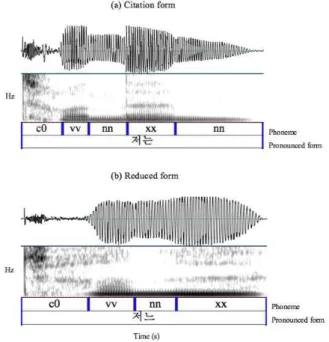
Figure 1 illustrates one example of the speech data analyzed in the present study and presents two types of pronunciation forms:
citation form (1a) and reduced form (1b). Each form provides two tiers with phonemes labeled as roman symbols and pronounced forms transcribed in Hangul. In Figure 1, the citation form, 저는 (i.e., [tʃə.nɨn], “I-Nom”), in (1a) did not undergo any reduction processes. However, the reduced form, 저느 (i.e., [tʃə.nɨ], “I-Nom”), in (1b) underwent the deletion of the word-final coda consonant, that is, the alveolar nasal [n]. In the reduced form of (1b), the alveolar nasal [n] was not seen in the waveform and spectrogram, compared with that of the citation form in (1a). As shown in (1b), the current study extracted the words that underwent deletion of syllabic-final or word-final coda consonants.
The Korean Corpus of Spontaneous Speech (Yun et al., 2016)
showed high percentages of labeling consistency for the analysis of
the present study. There were nine labelers for the corpus, and the
percentage agreement of transcription was 98.1% for all segments
(i.e., the detailed segments: stops, 99.1%; fricatives, 98.6%;
affricates, 98.3%; nasals, 96.6%; liquids, 99.5%; and vowels, 97.7%)
Figure 1. Coda consonant deletion extracted from the Korean Corpus of Spontaneous Speech: The alveolar nasal [n] in citation form (1a) (i.e., 저는: [tʃə.nɨn], “I-Nom”) was deleted in reduced form (1b) (i.e.,저느:
[tʃə.nɨ], “I-Nom”), showing no evidence in waveform and spectrogram.
2.3. Data analysis
In the current study, a mixed-effect linear regression model was designed to evaluate and interpret the outcome variable as the deletion patterns of syllabic- and word-final coda consonants. A mixed-effect model was constructed using the lmer function in the lme4 package (Bates et al., 2015) in R (version 3.2.2.). In this model, the word position (i.e., final vs. internal), the type of deleted consonants, the type of morphemes (i.e., root vs. affix), and the morpheme frequency were used as fixed-effects predictors. In order to consider subject-specific differences in coda deletion patterns, subjects were used as random-effects predictors regarding the intercept.
3. Results
3.1. Word positions
Tokens of coda consonants were coded for word positions (i.e., final vs. internal) to examine the effect of word structure on coda deletion. The proportion of deletion for word-final coda consonants was significantly different from that of word-internal coda consonants (β = -0.077253, t = -5.666, p < 0.001). As shown in Figure 2, the proportion predicting coda deletion in the word-final position was 0.89, and that of the word-internal position was 0.11.
This result reveals that productions of word-final coda consonants trigger much higher proportions of deletion in spontaneous speech than productions of word-internal codas.
Figure 2. Word positions relative to coda deletion. The word “final”
refers to deletion in the word-final coda position and “internal” refers to deletion in the word-internal position.
3.2. Coda consonant types
The deletion patterns in coda position show variability across the consonant types. The current study observed six consonant types in the patterns of coda deletion as shown in Figure 3. The alveolar nasal [n] has the highest proportion of coda deletion at 0.46, while the lateral liquid [l] has the second highest proportion of coda deletion at 0.4. The alveolar nasal did not show a significant difference compared to the lateral liquid (β = -0.005150, t = -0.827, p = 0.412). On the other hand, the alveolar nasal was significantly different from the bilabial nasal [m] (β = -0.042811, t = -6.872, p <
0.001), the bilabial stop [p] (β = -0.043844, t = -7.044, p < 0.001), the velar nasal [ŋ] (β = -0.036803, t = -5.907, p < 0.001), and the velar stop [k] (β = -0.038519, t = -6.183, p < 0.001). Other than the proportions of the alveolar nasal and lateral liquid sounds, other consonant types revealed low proportions of deletion (i.e., [m]:
0.017, [p]: 0.006, [ŋ]: 0.08, [k]: 0.06). Based on this result, it can be said that particular coda consonants are more frequently deleted than other consonants.
Figure 3. Consonant types relative to coda deletion: “alveolar nasal” [n],
“bilabial nasal” [m], “bilabial stop” [p], “lateral liquid” [l], “velar nasal”
[ŋ], and “velar stop” [k].
3.3. Effects of morphological structure
3.3.1. The relation of morpheme types and word positions
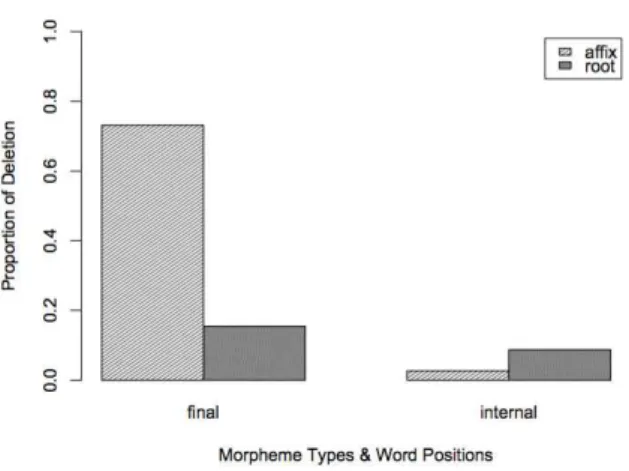
The types of morphemes within a word are generally divided into a root and an affix (or affixes). In order to consider whether coda deletion dependent on word position can affect the types of morphemes, the interaction between morpheme types and word positions was examined. As illustrated in Figure 4, the proportion of coda deletion in the word-final position was much higher for affixes (i.e., 0.73) than for roots (i.e., 0.15). Regarding coda deletion in the word-internal position, the proportion for affixes was 0.03, while the proportion for roots was 0.09, thus showing that there were few differences. Coda deletion according to morpheme type significantly differed between affixes and roots (β = -0.057725, t = -6.799, p <
0.001). Moreover, the relation of morpheme type and word position showed a significant interaction (β = 0.063734, t = 5.308, p <
0.001). Therefore, it is clear that the codas of word-final affixes are more likely to be deleted than those of other word positions.
Figure 4. The relation of morpheme types and word positions to coda deletion.
3.3.2. The relation of morpheme types and coda consonant types
It is assumed that the deletion of coda consonants can vary depending on the morpheme type. As shown in Figure 5, when the coda was an alveolar nasal, the proportions of morpheme types were 0.4 for affixes and 0.05 for roots. When the coda was a lateral liquid, the proportion was 0.35 for affixes and 0.05 for roots. For both coda consonants, the proportions of coda deletion significantly differed between affixes and roots. For other coda consonants, the proportion of deletion was not as high as both the alveolar nasal and lateral liquid. When the coda was a bilabial nasal, the proportion was 0.003 for affixes and 0.014 for roots; with a bilabial stop, the proportion was zero for affixes and 0.006 for roots. With a velar nasal, the proportion was 0.003 for affixes and 0.07 for roots; with a velar stop, the proportion was 0.006 for affixes and 0.05 for roots. A mixed-effect linear regression model showed that the interaction of the alveolar nasal and affixes was statistically different from the interaction of the bilabial nasal and roots (β = 0.036373, t = 6.237, p
< 0.001), the bilabial stop and roots (β = 0.035944, t = 6.164, p <
0.001), the velar nasal and roots (β = 0.042382, t = 7.267, p <
0.001), and the velar stop and roots (β = 0.040021, t = 6.863, p <
0.001). However, there was no significance for the interaction of the
means that when the codas of affixes were alveolar nasals or lateral liquids, the tendency of deletion increased.
Figure 5. The types of morphemes and consonants relative to coda deletion.
3.3.3. Affix frequencies with coda deletion
Affixes are used to produce new words in speech. As shown in Table 1, there were very common affixes that underwent the coda deletion process in spontaneous Seoul Korean speech. The most frequent affix, [nɨn], was 0.40 in its proportion among affixes. The second frequent affix, [lɨl], was 0.25. These proportions of affixes that occurred in spontaneous speech reflected the proportions of coda deletion observed in the previous sections. Table 1 revealed that the codas of the seven most frequent affixes were alveolar nasals and lateral liquids. The frequencies of these affixes confirm that the coda deletion proportions for an alveolar nasal and a lateral liquid were much higher than other coda consonants. Some less common affixes with very low proportions were excluded from Table 1.
Table 1. The seven most frequent affixes with coda deletion
3.4. Are there individual differences relative to coda deletion?
The current study predicted that there may be individual variability in coda deletion, but the differences between subjects, as shown in Figure 6, were not significant (i.e., M1, 0.08; M2, 0.09; M3, 0.07;
M4, 0.15; M5, 0.14; F1, 0.02; F2, 0.03; F3, 0.125; F4, 0.14;and F5,
0.137). The mixed-effect linear regression model also showed no
significant differences for the intercepts of subjects. The highest
intercept value, as shown in Figure 7, was 0.005, while the lowest
intercept value was -0.007. The intercept values above zero for the
subjects 4, 9, 5, 10, and 8 in Figure 7 corresponded to the
proportions of deletion for the subjects M4, F4, M5, F5, and F3 that
represented the five highest proportions of coda deletion in Figure 6.
Both the proportion of coda deletion and intercept for each subject indicated that there was little variation for consonant deletion in the coda position of affixes.
Figure 6. Individual differences relative to coda deletion (“M” = male;“F” = female).
Figure 7. The intercept value for each subject relative to coda deletion (subjects: 1, 2, 3, 4, 5 = males; 6, 7, 8, 9, 10 = females).
4. Discussion
The current study concerned the effects of morphological structure on the patterns of coda deletion in words drawn from spontaneous Seoul Korean speech. To summarize, the findings are as follows:
First, when predicting coda deletion, there was strong evidence that the codas of word-final affixes were more likely to be deleted than other types. Second, the coda deletion of consonant types, such as an alveolar nasal [n] and a lateral liquid [l], was associated with the affix frequency that appeared in spontaneous Seoul Korean speech.
Additionally, the coda deletion observed in affixes did not show significant variation among subjects. Regarding these aspects of coda deletion, the findings will be examined in further detail in the following subsections.
4.1. Consonant type effects on word-final coda deletion The major factor promoting coda deletion in the current study was the coda’s position within a word. It has been well documented that codas in the word-final position tend to undergo a reduction process compared with codas in other positions. The current study observed that the highest occurrence of coda deletion was in the word-final position, while coda deletion in the word-internal position was infrequent. A word-internal coda was likely to be resyllabified as an
onset in the event that an onset was absent in the following syllable.
In the dataset of the current study, a word such as [tʃin. tʃ*a] ‘real’
underwent coda deletion (i.e., [n]) word-internally, as in [tʃi.tʃ*a], when it was followed by an onset consonant. However, coda deletion in the word-internal position showed an insignificant proportion in the current results. On the other hand, the proportion of word-final coda deletion played a prominent role, thus indicating the positional factor in accounting for the deletion of codas.
In the current study, the consonants deleted in the word-final position revealed six types of consonant classification (i.e., [n, m, p, l, ŋ, k]). Alveolar consonants such as [n] and [l] were most likely to undergo deletion, as both [n] and [l] showed much higher deletion proportions in word-final position than other codas. Research has long shown that alveolar consonants are often prone to the process of reduction, particularly in English word-final positions (Coetzee &
Pater, 2011; Guy, 1991; Keating, 1998; Labov, 1989). The common deletion of [n] and [l] in the word-final coda position of spontaneous Seoul Korean speech occurs in the same place of articulation (i.e., alveolar) as observed in English. However, the phonetic characteristics triggering the deletion of [n] and [l] in Korean needs to be examined in future research.
4.2. Affix effects on word-final coda deletion
Increased coda deletion in the word-final position was found to be related to morpheme type. In the dataset of the current study, the affixes at the ends of words often underwent deletion in coda position. Given that there is a division between a root and an affix in a word structure, the proportion of coda deletion for affixes was statistically more significant than that of roots. In the word-internal position, the difference in coda deletion between affixes and roots was not significant, thus indicating that the prominent factor promoting coda deletion was the word-final affixes (e.g., Lammert et al., 2014; Pluymaekers, 2007). The affixes in the word-final position tended to have their codas deleted, and the consonant types predicting coda deletion were mostly alveolar consonants such as [n] and [l]. The affixes [nɨn] and [lɨl] showed high proportion in coda deletion. In observing the proportion of coda deletion in affixes, [nɨn] was the most frequent affix and [lɨl] was the second most frequent one. The seven most frequent affixes with coda deletion as displayed in Table 1 showed the deletion of alveolar consonants [n] and [l] in their coda positions. In other words, alveolar consonants tended to be deleted in the coda position of affixes in spontaneous Seoul Korean speech. More specifically, high-frequency affixes such as [nɨn] and [lɨl] were more likely to be reduced in the word-final position. The affixes [nɨn] and [lɨl] are very common affixes used to complete Korean sentences and provide no primary semantic content. Considering the current results, it is assumed that affixes without critical semantic information can be targets in triggering extreme articulation (i.e., deletion). In contrast to the results of the current study, the codas in affixes in American English were deleted less often when the affixes were used as past tense verb forms than in monomorphemic verbs (Coetzee & Pater, 2011; Guy, 1991). The findings imply that affixes in Korean such as [nɨn] and [lɨl] do not convey substantial information to the listeners in conversational speech. Therefore, the affixes in example (2) tend to undergo coda deletion more frequently than the roots in example (1).
Generally, the current results showed that alveolar consonants as
affixes’ codas tend to undergo reduction in subjects’ articulatory
strategies. In particular, there were little individual differences relative to coda deletion in the current study. Some subjects used more coda deletion in affixes than other subjects, but there was insignificant variation in individual degrees of deletion. With respect to the current evidence, the coda deletion in affixes seems to be a general tendency that can occur frequently in spontaneous speech.
5. Conclusion
The current study examined one process of reduction (i.e., deletion) in coda positions from the Korean Corpus of Spontaneous Speech.
Less attention has been paid to the deletion of coda consonants in word-final affixes. However, the current study found that high-frequency affixes are likely to be reduced in word-final position. Moreover, the patterns of coda deletion in affixes can vary depending on the place of articulation of coda consonants. It was established that alveolar consonants in coda position are prone to undergoing reduction; this reflects a general effect on individual variance. On this point, however, the current study’s investigation of the patterns of coda deletion has been limited to the morphological structures of words. Areas of further investigation regarding coda deletion include linguistic variables such as function vs. content words, phonetic context, and extra-linguistic variables such as the rate of speech, speaker age and gender, and speech fluency. These items will be reserved for future studies.
References
Bates, D., Maechler, M., Bolker, B., & Walker, S. (2015). Fitting linear mixed-effects models using lme4. Journal of Statistical Software, 67, 1-48.
Bell, A., Jurafsky, D., Fosler-Lussier, E., Girand, C., Gregory, M., &
Gildea, D. (2003). Effects of disfluencies, predictability, and utterance position on word form variation in English conversation.
The Journal of the Acoustical Society of America, 113, 1001-1024.
Bien, H., Baayen, H., & Levelt, W. J. M. (2011). Frequency effects in the production of Dutch deverbal adjective and inflected verbs.
Language and Cognitive Processes, 26, 683-715.
Coetzee, A., & Pater, J. (2011). The place of variation in phonological theory. In J. Goldsmith, J. Riggle, & A. C. L. Yu (Eds.), The handbook of phonological theory (2
ndedition), (pp. 401-434).
Oxford: Blackwell.
Dilts, P. (2013). Modelling phonetic reduction in a corpus of spoken English using random forests and mixed-effects regression. Ph.D.
Dissertation, University of Alberta.
Godfrey, J., Holliman, E., & McDaniel, J. (1992). Switchboard:
Telephone speech corpus for research and development.
Proceedings of the IEEE International Conference on Acoustics, Speech, and Signal Processing (pp. 517-520). San Francisco.
Guy, G. R. (1991). Contextual conditioning in variable lexical phonology. Language Variation and Change, 3, 223-239.
Johnson, K. (2003). Massive reduction in conversational American English. In K. Yoneyama, & K. Maekawa (Eds.), Spontaneous speech: Data and analysis. Proceedings of the 1st session of the 10th International Symposium (pp. 29-54). Tokyo, Japan.
Jurafsky, D., Bell, A., Fosler-Lussier, D., Girand, C., & Raymond, W.
D. (1998). Reduction of English function words in Switchboard.
Proceedings of the International Conference on Spoken Language Processing (pp. 3111-3114).
Jurafsky, D., Bell, A., Gregory, M., & Raymond, W. D. (2001).
Probabilistic relations between words: Evidence from reduction in lexical production. In J. Bybee, & P. Hopper (Eds.), Frequency and the emergence of linguistic structure: Typological studies in language 45 (pp. 229-254). Philadelphia: John Benjamins.
Keating, P. (1998). Word-level phonetic variation in large speech corpora, In A. Alexiadow, N. Fuhrhop, U. Kleinhenz, & P. Law (Eds.), ZAS Working Papers in Linguistics, 11, 35-50.
Kim, J. (2015). The effect of word frequency on the reduction of English CVCC syllables in spontaneous speech. Phonetics and Speech Sciences, 7, 45-53.
Kim, J., Yun, W., & Kang, D. (2016). Patterns of consonant deletion in the word-internal onset position: Evidence from spontaneous Seoul Korean speech. Phonetics and Speech Sciences, 8, 45-51.
Labov, W. (1989). The child as linguistic historian. Language Variation and Change, 1, 85-97.
Lammert, A., Goldstein, L., Ramanarayanan, V., & Narayanan, S.
(2014). Gestural control in the English past-tense suffix: An articulatory study using real-time MRI. Phonetica, 71, 229-248.
Oostdijk, N. (2000). The spoken Dutch corpus project, The ELRA Newsletter, 5, 4-8.
Pitt, M. A., Dilley, L., Johnson, K., Kiesling, S., Raymond, W., Hume, E., & Fosler-Lussier, E. (2007). Buckeye corpus of conversational speech (2
ndrelease). [www.buckeyecorpus.osu.edu] Columbus, OH: Department of Psychology, Ohio State University (Distributor).
Pluymaekers, M. (2007). Affix reduction in spoken Dutch:
Probabilistic effects in production and perception. Ph.D.
Dissertation, Radboud University, Nijmegen.
Raymond, W. D., Dautricourt, R., & Hume, E. (2006). Word-internal /t, d/ deletion in spontaneous speech: Modeling the effects of extra-linguistic, lexical, and phonological factors. Language Variation and Change, 18, 55-97.
Yao, Y. (2011). The effects of phonological neighborhoods on pronunciation variation in conversational speech. Ph.D.
Dissertation, The University of California at Berkeley.
Yun, W., Yoon, K., Park, S., Lee, J., Cho, S., Kang, D., Byun, K., Hahn, H., & Kim, J. (2015). The Korean corpus of spontaneous speech. Phonetics and Speech Sciences, 7, 103-109.
● Jungsun Kim