ABSTRACT
Background and Objectives: Implantation of cardiac implantable electronic devices (CIED), including permanent pacemakers (PM), implantable cardioverter-defibrillators (ICD), and cardiac resynchronization therapy (CRT) devices, has increased significantly over the past several years. However, limited data exists regarding temporal trends of CIED implantations in Asian population. This study aimed to investigate temporal trends of CIED treatment in Korea.
Methods: Using the National Health Insurance Service database of the entire Korean adult population, temporal trends of CIED procedures between 2009 and 2016 were evaluated.
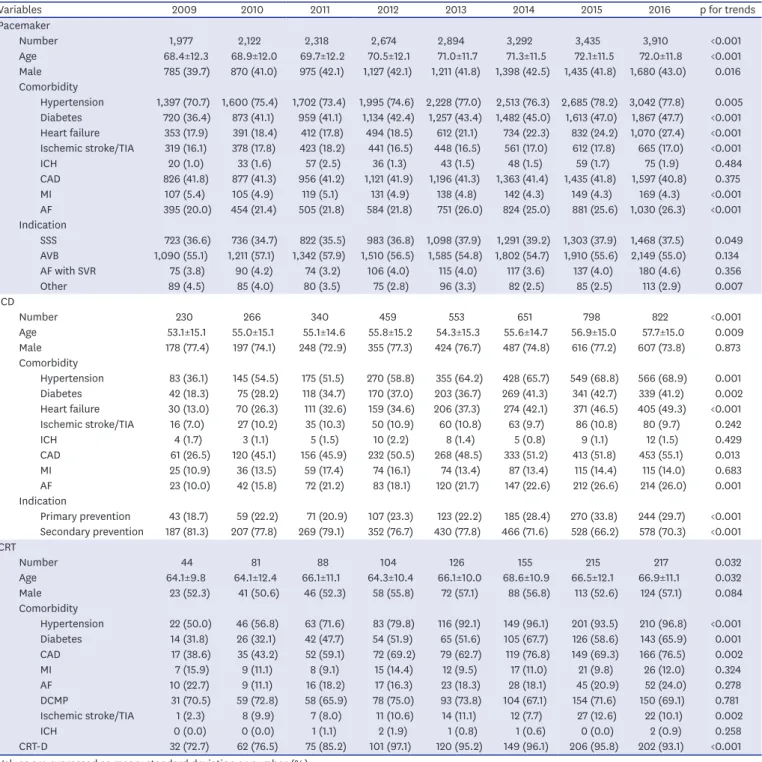
Additionally, temporal changes in the prevalence of patients' comorbidities were evaluated.
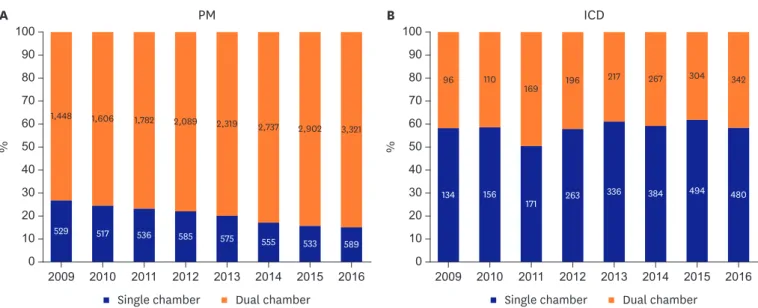
Results: A total of 35,421 CIED procedures (new implantations: 27,771, replacements: 7,650) were performed during the study period. The mean age of new CIED recipients and the prevalence of comorbidities, including hypertension, diabetes mellitus, heart failure, stroke, and atrial fibrillation, increased substantially with time. Compared to 2009, the number of new implantations of PM, ICD, and CRT devices increased by 2.0 (1,977 to 3,910), 3.6 (230 to 822), and 4.9 (44 to 217) times in 2016, respectively. The annual new implantation rate of CIED also increased accordingly (5.1 to 9.3 for PM, 0.6 to 1.9 for ICD, and 0.1 to 0.5 for CRT devices, per 100,000 persons).
Conclusions: The number of CIED implantation increased substantially from 2009 to 2016 in Korea. Also, the patients with CIED have been changed to be older and have more comorbidities. Therefore, the burden of health care cost in patients with CIED would be expected to increase in the future.
Keywords: Artificial pacemaker; Implantable defibrillators; Epidemiology pISSN 1738-5520·eISSN 1738-5555
Original Article
Received: Dec 16, 2018 Revised: Mar 4, 2019 Accepted: Mar 27, 2019 Correspondence to Eue-Keun Choi, MD, PhD
Department of Internal Medicine, Seoul National University Hospital, 101 Daehak-ro, Jongno-gu, Seoul 03080, Korea.
E-mail: [email protected]
*Ji Hyun Lee and So-Ryoung Lee contributed equally to this work.
Copyright © 2019. The Korean Society of Cardiology
This is an Open Access article distributed under the terms of the Creative Commons Attribution Non-Commercial License (https://
creativecommons.org/licenses/by-nc/4.0) which permits unrestricted noncommercial use, distribution, and reproduction in any medium, provided the original work is properly cited.
ORCID iDs Ji Hyun Lee
https://orcid.org/0000-0002-7162-1248 So-Ryoung Lee
https://orcid.org/0000-0002-6351-5015 Eue-Keun Choi
https://orcid.org/0000-0002-0411-6372 Jaehan Jeong
https://orcid.org/0000-0002-9433-6052 Hyung-Deuk Park
https://orcid.org/0000-0002-6418-7041 So-Jeong You
https://orcid.org/0000-0002-3760-943X Sang-Soo Lee
https://orcid.org/0000-0002-3619-6303 Seil Oh
https://orcid.org/0000-0002-2504-9615
Ji Hyun Lee , MD, PhD
1,*, So-Ryoung Lee , MD
2,*, Eue-Keun Choi , MD, PhD
2, Jaehan Jeong , BS
3, Hyung-Deuk Park , MS
3, So-Jeong You , BS
3,
Sang-Soo Lee , PhD
3,4, and Seil Oh , MD, PhD
21
Department of Cardiology, Cardiovascular Center, Seoul National University Bundang Hospital, Seongnam, Korea
2
Department of Internal Medicine, Seoul National University Hospital, Seoul, Korea
3
Medtronic Korea, Ltd., Seoul, Korea
4