http://dx.doi.org/10.5468/ogs.2016.59.3.208 pISSN 2287-8572 · eISSN 2287-8580
Introduction
The occurrence of pelvic organ prolapse (POP) in women sig- nificantly increases with age [1]. Approximately 40% of wom- en aged 49 to 75 years show evidence of vaginal prolapse, including anterior and vaginal vault prolapse [2]; over 200,000 surgical procedures to remedy this condition are performed in the United States each year [3]. The risk of a POP surgery throughout a woman’s life is 11%; 29.2% of these women undergo multiple surgeries [4]. As functional life expectancy increases, the demand for POP repair will also increase [5].
Vaginal extraperitoneal colpopexy with placement of an anterior and posterior mesh using a trocar-based kit is a mini- mally invasive approach to POP repair [6] that is associated with a good success rate (86.6%) at 1 year postoperatively [7].
However, there is concern that the vaginal mesh implant pro- cedure may present a risk of mesh exposure and poor func-
tional outcomes [8]. The Food and Drug Administration (FDA) has issued safety warnings regarding the use of vaginal mesh implants for POP. Our study aimed to evaluate the complica- tion and recurrence rates in patients undergoing trocar-guided synthetic mesh implant to treat POP.
A clinical study on the trocar-guided mesh repair system for pelvic organ prolapse surgery
Seul Gi Bak, Jeong Beom Moon, Sang Ki Hong, Kyoung Jin Kim, Kyoung A Kim, Ju Hyang Lee
Department of Obstetrics and Gynecology, Presbyterian Medical Center, Jeonju, Korea
Objective
To evaluate the complication and recurrence rates in patients undergoing trocar-guided mesh implant for pelvic organ prolapse (POP) treatment.
Methods
A retrospective study was performed based on the medical records of patients who had undergone mesh implant by one surgeon from May 2006 to August 2013 at the Presbyterian Medical Center in Korea. We evaluated perioperative complications such as bladder injury, mesh exposure, urinary symptoms, infections, and chronic pelvic pain. Recurrence was defined as a POP-quantification system stage ≥II or any symptomatic prolapse.
Results
Sixty-seven patients were evaluated, and the mean age of patients was 65.4±7.2 years. Stage ≥III POP-quantification Ba was noted in 61 patients (91%). Intraoperative complications included three cases of bladder injury (4.5%). The mean follow-up period was 44.1±7.9 months. Postoperative complications occurred in seven women (10.5%): four cases of urinary symptoms (6%), two cases of infections (3%), and one case of chronic pelvic pain (1.5%). Mesh exposure did not occur (0%). Prolapse recurrence was reported in five patients (7.5%).
Conclusion
Based on our operational result, the trocar-guided mesh implant seems to provide safe and effective outcomes.
Keywords: Complications; Pelvic organ prolapse; Recurrence; Surgical mesh
Articles published in Obstet Gynecol Sci are open-access, distributed under the terms of the Creative Commons Attribution Non-Commercial License (http://creativecommons.
org/licenses/by-nc/3.0/) which permits unrestricted non-commercial use, distribution, and reproduction in any medium, provided the original work is properly cited.
Copyright © 2016 Korean Society of Obstetrics and Gynecology Received: 2015.8.28. Revised: 2015.11.12. Accepted: 2015.11.12.
Corresponding author: Sang Ki Hong
Department of Obstetrics and Gynecology, Presbyterian Medical Center, 365 Seowon-ro, Wansan-gu, Jeonju 54987, Korea
Tel: +82-63-230-1502 Fax: +82-63-230-8115 E-mail: [email protected]
http://orcid.org/0000-0002-1432-8256
Materials and methods
We retrospectively reviewed medical records (non-randomized) from May 2006 to August 2013 at the Presbyterian Medical Center in Korea. All women presenting with POP were evalu- ated, including those treated with trocar-guided mesh im- plants. The medical history included the age, parity, hormonal status, prior prolapse surgery, and physical examination find- ings were recorded. POP was quantified preoperatively and during follow-up using the POP-quantification (POP-Q) system [9]. The mesh implant surgical technique was standardized ac- cording to local protocols [10]. The trocar-guided transvaginal mesh kit, Prolift (Gynecare/Ethicon, West Somerville, NJ, USA), and Easycele system (Biermedics, Wonju, Korea) were used to repair anterior and/or posterior prolapse. Intraoperative characteristics, including the estimated blood loss, type of an- esthesia, and operative time, were evaluated. We also noted concomitant hysterectomy as well as intraoperative and post- operative complications. A postoperative gynecological exami- nation was performed at 1 week; 1, 3, 6, and 12 months; and then annually. Failure was defined as recurrent prolapse of stage ≥II or any symptomatic prolapse of the same part at the surgical site.
In addition to the regular physical examination, all patients were contacted by phone in March 2015 to reassess their symptoms and inquire whether any complications occurred or if they required any other treatment related to their initial prolapse surgery. To achieve a longer follow-up period, we did not include patients who had undergone surgery <1 year previously and those who did not respond to the survey. Sta- tistical analysis was performed using IBM SPSS ver. 20.0 (IBM Corp., Armonk, NY, USA). Patients provided informed consent for study participation, and this study was approved by the Presbyterian Medical Center institutional review board.
Results
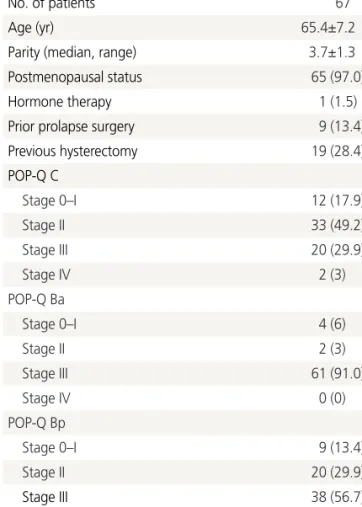
Sixty-seven women who were treated by vaginal mesh im- plants to treat POP were evaluated. The median follow-up pe- riod was 44.1±7.9 months. The procedures were performed by one gynecologist. Previous hysterectomies had been performed in 19 patients (28.4%). POP-Q Ba of greater than stage III were found in 61 women (91%) (Table 1).
Concomitant vaginal hysterectomy with mesh implants was
performed in 34 cases (50.7%). Intraoperative bladder injury occurred in three patients (4.5%) (Table 2), and it occurred in Table 1. Patients’ characteristics at surgery
Variable Value
No. of patients 67
Age (yr) 65.4±7.2
Parity (median, range) 3.7±1.3
Postmenopausal status 65 (97.0)
Hormone therapy 1 (1.5)
Prior prolapse surgery 9 (13.4)
Previous hysterectomy 19 (28.4)
POP-Q C
Stage 0–I 12 (17.9)
Stage II 33 (49.2)
Stage III 20 (29.9)
Stage IV 2 (3)
POP-Q Ba
Stage 0–I 4 (6)
Stage II 2 (3)
Stage III 61 (91.0)
Stage IV 0 (0)
POP-Q Bp
Stage 0–I 9 (13.4)
Stage II 20 (29.9)
Stage III 38 (56.7)
Stage IV 0 (0)
Values are presented as mean±standard deviation or number (%) un- less otherwise indicated.
POP-Q, pelvic organ prolapse-quantification.
Table 2. Intraoperative status and complications
Associated surgery Value
Surgical method
Anterior and/or posterior repair only 33 (49.3)
Concomitant hysterectomy 34 (50.7)
Type of anesthesia
General 23 (34.3)
Spinal 44 (65.7)
Operative time (min) 101.6±23.7
Intra-operative blood loss (mL) 95.3±30.6 Perioperative complications
Perioperative bladder injury 3 (4.5)
Values are presented as number (%) or mean±standard deviation.
the tenth, forty-seventh, and forty-ninth case of 67 patients.
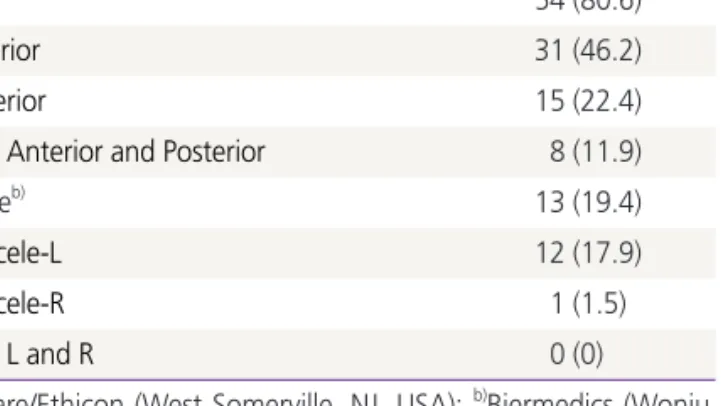
The Prolift system was used in 80.6%, and the Easycele sys- tem was used in the remaining patients, since Prolift produc- tion was stopped following an FDA safety warning (Table 3).
Postoperative complications occurred in seven cases (10.5%) throughout the follow-up period, which included four cases of urinary symptoms (6%), two cases of infection (3%), and one case of chronic pelvic pain (1.5%). The cases of urinary symptoms included two of incontinence and two of frequen- cy. Mesh exposure did not occur. Urinary symptoms or chronic pelvic pain was considered a complication only when the symptoms were serious in comparison to the symptoms preoperatively or those de novo postoperatively. To classify infection as a complication, it had to have occurred postoper- atively and be sufficiently serious enough to require treatment.
The prolapse recurrence rate during the follow-up period was 7.5% (Table 4).
Discussion
The FDA warning published in July 2011 [11] reported the potential risk and complications of mesh implants, prompting a critical debate and exciting developments in POP surgery [12]. After the FDA statement, many vaginal mesh kits for POP repair have been withdrawn from the market; however, com- parative studies of vaginal mesh repair and anterior colpor- rhaphy for anterior compartment prolapse showed a decrease in prolapse recurrence [13]. Recent studies have also reported the anatomical success of transvaginal mesh-augmented reconstruction, demonstrating reinforcement of native con- nective tissue repair by up to 10% [14,15]. In advanced stages of cystocele and recurrent cases, there is often a lack of suffi- cient connective tissue to achieve reconstruction between the vaginal wall and bladder, leading to an increase of cystocele recurrence of at least 20% and as high as 67% [16,17]. Re- currence rates are up to 58% after traditional POP procedures [18]; however, synthetic mesh implants support the weak native connective tissue, which helps fix the prolapsed pelvic compartment, especially the anterior wall. In our study, the postoperatively recurrence rate for POP treatment was 7.5%, which is similar to a previously published recurrence rate of 8.0% after mesh implant [19].
Increased complication rates have also been associated with transvaginal mesh procedures [20-22]. In previous stud- ies, mesh exposure was reported as the primary complication contributing to surgical revisions, occurring at rates of 3.2%
to 10% [13,14,19,23]. Jambusaria et al. [8] noted that the increased risk of complication related to vaginal mesh expo- sure may be related to the surgical technique, specifically the depth of dissection of the vaginal wall. According to their study, the depth of vaginal incision for mesh placement dif- fers between surgeons. A more superficial dissection causes subsequent superficial placement of the mesh and increased risk of mesh exposure. Marschke et al. [12] reported the surgi- cal technique as one of the main factors for a low erosion rate (3.2%). Procedures performed by experienced surgeons are associated with low complication rates, especially the rate of exposure [24]. In our study, there was no case of mesh ex- posure or erosion. Moreover, perioperative bladder perforation occurred in three cases (4.5%). The risk of bladder injury re- lated to transvaginal mesh surgery was 1.6% to 3.5% [13,25], which was 6.71-fold greater than that of colporrhaphy [26].
The higher frequency of perioperative bladder injury and the Table 3. The mesh system used in the mesh group
Mesh system Number (%)
Prolift
a)54 (80.6)
Anterior 31 (46.2)
Posterior 15 (22.4)
Both Anterior and Posterior 8 (11.9)
Easycele
b)13 (19.4)
Easycele-L 12 (17.9)
Easycele-R 1 (1.5)
Both L and R 0 (0)
a)