Phonetic variations of Korean liquids in Seoul Corpus
Miyeon Ahn
(Hankyong National University)
Ahn, Miyeon. 2021. Phonetic variations of Korean liquids in Seoul Corpus.
Studies in Phonetics, Phonology and Morphology 27.2. 215-228. The purpose of this study is to explore the acoustic aspects of the Korean liquid ‘l’ by examining spontaneous speech of Seoul Korean from Seoul Corpus (Yun et al. 2015). The Korean liquid appears in various positions within a word, although word-initial occurrences are limited to loanwords. In this study, we classified Korean liquids into separate categories depending on their phonological contexts, and then analyzed the acoustic nature of the liquids in each category. Both the temporal and spectral properties of the liquids were found to be gradient rather than categorical.
(Hankyong National University, Assistant professor)
Keywords: liquid, Korean, phonological contexts, Seoul Corpus
1. Introduction
It is well known that Korean learners of English often experience the difficulty in differentiating English [l] and [ɹ]. This difficulty mainly results from the phonological difference between Korean and English in which, unlike English, Korean has a single liquid in its system, ‘ㄹ’ in Korean orthography Hangeul. The two distinctive English sound categories, thus, fall onto one in Korean. That is, English [l] and [ɹ] are alternative pronunciations of the same phonemic category in Korean (Maddieson 2013).
When listeners experience the difficulties in perceptual phonemic distinction, as in
the Korean case, language differences in terms of segmental contrasts are often
attributed to cause them. Listeners often perceive two non-native sounds as similar
and so find difficulties in discriminating two separate sound categories. It is widely
known that listeners experience various degrees of difficulties in discriminating
phoneme identification depending on their native language and segmental contrasts
(Best and Strange 1992, Best et al. 2001). Non-native categories are perceptually
assimilated to native ones and the degree of perceptual assimilation leads to gradient performance of listeners (Best et al. 1988).
As for the Korean liquid case, literatures have explained the two English liquids are not employed contrastively in Korean. Traditionally, phonologists have long discussed that Korean liquids are categorized into these two allophones depending on the phonological contexts as in that they are realized as either [ɹ] (or [ɾ]) between vowels but as [l] elsewhere (Cho and Whitman 2019, Carr 2020). Some of previous studies explained the [l] and [ɹ] distinction in Korean by adopting phonetic properties of Korean unreleased codas (Iverson and Sohn 1994) while others suggest the role of Lateral Onset Constraint in which the feature [lateral] is limited to coda only (McDonough 1995, Yoo 1996). See Cho and Iverson (1997) for further details.
In this study, we argue that the phonetic properties of Korean liquids are rather gradient with respect to their phonological contexts. In other words, where the liquids stand within a word results in dynamic phonetic characteristics of liquids. We investigate the contextual effect in acoustic realizations of Korean liquids by consulting various liquids from Seoul Corpus (Yun et al. 2015). It contains various natural speech collected in interview settings. Speakers participated in the interviews range from 10s to 40s with equal gender distributions. Seoul Corpus supplies with phonological boundary markings such as segmentation, word and utterance in both pronunciation and orthography. Consulting within-word position (i.e., whether liquids are placed in word-initial, -medial or -final) and phonological environments (i.e., neighboring sounds before a vowel or consonant), we classify liquids into several categories and examine the acoustic characteristics of various Korean liquids.
2. Analysis of Korean liquids in Seoul Corpus
In order to examine the acoustic properties of Korean liquids in various phonological contexts, we first examined where liquids can appear and classified them into categories below: Korean liquids appear in every position within a word, word-initial, -medial and -final and it can be preceded by either a consonant or a vowel.
Classifying words was based on phrasal words provided in Seoul Corpus.
Technically, therefore, the phonological environments where Korean liquid appears
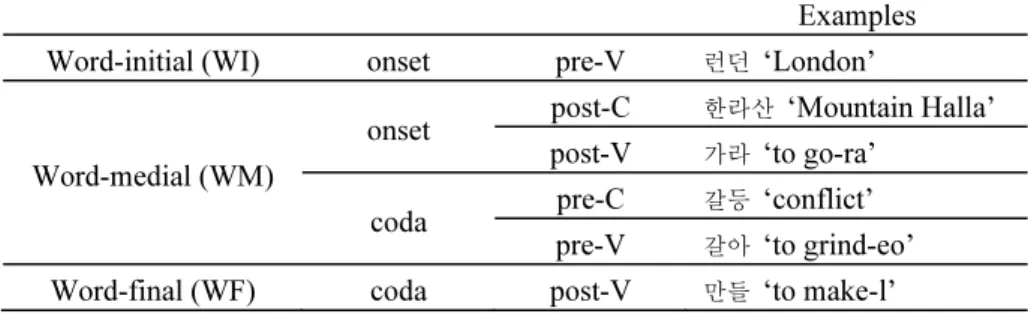
can be categorized into the six contexts as in Table 1. Since word-initial liquids are
limited to loanwords, we employed separate analysis for loans (2.1). Allophonic
palatalization was considered as a possible factor to vary the phonetic characteristics
of Korean liquids, we sorted out the repetition of liquids into a separate category (2.2). All the other environments were compared in parallel (2.3).
Table 1. Korean liquids in different environments
1Examples
Word-initial (WI) onset pre-V
런던‘London’
Word-medial (WM)
onset post-C
한라산‘Mountain Halla’
post-V
가라‘to go-ra’
coda pre-C
갈등‘conflict’
pre-V
갈아‘to grind-eo’
Word-final (WF) coda post-V
만들‘to make-l’
As Table 1 illustrates, orthographically, liquids appear in the six phonological contexts. Since Korean allows only one consonant for each onset and coda on the surface, a word-initial liquid cannot be followed by a consonant and a word-final one cannot appear after a consonant. That is, a pre-C onset or a post-C coda liquid is not allowed.
A word-medial liquid is rather complex: they may become an onset or a coda. On the one hand, the onset liquids can be preceded by a consonant (i.e., post-C) or by a vowel (i.e., post-V). In a post-C context, orthographically, word-medial onset liquids may follow obstruents or nasals as in 격려 ‘encouragement’ or 한라산 ‘Mountain Halla’. Due to Korean phonotactics, however, both obstruent+liquid and nasal+liquid sequences are not allowed on the surface (Iverson and Kim 1987, Han 1993, Jun 2000, Seo 2004) and so word-medial onset post-C is not found. These combinations change them into a sequence of nasals as in 격려 /kjʌkljʌ/ to [kjʌŋnjʌ] or a sequence of liquids as in 한라산 /hɑnlɑsɑn/ to [hɑllɑsɑn], respectively. These types of sound sequence restrictions are phonologically explained by adopting Syllable Contact Law (Davis and Shin 1999, Kang 2003). Word-medially, a coda Korean liquid followed by a vowel initial syllable is resyllabified into the following syllable.
In the word-medial post-V context, therefore, the liquid becomes to be placed between vowels which is where the liquid is known to be realized as [ɹ] or a flap in the literature. On the other hand, word-medial codas can be preceded by either a
1
Classifying words was based on phrasal words provided in Seoul Corpus.
consonant (i.e., pre-C) or by a vowel (i.e., pre-V). Pre-V coda liquids are also intervocalic that is phonologically same as word-medial onsets. The pre-V codas would be considered as onsets after syllabification, which is possibly different from post-V onsets in terms of phonetic realization.
Additionally, as in Table 2, we sorted out geminated liquids into a separate category in order to examine whether or not the first liquid in the geminate is acoustically different from the second. Previous studies have reported that Korean liquids become palatalized before [i] but not before any other vowels except [i] (Ahn, S.-C. 1985, Cho and Iverson 1997). We explore whether the acoustic difference between palatalized vs. non-palatalized liquids can be found in the corpus.
Table 2. Geminate liquids
Geminate _[i] palatalization 달리
_V No palatalization 달라
For the purpose of acoustic analysis, we first separated out all the liquids (i.e., /l/
phoneme) labelled as ‘ll’ in the Seoul Corpus and classified them into the categories provided above. Then we excluded some of words as follows: (i) words that should not be pronounced with liquids but they were (e.g., [polɛtʌn] 보래떤 for [ponɛtʌn]
보냈던 ‘having sent’), (ii) words with two coda consonants in orthography such as [tɑlm-ɑ] 닮아 ‘similar’ or [hɨlk-i] 흙이 ‘soil-SUB’, and (iii) word-medially liquid embedding loans such as [dɑunlodɨ] 다운로드 ‘download’ so as to avoid non- native lexical effects. As for a syllable-initial /h/, if it was pronounced as in [kɑcoktɨl-hɑko] 가족들하고 ‘with family’, the liquid was considered as a pre-C coda; otherwise, a pre-V coda as in [kɑcoktɨl-∅ɑko]. Words with a nasal+liquid sequence that is pronounced with the repetition of /ll/ as in ‘Mountain Halla’ were categorized as geminate. Some of the words that were not supposed to be geminates but pronounced so were included in this category such as 갈려고 ‘in order to go’ or 가질려고 ‘in order to have’ instead of 가려고 and 가지려고, respectively.
Concerning the acoustic properties of liquids, we examined both the temporal and spectral characteristics of Korean liquids in various contexts. We compare how the length and the formant frequencies vary depending on each phonological context.
Outliers were excluded by adopting Inter-Quartile Range (IQR) method in the
analysis of formant frequencies.
2.1 Word-initial liquids in loans
In contemporary Seoul Korean, a word-initial liquid is replaced by [n] or deleted [∅]
although it is spelled as ‘ㄴ’ or ‘ㅇ’ as in /lodoŋ/ 로동 to [nodoŋ] 노동 ‘labor’ or /lipalso/ 리발소 to [∅ibalso] 이발소 ‘barborshop’. This sound replacement of word-initial liquids into /n/ or zero pronunciation is due to an initial sound rule in Korean called Dueum Beopchik or Initial Law (Shin 2018). The rule applies to most of Korean words so a word-initial liquid is not found in native Korean words. Rather recently borrowed loanwords, however, are exceptions to this rule; thus, word-initial liquids are limited to loanwords such as /lʌntʌn/ 런던 ‘London’ or /lɛsʌpi/ 레서피
‘recipe’.
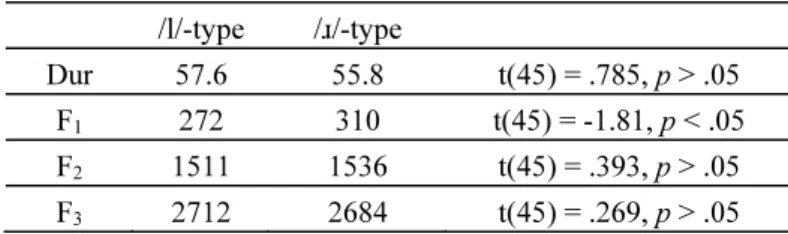
Unlike native words, pronouncing loans may be influenced by several factors including language fluency, the degree of nativization amongst others. One possible factor that we could examine in the corpus was whether the phonemic difference of the source of the loans possibly causes any liquid variations. To this end, we divided the word-initial liquid embedded words into l-type (e.g., London) vs. r-type (e.g., recipe) words. Table 3 below illustrates the temporal and spectral properties of word- initial liquids in the two categories.
Table 3. Mean duration (ms) and F
1, F
2and F
3(Hz) of Korean liquids by the source of the loans
/l/-type /ɹ/-type
Dur 57.6 55.8 t(45) = .785, p > .05 F
1272 310 t(45) = -1.81, p < .05 F
21511 1536 t(45) = .393, p > .05 F
32712 2684 t(45) = .269, p > .05
The duration, F
2and F
3in l-type vs. r-type liquids were not found to be different depending on the source of the loans, whereas, F
1frequency values were found to be different. The result is rather unusual in that concerning (i) English /ɹ/ is characterized by relatively low F
3frequency but /l/ is by rather high F
3(Ladefoged 2014) and (ii) English listeners distinguish /l/ and /ɹ/ by primarily relying on the F
3frequency values (Shinohara and Iverson 2018, Idemaru and Holt 2011), it is not
likely that Korean speakers differentiate F
1but not F
2and F
3. The significant
difference on F
1may be due to the limited number of observations and extended study with larger number of tokens would be necessary to investigate it in more detail. Tentatively, we could state that the temporal and spectral properties of Korean liquids are fairly consistent regardless of the phonemic difference of the source of the loans.
2.2 Geminated liquids
Korean liquids are known to be allophonically palatalized as [ʎʎ] before [i, j] (Ahn, S.-C. 1985, Cho and Iverson 1997). It is also known that speakers of Seoul Korean often delete the glide /j/ (Kang 1998). Since the deletion is variable, we limit the palatalized environment as before /i/ only context. Thus, the liquids before __ [i]
context is considered as ‘palatalized’ while before any other vowels __ [V] is non- palatalized. For the ease of analysis, the first one in geminated liquids is referred to as l
1and the second one as l
2. Excluding outliers, 4504 tokens were analyzed (949 palatalized vs. 3356 non-palatalized tokens and 2244 l
1vs. 2260 l
2tokens).
(a) (b)
(c) (d)
Figure 1. Mean duration (a) and the first three formants (b, c, d) in geminated
liquids
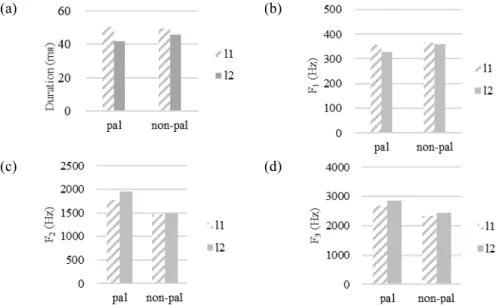
Figure 1 illustrates the duration and the first three formant frequencies of geminated liquids depending on palatalization (i.e., palatalized vs. non-palatalized) and liquid position (i.e., l
1vs. l
2). Four individual two-way ANOVAs were carried for duration, F
1, F
2and F
3in which these values were considered as dependent variables and palatalization and liquid position were independent variables. The statistical analysis for duration showed the significant main effects of palatalization [F(1, 4502) = 5.194, p < 0.05] and liquid position [F(1, 4502) = 62.816, p < .001]. The analyses for the three formants also showed the effects of palatalization (F
1, [F(1, 4502) = 18.408, p
< .001]; F
2, [F(1, 4502) = 49.502, p < .001] and F
3, [F(1, 4502) = 82.786, p < .001]), and liquid position (F
1, [F(1, 4502) = 46.712, p < .001]; F
2[F(1, 4502) = 1167.403, p
< .001] and F
3, [F(1, 4502) = 520.545, p < .001]) were significant. As Figure (1a) illustrates, the preceding liquid l
1was significantly longer than the following one l
2and non-palatalized liquids were longer than palatalized ones mostly due to long l
2in the context. In palatalized contexts, the first formant frequency of l
1was higher but the second and the third formants of l
1were lower than l
2as in Figure (1b, c and d).
The formant frequencies were similar in non-palatized contexts.
2.3 Liquids in other contexts
Excluding the previously analyzed two conditions – word-initial and geminated liquids – the rest phonological contexts were pooled to compare the duration and the three formants of liquids in each context. Since word-medial contexts were further divided into onset, coda pre-V and coda pre-C, the phonological contexts examined were four in total: word-final (WF), word-medial onset (WM_o), word-medial coda pre-V (WM_c_pre-V) and word-medial coda pre-C (WM_c_pre-C).
Figure 2 displays the gradient and dynamic temporal and spectral properties of
liquids depending on the various phonological contexts. Four one-way ANOVA were
conducted to examine whether the duration and the three formant frequencies vary by
where they stand within a word. As Figure 2 (a) shows, the temporal property, i.e.,
duration, was significantly different depending on the phonological conditions [F(3,
48156) = 2052.683, p < .001]. Both Scheffe and Tukey showed the duration of liquids
significantly differed in all conditions. The three formant frequencies were also
found to be significantly different by within word positions: F
1, [F(3, 48156) =
56.122, p < .001]; F
2, [F(3, 48156) = 253.608, p < .001] and F
3, [F(3, 48156) =
124.577, p < .001], respectively. Post-hoc tests showed that F
1in WM_c_pre-V was
different from those in the other three groups but F
1values in the rest three were not different. As for F
2, both WF and WM_o conditions were significantly different from each other and from WM_c_pre_V and WM_c_pre-C conditions. F
3, on the other hand, was found to be significantly different from in all conditions.
(a) (b)
(c) (d)
Figure 2. Mean duration (a) and the first three formants (b, c, d) in WF, WM_o, WM_c_pre-V and WM_c_pre-C liquids
3. Discussion
In the present study, we examined the durational and spectral properties of Korean liquids vary with respect to their phonological contexts. In this section, let us incorporate all the previously discussed statistical results and consider phonetic variations of Seoul Korean liquids along with their phonological consequences.
Taken the above results together, we found that Korean liquids show comparatively
various phonetic properties depending on phonological contexts. Table 4 summarizes
previously demonstrated acoustic properties of liquids in each category.
Table 4. Mean duration (ms) and F
1, F
2and F
3(Hz) of Korean liquids
WI WF WM_o WM_c_
pre-V
WM_c_
pre-C
dur 60 63 35 39 56
F
1291 367 363 343 351
F
21523 1673 1620 1742 1724
F
32698 2705 2673 2776 2739
With regard to the temporal properties, phonological contexts considerably affect the segmental duration of Korean liquids. Liquids vary in length in all contexts. Long liquids are found in WF and WM_c_pre-C, which is not surprising in that segmental length varies due to boundary effects. They are syllable-final and word-final, respectively, wherein domain final segments often become prolonged. Conversely, intervocalic liquids in WM_o and WM_c_pre-V were notably shorter than liquids in non-intervocalic contexts. This result is consistent with the previous literature in that intervocalic liquids are known to be realized as flaps/taps or [ɹ]. Concerning that flaps/taps are produced by a brief contact of two articulators and that their primary characteristic is short duration, it may be that intervocalic liquids are comparable to flaps/taps rather than [ɹ].
2It is interesting that liquids in WM_c_pre-V (e.g., 갈아) was longer than those in WM_o (e.g., 가라). Phonologically, liquids in these two contexts are equivalent as intervocalic; however, due to the difference in syllable structure, liquids in WM_c_pre-V are derived onsets while those in WM_o are canonical ones (Strycharczuk and Kohlberger 2016). To be articulated, derived onsets requires an extra step – resyllabification resyllabified as in /l.V/ /.lV/. This additional processing step may slow down overall articulatory procedures by allowing articulators to stay longer in their own articulatory gestures, which in turn extends the duration of coda liquids. Given that several factors affect segmental duration as well as syllable structure, further investigation needs to follow so that morphological, phrasal or prosodic boundaries are taken into account (Cho et al. 2014).
2