• 검색 결과가 없습니다.

The Effect of Prosodic Position and Word Type on the Production of Korean Plosives

N/A
N/A
Protected

Academic year: 2021

Share "The Effect of Prosodic Position and Word Type on the Production of Korean Plosives"

Copied!
11
0
0

로드 중.... (전체 텍스트 보기)

전체 글

(1)

말소리와 음성과학 제3권 제4호 (2011) pp. 71~81

ABSTRACT

This paper investigated how prosodic position and word type affect the phonetic structure of Korean coronal stops. Initial segments of prosodic domains were known to be more strongly articulated and longer relative to prosodic domain-medial segments. However, there are few studies examining whether the properties of prosodic domain-initial segments are affected by the information content of words (real vs. nonsense words). In addition, since the scope of domain-initial effect was known to be local to the initial consonant and the effects on the following vowel have been found to be limited, it is thus worth examining whether the prosodic domain-initial effect extends into the vowel after the initial consonant in a systematic way across different prosodic domains. The acoustic properties of Korean coronal stops (lenis /t/, aspirated /tʰ/, and tense /t’/) were compared across Intonational Phrase, Phonological Phrase and Word-initial positions both in real and nonsense words. The durational intervals such as VOT and CV duration were cumulatively lengthened for /t/ and /tʰ/ in the higher prosodic domain-initial positions. However, tense stop /t’/ did not show any variation as a function of prosodic position and word type.

The domain-initial lenis stop showed significantly longer duration in nonsense words than in real words. But the prosodic domain-initial effect was not found in the properties of F0 and [H1-H2] of the vowel after initial stops. The present study provided evidence that speakers tend to enhance speech clarity when there is less contextual information as in prosodic domain-initial position and in nonsense words.

Key words: prosodic-domain, Korean stops, word type, VOT, CV duration

1. Introduction

This research aims to explore how prosodic position and word type affect the phonetic structure of Korean stops. Segmental properties are known to be affected by prosodic structure.

Acoustic and articulatory studies have focused on both phrase-final intonational contrasts and final lengthening (Pierrehumbert & Beckman, 1988; Shattuck-Hufnagel et al., 1996) as well as initial prosodic domains across syllable, word and phrasal levels (Pirrehumbert and Talkin, 1992; Browman and Goldstein, 1995; Redford and Diehl, 1999; Keating et al., 1999;

Fougeron, 2001). It has been recently found that the initial

1) Seoul National University, [email protected]

접수일자: 2011년 11월 15일 수정일자: 2011년 12월 18일 게재결정: 2011년 12월 20일

segment of prosodic domains is more strongly articulated and longer relative to prosodic domain-medial segments (Fougeron &

Keating, 1997; Cho & Keating, 2001; Keating et al., 2003) and there is reduced coarticulation between phonemes that span the phonological phrase boundary (Byrd et al., 2000; Cho, 2004).

With regard to linguopalatal articulation at the word level, initial consonants have a greater linguopalatal constriction than medial consonants (Byrd, 1994; Keating et al., 1999). At phrase and sentence levels, more linguopalatal contact for coronal stops was shown in initial position of higher domain than in lower ones, as measured by electropalatography (e.g. in English (Keating et al., 1999), in French (Fougeron and Keating, 1997;

Fougeron, 2001) and in Korean (Cho & Keating, 2001).

Fougeron and Keating (1997) described the increase in

linguopalatal contact in domain-initial position as articulatory

strengthening, meaning the articulation of a consonant is more

extreme in initial position compared to medial, and more

(2)

extreme at the beginning of higher level constituents than at the beginning of lower ones. The articulatory properties found in initial segments reflect the hierarchical organization of the constituents.

Cho and Keating (2001) examined the effect of prosodic position on the segmental properties of the Korean consonants /n, t, tʰ, t’/ in initial position in five prosodic domains of the Korean prosodic hierarchy. The peak linguopalatal contact showed a progressively increasing pattern Utterance-initial (Ui)

> Intonational Phrase-initial (IPi) > Accentual Phrase 2) -initial (APi) > Word-initial (Wi) positions. A progressively increasing trend was also found in domain-initial lengthening of voice onset time (VOT) for /t, tʰ/ and total voiceless interval for /tʰ/

(Cho & Jun, 2000; Cho & Keating, 2001). The results of VOT in this study showed the pattern Ui > IPi > APi > Wi positions. Acoustic total voiceless interval combined voiceless closure duration and VOT. The aspirated stop showed the pattern IPi > APi > Wi. It revealed that the duration of glottal opening was greater in the higher prosodic positions than in the lower prosodic positions. Relative to /t/ and /tʰ/, /t'/ did not show variation in durational properties across prosodic domain-initial positions. With regard to the increasing trend in phrase-initial position, Jang (2011) also reported that VOT of Korean aspirated /pʰ/ was significantly longer at the beginning of a Phonological phrase (PP) than in the medial position of a PP.

In the study of domain-initial effects on bilabial stops /p, pʰ, p'/, Cho and Jun (2000) found that the three stop categories were maximally dispersed for VOT and integrated airflow in IPi position. They claimed that laryngeal contrast was enhanced in the higher prosodic domain-initial positions. However, in the recent studies of Korean plosives, it was also noted that lenis stops have a high degree of aspiration, at least for Seoul speakers and there is a change in progress concerning the contrast between lenis and aspirated stops. VOT differences between lenis and aspirated stops have decreased, in some cases to the point of complete overlap (Silva, 2006). In the perception study, it was confirmed that speakers were relying more heavily on the pitch/tone differences between lenis and aspirated stops than the VOT differences (Silva, 2006; Wright, 2007). Kang and Guion (2008) also reported that young

2) Accentual Phrase is constrained by non-syntactic factors such as pitch accent and phrasal tone (Jun, 1998). The Korean AP is known to have the underlying phrasal tone sequences, LHLH or HHLH.

speakers of Korean produced nondistinctive VOT values between aspirated and lenis stops. In their study of clear speech, the two stops were found to be differentiated with a small VOT difference, whereas F0 distance between the two stop categories was expanded. Since younger Korean speakers were predicted to have different phonetic targets for stop categories, it is worth examining how the three-way stop contrast is enhanced across different prosodic domain-initial positions.

In comparing RMS burst energy to each domain-initial vowel, there were no significant results. Cho and Keating (2001) mentioned that RMS burst energy was smaller for Ui and IPi than APi and Wi for /tʰ, t’/ but that the pattern was not found for /t/. In English, the RMS burst energy of /t/ was lower in Utterance-initial position than in Utterance-medial position (Cho & Keating, 2007). Since the effect of prosodic domain-initial position on RMS burst energy found in the previous studies was inconclusive, it is necessary to examine the difference for normalized RMS burst energy across different prosodic domain-initial positions. Since Cho and Keating (2001) did not normalize the RMS burst energy across speakers, it seems that the effect of prosodic domain-initial position could have been washed out by individual differences. In order to compare energy values of each speaker, RMS burst energy should be normalized.

In a study of phonetic variation as a function of different hyper-articulation conditions (in clear speech, IP-initial and focused conditions), Cho et. al (2011) found that relative to IP-medial CV syllables, /i/ and /a/ in IP-initial CV syllables showed extreme F1 and F2 values and its accompanying vowel space expansion. Their study also confirmed that there was no boundary-induced lengthening of the vowel after the IP-initial stops. One of interesting findings in their study was that intensity peak of the vowel in the second syllable and the second syllable duration were increased when the test word was positioned IP-initially than IP-medially. They claimed that the scope of domain-initial strengthening spreaded into the second syllable. However, their study was limited in the phonetic properties of stop and the following vowel in IP-initial and IP-medial positions. In order to find out the effect of prosodic domain on the phonetic manifestation of vowels, we need to compare the phonetic properties of the vowel after domain-initial stops across different prosodic domains.

It is well known that Korean stop and fricative categories

(3)

are distinguished in part by [H1-H2] values and F0. In the pilot study, it was found that [H1-H2] values after stops were greater in lower prosodic domain-initial positions than in higher prosodic domain-initial positions (that is, the creakiness of the vowel is less). When it comes to F0, it is well known that focused words are often phonetically realized by raising F0. In the study of English and Croatian (Similjanicˊ and Bradlow, 2005), pitch range expansion was found in clear speech. In the study of Korean, it was found that F0 peaks for the vowel in the domain-initial syllable were increased in focused condition (Cho et al., 2011) and the F0 difference across stop categories was enhanced in clear speech for younger speakers (Kang & Guion, 2008). Likewise, it is plausible to assume that F0 of the vowel is affected by different prosodic domain-initial positions. It is thus interesting to examine whether there is a distinction of F0 across different prosodic domain-initial positions.

In addition to the effect of prosodic domain-initial position, different word type is expected to influence the acoustic properties of prosodic domain-initial stops. According to Lindblom (1990), speakers have to be more careful in production when the listener has trouble understanding but they can be less careful and coarticulate more when the listeners have better conditions for understanding. Moon and Lindblom (1994) found that English front vowels were less coarticulated in clear speech compared to citation-form speech.

It has been also shown that speakers modulate the clarity of speech according to demands imposed by the information content of the message. For example, words produced in isolation were more accurately identified than the same words excised from running speech (Pollack & Pickett, 1963). The excised word tokens tend to have lower information content due to their greater predictability in the original contexts.

Relative to real word condition, nonsense words are hard to be predictable in the context and tend to contain higher information content. So, phonetic segments in nonsense words are expected to be more clearly articulated than those in real words due to the hyperarticulation of target words produced as nonsense words.

The contrast enhancement in clear speech and focused condition has been found in the previous studies (Kang &

Guion, 2008; Hay et al., 2006; Smiljanicˊ & Bradlow, 2005), but there are few studies comparing the segmental properties between real and nonsense words. Since speech production in nonsense word condition can be viewed as production along

the hyperarticulated end of the continuum, it is worth examining how phonetic properties of prosodic domain-initial segments vary as a function of different word types. If there is more enhancing of the phonetic properties in nonsense words, the results will also show more extended prosodic domain effects.

The goal of the present study is to examine whether initial Korean stops in higher prosodic domains have more enhanced acoustic properties than those in lower prosodic domains and to find out whether prosodic domain-initial properties are more reinforced in nonsense words than in real words. Based on the results of the previous analyses, it is expected that the durational properties of initial stops are enhanced in the higher prosodic domains than in lower prosodic domains. F0 of the vowel after initial stop is also expected to be higher in higher prosodic domains than in lower prosodic domains.

However, RMS burst energy and [H1-H2] of the vowel after initial stops are expected to be lower in higher prosodic domains than in lower prosodic domains. The prosodic domain-initial segments from nonsense words are expected to have more distinctive acoustic properties than those form real words.

The organization of this paper is as follows. I briefly introduce Korean plosives and their acoustic properties, and phonological hierarchy in Korean in section 1.1 and 1.2. In section 2, the research methods are provided. The results of the experiment are seen in section 3. Section 4 concludes the paper.

1.1. Korean plosives

Korean has a three-way phonation contrast among voiceless lenis ([p, t, k]), aspirated ([p

h

, t

h

, k

h

]) and tense stops ([p’, t’, k’]) and each of these occurs at three places of articulation:

bilabial, alveolar and velar. They use the pulmonic egressive airstream.

The phonetic correlates of this contrast have been examined by many researchers. In an acoustic study, Lisker and Abramson (1964) showed that Korean aspirated stops have the longest VOT, lenis consonants an intermediate VOT, and tense ones almost zero VOT. However, several researchers found that the VOT ranges overlap in Korean stops. In perceptual studies, it was also found that the difference in VOT alone was not sufficient for distinguishing the Korean three-way phonation contrast (Kim, 1965; Han and Weitzman, 1970; Kim, Beddor,

& Horrocks, 2002; Cho et al., 2002). Han and Weitzman

(4)

a. IP-initial position

IP

{nae toŋseŋdɨl-a},

IP

{

PP

{tasukjəl-lo kəlʧəŋ-hay}}

my brothers-Voc majority-by decide-do ‘My brothers, let’s make a decision by majority.’

b. PP-initial position

IP

{

PP

{sosimhan minsu-ka}

PP

{tasi toʧən-ɨl hay-s’ə}}

timid Minsu-Nom again challenge-Acc do-past ending ‘A timid Minsu challenged again’

c. Wd-initial position

IP
{

PP

{minyoungi-ka}

PP

{op’a tatʰɨ-lɨl}

PP

{pələ-s’əyo}}

Minyoung-Nom brother dart-Acc throw away-past ending 'Minyoung threw away her brother’s dart’

(1970) claimed that the acoustic intensity build-up in a vocalic segment following the three-way phonation contrast is highest after the tense consonants, intermediate after the aspirated and lowest after the lenis ones, contributing to the laryngeal distinction. They suggested that the onset value of F0 after aspirated and tense consonants is higher than that of lenis ones.

This result showed that F0 contrasts serve as a supplementary cue to distinguish lenis stops from tense and aspirated ones.

Several fiberscoptic studies of Korean (Kagaya, 1974; Jun, Beckman, & Lee, 1998) have reported that glottal opening was smallest for tense stops, moderate for lenis stops and largest for aspirated stops. In stroboscopic-cine MRI experiments, Kim et al. (2005) found that the glottis opens much wider for the aspirated consonants than for the tense and lenis ones word-medially and word-initially and that the movement of the tongue blade and closure duration varies from short to long in the order lenis < aspirated < tense.

The voice quality of the onset of the following vowel was found to be influenced by the preceding consonant (Abberton, 1972; Cho et al., 2002). The onset of vowels after lenis stops have a breathy voice as indicated by positive [H1-H2] values (the difference in amplitude between the first and second harmonics), whereas tense stops have some of the characteristics of creaky voice with smaller or negative [H1-H2] values (Cho et al., 2002).

1.2 Prosodic hierarchy in Korean

Speech utterances are hierarchically organized, with higher units being decomposed into lower constituents (Nespor &

Vogel, 1986; Selkirk, 1986). The sample structure of the hierarchical organization of the prosodic domains is given in Fig. 1.

The figure 1 illustrates that Syllables are grouped into Words; Words are grouped into Phonological Phrases (or Accentual Phrases); Phonological Phrases are grouped into Intonational Phrases. In Seoul Korean, the intermediate phrase between Words and Intonational Phrases is usually marked by LHLH or HHLH tonal pattern (Jun, 1998).

Intonational phrase IP Phonological phrase PP PP Word W W W W Syllable σ σ σ σ

Figure 1. Prosodic structure of Korean

2. Methods

2.1 Participants

Three male and three female speakers, aged 30 to 43, participated in the study. They are speakers of Seoul Korean, with no known hearing problems. They were graduate and undergraduate students at the University of Texas at Austin.

2.2 Materials

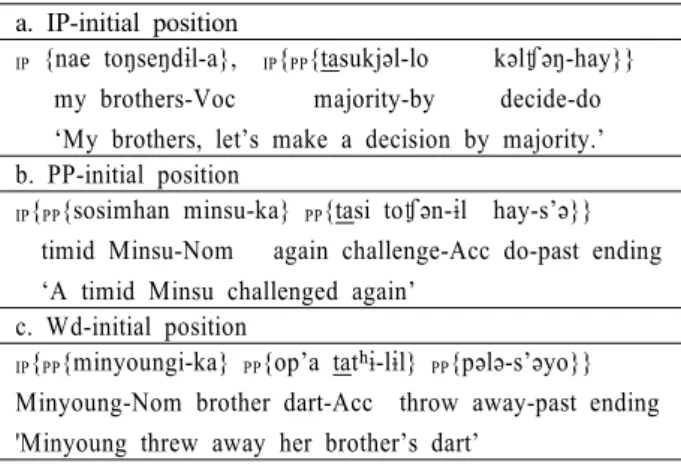
In order to test the hypotheses, the stimuli consisted of real words and nonsense words in which each of the three stops /t, tʰ, t’/ appeared in IP, PP, and Wd-initial positions. The IP was followed by a pause and also marked by lengthening on the final vowel and boundary tone. To place the target segments in PP-initial position, the segments were placed in the initial position of the second PP. The first PP was marked by either LHLH or HHLH pitch accent, while the second PP which was in an IP-final position was marked by boundary tone (L%). Wd-initial stops were placed within a PP.

In order to control vowel context, low vowel /a/ was used as the preceding and following vowel of the initial consonant of each prosodic domain. All test sentences consisted of 13 syllables in order to control the speech length. To summarize, there were 18 conditions (3 segment types * 3 prosodic positions * 2 word types) and 3 test sentences were used for each condition. Filler utterances, /ʧ, ʧʰ, ʧ’/ were used in the same prosodic positions both in real and nonsense words.

Representative stimuli are shown in table 1. The target CV is underlined in each prosodic position below.

Table 1. Example stimuli

In order to ensure that any enhanced phonetic properties of

the target segments are due to the effect of prosodic

domain-initial position, other prosodic factors need to be

(5)

controlled. For example, Hay et al. (2006) noted that there are several distinctiveness-enhancing correlates of vowels in [+focus] context in English, French and German. In producing vowels in [+focus] context, all three language groups increased spectral differences among vowels and German speakers increased vowel duration differences. So, to avoid possible confounding effects from focus, wh-questions were given in parenthesis before the target sentence as in (1). Since subjects tended to put their contrastive focus on the subject phrase as an answer to a wh-word, the target words were controlled in non-focused position. To avoid focus on the target IP, a focus-cueing sentence was suggested before the target sentence. The focus-cueing sentence was exactly the same as the target sentence except for the word in the first IP.

Because the target sentence already had the same information in the second IP, speakers tended to put a contrastive focus on the initial IP with new information and the target word in the second IP was controlled in non-focused position.

In the recording, subjects were not asked to read the wh-questions and focus-cueing sentences. The sample wh-questions is given in (1).

(1) nu-ka tasi toʧən-ɨl hay-s’ə?

Who-Nom again challenge-Acc do-past ending?

‘Who challenged again?’

2.3. Procedures

Subjects were asked to read materials written in Korean orthography, at a natural speaking rate throughout the recording session. The test sentences were presented in random order on separate slides in a timed PowerPoint presentation on an IBM laptop. The word list was rehearsed with sample sentences before the recording. Speakers were recorded in a sound-proof booth, using a solid state recorder, Maranz PMD 670, in the Phonetics Laboratory at the University of Texas at Austin. Recorded materials were digitized at a sampling rate of 22050 Hz.

2.4. Measurement

In order to compare the acoustic properties of stops in IP, PP and Wd-initial position, I measured VOT, CV duration, relative RMS burst energy, F0 and [H1-H2]. All measurements were taken in Praat. The detailed measurement points are specified in (2).

(2) a. Voice onset time: VOT for /t, tʰ, t’/ was taken from the point of release of noise or aperiodic wave to onset of periodicity in waveform

b. CV duration: CV duration for /t, tʰ, t’/ was taken from the point of the stop release to the offset of the vocalic energy associated with the following vowel. The duration of the silent stop closure was not included in measuring CV duration because in IP-initial position, the entire silent period before the stop release was likely to include a silent period associated with the IP boundary that was independent of stop production. So, the differences in stop closure duration among each prosodic position were eliminated in the current study.

c. RMS burst energy: The acoustic energy at the burst was measured from an FFT spectrum giving the RMS value over all frequencies. A 10 ms window was centered over the release of the stop /t, tʰ/. For the tense stop /t’/, a shorter window (less than 5 ms) was used in order to prevent the window from including the following vocalic energy. To normalize the energy difference across speakers, the percentage value of the burst energy relative to the energy at the midpoint of the following vowel was measured.

d. Fundamental frequency (F0):F0 was taken at the midpoint of the following vowel, using the pitch tracking function in Praat. When the pitch line abruptly moved or was discontinued, F0 was calculated by measuring the duration of the relevant period in seconds. As supplementary checks, the tenth harmonic values were divided by 10 from an FFT with a 25 ms window.

e. [H1-H2]:

The amplitude (dB) difference between the first (H1) and the second (H2) harmonic was measured just after the first full glottal pulse of the vowel onset in the waveform. The amplitude values were calculated using a narrowband fast Fourier transform spectrum using a Hamming window (window length of 25 ms).

3. Results

In the results of duration parameters, I excluded several test

sentences for /t/ in Wd-initial position due to the voicing of

the segment. It has been known that lenis stop in Korean

(6)

becomes voiced intervocalically within an intermediate phrase, AP or PP. However, only one speaker produced voiced lenis stop in Wd-initial positions in this experiment.

As evidence for demarcation across three different prosodic positions, phrase-final lengthening was also considered. Final vowels were lengthened cumulatively when the position moves up in the hierarchy in the order IP >> PP >> Wd. I excluded test sentences when they did not show a three-way distinction across the prosodic domains in phrase-final lengthening.

3.1 VOT

Figure 2. Pooled graph of VOT by segment type * prosodic domain

In Fig. 2, VOT values of the stop categories in real and nonsense words were compared across three different prosodic domain-initial positions IP, PP and Wd. In the graph, t-NS, tʰ-NS, and t'-NS represent /t/, /tʰ/, and /t'/ in nonsense words, respectively.

It displays that for /t/ and /tʰ/, VOT values are greatest in IP, intermediate in PP and smallest in Wd-initial position.

Results of a repeated measures analysis of variance (ANOVA) on VOT showed significant main effects for stop category (F (2, 10) =55.581, p <0.000), prosodic position (F (2, 10) =8.989, p =.006), and word type (F (1, 5) =16.878, p

=.009). There was also a highly significant interaction among prosodic position, stop category and word type (F (4, 20) = 32.546, p <.000).

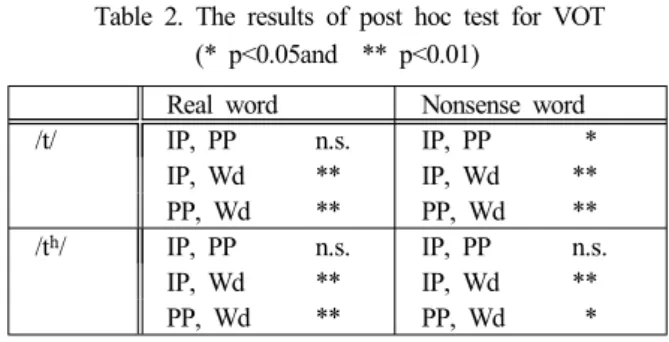
The results of pairwise post hoc analyses are seen in Table 2. VOT values for both /t/ and /tʰ/ between IP and Wd, and PP and Wd were found to be significantly different in real and nonsense words. However, there was no significant difference of VOT between IP and PP for /tʰ/ in real and nonsense word, and for /t/ in real words. /t/ in nonsense words showed a significant difference between IP and PP.

That is, VOT distinction between IP and PP was not as clear as between IP and Wd, and between PP and Wd and the

results showed the pattern IP, PP >> Wd in general. For /t’/, there is no significant distinction among the three different domain-initial positions and between two word types across.

In the comparison between real and nonsense words, only lenis stop showed a significant difference between the two word types in IP-initial position (p=.008). So, speakers exhibited enhanced VOT in higher prosodic domain-initial positions for /t/ and /tʰ/ and a limited word type effect on /t/.

Table 2. The results of post hoc test for VOT (* p<0.05and ** p<0.01)

Real word Nonsense word

/t/ IP, PP n.s. IP, PP *

IP, Wd ** IP, Wd **

PP, Wd ** PP, Wd **

/tʰ/ IP, PP n.s. IP, PP n.s.

IP, Wd ** IP, Wd **

PP, Wd ** PP, Wd *

3.2. CV Duration

Figure 3. Pooled graph for CV duration by segment type * prosodic domain

In Fig.3, the CV durations of target stops were compared at IP, PP and Wd-initial positions between the two word types.

The pooled graph shows that the CV duration is shortest in Wd-initial position than in the other prosodic domain-initial positions for /t/ and /tʰ/ in real and nonsense words, and /t’/

in nonsense words. These segments showed cumulatively increasing CV durations when a position moved up in prosodic hierarchy.

The main effects for stop category and word type were

significant but the prosodic position effect was not significant

(F (2, 10) =25.864, p < .000 for stop category; F (2, 10) =

.205, p = .818 for prosodic position; F (1, 5) = 7.980, p =

.037 for word type). There was highly significant interaction

of prosodic position, stop category and word type (F (4, 20)

(7)

= 7.147, p < .001).

The results of follow-up analyses showed that for /t/ and /tʰ/, the CV durations across the three different prosodic positions were significantly different only in the real word condition. In this context, CV durations differed significantly between IP and Wd, and between PP and Wd-initial positions. But they did not differ significantly between IP and PP-initial positions for both /t/ and /tʰ/. This result is the same as we saw for VOT values. As with the results of VOT, the results of CV duration for lenis and aspirated stops showed the pattern IP, PP >> Wd in real words.

Table 3. The results of post hoc test for CV duration (* p<0.05 and ** p<0.01)

Real word Nonsense word

/t/ IP, PP n.s. IP, PP n.s.

IP, Wd * IP, Wd n.s.

PP, Wd * PP, Wd n.s.

/tʰ/ IP, PP n.s. IP, PP n.s.

IP, Wd ** IP, Wd n.s.

PP, Wd ** PP, Wd n.s.

The post hoc tests for the two word types revealed that only lenis stop showed significant difference between real and nonsense words in Wd-initial position (p=.007). The other stops did not show significant difference between the two word types across different prosodic positions.

Relative to the other stops, /t'/ in real words did not show increasing trend in higher prosodic domain-initial positions. It had longer CV duration in Wd-initial position than in the other higher prosodic domain-initial positions. Although /t'/

showed enhanced CV duration in the higher prosodic domains in nonsense words, the difference was not statistically significant. The CV durations of /t’/ in real and nonsense words were relatively shorter than those of the other stops.

The duration of the stop closure was known to be longest for tense stop among Korean stop categories, but the acoustic closure duration was excluded in the current measurements of CV duration, resulting in a relatively shorter CV duration for tense stop. So, the inconsistent variation for tense stops across prosodic domains was related to the results of VOT.

3.3. Relative RMS Burst Energy

Figure 4. Pooled graph for relative RMS burst energy by segment type * prosodic domain

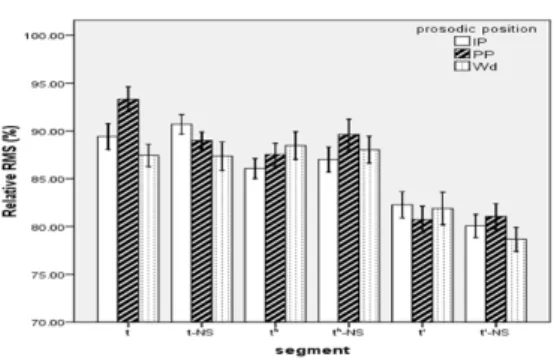
Figure 4 displays that the results of relative RMS burst energy do not show systematic difference across the three prosodic positions for all stops but that /t’/ has relatively smaller relative RMS burst energy than the other stops.

The main effect for stop category was significant but the other main effects were not significant (F (2, 10) = 27.738, p

< .000 for stop category; F (2, 10) = .628, p = .553 for prosodic position; F (1, 5) = .021, p = .890 for word type).

None of the interactions were significant. The significant effect of stop category was due to the fact that the relative RMS of /t’/ was relatively smaller than that of the other stops.

The results of this study did not have the same pattern as in Cho and Keating (2001). They showed that RMS burst energy was smaller for Ui and IPi than for APi and Wi for

/tʰ, t’/ but there was no systematic pattern for /t/. Only /tʰ/

in the current study paralleled their findings, but /t’/ did not replicate their results in Cho and Keating (2001). Since the significant difference across prosodic positions was not found in this study with a relatively large subject pool, it is hard to conclude that there is a significant prosodic effect on RMS burst energy.

3.4. F0

Figure 5. Pooled graph for F0 by

segment type * prosodic domain

(8)

In Figure 5, F0 in IP-initial position is higher than in the other prosodic domain-initial positions except for /t'/ in nonsense words. F0 after a lenis stop is lower than F0 after the other stops, in general.

The main effect for stop category was significant but the effect of prosodic position was not significant (F (2, 10)

=13.767, p = .001 for stop category; F (2, 10) =1.444, p = .281 for prosodic position). The main effect for word type was significant (F (1, 5) = 12.391, p = .017 for word type).

None of the interactions were significant. Although there was significant word type effect on F0, the results of F0 did not show consistent variation across prosodic domain-initial positions.

In comparison of F0 after stop categories, there was no distinction of F0 between aspirated and tense stops for Seoul speakers in Cho et al. (2002). But in their study, the target stops were placed in the initial position of a word in isolation and words produced in isolation, while target stops in the current study were placed across different prosodic domain-initial positions in the middle of test sentences. In addition, target segments were controlled to be placed in non-focused positions. Since all speakers in this study showed greater F0 after aspirated stop than after tense stop, the results of this study showed that the distinction of F0 after aspirated and tense stops existed in continuous speech.

3.5. [H1-H2]

In Figure 6, [H1-H2] values at the following vowel of target stops were compared at IP, PP and Wd-initial positions in real and nonsense words. The pooled graph illustrates that [H1-H2] values are greater (positive) after lenis and aspirated stops than after tense stops.

Figure 6. Pooled graph for [H1-H2] difference by segment type * prosodic domain

The main effect for stop category was significant but the other main effects were not significant (F (2, 10) =17.450, p

= .001 for stop category; F (2, 10) = 1.479, p = .274 for prosodic position; F (1, 5) = .009, p = .929 for word type).

None of the interactions was significant. The significant effect of stop category was caused by the difference of [H1-H2]

between tense stop, and aspirated and lenis stops. There was no significant difference in [H1-H2] between lenis and aspirated stops (p=.619) but [H1-H2] in tense stop was significantly different from lenis stop (p=.013) and aspirated stop (p <.000).

Although there was no significant prosodic position effect on [H1-H2] values, the pooled graph showed that for /t/ and /tʰ/, [H1-H2] values in IP-initial position were smaller than those in the lower prosodic positions. For /t’/, [H1-H2] values were smaller and more negative in Wd-initial position than in the higher prosodic positions. However, all speakers in the present study showed different patterns across prosodic domains in the results of [H1-H2], it was hard to conclude that there was prosodic position effect on [H1-H2].

4. Discussion

The results of various analyses of prosodic domain-initial effects confirmed the fact that Korean stops had a limited set of acoustic parameters that showed more enhanced acoustic properties in higher prosodic domains relative to lower prosodic domains. In the results of durational intervals, a significantly increasing trend was found when the prosodic position gets higher. However, not all prosodic domains were distinguished by the durational properties. The results of VOT and CV durations showed the pattern, IP, PP >> Wd.

With regard to the variability depending on phonation and

articulation types, as noted in Cho and Keating (2001) and

Cho and Jun (2000), Korean tense stop did not show

variability in VOT across different prosodic domain-initial

positions. In the higher prosodic domain-initial positions, the

contrast between tense stop and the other stops was found to

be enhanced. However, the contrast between lenis and

aspirated stops becomes less distinctive since the duration

parameters for lenis stop increased to a great degree in the

higher prosodic positions and in nonsense words but aspirated

stop showed slightly greater VOT values in those conditions

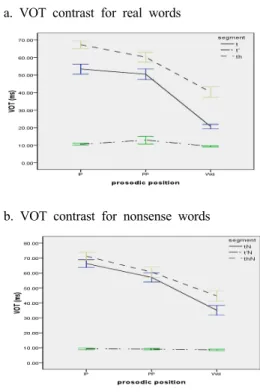
as shown in Figure 7. The mean VOT for lenis stop in

nonsense words was very close to the mean VOT for

(9)

aspirated stop, while VOT for lenis stop in real words was comparatively smaller than that for aspirated stops.

Cho and Jun (2000) demonstrated that the variation for lenis stop rarely overlapped with that of aspirated stop, and the enhanced properties did not blur the contrast between aspirated and lenis stops. But in the current study, VOT values for lenis stop in higher prosodic positions and nonsense words did overlap with those for aspirated stops. This result rather paralleled the findings in Silva (2006) and Kang and Guion (2008) that the younger speakers of Korean tend to neutralize the difference of VOT values between lenis and aspirated categories. In comparison of glottal opening among stop categories in Kim et al. (2010), word-initial /p/ and /k/ were also found to have greater glottal opening than word-medial /pʰ/

and /kʰ/. To summarize, the enhancing strategy in the prosodic domain-initial positions was different across phonation types.

The increased duration did not cause the enhanced contrast across different phonation types. It seems that the less distinctive contrast between lenis and aspirated categories in higher prosodic domains and nonsense words is caused by the phonetic shift between the two categories by younger generation of Korean.

a. VOT contrast for real words

b. VOT contrast for nonsense words

Figure 7. Variation of VOT as a function of prosodic position and word type

With regard to the word type effect on prosodic domain-initial stops, a significant durational difference between

the two word types was only found in lenis stop, as aspirated stop and tense stop did not show enhanced duration in nonsense words. In Kang and Guion (2008), VOT contrast between lenis and aspirated stops was enhanced in clear speech for younger speakers but the difference across speaking styles was relatively small compared to the results for older speakers. The VOTs for aspirated stops were found to be relatively stable across speaking styles for younger speakers.

They explained that since stimuli were elicited in the utterance-initial position, the high VOT values for aspirated stops were already enhanced by domain-initial strengthening and may be close to the phonetic target.

Another reason for less variability in those phonation types is related to their articulatory properties. Aspirated and tense stops are known to have longer acoustic closure duration, more tongue blade contact, higher tongue movements and higher glottal raising than lenis coronal stop. The less variability in articulation could be a reason for the less variability of duration in prosodic position and word type effects for tense and aspirated stops. On the contrary, lenis category seems to have more enough room for variation in linguopalatal contact as a function of prosodic positions and word types. Likewise the aspirated stop in the current study was enhanced in acoustic duration at the initial position of higher prosodic domains and might overshoot the phonetic target. As a result, the increased duration would not be expected in nonsense words.

In the results of RMS burst energy, F0 and [H1-H2] of the following vowels for stops, there was no significant prosodic domain-initial effect. In the study of Korean fricatives, the enhanced phonetic properties were not found in the results of F0 and [H1-H2] for the vowels after prosodic domain-initial fricatives (Jang, 2011). Since the boundary-induced lengthening has not been found in the vowel after domain-initial consonant, the domain-initial effect seemed to be local to the initial consonant of prosodic domains. However, the effect of prosodic domain on the phonetic manifestation of vowels was found in the results of F1 and F2 values in IP-initial position in Cho et al. (2011). Since their study was limited in the phonetic enhancement in IP domain, it is not yet clear whether the vowel space expansion found in IP-initial position is distinctive across different prosodic domains.

In conclusion, the present study provides evidence that

segmental properties are affected by prosodic position and

word type. When there is less contextual information as in

(10)

prosodic domain-initial position and in nonsense words, speakers try to enhance speech clarity and to provide perceptual cues for the higher information content of the segment although the enhancing strategies are different among phonation types. In order to prove whether listeners are sensitive to the prosodically conditioned realizations of a segment, a perception experiment that manipulates the different prosodically conditioned properties of Korean stops is in preparation for a subsequent paper.

References

Abberton, E. (1972). Some laryngographic data for Korean stops. Journal of International Phonetic Association 2, 67-78.

Byrd, D., Kaun, A., Narayanan, S. & Salzman, E. (2000).

Phrasal signature in articulation, In M. Broe, & J.

Pierrehumbert (Eds.), Acquisition and the lexicon: Papers in laboratory phonology V, 70-88. Cambridge, UK:

Cambridge University Press.

Byrd, D. (1994). Articualtory timing in English consonant sequences, Ph.D. dissertation, University of California, Los Angeles.

Cho, T.-H. (2004). Prosodically conditioned strengthening and vowel-to-vowel coarticulation in English, Journal of Phonetics 32, 141-176.

Cho, T.-H. & Keating, P. (2007). Effects of initial position versus prominence in English. UCLA Working Papers in Phonetics 106, 1-33.

Cho, T.-H. & Jun, S.-A. (2000). Domain-initial strengthening as featural enhancement: Aerodynamic evidence from Korean, Chicago Linguistics Society 36, 31-44.

Cho, T.-H. & Keating, P. (2001). Articulatory and acoustic studies of domain-initial strengthening in Korean, Journal of Phonetics 29, 155-190.

Cho, T.-H., Jun, S.-A. & Ladefoged, P. (2002). Acoustic and aerodynamic correlates of Korean stops and fricatives, Journal of Phonetics 30, 193-228.

Cho, T.-H., Lee, Y.-J. & Kim, S.-H. (2011).

Communicatively driven versus prosodically driven hyper-articulation in Korean, Journal of Phonetics 39, 344-361.

Fougeron, C. & Keating, P. (1997). Articulatory strengthening at edges of prosodic domains, Journal of the Acoustical Society of America 101(6), 3728-3740.

Fougeron, C. (2001). Articulatory properties of initial segments in several prosodic constituents in French, Journal of Phonetics 29, 109-136.

Han, M. S. & Weitzman, R. (1970). Acoustic features of Korean /P, T, K/, /p, t, k/ and /ph, th, kh/, Phonetica, Vol.22, 112-128.

Hardcastle, W. J. (1973). Some observations on the tense-lax distinction in initial stops in Korean, Journal of Phonetics 1, 263-272.

Hay, J. F., Sato, M., Coren, A., Moran, C. & Diehl, R.

(2006). Enhanced contrast for vowels in utterance focus:

A cross-language study, Journal of the Acoustical Society of America 119(5), 3022-3032.

Jang, M. (2011). An acoustic analysis of the aspiration merger in Korean, Journal of the Korean Society of Speech Sciences 3.1. 67-77.

Jun, S.-A., Beckman, M. & Lee, H.-J. (1998). Fiberscopic evidence for the influence on vowel devoicing of the glottal configurations for Korean obstruents, UCLA Working Papers in Phonetics 96, 43-68.

Jun, S.-A. (1998). The Accentual Phrase in the Korean prosodic hierarchy, Phonology 15, 189-226.

Kagaya, R. (1974). A fiberscopic and acoustic study of the Korean stops, affricates and fricatives, Journal of Phonetics 2, 161-180.

Kang, K.-H. & Guion, G. S. (2008). Clear speech production of Korean stops: Changing phonetic targets and enhancement strategies. Journal of the Acoustical Society of America 124 (6), 3909-3917.

Keating, P., Wright, R. & Zhang, J. (1999). Word-level asymmetries in consonant articulation, UCLA working Papers in Phonetics 97, 157-173.

Keating, P., Cho, T.-H., Fougeron, C., & Hsu, C.-S. (2003).

Domain-initial strengthening in four languages in Papers in laboratory phonology VI: Phonetic interpretations, 145-163. Cambridge, UK: Cambridge University Press.

Kim, M.-R., Beddor, P. S., & Horrocks, J. (2002). The contribution of consonantal and vocalic information to the perception of Korean initial stops. Journal of Phonetics 30 (1), 77-100.

Kim, C.-W. (1965). On the autonomy of the tensity feature in stop classification, Word 21, 339-359.

Kim, H.-S. & Kiyoshi, H. & Shinju, M. (2005).

Stroboscopic-cine MRI study of the phasing between the

tongue and the larynx in the Korean three-way phonation

(11)

contrast, Journal of Phonetics 33, 1-26.

Kim, H.-S. & Kiyoshi, H. & Shinji, M. (2010). Invariant articulatory bases of the features [tense] and [spread glottis]

in Korean plosives: New stroboscopic cine-MRI data, Journal of Phonetics 38(1), 90-108.

Moon, S.-J. & Lindblom, B. (1994). Interaction between duration, context, and speaking style in English stressed vowels, Journal of the Acoustical Society of America 96, 40-55.

Nespor, M. & Vogel, I. (1986). Prosodic Phonology.

Dordrecht: Foris publications.

Pierrehumbert, J. & Beckman, M. (1988). Japanese tone structure, MIT Press.

Pierrehumbert, J. & Talkin, D. (1992). Lenition of /h/ and glottal stops in Papers in Laboratory Phonology II:

gesture, segment, prosody, 90-117. Cambridge, U.K.:

Cambridge University Press.

Pollack, I. & Pickett, J. (1963). The intelligibility of excerpts from conversation, Language and Speech 6, 165-171.

Redford, M. & Diehl, R. (1999). The relative perceptual distinctiveness of initial and final consonants in CVC syllables, Journal of the Acoustical Society of America 106(3), 1555-1565.

Selkirk, E. (1986). On derived domains in sentence phonology, Phonology Yearbook 3, 371-405.

Shattuck-Hufnagel, S. & Turk, A. (1996). A prosody tutorial for investigators of auditory sentence processing, Journal of Psycholinguistics Research 25, 193-247.

Silva, D. J. (2006). Acoustic evidence for the emergence of tonal contrast in contemporary Korean, Phonology 23, 287-308.

Similjanicˊ, R. & Bradlow, A. R. (2005). Production and perception of clear speech in Croatian and English.

Journal of the Acoustical Society of America 118(3), 1677-1688.

Wright, J. D. (2007). Laryngeal contrast in Seoul Korean, Doctoral dissertation, University of Pennsylvania.

y Jang, Mi

Seoul National University E-mail: [email protected] Interest: phonetics, speech perception

Appendix: Sample Stimuli

(1) /t/

IP-initial

[IP nae doŋseŋdɨl-a], [IP tatʰɨ-lɨl tənʤjəbwa-ɾa]

My brothers-VOC, dart-Acc throw-IMP ‘My brothers, throw the dart’

PP-initial

[IP[PP sosimhan minsu-ka] [PP tasi toʤən-ɨl he-s’ə]]

Timid Minsu-Nom again challenge-Acc do-Past ‘A timid Minsu challenged again’

Wd-initial

[IP minjəŋi-ka [PP ap’a [Wd tatʰɨ-lɨl] pusjə-s’ə-jo]]

minyoung-Nom father(‘s) dart-Acc break-past-DEC ‘Miyoung broke her father’s dart’

(2) /tʰ/

IP-initial

[IP nae doŋseŋdɨl-a], [IP tʰaʤo-lɨl t’aɾaga-bwa]

My brothers-VOC, ostrich-Acc follow-IMP ‘My brothers, follow the ostrich’

PP-initial

[IP[PP səŋsilhan minsu-ka] [PP tʰaʤak-ɨl siʤak-he-s’ə]]

diligent Minsu-Nom harvest-Acc start-do-Past ending ‘A diligent Minsu starts his harvest’

Wd-initial

[IP minjəŋi-ka [PP ap’a [Wd tʰaʤo-lɨl] ʧ’igə-s’ə-jo]]

Minyoung-Nom father ostrich-Acc take a picture-past-DEC ‘Minyoung took a picture of a daddy ostrich’

(3) /t’/

IP-initial

[IP nae doŋseŋdɨl-a], [IP t’at’ɨthe ʧigoi-s’ə]

My brothers-VOC, warm become-DEC ‘My brothers, it is getting warmer’ PP-initial [IP[PP həjakhan minsu-ka][PP t’at’ɨthan kəs-ɨl məg-ə]]

weak Minsu-Nom warm thing-Acc eat-DEC ‘A weak Minsu eats warm things’ Wd-initial [IP minjəŋi-ka [PP op’a [Wd t’agwi-lɨl] t’eɾjə-s’ə-jo]]

Minyoung-Nom brother cheek-Acc slap-past-DEC

‘Minyoung slapped brother on the cheek’

수치

Figure 1. Prosodic structure of Korean
Figure 2. Pooled graph of VOT by segment type * prosodic domain
Table 3. The results of post hoc test for CV duration (* p&lt;0.05 and ** p&lt;0.01)
Figure 6. Pooled graph for [H1-H2] difference by segment type * prosodic domain
+2

참조

관련 문서