335
동해 울릉분지에서의 황산염 환원작용과 유기물의 기원
박명호
1·김지훈
2*·류병재
2·김일수
3·이영주
2·장호완
41
한국석유공사 기술실,
2한국지질자원연구원 석유해저자원연구부,
3한국석유공사 대륙붕탐사처,
4서울대학교 지구환경과학부
Sulfate Reduction and Origin of Organic Matter in the Ulleung Basin, East Sea
Myong-Ho Park
1, Ji-Hoon Kim
2*, Byong-Jae Ryu
2, Il-Soo Kim
3, Youngju Lee
2and Ho-Wan Chang
41
Technical Department, Korea National Oil Corporation, Anyang 431-711, Korea
2
Petroleum and Marine Resources Research Division, Korea Institute of Geoscience and Mineral Resources, Daejeon 305-350, Korea
3
Domestic Exploration Team I, Korea National Oil Corporation, Anyang 431-711, Korea
4
School of Earth and Environmental Science, Seoul National University, Seoul 151-742, Korea
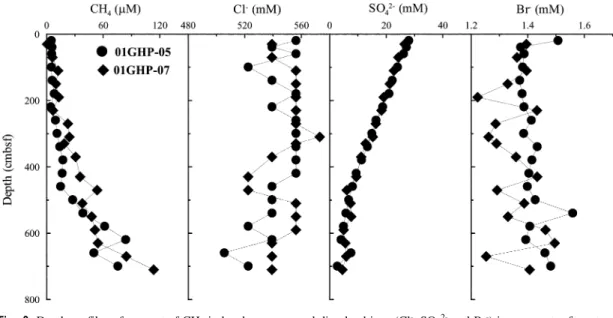
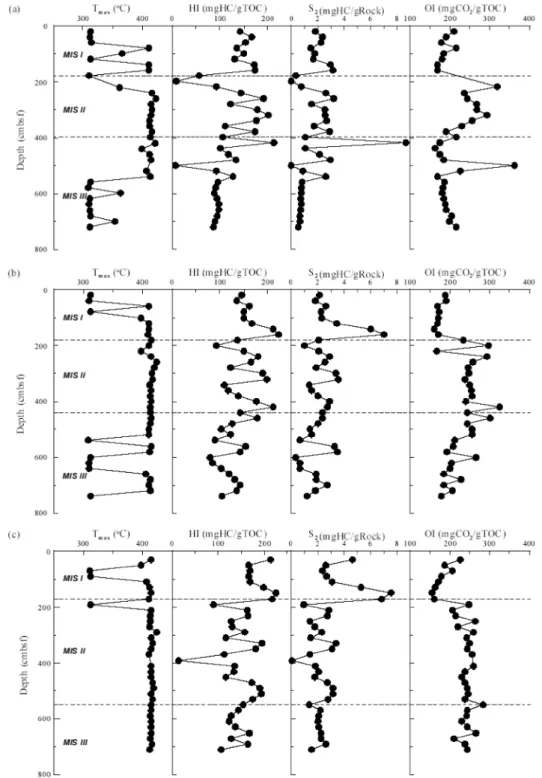
In this study, core sediments and pore water were analysed to identify the origin of organic matter and gas in late Quaternary sediments from the northwestern Ulleung Basin of the East Sea. C/N and C/S ratios in the sediments show that the organic matter in the study area originated predominantly from marine algae. However, the results of Rock-Eval pyrolysis indicate that the organic matter has an origin of the land-plant (Type III), locating in the immature stage. These different results might be due to the heavy oxidizing of the organic matter during sinking down to the seafloor or after deposition in the sediments. Concentration of sulfate in the pore water decreases grad- ually with core depth, while concentration of CH
4increases gradually with core depth. This indicates that sulfate reduction and methanogenesis occurred actively in the sediments. Also, it is likely that the compositions of CH
4are characterized as a more biogenic origin, mostly caused by microbial activity, rather than a thermogenic one.
Key words : core sediment, pore water, sulfate reduction, methanogenesis, late Quaternary, Ulleung Basin, East Sea
이 연구에서는 동해 울릉분지 북서부해역의 제4기 후기 퇴적물 내의 유기물과 가스의 기원을 규명하기 위해서 천 부 퇴적물과 공극수를 분석하였다. 연구지역에서 채취한 코어퇴적물을 원소 분석한 결과, C/N 및 C/S 비(wt. %)는 퇴 적물 내 유기물이 주로 해양조류 기원을 가지고, 일반적인 해양 또는 정체 환경에서 퇴적되었음을 지시한다. 그러나 열분석 결과는 유기물 기원이 육상식물이고, 열적 성숙단계가 미성숙단계임을 보여준다. 이러한 원소분석과 열분석간 의 관계는 유기물이 침강하는 동안 또는 퇴적 후 이루어진 강한 산화작용에 기인한 것으로 추정된다. 퇴적물 내 공극 수와 공기층 가스의 분석을 통하여 매몰심도가 증가할수록 SO
42-농도는 감소하고, 공기층 가스의 주성분인 CH
4의 양 이 증가한다는 것을 알 수 있었다. 이것은 코어퇴적물에서 미생물과 관련된 황산염 환원작용이 일어났으며, 점진적으 로 메탄생성단계로 전이가 일어났음을 의미한다. 또한 CH
4의 성분은 열기원보다는 생물기원임을 가리킨다.
주요어 : 코어퇴적물, 공극수, 황산염 환원작용, 메탄생성단계, 제4기 후기, 울릉분지, 동해
1. 서 론
울릉분지에 대한 연구는 1990년대에 들어 한국지질 자원연구원(KIGAM)과 한국해양연구원(KORDI)의 탐 사선을 이용한 지구물리탐사와 퇴적물 시료 채취 · 분
석 등에 의하여 시작되었다. 대부분의 연구는 물리탐 사와 유공충 및 테프라층(tephra layer)을 이용한 울릉 분지 퇴적물의 층서 확립과 고해양 및 고환경 복원에 중점을 두었으며(예: 한상준 등, 1997; Kim et al., 1998; Kim, 1999; Kim et al., 2000; 박명호 등,
*Corresponding author: [email protected]
2002; Park et al., 2003; 김일수 등, 2003; Chun et al., 2004; 박명호 등, 2004), 천부 퇴적물과 퇴적물 내 공극수(pore water)의 지화학적 특성에 대한 연구 는 드문 편이었다(예: 차현주, 2002; Kim et al., 2003, 2004).
일반적으로 지화학적 분석을 통하여 퇴적물의 기원지 (provenance) 와 퇴적환경 변화 및 속성작용(diagenesis) 을 추정하며, 공극수 분석으로는 퇴적물과의 상호작용, 퇴적환경 변화, 환원작용단계(reduction stage) 등을 추 정할 수 있다(Ganeshram et al., 1999; Chester, 2000).
이 논문에서는 울릉분지 북서부해역에서 채취한 피스톤 코어(piston core)의 천부 퇴적물과 공극수의 지화학적 분석을 통해 유기물의 기원, 퇴적물의 성숙 정도와 퇴 적환경, 퇴적물의 공기층 가스(headspace gas) 기원, 공 극수의 지화학적 특성과 환원작용단계 등을 밝히고자 하였다.
2. 연구지역의 지형과 지질
동해는 4개의 해협을 통하여 대양과 연결된 주변해 (marginal sea) 이다. 수심이 깊은 곳은 4,000 m 이상 되며, 서너 개의 해양뱅크(oceanic bank)나 해양대지 (oceanic plateau) 에 의하여 나뉘어져 있고, 그 사이로 동해분지(East Sea/Japan Basin), 야마토분지(Yamato Basin), 울릉분지(Ulleung Basin) 등과 같은 커다란 해 양분지가 발달해 있다.
특히 울릉분지는 동쪽으로 오키뱅크(Oki Bank), 서 쪽으로 경사가 가파른 한반도의 대륙사면, 남쪽으로 일
본 열도의 완만한 사면, 그리고 북쪽으로 지형의 굴곡 이 대체로 심한 남부한국대지(South Korea Plateau)에 의하여 둘러싸여 있어, 전체적으로 오목한 형태이다 (Fig. 1). 분지의 북쪽과 서쪽 경계면은 경사가 커서 사면침식, 사면붕락, 미끄럼사태 등에 의해 영향을 받 고 있다(Chough et al., 2000). 울릉분지는 대략 수심 이 1,800~2,400 m이며, 분지의 경계면에 위치한 일부 섬(울릉도와 독도)과 화산 기원의 해산(seamount, 예:
울릉 해산과 독 해산)을 제외하고는 일반적으로 완만 한 형태를 갖는다. 울릉도와 독도 사이에는 수심이 깊 은 울릉분지간통로(Ulleung Interplain Gap)가 존재하 는데, 이 통로를 통하여 울릉분지는 수심이 더 깊고 큰 동해분지와 연결되어 있다.
울릉분지에서 채취한 피스톤 코어에 대한 최근 연구 에 의하면, 퇴적물의 최상부 약 10 m 구간은 대부분 MIS(Marine Isotope Stage) III 이후의 간빙기-빙기- 간빙기에 퇴적된 이질 퇴적물(muddy sediments)로 주 로 구성되어 있으며, 일본 열도와 울릉도에서 기원한 서너 매의 테프라층이 협재되어 있다(박명호 등, 2002;
Park et al., 2003).
3. 코어 선정과 연구방법
한국지질자원연구원(KIGAM)의 탐사선 탐해 II호 (R/V Tamhae II) 의 피스톤 코어러(piston corer)를 이 용하여 울릉분지와 남부한국대지에서 총 8개의 피스톤 코어를 채취하였으며, 이 중에서 보존상태가 양호한 3 개의 코어(01GHP-5, 01GHP-6, 01GHP-7)를 연구코어 로 선정하였다(Fig. 1). 선정된 코어의 위치와 심도 그 리고 회수 길이는 Table 1과 같다.
01GHP-5 와 01GHP-7 코어의 경우 공극수와 지화학적 분석을 위하여 현장에서 절개하였고, 01GHP-6 코어는 실험실에서 절개하였다. 현장에서 절개된 01GHP-5와 01GHP-7 코어의 퇴적물은 공기층 가스 분석을 위하여 주사기를 이용하여 40 cm 간격으로 5 cm
3의 부피로 유 리병에, 공극수 분석을 위하여 50 cm
3의 원심분리병에 채취하였다. 또한 지화학적 분석을 위하여 각 코어마다 20cm 간격으로 코어퇴적물의 시료를 채취하였다. 채취 Table 1. Sampling log of the piston cores in the present study.
Core No. Latitude Longitude Water Depth (m)
Recovered Length(cm) 01GHP-5 37
o14.56'N 130
o47.17'E 2,170 735 01GHP-6 37
o09.03'N 130
o31.53'E 2,174 755 01GHP-7 37
o03.02'N 130
o14.55'E 2,154 732 Fig. 1. A map showing the sampling locations of three
piston cores (01GHP-5, 01GHP-6 and 01GHP-7) in the
Ulleung Basin, East Sea (Bathymetry in meter).
Fig. 2. Sedimentary facies and stratigraphic correlation of three piston cores (01GHP-5, 01GHP-6 and 01GHP-7). Symbols on the right side of the column indicate sedimentary facies: BM bioturbated mud, HM homogenous mud, LM laminated mud, SLM slightly laminated mud, SS slightly laminated sand, FO foraminiferal ooze, TL lapilli layer, and AL ash layer. M.
S, and G indicate mud, sand, and gravel, respectively. MIS represents Marine Isotope Stage. The closed triangles indicate
14