Trends in Agriculture & Life Sciences, Vol. 56, 2018. 12.
농업생명과학연구동향, 제56집
유용미생물처리가 토마토 수량 및 과실 성분에 미치는 영향
김은정1 ․ 김충우1 ,* ․ 김선국1 ․ 장후봉1 ․ 김영호1 ․ 송재경2 ․ 권장식2
1
충청북도농업기술원,
2농촌진흥청 국립농업과학원
Effect of Effective Microorganism Applications on Growth, Yield and Fruit Nutrient Contents in Fresh Tomato
Eun-Jeong Kim
1, Chung-Woo Kim
1,*, Sun-Kook Kim
1, Who-Bong Chang
1, Young-Ho Kim
1, Jae-Kyeong Song
2and Jang-Sik Kwon
21
Chungbuk Agricultural Research and Extension Services, Ochang 28130, Korea
2
Agricultural Microbiology Division, National Institute of Agricultural Science, Wanju 55365, Korea
*Corresponding author: [email protected]
ABSTRACT
This study was carried out to develop a method to effectively utilize Bacillus subtilis S37-2 strain, which has been proven to promote growth and antifungal effect on tomato cultivation.
Soil treated with the suspension of Bacillus subtilis S37-2 showed a tendency that the electric conductivity (EC) decreased and the organic matter and effective phosphoric acid content increased more than the soil before the test. Bacillus subtilis S37-2 treated with the suspension was thicker and 3~16% larger than the control. In addition, navel rot was reduced by 4.7~6.0%, and heat loss was decreased by 0.4~3.7%, and the product overspeed ratio increased by 5~10%. The functional substances and antioxidative activities of the Bacillus subtilis S37-2 suspension were diluted to 1.0×10
6CFU mL
−1concentration, and the sugar content of the leaves treated with leaf surface treatment was increased by 0.5 °Bx and the content of lycopene and vitamin C and DPPH radical scavenging ability, which showed antioxidant activity, was the highest. When the suspension of Bacillus subtilis S37-2 was applied to the tomato cultivation, it was diluted to 1.0×10
6CFU mL
−1concentration, and after five rounds of foliar application every 7 days after the tomato planting, the growth was promoted and the quality was improved respectively.
Additional key words: Bacillus subtilis S37-2, Tomato, Growth promotion, Effective microorganism
서 론
안전한 먹을거리에 대한 관심 증가와 지속가능한 농업을 위해 미생물을 활용한 친환경농업에 대한 연
구와 투자가 이루어져 국내 미생물 시장도 급격하게
성장하고 있다. 다양한 유용미생물(Bacillus sp., Lacto-
bacillus sp., Saccharomyces sp. 등)에 대한 농업적 효
과가 검증되면서 시설재배지 중심으로 유용 미생물
수요가 증가하여 전국에 미생물을 보급하는 시 ․ 군 농업기술센터가 2016년 134개 지역으로 증가하였다 (RDA, 2016). 단일 미생물은 종류에 따라 작물생장 촉 진, 병해충 방제, 토양개량, 품질향상 등 기능적 분류 가 가능하지만, 현재 생산되어 보급되는 유용 미생물 들은 대부분 세균, 젖산균, 효모를 혼합한 EM(Effec- tive Microorganisms)으로 미생물 사용에 대한 효과를 명확하게 구분할 수 없다. 그리고 유용미생물의 작물 에 따른 처리 효과 검증이 부족하여 제대로 된 미생물 처리 효과를 얻지 못하는 것이 문제되고 있다. 따라서 효과가 검증된 미생물에 대해 작물별 사용방법을 적 립하여 농가에서 안정적으로 사용할 수 있는 사용법 개발이 필요한 상황이다. 본 연구는 내열성 및 내염성을 함께 가지고 있어 불량 토양환경에 대한 적응능력이 뛰어나며, 뿌리에 침투하는 식물병원균을 효과적으로 억제하고, 식물생육촉진 효과도 검증된 Bacillus sub- tilis S37-2 균주(Kwon et al., 2007)를 시설재배지에서 효과적으로 활용할 수 있는 처리 방법을 개발하고자 하였다. 대상작물은 2018년 기준 1인당 연가소비량이 7.1 kg, 2015년 기준 생산액이 9,850억 원으로 전체 농업생산액의 2.2%를 점유(KOSIS, 2018)하여 안정 적 소비층이 확보되어 있는 토마토를 선정하였다.
재료 및 방법
1. 시험균주
본 연구에 사용된 Bacillus subtilis S37-2(KACC 91281P) 균주는 농업미생물은행(Korean Agricultural Culture Collection, KACC)에서 분양 받은 균주를 TSB(Tryptic Soy Broth, Difco Lab., USA) 액체배지 용액에 Bacillus subtilis S37-2를 접종시켜 37℃에서 24시간 배양한 후 1×10
8CFU mL
−1농도로 희석하여 균 현탁액을 준비하여 사용하였다.
2. 재배방법 및 처리조건
충청북도농업기술 시설하우스에서 토마토(품종:
슈퍼도태랑)를 대상으로 시험하였다. 시험구 배치는 완전임의배치법(Completely randomized design)을 이 용하였고, 재식거리는 20 cm×20 cm로 실시하였다.
시험구는 Bacillus subtilis S37-2 균체가 없는 균주 현 탁액, Bacillus subtilis S37-2 균주 현탁액을 1.0×10
7CFU mL
−1, 1.0×10
6CFU mL
−1농도로 희석하여 7일 간격으로 5회 관주 및 엽면 처리하였다. 이때 처리량 은 1 ton 10a
−1기준으로 시험구 당 400 mL씩 처리하 였다.
3. 토양 화학성 조사
Bacillus subtilis S37-2 균주 현탁액의 처리 전 ․ 후 에 따른 시험포장 토양의 화학성 분석은 농촌진흥청 토양 및 식물체 분석법(2000)에 따라 분석하였는데, 토양의 pH와 EC는 초자전극법으로 측정하였고, 유기 물 함량은 Walkey-Black법, 유효인산은 Langcaster 법, 유효 규산은 1N-NoAC(pH4.0) 용액에서 침출하 여 700 nm에서 비색정량하였고, 치환성 양이온인 K, Ca, Mg, Na은 1N-ammonium acetate(pH7.0)로 침출 하여 ICP(Agilent, 720OES)로 분석하였다.
4. pH와 총산도 측정
pH 측정은 실온에서 pH meter(Sartorius AG, Gottin- gen, Germany)를 사용하였다. 산도는 AOAC(1995) 방법에 따라 상등액 20 mL에 1% phenolphthalein을 지시약으로 하여, 0.1 N NaOH 용액으로 중화 적정하 여 citric acid로 나타내었다.
5. 기능성 물질과 항산화 활성
총폴리페놀 함량은 Folin-Ciocalteu's 방법에 따라 측정하였다(Schmidit 등 1977). 추출물 0.1 mL에 증 류수 8.4 mL와 2 N Folin-Ciocalteu's 시약(Sigma Co., St. Louis, MO, USA) 0.5 mL를 첨가하고, 20% Na
2CO
31 mL를 가하여 1시간 방치한 후 분광광도계를 사용 하여 725 nm에서 흡광도를 측정하였다. 표준곡선은 gallic acid(Sigma Co.)를 이용하여 검량선을 작성하 고 그 양을 환산하였다.
DPPH radical 소거능 측정은 여과한 시료 0.2 mL
에 0.4 mM DPPH 용액 0.8 mL를 가한 후 vortex mixer
로 10초간 진탕하고, 실온에서 10분간 방치 후 분광광
도계(Cary UV-Vis spectrophotometer, Agilent Tech-
nologies, Santa Clara CA, USA)를 사용하여 525 nm
에서 흡광도를 측정하였다(Blois MS 1958). ABTS
(2,2'-azino-bis-3-ethylbenzothiazoline-6-sulfonic acid)
radical 소거능 측정은 ABTS(2,2'-azino-bis-3-ethylbenzo-
thiazoline-6- sulfonicacid) 7.4 mM과 potassium persul- phate 2.6 mM을 혼합하여 암실에서 16시간 동안 반 응시켜 ABTS·⁺을 형성한 후, 734 nm에서 흡광도를 측정하였다.
6. Ascorbic acid 함량
시료 5 mL에 10% TCA(trichloroacetic acid) 용액 4 mL를 넣어 3,000 rpm으로 5분간 원심분리 상등액 2.5 mL와 증류수 7.5 mL 및 10% folin phenol reagent 1 mL를 혼합 후 실온에서 10분간 방치한 후 760 nm 에서 흡광도를 측정하였다.
7. Lycopene 함량
균질화한 토마토 과육 5 g에 lycopene extraction solution을 45 mL 가한 후 180 rpm에서 20분간 sha- king 한 후 6 mL의 차가운 증류수를 가하여 180 rpm 에서 8분간 shaking 상온에서 20분간 분리시킨 후 상 층액을 취하여 503 nm에서 흡광도 측정하였다.
8. 통계처리 분석
SPSS program(version17.0)을 이용하여 Mean±SD, ANOVA 분석, Duncan's multiple range test 및 Pear- son 상관분석을 수행하였다.
결과 및 고찰
Bacillus subtilis S37-2 균주 현탁액 처리가 토마토
Table 1. Chemical properties of soil after the experiment by the different levels of applied Bacillus subtilis S37-2
Stage Treatment pH
(1:5) EC (dS/m)
OM (g/kg)
P
2O
5(mg/kg)
K Ca Mg Na
---(cmol(+)/kg)--- Before planting 7.0 4.01 7 129 0.13 9.49 6.03 0.20
Harv- esting
Control 7.0 3.82 10 165 0.14 15.01 8.32 0.19
Soil drench
1.0×10
77.2 3.32 12 178 0.18 15.24 8.61 0.20 1.0×10
67.3 3.94 12 181 0.19 15.35 9.12 0.19 Foliar
application
1.0×10
77.0 4.54 14 175 0.19 15.92 9.65 0.20 1.0×10
67.0 4.67 13 179 0.18 15.52 9.07 0.19
재배 토양에 미치는 영향을 조사하기 위하여 시험 전 토양과 수확 후 미생물 처리 토양을 채취하여 화학성 분을 분석하였다(Table 1). 시험 전 토양의 pH는 7.0, EC는 4.01 dS m
−1정도이고, 유기물 함량은 7 g kg
−1, 유효인산 함량은 129 mg kg
−1으로 유기물함량과 유 효인산 모두 시설토양의 적정범위보다 낮았다. 토마 토 수확 후 처리구별 토양을 분석한 결과, 시험 전 토 양에 비해 Bacillus subtilis S37-2 균주 현탁액을 처리 한 토양에서 전기전도도(EC)는 감소하고, 유기물과 유효인산 함량이 증가하는 경향을 보였다. 이러한 결 과는 미생물혼합제제를 토양에 처리했을 때 토양비 옥도가 개선된다(Ryu et al., 2012)는 결과와 비슷한 경향을 나타냈으나, Bacillus subtilis S37-2 균주 현탁 액 처리농도별 처리 방법간에는 유의차가 인정되지 않아, 상추에 Bacillus subtilis S37-2 균주 현탁액을 관주처리 했을 때 농도 차이에 따른 화학성분은 영향 을 받지 않는다(Heo et al., 2016)는 결과와 유사한 경 향이었다.
Bacillus subtilis S37-2 균주 현탁액을 1.0×10
7CFU mL
−1과 1.0×10
6CFU mL
−1농도로 희석하여
7일 간격으로 5회 관주와 엽면처리로 나누어 처리한
후 생육과 수량 그리고 상품과율을 조사하였다. 처리
농도별 처리 방법 간 초장 변화는 유의성이 인정되지
않았으나, 경장은 Bacillus subtilis S37-2 현탁액을
1.0×10
6CFU mL
−1농도로 엽면처리구에서 무처리
대비 0.9 mm 굵어지는 경향을 나타내었다. 이 결과는
Bacillus subtilis 균주를 이용하여 토마토에 대한 생육
촉진 및 병 저항성 활성을 평가한 결과, 토마토의 초
Fig. 1. Growth characteristics of tomato by Bacillus subtilis S37-2 treatment methods .
장, 잎의 크기 등 생육 촉진효과를 나타냈다는 Park et al.(2010)의 결과와 유사한 경향이었다.
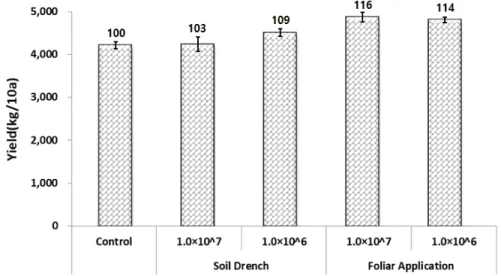
Bacillus subtilis S37-2 균주 현탁액 처리농도 및 처리방법에 따른 수량변화는 Fig. 2와 같다. Bacillus subtilis S37-2 균주 현탁액을 처리하였을 때 대조구 대비 3~16% 증수되었는데, 엽면 처리구가 관주 처리 구보다 수량이 더 증가하는 경향을 나타냈다. 1.0×
10
7CFU mL
−1농도로 엽면 처리하였을 때 4,977 kg 10a
−1으로 대조구 대비 16% 수량이 증가되었고, 1.0×
10
6CFU mL
−1농도로 엽면 처리 시 4,750 kg 10a
−1로 대조구 대비 14%의 수량이 증가되었다. 상추에 Bacillus subtilis S37-2 균주 현탁액을 1.0×10
6CFU
Fig. 2. Yield characteristics of tomato by Bacillus subtilis S37-2 treatment methods .
mL
−1농도로 정식 후 5일 간격으로 3회 관주에 처리 하였을 때 무처리에 비해 29%의 수량증대 효과가 있 다(Heo et al., 2016)는 연구 결과와 비슷한 경향을 나 타내었다.
Bacillus subtilis S37-2 현탁액 처리농도 및 처리방
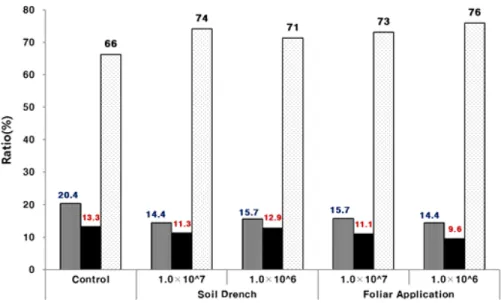
법에 따른 토마토 과실 특성은 Fig. 3 및 Fig. 4와 같
다. Bacillus subtilis S37-2 균주 현탁액을 토마토에
처리하였을 때 대조구 대비 배꼽썩음병은 4.7~6.0 %
감소하였고, 열과는 0.4~3.7% 감소하였다. 배꼽썩음
병과 열과 등의 비상품과 비율이 감소하면서 대조구
대비 Bacillus subtilis S37-2 현탁액 처리구의 상품과
율 비율은 5~10% 증가하는 경향을 나타내었다. Ba-
Fig. 3. Productivity of tomato by treatment with Bacillus subtilis S37-2 .
Fig. 4. Characteristics of tomato by Bacillus subtilis S37-2 treatment methods .
cillus subtilis S37-2 현탁액을 1.0×10
6CFU mL
−1농 도로 정식 후 7일 간격으로 5회 엽면살포 해주었을 때 상품과율이 대조구 대비 10% 향상되었다. 배꼽썩 음병의 원인은 칼슘 부족이 원인이므로 수확기 토양 에서 대조구에 비해 칼슘함량이 높아진 것과 상관관 계가 있을 것으로 판단된다.
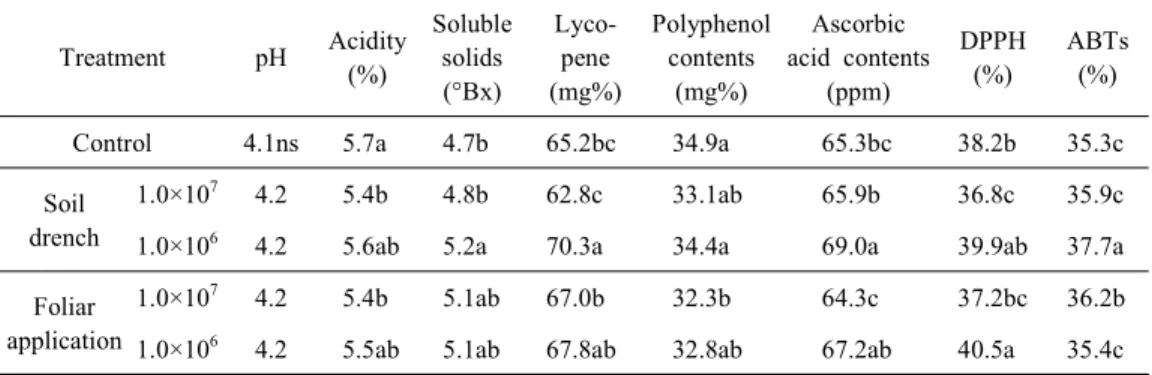
Bacillus subtilis S37-2 현탁액 처리농도 및 처리 방법에 따른 토마토 기능성 물질과 항산화 특성은 표 2와 같다. Bacillus subtilis S37-2 균주 현탁액을 1.0× 10
6CFU mL
−1농도로 희석하여 정식 후 7일 간격으로 5회 엽면처리한 결과, 대조구보다 당도가
0.5 °Bx 높아졌고, 기능성물질인 라이코펜과 비타민 C 함량도 유의적으로 증가하였고, 항산화 활성을 나 타내는 DPPH 라디컬 소거능도 가장 높게 나타났다.
미생물제 엽면처리가 토마토 배꼽썩음병 발생이 억
제되어 총수량이 증가하는 효과를 보였고, 토마토
과실의 산 함량을 제외한 가용성 고형물, 당 및 비타
민 C 함량이 높게 나타나 품질을 향상시키는 결과를
얻었다(Jeong et al., 2005)는 결과와 유사한 경향을
나타내어 Bacillus subtilis S37-2 균주 현탁액 처리가
토마토 품질향상에 효과를 나타내는 것으로 판단되
었다.
Table 2. Functional materials and antioxidant activity of tomato by Bacillus subtilis S37-2 treatment methods
Treatment pH Acidity (%)
Soluble solids (°Bx)
Lyco- pene (mg%)
Polyphenol contents
(mg%)
Ascorbic acid contents
(ppm)
DPPH (%)
ABTs (%)
Control 4.1ns 5.7a 4.7b 65.2bc 34.9a 65.3bc 38.2b 35.3c Soil
drench
1.0×10
74.2 5.4b 4.8b 62.8c 33.1ab 65.9b 36.8c 35.9c 1.0×10
64.2 5.6ab 5.2a 70.3a 34.4a 69.0a 39.9ab 37.7a Foliar
application
1.0×10
74.2 5.4b 5.1ab 67.0b 32.3b 64.3c 37.2bc 36.2b 1.0×10
64.2 5.5ab 5.1ab 67.8ab 32.8ab 67.2ab 40.5a 35.4c Mean separation within columns by Duncan’s multiple range test at p = 0.05.
적 요
본 연구는 생육촉진과 항진균 효과가 검증된 Ba- cillus subtilis S37-2 균주를 시설토마토 재배에 효과 적으로 활용할 수 있는 방법을 개발하기 위해 수행하 였다. Bacillus subtilis S37-2 균주 현탁액을 처리한 토 양이 시험 전 토양보다 전기 전도도(EC)는 감소하고, 유기물과 유효인산 함량이 증가하는 경향을 보였다.
Bacillus subtilis S37-2 현탁액 처리 시 대조구에 비해 경장이 굵어지고 3~16%의 수량이 증수되었다. 또한 배꼽썩음병은 4.7~6.0% 감소하였고, 열과는 0.4~3.7%
감소하여 상품과율 비율은 5~10% 증가하는 경향을 나타내었다. 기능성 물질 및 항산화 활성은 Bacillus subtilis S37-2 균주 현탁액을 1.0×10
6CFU mL
−1농 도로 희석하여 엽면처리한 시험구가 대조구보다 당 도가 0.5°Bx 높아졌고, 기능성 물질인 라이코펜과 비 타민 C 함량도 유의적으로 증가하였으며, 항산화 활 성을 나타내는 DPPH 라디컬 소거능도 가장 높게 나 타났다. Bacillus subtilis S37-2 균주 현탁액을 시설토 마토 재배에 처리할 때는 1.0×10
6CFU mL
−1농도로 희석한 후 토마토 정식 후 7일 간격으로 5회 엽면처 리 한 결과, 생육이 촉진되고 품질도 향상되는 경향을 나타내었다.
감사의 글
본 연구는 국립농업과학원 농업과학기술 연구개 발사업(과제번호: PJ010825)의 지원에 의해 이루어진 것입니다.
참고문헌