IN VITRO STUDY OF THE TENSILE BOND STRENGTH OF CEMENT-RETAINED SINGLE IMPLANT PROSTHESIS BY THE VARIOUS PROVISIONAL LUTING CEMENTS AND
THE SURFACE TREATMENT OF ABUTMENTS
Hwa-Yeon Lee, D.D.S., Prof. Dr. med. dent., Ho-Sang Lee, D.D.S.
Division of Prosthodontics, Department of Dentistry, Uijongbu St.Mary’s Hospital, Catholic University of Korea
The main disadvantage of cement-retained implant restorations is their difficulty in retriev- ability. Advocates of cemented implant restorations frequently state that retrievability of the restoration can be maintained if a provisional cement is used.
The purpose of this study was to find the optimal properties of provisional luting cements and the surface treatment of abutments in single implant abutment system.
30 prefabricated implant abutments, height 8mm, diameter 6mm, 3-degree taper per side, with light chamfer margins were obtained. Three commercially available provisional luting agents which were all zinc oxide eugenol type ; Cavitec, TempBond and TempBond NE were eval- uated. No cement served as the control. TempBond along with vaseline, a kind of petrolatum (2:1 ratio) was also evaluated. Ten out of thirty abutments were randomly selected and abutment surfaces were sandblasted with 50㎛ aluminum oxide. Another ten abutments were sandblasted with 250㎛ aluminum oxide. A vertical groove, 1 mm deep and 5mm long was cut in each twenty abutments. Ten of them were sandblasted with 50㎛ aluminum oxide. The full coverage casting crowns were cemented to the abutments with the designat- ed provisional luting agent. Specimens were stored in distilled water at 37℃ for 24 hours. Each specimen was attached to a universal testing machine. A crosshead speed of 0.5mm/min was used to apply a tensile force to each specimen.
Within the limitations of this in vitro study, the following conclusions were drawn:
1. Tensile bond strength of provisional luting cements in no surface treatment decreased with the sequence of TempBond NE, TempBond, Cavitec, TempBond with vaseline, no cement.
2. Tensile bond strength more increased by surface treatment. Sandblasting with 250㎛ aluminum oxide exhibited the highest tensile bond strength in the abutment cemented with TempBond NE and sandblasting with 50㎛ aluminum oxide exhibited the highest tensile bond strength in cemented with TempBond.
3. In the aspect of a groove formation, tensile bond strength significantly increased in TempBond with vaseline only and the others had no significant effect on tensile bond strength.
Key Words
Tensile bond strength, Single implant, Provisional luting cement, Surface treatment J Korean Acad Prosthodont : Volume 40, Number 3, 2002
D
ental implants have been used successful- ly for restorative treatment for more than twen- ty years. So a lot of edentulous and partially edentulous patients are being treated with implant- supported prostheses. Currently, there are many options for prosthetic designs that differ from those proposed by Bra�nemark et al.1These options are related not only to the materials used, but also to the method of fixation of the restorations to the implants.There are currently two different philosophies of how best to restore dental implants. Prostheses utilizing screw retention have been and remain the standard design in most situations for many clinicians. Others prefer to fabricate more tra- ditional dental restorations for implant use, involving cementaion of the restoration. The choice of cementation versus screw retention seems to be primarily one of personal prefer- ence of the clinician involved. There is no evidence that one method of retention is superior to the oth- er. Advantages claimed for screw retention are pri- marily limited to issues of retrievability, which cer- tainly is an advantage for a screw-retained restora- tion. On the other hand, advocates of cement- retained implant restorations list better esthetics, better occlusion, easier axial loading, use of tra- ditional prosthetic techniques and fewer frac- tures of acrylic resin or porcelain, and fewer appointments.2,3An additional possible advantage of a cemented restoration is that it has been the potential for being completely passive when placed in the mouth. The absence of a screw to draw misfitting components together with a clamping force would tend to eliminate strain intro- duced into the restoration-implant assembly by the tightening force of the screw. If a restora- tion can be made to seat passively on multiple abut- ments, the introduction of cement into the space between prosthesis and abutment would not by itself introduce stresses into the system. This
potential advantage, coupled with the others mentioned, makes cemented implant restora- tions increasingly popular.4And the luting agent may act as a shock absorber.5,6Screw-retained implant-supported prostheses may require addi- tional maintenance because screws may loosen or break. In addition, the esthetics of screw-retained prostheses may be compromised if the access opening is positioned near the facial surface of pros- theses.
The main disadvantage of cemented prostheses is their difficulty in retrievability. Advocates of cemented implant restorations frequently state that retrievability of the restoration can be main- tained if a provisional cement is used. There is lit- tle evidence that demonstrates predictable retriev- ability of various provisional luting agents when cementing two or more metallic components together. It is likely that a cement that functions well as a provisional cement for restorations cemented to teeth may be a permanent luting agent for metal cemented to metal. Similary, cements used for permanent luting on teeth may be inad- equate when cementing metal to metal.
The purpose of this study is to find the optimal properties of provisional luting cements and the surface treatment of abutments in single implant abutment system.
This study reports on the retentive strengths of two zinc oxide eugenol cements and one noneu- genol-containing zinc oxide cements commonly used for temporary cementation and evaluates the effect of adding petrolatum on retentive strength.
MATERIAL AND METHODS
Thirty prefabricated implant abutments, height 8mm, diameter 6mm, 3-degree taper per side, with light chamfer margins(CAR648, Osstem, Korea) were obtained. Each screw-retained abutment was attached to an implant lab-analog with a 35 Ncm torque wrench. The occlusal access open-
ing of each abutment was completely filled with polyvinylsiloxane putty(Exaflex, GC, Japan) after filled with two cotton pellets. Two coats of die spacer(VITA In-Ceram, VITA, Germany) were applied on it. Then cast crown copings with 1.5�
2mm wide were formed by melted inlay wax(YETI, YETI Dental, Germany). Also wax rings with 2.5mm wide and 5mm diameter were added to occlusal portion of the waxed copings for attach- ment to the tensile testing device(Fig. 1).
Wax patterns were sprued, invested with phos- phate bonded investment material (Hi-Temp, Whip-mix, U.S.A.). After setting investment, they were cast in a nonprecious metal alloy for porcelain fused to metal crown(Vera Bond, Aalba Dent, U.S.A.) through burning out(Accu-therm Ⅱ 850, Jelenko, U.S.A.) at 850℃. Casting were divested and investment materials attached to crown coping were removed by sandblasting with 50㎛ aluminum oxide(Sand Storm, VANI- MAN, U.S.A.). Then casting were inspected for sur- face irregularities. Small internal nodule in the cast- ing crowns were removed with a No. ½ round bur. Adaptation evaluation between casting crowns and abutments were conducted by using Fit-checker(GC, Japan) and marginal misfits within 0.5mm were corrected to use but specimens with errors over 0.5mm were remade. The spec- imens were used repeatedly during the experiment
and recycled as follows. After tensile testing, each casting was heated to a temperature of 600℃
for 1.5hours to remove luting cements and then allowed to bench cool at room temperature.7,8 Casting were placed in an ultrasonic cleaner(OM- 50T Orient mechanic industry Co., Korea) for 30minutes with a dental cement-removing solu- tion(Orange Oil, Sultan Chemist, U.S.A.) and placed in neutral detergent(Pongpong, Aegyong, Korea) in an ultrasonic cleaner for 30minutes and finally placed in distilled water in an ultrasonic cleaner for 30minutes.
Three commercially available provisional luting agents which were all zinc oxide eugenol type;
Cavitec, TempBond and TempBond NE were evaluated. No cement served as the control.
TempBond along with vaseline, a kind of petro- latum(2:1 ratio) was also evaluated(Table Ⅰ).
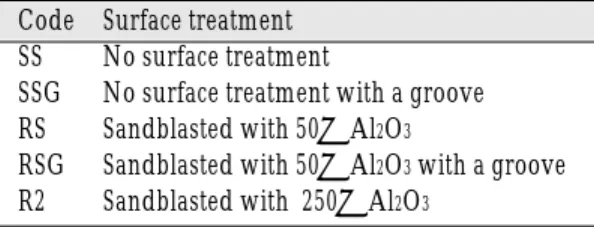
Ten out of thirty abutments were randomly extracted and abutment surfaces were sand- blasted with 3.5 kPa, 50㎛ aluminum oxide(Sand Storm, VANIMAN, U.S.A.) from a 5mm dis- tance for 1 minute. Another ten abutments were sandblasted with 250㎛ aluminum oxide(Cobra, Renfert, Germany) in the same way(Table Ⅱ).
A vertical groove, 1mm deep and 5mm long was cut in each twenty abutments. This groove was cut by milling machine(MP3000�, Metalor, Swiss) with milling bur(2936.010, EDENTA AG, Swiss).
Ten of them were sandblasted with 50㎛ alu- minum oxide(Table Ⅱ).
The full coverage casting crowns were cement- ed to the abutments with the designated provi- sional luting agent. The maximum finger force of the same dentist was used to seat and secure the crown.
After they were left at room temperature for 12 hours, excess cement was then removed. Specimens were stored in distilled water at 37℃ for 24hours.
Each specimen was attached to a universal testing machine(Instron 4465, England) A crosshead speed of 0.5mm/min by International Organization Fig. 1.Abutment and casting crown
of Standardization(ISO) specifications was used to apply a tensile force to each specimen(Fig. 2).
One-way analysis of variance(ANOVA) and Scheffe’s multiple comparison analysis were conducted with SPSS/PC+software(SPSS, Chicago, IL, USA). A p value of 0.05 was used as the boundary of significance. T-test was used to compare the difference between the bond strength of a groove formation.
RESULTS
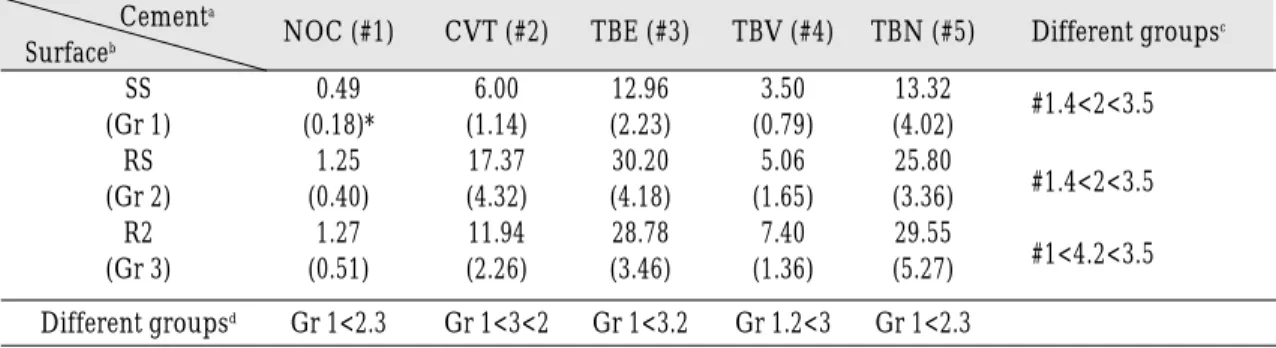
First, tensile bond strength of provisional lut- ing cements by cement type in the same surface treatment was obtained. Mean tensile bond strength values in kilograms between abutments and crowns by the surface treatment and the cement were presented in Table Ⅲ and Fig. 3. The results of ANOVA were also presented.
The tensile bond strength of no surface treat- ment(SS) was that there was no significant dif- ference between no cement(NOC) and TempBond mixed with Vaseline(TBV). Significantly higher tensile bond strength was observed in TempBond(TBE) and TempBond NE(TBN) than other three groups. The tensile bond strength of the specimens sandblasted with 50㎛ alu- minum oxide was found to be statistically simi- lar to no surface treatment. There was no differ- ence between TempBond with Vaseline(TBV) and Cavitec(CVT) in groups sandblasted with
250㎛ aluminum oxide and TempBond and TempBond NE exhibited significantly higher tensile bond strength.
Second, tensile bond strength of provisional luting cements by surface treatment in the same cement type was obtained.
Generally there was significant difference between no surface treatment and sandblast- ing with aluminum oxide but little difference between 50㎛ and 250㎛ sandblasting.
In no cement(NOC) group, tensile bond strength of no surface treatment(SS) was 0.49 Kgf. That of sandblasting was 1.25�1.27 Kgf and signifi- cantly increased. There was no difference between Table Ⅱ.Code designations by the surface treatment
Code Surface treatment SS No surface treatment
SSG No surface treatment with a groove RS Sandblasted with 50㎛ Al2O3
RSG Sandblasted with 50㎛ Al2O3with a groove R2 Sandblasted with 250㎛ Al2O3
Table Ⅰ.Provisional luting cements used and addi- tional code designations by the luting agent
Code Brand name Batch Number Manufacturer CVT Cavitec 0157917 Kerr, U.S.A.
TBE TempBond 220841 Kerr, U.S.A.
TBN TempBond NE 960220 Kerr, U.S.A.
NOC No cement
TBV TempBond (Angine
with Vaseline Co. Korea)
Fig. 2. Test assembly attached to test machine
sandblasted particle size. In Cavitec(CVT), tensile bond strength of no surface treatment(SS) was 6.00 Kgf. That of sandblasting was 11.94�17.37 Kgf and significantly increased. There was no difference between sandblasted particle size. Sandblasting with 50㎛ aluminum oxide exhibited signifi- cantly higher tensile strength than 250㎛ alu- minum oxide. In TempBond(TBE), tensile bond strength of no surface treatment(SS) was 12.96 Kgf.
That of sandblasting was more than 28.78 Kgf and
significantly increased. There was no difference between sandblasted particle size. Sandblasting with 50㎛ aluminum oxide exhibited signifi- cantly higher tensile strength than 250㎛ alu- minum oxide. In TempBond with Vaseline(TBV), tensile bond strength of no surface treatment(SS) was 3.50 Kgf. That of 50㎛ sandblasting was 5.06 Kgf and there was no significant difference between no surface treatment. Sandblasting with 250㎛ aluminum oxide exhibited significantly
Table Ⅲ.Tensile bond strength (Kgf) between abutment and crown by the cement and the surface treatment Cementa
Surfaceb NOC (#1) CVT (#2) TBE (#3) TBV (#4) TBN (#5) Different groupsc
SS 0.49 6.00 12.96 3.50 13.32
#1.4<2<3.5
(Gr 1) (0.18)* (1.14) (2.23) (0.79) (4.02)
RS 1.25 17.37 30.20 5.06 25.80
(Gr 2) (0.40) (4.32) (4.18) (1.65) (3.36) #1.4<2<3.5
R2 1.27 11.94 28.78 7.40 29.55
(Gr 3) (0.51) (2.26) (3.46) (1.36) (5.27) #1<4.2<3.5
Different groupsd Gr 1<2.3 Gr 1<3<2 Gr 1<3.2 Gr 1.2<3 Gr 1<2.3 a : Cement means the code of the luting cement used.
b : Surface means the code of the surface treatment.
c : Different groups in the same row(surface treatment), and “<”means
significantly different group marker from Scheffe’s multiple comparison analysis(p<0.05).
d : Different groups in the same column(luting cement), and “<”means
significantly different group marker from Scheffe’s multiple comparison analysis(p<0.05).
* : Standard deviations are in parentheses.
Table Ⅳ.Tensile bond strength(Kgf) between abutment and crown by a groove formation Cementa
Surfaceb NOC CVT TBE TBV TBN
SS 0.49 (0.18)* 5.97 (1.14)# 12.96 (2.23) 3.50 (0.79)# # 13.33 (4.03) SSG 0.53 (0.34) 7.67 (1.55) 13.82 (2.96) 5.32 (0.96) 12.74 (2.70) RS 1.25 (0.40) 17.37 (4.31) 30.20 (4.18) 5.06 (1.65)# # 25.80 (3.36) RSG 1.80 (0.89) 18.47 (2.46) 32.76 (3.15) 11.49 (4.16) 22.21 (3.88) a : Cement means the code of luting cement used.
b : Surface means the code of surface treatment.
* : Standard deviations are in parentheses.
# : In this pair, the bond strength was significantly different depending on a groove formation from a t-test at the level of significance of 0.05 ( # ) or 0.01 ( ## ).
higher tensile strength.
In TempBond NE(TBN), tensile bond strength of no surface treatment(SS) was 13.32 Kgf. That of sandblasting was over 25.80 Kgf and signifi- cantly increased. There was no difference between sandblasted particle size.
Third, tensile bond strength of provisional lut- ing cements by a groove formation was obtained.
Mean tensile bond strength values in kilograms between abutments and crown by a groove for- mation were presented in Table Ⅳ and Fig. 4. The results of t-test were also presented.
In no cement group(NOC), both no surface treatment(SS) and sandblasting with 50㎛ alu- minum oxide(RS) result in no effect on tensile bond strength by a groove formation (p>0.05). In Cavitec(CVT), TempBond(TBE) and TempBond NE(TBN), similar results were found in both no surface treatment(SS) and sandblasting with 50㎛
aluminum oxide(RS) but in TempBond with Vaseline(TBV), tensile bond strength by a groove formation was significantly increased.
DISCUSSION
It is difficult to compare tensile strength with other studies, because units such as kilograms or newtons are often used. Force per unit area mea-
surements would allow more comparisons among studies. So the surface area of used abutment in this study was calculated9; horizontal sur- face was 8.1mm2and vertical surface was 140.7mm2 and total surface area was 148.8mm2that is almost equal to 1.5cm2.
In case of TempBond in smooth surface abutment i.e. no surface treatment, force per unit area of this study was 12.96 kgf/1.5cm2=8.64 kgf/cm2=0.85 MPa, and that of Ramp et al10 was 1.29 MPa, and that of Breeding et al8was 0.871 MPa. The result of this study was similar to that of Breeding but a little difference was detected between Ramp and this study. The abutments used in the Ramp et al-study had a 6-degree taper; abut- ments used in the Breeding et al-study had a 9- degree taper and 5mm height. The machined surface texture of the abutments and the texture of internal surface of the cast crowns may have var- ied among 3 investigations. Also the difference between crosshead speed during the test of ten- sile strength was found. Ramp et al and Breeding et al applied crosshead speed to 0.5 cm/min and this study used with 0.5 mm/min. So this experiment used 10 times slower speed. As the study of Wilson11 demonstrated, the compres- sive strength of zinc oxide eugenol cements was affected by applied loading(silmilar to crosshead- Fig. 3.Tensile bond strength(kgf) between abutment and
crown by the cement and the surface treatment.
Fig. 4.Tensile bond strength(kgf) between abutment and crown by a groove formation.
speed), which might have an influence on this study.
Since the only major disadvantage of cement- ed implant-supported restoraions appears to be the difficulty of retrievability, factors that influ- ence the amount of retention are of interest12-14These include taper or parallelism, surface area and height, surface finish or roughness and type of cement. Taper greatly influences retention provided in a cement-retained prosthesis. It has been stat- ed that for tooth preparation, a 6-degree taper is ideal.14,15This is the reason why in the implant industry, most manufactures machine their abut- ments to a 6-degree taper. It is evident that UCLA abutments offer more retention, because their walls are parallel.
In the study of Covey et al9, it was stated that the relationship between the height and width of the abutment is more important than the tooth sur- face area of the abutment in determining crown retention. Total surface area and the width of the abutment do not provide good predictors of uniaxial retention values. This effect has been found in other studies. Kent et al16 mentioned increasing the abutment’s vertical height or the height to width ratio had a positive effect on the uniaxial testing values of zinc phosphate- cemented samples.
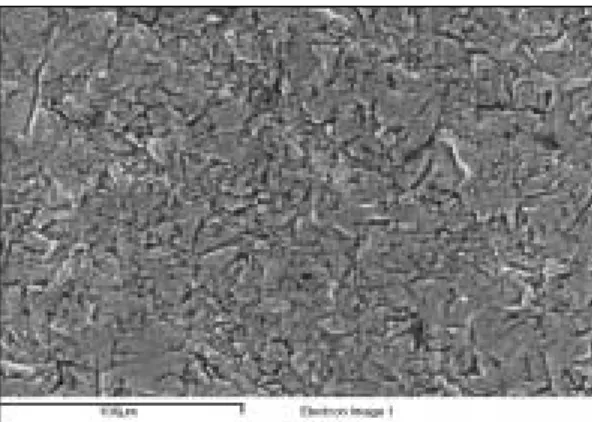
Fig. 5 presents the abutment surface not prepared with sandblasting under scanning electronic microscope(JEOL JSM-840A, Japan). Fig. 6 and 7 exhibit the abutment surface prepared with 50㎛
and 250㎛ sandblasting, respectively. Sandblasting with 50㎛ aluminum oxide is relatively regular and small interface and Sandblasting with 250㎛ alu- minum oxide is mixed with small and large microstructure irregularly. Results measured by surface illuminometer(Ra value) show that no sand- blasting was 0.94±0.04㎛, Sandblasting with 50
㎛ aluminum oxide was 1.98±0.17㎛ and sand- blasting with 250㎛ aluminum oxide was 2.70±
0.25㎛. The SEM confirmed that a coarse sand-
Fig. 6.Sandblasting with 50㎛ aluminum oxide under SEM(X500)
Fig. 7.Sandblasting with 250㎛ aluminum oxide under SEM(X500)
Fig. 5.No surface treatment under SEM(X500)
blast(250㎛) created a statistically more reten- tive abutment surface than a fine sandblast(50㎛).
Axial surface prepared with a coarse sandblast pro- vided longer projections than those produced with a fine sandblast. Spaces between a number of these projections were filled with cement.
Therefore the maximal retentive force was achieved when cement had completely occu- pied the spaces. The greater retention of crowns from the rough surfaces may have resulted from the larger tooth-cement interlocking areas.17
Olin et al18described the addition of petrolatum significantly reduced the retention rate of the temporary dental cement and the noneugenol cements had higher retention values than the eugenol-containing cements, indicating that noneugenol cements could be used when the need for a higher retentive value exists. This is the same result as this study.
In this study, when cemented with no cement, TempBond or TempBond NE in abutment with a groove, no significant effect was attained.
Wiskott et al19evaluated the effect of tooth prepa- ration height and diameter on the resistance of complete crowns to fatigue loading. When height of abutments was 1�7 mm and diameter of abutments was 3, 4, 5, 6, 7 and 8 mm, there was significant linear relationship between abutment height or diameter and resistance of crowns to fatigue loading.
This is the reason why long abutment, 8mm in this study due to sufficiant retention without a groove may weaken the effect of a groove and this retention was mainly attributed to the strength of cement.
Dario et al20Cement-retained prostheses can be made retrievable by selecting a cement with retentive properties to match the retention required by the restoration. A restoration on multiple long abutments would require a cement of less retention as compared with a restoraion on a few short abutments. Evaluation of the reten-
tion of the provisional restoration may offer a point of reference. Retrieval of a cement-retained restoration may involve less time and effort as com- pared with screw-retained prostheses.
GaRey et al21compared the effects of thermo- cycling, load-cycling, and human blood conta- mination on the retentive strength of five dif- ferent cements for luting posts to root form implants. Significant retentive differences were identified among the cements with load-cycling, but minimal effect on the retentive strength was demonstrated from thermocycling. Bood conta- mination in combination with thermocycling and load-cycling adversely affected the reten- tive strengths of all of the cements and blood contamination should be avoided because of a major cause of abutment failure in dental implants.
Michalakis et al22evaluated the cement failure loads of four provisional luting agents used for the cementation of fixed partial dentures(FPD) sup- ported by two or four implants. TempBond NE and TempBond presented significantly differ- ent values for the 2-implant FPD, but not for the 4-implant model. This study applied single implant system only, if considered splinting between single implants, the use of provisional cements with much lower retention would be desirable.
Wiskott et al23measured the effect of film thick- ness and surface texture on the resistance of cemented extracoronal restorations to lateral fatigue loading. In zinc oxide eugenol cement, retention was affected by surface texture, the higher film thickness, the lower fatigue strength, and sandblasting increased retention. This study did not consider film thickness i.e. adaptation between crown and abutment which is very important for retention of crown. When film thickness is thick, dissolution of cements would be accelerated.
Singer and Serfaty24 reported a six month to three year follow-up of Cement-retained implant-
supported fixed partial dentures. The problem of implants cemented with provisional cements was cement wash-out, porcelain fracture, screw loosening, implant fracture and they evaluated cement-retained prostheses would have less problem than screw-retained prostheses.
The findings of this study indicate that TempBond is usually used in cement-retained implants and we may also try TempBond NE, Cavitec, TempBond with vaseline for control of retention . When we don’t change the kind of pro- visional luting agents, we can control the reten- tion force by surface treatment of abutments. If there is TempBond only as a provisional luting agent, the retention may be controlled by adding petrolatum.
In the short abutment and no sufficient retention by TempBond, surface treatment of abutments or groove formation can be applied for increase of retention.
CONCLUSIONS
Within the limitations of this in vitro study, the following conclusions were drawn:
1. Tensile bond strength of provisional luting cements in no surface treatment decreased with the sequence of TempBond NE, TempBond, Cavitec, TempBond with vaseline, no cement and exhibited 0.49�13.32 Kgf.
2. Tensile bond strength more increased by sur- face treatment. Sandblasting with 250㎛ alu- minum oxide exhibited the highest tensile bond strength in the abutment cemented with TempBond NE and sandblasting with 50㎛
aluminum oxide exhibited the highest tensile bond strength in cemented with TempBond.
3. In the aspect of a groove formation, tensile bond strength significantly increased in TempBond with vaseline only and the oth- ers had no significant effect on tensile bond strength.
REFERENCES
1. Branemark P-I,Zarb GA,Albrektsson T(eds). Tissue- integrated prostheses:Osseointegration in clini- cal dentistry. Chicago:Quintessence,1986:241-282.
2. Hebel KS,Gajjar RC.Cement-retained versus screw- retained implant optimal occlusion and esthet- ics in implant dentistry.J Proasthet Dent 1997;77(1):28-35.
3. Misch CE.Contemporary implant dentistry.
St.Louis:Mosby-year Book Inc,1993:651-685.
4. Thomas DT,John RA, Theodora V. Implant prostho- dontics : Current perspective and future direc- tions. Int J Oral Maxillofac Implants 2000;15:66-75.
5. Singer A,Serfaty V.Cement-retained implant-sup- ported fixed partial denture :A 6-month to 3-year follow-up.Int J Oral Maxillofac Implants 1996;11:645- 649.
6. Guichet DL.Load transfer in screw- and cement-re- tained implant fixed partial denture design(abstract).J Prosthet Dent 1994;72:631.
7. Dixon DL,Breeding LC, Lilly KR. Use of luting agents with an implant system: Part II. J Prosthet Dent 1992;68:885-90.
8. Breeding LC, Dixon DL, Bogacki MT, Tietge JD. Use of luting agents with an implant system: Part I. J Prosthet Dent 1992;68(5):737-741.
9. Covey DA, Kent DK, St Germain HA Jr,Koka S.
Effects of abutment size and luting cement type on the uniaxial retention force of implant-supported crowns. J Prosthet Dent 2000 83(3):344-348.
10. Ramp MH, Dixon DL, Ramp LC, Breeding LC, Barber LL. Tensile bond strengths of provisional luting agents used with an implant system. J Prosthet Dent 1999;81:510-514.
11. Wilson AD. Examination of the test for compres- sive strength applied to zinc oxide eugenol cements.
J Dent Res 1976;55(1):142-147.
12. Jorgensen KD. The relationship between reten- tion and convergence angle in cemented veneer crowns. Acta Odontol Scand 1955;13:35-40.
13. Gilboe DB, Teteruck WR.Fundamentals of extra- coronal tooth preparation.PartI:Retention and re- sistance form. J Prosthet Dent 1974;32:651-656.
14. Shillingburg HT Jr, Jacobi R, Brackett SE. Fund- amentals of tooth preparations for cast metal and porcelain restorations. Chicago: Quintesssence, 1987:17-23.
15. Rosenstiel SF,Land MF, Fujimoto J. Contemporary fixed prosthodontics. St.Louis:Mosby,1988:130.
16. Kent DK, Koka S, Froeschle ML.Retention of ce- mented implant-supported restorations. J Prosthodont 1997;6(3):193-196.
17. Tuntiprawon M. Effect of tooth surface rough- ness on marginal seating and retention of complete metal crowns. J Prosthet Dent 1999;81:142-147.
18. Olin PS, Rudney JD, Hill EM. Retentive strength of six temporary dental cements. Quintessence Int 1990;21(3):197-200.
19. Wiskott HW, Nicholls JI, Belser UC. The effect of tooth preparation height and diameter on the re- sistance of complete crowns to fatigue loading. Int J Prosthodont 1997;10(3):207-215.
20. Dario LJ. Implant angulation and position and screw or cement retention: Clinical guidelines.
Implant Dentistry 1996;5:101-104.
21. GaRey DJ, Tjan AHL, James RA, Caputo AA.
Effects of thermocycling, load-cycling, and blood contamination on cemented implant abutments. J Prosthet Dent 1994;71:124-132.
22. Michalakis KX, Pissiotis AL, Hirayama H. Cement failure loads of 4 provisional luting agents used for the cementation of implant-supported fixed par- tial dentures. Int J Oral Maxillofac Implants 2000;15(4):545-549.
23. Wiskott HW, Belser UC, Scherrer SS. The effect of
film thickness and surface texture on the resistance of cemented extracoronal restorations to lateral fa- tigue loading. Int J Prosthodont 1999;12(3):255- 262.
24. Singer A, Serfaty V. Cement-retained implant- supported fixed partial dentures: a 6-month to 3-year follow-up. Int J Oral Maxillofac Implants 1996 11(5):645-649.
Reprint request to:
DR.HWA-YEONLEE
DIV. OFPROSTHODONTICS,DEPARTMENT OFDENTISTRY, UIJONGBU ST.MARY’SHOSPITAL,CATHOLICUNIVERSITY OFKOREA 65-1,KUMOH-DONG, UIJONGBU, KYUNGGI-DO, 480-130 Tel:+82-31-820-3184, Fax:+82-31-847-2894 E-mail: [email protected]