J. Appl. Biol. Chem. 50(1), 29-31 (2007)
Short Communication
Isolation and Identification of Phenylethyl Alcohol from Pichia anomala SKM-T
Eun Kyoung Mo1 and Chang Keun Sung2,*
1Research and Development Center, DBIO Incorporation, Daejon 305-764, Korea
2Department of Food Science and Technology, Chungnam National University, Daejon 305-764, Korea Received July 24, 2007; Accepted December 27, 2007
Key words: phenylethyl alcohol, Pichia anomala SKM-T Phenylethyl alcohol (PEA, GRAS 2858), which has a rose-like aroma, is an important fragrance in the cosmetic industry and possesses organoleptic characteristics that contribute to the quality of beverage and foods [Fabre et al., 1998]. It has been estimated that approximately 700,000 kg of PEA is consumed annually as a food component [Maarse et al., 2000].
The biologically synthesized PEA is 250- to 300-fold more expensive than chemically synthesized one [Etschmann et al., 2002]. Flavors and fragrances that can be labeled “natural” both in the United States and Europe have to be produced from natural sources by physical, enzymatic, or microbiological processes [US Food and Drug Administration, 2001]. Scientifically, there is no difference between a flavor compound synthesized in nature and the same molecule produced in the laboratory;
however, consumers are critical of things they regard as artificial and demand natural food additives [Anonymous, 1999]. Therefore increasing demand for natural flavors makes microbial production of PEA an interesting research field.
Pichia anomala is an ascomycetous heterothallic yeast that reproduces asexually by budding and sexually by the formation of hat-shaped ascospores [Kurtzman and Fell, 1998]. P. anomala is present in many types of environments and have been isolated from fruit and plant materials [Kurtzman and Fell, 1998], cereal grain [Lacey and Magan, 1991], maize silage [Kitamo et al., 1999], high sugar food products [Lanciotti et al., 1999], and wine
[Mingorance-Cazorla et al., 1999]. P. anomala is classified as a biosafety level 1 organism that is considered safe for healthy individuals [De Hoog, 1996]. In the literature, there are no reports on hazardous mycotoxin formation or the production of allergenic spores from yeast.
The most prominent microorganisms regarding production of natural PEA are yeasts. In this study, we have isolated PEA with proper identification from P.
anomala SKM-T fermentation.
Cultivation. Pichia anomala SKM-T was isolated and identified by our research team [Mo et al., 2004]. This strain was cultured on potato dextrose broth (PDB, Difco, Detroit, MI) in 5l-Erlenmeyer flask. Initial pH of medium was adjusted with 0.1 N HCl to pH 4.5.
Cultivation was conducted at 30oC and with agitation speed of 200 rpm for 24 h.
Extraction and isolation of PEA. The cultured broth (2l) was centrifuged for 30min at 3,000rpm. The supernatant was extracted with 200 ml solvent (dichloromethane : pentane = 2 : 1, v/v) for five times, then solvent phase was evaporated with rotary vacuum evaporator (N- 1000S-W, Eyela, Tokyo, Japan) and nitrogen gas.
The concentrated fraction was separated on thin layer chromatography (TLC, Silicagel 60, Art 5721, Merck, Darmstadt, Germany) and silica gel column (Kieselge 60, 70~230 mesh, Merck, Darmstadt, Germany) and eluted with a solvent (hexane : ethyl acetate : water = 12 : 8 : 1, v/v). The purified extracts were used for analytical procedure.
Analytical conditions. The analysis of PEA was performed on an Aglient 6890 N gas chromatograph equipped with flame ionization detector and a capillary column (HP-5, 30 m × 0.320 mm, thickness 0.25µm).
The injector and detector were held at 250oC and the oven temperature was increased as follows: hold at 50oC for 1 min, raised from 50oC to 230oC at 15oC/min, hold at 230oC for 1 min. A volume of 1µL was injected in all analyses.
Electron impact-mass spectrometry (EI-MS) was performed using a mass spectrometer (HP6890 GC, 5973 MSD, Hewlett Packard) under the same GC analytical condition. Spectra were obtained at 70 eV, ion species were normal ion (MF-Linear) and TIC range was m/z 0 to 600. The spectrometric data were compared with those from the NIST Hewlett-Packard 59942C original library mass-spectra.
A UV absorption spectrum of the purified isolate in ethanol was recorded on a spectrophotometer (DU 650, Beckman, USA) at the range of 200 to 600 nm. FT-IR spectrum was taken on a FT-IR spectrometer (Bio-Rad,
*Corresponding author Phone: 82-42-821-6722; Fax:
E-mail: [email protected]
30 Eun Kyoung Mo and Chang Keun Sung Cambridge, USA) as KBr discs and the absorbance
frequency was expressed in cm−1. The PEA fraction was dissolved in CDCl3 (Sigma), and 1H-NMR spectrum was recorded on an FT-NMR spectrometer (JNM-AL400, JEOL, Akishima, Japan) operated at 400 MHz.
As the authors reported before [Mo et al., 2003], PEA was a main volatile flavor compound in P. anomala SKM-T. Thereby, in order to isolate the PEA among volatiles produced from the tested strain, cultured broth was extracted and performed TLC. As a consequence of open column chromatography, we obtained several fractions.
To examine the isolation of PEA, separated fractions were performed GC-MS, and one fraction showed desirable molecular weight (MW 122; Fig. 1). Therefore, to confirm the isolation of PEA, UV absorption was observed at 200~300 nm for the separated compound with the maximum absorption shown at 259 nm (Fig. 2).
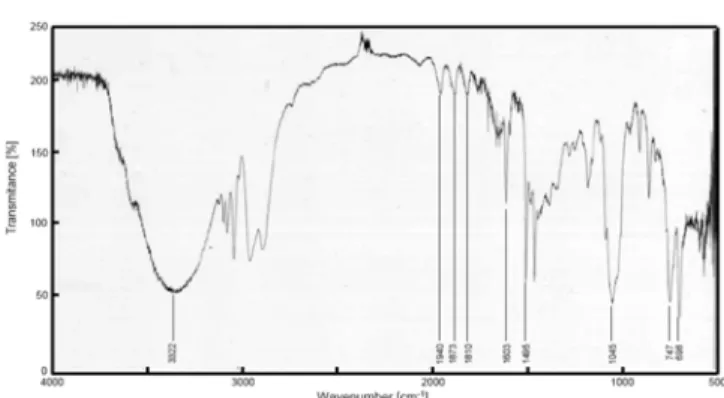
Hence, we assumed that separated compound has an aromatic ring. Figure 3 shows the FT-IR spectrum of the separated compound. FT-IR spectrum revealed the presence of 3322 cm−1 (OH), 2944~2876 cm−1 (C-H stretching), 1810~1940 cm−1 (w, combination), 1495~1603 cm−1 (aromatic), 1045 cm−1 (CO), and 698~747 cm−1 (s,
monosubstituted). Therefore, we considered that the separated compound has a hydroxyl group in its structure.
In order to obtain high familiarity for structure elucidation,
1H-NMR analysis was performed. 1H-NMR spectrum of separated compound, in which mono-substitute phenol ring was verified from the 5 proton signals between δ7.19 and δ7.29. In addition, a hydroxyl group was observed at
δ3.80 (2H, t, H-8) and a proton adjacent aromatic ring was monitored at δ2.82 (2H, t, H-7).
Consequently, the isolated compound from P. anomala SKM-T was identified as a phenylethyl alcohol based on the experimental results described above. This study confirmed that P. anomala SKM-T is PEA producing strain with PEA isolation and/or identification. With regard to an industrial process and/or economic aspects, further studies are needed to establish the optimum culture condition of PEA production and in situ product recovery technique.
Acknowledgment. This study was supported by Technology Development Program for Agriculture and Forestry, Ministry of Agriculture and Forestry, Republic of Korea.
References
Anonymous (1999) USDA authorizes ‘certified organic’
meat, poultry labeling. Food Labeling Nutr News 7, 7-9.
De Hoog GS (1996) Risk assessment of fungi reported from humans and animals. Mycoses39, 407-417.
Etschmann MMW, Bluemke W, Sell D, and Schrader J (2002) Biotechnological production of 2-phenylethanol.
Appl Microbiol Biotechnol 59, 1-8.
Fabre CE, Blanc PJ, and Goma G (1998) Production of 2- phenylethyl alcohol by Kluyvermyces marxianus. Bio- technol Prog14, 270-274.
Kitamoto HK, Hasebe A, Ohmomo S, Suto EG, Muraki M, and Iimura Y (1999) Prevention of aerobic spoilage of maize silage by a genetically modified killer yeasts, Fig. 1. EI-MS spectrum of the isolated compound from
Pichia anomala SKM-T. Mass spectra were obtained by electron impact ionization at 70 eV. The ion species were of a normal ion (MF-Linear) and the TIC range was 0 m/z to 600.
Fig. 2. UV spectrum of the isolated compound from Pichia anomala SKM-T.
Fig. 3. FT-IR spectrum of the isolated compound from Pichia anomala SKM-T.
Isolation of Phenylehtyl Alcohol from P. anomala SKM-T 31 Kluyveromyces lactis, defective in the ability to grow on
lactic acid. Appl Environ Microbiol65, 4697-4700.
Kurtzman CP and Fell JW (1998) The yeast, a Toxonomi- cal study, (4th ed). p. 1055, Elsevier Science, Amster- dam, The Netherlands.
Lacey J and Magan N (1991) Fungi in cereal grains: their occurrence and water and temperature relations, In Cereal grain-Mycotoxins, fungi and quality in drying and storage, Chelkowski, J (ed), pp. 77-118, Elservier Science, The Netherlands.
Lanciotti R, Sinigaglia M, Gardini F, and Guerzoni ME (1999) Hansenula anomala as spoilage agent of arean- filled cakes. Microbiol Res153, 145-148.
Maarse H, Visscher CA, Willensens LC, and Boelens MH (2000) Volatile components in food-qualitative and quan- titative data. Central Institute Voor Voedingsondezioke, TNO Zeist, Netherlands.
Mingorance-Cazorla L, Clemente-Jimenez JM, Martinez- Rodriguez S, Las Heras-Vazquez FJ, and Rodriguez-Vico F (2003) Contribution of different natural yeasts to the aroma of two alcoholic beverages. World J Microbiol Biotechnol19, 297-304.
Mo EK, Kang HJ, Lee CT, Xu BJ, Kim JH, Wang QJ, Kim JC, and Sung CK (2003) Identification of phenylethyl alcohol and other volatile compounds from yeasts, Pichia farinosa SKM-1, Pichia anomala SKM-T, and Galactomyces geotirchum SJM-59. J Microbiol Biotech- nol13, 800-808.
Mo EK, Lee JH, Xu BJ, and Sung CK (2004) Identifica- tion of yeasts from Korean feces and prerequisite charac- terization for preparation of probiotics. Food Sci Biotechnol13, 63-70.
US Food and Drug Administration (2001) Code of Federal Regulations. 21CFR 101.22.