J. Appl. Biol. Chem. 50(2), 70-73 (2007) Article
Antioxidant Properties of Water Extract from Acorn
Yu Yin, Seong-Il Heo, Mee Jung Jung and Myeong-Hyeon Wang*
School of Biotechnology, Kangwon National University, Chuncheon 200-701, Korea Received February 28, 2007; Accepted June 8, 2007
Antioxidant and anti-diabetic activities of acorn were evaluated by its potential for scavenging stable DPPH free radical, inhibition of lipid peroxidation, reducing power, and inhibiton of α- glucosidase and α-amylase. The water extract of acorn exhibited strong antioxidant and anti- diabetic related activities in the tested model systems. Solvent fractionation of the water extract revealed that the water fraction and the EtOAc fraction had strong antioxidant activity, and inhibitory activity on α-glucosidase and α-amylase. The water fraction exhibited higher DPPH radical scavenging activity (EC50= 7.19µg/mL) than that of α-tocopherol (EC50= 7.59µg/mL). It is considered that water extract of acorn has the potential for natural antioxidant and anti-diabetic products.
Key words: acorn, anti-diabetic activity, antioxidant activity, α-amylase, α-glucosidase
Acorn has been used for local diet in Korea. It has been consumed in the form of bread cake and other types of foods. The beneficial use of acorn in the human diet has been reported in Serbia since the end of the 19th century (Pelagic, 1893), with recommendations about its application and beneficial effects. The preparation of drinks based on thermally treated acorn (dry roasting) was especially recommended for children. Antioxidative effects of some acorn components have been reported (Lee et al., 1992;
Chiou, 1989; Rakic et al., 2006). It has been known that oxidative stress is closely related to various diseases such as artherosclerosis, cancer, brain disorder, and aging.
Therefore, antioxidants are considered as protectants against oxidative stress related disease.
Here, we describe the solvent extracted fractions of water extract of acorn, and their antioxidant and anti- diabetic related activities.
Materials and Methods
Plant materials and solvent fractionation. Acorns were obtained from Chuncheon-si, Gangwon-do, Korea.
Dried acorn powder (100 g) was refluxed with water for 3 days at room temperature, and the water extract (5 g) was suspended in distilled water and partitioned with hexane, CH2Cl2, EtOAc in sequence to afford the fractions of hexane (0.1 mg), CH2Cl2 (5 mg), EtOAc (45 mg) and H2O (3185 mg)
DPPH radical scavenging activity. DPPH radical scavenging activity was assessed as described by Kilani
et al (Kilani et al., 2005) with some modification. Two milliliters of various concentrations of sample or water (control) was added to 2 mL DPPH solution (6.5 × 10⁻⁴ mol/mL in MeOH). Blanks contained each of 2 mL distilled water and sample solution. The mixture was shaken immediately after adding DPPH and allowed to stand at room temperature in the dark, and the decrease in absorbance at 517 nm was measured after 30 min until the reaction reached at steady state. All the experiments were run in triplicate. DPPH radical scavenging activity was calculated as follows : Scavenging effect (%) = [1− (Ai−Aj )/A0] × 100; where A0 is the A517 of DPPH without sample (control), Ai is the A517 of sample and DPPH, and Aj is the A517 of sample without DPPH (blank). The effective concentration required for 50%
plaque reduction (EC50) was determined from a curve relating plaque number to the concentration of a sample.
Reducing power assay. The determination of the reducing power was conducted according to the method developed (Oyaizu, 1986). Fractions were spiked with 2.5 mL of phosphate buffer (0.2 M, pH 6.6) and 2.5 mL of 1% potassium ferricyanide. The mixture was then placed in a 50oC water bath for 30 min. Then, samples
*Corresponding author
Phone: +82-33-250-6486; Fax: +82-33-241-6480 E-mail: [email protected]
Abbreviations: BHT, 2,6-di-tetra-butyl-4-methylphenol; DNS, 3,5-dinitrosalicylic acid; DPPH, 2,2-diphenyl-1-picrylhydrazyl;
EtOAc, ethyl acetate; FeCl2-AA; FeCl2-ascorbic acid; MDA, malondialdehyde; SDS, sodium Dodecyl Sulfate; TBA, 4,6- dihydroxy-2-mercaptopyrimidine; TBA-RS, thiobarbituric acid- reactive substances.
Antioxidant Activities of Acorn 71 were kept at room temperature and 2.5 mL of 10%
trichloroacetic acid was added to the mixture. Then, the mixture was centrifuged at 3000 rpm for 10 min, and 2.5 mL of the upper layer solution as mixed with 2.5 mL distilled water and 0.5 mL of 0.1% ferric chloride. The absorbance of the reaction mixture was measured at 700 nm with a UV-vis spectrophotometer.
Lipid peroxidation inhibitory activity in rat liver homogenate. Rat liver homogenate was prepared from young male rats according to the method as described by Masao et al. (Masao et al., 1993). Rats were killed by decapitation and their liver tissues were quickly removed.
A 2 g portion of liver tissue was sliced and then homogenized with 10 mL of 150 mM KCl-Tris-HCl buffer (pH 7.2). Protein content was determined by Lowery method (Lowery et al., 1951). According to the method (Yoshiyuki et al., 1981), the reaction mixture was composed of 0.1 mL of liver homogenate, 0.25 mL of Tris-HCl buffer (pH 7.2), 0.05 mL of 0.1 mM ascorbic acid, 0.05 mL of 4 mM FeCl2 and 0.05 mL of various tests fraction. The mixture was incubated at 37oC for 1 h in a capped tube, then 0.5 mL of HCl (0.1 N), 0.2 mL of SDS (9.8%), 0.9 mL of distilled water and 2 mL of TBA (0.6%) were added to each tube and vigorously shaken.
The tubes were placed in a boiling water bath (100oC) for 30min. After cooling, the flocculent precipitate was removed by adding 5 mL of four fractions and centrifuged at 3000 rpm for 25 min, and then the absorbance of the supernatant was measured at 532 nm. MDA (nmol/mg protein) = [ODs⋅C standard/OD standard⋅Mp]; where ODs is the A532 of sample reactive solution, C standard is any concentration we selected, OD standard is A532 according to C standard in standard (TEP) curve and Mp is the mass of protein in the reactive solution.
α-Amylase inhibitory activity. Twenty µL of α- amylase (0.05 U/µL) was premixed with 20µL of sample and 250µL of 2% starch solution in 0.1 M sodium phosphate buffer (pH 6.9) was added as a substrate to start the reaction.The reaction was carried out at 37oC for 10 min and terminated by the addition of 200µL of DNS reagent (1% 3,5-dinitrosalicylic acid and 12% sodium potassium tartrate in 0.4 M NaOH) (Maeda et al., 1985).
The reaction mixture was heated for 15 min at 100oC and then diluted with 5 mL of distilled. α-Amylase activity was determined by measuring absorbance at 540 nm. IR
= [1−(Ai−AiB)/(A0−A0B)] × 100; Ai is the A540 of sample reactive solution, A0 is the A540 of control reactive solution, AiB is the blank of sample and A0B is the blank of control.
α-Glucosidase inhibitory activity. One hundred microliters of 3 mM p-nitrophenyl α-D-glucopyranoside in 0.1 M sodium phosphate buffer (pH 6.9) was added as
a substrate to the mixture of 50µLof α-glucosidase (0.3 unit/mL) and 50µL of sample to start the reaction. The reaction was conducted at 37oC for 15 min and stopped by the addition of 750µL of 0.1 M Na2CO3. α-Glucosidase activity was assessed by measuring the release of p- nitrophenol from p-nitrophenyl α-D-glucopyranoside at 400 nm (Kim and Jeong, 2005).
Results and Discussion
Table 1 shows the DPPH radical scavenging ability of the acorn fractions and the commercial standards, α- tocopherol and vitamin C. H2O fraction showed the highest DPPH radical scavenging activity (EC50= 7.19
µg/mL) which was higher than that of α-tocopherol (EC50
= 7.59µg/mL). EtOAc and CH2Cl2 fraction also showed DPPH radical scavenging activity with EC50 values of 10.89µg/mL and 31.78µg/mL, respectively. While, the EC50 values of α-tocopherol and vitamin C were 7.59µg/
mL and 3.42µg/mL, respectively.
The reducing power ability of the fractions steadily increased by dose-dependent manner (Fig. 1). H2O and EtOAc fractions showed higher activity than BHT.
Lipid peroxidation of rat liver homogenate was induced by non-enzymatically with ascorbic acid/Fe2+ (FeCl2- AA). The H2O and EtOAc fractions on formation of TBA-RS exhibited strong activity at a concentration of 0.5 mg/mL (Fig. 2). This is comparable to that of α- Table 1. Antioxidant activity of solvent extracted frac- tions from acorns evaluated by DPPH radical scaveng- ing ability
Samples EC50 (µg/mL)
Hexane fraction 4599.02
CH2Cl2 fraction 31.78
EtOAc fraction 10.89
H2O fraction 7.19
α-Tocopherol 7.59
Vitamin C 3.42
Fig. 1. Reducing power of water fraction and EtOAc fraction from acorn water extract. BHT was positive control (□: 5 µg/mL, ▨: 20 µg/mL,■: 50 µg/mL).
72 Yu Yin et al.
tocopherol at a concentration of 0.5 mg/mL, which was used as the positive control. These results, the H2O and EtOAc fractions showed significant anti-lipid peroxidation activities.
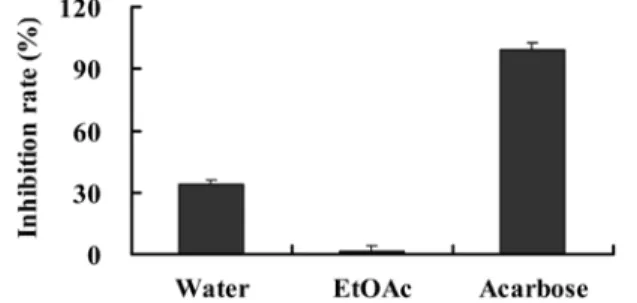
H2O fraction and EtOAc fraction had α-glucosidase and α-amylase inhibitory activity at the concentration of 0.5 mg/mL (Fig. 3; Fig. 4). H2O fraction inhibited α- glucosidase and α-amylase 33.82% and 10.59% at the concentration of 0.5 mg/mL, respectively. Many drugs have been developed for diabetes, and the best way to control postprandial plasma glucose levels was with medication combined with dietary restrictions and exercise programs (Yki-Jarvinen, 1997). One therapeutic approach to decreasing postprandial hyperglycemia was to retard the absorption of glucose by inhibiting carbohydrate hydrolysing enzymes, for example α-glucosidase, in the digestive organs (Toeller, 1997). Inhibitors of intestinal α- glucosidases (AGIs) have used in the treatment of non- insulin-dependent diabetes mellitus (NIDDM) and represented at the huge proportion of antidiabetic drug market (Inzucchi, 2002).
The total phenolic content of various fractions of acorn was measured by the Folin-Denis method. The phenolic
contents of EtOAc, CH2Cl2, H2O and hexane fractions were 28.41, 8.90, 6.31 and 1.21 TA µg/mg (Table 2).
Previously a strong positive correlation has been observed between total polyphenolic content and DPPH radical scavenging activity (Siriwardhana and Shahidi, 2002;
Oki et al., 2002). But, here it didn’t match between total polyphenolic content and DPPH radical scavenging activity. It may be suggested that some other undiscovered compounds are still remaining in H2O fraction of acorns.
The results of the various inhibitor assays (including DPPH free radical scavenging, lipid peroxidation scavenging and reducing power assay) revealed that the various fractions from crude H2O extract of acorn have shown significant antioxidant activity. The H2O fraction has represented the highest levels of antioxidant activity in different assays. From the results, acorn could be considered as an ingredient of functional foods and pharmaceutical purposes. Furthermore, the identification of biologically active compounds containing antioxidant properties in vivo experiments is needed to understand their own actions.
Acknowledgments. This work was supported by a Grant from Korean Research Foundation (KRF- 0805012-1-2) and partly supported by Institutive of Fig. 2. MDA contents after lipid peroxidation inhibi-
tion assay. The concentration of all the fractions is 0.5 mg/mL, α-tocopherol (0.5 mg/mL) was used as a control.
Hexane fraction and CH2Cl2 fraction have no inhibition effect.
Fig. 3. α-Glucosidase inhibition rate of fractions of acorn. The concentration of all the fractions is 0.5 mg/mL, acarbose (0.5 mg/mL) was used as a positive control. Hex- ane fraction and CH2Cl2 fraction have no inhibition effect.
Fig. 4. α-Amylase inhibition rate of fractions from acorn water crude extract. The concentration of all the fractions is 10 mg/mL, acarbose (0.5 mg/mL) was used as a positive control. Hexane fraction and CH2Cl2 fraction have no inhibition effect.
Table 2. The yield and total phenolic content of the sol- vent extracted fractions from water extract of acorn
Samples Yield (%) Total phenolic content(µg TAa/mg)
Hexane fraction 0.0021 1.21
CH2Cl2 fraction 0.1000 8.90
EtOAc fraction 0.9000 28.400
H2O fraction 63.70000 6.31
aTannic acid (TA) was used as a standard for measuring the total phenolic content.
Antioxidant Activities of Acorn 73
Bioscience and Biotechnology in Kangwon National University.
References
Athukorala Y, Kim KN, and Jeon YJ (2006) Antiprolifera- tive and antioxidant properties of an enzymatic hydroly- sate from brown alga, Ecklonia cava Food Chem Toxicol
44, 1065-1074.
Chiou JW (1989) The antioxidant activity and the chemical structure of selected components acorns and their poten- tial use as inhibitors of milk oxidation. A Dissertation of Cornell University, USA.
Inzucchi SE (2002) Oral antihyperglycemic therapy for type 2 diabetes: scientific review. JAMA 287, 360-372.
Kilani S, Ammar RB, Bouhlel I, Abdelwahed A, Hayder N, Mahmoud A, Ghedira K, and Chekir-Ghedira L (2005) Investigation of extracts from (Tunisian) Cyperus rotun- dus as antimutagens and radical scavengers. Environ Toxicol Phar 20, 478-484.
Kim YM and Jeong YK (2005) Inhibitory effect of pine extract on α-glucosidase activity and postprandial hyper- glycemia. Nutrition 21, 756-761.
Lee MH, Jeang JH, and Oh MJ (1992) Antioxidant activity of galic acid in acorn extract. J Korean Soc Food Nutr
21, 639-700.
Lowry OH, Rosebrough NJ, Farr AL, and Randall RJ (1951) Protein measurement with the folin phenol reagent. J Biol Chem193, 265-275.
Maeda K, Kakabayashi S, and Matsubara H (1985) Com- plete amino acid sequence of an α-amylase inhibitor in wheat kernel (0.10-inhibitor). Biochem Biophys Acta
828, 213-221.
Masao H, Yang XW, Miyashiro H, and Nabma T (1993) Inhibitory effects of monomeric and dimeric phenylpro- panoids from mice on lipid peroxidation in vivo and in vitro. Phytother Res7, 395-401.
Mihara M, Uchiyama M, and Fukuzawa K (1980) Thiobar- bituric acid value on fresh homogenate of rats as a parameter of lipid peroxidation in aging, CCl4 intoxica- tion, and vitamin E deficiency. Biochem Med 23, 302- Oki T, Masuda M, Furuta S, Nishibia Y, Terahara N, and311.
Suda I (2002) Involvement of anthrocyanins and other phenolic compounds in radical scavenging activity of purple-fleshed sweet potato cultivas. Food Chem 67, 1752-1756.
Oyaizu M (1986) Studies on products of browning reaction prepared from glucosamine. Japanese J Nutr 44, 307- Pelagic V (1893) Folks teacher IV (in Serbian), Matica315.
Srpska, Novi Sad.
Rakic S, Povrenovic D, Tes¡evic V, Simic M, and Maletic R (2006) Oak acorn, polyphenols and antioxidant activity in functional food. J Food Eng 74, 416-423.
Siriwardhana SSKW and Shahidi F (2002) Antiradical activ- ity of extracts of almond and its by-products. J Am Oil Chem Soc79, 903-908.
Toeller M (1994) Alpha-glucosidase inhibitors in diabetes:
efficacy in NIDDM. subjects. Eur J Clin Invest 24, 31- Wong SH, Knight JA, Hopfer SM, Zaharia O, Leach CN,35.
and Sunderman FW (1987) Lipoperoxide in plasma as measured by liquid-chromatographic separation of mal- ondialdehyde-thiobarbituric acid adduct. Clin Chem 33, 214-220.
Yki-Jarvinen H (1997) Acute and chronic effects of hyperg- lycemia on glucose metabolism. Diabet Med 33, 579- Yoshiyuki K, Michinori K, Tadato T, Shigeru A, and Hiro-585.
michi O (1981) Studies on scutelariae radix, IV. Effects on lipid peroxidation in rat liver. Chem Pharml Bull 29, 2610-2617.