Spectral Analysis of CO
2Corrosion Product Scales on 13Cr Tubing Steel
Lin Guan-fa†, Xu Xun-yuan1, Bai Zhen-quan, and Feng Yao-rong
The Key Laboratory for Mechanical and Environmental Behavior of Tubular Goods, CNPC, Xi’an 710065
1PetroChina Tarim Oilfield Compamy, Korla, 841000
CO2 corrosion product scales formed on 13 Cr tubing steel in autoclave and in the simulated corrosion environment of oil field are investigated in the paper. The surface and cross-section profiles of the scales were observed by scanning electron microscopy (SEM), the chemical compositions of the scales were analyzed using energy dispersion analyzer of X-ray (EDAX), X-ray diffraction (XRD) and X-ray photoelectron spectroscopy (XPS) to confirm the corrosion mechanism of the 13 Cr steel in the simulated CO2 corrosion environment. The results show that the corrosion scales are formed by the way of fashion corrosion, consist mainly of four elements, i.e. Fe, Cr, C and O, and with a double-layer structure, in which the surface layer is constituted of bulky and incompact crystals of FeCO3, and the inner layer is composed of compact fine FeCO3 crystals and amorphous Cr(OH)3. Because of the characteristics of compactness and ionic permeating selectivity of the inner layer of the corrosion product scales, 13 Cr steel is more resistant in CO2 corrosion environment.
Keywords : CO2 corrosion, corrosion product scale, spectral analysis, 13 Cr steel
†Corresponding author: [email protected]
1. Introduction
The carbon dioxide corrosion is one of the main types of oil tube damage and failure in environment of oil and gas exploitation.1) The carbon steel and low alloy steel could be resistant to the CO2 corrosion under low temper- ature and common pressure condition and can also meet the requirement specified in relative standard.2),3) With in- creasing the depth of the well the temperature and pressure get higher and higher, the corrosion condition becomes more rigorous, which leads to that some advanced steels with good corrosion resistance such as some stainless (304L, 316L, et al) and high Cr steels (HP13Cr type, 18Cr type, 22Cr type, 25Cr type or SAF 2205, et al) have been used in some oil and gas fields,4)-7) in spite of the much higher exploiting cost.
Many researches7)-10) showed that the corrosion resist- ance and the price of common 13 Cr steel is between that of common carbon steel and advanced corrosion resistance steel, so it is necessary to research the corrosion resistance characteristic of common 13 Cr steel in the corrosion envi- ronment with higher temperature and pressure, and is help- ful for petroleum industry to choose the reasonable materi-
al used in the corrosion environment and to increase the commercial benefit of the oil fields.
For evaluating the corrosion resistance character of common 13 Cr steel, the CO2 corrosion product scales on common 13 Cr steel were prepared in autoclave by simulating more serious corrosion environment of oil field, and their chemical compositions were confirmed using spectral analysis associated with analyzing the profile characteristics to infer the forming mechanism of the cor- rosion scale.
2. Experimental
The tested material is 13 Cr steel with the chemical composition listed in Table 1.
The samples were machined into arc slices of Φ72.0 mm×11.0 mm×3.0 mm (their central angles are all 60°), and the investigated surfaces were polished with sand pa- pers from 120# to 1000#, then put in acetone for removing oil, and dried. The other surfaces were sealed up with sili- con rubber NQ-704. The samples were fixed on the outer circumferential surface of a discal clamp with the silicon rubber, placed in a desiccator for 24 h solidified.
The experiment was performed in a 344.4×10⁵Pa dy- namic autoclave manufactured by Cortest Co.(America)4)
C Si Mn P S Cr Mo Ni V Ti Cu
0.18 0.33 0.48 0.020 0.001 12.94 0.013 0.10 0.048 0.016 0.013
Table 1. Chemical composition of 13 Cr steel(wt %)
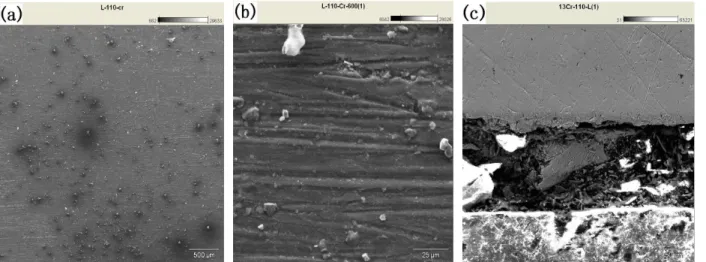
Fig. 1. Morphologies of the surface and the cross-section of the CO2 corrosion scales on 13 Cr steel at 110℃(a: 25×; b:
600×; c: 400×)
by fixing the discal clamp with the samples on an auto- clave stirrer in the corrosive medium, 5000 mg/L NaCl solution. After being sealed and covered, the autoclave was aerated with N2 gas to drive O2 for 6 h, and then aerated with CO2 for 8h. The testing temperature, CO2
partial pressure and rotary speed were adjusted to their predefined values. The corrosion experiment lasted for 15d. After that, the corroded samples were washed with water, dried with absolute alcohol, and kept in the other desiccators.
The surface and cross-section morphology of CO2 corro- sion scales were observed with SEM (PHILIPS XL-20), the composition of the scales was analyzed with energy dispersion analysis of X-ray (EDAX), and the X-ray dif- fraction (XRD) pattern of the scales was investigated by D/max-3C automatic X-ray diffract-meter with a copper KαX-ray source, 40 kV and 100 mA.
The corrosion scale on the corroded surface is analyzed using X-ray photoelectron spectroscopy (XPS, Perkin Elmer, PHI 5000, ESCA) with a set of operating parame- ters as follows: the magnesium KαX-ray source with a power of 300 W, the pass energy of 89.45 eV for all ele- ments or 71.55 eV for single element through narrow scan- ning, an analysis area approximately 1.0 mm2, the vacuum in the test chamber of 2×10⁻⁸ Pa, and an angle of X-ray incidence of 45°. The binding energies were calibrated by taking C1s peak, 284.6 eV as a criterion. The original
surface of the scale was first spattered using argon gas for 10 min. to remove the surface impurity adsorbed from the air by pretreatment, and then the scanning for all ele- ments of the scale was performed from 0 to 1000 eV.
3. Results
3.1 Profile characteristics of CO2 corrosion product scales on 13 Cr steel
The corrosion product scale formed on the substrate sur- face of 13 Cr steel is puce and the morphologies of the surface and cross-section of the corrosion scales formed at 110℃ are displayed in Fig. 1. It can be seen from Figs.
1(a) and (b) that the corrosion scales are even, uniform and compact with many fine nicks on the surface of the substrate covered by a thin layer of corrosion scale, which can lead to the conclusion that the corrosion type of 13 Cr steel under the testing condition is uniform corrosion.
There are a few of dispersed corrosion product crystals on the surface of the corrosion scale, which their shape and colour are varied with that in the corrosion product scale close to the metallic substrate (called as the inner layer), and the composition of which should also be differ- ent from that in the inner layer as shown in the following compositive analysis. The morphology of the CO2 corro- sion scale formed on 13 Cr steel at 170℃ is showed in Fig. 2, in which the dispersed crystals is more than that
Fig. 2. Surface morphologies of the CO2 corrosion product scales on 13 Cr steel at 170℃(a: 25×; b: 600×)
in Figs. 1(a) and (b), the area uncovered with the crystals in Fig. 2 is less than that in the latter, but the interspace between the crystals is still very big. All this observation shows that the baffling function of the corrosion scale from corrosion medium is very low, and in fact only the thin inner layer should have good inhibitive property and plays an important role in resisting the permeation of corrosion solution because of its compactnesss. The cross-section structure of the corrosion scale in Fig. 1(c) shows the inter- face between the steel substrate in the upper and the corro- sion scale in the center is even and flat, no sharp hollow or bulgy, from which it can be inferable that the corrosion of 13 Cr steel is the type of uniform corrosion.
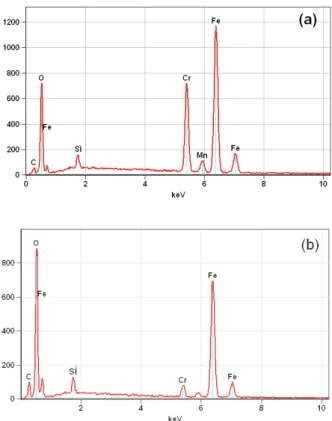
2.2 EDAX analysis of CO2 corrosion product scale Energy dispersion analysis of X-ray for the corrosion product scale on 13 Cr steel at 110℃ in Fig. 3 shows that there are four elements, i.e. Fe, Cr, O and C, in the
Fig. 3. EDAX analysis of corrosion scale formed on 13 Cr steel at 110℃(a: the inner layer; b: the surface layer)
Table 2. Element percentage of the scale analyzed with EDAX
Element C O Cr Mn Fe Total
Inner layer 7.41 31.16 17.29 0.30 43.84 100 Outer layer 19.61 52.68 1.13 / 26.58 100
inner layer and the surface crystals, in which Fe and Cr come from the substrate of 13 Cr steel, O element from the corrosion medium, and C element mainly from the corrosion medium and a little from the substrate. It is worthwhile to note that Si element is from silicon rubber used as the material sealed the samples and C element comes also from containing carbon impurity imported from the processes of preparing the samples. There exists distinctly a little Mn element in the inner layer in Table 2, because Mn is one of the participators of the anodic corrosive reaction and it is only much less Mn existed in the alloy substrate (0.48%, see Table 1).
The element percentage of CO2 corrosion product scale on 13 Cr steel at 110℃ analyzed with EDAX is listed in Table 2. It can be seen from the table that the main components in the corrosion scale should be the product of corrosion reaction for Fe and Cr elements, which is proved by the following XRD and XPS analyses as well.
0 2 0 4 0 6 0 8 0 0
2 0 4 0 6 0 8 0 1 0 0 1 2 0 1 4 0 1 6 0
1 - F e 2 - F e - C r 3 - F e C O3
3 3 3
3
2 2
1 3
2 1 1
CPS
2 t h e t a / 0
Fig. 4. XRD spectrum of CO2 corrosion scale formed on the 13 Cr steel at 110℃
2.3 XRD analysis of CO2 corrosion product scale The XRD spectrum of CO2 corrosion product scale formed on 13 Cr steel at 110℃in Fig. 4 shows that the main composition of corrosion scale is Fe, Fe-Cr and FeCO3. It is worthwhile to be note that a little protuberant peak located at 22° in the figure is one of the typical char- acteristics for amorphous compounds in XRD spectrum.
Under some reaction condition, Cr element of the substrate may form Cr(OH)3 and its dehydrated product Cr2O3. Since Cr(OH)3 is an amorphous compound but Cr2O3 is a kind of crystal structure, a protuberant peak appears in the XRD spectrum, which means the existence of the amorphous compound Cr(OH)3 in corrosion product and the area of its peak accords with its content in the scale.
Because the area of the protuberant peak is less than that of the other compound’s peaks, the proportion of the amor- phous Cr(OH)3 is very little in the corrosion scale, which is consistent with the result of EDAX spectral analysis.
2.4 XPS analysis of CO2 corrosion product scale X-ray Photoelectron Spectrum (XPS) analysis, which can give a combined spectrum of various electronic sub-shell of each element in the corrosion scale and further the composition of the scale, is one of the impactful meth- ods for analyzing and affirming the chemical composition of corrosion scale and is helpful to confirm and understand the corrosion type and corrosion mechanism of the steel.
Fig. 5 shows XPS of all elements of CO2 corrosion product scale formed on 13 Cr steel at 110℃. It can be seen from the figure that the corrosion scale contains main- ly four kinds of elements, i.e. Fe, Cr, O and C, except Si element as mentioned above of the results of EDAX and XRD analysis. The element content of the corrosion scale tested by XPS is listed in Table 3. The measured result is various with that in Table 2, which is caused from the fact that EDAX tests at a dot, but XPS belongs to an area and an average value as taking its result.
The narrow XPS spectrum is then analyzed for each
Fig. 5. XPS of all elements in CO2 corrosion scale
Fig. 6. XPS of Fe element in CO2 corrosion scale
Table 3. Element content of corrosion scale tested by XPS (wt%)
Element C O Cr Fe Total
Content 44.54 43.08 2.28 10.10 100
element to confirm further its chemical combining state in the scale. The figure of XPS of Fe element in CO2
corrosion product scale formed on 13 Cr steel at 110℃
in Fig. 6 shows three standard peaks located at 706.38 eV, 709.51 eV and 713.27 eV, which correspond to Fe0, Fe2+ and the concomitant peak of Fe element, respectively.
As a little pure iron examined by XPS in the scale comes from the rudimental scrap iron produced in the process of machining steel samples and a few substrate grains en- wrapped in the scale, the Fe element in the scale on 13 Cr steel exists in the form of FeCO3.
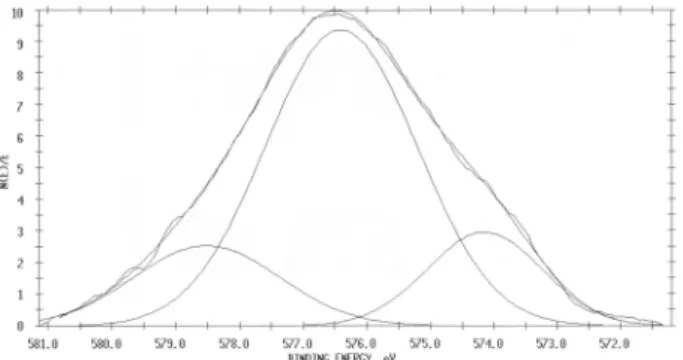
Fig. 7 shows XPS of Cr element of CO2 corrosion prod- uct scale formed on 13 Cr steel at 110℃ which contains three standard peaks located at 574.15 eV, 576.41 eV and 578.51 eV corresponding to Cr0, Cr+3 and Cr+6 chemical combining state, respectively. The peak area of Cr0 or Cr+6 chemical combining state is less than that of Cr+3, so Cr element in the scale might exist mainly as Cr+3 compound.
From the test result of XRD for the scale, the Cr+3 com- pound may be the amorphous Cr(OH)3 but not the crystal
Fig. 7. XPS of Cr element in CO2 corrosion scale
Fig. 8. XPS of C element in CO2 corrosion scale
Fig. 9. XPS of O elements in CO2 corrosion scale
Cr2O3. Cr+6 chemical combining state exists maybe in the combining form of CrO3 or Cr2O72-, but their content in the scale is limited.
Fig. 8 shows XPS of C element of CO2 corrosion prod- uct scale formed on 13 Cr steel at 110℃. It is seen from the figure that the energy spectrum can be simulated from three standard peaks located at 288.97 eV, 287.30 eV and 284.59 eV, which may correspond with CO32- or HCO3-, simple organic compounds and metallic carbide. Here, the metallic carbide should be Fe3C or (Fe, Cr)7C3 from the substrate of 13 Cr steel, organic compounds should be absorbed in the process of sealing, washing, drying, storing of the corrosion samples, so C element of the corrosion
scale exists in the form of carbonate or bicarbonate.
XPS of O element in Fig. 9 can be imitated from three standard peaks located at 532.24 eV and 529.99 eV corre- spond to hydrate or oxide of Fe and Cr elements res- pectively. The content of Cr hydrate is more than that of oxide, and the ferrous oxide or hydrate is very little.
4. Discussion
In the CO2 Corrosion environment, the alloying ele- ments of 13 Cr steel can produce the following anodic reactions11),12):
Fe → Fe2+ + 2e (1)
Cr → Cr3+ + 3e (2)
The alloy contains Mn and Ni elements which take also part in such anodic reactions, as mentioned above in the result of the EDAX. There contains commonly the follow- ing reactive process in the corresponding cathodal CO2
corrosion reactions11),12):
CO2 + H2O ⇋ H2CO3 (3)
2H2CO3 + 2e ⇋ H2 + 2HCO3- (4) 2HCO3- + 2e → H2 + 2CO32- (5)
2H+ + 2e → H2 (6)
In neutral or weak acidic corrosion environment, the positive and negative ions in above reactions can form corrosion products through the following reactions11),12):
Fe2++ 2HCO3→ Fe(HCO3)2→ FeCO3+ CO2+ H2O (7)
Fe2+ + CO32- → FeCO3 (8)
Cr3+ + 3H2O → Cr(OH)3 → Cr2O3 + H2O (9) The corrosion reaction of Mn2+ ion of forming the corro- sion product is similar to that of Fe2+ ion, but as a little Mn element in the substrate, only a little Mn2+ corrosion product may also be included in the CO2 corrosion product scale of 13 Cr steel.
With increasing the temperature or decreasing the CO2
partial pressure in the corrosion process, the ferrous corro- sion product can form its oxides through the following reactions13):
FeCO3 → FeO + CO2 (10)
4FeO + O2 → 2F2O3 (11)
3FeO + CO2 → Fe3O4 + CO (12) 3FeO + H2O → Fe3O4 + H2 (13) 4Fe3O4 + O2 → 6Fe2O3 (14)
The reaction (10) can occur below 100℃, but it is lim- ited only at high CO2 partial pressure (pCO2=2MPa); the reactions (11)~(14) follow the reaction (10), but the re- actions (12) and (13) occur in the anoxic condition, and the reactions (11) and (14) in the aerobian condition. The total amount of ferreous oxides in the corrosion scale on 13 Cr steel is so very little that they can’t be measured with XRD spectrum. Likewise, it is seen from the result of XRD analysis that chromic oxides in the scale are very little. The corrosion scale formed on 13 Cr steel at 110℃
is consisted of FeCO3 and Cr(OH)3, with mainly bigger crystal of FeCO3 in the surface layer and amorphous Cr(OH)3 besides FeCO3 crystals in the inner layer close to the substrate, and that Cr(OH)3 exists only almost in the inner layer.
Under the testing condition, when FeCO3 and Cr(OH)3
have formed in the corrosion medium, as the two com- pounds have very small solubility in the medium, the two corrosion products can deposit on the surface of the sub- strate and also the other surface in autoclave, which results in the corrosion rate of the substrate to be decreased into a small stable value after some time.14) As the corrosion rate at initial corrosion stage is higher, the size of the de- posited corrosion product grains is smaller; the corrosion rate at the ending corrosion stage is lower, the size of the grains is bigger. At the same time the grains formed at the ending stage deposit on the surface of corrosion layer formed in initial corrosion process, so the corrosion product scale is with double-layer structure, in which the crystals in the surface layer is more bulky and the grains in the inner layer is finer.14) Because of the amorphous Cr(OH)3 in the inner layer and its ionic permeating se- lectivity,15) this two important aspects are helpful to en- hance the compactness of the corrosion product scale, which is one of primary reasons why 13 Cr steel has good corrosion resistance in CO2 environment.
5. Conclusion
1) Under the testing condition, the CO2 corrosion prod-
uct scale formed on 13 Cr steel is with double layers struc- ture, in which the thin compact inner layer consists of fine grains and the thick loose surface layer of bulky crystals.
2) The CO2 corrosion product scale contains mainly four elements: Fe, Cr, C and O, but the compositions of the two layers are obviously different, the amorphous Cr(OH)3
besides FeCO3 in the inner layer and mainly FeCO3 crys- tals in the outer layer.
3) Ferreous oxides aren’t all discovered in the two layers of CO2 corrosion scale on 13 Cr steel, which results from that CO2 partial pressure in the testing condition is so high that the decomposing reaction of FeCO3 is restrained.
4) The amorphous Cr(OH)3 in the inner layer helps to enhance the compactness and selectivity of the corrosion product scale, which is one of main reasons why 13 Cr steel has good corrosion resistance in CO2 corrosion environment.
Acknowledgement
Financial support from the National Natural Science Foundation of China (No. 50231020) and Applied Basic Research Project of China National Petroleum Corporation (No. 06A40302) is gratefully acknowledged.
References
1. J. S. Zheng and Z. P. Lu, Acta petrolei sinica, 16, 134 (1995).
2. M. L. Yan, G. X. Zhao, and M. X. Lu, Materials Protection, 32, 27 (1999).
3. G. X. Zhao, M. L. Yan, M. X. Lu, and P. Q. Li, Corrosion Science and Protection Technology, 12, 240 (2000).
4. D. Q. Tong and J. Wu, Journal of Iron and Steel Rearch, 3, 1 (1991).
5. J. Wang, Z. Q. Bai, G. F. Lin, and H. L. Li, Materials Development and Application, 20, 26 (2005).
6. Z. B. Chen, D. Q. Song, X. Y. Tang, and Q. Zhang, Gas and Oil, 24, 1 (2006).
7. X. H. Dong, G. X. Zhao, Y. R. Feng, and Y. Jiang, Oil Field Equipment, 32, 1 (2003).
8. X. H. Lu, G. X. Zhao, Z. H. Fan, Y. Q. Yang, C. F.
Chen, and M. X. Lu, Materials Protection, 37, 34 (2004).
9. A. Ikeda, S. Mukai, and M. Ueda, Corrosion, 41, 185 (1985).
10. X. H. Lu, G. X. Zhao, Y. Q. Yang, J. Z. Ma, C. F.
Chen, and M. X. Lu, Materials Engineering, 10, 16 (2004).
11. C. Waard and D. E. Millliams, Corrosion, 31, 177 (1975).
12. E. Dayalan, G. Vani, and J. R. Shadley, Corrosion/95, paper 118, NACE, Houston (1995).
13. J. K. Heuer and J. F. Stubbins, Corrosion Science, 41, 1231 (1999).
14. G. Lin, M. Zheng, Z. Bai, and X. Zhao, Corrosion,
62, 501 (2006).
15. A. R. Brooks, C. R. Clayton, K. Doss, and Y. C. Lu, Journal of Electrochemical Society, 133, 2459 (1986).