556
Abstract − A hemoglobin/silver nanoparticle heterolayer was fabricated for bioelectronic device with electrochemical signal-enhancement effect. As a device element, a hemoglobin, the metalloprotein, contained the heme group that showed the redox property was introduced for charge storage element. For electron transfer facilitation, a silver nanoparticle was introduced for electrochemical signal facilitation, the hemoglobin was immobilized onto Au substrate using chemical linker 6-mercaptohexanoic acid (6-MHA). Then, the silver nanoparticle was immobilized onto fabricated hemoglobin/6-MHA heterolayers by layer-by-layer (LbL) method. The surface morphology and surface roughness of fabricated heterolayer were investigated by atomic force microscopy (AFM). The redox property of hemoglobin/silver nanoparticle heterolayer was investigated by a cyclic voltammetry (CV) experiment for obtaining an oxidation potential and reduction potential. Moreover, for the assessing charge storage function, a chronoamperometry (CA) experiment was conducted to hemoglobin/silver nanoparticle-modified heterolayer electrode using oxidation and reduction potentials, respectively. Based on the results, the fabricated hemoglobin/silver nanoparticle heterolayer showed that an increased charge storage effect compared to hemoglobin monolayer-modified electrode.
Key words: Hemoglobin, Silver nanoparticle, Electrochemical bioelectronic device, Cyclic voltammetry, Atomic force microscopy
1. Introduction
Nanobioelectronics is a cornerstone of the silicon industry for developing new concept electronic components such as transistors, logic gates and microprocessors [1,2]. Among them, the information storage device has been developed using biomolecules. Several groups have attempted to fabricate several types of information stor- age devices [3-5]. Especially, the electrochemical bioelectronic devices were broadly proposed to develop field-effect transistors (FET), bio- sensors because of various functionalities, ease-of-fabrication and future applications [6,7].
Several groups have developed various bioelectronics devices; the Winfree group developed DNA-based programmable computing with applications [8,9]. The Yang group developed a virus-nanopar- ticle-based digital memory device [10]. The Smolke group suggested the RNA-based information processing system. [11]. The Willner group also suggested enzyme-based information processing [12]. The Cho group developed the metalloprotein-nanoparticle based resistive charge storage system that shows excellent electrical resistive property for future memory devices [13].
Since 2000, Choi’s group has focused on a biomolecule-based apparatus which mimics the natural characteristics of a biological organism in inorganic devices. In an initial stage, they suggested pro- tein-based photodiode and visual information controller [14-16].
After that, they developed a metalloprotein-based electron charge sys- tem using redox property of metalloproteins [17]. Also, the metalloprotein can be modified using DNA recombinant technique for introducing additional functional group such as thiol group. Several types of information storage devices have been developed, for example, a multi-level biomemory, a multi-functional biomemory and a DNA- based WRER-type biomemory [18-20]. Recently, they developed a bioprocessing device consisting of protein-DNA-nanoparticles and RNA-nanoparticle-based resistive memory device [21]. Like this, to fabricate the various bioelectronics devices, fabricating the protein- nanoparticle heterolayer is an essential technique.
Hemoglobin is a well-known metalloprotein. It has the four elec- troactive ferrous ions (Fe2+) in a heme group; the heme groups are oxidized to ferric ions (Fe3+) that provide the redox property. The hemoglobin has been widely investigated in the life sciences, medi- cine and nanobiotechnology [22,23]. In particular, the electron trans- fer property of hemoglobin is very interesting for biosensor and bioelectronic device applications. If the electron transfer facilitation can be enhanced by additional extra nanomaterials, this can be very effective for constructing the charge storage device. The silver nanoparticle is suitable to facilitate electron transfer because of biocompatibility, cheap cost and ease of preparation. In this study, we fabricated the
†To whom correspondence should be addressed.
E-mail: [email protected]
‡This article is dedicated to Prof. Choon Han on the occasion of his retirement from Kwangwoon University.
This is an Open-Access article distributed under the terms of the Creative Com- mons Attribution Non-Commercial License (http://creativecommons.org/licenses/by- nc/3.0) which permits unrestricted non-commercial use, distribution, and reproduc- tion in any medium, provided the original work is properly cited.
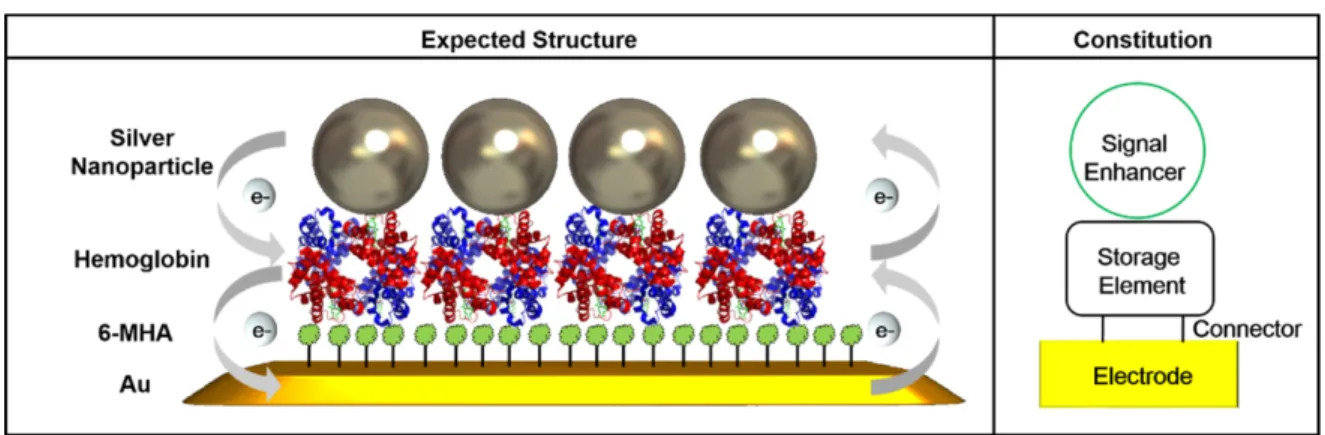
hemoglobin/silver nanoparticle heterolayer for confirming the elec- trochemical signal-enhanced charge storage property. The hemoglo- bin was self-assembled onto the Au substrate through additional linker 6-Mercaptohexanoic acid (6-MHA). Then, the silver nanopar- ticle was immobilized onto hemoglobin-modified substrate using layer-by-layer (LbL) technique. The prepared hemolgobin/silver nanoparticle heterolayer was investigated by atomic force micros- copy (AFM). The surface roughness analysis was carried out to con- firm the surface properties. Furthermore, the redox properties of hemoglobin and silver nanoparticle/hemoglobin were monitored by cyclic voltammetry (CV). The charge storage property of hemoglobin and silver nanoparticle/hemoglobin was assessed by chronoamper- ometry (CA). Fig. 1 shows the schematic diagram of fabricated hemoglo- bin/silver nanoparticle immobilized on the Au substrate. The following sections describe the preparation of hemoglobin/silver nanoparticle heterolayer and its characteristics.
2. Experimental Details
2-1. Materials
To fabricate the bioelctronic device electrode, Au substrate [Au (43 nm)/Cr (2 nm)/SiO2 (200 nm) Si (p-type) wafers] was manufactured as the working electrode (G-MEK, South Korea). For the electro- chemical experiments and charge storage test, Pt wire and the Ag/
AgCl reference electrode were purchased from BAS (USA) for 3 elec- trode electrochemical system. The hemoglobin was extracted from horse heart, 6-Mercaptohexanoic acid (6-MHA) and obtained from Sigma-Aldrich (USA). Sulfo-SMCC (sulfosuccinimidyl 4-(N-maleimi- domethyl)cyclohexane-1-carboxylate) was obtained from Thermo- Fisher Scientific (USA). A 10 µM of hemoglobin solution was dil- luted in 10 mM PBS buffer at pH 7.4. The silver nanoparticle (20 nm) was obtained from BBI (UK).
2-2. Fabrication of hemoglobin/silver nanoparticle heterolayer For the electrode preparation, Au substrates were washed by pira- nha solution (H2O2 and H2SO4, 3:7 composition) at 70 °C for 3 min to remove the residues on the surface of substrates. Then, the sub-
strates were rinsed with ethanol, DI water, respectively, and dried by N2 gas. The prepared 1 mM of the 6-MHA solution (20 µl) was dropped onto the Au surface for connection between hemoglobin and Au sub- strate for 12 hrs at 4 °C. The head group (thiol group) of 6-MHA was bound to Au substrate through the covalent bonding. Continuously, the prepared 10 µM of the hemoglobin solution (20 µl) was dropped onto the 6-MHA-modified Au surface through interaction between tail group (carboxylic acid) and amine group of hemoglobin by EDC/
NHS reaction for 6 hrs. The modified substrates were cleaned with deionized water and dried under N2 gas stream. Then, 1 mM solu- tion of the Sulfo-SMCC solution was immersed in prepared sub- strate for 6 hrs. Next, 0.2 mg/ml of silver nanoparticle solution (20 µl) was added onto the substrate for 12 hrs. Finally, the modified sub- strates were washed with DI water and dried under N2 gas flow. The fabrication process was carried out in a humidity chamber at 25 °C [24].
2-3. Surface morphology investigation of hemoglobin/silver nanoparticle heterolayer using AFM
To confirm the immobilization of hemoglobin/silver nanoparticle heterolayer, the surface morphologies of hemoglobin monolayer, hemoglobin/silver nanoparticle heterolayer were investigated using AFM. The AFM experiment was conducted using a Nanoscope IV / Multimode (Bruker, USA). The AFM tip was purchased from Bruker (USA). The tip was composed of phosphorous (n-type doped Si). Spring constants of 30~80 N/m were used. Before scanning the sample, the auto set point and gain values were adjusted to optimize the force between the tip and the surface [18].
2-4. Electrochemical analysis of hemoglobin-silver nanoparticle heterolayer
Electrochemical experiments and charge storage validation test of hemoglobin/silver nanoparticle heterolayer were confirmed using a CHI660A electrochemical workstation (CH Instruments, USA). The electrochemical analysis was performed in 10 mM PBS buffer solu- tion (pH = 7.4) at room temperature [16]. All electrochemical experi- ments were repeated with five samples.
Fig. 1. Schematic diagram of Hemoglobin/Silver Nanoparticle Heterolayer.
and small aggregated circular shapes. Compared to the surface mor- phology of hemoglobin monolayer, AFM result of fabricated hemo- globin/silver nanoparticle heterolayer is shown in Fig. 2(b). There existed a hemoglobin-silver nanoparticle heterolayer with around 30 nm size diameter and some irregular aggregated shapes which were bigger than the result of hemoglobin monolayer on average.
This result was induced by the introduction of silver nanoparticles on hemoglobin monolayer. Also, Fig. 2(c) exhibits the roughness analy- sis of fabricated biofilms. Roughness average (Ra), RMS roughness (Rq) and maximum height (Rmax) values of hemoglobin monolayer were 0.488 ± 0.175 nm, 1.687 ± 0.439 nm and 2.436 ± 1.285 nm, respectively. In the case of hemoglobin/silver nanoparticle heterolayer, those values were 1.476 ± 0.302 nm, 4.874 ± 1.238 nm and 3.974 ± 0.671 nm, respectively. By comparision of Ra, Rq and Rmax values of hemoglobin monolayer and hemoglobin/silver nanoparticle het- erolayer, hemoglobin/silver nanoparticle heterolayer showed the increased roughness due to the immobilization of silver nanoparticle on the hemoglobin monolayer. Based on the AFM results, the fabri- cation of hemoglobin/silver nanoparticle heterolayer self-assembled on the Au substrate via 6-MHA was confirmed well.
3-2. Electrochemical investigation of hemoglobin-silver nanoparti- cle heterolayer
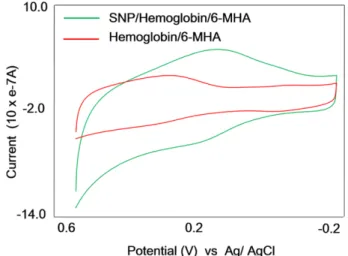
The electrochemical property of fabricated hemoglobin-silver nanopar- ticle heterolayer was investigated by CV. Fig. 3 shows the cyclic vol- tammogram of hemoglobin monolayer and hemoglobin/silver nanoparticle heterolayer. The cyclic voltammogram showed the reduction and the oxidation potential peak of the fabricated films. The reduction and the oxidation potential values of hemoglobin monolayer were 320 ± 18 mV and 375 ± 31 mV, respectively. Also, those values for hemoglobin-silver nanoparticle heterolayer were 173 ± 27 mV and 251 ± 32 mV, respec- tively. The cyclic voltammogram showed that hemoglobin/silver nanoparticle heterolayer exhibited the electrochemical signal ampli- fied currents compared to the results of hemoglobin monolayer. The amplification of the electrochemical signal was induced by immobi-
Fig. 2. AFM images of (a) Hemoglobin self-assembled on 6-MHA layer, (b) Silver nanoparticle/Hemoglobin self-assembled on 6-MHA layer, (c) Surface roughness analysis of each biofilm.
Fig. 3. Cyclic voltammogram of hemoglobin (Red line) and hemo- globin/silver nanoparticle (Green line) self-assembled on 6-MHA layer-modified Au substrate, respectively.
lization of silver nanoparticle. The silver nanoparticle facilitated the electron transfer rate of the fabricated heterolayer biofilm due to the increment of the electron coupling effect between hemoglobin and the Au substrate. Presumably, the hemoglobin/silver nanoaprticle het- erolayer showed the amplified electrochemical signals compared to the hemoglobin monolayer prepared without silver nanoparticle.
3-3. Charge storage investigation of hemoglobin-silver nanoparti- cle heterolayer for biomemory application
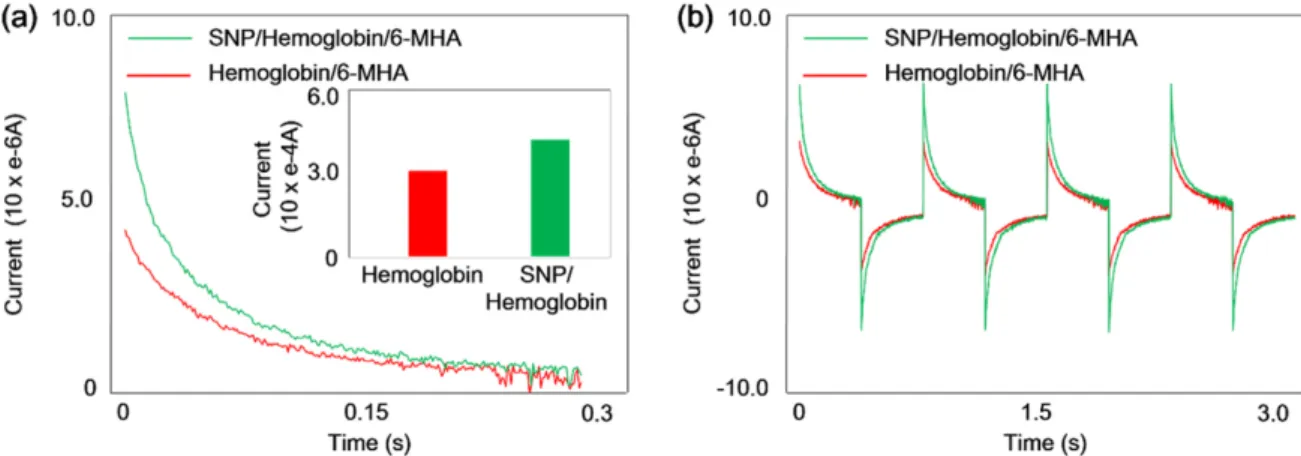
To investigate the charge storage function of hemoglobin/silver nanoaprticle heterolayer on the Au substrate, CA was done for biomem- ory application. For validating charge storage function, the reduction potential value and the oxidation potential value acquired from CV were used as the parameters to operate CA technique. The reduction potential of 320 mV and the oxidation potential of 375 mV obtained from CV were applied for hemoglobin monolayer. Like this, the reduc- tion potential of 173 mV and the oxidation potential of 251 mV were applied to hemoglobin/silver nanoparticle heterolayer-modified elec- trode. Fig. 4 shows the charge storage properties of the fabricated biofilms. In Fig. 4(a), CA graphs of hemoglobin-silver nanoaprticle heterolayer and hemoglobin monolayer from 0 sec to 0.3 sec are shown and charged current values of them are shown in the inserted Fig 4(a).
To estimate the charged current value for charge storage function, the formula of ‘Q = i*dt’ was used. Based on the formula, the area under the acquired graph was calculated to obtain the charged current value of each biofilm. During 0.3 sec, CA graph of hemoglobin/silver nanoaprticle heterolayer showed the amplified electrochemical sig- nal compared to the result of hemoglobin monolayer. Therefore, the calculated charge current value of hemoglobin/silver nanoaprticle heterolayer 4.34 × 10⁻⁴ A was higher than the value of hemoglobin monolayer 3.18 × 10⁻⁴ A. That indicates the silver nanoparticle facil- itates the charge transfer between hemoglobin and Au substrate around 136% more. Also, the hemoglobin/silver nanoaprticle heterolayer showed a repetitive current response by applied potentials for a total duration for 4 cycles with amplified electrochemical signal compared
to the hemoglobin monolayer fabricated without silver nanoparticle.
From CA results, the charge storage property of hemoglobin/silver nanoaprticle heterolayer for bioelectronic device application was verified well.
4. Conclusion
A hemoglobin/silver nanoparticle heterolayer was fabricated with the electrochemical signal-enhancement effect for bioelectronic device application. For this purpose, the hemoglobin was immobilized through 6-MHA chemical linker on the Au substrate. After that, the silver nanoparticle was immobilized onto hemoglobin-modified electrode.
The heterolayer fabrication was confirmed by AFM and surface analy- sis well. AFM results showed that each hemoglobin, hemoglobin/
silver nanoparticle heterolayer was well organized. Moreover, the electrochemical property of hemoglobin/silver nanoparticle hetero- layer was well investigated by CV. CA experiment showed the increased charge storage values of hemoglobin/silver nanoparticle heterolayer compared to hemoglobin monolayer around 136%. Based on the electrochemical experiments, the hemoglobin/silver nanopar- ticle heterolayer can be used for bioelectronic device applications such as biomemory, bioprocessing devices and biosensor applica- tions in the near future.
Acknowledgment
This research was supported by Sogang University and by a Research Grant of Kwangwoon University in 2017.
References
1. Lieber, C. M. and Lu, W., “Nanoelectronics from the Bottom Up,” Nat. Mater., 6, 841-850(2007).
2. Petty, M. C., Molecular Electronics: From Principles to Prac- tice, 1st ed., Wiley, Chichester(2007).
3. Noy, A., “Bionanoelectronics,” Adv. Mater., 23, 807-820(2011).
∫
Fig. 4. (a) Confirmation of charge storage properties. The current response curve corresponding to the applied oxidation potentials (Red line:
hemoglobin, Green line: silver nanoparticle/hemoglobin), inset figure shows the charged current value of each electrode. (b) The cur- rent response corresponding to the applied potential series for a total duration for 4 cycles.
S., “Toward Reliable Algorithmic Self-Assembly of DNA Tiles:
A Fixed-Width Cellular Automaton Pattern,” Nano. Lett., 8, 1791- 1797(2008).
9. Qian, L., Winfree E. and Bruck, J., “Neural Network Computa- tion with DNA Strand Displacement Cascades,” Nature, 475, 368-372(2011).
10. Tseng, R. J., Tsai, C., Ma, L., Ouyang, J., Ozkan, C. S. and Yang, Y., “Digital Memory Device Based on Tobacco Mosaic Virus Conjugated with Nanoparticles,” Nat. Nanotechnol., 1, 72-77(2006).
11. Win, M. N. and Smolke, C. D., “Higher-Order Cellular Information Processing with Synthetic RNA Devices,” Science, 322, 456-460 (2008).
12. Baron, R., Lioubashevski, O., Katz, E., Niazov, T. and Wilner, I.,
“Elementary Arithmetic Operations by Enzymes: A Model for Meta- bolic Pathway Based Computing,” Angew. Chem. Int. Ed., 45, 1572- 1576(2006).
13. Cho, B., Song, S., Ji, Y., Kim, T.-W. and Lee, T., “Organic Resistive Memory Devices: Performance Enhancement, Integration, and Advanced Architectures,” Adv. Funct. Mater., 21, 2806-2829(2011).
14. Choi, H.-G., Jung, W.-C., Min, J., Lee, W. H. and Choi, J.-W.,
“Color Image Detection by Biomolecular Photoreceptor using
18. Lee, T., Kim, S.-U., Min, J. and Choi, J.-W., “Multilevel Biomem- ory Device Consisting of Recombinant Azurin/Cytochrome c,”
Adv. Mater., 22, 510-514(2010).
19. Lee, T., Min, J., Kim, S.-U. and Choi, J.-W., “Multifunctional 4- bit Biomemory Chip Consisting of Recombinant Azurin Vari- ants,” Biomaterials, 32, 3815-3821(2011).
20. Lee, T., El-Said, W. A., Min, J. and Choi, J.-W., “Multifunctional DNA-Based Biomemory Device Consisting of ssDNA/Cu Het- erolayers,” Biosens. Bioelectron., 26, 2304-2310(2011).
21. Lee, T., Yagati, A. K., Pi, F., Sharma, A., Choi, J.-W. and Guo, P., “Construction of RNA-Quantum Dot Chimera for Nanoscale Resistive Biomemory Application,” ACS Nano, 9, 6675-6682(2015).
22. Schechter, A. N., “Hemoglobin Research and the Origins of Molecular Medicine,” Blood, 112, 3927-3938(2008).
23. Han, X., Cheng, W., Zhang, Z., Dong, S. and Wang, E., “Direct Electron Transfer between Hemoglobin and a Glassy Carbon Elec- trode Facilitated by Lipid-Protected Gold Nanoparticles,” Bio- chim. Biophys. Acta-Bioenerg., 1556, 273-277(2002).
24. Lee, T., Yagati, A. K., Min, J. and Choi, J.-W., “Bioprocessing Device Composed of Protein/DNA/Inorganic Material Hybrid,”
Adv. Funct. Mater., 24, 1781-1789(2014).