PGHN
Original Article
Current Role of Lamivudine Regarding Therapeutic Response and Resistance in Children with Chronic Hepatitis B
Suk Jin Hong, Yeo Hyang Kim, Byung-Ho Choe, Hyo Jung Park, Won-Young Tak* and Young-Oh Kweon*
Departments of Pediatrics and *Internal Medicine, Kyungpook National University School of Medicine, Daegu, Korea
Purpose: To identify the predictive factors of long-term therapeutic response or resistance to lamivudine treatment in children and adolescents with chronic hepatitis B.
Methods: Eighty one children and adolescents with chronic hepatitis B were included, who received lamivudine treat- ment for at least 6 months. Their condition was monitored for at least 12 months (12-88 months) thereafter. Twenty one (25.9%) were preschool children (age≤6). For patients who had developed HBeAg seroconversion or break- through, univariate and multivariate analyses were used to identify the effects of age, gender, pretreatment alanine aminotransferase (ALT) and hepatitis B virus DNA levels.
Results: HBeAg seroconversion occurred in 49 (60.5%) of the 81 patients after the initiation of the lamivudine therapy.
In 65 patients whom were monitored for over 24 months, the seroconversion rate was significantly higher in younger patients (p=0.040), especially in those patients of preschool age (age≤6, p=0.031). The seroconversion rate was significantly higher in higher pretreatment ALT (p=0.003). The breakthrough occurred in 21 (25.9%) of the 81. The breakthrough rate was lower in younger aged patients (age≤6), and with higher pretreatment ALT levels, but no significant difference.
Conclusion: Younger age is a good predictor of HBeAg seroconversion in children with long-term lamivudine treat- ment as well as high pretreatment ALT levels. (Pediatr Gastroenterol Hepatol Nutr 2013; 16: 80∼88)
Key Words: Chronic hepatitis, Child, Lamivudine, Seroconversion, Therapeutics
Received:March 18, 2013, Revised:June 11, 2013, Accepted:June 17, 2013
Corresponding author: Byung-Ho Choe, Department of Pediatrics, Kyungpook National University Hospital, 130, Dongdeok-ro, Jung-gu, Daegu 700-721, Korea. Tel: +82-53-420-5718, +82-53-420-5704, Fax: +82-53-425-6683, E-mail; [email protected]
No potential conflict of interest relevant to this article was reported.
Copyright ⓒ 2013 by The Korean Society of Pediatric Gastroenterology, Hepatology and Nutrition
This is an openaccess article distributed under the terms of the Creative Commons Attribution NonCommercial License (http://creativecommons.org/licenses/by-nc/3.0/) which permits unrestricted noncommercial use, distribution, and reproduction in any medium, provided the original work is properly cited.
INTRODUCTION
Serum hepatitis B virus (HBV) DNA clearance oc- curs in up to two thirds of children with HBeAg pos- itive chronic hepatitis before reaching adulthood, though they have a high risk of chronic progressive
liver diseases, including cirrhosis and hepatocellular carcinoma [1,2]. The goals of treatment are to de- crease viral replications by obtaining HBeAg sero- conversion, to normalize serum aminotransferase levels and liver histopathology, and to prevent long-term progressive liver diseases.
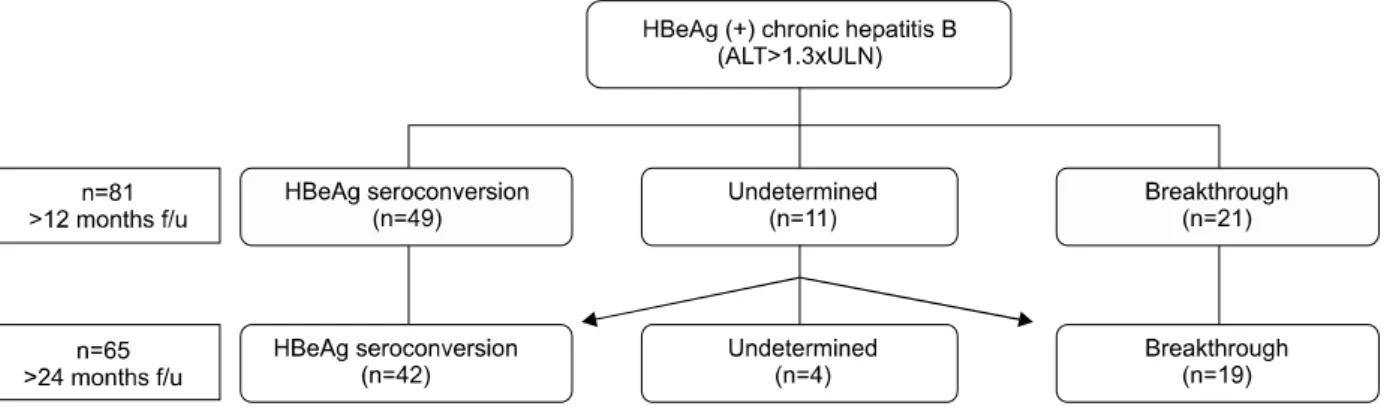
Fig. 1. Algorithm of treatment for HBeAg (+) chronic hepatitis B. Analysis was done for 81 and 65 patients who have followed-up for over 12 months and 24 months, respectively. ×ULN: times the upper limit of the normal range, f/u: follow-up.
Lamivudine, an oral nucleoside analogue, effec- tively suppresses HBV replications and improves liv- er enzymes as well as liver histology of chronic hep- atitis B in both adults and children [3,4]. Known pre- dictive factors of therapeutic response with lam- ivudine are high histologic activity index (HAI) score [5], high pretreatment alanine aminotransferase (ALT) [5], low HBV DNA [6] and HBeAg level [7], duration of lamivudine therapy [8,9], and good com- pliance [10], amongst others.
However, studies for identifying the predictive factors in children are limited so far and most of the studies done at several centers were assessed at the end of 52 weeks treatment of lamivudine, though long-term treatment is essential for lamivudine therapy [5,6,11].
The objective of our study is to evaluate predictors of better therapeutic responses including virologic responses and HBeAg seroconversion, as well as lamivudine resistance during long-term lamivudine treatment in children and adolescents with chronic hepatitis B.
MATERIALS AND METHODS
Patient population
Eighty one children and adolescents (58 male and 23 female; age, 0.8-20 years, mean, 11.5 years) with chronic hepatitis B were enrolled consecutively in this prospective cohort study (Fig. 1). They received
lamivudine for at least 6 months starting from March 1999 to August 2005. They were followed for at least 12 months (a mean period of 44.0±22.7 months) until August 2006 at the Department of Pediatrics and Division of Gastroenterology, Kyungpook National University Hospital, Korea.
The informed consent was obtained from the pa- tients or their parents, and our study was approved by the Institutional Review Board of Kyungpook National University Hospital.
Inclusion and exclusion criteria
All 81 patients treated with lamivudine had HBsAg and HBeAg positive, anti-HBs and anti-HBe negative, elevated HBV DNA (>10 pg/mL, with a lower limit of detection of 0.5 pg/mL) for at least 6 months, and serum ALT values more than 1.3×ULN (times the upper limit of the normal range) for at least 3 months without a 1 log drop of HBV DNA dec- rement before treatment.
Patients were excluded if they had received any agents affecting treatment results such as systemic antiviral agents, corticosteroids, cytotoxic agents, or immunosuppressive drugs within the past 6 months.
Patients were also excluded if they were coinfected with the hepatitis C virus or if they had decom- pensated liver diseases or other causes of liver dis- ease such as Wilson disease or steatohepatitis by ul- trasonography and/or biopsy. The hepatitis D virus or human immunodeficiency virus was not examined
because of its extremely rare incidence in Korean children and adolescents.
Treatment and follow-up of patients
Lamivudine, at a dose of 3 mg/kg orally (maximal dose 100 mg, tablet or syrup), once daily, was given for at least 6 months. The patients who completely responded with normalized ALT, undetectable HBV DNA, and HBeAg/anti-HBe seroconversion con- tinuously received lamivudine therapy for at least 6 additional months after HBeAg/anti-HBe serocon- version. Thereafter, lamivudine treatment was stopped. If breakthrough developed during the lam- ivudine therapy, it was given for 6-12 additional months. After that, YMDD mutation was assessed along with discontinuation of lamivudine if there were no more therapeutic responses. Virologic breakthrough was defined as ≥1 log10 increase in HBV DNA on two consecutive occasions after clear- ance in serum after an initial virologic response (HBV DNA<4 log10 copies/mL after 6 months on treatment) or an initial decline in HBV DNA by >2 log10 copies/mL during lamivudine treatment.
The follow-up monitoring was performed one month after the initiation of lamivudine therapy and every 2-3 months until the end of therapy. The pa- tients with complete response (HBeAg/anti-HBe se- roconversion and HBV DNA negativization) were followed up at 2-3 month intervals for 6 months and then every 3-6 months thereafter. Periodic evalua- tion included clinical history, physical examination, aspartate aminotransferase, ALT, and serologic HBV markers (HBsAg and anti-HBs, HBeAg and an- ti-HBe, HBV DNA).
HBsAg, HBeAg and antibodies were assayed by commercial enzyme immunoassays (Behringer ELISA Processor III; BEP III, Dade Behringer Diagnostics, Marburg, Germany) by the year 1999 or electrochemiluminescence immunoassay (ECLIA method, Roche Diagnostics Corporation, Indianapo- lis, IN, USA) thereafter, and HBV DNA was meas- ured quantitatively on manual blot hybridization by the year 2000 or on a hybrid capture II HBV DNA as- say (DML 2000 System, Digene, Gaithersburg, MD,
USA) thereafter, of which the detection limit was 0.5 pg/mL.
Evaluation of efficacy and resistance
For patients followed up for over 12, 18, and 24 months after the initiation of lamivudine, the sero- conversion and breakthrough rates were compared according to age differences (≤6 yr, 6<≤15 yr, 15
<≤20 yr), pretreatment ALT and HBV DNA levels in the HBe Ag seroconversion group and breakthrough group, respectively.
HBeAg seroconversion was defined as losses of HBeAg and concomitant developments of anti-HBe after initiating the treatment.
Univariate and multivariate analyses were applied for patients with HBeAg seroconversion or with breakthrough according to age, gender, pretreat- ment ALT and HBV DNA levels.
Statistical analysis
The data were analyzed using a χ2 test or Fisher’s exact test for association between two qualitative variables: ANOVA test for the comparison of con- tinuous variables such as age, pretreatment ALT, and HBV DNA levels. Logistic-regression analysis was used in lamivudine responsive or resistant groups to assess factors related to the rate of therapeutic re- sponses after adjustment for the following baseline factors: ALT level, HBV DNA level, and age.
All statistical analysis was performed using stat- istical software (SAS ver. 9.13; SAS Institute, Cary, NC, USA) and a standard personal computer system (Samsung Magic Station M2950; Samsung, Seoul, Korea). p-values below 0.05 were considered to in- dicate statistical significances.
RESULTS
Baseline characteristics
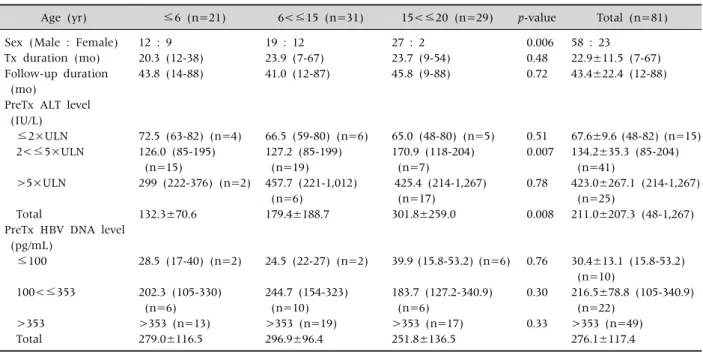
Baseline demographics of the lamivudine treated groups according to age difference were compared in Table 1.
Twenty one (25.9%) of the 81 patients were pre- school children (age≤6), thirty one (38.3%) were
Table 1.Baseline Demographics and Clinical Characteristics of Lamivudine Treated Group according to Age Difference Age (yr) ≤6 (n=21) 6<≤15 (n=31) 15<≤20 (n=29) p-value Total (n=81) Sex (Male : Female)
Tx duration (mo) Follow-up duration (mo)
PreTx ALT level (IU/L) ≤2×ULN 2<≤5×ULN
>5×ULN
Total
PreTx HBV DNA level (pg/mL)
≤100
100<≤353
>353 Total
12 : 9 20.3 (12-38) 43.8 (14-88)
72.5 (63-82) (n=4) 126.0 (85-195) (n=15)
299 (222-376) (n=2)
132.3±70.6
28.5 (17-40) (n=2)
202.3 (105-330) (n=6)
>353 (n=13) 279.0±116.5
19 : 12 23.9 (7-67) 41.0 (12-87)
66.5 (59-80) (n=6) 127.2 (85-199) (n=19) 457.7 (221-1,012) (n=6)
179.4±188.7
24.5 (22-27) (n=2)
244.7 (154-323) (n=10)
>353 (n=19) 296.9±96.4
27 : 2 23.7 (9-54) 45.8 (9-88)
65.0 (48-80) (n=5) 170.9 (118-204) (n=7)
425.4 (214-1,267) (n=17)
301.8±259.0
39.9 (15.8-53.2) (n=6)
183.7 (127.2-340.9) (n=6)
>353 (n=17) 251.8±136.5
0.006 0.48 0.72
0.51 0.007
0.78
0.008
0.76
0.30
0.33
58 : 23
22.9±11.5 (7-67) 43.4±22.4 (12-88)
67.6±9.6 (48-82) (n=15) 134.2±35.3 (85-204) (n=41)
423.0±267.1 (214-1,267) (n=25)
211.0±207.3 (48-1,267)
30.4±13.1 (15.8-53.2) (n=10)
216.5±78.8 (105-340.9) (n=22)
>353 (n=49) 276.1±117.4
Value: mean (range), total value: mean±standard deviation. yr: years old, Tx: treatment, preTx: pretreatment, ALT: alanine aminotransferase, ×ULN: multiples of upper limit of the normal range (39 IU/L), HBV: hepatitis B virus. p-value analyzed by ANOVA test among 3 age groups.
school children (6<age≤15), and twenty nine (35.8%) were adolescents (15<age≤20). Sixty one patients (75.3%) had family history of hepatitis B (56 maternal, 4 paternal, 1 brother). There was no sig- nificant difference between the groups in treatment and follow-up duration, pretreatment HBV DNA lev- els, and pretreatment ALT levels (≤2×ULN, > 5×ULN). The number of male was significantly larg- er (p=0.006) and pretreatment ALT level (2<≤
5×ULN) were significantly higher (p=0.007) in lam- ivudine treated adolescents.
Overall therapeutic efficacy and resistance to lamivudine treatment over 12 or 24 months follow-up
Baseline demographics and clinical character- istics of the lamivudine treated group according to seroconversion or breakthrough 12 months after the initiation of the treatment were compared. There was no significant difference between the sero- conversion and breakthrough groups in sex, age,
pretreatment ALT levels and pretreatment HBV DNA levels (>100). Treatment duration was sig- nificantly longer (p=0.026) in the breakthrough group.
The HBeAg seroconversion and breakthrough oc- curred in 49 (60.5%) and 21 (25.9%) respectively, of the 81 patients treated with lamivudine. The sero- conversion rate was significantly higher in those with higher pretreatment ALT level (p=0.013) but there was no significantly different seroconversion rate in sex, age, pretreatment HBV DNA levels.
Eleven (13.6%) of 81 patients were neither com- pletely responsive to lamivudine, nor resistant to therapy (i.e. HBeAg positive, HBV DNA negative state) 12 months after the initiation of lamivudine.
The HBeAg seroconversion and breakthrough oc- curred in 42 (64.6%) and 19 (29.2%) respectively, of the 65 patients treated with lamivudine for over 24 months. The number of undetermined children re- duced to four (6.2%) out of 65 patients 24 months af- ter the initiation of therapy.
Table 2.HBeAg Seroconverion Rate by Minimal Follow-up Duration according to Age, Pretreatment ALT levels, and Pretreatment HBV DNA Levels
≥12 months (n=81) ≥24 months (n=65)
Seroconversion (N/%) (n=49) OR (CI) Seroconversion (N/%) (n=42) OR (CI) Age (yr)
≤6 (n=21, 18) 6<≤15 (n= 31, 22) 15<≤20 (n=29, 25) PreTx ALT levels (IU/L) 1.3<≤2×ULN (n=15, 14) 2<≤5×ULN (n=41, 30) >5×ULN (n=25, 21) PreTx HBV DNA levels (pg/mL) 10<≤100 (n=11, 10) 100<≤353 (n=22, 19) >353 (n=48, 36)
16 (76%) 17 (55%) 16 (55%)
5 (33%) 24 (59%) 20 (80%)†
9 (82%) 13 (59%) 27 (56%)
2.60 (0.75-9.01) 0.99 (0.36-2.73)
1
1 2.82 (0.82-9.76) 8.00 (1.87-34.23)
3.50 (0.68-17.95) 1.12 (0.40-3.13)
1
16 (89%)*
12 (55%) 14 (56%)
5 (36%) 19 (63%) 18 (86%)‡
8 (80%) 12 (63%) 22 (61%)
6.29 (1.19-33.35) 0.94 (0.30-2.99)
1
1 3.11 (0.83-11.66) 10.80 (2.10-55.65)
2.55 (0.47-13.77) 1.09 (0.35-3.44)
1
Value: mean (range), OR: odd ratio, CI: 95% confidence interval, yr: years old, Tx: treatment, PreTx: pretreatment, ALT: alanine aminotransferase, ×ULN: multiples of upper limit of the normal range, HBV: hepatitis B virus. *p=0.040 by chi-square test (cf.
multivariate analyses adjusted OR=13.99), †p=0.013 by chi-square test, ‡p=0.003 by chi-square test (cf. multivariate analyses adjusted OR=46.72).
Seroconversion rate by minimal follow-up duration
Seroconversion rate according to age, pretreat- ment ALT and pretreatment HBV DNA levels were compared by minimal follow-up duration in Table 2.
The HBeAg seroconversion occurred in 49 (60.5%), 45 (63.3%), 42 (64.6%) respectively, of the 81, 71, and 65 patients monitored for over 12, 18, and 24 months after the initiation of the treatment. In pa- tients monitored for over 24 months, the sero- conversion rate was significantly higher in the younger group (p=0.040), especially in those pa- tients of preschool age (age≤6, odds ratio [OR]=6.29 vs. age>15, p=0.031, Fig. 1).
Furthermore, HBsAg disappeared in 8 (50.0%) out of 16 children of preschool age (age≤6), whereas only one (3.8%) out of 26 patients over age 6. The rate of HBsAg loss was significantly higher in preschool age group (age≤6, [OR]=25 vs. age>6, p=0.001).
The seroconversion rate was significantly higher in patients with greater pretreatment ALT level (p=
0.003), especially in patients with an increased level more than 5 times the upper limit of normal (≤2
×ULN OR=1 vs. 2<≤5×ULN OR=2.82, 2.91, 3.11 vs. >5×ULN OR=8.00, 8.55, 10.80) at follow-up du-
ration for over 12, 18, and 24 months (p=0.013, p=0.016, p=0.003 vs. ≤2×ULN) respectively, but there was no significantly different seroconversion rate in sex, pretreatment HBV DNA levels.
Multivariate analyses were used to assess the pure effects of age and pretreatment ALT, which were con- trolled by age, gender, pretreatment ALT and HBV DNA levels. None of these interactions were significant. The multivariate analyses’ adjusted odds ratio in preschool children (age≤6) was 13.99 times (95% confidence interval [CI], 1.61-121.0, p=0.0169) that of adolescents (age>15). The multivariate anal- yses’ adjusted odds ratio in higher pretreatment ALT (>5×ULN) levels was 46.72 times (CI, 4.54-480.87, p=0.0012) that of those in lower ALT (≤2×ULN) levels.
Breakthrough rate by minimal follow-up duration
Breakthrough rate according to age, pretreatment ALT and pretreatment HBV DNA levels were com- pared by minimal follow-up duration in Table 3.
Breakthrough occurred in 21 (25.9%), 19 (29.2%) respectively, of the 81, and 65 patients monitored for over 12, 24 months after the initiation of the
Table 3. Breakthrough Rate by Minimal Follow-up Duration according to Age, Pretreatment ALT levels, and Pretreatment HBV DNA levels
≥12 months (n=81) ≥24 months (n=65)
Breakthrough (N/%) (n=21) OR (CL) Breakthrough (N/%) (n=19) OR (CL) Age (yr)
≤6 (n= 21, 18) 6<≤15 (n=31, 22) 15<≤20 (n=29, 25) PreTx ALT levels (IU/L) 1.3<≤2×ULN (n=15, 14) 2<≤5×ULN (n=41, 30) >5×ULN (n=25, 21) PreTx HBV DNA levels (pg/mL) 10<≤100 (n=11, 10) 100<≤353 (n=22, 19) >353 (n=48, 36)
3 (14%) 10 (32%) 8 (28%)
6 (40%) 12 (29%) 3 (12%)
2 (18%) 7 (32%) 12 (25%)
0.44 (0.10, 1.90) 1.250 (0.412, 3.790)
1
1 0.62 (0.18, 2.13) 0.21 (0.04, 1.00)
0.67 (0.13, 3.53) 1.40 (0.46, 4.25)
1
2 (11%) 9 (47%) 8 (42%)
6 (43%) 10 (33%) 3 (14%)
2 (20%) 5 (26%) 12 (33%)
0.27 (0.05, 1.44) 1.47 (0.45, 4.86)
1
1 0.67 (0.18, 2.45) 0.22 (0.04, 1.12)
0.50 (0.09, 2.73) 0.71 (0.21, 2.45)
1 Value: mean (range), OR: odd ratio, CL: confidence limits, yr: years old, PreTx: pretreatment, ALT: alanine aminotransferase, ×ULN:
multiples of upper limit of the normal range, HBV: hepatitis B virus.
Table 4.Seroconverion and Breakthrough Rate by Minimal 12 or 24 Months Follow-up Duration according to Age and Pretreatment ALT levels
Follow-up periods Response/resistance rate Age≤6, preTx ALT>2×ULN Age>6, preTx ALT≤2×ULN p
≥12 months
≥24 months
Seroconversion rate Breakthrough rate Seroconversion rate Breakthrough rate
14/17 (82.4%) 1/17 (5.9%) 14/14 (100%)
0/14 (0%)
3/11 (27.3%) 4/11 (36.4%) 3/10 (30.0%) 4/10 (40.0%)
0.0062*
0.0618 0.0003*
0.0198*
PreTx: pretreatment, ALT: alanine aminotransferase, ×ULN: multiples of upper limit of the normal range. *Fisher's exact test.
treatment.
YMDD mutation was found in 14 (82.4%) among 17 tested patients who have developed breakthrough.
Seroconversion and breakthrough rate accor- ding to age and pretreatment ALT levels The seroconverion and breakthrough rate of the preschool aged children with higher pretreatment ALT levels (age≤6, pretreatment ALT>2×ULN) were 14/17 (82.4%) and 1/17 (5.9%), compared to 3/11 (27.3%) and 4/11 (36.4%) of school aged chil- dren with lower pretreatment ALT levels (age>6, pretreatment ALT≤2×ULN), applying a minimal 12 months follow-up duration (p=0.0062, Table 4).
In addition, the seroconverion and breakthrough rate of the preschool aged children with higher pre- treatment ALT levels were 14/14 (100%) and 0/14
(0%), as compared to 3/10 (30.0%) and 4/10 (40.0%) of school aged children with lower pretreatment ALT levels, applying a minimal 24 months follow-up du- ration (p=0.0003 and 0.0198) (Table 4).
DISCUSSION
Chronic hepatitis B in children is treated with in- terferon-alpha and lamivudine, of which therapeutic responses of lamivudine are associated with a pre- treatment state of low HBV DNA level and high ALT level [5,6]. The cumulative HBeAg seroconversion rates were 28% and 39% at 1 and 2 years, respectively after the initiation of lamivudine treatment in 519 Korean adults [7]. In children, the cumulative sero- conversion rates were 34% and 68% at 1 and 2 year after initiation of lamivudine treatment, respectively
[4]. This suggested that long-term lamivudine treat- ment in children had better effects of improving HBeAg seroconversion rates than in adults.
The efficacy after 12 months of lamivudine treat- ment was not better than that of interferon alpha in children [12,13]. However, the authors have demon- strated in previous studies that lamivudine had a better therapeutic effect than interferon-alpha two years after the initiation of treatment and lesser ad- verse effects [4].
Although the longer lamivudine treatment in- duced the higher seroconversion rate, the risk of viral resistance increased with development of YMDD mutations and breakthrough hepatitis [14]. In Korean adult studies, the incidence of YMDD muta- tions were 8%, 36%, and 52% at 1, 2, and 3 year, re- spectively [7,15]. In addition, relapse is frequent if lamivudine is discontinued before or immediately after HBeAg seroconversion [7,15,16].
However, unlike interferon, there is no fixed dura- tion of treatment in a nucleoside analogue.
Therefore, the discontinuation of lamivudine, irre- spective of therapeutic response, is not acceptable af- ter treatment of a fixed duration. Lamivudine should be continued until at least 6 months after HBeAg se- roconversion to reduce relapse [17]. For these rea- sons, it is necessary to assess patients treated for an additional period over 6-12 months after HBeAg se- roconversion, for the identification of the best pre- dictive factors.
Though therapeutic response is increased by lon- ger lamivudine treatment, only a few studies have been published about long-term treatment of lam- ivudine in children to date. Until now, previous stud- ies have shown that predictive factors for the ther- apeutic response to lamivudine were high HAI score[5], high pretreatment ALT [5], low HBV DNA [6] and HBeAg level [7], duration of lamivudine therapy [8,9], and good compliance [10], amongst others. However, most of the above studies were as- sessed by only therapeutic response to 52 weeks of lamivudine [5,6].
Pretreatment ALT levels and HAI scores have been suggested to have values in predicting therapeutic
response, but age, gender, previous interferon ther- apy, baseline weight, HBV DNA, and BMI had no val- ue as predictors to lamivudine treatment, demon- strated in a randomized, double-blind, placebo-con- trolled, and multicenter trial of lamivudine in chil- dren for 52 weeks [5].
However, in our study, the seroconversion rate was significantly higher in patients of preschool age (age≤6) monitored for over 24 months, but insignif- icant if following-up was not done for more than 12 months. The univariate and multivariate analyses which adjusted odds ratio in preschool children (age
≤6) was 6.29 and 13.99 times higher than adoles- cents (age>15) respectively, which suggests that lamivudine treatment has a better therapeutic effect at a younger age. In addition, when ALT levels were
>5×ULN, the HBeAg seroconversion rates were sig- nificantly higher than those with lower pretreat- ment ALT levels. Plus, in preschool aged children with ALT levels greater than 2×ULN, the sero- conversion rate was 100% and breakthrough rate was 0%, which were far better results than the group with age>6 and ALT<2×ULN (p<0.05). This data is in line with the higher HBsAg loss rate in preschool children [18].
In our study, HBeAg seroconversion occurred in 49/81 (60.5%) and 42/65 (64.6%) patients who were followed-up for at least over 12 and 24 months, re- spectively, after the initiation of the treatment. This represented higher efficacy rates than those in adults and other pediatric studies though most have been infected perinatally [5,19-22]. This result could be partially contributed by compliance and higher pre- treatment ALT levels of enrolled patients as well as including young children.
Breakthrough occurred in 21 (25.9%) among 81 patients who received treatment, and were moni- tored for more than 12 months in our study, which is consistent with the results in the authors’ previous study; breakthrough rates are 1 year 15.7% (8/51), 2 year 24.4% (10/41), with lower resistances than oth- er studies [11,23].
Based on our study, efficacy rates in preschool children with chronic hepatitis B who received suffi-
cient duration of lamivudine were higher, and resist- ance seemed to occur less than in school children or adolescent patients. Compared to previous studies with a 1-year monitoring period, younger age was proven to be a good predictor, but only if there was monitoring for over 2 years, suggesting that studies with a long-term treatment period are required to find predictors of nucleoside analogue. The authors believe that lamivudine should be used for at least 12 months and an additional 12 months after HBeAg/
anti-HBe seroconversion in order to get a good ther- apeutic response, even in preschool children.
Nevertheless, pretreatment ALT should be higher than 2×ULN to reduce the resistances.
The limitations of our study are as below. First, by ethical reason, there is no untreated or interfer- on-treated control group because this is a long-term follow-up study. Second, the pretreatment mean ALT level (2<≤5×ULN) was significantly higher (p=0.007) in lamivudine treated adolescents than in children, which could have slightly improved the therapeutic response of adolescents, but did not.
Although the high ALT 10-20 times ULN were in- cluded in our study, their HBV DNA was not that low for spontaneous HBeAg seroconversion.
In conclusion, the predictors of therapeutic re- sponses include younger age and high pretreatment ALT levels for long-term lamivudine treatment in children with chronic hepatitis B. The authors advo- cate that lamivudine could be the first therapeutic option for pre-school children in Korea where the in- surance coverage of new nucleos(t)ides for children are still not permitted [24,25].
REFERENCES
1. Bortolotti F, Cadrobbi P, Crivellaro C, Guido M, Rugge M, Noventa F, et al. Long-term outcome of chronic type B hepatitis in patients who acquire hepatitis B virus in- fection in childhood. Gastroenterology 1990;99:805-10.
2. Conjeevaram HS, Di Bisceglie AM. Management of chronic viral hepatitis in children. J Pediatr Gastroenterol Nutr 1995;20:365-75.
3. Dienstag JL, Schiff ER, Wright TL, Perrillo RP, Hann HW, Goodman Z, et al. Lamivudine as initial treatment
for chronic hepatitis B in the United States. N Engl J Med 1999;341:1256-63.
4. Choe BH, Lee JH, Jang YC, Jang CH, Oh KW, Kwon S, et al. Long-term therapeutic efficacy of lamivudine compared with interferon-alpha in children with chron- ic hepatitis B: the younger the better. J Pediatr Gastroenterol Nutr 2007;44:92-8.
5. Hom X, Little NR, Gardner SD, Jonas MM. Predictors of virologic response to Lamivudine treatment in chil- dren with chronic hepatitis B infection. Pediatr Infect Dis J 2004;23:441-5.
6. Liberek A, Szaflarska-Popławska A, Korzon M, Łuczak G, Góra-Gebka M, Łoś-Rycharska E, et al. Lamivudine therapy for children with chronic hepatitis B. World J Gastroenterol 2006;12:2412-6.
7. Park NH, Shin JW, Park JH, Bang SJ, Kim DY, Joo KR, et al. Predictive factors and efficacy of lamivudine treat- ment in chronic hepatitis B infection. Korean J Gastroenterol 2003;42:303-12.
8. Leung NW, Lai CL, Chang TT, Guan R, Lee CM, Ng KY, et al; Asia Hepatitis Lamivudine Study Group.
Extended lamivudine treatment in patients with chronic hepatitis B enhances hepatitis B e antigen sero- conversion rates: results after 3 years of therapy.
Hepatology 2001;33:1527-32.
9. Yoon SK, Jang JW, Kim CW, Bae SH, Choi JY, Choi SW, et al. Long-term results of lamivudine monotherapy in Korean patients with HBeAg-positive chronic hepatitis B: response and relapse rates, and factors related to du- rability of HBeAg seroconversion. Intervirology 2005;48:341-9.
10. Hartman C, Berkowitz D, Eshach-Adiv O, Hino B, Rimon N, Satinger I, et al. Long-term lamivudine ther- apy for chronic hepatitis B infection in children un- responsive to interferon. J Pediatr Gastroenterol Nutr 2006;43:494-8.
11. Sokal EM, Kelly DA, Mizerski J, Badia IB, Areias JA, Schwarz KB, et al. Long-term lamivudine therapy for children with HBeAg-positive chronic hepatitis B.
Hepatology 2006;43:225-32.
12. Jonas MM, Mizerski J, Badia IB, Areias JA, Schwarz KB, Little NR, et al; International Pediatric Lamivudine Investigator Group. Clinical trial of lam- ivudine in children with chronic hepatitis B. N Engl J Med 2002;346:1706-13.
13. Sokal EM, Conjeevaram HS, Roberts EA, Alvarez F, Bern EM, Goyens P, et al. Interferon alfa therapy for chronic hepatitis B in children: a multinational randomized controlled trial. Gastroenterology 1998;
114:988-95.
14. Lau DT, Khokhar MF, Doo E, Ghany MG, Herion D,
Park Y, et al. Long-term therapy of chronic hepatitis B with lamivudine. Hepatology 2000;32:828-34.
15. Song BC, Suh DJ, Lee HC, Chung YH, Lee YS. Hepatitis B e antigen seroconversion after lamivudine therapy is not durable in patients with chronic hepatitis B in Korea. Hepatology 2000;32:803-6.
16. Hong SP, Han KH, Ahn SH, Paik YH, Moon BS, Chon CY, et al. Long-term efficacy and durability of lam- ivudine therapy in patients with chronic hepatitis B.
Korean J Hepatol 2001;7:423-31.
17. Broderick A, Jonas MM. Management of hepatitis B in children. Clin Liver Dis 2004;8:387-401.
18. Kim JM, Choe BH, Chu MA, Cho SM. Comparison of lamivudine-induced HBsAg loss rate according to age in children with chronic hepatitis B. Korean J Hepatol 2009;15:168-78.
19. Figlerowicz M, Kowala-Piaskowska A, Filipowicz M, Bujnowska A, Mozer-Lisewska I, Słuzewski W. Efficacy of lamivudine in the treatment of children with chronic hepatitis B. Hepatol Res 2005;31:217-22.
20. Dikici B, Ozgenc F, Kalayci AG, Targan S, Ozkan T, Selimoglu A, et al. Current therapeutic approaches in childhood chronic hepatitis B infection: a multicenter study. J Gastroenterol Hepatol 2004;19:127-33.
21. Dikici B, Ece A, Bosnak M. Which combination should be preferred in the management of children with chron- ic hepatitis B infection? J Clin Gastroenterol 2005;39:745-6.
22. Ozgenç F, Arikan C, Sertoz RY, Nart D, Aydogdu S, Yagci RV. Effect of long-term lamivudine in chronic hepatitis B virus-infected children. Antivir Ther 2004;9:729-32.
23. Choe BH, Kim JM, Lee JH, Jang YC, Jang CH, Oh KW, et al. Lamivudine treatment in children with chronic hepatitis B: long-term therapeutic Response, optimal duration and resistance. the 39th Annual Meeting of ESPGHAN; 2006; Dresden, Germany. J Pediatr Gastroenterol Nutr 2006:E64-5.
24. Hong SJ, Choe BH. Strategy to overcome drug resist- ance that develops during treatment of chronic hep- atitis b in children. Pediatr Gastroenterol Hepatol Nutr 2012;15:63-73.
25. Chu M, Cho SM, Choe BH, Cho MH, Kwon S, Lee WK.
Virologic responses to add-on adefovir dipivoxil treat- ment versus entecavir monotherapy in children with lamivudine-resistant chronic hepatitis B. J Pediatr Gastroenterol Nutr 2012;55:648-52.