Printed in the Republic of Korea
http://dx.doi.org/10.5012/jkcs.2013.57.5.625
Polycyclotriphosphazene Derivative Grafted and NanometerY
2O
3Doped SPEEK Composite Membrane for DMFC
Xia Li, Qiang Guo*, Tianjiao Zhang, Junzhi Qian, and Xiaolin Tan
School of Materials Science and Engineering, Shanghai University, Shanghai, 200444, China
*E-mail: [email protected]
(Received May 19, 2013; Accepted August 21, 2013)
ABSTRACT. A type of polycyclotriphosphazene derivative (PCTPD), hexasulfanilic acid polycyclotriphosphazene (HSACP) and HSACP grafting SPEEK, sulfonated poly[2-(petachloropolycyclotriphosphazene-oxy)] etheretherketone (SPPSACPEEK) were syn- thesized, which were characterized by FTIR and 31P NMR. Then three types of composite membranes such as HSACP grafting SPEEK, HSACP blending SPEEK, and nano Y2O3 doping and HSACP grafting SPEEK, respectively, were continuously pre- pared by solution-casting method. Comparing to SPEEK membranes with different amount of HSACP grafted or blended, grafting 15 wt% HSACP and doping 10 wt% nano Y2O3 SPEEK membrane conducted outstanding overall behavior of proton conductivity reaching 3.18 × 10⁻² S/cm at 90oC which was merely junior to SPEEK with 15 wt% HSACP grafted, methanol permeability coefficient getting 9.46 × 10⁻⁸ cm2·s−1, swelling degree of 20.9% and solid residue of 98.98% which was superior to all specimen.
Key words: Polymer membranes, SPEEK, Polycyclotriphosphazene derivative, Y2O3
INTRODUCTION
Nowadays, it is widely thought proton conductivity, methanol permeability coefficient and swelling degree play an important role for proton exchange membranes.1 Mikhailenko et al.2,3 have reported that sulfonated poly- etheretherketone (SPEEK) with high degree of sulfonation (DS) could reach high proton conductivity and methanol permeability coefficient, which wasn’t preferable in terms of its application. As a result, rare earth oxide such as yttrium oxide (Y2O3), titanium oxide (TiO2) and cerium oxide (CeO2) has been used to improve SPEEK integra- tive properties because of their broad transparency, excel- lent physical and chemical stability.4,5 Tong et al.6 have prepared the SPEEK/Y2O3 composite membranes and con- cluded that coordination bonds existed between yttrium cation of Y2O3 and oxygen anion of sulfonic groups char- acterized by FTIR and XRD, which showed good effect on methanol resistance while reducing proton conductiv- ity in the long run.
On the other hand, ionic liquid composed of organic cat- ions and organic or inorganic anions at room temperature7 is considered scientific hotspot, which aimed at upgrad- ing proton conductivity of SPEEK. Chen et al.8 improved SPEEK integrative properties by doping 1-ethyl-3-meth- ylimidazole tetrafluoroborate (EB) or 1-butyl-3-methylimida- zole methanesulfonate (BS) and dispersed Y2O3 into system.
Consequently, proton conductivity of SPEEK/EB/Y2O3
composite membrane was above 10−2 S/cm at 90oC.
However, it is so easy for ionic liquid to run off that modified SPEEK membranes deserved ineffective9,10 and most ionic liquid is hydrophilic which is beneficial to proton conduction but detrimental to methanol resistance and anti-swelling degree.
Due to the superior flexibility of backbones and diversity of side groups, PCTPD are expected to emerge as novel membrane materials for direct membranes fuel cells (DMFC).
Allcock11 has synthesized poly [(4-bromophenoxy) (3- methyl-phenoxy)] phosphazene and its proton conductiv- ity was approximately 10−2 S/cm, methanol permeability coefficient was little lower than Dupont Nafion115 mem- branes. In this paper, HSACP was used for promoting pro- ton productivity by grafting and blending SPEEK, then doping nano Y2O3 to reduce methanol permeability coef- ficients and swelling degree.
MATERIALS AND MEMBRANE SPECIMENS
Synthesis of SPEEK Grafted by HSACP
Polyetheretherketone (PEEK) was obtained from Chem- istry Department of Jilin University (Jilin, China) in the form of particle and SPEEK was prepared as reported ear- lier.12,13 After getting SPEEK with DS of 64.10%, NaBH4
from Sinopharm Chemical Reagent Co. Ltd. (Shanghai,
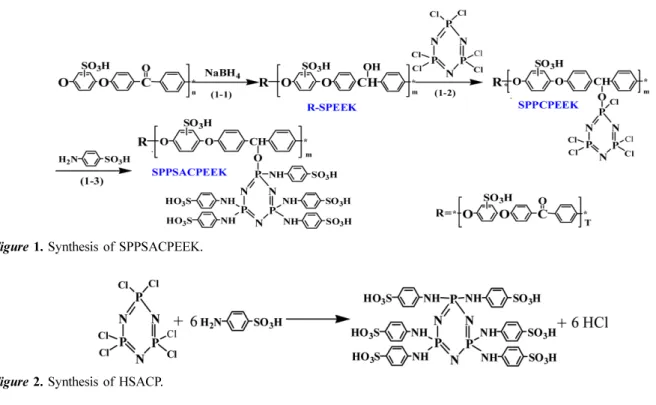
China) was utilized to accomplish carbonyl reduction of SPEEK at 100oC, 24 h for synthesis of sulfonated poly [2- hydroxy] etheretherketone (R-SPEEK) (Fig. 1, 1-1). Sub- sequently, sulfonated poly [2-(petachloropolycyclotriph- osphazene-oxy)] etheretherketone (SPPCPEEK) was synthesized by adding R-SPEEK solution into hexachlo- rocyclotriphosphazene (HCCP) (laboratory self-synthesized) dissolving in DMAC at iced-water atmosphere for 20 h with mechanical stirring (Fig. 1, 1-2). After that, certain amount of hexasulfanilic acid (SA) from Aladdin Reagent Co. Ltd. (Japan) was put into SPPCPEEK solution to syn- thesize sulfonated poly [2-(petasulfanilicacidpolycyclot- riphosphazene-oxy)] etheretherketone (SPPSACPEEK) (Fig. 1, 1-3) under ultrasonic firstly then at 60oC for 4 h.
Preparation of Membranes
Composite membranes were obtained by casting their viscous solution onto a glass plate and thickness of the dried composite membranes was about 100µm. Accord- ingly, three kinds of membranes were prepared namely HSACP grafting SPEEK, HSACP blending SPEEK, and
nano Y2O3 doping and HSACP grafting SPEEK. HSACP was synthesized by reacting HCCP with SA shown in Fig.
2 and its experimental condition was identical with reac- tion (1-3) in Fig. 1.
Different compositions of membranes were described in Table 1, where “GR”, “B” and “Y” represented HSACP grafting SPEEK, HSACP blending SPEEK and Y2O3 dop- ing respectively, and the subsequent values of “GR” in codes GR2, GR5, GR8, GR10, GR15, GR15Y01, GR15Y05 and GR15Y10 indexed grafting degree weight percent of SPEEK (e.g., GR15 represented system with 15 wt% HSACP grafting SPEEK), and that of “Y” indexed weight percent of Y2O3 (e.g., GR15Y10 represented system with 15 wt%
HSACP grafting SPEEK and 10 wt% nano Y2O3 doped).
EXPERIMENTAL
Analysis Methods of Material Structure and Mem- brane Surface Morphology
Structural characterization were analyzed by Fourier Transform Infrared (FTIR), 1H Nuclear Magnetic Reso- Figure 1. Synthesis of SPPSACPEEK.
Figure 2. Synthesis of HSACP.
Table 1. Contents of membrane specimens
Code SPEEK B05 B10 GR15Y01 GR15Y05 GR15Y10
SPEEK (wt%) 100 95 90 0 0 0
15 wt% HSACP grafting SPEEK (wt%) 0 0 0 99 95 90
HSACP (wt%) 0 5 10 0 0 0
Y2O3 (wt%) 0 0 0 1 5 10
nance (1H NMR) and 31P Nuclear Magnetic Resonance (31P NMR). The FTIR spectra of specimens were recorded with AVATAR370 Infrared Spectrometer (Thermo Nico- let Instrument Co., USA) while 1H NMR and 31P NMR with AVANCE 500MHz (Bruker, Switzerland). All the spec- imens were liquid (before preparation of membranes) so we painted them on glass plate directly for FTIR and chose deuterium dimethyl sulfoxide (DMSO-d6) as solvent for
1H NMR and 31P NMR.
The morphology of membrane surface was investigated by scanning electron microscope (SEM) HITACHI S-4800 (Tokyo, Japan). The specimens were pretreated by freez- ing the dry membranes in liquid nitrogen. The fresh cryogenic fracture of the membrane specimens was sputtered with a thin layer of Au in vacuum prior to SEM measurements.
Testing Method of Proton Conductivity
Proton conductivity of membrane specimens in the traverse direction was tested in a measurement cell using AC Electrochemical Impedance Spectroscopy (EIS), which was composed of a Solartron Instruments 1287 electro- chemical interface and a Solartron Instruments 1255B fre- quency response analyzer (Farnborough, UK), both of which were interfaced via GPIB to a computer. The EIS recorded over a frequency range of 1−106 Hz. The ampli- tude of the sinusoidal modulation voltage was 10 mV, and the testing temperature ranged from 30 to 90oC. The resis- tance of membranes was measured and the proton conduc- tivity was calculated as described in the reference.13
Testing Method of Methanol Permeability Coefficient Methanol permeability coefficient of membrane spec- imen was determined by a home-made diaphragm diffu- sion cell, which was amply described in reference.14 The membranes were immersed in de-ionized water at room temperature for 24 h before testing, and both thickness and area of wet membrane specimens were measured.
Thereafter, membrane specimens were placed in diffu- sion cell for the measurement of methanol permeability.
70 ml 5 mol/L methanol solution was placed in one side of the diffusion cell and de-ionized water of the same volume was placed in the other side. The methanol permeability coefficient was calculated by the second of law of Fick’s diffusion as showed below (Equation 1).
(1)
Testing Method of Swelling Degree and Thermal Stability Swelling degree (Sd) was calculated by measuring the
volume difference between the dry and hydrous mem- brane specimens.12,13 The dried membranes were mea- sured volume (Vdry) before being immersed in de-ionized water for 24 h at 30oC, 50oC, 70oC and 90oC respec- tively. After that, the membranes were wiped with blotting paper to remove the surface water and measured (Vwet) again. The Sd was calculated by the following equation:
(2)
Thermal stability of membranes was evaluated by record- ing thermo-gravimetric (TG) traces in nitrogen atmosphere (Q500, TA Company, USA). Heating rate of 10oC/min.
Temperature ranges from 10oC to 600oC and sample weights from 3 to 7 mg in the form of membrane were used for recording TG traces.
RESULTS AND DISCUSSION
Structural Analysis
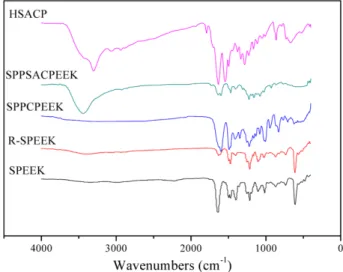
Comparing SPEEK with R-SPEEK spectra in Fig. 3, both of them possessed characteristic peaks at 1650 cm−1 for –Ar−C(=O)−Ar−, 1118 cm−1 for –Ar−O−, 1226 cm−1 for O=S=O asymmetric stretching vibration, 1080 cm−1 and 740 cm−1 for O=S=O and S=O symmetric stretching vibra- tion respectively. However, there appeared a wide absorption peak around 3400 cm−1 in R-SPEEK spectra corresponded to O−H stretching vibration. Because the amount of sulfonic groups remained unchanged after reaction (1-1) in Fig. 1, we cited internal standard method to calculate degree of carbonyl reduction,15 namely dividing absorption peak areas at 1650 cm−1 (−C=O) with 1080 cm−1 (−SO3H) before and after reaction. Therefore, we got degree of SPEEK
P S Vl AC---
=
Sd Vwet–Vdry Vdry
--- 100%×
=
Figure 3. FTIR spectra of HSACP, SPEEK and modified SPEEK.
carbonyl reduction as 29.8% according to the following equation (3):
(3)
While it turned to 1H NMR characterization of R-SPEEK in Fig. 4, absorption peaks between 7.0 ppm and 8.0 ppm indexed hydrogen protons of R-SPEEK benzene rings.
The weak absorption peak at 5.7 ppm corresponded to hydrogen of tertiary carbon certified structure changing partially from –Ar−C(=O)−Ar− to –Ar−CH(−OH)−Ar−.
Moreover, Fig. 3 also included the FTIR spectra of SPPCPEEK. Besides characteristic peaks of SPEEK men- tioned above, absorption peaks appeared at 527 cm−1 and 605 cm−1 for different conformation of P−Cl, 947 cm−1 for P−O stretching vibration, 870 cm−1 for P−N absorption and 1217 cm−1 for P=N stretching vibration. Thus, auxiliary to evidence from 31P NMR spectra of SPPCPEEK, where existed phosphorus atoms of two kind of chemical envi- ronments. One chemical shift at 19.8 ppm was for five P−Cl while the other at 9.6 ppm for one P–O within one cyclo- triphosphazene ring. As a result, HCCP proved to be grafted onto SPEEK backbones.
To improve proton conductivity and system stability, SA reacted with SPPCPEEK to increase numbers of sul- fonic groups and benzene rings. According to Fig. 3, spec- tra of SPPSACPEEK still included characteristic peaks of SPPCPEEK except for P−Cl stretching vibration at 527 cm−1 and 605 cm−1 which demonstrated the fact all chlorine atoms were substituted by SA. Absorption peak between 3400 cm−1 and 3450 cm−1 was for N−H stretching vibration, 1490 cm−1 and 1580 cm−1 were for benzene rings. Fig. 4 showed 31P NMR spectra of SPPSACPEEK where two kinds of chem-
ical shift were caught. One at 7.4 ppm was for phosphorus atoms connected with SA while the other at 9.6 ppm was with SPEEK backbones. In contrast to 31P NMR spectra of SPPCPEEK, there was no chemical shift for SPPSACPEEK at 19.8 ppm which proved chlorine atoms were substituted by SA once more.
As for synthesis of HSACP, absorption peaks at 870 cm−1 and 1217 cm−1 were for polycyclotriphosphazene rings, 1490 cm−1 and 1640 cm−1 were for −NH−Ar−, 710 cm−1, 1020 cm−1, 1092 cm−1 and 1250 cm−1 were for sulfonic groups. Stretching vibration peak at 3370 cm−1 suggested N−H stretching vibration. 31P NMR characterization proved there only existed one kind chemical atmosphere at 7.62 ppm corresponded to −P−NH−.16
Proton Conductivity of Membranes
Since proton conductivity played an important role in application for DMFC, its value should reach 10−2 S/cm above. Proton conductivity of SPEEK and SPPSACPEEK membranes were measured from 20 to 90oC shown in Fig. 5. With increasing temperature, proton conductivity of all specimens improved considerably since activity of proton was strengthened to enhance the efficiency of con- duction in the membranes. As more HSACP being grafted, proton conductivity advanced more fiercely at the same temperature. Especially for specimen GR15, its productiv- ity was over 10−2 S/cm at 40oC even reached 4.81×10⁻² S/cm at 90oC. From one way, with more HSACP being grafted, sulfonic groups on SPPSACPEEK side chains might gen- erate wide range of transmission channels with ones on backbones which facilitated speed and efficiency of pro- ton conduction and hydrogen bonds interaction bridged between sulfonic and amino groups.17 From another way, α 1 [A1650/A1080]After
A1650/A1080
[ ]Before
--- 100%× –
=
Figure 4. 1H NMR spectra of R-SPEEK and 31P NMR spectra of HSACP and modified SPEEK.
Figure 5. Proton conductivity of SPEEK and SPPSACPEEK membranes.
long pair electrons of nitrogen atoms in HSACP contrib- uted to adhesion of water molecules that ensured proton flopping, where HSACP encouraged separation of hydro- philic and hydrophobic phases to reduce difficulty of pro- ton conduction.
In contrast to Fig. 5, proton conductivity of B05 and B10 in Fig. 6 could be divided into two parts although their values were always under 10−2 S/cm at whatever tem- perature. When it rose from 20 to 60oC, proton conduc- tivity upgraded apparently and the mechanism was likely to the one mentioned in Fig. 5. As temperature continu- ously rose up to 90oC, both of their conductivity ceased to upgrade directly and reached almost same values with pure SPEEK because bond energy of physical interaction was so weak that thermal energy would destroyed transmis- sion channels generated in blending system and HSACP was doomed to running off.
It was concluded that grafting HSACP was far more effective than doping one on enhancement of proton con- ductivity. Therefore, Y2O3 was doped into SPPSACPEEK system for further research on conductivity promotion.
Fig. 7 displayed the same trend as Fig. 5 that proton con- ductivity upgraded from 20 to 90oC. However, conduc- tivity of specimen GR15Y05 and GR15Y10 was little lower than GR15 from 70 to 90oC which was near to operating temperature of proton exchange membranes. As was drawn in Fig. 8, nanoY2O3 mostly dispersed around side chains where were abundant in sulfonic clusters then the sulfonic groups on the backbones took more respon- sibility for proton conduction because of steric hindrance of side groups that made Y2O3 uneasily act on backbones.
Moreover, volume effect caused by Y2O3 might also be
possibly to influence proton conduction a little. Conse- quently, adding little amount of Y2O3 didn’t detract from its proton conductivity remarkably from 70 to 90oC since pure SPEEK with high DS was good at proton conduc- tion.2,3
Methanol Permeability Coefficients of Membranes It was known that low methanol concentration was equal to small methanol permeability coefficients. Methanol concentration of SPEEK and SPPSACPEEK membranes was tested shown in Fig. 9. With the increase of grafting degree, methanol concentration upgraded simultaneously. At the same time, GR15 reached the highest methanol con- centration but its value was only little higher among all specimens. Both sulfonic groups on side chains and ones on backbones would generate hydrophilic regions in mem- branes and this effect was in favor of methanol molecules running through membranes. Combined with Fig. 8, HSACP as side groups of SPSSACPEEK increased steric hin- drance so as to relieve penetration of methanol molecules.
Figure 6. Proton conductivity of SPEEK and HSACP blending SPEEK membranes.
Figure 7. Proton conductivity of SPEEK and Y2O3 doping SPP- SACPEEK membranes.
Figure 8. Operation principle of Y2O3 doping SPPSACPEEK membranes.
Thus, Fig. 10 showed the same trend as Fig. 9 at all. After carefully comparing GR15 with B10 under the same hori- zon, GR15 had little lower methanol concentration than B10. Maybe this slight difference was caused by the effect of side groups.
As experienced above, grafting modification behaved relatively better than doping one in terms of proton con- ductivity and methanol permeability coefficients. Since GR15 had the highest proton conductivity from 20 to 90oC, defined amount of nano Y2O3 was doped to enhance its methanol resistance based on the conclusion that small amount of Y2O3 shouldn’t decrease proton conductivity substantially. In Fig. 11 within the same time, methanol concentration of GR15Y01 was still higher than pure SPEEK but little lower than GR15 which demonstrated the fact that Y2O3 was good at methanol resistance but not dominant in system. As for GR15Y05 and GR15Y10,
their methanol resistance enhanced apparently especially for latter one compared with GR15. It was reported17,18 that coordination bonds existed between sulfonic groups and Y2O3, which largely destroyed hydrophilic regions around side chains rather than ones near backbones in ref- erence to Fig. 8 and this effect made penetration of meth- anol molecules through SPPSACPEEK membranes harder.
Moreover, as was shown in Fig. 12, Y2O3 dispersed evenly in SPPSACPEEK membranes which helped to strengthen density of membranes for preventing the penetration of methanol molecules. Owing to the reasons above, meth- anol permeability coefficient of specimen GR15Y10 reached 9.46×10⁻⁸ cm2·s−1 calculated by Equation 1.
Swelling Degree of Membranes
SPEEK proton exchange membranes should also possess good anti-swelling property because cathode of DMFC was mainly filled with water and over-swelling degree would shorten its service life. In Fig. 13, swelling degree was accel- erated remarkably especially for specimen GR15 with increasing temperature. Since GR15 membrane was abun- dant in sulfonic groups, it deserved to absorb plenty of water and thermal energy would push that process hap- pening then led to high swelling degree. As a result, GR15 began to swell at 50oC and reached swelling degree of 73.8% at 90oC. Meanwhile, Fig. 14 had the same tendency as Fig. 13 even B10 reached swelling degree of 89.9% at 90oC because thermal energy ruined physical interaction between SPEEK and HSACP, which resulted in HSACP unevenly dispersed in SPEEK membranes. This consequence would easily cause local over-water absorption and high swelling degree.
When it occurred to Fig. 15, there was no doubt that Figure 9. Methanol concentration of SPEEK and SPPSACPEEK
membranes.
Figure 10. Methanol concentration of SPEEK and HSACP blend- ing SPEEK membranes.
Figure 10. Methanol concentration of SPEEK and HSACP blend- ing SPEEK membranes.
Figure 11. Methanol concentration of SPEEK and Y2O3 doping SPPSACPEEK membranes.
GR15Y10 displayed the best anti-swelling property, even at 90oC, its swelling degree was just 20.9% and Y2O3 took effect not only to properly decrease number of sulfonic
groups but also to disperse evenly in SPPSACPEEK mem- branes to avoid mass aggregation of water molecules in membranes.
Figure 12. SEM photographs of 10 wt% Y2O3 doping SPPSACPEEK membranes.
Figure 13. Swelling degree of SPEEK and SPPSACPEEK mem- branes.
Figure 14. Swelling degree of SPEEK and HSACP blending SPEEK membranes.
Figure 15. Swelling degree of SPEEK and Y2O3 doping SPP- SACPEEK membranes.
Figure 16. Thermal stability of SPEEK and Y2O3 doping SPP- SACPEEK membranes.
Thermal Stability of Membranes
SPEEK proton exchange membranes worked at 90oC in DMFC normally. As discussed above, doping Y2O3 into grafting system was far more effective than doping it on enhancement of proton productivity, methanol resistance and swelling degree. Therefore, Fig. 16 showed thermal stability of SPEEK and Y2O3 doping SPPSACPEEK membranes. All specimen existed weight loss dividing into three stages. The first one took place around 150oC largely caused by water and residual solvent evaporation while the second one happened around 400oC caused by decomposition of sulfonic groups, breakage of P−O and P−N. Eventually, the third stage corresponded to decom- position of SPEEK backbones and ring-opening of phos- phazene rings.
CONCLUSION
A type of polycyclotriphosphazene derivative (PCTPD), hexasulfanilic acid polycyclotriphosphazene (HSACP) and HSACP grafting SPEEK, sulfonated poly [2-(petachloropoly- cyclotriphosphazene-oxy)]etheretherketone (SPPSACPEEK) were synthesized, which were characterized by FTIR and
31P NMR. Then three types of composite membranes such as HSACP grafting SPEEK, HSACP blending SPEEK, and nano Y2O3 doping and HSACP grafting SPEEK, respectively, were continuously prepared by solution-casting method.
Consequently, grafting 15 wt% HSACP onto SPEEK back- bones reached proton conductivity of 4.81×10⁻² S/cm at 90oC because of great number of sulfonic groups deriv- ative from HSACP, and continuously doping small amount of Y2O3 wouldn’t decrease proton conductivity remark- ably. After different mass Y2O3 was doped into SPEEK systems with 15 wt% PCTPD grafted, these membranes showed extremely excellent methanol resistance and anti- swelling ability.
To conclude, grafting 15 wt% PCTPD and doping 10 wt% nano Y2O3 to modify SPEEK at 90oC performed on a quite satisfactory level with proton conductivity reach- ing 3.18×10⁻²S/cm, methanol permeability coefficient get- ting 9.46×10⁻⁸ cm2·s−1, swelling degree of 20.98% and solid residue of 98.98%.
Acknowledgments. The authors are grateful to the National Natural Science Foundation of China (No.50975167) and Research Fund for the Doctoral Program of Higher Edu- cation of China (Grant No.20113108110015) for the con- tinuing support to this research. And the publication cost of this paper was supported by the Korean Chemical Society.
REFERENCE
1. Bose, S.; Kuila, T.; Nguyen, T. X. H.; Kim, N. H.; Lau, K.; Lee, J. H. Polymer Membranes for High Temperature Proton Exchange Membrane Fuel Cell: Recent Advances and Challenges. Progress in Polymer Science 2011, 6, 813−843. DOI: 10.1016/j.progpolymsci.2011.01.003.
2. Zaidi, S. M. J.; Mikhailenko, S. D.; Robertson, G. P.; Guiver, M. D.; Kaliaguine, S. Proton Conducting Composite Mem- branes from Polyetheretherketone and Heteropolyacids for Fuel Cell Applications. Journal of Membrane Science 2000, 173, 17−34.
3. Xing, P. X.; Robertson, G. P.; Guiver, M. D.; Mikhailenko, S. D.; Wang, K. P.; Kaliaguine, S. Synthesis and Char- acterization of Sulfonated Polyetheretherketone for Pro- ton Exchange Membranes. Journal of Membrane Science 2004, 229, 95−106. DOI: 10.1016/j.memsci.2003.09.019.
4. Qiao, Y. M.; Guo, H. Upconversion Properties of Y2O3: Er Films Prepared by Sol-Gel Method. Journal of Rare Earths 2009, 27, 406−410. DOI: 10.1016/S1002-0721(08)60261-6.
5. Wu, X. Y.; Liang, Y. J.; Liu, M. Y.; Chen, R.; Li, Y. Z.
Synthesis and Fluorescence Properties of Y2O3: Er by Mol- ten Salt Synthesis Method. Journal of Rare Earths 2010, 28, 688−692. DOI: 10.1016/S1002-0721(09)60180-0.
6. Tong, J. Y.; Guo, Q.; Wang, X. X. Properties of SPEEK/
Y2O3 Proton Exchange Membrane. Proceedings of 2009 International Conference on Advanced Fibers and Polymer Materials. 2009; Volume II, p 1277.
7. Che, Q. T.; Sun, B. Y.; He, R. H. Preparation and Char- acterization of New Anhydrous, Conducting Membranes Based on Composites of Ionic Liquid Trifluoroacetic Pro- pylamine and Polymers of Sulfonated Polyetheretherke- tone or Polyvinylidenefluoride. Electrochim Acta 2008, 53, 4428−4434. DOI: 10.1016/j.electacta.2008.01.028.
8. Chen, J. B.; Guo, Q.; Li, D.; Tong, J. Y. Properties Improve- ment of SPEEK Based Proton Exchange Membranes by Doping of Ionic Liquids and Y2O3. Progress in Natural Science: Material International 2012, 22, 26−30. DOI:
10.1016/j.pnsc.2011.12.005.
9. Yi, S. Z.; Zhang, F. F.; Li, W.; Huang, C.; Zhang, H. N.;
Pan, M. Anhydrous Elevated-temperature Polymer Electrolyte Membranes Based on Ionic Liquids. Journal of Membrane Science 2011, 366, 349−355. DOI: 10.1016/j.memsci.2010.
10.031.
10. Che, Q. T.; He, R. H.; Yang, J. H.; Feng, L.; Savinell, R. F.
Phosphoric Acid Doped High Temperature Proton Exchange Membranes Based on Sulfonated Polyetheretherketone Incorporated with Ionic Liquids. Electrochemistry Com- munications 2010, 12, 647−649. DOI: 10.1016/j.elecom.
2010.02.021.
11. Allcock, H. R.; Hofmann, M. A.; Ambler, C. M.; Lvov, S. N.; Zhou, X. Y. Elena Chalkova, Jamie Weston. Phenyl Phosphonic Acid Functionalized Poly[aryloxyphosphazenes]
as Proton-Conducting Membranes for Direct Methanol Fuel Cells. Journal of Membrane Science 2002, 201, 47−54.
12. Tong, J. Y.; Guo, Q.; Tan, X. L. Characterization of SPEEK/
Y2O3 Proton Exchange Membrane Treated with High Mag- netic Field. Journal of Rare Earths, 2011, 6, 604−608.
DOI: 10.1016/S1002-0721(10)60506-6.
13. Tong, J. Y.; Guo, Q.; Wang, X. X. Properties and Struc- ture of SPEEK Proton Exchange Membrane Doped with Nanometer CeO2 and Treated with High Magnetic Field.
Express Polymer Letters 2009, 3, 821−831. DOI: 10.3144/
expresspolymlett.2009.101.
14. Gil, M.; Ji, X. L.; Li, X. F.; Na, H.; Hampsey, J. E.; Lu, Y. F. Direct Synthesis of Sulfonated Aromatic Polyethere- therketone Proton Exchange Membranes for Fuel Cell Appli- cations. Journal of Membrane Science 2004, 234, 75−81.
DOI: 10.1016/j.memsci.2003.12.021.
15. Feng, S. G.; Shang, Y. M.; Wang, Y. W.; Liu, G. S.; Xie, X. F.; Dong, W. Q.; Xu, J. M.; Mathur, V. K. Synthesis and Crosslinking of Hydroxyl-functionalized Sulfonated Polyeh- tertherketone Copolymer as Candidates for Proton Exchange
Membranes. Journal of Membrane Science 2010, 352, 14−
21. DOI: 10.1016/j.memsci.2010.01.040.
16. Rivals, F.; Lawson, G. T.; Benson, M. A.; Richards, P. I.;
Zacchini, S.; Steiner, A. Lithium Complexes of Tri- and Hexaanionic Cyclophosphazenates, the Impact of Metal Coor- dination on the Ring Conformation. Inorganic Chimica Acta 2011, 372, 304−312. DOI: 10.1016/j.ica.2011.01.103.
17. Niknam, K.; Saberi, D.; Sefat, M. N. Silica-Bonded S- Sulfonic Acid: An Efficient and Recyclable Solid Acid Cat- alyst for the Three-component Synthesis of Amino-nitriles.
Tetrahedron Letters 2010, 51, 2959−2962. DOI: 10.1016/
j.tetlet.2010.03.093.
18. Li, D.; Guo, Q.; Tan, X. L.; Dong, Y. F.; Tong, J. Y.; Li, M.
Research on Properties of SPEEK Based Proton Exchange Membranes Doped with Ionic Liquids and Y2O3 in Differ- ent Humidity. IUMRS-ICA 2011 12th IUMRS International Conference in Asia, Taibei, 2011, 314−317.