INTRODUCTION
Over the last decade there has been a dramatic in- crease in the use of computer technology. The use of computers in education has proven effective in many ways. Computer programs can stimulate students’ learn- ing needs, lead to interesting learning opportunities, and offer ways for convenient data storage and utilization.
Web-based courses have emerged as a new mode of edu-
cation that enables students to access the course anytime and anywhere, and enhances the educational effects of lectures by helping students to become more creative, more knowledgeable, and more curious about learning (Athappilly, Durben, & Woods, 1994). As the complexi- ty of nursing education increases in response to the in- creased complexity of the health care system, the devel- opment and need for web-based learning in higher edu- cation has become a recurring theme in the nursing edu- cational literature (Gilliver, Randall, & Pok, 1998; Gang,
Development and Evaluation of the Web-based Wound Care Course for
Undergraduate Nursing Students
Il-Sun, Ko, RN, PhD1, Jin-Hee, Park, RN, PhD2, Kyu-Sook, Kang, RN, MS1, Shin-Young, Yook, RN3, In-Ja, Song, RN, MS1, Sun-a, Cho4, Sung-A, Park, RN, MS, WOCN5
Purpose. This study developed a web-based wound care course for undergraduate nursing students and evaluat- ed the course’s content, system, and student-satisfaction.
Methods. This study was done in three stages, the development of the web-based wound care course, the imple- mentation and evaluation of the course. The course was developed based on the ARCS model. 80 under- graduate nursing students to Y University in Korea used the web-based wound care program during four weeks. After that, they completed questionnaires, evaluating the contents, system, and their satisfaction.
Results. Eighteen learning objectives were used to create the web-based wound care course and the course was developed with 7 chapters and 20 subsections. The analysis of the questionnaires showed a mean score for content and system-related items of 3.04 each, out of a possible 4 points. Student satisfaction items had a mean score of 2.89.
Conclusions. The web-based course allowed students access to the course anytime and anywhere, and according to their own learning abilities. However this advantage would only be possible when nurse educators devel- op qualitative web-based course to meet the demand of a complex health care system as well as the needs of the students and the effectively incorporate it into traditional lectures.
Key Words : Computer assisted instruction, Wound care, Internet
1. Professor, Yonsei University College of Nursing, Seoul, Korea 2. Research Fellow, College of Nursing, Ajou University, Korea 3. Severance Hospital Seoul, Korea
4. Assistant Manager, R & D Team, Maekyoung Internet Inc, Seoul, Korea 5. Yongdong Severance Hospital, Seoul, Korea
Corresponding author: Il-Sun, Ko, RN, PhD, Associate professor, Yonsei University College of Nursing, Nursing Policy Research Institte, Seoul, Korea 134 Sinchon-dong, Seodaemun-gu, Seoul 120-752, Korea
Tel: 82-2-2228-3255 Fax: 82-2-392-5440 E-mail: [email protected] Received April 17, 2006 ; Accepted July 10, 2006
Han, & Kim, 2000).
Currently, the web-based environment backed by Internet-assisted tools is a widely and consistently used new technology for education of medical and nursing students (Plank, 1998; Agius & Bagnall, 1998). In Korea, some universities and hospitals have offered Internet-based distance learning to support continuing education programs and some lectures use the web- based course as a resource to supplement their class- room teaching such as nursing processes, clinical educa- tion, health assessment, and health education(Kim, 2001; Gang, Han, & Kim, 2000; Min, 2000; Oh, Kim, Shin, & Jung 2004; Lee & Lee, 2004).
Web-based education programs have proven to be ex- cellent in helping students improve their self-study and in providing a broader range of information to be shared with the students. Web-based education programs offer educators the opportunity to develop web-based courses that extend beyond traditional teaching methods.
Further, the use of computer-assisted learning has poten- tial benefits for students (Kenny, 2000). Classes using the Internet as a teaching medium may differ from tradi- tional classes as students become active participants and the level of sharing of information increases (Connors, Smith, DeCock, & Langer, 1996).
Nurses play a crucial role in wound care thus wound care has developed into a specialty area requiring pro- fessional nursing skills. Web-based wound care courses can utilize multimedia technology as a medium through which student nurses can better prepare their skills in wound care. Courses can be an efficient teaching tool, which allows student nurses to learn practical skills, standard procedures and decision-making in wound care using a variety of interactive video, sound and written information. Also, it is method of familiarizing students with clinical practice and in the academic environment.
The study had the following objectives:
•To develop a web-based wound care course for un- dergraduate nursing students
•To implement the course to nursing students
•To evaluate the course as a teaching tool for nursing students by investigating students’ view about the content and the system and students’ satisfaction.
METHODS
This study was done in three stages, the development of a web-based wound care course, implementation and evaluation of this course. Participants were 80 under- graduate nursing students enrolled in a second year course on Fundamentals of Nursing at Y University in Korea.
Development of the course contents
To develop the content for the web-based wound care course used in this study, learning objectives were devel- oped and 18 were finalized based on standard objectives suggested by the Korean Nurses Association for the National Registered Nurse Examination. Based on these objectives, the authors developed titles for seven chap- ters and twenty subsections on wound care. The chapters and subsections for the wound care course were re- viewed by a group of ten nursing professors and five nurses specializing in wound care.? Chapters and subsec- tions with an average Content Validity Index (CVI) score of 0.90 or above made up the web-based wound care course. The content was then written according to these chapters and subsections determined by the validation process. The chapters’ titles included the skin, causes and types of wounds, wound healing, assessment of wounds, nursing diagnoses, nursing interventions, and nursing outcomes.
Development of the web-based wound care course To develop a web-based wound care course, the neces- sary resources and learning environment for potential users were identified and analyzed. A programmer and a web specialist offered technical assistance for the pro- gram’s overall structure and screen presentations. As for pictures and video streaming content on wound dress- ings, a nurse specializing in wound care and a profes-
Table 1. The ARCS Model for the Web-based Course A (attention): use of audio-video media
R (relevance): suggestion of terms, examples, concepts, and learning objectives related to learning experiences and values accomplished by learners.
C (confidence): suggestion of performance criteria and assessment standards.
S (satisfaction): positive reinforcement and feedback
sional photographer were consulted before taking pic- tures or videotaping.
The web-based wound care course was designed based on the ARCS Model as follows (Table 1). In an effort to stimulate the learning interests of students, all images were produced using a scanner or digital camera. A step- by-step demonstration of how to care for the wound and apply the dressing was videotaped, edited and stored in a server to be offered via video streaming. The overall program diagram and menu bar were designed to facili- tate the students’ navigation according to their study speed and interests. In addition, when students had any questions, they were allowed to contact the authors us- ing email addresses available on the site.
The screen presentations were designed based on the program diagram and story- board images using Internet files and an html web editor and installed on Linux serv- er. The wound care course was maintained by MY-SQL database. The finalized course was tested for a week us- ing the apache-mounted web server, and any weakness- es were corrected.
Implementation of web-based wound care course The web-based wound care course was available to 80 undergraduate nursing students at Y University in Seoul, Korea. It was scheduled to be available for the four weeks from October 1 to October 30, 2002 to coincide with the time frame in their course schedule when the
students would be learning about wound care. Students could access to the program via the Internet at school or at home.
The wound care course was explained to the students, and they were asked to create their own ID and pass- word to protect the program’s password. During the four-week period, the students used the course at their convenience and watched the video streaming on care of wounds. In addition they practiced dressing wounds in an open laboratory.
The students used the program in Pentium III 350MHz and 64.0 Megabytes computer environment. The web- site address for the web-based wound care course is http://128.134.207.23/ebook/wound/.
Evaluation of the web-based wound care course The content, system, and student satisfaction of the web-based wound care course were evaluated after the four-week self-study period. A questionnaire developed by the authors was used for evaluation. The items in the questionnaire covered the three categories, 9 were con- tent-related questions, 11, system-related questions and 4, student satisfaction-related questions, bringing the to- tal to 24 questions. The questionnaire was validated with six nursing professors who had experience in the development of web-based education programs. Each item was on a 4-point scale with “4” being “Strongly agree” and “1” being “Strongly disagree.”
Figure 1.Research process Meet to outline the overall plan
Develop course content
Set learning objectives Finalize chapters Write content and subsections
Development of program
Design Design Graphic Document Take photos & Integrate & Test
interaction screen design html videotape wound complete and
procedures presentations dressing the program Revise
Use Course
Evaluate Course
The questionnaire survey was conducted for three days from November 1 to November 3, 2002 at the end of the four-week study period. All 80 students participated in the survey, but two questionnaires turned out to be in- valid, leaving 78 valid questionnaires for analysis.
The entire research process is illustrated in Figure 1.
RESULTS
Development of the course content
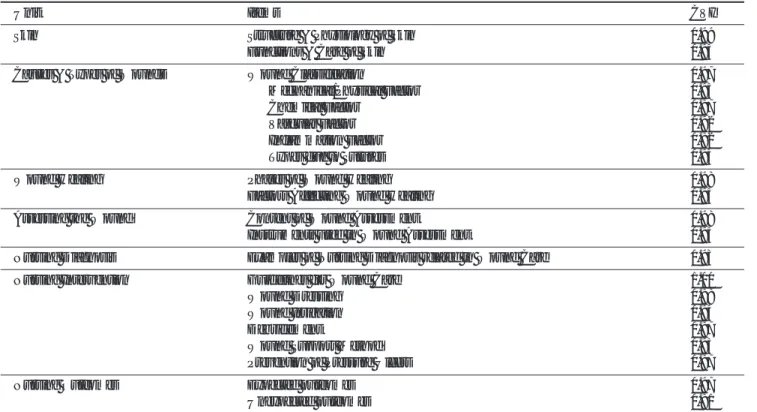
In order to achieve the 18 learning objectives defined for this study, the web-based wound care course was de- veloped with seven chapters and twenty subsections (Table 2).
Development of the web-based wound care course The course was developed with the most efficient con- tent structure and image display and all screen presenta- tions were designed in a way that students could opti- mize the course. There were a total of 34 screen presen- tations for the course, including one main screen, two for Chapter 1 on the skin, five for Chapter 2 on causes and types of wounds, two for Chapter 3 on wound healing, two for Chapter 4 on assessment of wounds, one for Chapter 5 on nursing diagnoses, 13 for Chapter 6 on nursing interventions, and two for Chapter 7 on nursing
outcomes. Four relevant sites were also developed along with one introducing the authors and one giving refer- ences.
1) Main screen
The main screen, which was presented when the course was started, included the titles of the seven chap- ters and learning objectives. On the left side was a login box to be filled with the user’s ID and password. Below the login box was the introduction of authors and refer- ences When users were finished with the wound care course, they were linked to the session in which they could offer their opinion and evaluation of the course it- self and the effects of self-study.
Included in the authors’ introduction was their email addresses. Any student who had a question on the course could email one of the authors, allowing for an interaction between students and authors. The reference menu contains reference lists related to the study, and provided the students with access to a broad range of in- formation. In addition, the main screen provided linkage to useful sites such as Y University’s Medical Library and Central Library to facilitate information surfing by the students (Figure 2).
Table 2. Chapters and Sections of the Web-based Wound Care Course
Unit Items CVI
Skin Structure & Physiology of Skin 0.99
Functions & Care of Skin 0.93
Causes & Types of Wounds Wound Classification 0.97
Mechanical/Physical Factor 0.95
Chemical Factor 0.97
Vascular Factor 0.92
Inflammation Factor 0.92
Types due to Sutures 0.94
Wound Healing Phases of Wound Healing 0.98
Factors Affecting Wound Healing 0.95
Assessing the Wound Content of Wound Assessment 0.98
Instruments used in Wound Assessment 0.95
Nursing Diagnosis Examples of Nursing Diagnosis related in Wound Care 0.93
Nursing Intervention Guidelines for Wound Care 1.00
Wound Dressing 0.98
Wound Irrigation 0.94
Debridement 0.97
Wound Support Method 0.95
Prevention of Pressure Ulcers 0.97
Nursing Outcomes Expected outcomes 0.97
Unexpected outcomes 0.91
2) Menu bar
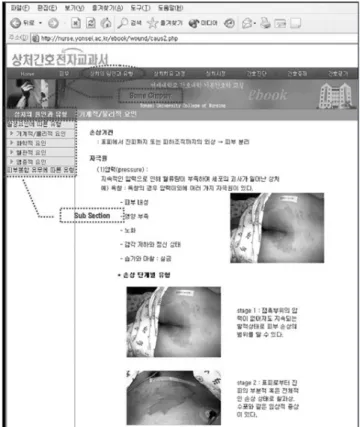
The menu bar, located at the top of the main screen, listed the titles of the seven chapters and provided access to all features of the course (Table 2). Double-clicking on a certain menu would open the respective content. The left-hand menu would expand and contract chapters and subsections, so a user could choose a specific chapter or subsection to study by clicking on the subsection listed for each chapter (Figure 3). By using the left-hand menu, students could browse the content of the specific chap- ters and subsections. Thus, the students could use the Internet-assisted learning course for self-study. In an ef- fort to draw the students’ attention to, and enhance their understanding of wound care, the main area of the course included 43 pictures, five illustrations of assess- ment instruments and three video streaming formats of wound dressing methods.
The three video streaming formats focused on step-by- step demonstrations as how to assess and how to dress a wound, so that students could easily practice by them- selves after watching the video streaming. The streaming video clips of three different methods of wound dressing could be downloaded. To access the video streaming, students could click on the “Nursing Intervention”
menu and choose “Wound Dressing” from the menu on the left side and then click on “view the streaming video.” Students could move around to choose the chap- ter and subsection for their self-study by clicking naviga- tion on the top bars and those down on the left hand
side of the screen (Figure 4).
Evaluation of the web-based wound care course After the course had been completed, a questionnaire was used to obtain formal feedback on the course con- tent, system and student satisfaction. The total mean
Figure 2.Main screen of the web-based wound care course
Figure 4.Screen for video streaming of the web-based wound care course
Figure 3.Menu bar of the web-based wound care course
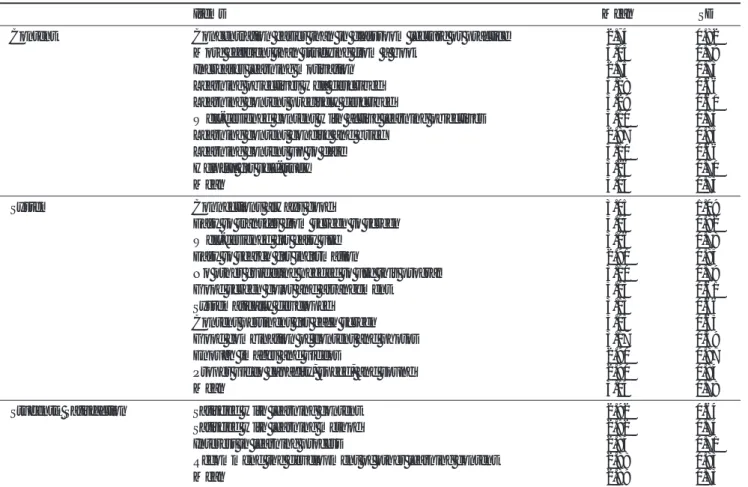
score for the evaluation was 2.99±0.75, out of a possi- ble 4 points. For content-related items, it was 3.04±
0.73 and for system-related items 3.04±0.78. For stu- dent satisfaction, the mean score was 2.89±0.73, indi- cating a moderate level of satisfaction (Table 3).
DISCUSSION
The purposes of this study were to develop a web- based wound care course and to evaluate its’ use from the students’ view of content, system, and student satis- faction. Nursing students could access to the web-based wound care course at their own convenience and accord- ing to their own learning abilities and speed. They re- ported being satisfied with the course content and sys- tem.
However this approach, the web-based course, repre- sented a relatively new technology for the students who were accustomed to traditional classroom lectures.
Students felt that they could not actively interact with the professors in this kind of web-based course even though they could e-mail the researchers when they had
any question on the course. While this contact with the researchers allowed an interaction, the lack of an imme- diate interaction between the professor and students was seen as weakness of the course. Students also tended to be less attentive while engaging in the program than in classroom for various reasons. These reasons included insufficient skill in handling computers and unfamiliarity with web-based learning. These weaknesses were identi- fied in the analysis as students strongly agreed with the items “precisely describing learning content” and “help- ful to self-study” while disagreeing with the items “easi- er to concentrate than in classroom lecture or laboratory practice” and “stimulating learning needs.” Educators should consider ways to activate the interaction between students and professors by, for example, discussion boards and should develop web-based courses that allow for active interaction like classroom lectures.
It is important, particularly for a practice-based disci- pline such as nursing, to recognize that computers will not replace education in the classroom (Deanne &
Campbell, 1985). Humanistic theories of education fo- cus on the value of human interaction (Rogers, 1983). To
Table 3. Evaluation of the Web-based Wound Care Course
Items Mean SD
Content Concentration easier than in classroom lecture or practice 2.74 0.82
More efficient than studying from a book 3.05 0.79
Increases learning motivation 2.75 0.73
Learning objectives well described 3.18 0.66
Learning content precisely described 3.29 0.60
Well-designed content with active learning objectives 3.10 0.74
Learning content concise and brief 2.87 0.85
Learning content up to date 3.10 0.66
Helpful for self-study 3.26 0.70
Mean 3.04 0.73
System Connections always good 3.05 1.09
Easy to transfer from screen to screen 3.04 0.82
Well-designed for easy use 3.06 0.78
Easy to search for information 2.91 0.85
No other guideline needed to use this program 3.10 0.79
Good screen color and arrangement 3.13 0.61
Systematically developed 3.13 0.66
Content pertinent for each screen 3.03 0.65
Good combination of content and photos 3.17 0.59
Enough images and videos 2.90 0.87
Proper video capacity, speed, and sound 2.90 0.84
Mean 3.04 0.78
Students’ Satisfaction Satisfied with learning content 2.92 0.64
Satisfied with learning method 2.92 0.74
Interest in learning process 2.84 0.71
Recommend the development of other learning content 2.88 0.83
Mean 2.89 0.73
many, the use of computer technology would be viewed as dehumanizing. However, the use of Internet and web- based learning will support students to develop as ac- tive, self-directed seekers of knowledge. Classes using the Internet as a teaching medium may differ from tradi- tional classes in that students become active participa- tors, and students are provided the freedom to work at their own pace (Connors et al., 1996; Jeffries, 2001;
Maag, 2004).
Student reactions to the web-based course need to be taken into consideration and the perceived requirement for professor support within the learning environment should be maintained. The Internet provides a golden educational opportunity for increasing information liter- acy and putting learners more in control of their learn- ing. But these advantages are only possible with a sup- portive policy and an investment of university and na- tional resources.
CONCLUSIONS
The purpose of this study was to develop web-based wound care course for undergraduate nursing students and evaluate the content, system and student satisfac- tion. Eighteen learning objectives were adopted for the course, and 7 chapters with 20 subsections were defined after consultation with relevant experts for validity of the content. The web-based wound care course was de- veloped based on the ARCS model through coordina- tion of programmers, nurses specializing in wound care and a photographer. 80 nursing students to Y University used the course during four weeks.
Then they completed a questionnaire to evaluate the course’s content, system and student-satisfaction.
Analysis of the questionnaires showed slightly higher mean scores for content-related and system-related items compared to student satisfaction items.
The merits of the web-based course is that it allows students to access the course at their convenience with- out concern about time or place and according to their own learning abilities and speed. The need for develop- ment of web-based learning for nursing education is seemingly endless.
But, it was found that it was impossible to completely replace traditional teaching with web-based learning.
Nurse educators should provide quality and effective web-based courses that prepare undergraduate nursing students to meet the demand of a complex health care system and further they should incorporate web-based learning into traditional teaching to meet the demands of nursing education.
References
Agius, R M., & Bagnall, G. (1998). Development and evaluation of the use of the internet as an educational tool in occupational and environmental health medicine. Occup Med, 48(5), 337- 343.
Athappilly, K., Durben, C., & Woods, S. (1994). Multimedia com- puting In: Reisman S (Ed). Multimedia computing. Harrisburg : IDEA Group Publishing.
Connors, H., Smith, C., DeCock, T., & Langer, B. (1996) Kansas nurses surf Web for master’s degrees. Reflections, 22(2), 16-17.
Deanne, D., & Campbell, J. (1995). Developing Professional Effectiveness in Nursing. Virginia : Deston Publishing.
Gang, S. B., Han, S. H., & Kim, J. E. (2000). Workshop for multi- media contents development. Maternity Nursing Practice.
Seoul : Korea Research Foundation.
Gilliver, R. S., Randall, B., & Pok Y. M. (1998). Learning in cyber- space: Shaping the future. J Comp Assist Learn, 14, 212-222 Jeffries, P. R. (2001). Computer versus lecture: A comparison of
two methods of teaching oral medication administration in a nursing skills laboratory. Nurs Educ, 40(7), 323-329
Kenny, A. (2000). Understanding the web barriers and benefits for nurse education: An Australian perspective. Nurs Educ Today, 20, 381-388.
Kim, J. A. (2001). The Development and Effectiveness of Web based Continuing Nurse Education Program. Unpublised doc- toral dissertation, Ewha Womans University, Seoul, Korea.
Lee, E. J., & Lee, S. S. (2004). Development of multimedia contents and web-based EPSS for the application of scientific nursing processes and training. J Korean Educ Inform, 10(2), 135-158.
Maag, M. (2004). The effectiveness of an interactive multimedia learning tool on nursing students’ math knowledge and self-ef- ficacy. Comput Inform Nur, 20(1), 26-33.
Min, Y. S. (2000). The development and effects of web instruction programs for drug abuse prevention in Korean adolescents. J Korean Acad Nurs, 30(4), 1055-1065.
Oh, P. J., Kim, I. O., Shin, S. R., & Jung, H. K. (2004).
Development of web-hased examination and health assess- ment course. J Korean Acad Nurs, 34(6), 994-1003.
Plank, R. K. (1998). Nursing on-line for continuing education credit.
J Contin Educ Nur, 29(4), 165.
Rogers, C. (1983). Freedom to learn. Columbus : Charles E Merrill.