Printed in the Republic of Korea
http://dx.doi.org/10.5012/jkcs.2011.55.6.1000
A Systematic Study on Knoevenagel Reaction and Nazarov Cyclization of Less Reactive Carbonyl Compounds Using Rare Earth Triflates
and Its Applications
A. Ilangovan*, S. Muralidharan, and S. Maruthamuthu†
School of Chemistry, Bharathidasan University, Tiruchirappalli - 620024, India.
*E-mail: [email protected], [email protected]
†Corrosion Protection Division, Central Electro Chemical Research Institute, Karaikudi-630 006, India (Received June 29, 2011; Accepted October 17, 2011)
ABSTRACT. A systematic study of Knoevenagel reaction and Nazarov cyclization was made on variety of less reactive car- bonyl compounds such as β-ketoesters, 1,3-diketones and cyclic active methylene compounds using Yb(OTf)3 as the catalyst.
Recycling study confirms reusability of the catalyst without much loss of activity.
Key words: Knoevenagel Reaction, Nazarov cyclization, Yetterbium triflate, 1,3-diketones, Ethyl acetoacetate
Highly substituted α,β-unsaturated olefins obtained via Knoevenagel condensation are key intermediates for var- ious reactions and have been extensively used in the syn- thesis of valuable compounds.1-4 Identification of diethylamine as a catalyst, first by Knoevenagel,5 paved way for the development of a large number catalysts,6-18 and condi- tions.19-28 Review of literature shows that compared to large number of bases as catalysts, Lewis acid (LA) cat- alysts known for Knoevenagel condensation are only lim- ited. Mg(ClO4)2,18 LaCl3,29 NbCl5,30 TiCl4,31,32 ZnCl2,33 and MgBr234 are known as LA catalysts. Some of these LAs need to be used in more than stoichiometric quantity35 and catalyst like Mg(ClO4)2 needs MgSO4 as additive.18 The presence of adventitious water as well as water generated during the course of the reaction generally degrades some of these conventional LAs, and renders it non reusable one and leads to generation of pollutants. In almost all of the LA mediated Knoevenagel condensations, only highly reac- tive carbonyl compounds such as malanonitrile, cyanoac- etates and malonates are used as substrates. Mg(ClO4)2, a potential explosive material, has been used as LA for the reaction on less reactive carbonyl compounds such as β- ketoesters and 1,3-diketones.18
Indanone ring systems is an important building block for the synthesis of biologically active compounds.36 LA catalysts such as Sc(OTf)3-LiClO4,37 SnCl438 AlCl3-N- fluorobenzenesulfonamide39 and Cu(OTf)3-N-fluoroben- zenesulfonamide40 are known to catalyse Knoevenagel condensation followed Nazarov cyclization between less reactive alkyl benzoylacetate and an aromatic aldehyde to
give the indanone ring system and its derivatives. How- ever, there are drawbacks such as the use of additives and more than stociometric quantity of the reagent. This sug- gests that there is a need for the development of novel LA catalysts which could work on less reactive carbonyl com- pounds.
Lanthanide triflates, (Ln(OTf)3)41,42 are new genera- tion, water compatible green LAs which can be recovered almost quantitatively and reused without much loss of activity. Based on our previous experience43-45 we feel that the hard Lewis acidic lanthanide triflates must be useful for Knoevenagel reaction on less reactive carbonyl com- pounds. Thus we observe successful condensation of 2- nitrobenzaldehyde (1e) as well as 2-chlorobenzaldehyde (1f) with ethyl acetoacetate (6a), in the presence of Yb(OTf)3 to get alkylidene β-ketoesters 7c and 7d respec- tively, which are useful intermediates for the synthesis of calcium channel blockers amlodipene and nifedipine (Table 3).
During the course of this study we noticed that there is a short report on the use of Yb(OTf)3 as a catalyst for Kno- evenagel reaction.46 However, the study involves only two highly reactive carbonyl compounds, malanonitrile and ethyl cyanoacetate, and among the various lanthanide tri- flates, only Yb(OTf)3 was examined as the catalyst. Sim- ilarly, Yb(OTf)3 was used in coupling reaction between alkynes and aldehydes to give trans-α,β-enones47 and in coupling of 8-hydroxyquinoline with aldehyde for the synthesis of alkaloids.48 However, there was no system- atic study on using Yb(OTf)3 as a catalyst for Knoeve-
nagel adduct formation between less reactive carbonyl compounds and aromatic aldehydes of varied reactivity.
To the best of our knowledge, there is no report on the use of Yb(OTf)3 as a catalyst for Nazarov cyclization. Here in we report our results.
To identify the best catalyst, Knoevenagel condensation was studied between a more reactive carbonyl compound, ethyl cyanoacetate (2b) and 4-methoxy benzaldehyde (1b) using different lanthanide trifltes, Nd(OTf)3, Sm(OTf)3, Gd(OTf)3 and Yb(OTf)3. This covers low to high Lewis acidity range of lanthanide triflates. The results are sum- marized in Table 1. With Yb(OTf)3 (10 mol%) in toluene, at 110 ºC, the adduct 3d was obtained, after 12 h, only in traces. With benzene, CH2Cl2, CH3CN and CH3NO2 as the solvent, the yield was not impressive.
However, when the reaction was carried out at 80-85 ºC, without any solvent, for 6 h, the desired adduct 3d was obtained in good yield (Table 1). Among the catalysts, Yb(OTf)3 gave high yield of the product in short time.
With 5 mol% of the catalyst it took more time for com- pletion (11 h, entry 5). Thus the use of Yb(OTf)3 (10 mol%) as the catalyst at 80-85 °C, without solvent was identified as the best condition for further study. In order to check reusability of the catalyst, it was recovered from aqueous workup and reused for the same reaction. The catalyst could be recovered up to 98% and the product yield was almost the same for the second (94%), third (93%) and fourth (93%) time. To establish the generality and scope of the method, further study on different active methylene compounds was carried out.
Excellent yield to very high yield of the Knoevenagel adduct was obtained on reaction of malanonitrile (2a), ethyl cyanoacetate (2b) with aromatic aldehydes (1a-f) containing electron donating as well as withdrawing sub- stituents (entry 1-8, Table 2). In case of diethyl malonate
(2c), aromatic aldehydes containing electron donating 4- OMe and 2-Cl substituent (entry 9 and 12) reacted fast compared to electron withdrawing 4-NO2 and 2-NO2 (entry 10 and 11) substituent. Overall the product yield was high. Comparison of reaction time between malono- nitrile (2a, 2 h) ethyl cyanoacetates (2b, 10 h) and diethyl malonate (2c, 30 h) especially, towards 4-NO2 benzalde- hyde (entry 2, 6 and 10) clearly shows that compound 2a is more reactive under Knoevenagel reaction conditions.
Comparison of reaction time 6 h and 30 h for 1b and 1d (entry 9 and 10) respectively clearly shows that the alde- hydes with electron donating substituent get activated eas- ily by Yb(OTf)3 compared to electron withdrawing substituent.
Only a single geometrical isomer was obtained.
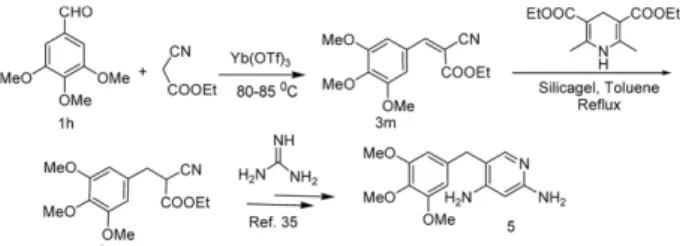
As a part of exploiting this methodology towards the synthesis of some biologically active compounds we car- ried out formal synthesis of antibacterial agent, trimethoprim (Scheme 1). Reaction of 3,4,5-trimethoxybenzaldehyde (1h) and ethyl cyano acetate (2b) gave the adduct 3m in quantitative yield. Compound 3m on reduction with Hantzch ester in the presence of silica gel, in toluene led to saturation of double bond and the product 4 was con- densed with guanidine49-51 by literature procedure to get trimethoprim 5. This is an easy and convenient method for the preparation of Trimethoprim.29,49-51
Having got good yield of Knovenagel adduct with highly reactive carbonyl compounds, we turned our atten- tion towards less reactive carbonyl compounds such as Table 1. Selection of rare earth triflate for Knoevenagel reaction
S. No Catalyst Yield (%) Time (hr)
1 Nd(OTf)3 67 12
2 Sm(OTf)3 72 10
3 Gd(OTf)3 53 11
4 Yb(OTf)3a 94, 94, 93, 93 06
5 Yb(OTf)3b 94 11
aThe reqaction was repeated using recovered catalyst for second, third and fourth time
b5 mol% of catalyst was used
Table 2. Yb(OTf)3 Catalysed Knoevenagel Reaction
Entry Starting Material
R1 X Y Prod-
uct Time
(h) Yield
(%) 1
2 3 4 5 6 7 8 9 10 11 12
4-OMe-C6H4 (1b) 4-NO2-C6H4 (1d)
-C6H5 (1a) 4-OMe-C6H4 (1b)
4-OH-C6H4 (1c) 4-NO2-C6H4 (1d) 2-NO2-C6H4 (1e) 2-Cl-C6H4 (1f) 4-OMe-C6H4 (1b)
4-NO2-C6H4 (1d) 2-NO2-C6H4 (1e) 2-Cl-C6H4 (1f)
CN CN CN CN CN CN CN CN COOEt COOEt COOEt COOEt
CN CN COOEt COOEt COOEt COOEt COOEt COOEt COOEt COOEt COOEt COOEt
3a 3b 3c 3d 3e 3f 3g 3h 3i 3j 3k 3l
2 2 4.5
6 8.5 10 25 12 6 30 24 7
98 98 95 94 95 92 92 85 84 80i 93 91
iYiled based on 25% recovered stating material
ethyl acetoacetate (6a) and acetyl acetone (6b). Gratify- ingly, the reaction between ethyl acetoacetate (6b) and 2- NO2 (1e) benzaldehyde took place readily to give prod- ucts 7b respectively in very good yield (entry 2, Table 3).
However aldehyde with 4-NO2 (1d) and 2-Cl (1f) sub- stituent reacted only slowly and the reaction was stopped after 15 h.
Geometrical isomers were formed in case of conden- sation between ethyl acetoacetate (6b) and aromatic alde- hydes. The reaction between ethyl acetoacetate (6a) and 4-NO2-benzaldehyde (1d) gave product 7a containing a mixture of E:Z geometrical isomers in the ratio 6:1. How- ever, 2-NO2-benzaldehyde (1e) and 2-Cl-benzaldehyde (1f) gave products 7b and 7c containing E:Z isomers in the ratio 5:5. Compound which shows lower δ value for COCH3
protons were assigned as E isomer, where COOC2H5 is trans to the aromatic ring and the other compound as Z iso- mer. The lower δ value for COCH3 protons could be attributed to the effective shielding by benzene ring which is positioned cis to COCH3 group. With acetyl acetone (6b) and 4-OMe benzaldehyde (1b), Knoevenagel adduct 7d was obtained in good yield. However, in case of 4- NO2-benzaldehyde (1d) containing strong electron with- drawing substituent, the reaction was slow. This obser- vation testifies that Yb(OTf)3 can even catalyse Knoevenagel reaction on less reactive active methylene compounds such as β-keto esters and 1,3-diketo compounds.
It is interesting to note that with the carbonyl com- pounds such as ethyl cyanoacetate (2b), diethyl malonate (2c) and ethyl acetoacetate (6a), the 2-nitro benzaldehyde (entry 7 and 11 in Table 2 and entry 2 in Table 3) gave high yield of the desired product, despite taking long reaction time. However, this is not the case with aromatic alde- hydes substituted with similar electron withdrawing, 4- NO2 or 2-Cl, substituents (entry 6, 8, 10, 12, Table 2 and entry 1 Table 3). This shows that the presence of 2-NO2
group adjacent to aldehyde must be helpful in forming a complex with Yb(OTf)3 and activation of the aldehyde group. The slow reaction rate may be due to, the lone pair of electrons from nitro group oxygen and the aldehyde oxygen forming a chelated complexes with Yb(OTf)3. Comparison of previous reports on Knoevenagel reaction reveals that in general under Lewis acid catalyzed conditions9,18,52 aromatic aldehydes substituted with elec- tron donating substituents react readily where as reverse is true with basic compounds as catalysts.8,17
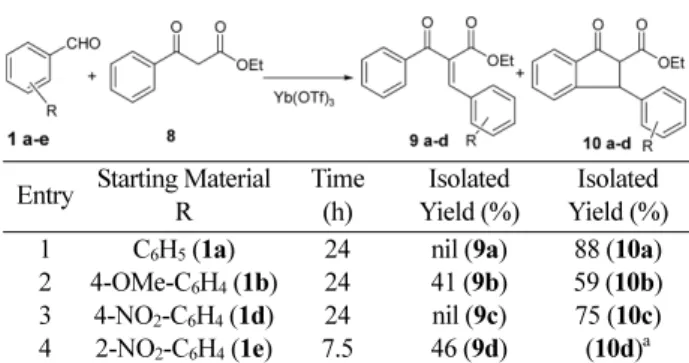
With a less reactive carbonyl compound, ethyl benzoy- lacetate, aromatic aldehydes underwent Knoevenagel condensation followed by cyclization in a tandem Naz- arov reaction to give indanone ring system in a one pot procedure (entry 1-4, Table 4). Benzaldehyde (1a, entry 1) and 4-NO2 benzaldehyde (1d, entry 3) gave the cyclized indanones (10a and 10c) as the only product in very good yield. However, 4-OMe and 2-NO2 benzaldehyde (entry 2 and 4) gave the uncyclized benzyledene β-keto esters (9b and 9d) in addition to the cyclized product. Formation of the cyclized product 10d could be identified from the 1H- NMR spectral data however, it could not be separated from the unidentified products formed. The four possible isomers formed in the reaction were not separated in our hands on purification by silica gel column chromatogra- phy.
Scheme 1. Synthesis of Triemthoprim.
Table 3. Yb(OTf)3 Catalysed Knoevenagel condensation of less reactive active methylebne cpompounds
Entry Starting Material R1 X Y Product Time (h) Yield (%) E/Z ratio
1 2 3 4 5
4-NO2-C6H4 (1d) 2-NO2-C6H4 (1e) 2-Cl-C6H4 (1f) 4-OMe-C6H4 (1b) 4-NO2-C6H4 (1d)
COCH3
COCH3 COCH3
COCH3 COCH3
COOEt COOEt COOEt COCH3 COCH3
7a 7b 7c 7d 7e
15 15 15 18 18
67i 76 57ii 50iii 34iv
6/1 5/5 5/5 - - Yield based on 55%, 40%, 40% and 60% starting material recovered from i, ii, iii and iv respectively.
Unlike the conventional Lewis acids, Yb(OTf)3 is known to be active even in the presence of Lewis basic amines and nitrogen heterocycles. Barbituric acid, a nitrogen het- erocycle with active methylene carbon, underwent facile reaction with aldehydes in the presence of Yb(OTf)3 to give the condensation adducts in very high yield. Both, electron donating as well as electron withdrawing alde- hydes gave products in high yield (entry 1-3, Table 5).
With yet another cyclic active methylene compound, Mel- drums acid, the cyclization product was obtained in mod- erate yield.
Based on the above observations a tentative mechanism
is proposed as given below. The reactivity pattern of aro- matic aldehyde indicates that the Lewis acid catalyst forms a complex with the aldehyde group first, followed by which the nucleophilic attack by active methylene should take place on the aldehyde carbon.
In case of the β-keto ester and β-diketones, the enol form is expected to undergo condensation in the following manner.
In conclusion, we have established Yb(OTf)3 (10 mol
%) as an effective catalyst for Knoevenagel reaction of several less reactive carbonyl compounds such as β-keto esters, 1,3-diketo compound and cyclic active methylene compounds. The catalyst was also useful for the Nazarov cylization on ethyl benzoylacetate. For all the reactions no special care was taken to exclude moisture, no solvent was used and simple workup procedure was followed. The cat- alyst can be recovered and reused without much loss of activity. All these features make this method an attractive Lewis acid catalyst for Knoevenagel condensation as well as Nazarov cyclization of less reactive carbonyl compounds.
EXPERIMENTAL
All yields reported were based on isolated compounds.
TLC separations were carried out on silica gel plates with UV indicator from Aldrich; visualization was by UV flu- orescence or by staining with iodine vapor. IR spectra were recorded on a FT-IR Bruker Vector 22 Infrared spec- trophotometer using KBr disks. NMR spectra were recorded on FT-NMR Bruker 400/200 MHz spectrometer as CDCl3 solutions with TMS as internal reference.
General Experimental Procedure for the Synthe- sis of Substituted Alkenes
To a mixture of an aromatic aldehyde (5.0 mmol) and active methylene compound (5.5 mmol), Yb(OTf)3 (0.5 mmol) was added and the resulting reaction mixture was Table 4. Yb(OTf)3 Catalysed Nazarov cyclisation Reaction
Entry Starting Material R
Time (h)
Isolated Yield (%)
Isolated Yield (%) 1
2 3 4
C6H5 (1a) 4-OMe-C6H4 (1b)
4-NO2-C6H4 (1d) 2-NO2-C6H4 (1e)
24 24 24 7.5
nil (9a) 41 (9b) nil (9c) 46 (9d)
88 (10a) 59 (10b) 75 (10c) (10d)a
aA mixture of steroisomers along with the uidentified products was obtained
Table 5. Yb(OTf)3 catalysed Knoevenagel condensation of cyclic activemethylene compounds
Entry Starting Material
Aldehyde Ketone Product Time (h)
Isolated Yield (%)
heated at 80–85 °C in an oil bath for required time. The progress of the reaction was monitored by thin layer chro- matography (TLC, silica gel, hexane: ethyl acetate, 8:2).
After completion of the reaction, the reaction mixture was diluted by adding ethyl acetate (10 mL) and washed with water (2×5 mL) and brine solution (5 mL). The organic layer was dried (Na2SO4) and concentrated under reduced pressure. The residue was purified by column chroma- tography (silica gel, hexane-EtOAc, 8.5:1.5) to afford the substituted olefin in very good yield. All the new products obtained were fully characterized by spectroscopic meth- ods such as IR, 1H NMR, 13C NMR and mass spectros- copy. If the compound is already known in the literature, IR, and 1H NMR values are given, compared with the spectral data already known, and a suitable reference is also mentioned.
2-(4-Methoxybenzylidene)malononitrile (3a) The reaction was carried out according to the general experimental procedure using 4-methoxybenzaldehyde (250 mg, 1.836 mmol), malononitrile (145 mg, 2.197 mmol) and Yb(OTf)3 (114 mg, 0.184 mmol). Conditions: 80-85oC, 2 h. The title compound 3a was obtained (330 mg, 98%) as a solid, mp 114-116oC. The spectral data for the com- pound 3a was in agreement with the values already reported in the literature.
1H NMR (400 MHz, DMSO) d 3.88 (s, 3H, -OCH3), 7.19 (m, 2H, ArH), 7.97 (m, 2H, ArH) and 8.40 (s, 1H, ArCH=). IR (KBr) 2224, 1605, 1571, 1513, 1370, 1319, 1279, 1185, 1022, 834 cm-1.
2-(4-Methoxy-benzylidene)-malonic acid diethyl ester (3i)
The reaction was carried out according to the general procedure using 4-methoxy benzaldehyde (100 mg, 0.735 mmol), diethyl malonate (129 mg, 0.808 mmol) and Yb(OTf)3 (52 mg, 0.074 mmol) conditions: 80-85oC, 6 h. The title compound 3i was obtained (171 mg, 84%) as an oily mass. The spectral data of the compound 3i was in agree- ment with the values reported in the literature.
1H NMR (400 MHz, CDCl3) δ 1.20 (t, J=7.2 Hz, 3H, -CH2CH3), 1.25 (t, J=7.2 Hz, 3H, -CH2CH3), 3.44 (s, 3H, -OCH3), 4.26 (m, J=7.2, 16.4 Hz, 4H, -CH2CH3), 7.49 (m, 4H, ArH), 7.72 (s, 1H, ArCH=). IR (KBr) 2982, 1723, 1628, 1448, 1375, 1255, 1196 cm-1.
2-Cyano-3-(3,4,5-trimethoxy-phenyl)-propionic acid ethyl ester (4)
The reaction was carried out 2-cyano-3-(3,4,5-trimethoxy-
phenyl)-acrylic acid ethyl ester (250 mg, 0.860 mmol), Hantzsch ester (240 mg, 0.950 mmol), and silica (2.5 g) in presence of toluene (5 mL) at reflex condition for 5 h. The title compound 4 was obtained (275 mg, 94%). The spec- tral data of the compound 4 was in agreement with the val- ues reported in the literature.
1H NMR (400 MHz, CDCl3) δ 1.22 (t, J=7.2 Hz, 3H, -CH2CH3), 3.12 (m, J=5.6, 13.6 Hz, 2H, Ar-CH2), 3.64 (t, J=5.6, 1H, ArCH2-CH-), 3.76 (s, 3H, -OCH3), 3.78 (s, 6H, 2-OCH3), 4.19 (q, J=7.2, 14. Hz, 2H, -CH2CH3), 6.42 (s, 2H, ArH). IR (KBr) 2942, 2253, 1743, 1592, 1509, 1463, 1245, 1127, 1005, 851 cm-1.
2-(2-Chloro-benzylidene)-3-oxo-butyric acid ethyl ester (7d)
The reaction was carried out according to the general procedure using 2-chloro benzaldehyde (100 mg, 0.711 mmol), ethylacetoacetate (102 mg, 0.783 mmol) and Yb(OTf)3 (50 mg, 0.071 mmol) conditions: 80-85oC, 15 h. The crude product was purified by column chromatography (silica gel, hexane: ethyl acetate. 9:1). First eluted was unreacted starting material 1d (40 mg, 40%). Second eluted was the title compound 7d was obtained (54 mg, 57%, yield calculated based on the recovered starting material) as an oilic mass. The spectral data of the com- pound 7d was in agreement with the values reported in the literature.
1H NMR (400 MHz, CDCl3) δ 1.17 (t, J=7.2 Hz, 3H, -CH2CH3), 2.42 (s, 3H, -COCH3), 4.24 (q, J=7.6, 14.0 Hz, 2H, -CH2CH3), 7.35 (m, 4H, ArH). 7.85(s, 1H, ArCH=).
IR (KBr) 1724, 1669, 1618, 1468, 1439, 1376, 1239, 1200 cm-1.
3-(4-Nitrobenzylidene)pentane-2,4-dione (7f) The reaction was carried out according to the general experimental procedure using 4-nitrobenzaldehyde (250 mg, 1.650 mmol), acetyl acetone (182 mg, 1.820 mmol) and Yb(OTf)3 (103 mg, 0.165 mmol). Conditions: 80-85oC, 18 h. The title compound 7f was obtained (131 mg, 34%) as a clear oilic mass. The spectral data for the compound 7f was in agreement with the values already reported in the literature.
1H NMR (400 MHz, CDCl3) δ 2.23 (s, 3H, -COCH3), 2.39 (s, 3H, -COCH3), 3.76 (s, 3H, -OCH3), 7.43 (s, 1H, ArCH=), 7.48 (d, 2H, ArH), 8.17 (d, 2H, ArH). IR (KBr) 1709, 1653, 1595, 1518, 1345, 1237, 1172, 858 cm-1.
5-(4-Hydroxy-3-methoxybenzylidene)pyrimidine-2,4,6 (1H,3H,5H)-trione (13c)
The reaction was carried out according to the general
experimental procedure using vaniline (250 mg, 1.645 mmol), barbituric acid (210 mg, 1.645 mmol) and Yb(OTf)3 (102 mg, 0.165 mmol). Conditions: 80-85oC, 5 h. The title compound 13c was obtained (415 mg, 96%) as a solid, mp 309-311oC. The spectral data for the compound 13c was in agreement with the values already reported in the lit- erature.
1H NMR (400 MHz, DMSO) δ 3.82 (s, 3H, -OCH3), 6.89 (d, 1H, ArH), 7.79 (m, 1H, ArH), 8.21 (s, 1H, ArCH=), 8.47 (d, 1H, ArH), 10.56 (s, 1H, -OH), 11.13 (s, 1H, -NH), 11.26 (s, 1H, -NH). IR (KBr) 3456, 3195, 3130, 3052, 2847, 1729, 1692, 1657, 1542, 1498, 1398, 1299, 1273, 1255, 1178, 1136, 1024, 851, 791, 516 cm-1.
2,2-Dimethyl-5-(4-methoxybenzylidene)-1,3-diox- ane-4,6-dione (14b)
The reaction was carried out according to the general experimental procedure using 4-methoxybenzaldehyde (250 mg, 1.836 mmol), meldrumsacid (317 mg, 2.201 mmol) and Yb(OTf)3 (115 mg, 0.185 mmol). Conditions: 80-85oC, 4.5 h. The title compound 14b was obtained (320 mg, 67%) as a solid, mp 127-129oC. The spectral data for the compound 14b was in agreement with the values already reported in the literature.
1H NMR (400 MHz, DMSO) δ 1.72 (s, 6H, -CH3), 3.87 (s, 3H, -OCH3) 7.09 (d, 2H, ArH), 8.22 (d, 2H, ArH), 8.30 (s, 1H, ArCH=).
IR (KBr) 3101, 2997, 2840, 1747, 1714, 1574, 1514, 1429, 1391, 1203, 1171, 1019, 933, 837, 798 cm-1.
Acknowledgments. Council of Scientific and Indus- trial Research (CSIR), New Delhi is gratefully acknowl- edged for financial support (Grant No.: 80(0067)/07/EMR- II, dt. 02-11-2007) and Senior Research Fellowship to SM. We are grateful to the DST-FIST for the use of 400 MHz NMR facility at the School of Chemistry, Bharathidasan University.
REFERENCES
1. Kraus, G. A.; Krolski, M. E. Therapeutic drugs. J. Org.
Chem. 1986, 51, 3347.
2. Tietze, L. F. Natural products. Pure Appl. Chem. 2004, 76, 1967.
3. Liang, F.; Pu, Y.; Kurata, T.; Kido, J.; Nishide, H. Her-
bicides, insecticides, functional polymers. Polymer. 2005, 46, 3767.
4. Zahouily, M.; Salah, M.; Bahlaouane, B.; Rayadh, A.;
Houmam, A.; Hamed, E.A.; Sebti, S. Fine chemicals. Tet- rahedron 2004, 60, 1631.
5. Knoevenagel, E. Bertt. 1898, 31, 2585.
6. Jones, G. Org. React. 1967, 15, 204.
7. Bose, D. S.; Narsaiah, A. V. J. Chem. Res. 2001, Suppl.
1, 36.
8. Narsaiah, A. V.; Basak, A. K.; Visali, B.; Nagaiah, K.
Synth. Commun. 2004, 16, 2893.
9. Cardilla, G.; Fabbroni, S.; Luca, G.; Massimo, G.; Tolo- melli, A. Synth. Commun. 2003, 9, 1587.
10. Abdallah, S.; Ayoubi, E. I.; Texir - Baullet, F. J.; Hamelin, J. Synthesis 1994, 258.
11. Acker, D. S.; Hertler, W. R. J. Am. Chem. Soc. 1962, 84, 3370.
12. Batsus, J. B. Tetrahedron Lett. 1963, 4, 955.
13. Sebti, S.; Smahi, A.; Solhy, A. Tetrahedron Lett. 2002, 43, 1813.
14. Rand, L.; Swisher, J. V.; Cronin, C. J. J. Org. Chem. 1962, 27, 3505.
15. Santamarta, F.; Verdia, P.; Tojo, E. Catal. Commun. 2008, 9, 1779.
16. Ramani, A.; Chanda, B. M.; Velu, S.; Sivasankar, S. Het- erogeneous catalysts. Green Chem. 1999, 163.
17. Lu, Y.; Ren, Z.; Cao, W.; Tong, W.; Gao. M. Neutral com- pounds. Synth. Commun. 2004, 34, 2047.
18. Bartoli, G.; Bosco, M.; Carlone, A.; Dalpozzo, R.; Galz- erano, P.; Melchiorre, P.; Sambri, L. Tetrahedron Lett.
2008, 49, 2555.
19. Saravanamurugan, S.; Palanichamy, M.; Hartmann, M.;
Murugesan, V. High reaction temperatures. Appl. Catal., A, 2006, 298, 8.
20. Bigi, F.; Chesini, L.; Maggi, R.; Sartori, G. High reaction temperatures. J. Org. Chem. 1999, 64, 1033.
21. Kantevari, S.; Bantu, R.; Nagarapu, L. Microwave irradi- ation: High reaction temperatures. J. Mol. Catal., A: Chem.
2007, 269, 53.
22. Bigi, F.; Conforti, M. L.; Maggi, R.; Piccino, A.; Sartori, G. Green Chem. 2000, 2, 101.
23. Hangarge, R. V.; Sonwane, S. A.; Jarikote, D. V.; Shin- gare, M. S. Green Chem. 2001, 3, 310.
24. Kaupp, G.; Naimi-Jamal, M. R.; Schmeyers, J. Tetrahe- dron. 2003, 59, 3753.
25. Yadav, J. S.; Subba Reddy, B. V.; Basak, A. K.; Visali, B.;
Narsaiah, A. V.; Nagaiah, K. Microwave irradiation. Eur.
J. Org. Chem. 2004, 546.
26. Deb, M. L.; Bhuyan, P. J. Tetrahedron Lett. 2005, 46, 6453.
27. Jenner, G. High pressure. Tetrahedron Lett. 2001, 42, 243.
28. McNulty, J.; Steere, J. A.; Wolf, S. Ultrasound. Tetrahe- dron Lett. 1998, 39, 8013.
29. Narasiah, A.V.; Nagaih, K. Synth. Commun. 2003, 33, 3825.
30. Leelavathi, P.; Ramesh Kumar, S. J. Mol. Catal., A: Chem.
2005, 240, 99.
31. Lehnert, W. Tetrahedron 1974, 30, 301.
32. Green, B.; Crane, R. I.; Khaidem, I. S.; Leighton, R. S.;
Newaz, S. S.; Smyser, T. E. J. Org. Chem. 1985, 50, 640.
33. Shanthan R. P.; Venkataratnam, R. V. Tetrahedron Lett.
1991, 32, 5821.
34. Saeed Abaee, M.; Mojtahedi, M. M.; Zahedi, M. M.;
Khanalizadeh, G. ARKIVOC 2006, XV, 48.
35. March, J. Advanced Organic Chemistry, 4th ed.; John Wiley and Sons: New York, 2003; Chap. 1, p 18. and ref- erences cited therein.
36. Frontier, A. J.; Collison, C. Tetrahedron 2005, 61, 7577.
37. Malona, J. A.; Colbourne, J. M.; Frontier, A. J. Org. Lett., 2006, 8, 5661.
38. Pridgen, L. N,; Huang, K.; Shilcrat, S.; Tickner - Eldridge, A.; Debrosse, C. S.; Haltwinger, R. C., Synlett 1999, 10, 1612.
39. Cui, H.-F.; Dong, K.-Y.; Zhang, G.-W.; Wang, L.; Na, J.- A. Chem. Commun. 2007, 2284.
40. Nie, J.; Zhu, H.-W.; Cui, H.-F.; Hua, M.-Q.; Ma, J.-A.
Org. Lett., 2007, 16, 3053.
41. Balasubramanian, T. M.; Liu, G. K.; Kinsley, S. A.; Duck-
worth, C. A.; Poteruca, J. J.; Brown, P. S.; Miller, J. L. J.
Org. Chem. 1987, 52, 1017
42. Kobayashi, S.; Sugiura, M.; Kitagawa, H.; Lam, W. W. L.
Chem. Rev. 2002, 102, 2227.
43. Sharma, G. V. M.; Ilangovan, A.; Mahalingam, A. K. J.
Org. Chem. 1998, 63, 9103.
44. Sharma, G. V. M.; Ilangovan, A. Synlett 1999. 1963.
45. Sharma, G. V. M.; Ilangovan, A.; Sreenivas, P.; Mahal- ingam, A. K. Synlett 2000, 615.
46. Wang, L.-M.; Sheng, J.; Zhang, L.; Han, J.-W.; Fan, Z.- Y,; Tian, H. Chinese J. Org. Chem. 2005, 25, 964.
47. Massimo, C.; Francesco, E.; Federica, M.; Ornelio, R.
Synlett 2003, 4, 552.
48. Lee, Y. R.; Kweon, H. I.; Koh, W. S.; Min, K. R.; Kim, Y.; Ho, S. Synthesis 2001, 12, 1851.
49. Smal, M.; Cheung, H. T. A.; Davis, P. E. J. Chem. Soc.
Perkin Trans. 1. 1986, 747.
50. Roth, B.; Falco, E. A.; Hitchings, G. H.; Bushby, S. R. M.
J. Med. Pharm. Chem. 1962, 5, 1103.
51. Sebti, S.; Nazih, R.; Rahir, R.; Salhi, L.; Saber, H. Flu- orapatite. Appl. Catal., A 2000, 197, L187.
52. Kumbhare, R. M.; Sridhar, M. Catal. Commun. 2008, 9, 403.