Impact of COVID-19 and Associated Preventive
Measures on Cardiometabolic Risk Factors in South Korea
Minji Sohn
1, Bo Kyung Koo
2, Ho Il Yoon
1, Kyoung-Ho Song
1, Eu Suk Kim
1, Hong Bin Kim
1, Soo Lim
1,*
1
Department of Internal Medicine, Seoul National University Bundang Hospital, Seoul National University College of Medicine, Seongnam;
2Department of Internal Medicine, SMG-SNU Boramae Medical Center, Seoul National University College of Medicine, Seoul, Korea
Background: During the coronavirus disease 2019 (COVID-19) pandemic, preventive measures mandated by government policies have included the closure of exercise facilities and movement restriction, which can lead to an unhealthy lifestyle. We investigated the effect of these preventive measures on metabolic parameters in indi- viduals with cardiometabolic disorders.
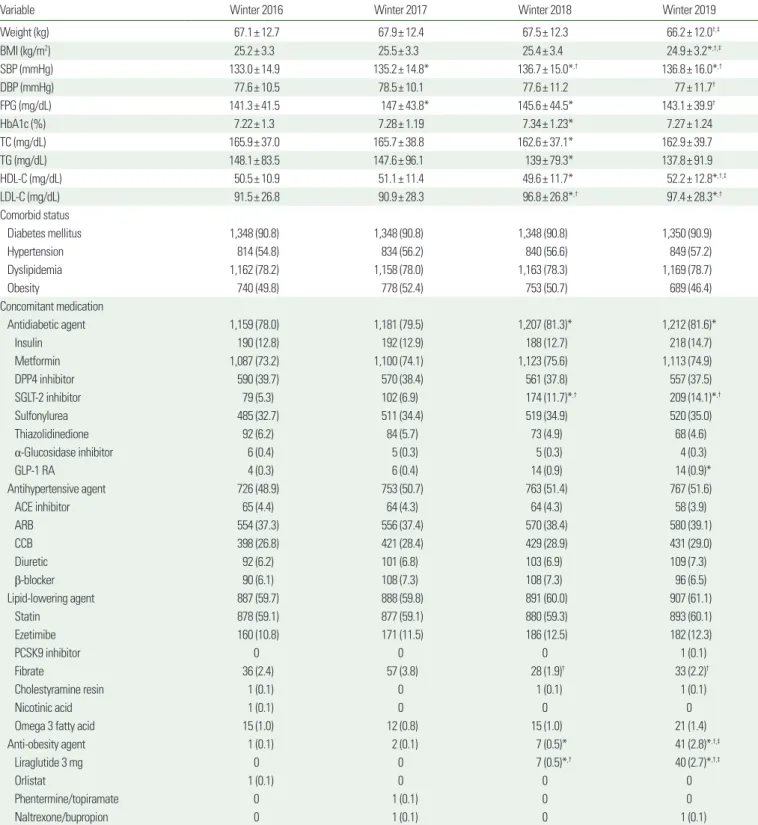
Methods: In this retrospective, observational study of patients who visited the hospital at least twice a year for the past 4 years, changes in cardiometabolic factors during the COVID-19 pandemic (2019–2020) were compared with changes in the same cohort at the same annual time points during the previous seasons of 2016–2019.
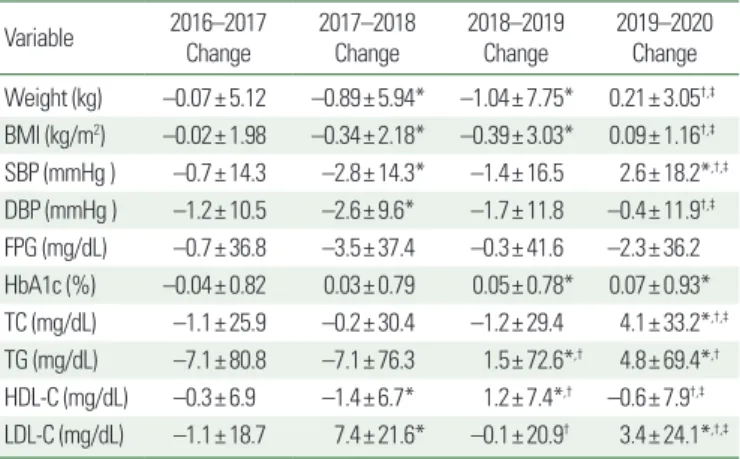
Results: A total of 1,485 individuals with a mean age of 61.8±11.7 years were included in the analyses. During the COVID-19 pandemic, the number of patients whose metabolic syndrome worsened increased significantly by 21% compared with the 2018–2019 season. Body mass index increased by 0.09±1.16 kg/m
2in the 2019–
2020 pandemic period, whereas it decreased by –0.39±3.03 kg/m
2in 2018–2019 and by –0.34±2.18 kg/m
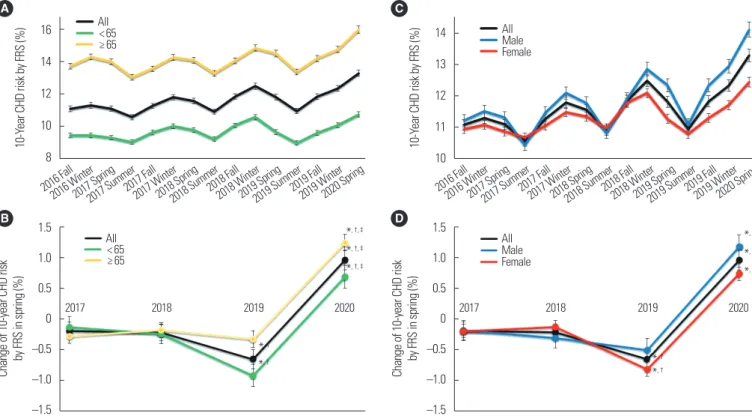
2in 2017–2018 (both P<0.05). Systolic blood pressure increased by 2.6±18.2 mmHg in the COVID-19 pandemic period, while it decreased in the three antecedent seasons (all P<0.05). Lipid profiles worsened in the pandemic period compared with the previous years. Framingham coronary heart disease risk score also increased signifi- cantly.
Conclusion: Nationwide strategies to maintain cardiometabolic health are necessary during contagious disease pandemics like COVID-19 to mitigate the adverse health effects of pandemic-preventative strategies.
Key words: COVID-19, Metabolic syndrome, Obesity, Dyslipidemia, Coronary heart disease
Received April 12, 2021 Reviewed May 15, 2021 Accepted May 17, 2021
* Corresponding author Soo Lim
https://orcid.org/0000-0002-4137-1671 Department of Internal Medicine, Seoul National University Bundang Hospital, Seoul National University College of Medicine, 82 Gumi-ro 173beon-gil, Bundang-gu, Seongnam 13620, Korea Tel: +82-31-787-7035
Fax: +82-31-787-4051 E-mail: [email protected]
INTRODUCTION
Severe acute respiratory syndrome coronavirus 2 (SARS-CoV-2) infection causes coronavirus disease 2019 (COVID-19). As of February 23, 2021, 111,365,509 cases and 2,466,239 deaths have been confirmed.
1SARS-CoV-2 induces mild symptoms in the ini- tial stage but has the potential to result in severe illness, including systemic inflammatory response syndrome, acute respiratory dis- tress syndrome, multiorgan involvement, and shock.
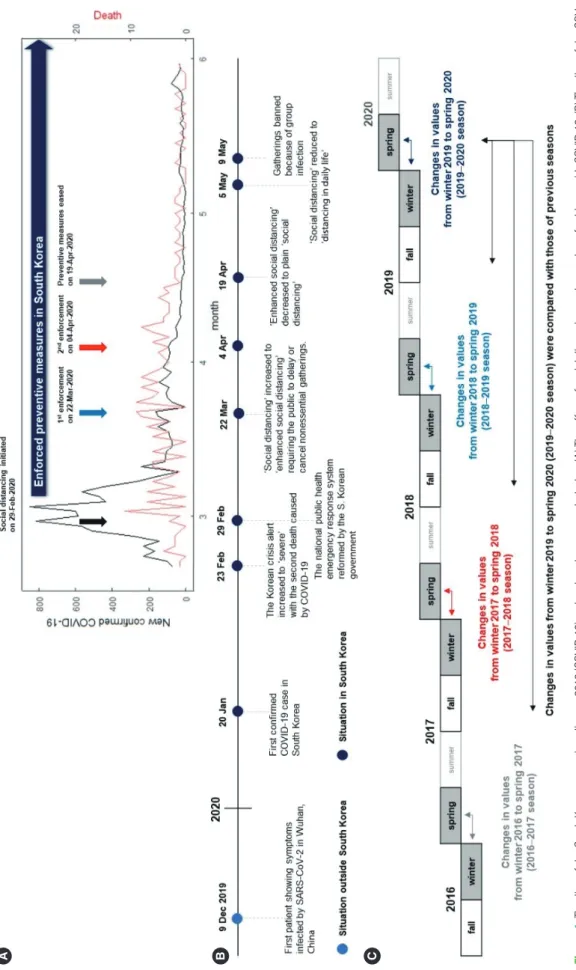
2In South Korea, the COVID-19 pandemic broke out in February 2020 (Fig. 1A), and in response the government raised the crisis alert level to “severe,” the highest (Fig. 1B). Infectious disease pre- vention and control measures included shutting down public facili- ties such as libraries and sports centers, and suspending school at- tendance. The public was requested to refrain from going outside unnecessarily, except for commuting to/from work, and to main- tain at least 1–2-m distance from others in the workplace.
3As a re- sult, personal movements decreased by 38.1% during the early pe-
Copyright © 2021 Korean Society for the Study of Obesity
This is an Open Access article distributed under the terms of the Creative Commons Attribution Non-Commercial License (https://creativecommons.org/licenses/by-nc/4.0/) which permits unrestricted non-commercial use, distribution, and reproduction in any medium, provided the original work is properly cited.
2017-03-16 https://crossmark-cdn.crossref.org/widget/v2.0/logos/CROSSMARK_Color_square.svg
Impact of COVID-19 and Associated Preventive
Measures on Cardiometabolic Risk Factors in South Korea
Minji Sohn
1, Bo Kyung Koo
2, Ho Il Yoon
1, Kyoung-Ho Song
1, Eu Suk Kim
1, Hong Bin Kim
1, Soo Lim
1,*
1