• 검색 결과가 없습니다.

Type Distribution of Human Papillomavirus in Genital Warts of Korean MenKyoung Ho Ryu, Jeong Ho Cho, Min Chong Lee, Tae Young Jung

N/A
N/A
Protected

Academic year: 2021

Share "Type Distribution of Human Papillomavirus in Genital Warts of Korean MenKyoung Ho Ryu, Jeong Ho Cho, Min Chong Lee, Tae Young Jung"

Copied!
6
0
0

로드 중.... (전체 텍스트 보기)

전체 글

(1)

Original Article Urogenit Tract Infect 2017;12(2):89-94

http://crossmark.crossref.org/dialog/?doi=10.14777/uti.2017.12.2.89&domain=pdf&date_stamp=2017-08-25

Type Distribution of Human Papillomavirus in Genital Warts of Korean Men

Kyoung Ho Ryu, Jeong Ho Cho, Min Chong Lee, Tae Young Jung

1

Goldman Urology Clinic, Seoul,

1

Department of Urology, VHS Medical Center, Seoul, Korea

Purpose: To analyze the distribution of human papillomavirus (HPV) types and the characteristics of genital condyloma in Korean men.

Materials and Methods: Between January 2015 and December 2015, we reviewed the medical charts of 435 male patients diagnosed with genital condyloma. A total of 441 samples were identified. The detection rate of each HPV type and its associated characteristics (age, number of HPV types, low-risk and/or high-risk types, number of lesions) were analyzed. Our sample population was divided into two groups: The non-urethral condyloma group and the urethral condyloma group.

In addition, subgroup analysis was also performed.

Results: Among the total 441 specimens, 409 (92.7%) were non-urethral condyloma and 32 (7.3%) were urethral condyloma. Single-type infection was observed in 56.7% and multiple-type infection was seen in 43.3%. HPV type 6 and type 11 were the most common types in total genital condyloma and subgroups.

HPV type 11, which was detected in 43.8% of those in the urethral condyloma group and in 22.0% of those in the non-urethral condyloma group (p=0.009), showed a statistically significant difference with respect to the type-specific detection rate.

Conclusions: As in previous studies, our study also showed that HPV type 6 was the most prevalent type among all genital condylomas, followed by HPV type 11.

A subgroup analysis also showed the same result.

Keywords: Human papilloma virus; Genital wart; Condyloma acuminata

Copyright 2017, Korean Association of Urogenital Tract Infection and Inflammation. All rights reserved.

This is an open access article distributed under the terms of the Creative Commons Attribution Non-Commercial License (http://creativecommons.org/licenses/by-nc/4.0) which permits unrestricted non-commercial use, distribution, and reproduction in any medium, provided the original work is properly cited.

Received: 18 April, 2017 Revised: 16 June, 2017 Accepted: 20 July, 2017

Correspondence to: Tae Young Jung

http://orcid.org/0000-0002-4634-3370 Department of Urology, VHS Medical Center, 53 Jinhwangdo-ro 61-gil, Gangdong-gu, Seoul 05368, Korea

Tel: +82-2-2225-1739, Fax: +82-2-484-4604 E-mail: [email protected]

INTRODUCTION

Human papillomavirus (HPV) infection is one of the most prevalent sexually transmitted infections (STIs) [1]. More than 100 types of HPV have been identified to date, and about 40 of these have been associated with genital disease [2,3]. Most HPV infections are naturally resolved within 2 years, but infection of several HPV types can persist and affect cell transformation. These types have oncogenic potentials and cause malignant diseases, such as cervical, penile, anal, and vulva cancer. Therefore, these types are classified as high-risk (HR) types [3,4]. A recent study

reported a moderate relationship between the occurrence

of bladder tumor and HPV infection [5]. However the most

commonly occurring disease related to HPV in men is

condyloma acuminate (genital condyloma), which is a

nonmalignant disease [6]. Most of the previous studies

regarding genital condyloma have been about penile,

scrotal, anal and urethral condyloma, showing that urethral

and meatal condyloma accounted for 20% of genital

condyloma [7-11]. Unlike other genital warts, urethral warts

require invasive procedures, such as urethro-cystoscopy

for diagnosis and treatment [12]. In cases of urethral wart

that are not confirmed with gross inspection or have no

(2)

obvious symptoms, appropriate treatment can be missed or postponed. Moreover, urethra and other genital areas have anatomical differences. Urethral orifice has a keratinized stratified squamous epithelium, and it abruptly changes to a non-keratinizing stratified squamous epithelium that lines the fossa navicularis. After that, it continues in the form of pseudostratified columnar epithelium in the penile urethra [13]. HPV also has various affinity for different anatomical sites, having different epithelial tropisms depending on the type [14]. Despite these differences and characteristics of HPV, studies of subgroup analysis in genital condyloma, especially in urethral condyloma, are very limited. Therefore, we analyzed the HPV type distribution in genital condyloma and performed a subgroup analysis between urethral condyloma and other genital condyloma.

MATERIALS AND METHODS

Between January 2015 and December 2015, we retrospectively reviewed the electronic charts of 438 patients diagnosed with genital condyloma via a histologic examination in the Goldman Urology Clinic (Gangnam-gu, Seoul, Korea). Three samples from three patients diagnosed with HIV or syphilis were excluded from the study; finally, 441 samples from 435 patients were included in this study.

The detection rate of HPV types and characteristics (age, number of HPV types, low-risk (LR) and/or HR types, number of lesions) of genital condyloma were compared.

For a subgroup analysis, total genital condyloma samples were divided into two groups. Regardless of whether other genital warts were accompanied or not, the samples of urethral condyloma were classified as the urethral condyloma group. Only urethral condyloma was analyzed for histologic examination and HPV typing test in urethral condyloma group. The samples of genital condyloma, which were not accompanied by urethral condyloma, were classified as the non-urethral condyloma group. Of the samples of multiple condyloma in the genital condyloma group, histological examination and HPV typing test were performed on the mass with the largest size.

Specimens were obtained by an excisional biopsy, and remaining wart tissues were removed by a laser therapy.

Electrocauterization was performed when bleeding control was required after an excisional biopsy. The specimens

from the non-urethral condyloma group were obtained from a penile shaft, penile glans, penile base, coronal sulcus, prepuce, pubic area, inguinal area, and anus. We conducted a histological examination only for urethral specimen in the urethral condyloma group. In the case of a meatal wart, an excisional biopsy was performed after the meatal eversion. Thereafter, urethrocystoscopy was performed to confirm additional intraurethral warts.

The HPV genotyping tests were performed with all samples using a multiplex real-time polymerase chain reaction (PCR) test, Anyplex

TM

II HPV 28 Detection system (Seegene, Seoul, Korea). Twenty eight different HPV types, including 20 HR types (16, 18, 26, 31, 33, 35, 39, 45, 51, 52, 53, 56, 58, 59, 66, 68, 69, 70, 73, 82) and 8 LR types (6, 11, 40, 42, 43, 44, 54, 61), were identified by this multiplex real-time PCR test.

The detection rate of HPV type in each group was calculated by dividing the number of each HPV type by the number of total specimens in each group. Subgroup analysis and a comparison of HPV type-specific detection rate in each group were performed using Pearson's chi-square test and Fisher’s exact test. All statistical analyses were performed using IBM SPSS Statistics ver. 20.0 (IBM Co., Armonk, NY, USA). A p-value of less than 0.05 was considered to be statistically significant.

RESULTS

A total of 441 genital condyloma samples were analyzed;

of them, 409 (92.7%) were non-urethral condyloma and 32 (7.3%) were urethral condyloma.

Table 1 shows the characteristics of the total genital condyloma group and each subgroup. The mean age of patients in the total genital condyloma group was 32.1±6.9 years (range, 18.1-66.0 years), and the samples from patients aged 30.1 to 40.0 years showed the highest distribution rate (47.8%). Single-type infection was observed in 56.7%

of all genital condylomas, and among these, 64.4% had only LR type. Samples of multiple lesions were identified in 76.2% of all genital condylomas. According to a subgroup analysis, there was no statistically significant difference in the distribution rates of single and multiple HPV type infections, LR and/or HR types and number of lesions.

Approximately 38.1% of the non-urethral condyloma group

and 56.3% of the urethral condyloma group were younger

(3)

Table 1. The characteristics of specimens in the non-urethral and urethral condyloma groups

Characteristic

Total genital condyloma

(n=441)

Non-urethral condyloma

(n=409)

Urethral condyloma

(n=32) p-value

a)

Mean age (y) 32.1±6.9 31.0±9.0 32.2±6.7 0.283

Age (y) 0.120

≤30.0 174 (39.5) 156 (38.1) 18 (56.3) 30.1-40.0 211 (47.8) 200 (48.9) 11 (34.4)

≥40.1 56 (12.7) 53 (13.0) 3 (9.4)

Number of HPV types 0.356

Single type 250 (56.7) 229 (56.0) 21 (65.6) Multiple type 191 (43.3) 180 (44.0) 11 (34.4)

Low- and/or high-risk type 0.914

Low 284 (64.4) 263 (64.3) 21 (65.6)

High 12 (2.7) 12 (2.9) 0 (0.0)

High & low 145 (32.9) 134 (32.8) 11 (34.4)

Number of lesions 0.059

Single 105 (23.8) 93 (22.7) 12 (37.5) Multiple 336 (76.2) 316 (77.3) 20 (62.5) Values are presented as mean±standard deviation or number (%).

HPV: human papillomavirus.

a)

Statistical analysis was performed between non-urethral condyloma group and urethral condyloma group.

Table 2. Distribution rate of HPV types in genital condyloma HPV type Total genital

condyloma (n=441)

Non-urethral condyloma

(n=409)

Urethral condyloma

(n=32) p-value

a)

Low-risk type

6 308 (69.8) 290 (70.9) 18 (56.2) 0.108 11 104 (23.6) 90 (22.0) 14 (43.8) 0.009

40 30 (6.8) 30 (7.3) 0 (0.0) 0.152

42 21 (4.8) 21 (5.1) 0 (0.0) 0.387

43 28 (6.3) 27 (6.6) 1 (3.1) 0.710

44 18 (4.1) 18 (4.4) 0 (0.0) 0.632

54 12 (2.7) 12 (2.9) 0 (0.0) 1.000

61 7 (1.6) 6 (1.5) 1 (3.1) 0.412

High-risk type

16 27 (6.1) 23 (5.6) 4 (12.5) 0.122

18 14 (3.2) 13 (3.2) 1 (3.1) 1.000

26 2 (0.5) 2 (0.5) 0 (0.0) 1.000

31 8 (1.8) 7 (1.7) 1 (3.1) 0.455

33 8 (1.8) 7 (1.7) 1 (3.1) 0.455

35 15 (3.4) 15 (3.7) 0 (0.0) 0.615

39 11 (2.5) 9 (2.2) 2 (6.3) 0.186

45 10 (2.3) 8 (2.0) 2 (6.3) 0.159

51 10 (2.3) 9 (2.2) 1 (3.1) 0.533

52 12 (2.7) 12 (2.9) 0 (0.0) 1.000

53 30 (6.8) 28 (6.8) 2 (6.3) 1.000

56 12 (2.7) 12 (2.9) 0 (0.0) 1.000

58 14 (3.2) 12 (2.9) 2 (6.3) 0.270

59 15 (3.4) 15 (3.7) 0 (0.0) 0.615

66 15 (3.4) 15 (3.7) 0 (0.0) 0.615

68 8 (1.8) 7 (1.7) 1 (3.1) 0.455

69 0 (0.0) 0 (0.0) 0 (0.0) -

70 7 (1.6) 7 (1.7) 0 (0.0) 1.000

73 6 (1.4) 6 (1.5) 0 (0.0) 1.000

82 8 (1.8) 8 (2.0) 0 (0.0) 1.000

Values are presented as number (%).

HPV: human papillomavirus.

a)
Statistical analysis was performed between non-urethral condyloma group and urethral condyloma group.

Table 3. Comparison of low and/or high risk human papillomavirus type between single- and multiple-type infections

Low risk High risk Low & high risk p-value Genital (total) condyloma (n=441) <0.001 Single type (n=250) 240 (96.0) 10 (4.0) 0 (0.0)

Multiple type (n=191) 44 (23.0) 2 (1.0) 145 (75.9)

Non-urethral condyloma (n=409) <0.001

Single type (n=229) 219 (95.6) 10 (4.4) 0 (0.0) Multiple type (n=180) 44 (24.4) 2 (1.1) 134 (74.4)

Urethral condyloma (n=32) <0.001

Single type (n=21) 21 (100.0) 0 (0.0) 0 (0.0) Multiple type (n=11) 0 (0.0) 0 (0.0) 11 (100.0) Values are presented as number (%).

than 30.0 years (p=0.059). There were 139 (31.5%) samples from patients who were previously treated with genital condyloma in the total genital condyloma, and 17 (53.1%) in the urethral condyloma group.

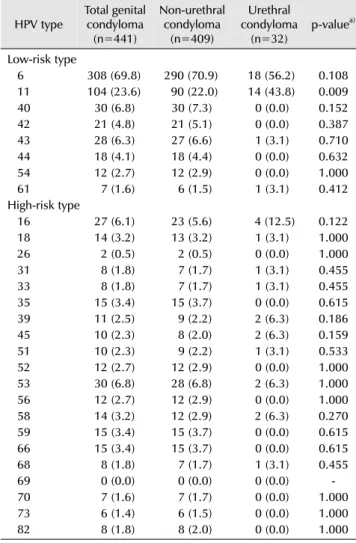
Among the total genital condyloma, HPV type 6 showed the highest detection rate (69.8%) and type 11 was confirmed with the second most common type (23.6%) (Table 2).

The detection rates of all other HPV types, except these two, were less than 7%. In each subgroup, HPV type 6 accounted for the largest proportion, followed by type 11.

The detection rate of HPV type 11 showed the only statistically significant difference in comparison of subgroups. In the urethral condyloma group, HPV type 11 accounted for 43.8%, which was higher than in the non-urethral group, with 22.0% detection rate (p=0.009).

While the most common type among the HR HPV types was HPV type 53 in the total genital condyloma group (6.8%) and in the non-urethral condyloma group (6.8%), HPV type 16 was the most common type in the urethral condyloma group (12.5%).

All three groups showed a higher detection rate of the HR types in multiple-type infection than in the single-type infection (Table 3). In the total genital condyloma group, the detection rate of the HR types from 191 multiple-type infections was 77.0%. Two (1.0%) specimens had only the

HR types, while 145 (75.9%) specimens had both LR and

HR types. In the non-urethral condyloma group, 136 (75.6%)

samples of multiple type infection were positive for HR

(4)

Table 4. Detection rate of high risk human papillomavirus type by age

Genital condyloma Non-urethral condyloma Urethral condyloma

Age (y) ≤30.0 >30.0 ≤30.0 >30.0 ≤30.0 >30.0

Detection of high-risk types

No 101 (58.4) 183 (68.3) 91 (58.3) 172 (68.0) 11 (61.1) 21 (65.6)

Yes 72 (41.6) 85 (31.7) 65 (41.7) 81 (32.0) 7 (38.9) 11 (34.4)

p-value 0.034 0.048 0.750

Values are presented as number (%).

types. In the urethral condyloma group, all 21 samples of the single-type infection had only the LR types, and all 11 multiple-type infections were positive for the HR types.

With respect to the detection rate of the HR types by age, there was a statistically significant difference between the those aged 30 years or under (younger group) and those over 30 years (older group). In genital condyloma group, HR type of the group aged 30 years old or under was positive for 41.6%, which was higher than 31.7% in the group over 30 years old (p=0.034) (Table 4). Moreover, in the non-urethral condyloma group, 41.7% of those in the younger group and 32.0% of those in the older group had HR types (p=0.048). In the urethral condyloma group, there was no significant difference (p=0.750).

DISCUSSION

HPV infection is one of the most highly prevalent STIs, and genital condyloma is the most common disease associated with HPV in men [1,6]. In previous studies, urethral condyloma was found in about 20% of all genital condylomas [7-11]. Our study showed that urethral condyloma accounted for 7.3% of all genital condylomas.

This discrepancy can be caused by the small sample size of urethral condylomas in our study. In addition, the incidence of urethral condyloma can be influenced by risk factors of urethral HPV infection, such as circumcision and urethritis.

There have been several studies on the prevalence and distribution of HPV types, including those with genital warts, especially with urethral warts. These studies varied greatly with respect to which HPV type was the most common.

Anic et al. [15] reported that HPV type 6 (43.8%), HPV type 11 (10.7%), and HPV type 16 (9.8%) were the most prevalent types. Park et al. [16] reported that the most common types were HPV types 6 (76.5%), 11 (15.9%),

40 (7.6%), and 16 (7.6%). In a study by Freire et al. [17], HPV types 6 (17.7%), 42 (13.8%), 16 (11.8%), and 51 (11.0%) were reported to be the most common. Our data suggest that HPV type 6 was the most common type, followed by types 11 (23.6%), 40 (6.8%), 43 (6.3%), and 53 (6.8%).

This finding was inconsistent with the previous studies.

In addition, samples in which HPV type 6 or 11 were detected accounted for 53.6% to 91.7% in previous studies [8,15,16].

In our study, all samples from the urethral condyloma group and 90.2% from the non-urethral condyloma group had HPV type 6 or 11.

In our report, the detection rate of HPV type 11 showed a significant difference between the urethral and non-urethral condyloma groups (p=0.009). However, Aguilar et al. reported that there was no difference in the HPV type distribution depending on the genital site [11].

Previous studies reported that HPV type 16 was the most common HR type. However, in our study, HPV type 53 was shown to be the most common. HPV type 16 was shown to be the second most common type of HR types in both the total genital condyloma and non-urethral condyloma groups. Conversely, in the urethral condyloma group, HPV type 16 (12.5%) was the most frequently detected, and this result is consistent with previous reports [15-19]. Arroyo et al. [9] reported that HPV type 16 was related to a higher number of lifetime sexual partners; the subjects in each previous study had differences of sexual partners and sexual behavior, thus influencing the prevalence of HPV types, including HPV type 16.

In our study, ten most common types of total genital

condyloma were HPV types 6 (69.8%), 11, (23.6%), 40

(6.8%), 53 (6.8%), 43 (6.3%), 16 (6.1%), 42 (4.8%), 44

(4.1%), 35 (3.4%), and 59 (3.4%). Currently, nonavalent

vaccine has the largest number of antigens among HPV

vaccines approved in Korea. The antigens contained in

an HPV vaccine were L1 protein of HPV types 6, 11, 16,

18, 31, 33, 45, 52, and 58. Of these nine HPV types, the

(5)

remaining seven types except for types 6 and 11 are HR types. In our study, HPV type 53 showed a higher detection rate than these 7 types. Moreover, HPV types 35, 59, and 66, except HPV type 16, were also detected in greater frequency than the preventable HR types contained in the vaccine. The purpose of HPV vaccination, which is being implemented in the national vaccination program, is the prevention of cervical cancer in women. Although men were known to act as a reservoir of HPV infection, men were not included in the subjects of the national vaccination project. In addition, considering the psychosocial distress associated with genital condyloma, a large-scale study of HPV type prevalence in Korean men is needed for the development of most optimized vaccines. Moreover, because there is no treatment for HPV itself, the prevention of HPV can be very important. We believe that our study will contribute to the overall objective of public health policies regarding prevention of HPV infection and development of future HPV vaccination.

Previous studies on genital warts reported that the prevalence of multiple-type infection was 7.9% to 58.7%

[8,9,15,18,19]. In our study, the prevalence of multiple-type infection was 43.3% among the entire sample population of 441 samples. As reported in a previous systematic review, the prevalence of single- or multiple-type infection can be influenced by the sampling method, anatomic sites for sampling, or the type of obtained specimens [20]. It was also reported that the clearance rate and clearance time of HPV could be varied depending on the HPV type, HIV status, number of sexual partners, and circumcision status [21,22]. Each patient with genital condyloma has a different period of time from the first HPV infection to the time of performing HPV typing test. HPV clearance in this period may also lead to different results of the type-specific detection rate. Especially in cases of urethral condyloma, most patients show no symptoms, and urethral condyloma can be invisible. Hence, the detection of urethral condyloma can be delayed, and this delayed detection can lead to a difference in the viral level at the time of detection.

In our study, multiple-type infection had a high proportion of the HR type, while single-type infection showed a high proportion of the LR type. In line with our study, Arroyo et al. [9] showed that the HR type was detected more frequently in multiple-type infections, while the LR type was more prevalent in single-type infections. Kwon et al.

[19] also reported that HR HPV infection is more likely to be identified in multiple HPV infections.

Moreover, multiple-type infection itself was reported as a risk factor for new acquisition of HPV types [23]. This means that the type-specific prevalence may be influenced by the proportion of multiple infections. Further studies are needed to determine the ability of specific types to make acquisitions of other types, and the correlation between the different types in multiple-type infections.

In both the total genital condyloma and non-urethral condyloma groups, the detection rate of HR types between the younger group and the older group showed statistically significant differences. However, most previous studies reported that there was no relevance between age and HPV types [9,17-19]. In fact, Arroyo et al. [9] reported a contradictory result to our study. On the other hand, Kwon et al. [19] reported that the proportion of HR type infection decreases as age increases, similar to our findings. Large scale studies are necessary to better elucidate the relationship between age and LR or HR type infections.

There are several limitations in this study. First, our analysis did not include factors that can affect the prevalence of HPV, such as sexual partners, sexual behaviors, circumcision status, size of genital warts, and presence of coexisting infections, including urethritis. Second, this study had a relatively small sample size, especially in the urethral condyloma group. In addition, we did not evaluate all HPV types that can cause genital condyloma, so there may be an underestimation of HPV type detection. Future study with a larger sample size and greater HPV type distribution considering sexual and socio-behavioral factors are needed.

CONCLUSIONS

As in previous studies, our study showed that HPV type

6 was the most frequently detected type in genital

condyloma, followed by type 11. This same result was

also confirmed in a subgroup analysis. The most frequently

detected types among HR types were HPV type 53 (6.8%)

in the non-urethral condyloma group and HPV type 16

(12.5%) in the urethral condyloma group. To the best of

our knowledge, our report is the first study analyzing the

HPV type on urethral condyloma in Korean men. A

large-scale research is still needed and an optimized vaccine

should be developed to prevent HPV infection in Korean

(6)

men.

CONFLICT OF INTEREST

No potential conflict of interest relevant to this article was reported.

REFERENCES

1. Giuliano AR, Anic G, Nyitray AG. Epidemiology and pathology of HPV disease in males. Gynecol Oncol 2010;117(2 Suppl):S15-9.

2. de Villiers EM, Fauquet C, Broker TR, Bernard HU, zur Hausen H. Classification of papillomaviruses. Virology 2004;324:

17-27.

3. Juckett G, Hartman-Adams H. Human papillomavirus: clinical manifestations and prevention. Am Fam Physician 2010;82:

1209-13.

4. zur Hausen H. Papillomaviruses in the causation of human cancers-a brief historical account. Virology 2009;384:260-5.

5. Jimenez-Pacheco A, Exposito-Ruiz M, Arrabal-Polo MA, Lopez- Luque AJ. Meta-analysis of studies analyzing the role of human papillomavirus in the development of bladder carcinoma.

Korean J Urol 2012;53:240-7.

6. Canepa P, Orsi A, Martini M, Icardi G. HPV related diseases in males: a heavy vaccine-preventable burden. J Prev Med Hyg 2013;54:61-70.

7. Oriel JD. Natural history of genital warts. Br J Vener Dis 1971;47:1-13.

8. Garland SM, Steben M, Sings HL, James M, Lu S, Railkar R, et al.

Natural history of genital warts: analysis of the placebo arm of 2 randomized phase III trials of a quadrivalent human papil- lomavirus (types 6, 11, 16, and 18) vaccine. J Infect Dis 2009;

199:805-14.

9. Arroyo LS, Basaras M, Arrese E, Hernaez S, Esteban V, Cisterna R. Distribution of genital human papillomavirus genotypes in benign clinical manifestations among men from Northern Spain. BMC Public Health 2016;16:81.

10. Aynaud O, Piron D, Bijaoui G, Casanova JM. Developmental factors of urethral human papillomavirus lesions: correlation with circumcision. BJU Int 1999;84:57-60.

11. Aguilar LV, Lazcano-Ponce E, Vaccarella S, Cruz A, Hernandez P, Smith JS, et al. Human papillomavirus in men: comparison of

different genital sites. Sex Transm Infect 2006;82:31-3.

12. Watson RA. Human papillomavirus: confronting the epidemic- a urologist’s perspective. Rev Urol 2005;7:135-44.

13. Pudney J, Anderson D. Innate and acquired immunity in the human penile urethra. J Reprod Immunol 2011;88:219-27.

14. Egawa N, Egawa K, Griffin H, Doorbar J. Human papillo- maviruses; epithelial tropisms, and the development of neoplasia. Viruses 2015;7:3863-90.

15. Anic GM, Lee JH, Stockwell H, Rollison DE, Wu Y, Papenfuss MR, et al. Incidence and human papillomavirus (HPV) type distribution of genital warts in a multinational cohort of men:

the HPV in men study. J Infect Dis 2011;204:1886-92.

16. Park SJ, Seo J, Ha SH, Jung GW. Prevalence and determinants of high-risk human papillomavirus infection in male genital warts.

Korean J Urol 2014;55:207-12.

17. Freire MP, Pires D, Forjaz R, Sato S, Cotrim I, Stiepcich M, et al.

Genital prevalence of HPV types and co-infection in men. Int Braz J Urol 2014;40:67-71.

18. Salehi-Vaziri M, Sadeghi F, Bokharaei-Salim F, Younesi S, Alinaghi S, Monavari SH, et al. The prevalence and genotype distribution of human papillomavirus in the genital tract of males in Iran. Jundishapur J Microbiol 2015;8:e21912.

19. Kwon T, Moon KH, Yang SH, Roh MC, Lee SH, Kim JW, et al.

Multiple human papillomavirus infection is associated with high-risk infection in male genital warts in Ulsan, Korea. J Korean Med Sci 2016;31:371-5.

20. Dunne EF, Nielson CM, Stone KM, Markowitz LE, Giuliano AR.

Prevalence of HPV infection among men: a systematic review of the literature. J Infect Dis 2006;194:1044-57.

21. Albero G, Castellsague X, Lin HY, Fulp W, Villa LL, Lazcano- Ponce E, et al. Male circumcision and the incidence and clearance of genital human papillomavirus (HPV) infection in men: the HPV Infection in men (HIM) cohort study. BMC Infect Dis 2014;14:75.

22. Taylor S, Bunge E, Bakker M, Castellsague X. The incidence, clearance and persistence of non-cervical human papillo- mavirus infections: a systematic review of the literature. BMC Infect Dis 2016;16:293.

23. Kjaer SK, Munk C, Winther JF, Jorgensen HO, Meijer CJ, van den

Brule AJ. Acquisition and persistence of human papillomavirus

infection in younger men: a prospective follow-up study

among Danish soldiers. Cancer Epidemiol Biomarkers Prev

2005;14:1528-33.

수치

Table 1. The characteristics of specimens in the non-urethral and  urethral condyloma groups
Table 4. Detection rate of high risk human papillomavirus type by age

참조

관련 문서

Wald-Type Tests for Detecting Breaks in The Trend Function of a Dynamic

Seung Soo Jang Sung Gyun Shin Min Jae Lee Sang Soo Han Chan Ho Choi Sungkyum Kim Woo Sung Cho and Song Hyun Kim POSTECH Yeong Rok Kang Wol Soon Jo Soo Kyung Jeong and

Chang Goo Kang, Ah Hyun Park, Jang Ho Ha, Young Soo Kim, Joon-Ho Oh, Jeong Min Park, Soo Mee Kim, Seung-Jae Lee, Seung Hee Lee, and Han Soo Kim(KAERI). Fabrication

11:20 Preliminary Study on Conceptual Design Analysis of PCCS for SMART Hae Seong Lee, Soon Joon Hong, Yeon Joon Choo, and Jeong Hee Ha(FNC Tech.) Chun Tae Park, Young In Kim,

Chang Je Park, Kwoen Ho Kang, Sang Ho Na, Young Hee Kim, Ho Jin Ryu, Geun Il Park, and Kee Chan Song (KAERI). Geun-Suk Choi and

Dong Won Lee, Young Dug Bae, Suk Kwon Kim, Hee Yun Shin, Bong Guen Hong, Hyun Kyu Jung, Yang Il Jung, Jeong Yong Park, Byung Kwon Choi, and Yong Hwan Jeong(KAERI). P07B04

Min Seok Ko, Bo An Lee, Sung Yong Lee, Yeong Jun Jang, Yoon Jeong Hong, and Sin Kim(JNU) TR-PIV Performance Test for a Flow Field Measurement in a Single Rod Test Section Ju

For confirmation of results of direct real-time melting curve analysis, we also performed an in-house JAK2 V617F ASP and a BsaXI-treated nested PCR-direct
