• 검색 결과가 없습니다.

Clinical Criteria to Perform the Step through Step Gait with a Cane in Chronic Stroke Patients

N/A
N/A
Protected

Academic year: 2021

Share "Clinical Criteria to Perform the Step through Step Gait with a Cane in Chronic Stroke Patients"

Copied!
8
0
0

로드 중.... (전체 텍스트 보기)

전체 글

(1)

Research Article Open Access

Clinical Criteria to Perform the Step through Step Gait with a Cane in Chronic Stroke Patients

Won-Bok Kim, MD, PhD, Jung-Ho Lee, PT, MSc 1†

Department of Physical Therapy, Daegu University

1 Department of Physical Therapy, Soonchunhyang University Hospital

1)

Received: July 11, 2014 / Revised: August 1, 2014 / Accepted: August 8, 2014

ⓒ 2014 J Korean Soc Phys Med

| Abstract |

PURPOSE: The purpose of this study was to propose clinical criteria to differentiate patients who are able to perform the step-through-step gait pattern in chronic stroke patients.

METHODS: Sixty patients with chronic stroke patients participated this study. To differentiate patients who could perform the step-through-step gait pattern, age, gender, and causes of stroke were noted, a Chedoke-McMaster (CM) damage list, Fugl-Meyer (FM) assessment scales and the Berg Balance Scale (BBS) were determined. A 10 meter gait test and Timed Up and Go (TUG) test were conducted to determine the differences in gait speed and dynamic balance between patients walking with or without canes in the step-through-step gait pattern group.

RESULTS: There was no significant statistical difference in age, gender, and stroke type between all subjects. There were significant differences in the CM scale for postural and lower extremities, and FM scale for lower extremities and

†Corresponding Author : [email protected]

This is an Open Access article distributed under the terms of the Creative Commons Attribution Non-Commercial License (http://creativecommons.org/licenses/by-nc/3.0) which permits unrestricted non-commercial use, distribution, and reproduction in any medium, provided the original work is properly cited.

BBS. The dynamic balance ability and gait speed showed significant differences between the subjects in the step-through-step gait pattern with or without a cane during gait.

CONCLUSION: CM and FM scales for the lower extremities and postural control, as well as BBS scales, can be used as criteria to differentiate patients who are able to perform the step-through-step gait pattern. These results can also be used to provide beneficial information to patients that are walking with canes.

Key Words: Stroke, Cane, Gait pattern

Ⅰ. Introduction

A stroke is a neurological disease that occurs due to

a disturbance in the blood supply to the brain. It is a typical

disease of the central nervous system that results in various

malfunctions in perception, sensation, language, and

mobility in the limbs on the opposite side of the region

in which the brain is damaged. The functional disabilities

of mobility due to a stroke are asymmetric posture,

difficulty in weight transfer, and degradation of the body’s

ability to balance, all of which cause a number of problems

(2)

in gait ability(Kwak et al., 2003). Gait ability is related to activity of daily living independence so that gait disorder has a major effect on disability following a stroke(Horvath et al., 2001). As a result, an improvement in gait ability has been a major issue for improving quality of life and it has become the main objective of stroke treatment (Schmid et al., 2007).

A stroke patient is aided by assistance tools, such as canes, to help ensure safety and facilitate daily living activities by improving gait functions and various gait-related problems(Kuan et al., 1999; Lauter, 2002).

However, Bobath(1990) reported that the use of canes slowed down the recovery of normal motor pattern and resulted in a greater need for a compensation strategy later on. Consequently, there has been controversy regarding the use of canes for stroke patients(Allet et al., 2009).

Nonetheless, other recent studies have revealed that the appropriate use of canes improved balance ability during walking and increased the maximum gait distance(Barra et al., 2009; Bohannon et al., 1991; Genthon et al., 2008;

Tyson et al., 2009); it also had an immediate effect on gait symmetry and provided stroke patients with psychological stability and confidence in their gait ability.(Aminzadeh et al., 1998; Beauchamp et al., 2009;

Dean et al., 1993).

In general, there are two gait methods that hemiplegic patients can use with canes: a step-through-step gait pattern in which the cane and the affected leg move at the same time and a step-to-step gait pattern in which the cane moves first followed by the affected leg. However, it was found that some stroke patients cannot perform the step- through-step gait pattern even after a great deal of practice.

Thus, this study aimed to propose clinical criteria to differentiate patients who are able to perform the step- through-step gait pattern from patients who are not able to perform that pattern and to verify whether there is a difference in gait speed and dynamic balance ability between patients who walked without canes and those who

perform the step-through-step gait pattern.

Ⅱ. SUBJECTS AND METHODS

1. Subjects

The study subjects were selected using the following criteria: patients who were diagnosed with stroke six months prior to the onset of the study, patients who could understand and follow oral commands, patients who could understand instructions, those who had Motor Assessment Scale G1-3, and those who could walk independently with the aid of a cane (the use of assistance tools was permitted).

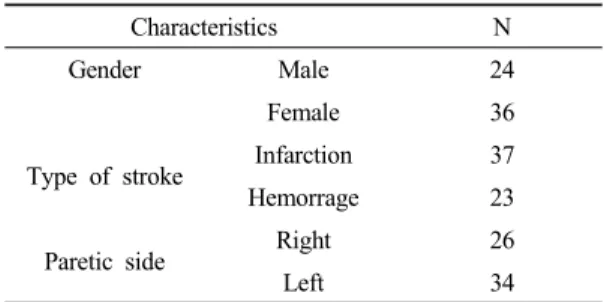
The following patients were excluded from the study: those with severe arthritis, those who regularly trained a cane gait before participating in this study, those who had undergone orthopedic surgery on their lower extremities or those whose had undergone the removal of their lower extremities over the prior six months, those who had no sensory deficits in their unaffected upper and lower extremities, and those who had brainstem and cerebellum dysfunction and bilateral brain disorders. All the subjects were informed about the purpose and method of the experiment and voluntary consent was obtained. A total of 60 subjects participated in the experiment. Table 1 shows the general characteristics of the subjects.

Characteristics N

Gender Male 24

Female 36

Type of stroke Infarction 37

Hemorrage 23

Paretic side Right 26

Left 34

Table 1. General characteristic of the subject

(n=60)

(3)

2. Methods

To produce clinical criteria that could be used to differentiate patients who could perform the step- through- step gait pattern from patients who could not perform that pattern, age, gender, and causes of stroke were noted, a Chedoke-McMaster (CM) damage list was produced, and Fugl-Meyer (FM) assessment scales were determined. The CM scale is a measure of impairment with 6 dimensions:

arm, hand, leg, foot, postural control, and shoulder pain.

Each dimension is scaled using a 7-point ordinal scale, which represents 7 stages of motor recovery based on Brunnstrom.(Gowland C et al., 1993) The FM scale was developed as an evaluation measure of stroke recovery and covers domains of impairment: motor function, sensory function, balance, joint range of motion, and joint pain.

Each of these domains is subdivided into multiple items that are scaled as follows: 0 is given if the participant cannot perform, 1 is given if the participant partial performance, or 2 is given if the participant full performance.(Fugl-Meyer AR et al., 1975)

The patients’ balance ability was measured using the Berg Balance Scale (BBS). The BBS was developed as a performance-oriented measure of balance. The BBS consists of 14 items that are scaled on a scale of 0 to 4. A scale of 0 is given if the participant is unable to do the task, and a scale of 4 is given if the participant is able to complete the task based on the criterion that has been assigned to it. The items include simple mobility tasks (transfers, standing unsupported, sit-to-stand) and more difficult tasks (tandem standing, turning 360°, single-leg stance)(Berg KO et al., 1989). Next, a 10 meter gait test was conducted to determine the differences in gait speed between patients walking with or without canes in the step-through-step gait pattern group while performing a Timed Up and Go (TUG) test to determine the differences in dynamic balance ability between the two groups. The 10 meter gait test measures the time that it takes a patients to walk 10 meter; it assesses the short-duration walking

speed, whereas the TUG test is a simple and quick functional mobility test that requires a subject to stand up, walk 3m, turn, walk back, and sit down(Podsiadlo D, 1991;

Watson MJ, 2002).

The tests were conducted with the aid of the same therapist using a standardized method. All the subjects participated in a 10-minute practice session to become sufficiently familiar with the step-through-step gait pattern, and a 5-minute rest time was given between the tests so that the subjects could have a sufficient amount of time to rest.

3. Data Analysis

The data collected for this study was processed statistically using SPSS software. A one-way ANOVA was conducted to verify whether there was a correlation between gait ability when performing the step-through-step gait pattern and whether differences could be attributed to age, gender, and the causes of strokes. In addition, descriptive statistics for the minimum and maximum values of every item on the CM damage list were determined and the FM assessment scales and the BBS scales were obtained to suggest criteria that could be used to identify the patients who could perform the step-through-step gait pattern. A paired T- test was conducted to verify the significance of each item on the list of criteria.

Furthermore, a paired T- test was conducted to determine the differences in gait speed and dynamic balance ability of the patients who could perform the step-through-step gait pattern, with or without canes. The statistical significance level, α was set as 0.05.

Ⅲ. Result

Among the 60 study participants, 34 were classified as

patients who could perform the step-through-step gait

pattern and 26 were classified as patients who could not

(4)

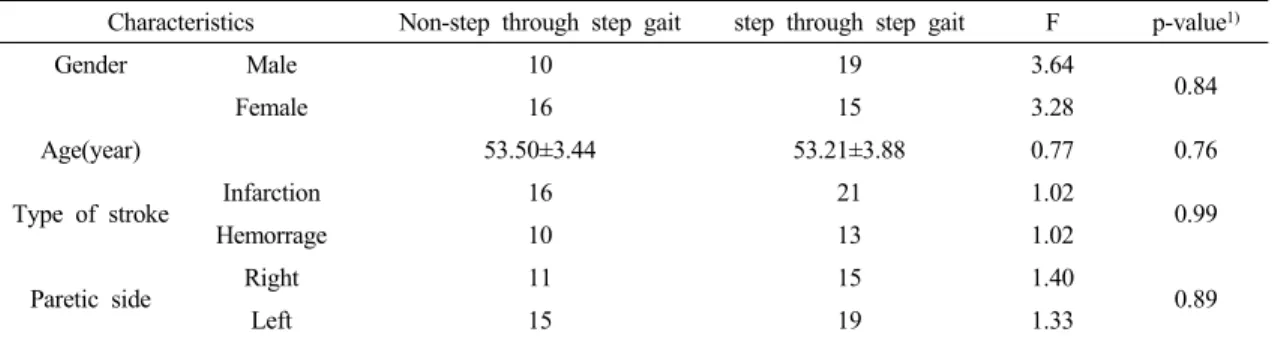
Characteristics Non-step through step gait step through step gait F p-value 1)

Gender Male 10 19 3.64

Female 16 15 3.28 0.84

Age(year) 53.50±3.44 53.21±3.88 0.77 0.76

Type of stroke Infarction 16 21 1.02

Hemorrage 10 13 1.02 0.99

Paretic side Right 11 15 1.40

Left 15 19 1.33 0.89

1) statistical significance was tested by One way analysis of variances among groups

Table 2. General characteristic of Non-step through step gait and step through step gait Participants

Characteristics Non-step through step gait(n=26) step through step gait(n=34) p-values CM scale

Postural control 2.35±0.60 (1-4) 4.50±0.50 (3-5) 0.00*

Upper Extremity 3.04±1.51 (1-5) 3.41±1.35 (1-5) 0.32

Lower Extremity 2.58±0.50 (2-3) 4.35±0.54 (3-5) 0.00*

FM scale Upper Extremity 13.89±2.38 (2-17) 23.92±16.20 (2-50) 0.40

Lower Extremity 10.73±1.82 (8-13) 20.82±3.02 (15-24) 0.00*

BBS 22.65±4.95 (15-30) 42.94±3.44 (37-53) 0.00*

*p<.05

Mean±Standard deviation (minimum-maximum)

Table 3. Clinical characteristic of Non-step through step gait and step through step gait Participants perform the step-through-step gait pattern.

There was no significant statistical difference in age, gender, stroke type, and affected side between those who could and could not perform the step-through-step gait pattern (p>.05) (Table 2).

There was no difference in the CM scales and the FM scales for the upper extremities whereas there was difference in the CM scales for postural control and lower extremities, and the FM scale for the lower extremities and BBS scales(Table 3). For the CM scale, on average, the group that could perform the step-through-step gait pattern had a scale of 4.50±0.5 (third minimum scoring level) for postural control and a scale of 4.35±0.54 (third minimum scoring level) for lower extremities mobility while the group that could not perform the step-through-step gait pattern, on average, had CM scales of 2.35±0.60 (fourth maximum scoring level) for postural control and 2.58±0.5

(third maximum scoring level) for lower extremities mobility. Therefore, to be able to perform the step- through-step gait pattern, it is suggested that the scales for the postural control and lower extremities should be greater than third scoring level and third scoring level, respectively.

For the FM scale, on average, the group that could

perform the step-through-step gait pattern had a scale of

20.82±3.02 (15 minimum points) for lower extremities and

a scale of 42.94±3.44 (37 minimum points) for BBS while

the group that could not perform the step-through-step gait

pattern, on average, had FM scales of 10.73±1.82 (13

maximum points) for extremities and 22.65±4.95 (30

maximum points) for BBS. Therefore, to be able to perform

the step-through-step gait pattern, it is suggested that the

scales for the lower extremities and BBS should be greater

than 15-points and 37-points, respectively.

(5)

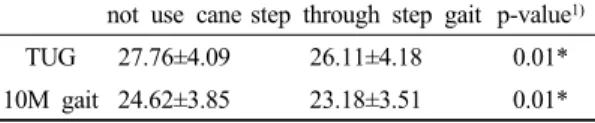
There was a significant difference in dynamic balance ability and gait speed between the subjects in the step- through-step gait pattern with or without a cane during gait (Table 4). In TUG, dynamic balance ability with the step-through-step gait pattern (26.11±4.18) increased significantly compared to the gait speed of the subjects that did not use a cane (27.76±4.09) (P<0.01).

In addition, in a 10 meter gait test, the gait speed with the step-through-step gait pattern (23.18±3.51) increased significantly compared to the gait speed of the subjects that did not use a cane (24.62±3.85) (P<0.01)

not use cane step through step gait p-value 1)

TUG 27.76±4.09 26.11±4.18 0.01*

10M gait 24.62±3.85 23.18±3.51 0.01*

*p<.05

1) Statistical significance was evaluated by paired T-test M±SD : Mean±standard deviation

Table 4. Comparisons of physical function between not use cane and step through step gait

Ⅳ. Discussion

This study aimed to provide clinical criteria that could be used to differentiate stroke patients who are able to walk using the step-through-step gait pattern from patients who are unable to use that pattern. In addition, this study also aimed to determine which factors could affect a stroke patient’s ability to use the step-through-step gait pattern.

The study results showed that age, gender, type of stroke, paretic side and the upper extremity CM and FM scales of the subjects were not factors that influenced whether or not the patients could perform the step-through-step gait pattern. However, the CM scales for postural control and lower extremities, and the FM scale for the lower extremities and BBS scales showed that a significant difference existed between the patients who could and could not use the step-through-step gait pattern. This finding

could be explained by the high correlation between balance impairment and paretic leg strength, and the ability to walk for a short distance(Patterson SL et al., 2007). The CM scale was developed to classify seven stages of mobile recovery for stroke patients in terms of the following six aspects: arms, hands, legs, feet, postural control, and shoulder pain.(Brunnstrom et al., 1996) Therefore, the patient’s stage is determined according to their mobility performance ability at each stage. On the other hand, the FM scale is more sensitive than the CM scale to the physical movement ability of the upper and lower extremities (Gowland Cet et al., 1993; Gladstone DJ et al., 2002).

In addition, the BBS balance ability scale showed more sensitivity than the scales obtained from the CM and FM scales. This was because the BBS scale is better able to refine the scales by utilizing a more diversified design to measure the balance ability than either the CM scale or the FM scale(de Oliveira R. et al., 2006).

In this study, clinical therapists suggested the use of the lower extremity mobility portion of the FM and the BBS scales to help determine whether or not stroke patients who walk with canes are able to perform the step- through-step gait pattern, thereby proving that those FM and BBS lower extremity mobility scales could be used to identify patients that could perform the step-through-step gait pattern.

Most of the subjects in this study had similar BBS scales and FM scales for lower extremity mobility. In other words, patients with a higher FM scales for lower extremity mobility also had higher BBS scales, demonstrating a close correlation between the two scales. This result was due to the fact that, ultimately, the various assessment items that were used to evaluate the lower extremity mobility portion of the FM scale were closely related to physical balance abilities.

This study also conducted a 10 meter gait test and a

TUG test to determine the effect that the step-through-step

gait pattern method had on gait speed and dynamic balance

(6)

ability for subjects who were able to perform the step-through-step gait pattern. The study’s results showed that patients with the step-through-step gait pattern showed a better result on gait speed and balance ability than patients walking without canes in the 10 meter gait test and the TUG test. This result was consistent with a study conducted by Boonsinsukh et al. (2009) in which external support provided via the use of canes could increase psychological self-confidence and stability, thereby improving gait speed and dynamic balance ability.

Furthermore, these results were obtained because stroke patients who were walking with canes had more weight load on their affected lower extremities than patients who were walking without canes. Using a cane while walking also reduced their risk of falls, thereby providing them with psychological comfort.

As a limitation of this study, the study results cannot be generalized because the study’s subjects were limited by geographical region and the number of subjects was not sufficient. In addition, only subjects who were using canes at the time of the experiment participated in our study, whereas patients walking without canes were excluded. Consequently, patients with minor mobility damage may not benefit as much as the participants in our experiments even if they could walk with our gait method using a cane. However, this concept was not proven in our study. Therefore, it is necessary to study this concept further, including examining diversity in the levels of stroke damage.

Ⅴ. Conclusion

The study’s results verified that CM and FM scales for the lower extremities and postural control, as well as BBS scales, can be used as criteria to differentiate patients who are able to perform the step-through-step gait pattern from patients who are not able to perform that gait pattern. In

addition, this study also verified that patients who were able to perform the step-through-step gait pattern using the criteria could improve their gait speed and dynamic balance ability more than patients that are walking without canes. Therefore, our study’s results can be used by clinicians as criteria to determine which patients require cane gait training; these results can also be used to provide beneficial information to patients that are walking with canes.

References

Aminzadeh F, Edwards N. Exploring seniors’ views on the use of assistive devices in fall prevention. Public health nursing. 1998;15(4):297-304.

Allet L, Leemann B, Guyen E, et al. Effect of different walking aids on walking capacity of patients with poststroke hemiparesis. Arch Phys Med Rehabil. 2009;90(8):

1408-13.

Barra J, Oujamaa L, Chauvineau V, et al. Asymmetric standing posture after stroke is related to a biased egocentric coordinate system. Neurology. 2009;72(18):1582-7.

Beauchamp MK, Skrela M, Southmayd D, et al. Immediate effects of cane use on gait symmetry in individuals with subacute stroke. Physiother Can. 2009;61(3):154-60.

Berg KO, Wood-Dauphinee SL, Williams JI et al. Measuring balance in eld erly: preliminary development of an instrument. Physiotherapy Canada. 1989;41(6):

304-11.

Bobath, B. Adult hemiplegia: evaluation and treatment(Vol.

3). Oxford. Heinemann Medical Books. 1990.

Bohannon RW. Relationship among paretic knee extension strength, maximum weight- bearing and gait speed in patients with stroke. J Stroke Cerebrovasc Dis.

1991;1(2):65-9.

Boonsinsukh R, Panichareon L, Phansuwan-Pujito P. Light

touch cue through a cane improves pelvic stability

(7)

during walking in stroke. Arch Phys Med Rehabil.

2009;90(6):919-26.

Brunnstrom S. Motor testing procedures in hemiplegia: based on sequential recovery stages. Phys Ther. 1966;46(4):

357-75.

Gowland C, Stratford P, Ward M, et al. Measuring physical impairment and disability with the Chedoke- McMaster Stroke Assessment. Stroke. 1993;24(1):58-63.

Fugl-Meyer AR, Jaasko L, Leyman I et al. The post-stroke hemiplegic patient. 1. a method for evaluation of physical performance. Scand J Rehabil Med.

1975;7(1):13-31.

Dean E, Ross J. Relationships among cane fitting, function, and falls. Phys Ther. 1993;73(8):494-500.

de Oliveira R, Cacho EW, Borges G. Post-stroke motor and functional evaluations: a clinical correlation using Fugl-Meyer assessment scale, Berg balance scale and Barthel index. Arq Neuropsiquiatr. 2006;64(3B):731-5.

Gowland C, Stratford P, Ward M, et al. Measuring physical impairment and disability with the Chedoke- McMaster Stroke Assessment. Stroke. 1993;24(1):58-63.

Genthon N, Rougier P, Gissot AS, et al. Contribution of each lower limb to upright standing in stroke patients.

Stroke. 2008;39(6):1793-9.

Gladstone DJ, Danells CJ, Black SE. The Fugl-Meyer assessment of motor recovery after stroke: a critical review of its measurement properties. Neurorehabil Neural Repair. 2002;16(3):232-40.

Horváth M, Tihanyi T, Tihanyi J. Kinematic and kinetic analyses

of gait patterns in hemiplegic patients. Facta universitatis-series: Physical Education and Sport.

2001;1(8):25-35.

Kuan TS, Tsou JY, Su FC. Hemiplegic gait of stroke patients:

the effect of using a cane. Arch Phys Med Rehabil.

1999;80(7):777-84.

Kwak KH Effect of Pelvic Tilting Exercise and Gait Training on Gait Characteristics of the Patients with Hemiplegia. Master’s degree. 2003.

Laufer Y. Effects of one-point and four-point canes on balance and weight distribution in patients with hemiparesis.

Clin Rehabil. 2002;16(2):141-8.

Patterson SL, Forrester LW, Rodgers MM, et al. Determinants of walking function after stroke: differences by deficit severity. Arch Phys Med Rehabil. 2007;88(1):115-9.

Podsiadlo D, Richardson S. The timed “Up & Go”: a test of basic functional mobility for frail elderly persons.

J Am Geriatr Soc 1991;39(2):142-8.

Schmid A, Duncan PW, Studenski S, et al. Improvements in speed-based gait classifications are meaningful.

Stroke. 2007;38(7):2096-100.

Tyson SF, Rogerson L. Assistive walking devices in nonambulant patients undergoing rehabilitation after stroke: the effects on functional mobility, walking impairments, and patients’ opinion. Arch Phys Med Rehabil. 2009;90(3):475-9.

Watson MJ. Refining the ten-metre walking test for use with neurologically impaired people. Physiotherapy 2002;

88(7):386-97.

(8)

수치

Table 1. General characteristic of the subject  (n=60)
Table 2. General characteristic of Non-step through step gait and step through step gait Participants
Table 4. Comparisons of physical function between not use cane and step through step gait

참조

관련 문서

Comparison of clinical risk factors and distribution of age, sex of patients aged ≧80 years and &lt;80 years... Comparison of the stroke subtype and thrombolysis of

In this study, to investigate how applying a critical pathway to stomach cancer patients affects their recovery and treatment, the clinical effect of the critical

The purpose of this study was to compare the microleakage of different adhesive systems (three 2-step adhesives and two 1-step adhesives) in class V

Therefore, in order to help educational instruction in the educational field, this study aims to examine whether in families of middle school students

Guidelines for the early management of adults with ischemic stroke: a guideline from the American Heart Association/American Stroke Association Stroke Council,

For this, the study presented a methodology to evaluate the driving safety and mobility of personal mobility devices, and measured acceleration and speed in

Although visceral fat adiposity has known to be associated with clinical, pathologic, and oncologic outcomes in patients with colorectal cancer (CRC), the

Prevention of coronary and stroke events with atorvastatin in hypertensive patients who have average or lower-than-average cholesterol concentrations, in