• 검색 결과가 없습니다.

Current Trend of Robotic Thoracic and Cardiovascular Surgeries in Korea: Analysis of Seven-Year National Data

N/A
N/A
Protected

Academic year: 2021

Share "Current Trend of Robotic Thoracic and Cardiovascular Surgeries in Korea: Analysis of Seven-Year National Data"

Copied!
7
0
0

로드 중.... (전체 텍스트 보기)

전체 글

(1)

ISSN: 2233-601X (Print) ISSN: 2093-6516 (Online)

1

Department of Thoracic and Cardiovascular Surgery, Seoul National University Hospital,

2

Department of Health Technology Assessment, National Evidence-based Healthcare Collaborating Agency,

3

Department of Nursing Science, Gachon University College of Nursing,

4

Department of Thoracic and Cardiovascular Surgery, Seoul National University Bundang Hospital

Received: October 6, 2014, Revised: December 11, 2014, Accepted: December 12, 2014, Published online: October 5, 2015

Corresponding author: Cheong Lim, Department of Thoracic and Cardiovascular Surgery, Seoul National University Bundang Hospital, 82 Gumi-ro 173beon-gil, Bundang-gu, Seongnam 13620, Korea

(Tel) 82-31-787-7139 (Fax) 82-31-787-4050 (E-mail) [email protected]

Seon Heui Lee, Department of Nursing Science, Gachon University College of Nursing, 191 Hambangmoe-ro, Yeonsu-gu, Incheon 21936, Korea

(Tel) 82-32-820-4235 (Fax) 82-32-820-4201 (E-mail) [email protected]

C

The Korean Society for Thoracic and Cardiovascular Surgery. 2015. All right reserved.

CC
This is an open access article distributed under the terms of the Creative Commons Attribution Non-Commercial License (http://creative- commons.org/licenses/by-nc/4.0) which permits unrestricted non-commercial use, distribution, and reproduction in any medium, provided the original work is properly cited.

Current Trend of Robotic Thoracic and Cardiovascular Surgeries in Korea: Analysis of Seven-Year National Data

Chang Hyun Kang, M.D, Ph.D.

1

, Jin San Bok, M.D.

1

, Na Rae Lee, M.PH.

2

, Young Tae Kim, M.D., Ph.D.

1

, Seon Heui Lee, M.PH., Ph.D.

3

, Cheong Lim, M.D., Ph.D.

4

Background: Robotic surgery is an alternative to minimally invasive surgery. The aim of this study was to report on current trends in robotic thoracic and cardiovascular surgical techniques in Korea. Methods: Data from the National Evidence-based Healthcare Collaborating Agency (NECA) between January 2006 and June 2012 were used in this study, including a total of 932 cases of robotic surgeries reported to NECA. The annual trends in the case volume, indications for robotic surgery, and distribution by hospitals and surgeons were analyzed in this study.

Results: Of the 932 cases, 591 (63%) were thoracic operations and 340 (37%) were cardiac operations. The case number increased explosively in 2007 and 2008. However, the rate of increase regained a steady state after 2011.

The main indications for robotic thoracic surgery were pulmonary disease (n=271, 46%), esophageal disease (n=199, 34%), and mediastinal disease (n=117, 20%). The main indications for robotic cardiac surgery were valvu- lar heart disease (n=228, 67%), atrial septal defect (n=79, 23%), and cardiac myxoma (n=27, 8%). Robotic thoracic and cardiovascular surgeries were performed in 19 hospitals. Three large volume hospitals performed 94% of the case volume of robotic cardiac surgery and 74% of robotic thoracic surgery. Centralization of robotic operation was significantly (p<0.0001) more common in cardiac surgery than in thoracic surgery. A total of 39 surgeons per- formed robotic surgeries. However, only 27% of cardiac surgeons and 23% of thoracic surgeons performed more than 10 cases of robotic surgery. Conclusion: Trend analysis of robotic and cardiovascular operations demonstrated a gradual increase in the surgical volume in Korea. Meanwhile, centralization of surgical cases toward specific sur- geons in specific hospitals was observed.

Key words: 1. Robotics 2. Cardiac surgery 3. Thoracic surgery

INTRODUCTION

Minimally invasive thoracic and cardiovascular operations

have become increasingly common. The well-documented ad- vantages of minimally invasive surgery include less postoper- ative pain, lower complication rates, and early recovery [1-4].

http://dx.doi.org/10.5090/kjtcs.2015.48.5.311

(2)

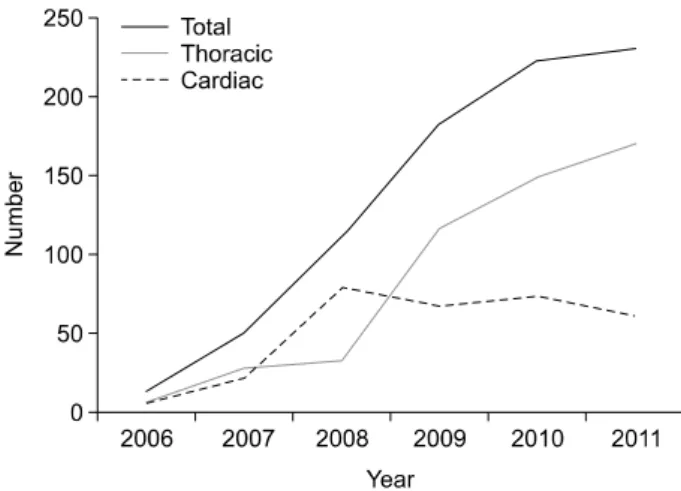
Fig. 1. Annual trend of robotic thoracic and cardiovascular surgery.

In the early period, explosive increase of robotic surgery was obs- erved. The rate of increase reached to steady state after 2010.

The recent development of robotic surgical technology has made robotic surgery another minimally invasive surgical option. A high-quality video system, three-dimensional view, free articulation of the robotic arms, motion scaling, and tremor filtering are specific features of the da Vinci robot system (Intuitive Surgical Inc., Sunnyvale, CA, USA) that can enhance the feasibility and improve the overall outcomes of minimally invasive surgery. Clinical studies on robotic sur- gery published in Korea have demonstrated that robotic sur- gery is more feasible and reliable than open thoracic or car- diovascular surgery [5-7]. However, it remains unclear how many robotic operations have been performed. The main in- dications for robotic surgery in Korea have not been estab- lished, and it is not known whether robots are being increas- ingly utilized in surgery in Korea. Therefore, the aim of this study was to identify overall trends in the occurrence of ro- botic thoracic and cardiovascular surgery in Korea by analyz- ing national data on robotic surgery collected by the National Evidence-Based Healthcare Collaborating Agency (NECA).

METHODS 1) Data collection

This study was approved by the institutional review board of Seoul National University Hospital (IRB No. 1403-096-566).

National data on robotic operations were collected by the NECA. In 2012, the Ministry of Health and Welfare re-

quested robotic surgery data from all hospitals in Korea in order to assess the policy question of the safety of robotic surgery. All hospitals where robot operations were performed submitted data to the Ministry of Health and Welfare. The data collected contained information about all cases of robotic surgery in Korea, and the NECA analyzed the data. The final analysis regarding the safety of robotic surgery in Korea was reported to the National Congress and released to the media.

Of the data collected in 2012, we selected data on operations that were identified as having been performed in the Department of Thoracic and Cardiovascular Surgery of any institution. A total of 932 cases of robotic surgery between January 2006 and June 2012 were included in our study. In order to protect the private information of patients and hospi- tals, the identifiers of patients, hospitals, and surgeons were blinded to the authors. In order to prevent biased comparison between hospitals, outcome variables, including mortality, morbidity, and length of hospital stay, were not provided to the authors. The data analyzed in this study included gender, age, diagnosis, operation name, operation date, blinded hospi- tal labels, and blinded surgeon labels. Therefore, the analysis was limited to annual trends in the frequency of robotic thoracic and cardiovascular surgery.

2) Statistical methods

The chi-square test or Fisher’s exact test was used to com- pare categorical variables. All statistical tests were two-sided.

IBM SPSS software ver. 21.0 (IBM Co., Armonk, NY, USA) was used for all statistical analysis. All p-values <0.05 were considered to indicate statistical significance.

RESULTS 1) Overall trends

The overall trend in the occurrence of robotic thoracic and

cardiac surgery is shown in Fig. 1. In the early period of ro-

botic surgery, few robotic thoracic and cardiac operations

were performed in Korea. In 2006, only 13 thoracic and car-

diac robotic operations were performed. The indications for

robotic surgery in 2006 were: esophageal disease (n=5), valv-

ular heart disease (n=4), mediastinal disease (n=2), and atrial

septal defects (n=2). The number of annual cases increased to

(3)

Table 1. Growth rate of robotic surgery compared to the previous year

Year Total (%) Thoracic (%) Cardiac (%)

2007 284 300 266

2008 124 17 259

2009 64 254 –15

2010 21 27 10

2011 3 14 –17

Table 2. Indications for robotic thoracic surgery

Diagnosis No. (%)

Lung cancer 261 (44.2)

Pulmonary metastasis 4 (0.7)

Bronchiectasis 3 (0.5)

Benign pulmonary nodule 2 (0.3)

Congenital lobar emphysema 1 (0.2) Esophagus

Esophageal cancer 173 (29.3)

Benign esophageal tumor 15 (2.5)

Achalasia 8 (1.4)

Esophageal diverticulum 2 (0.3)

Gastroesophageal reflux disease 1 (0.2) Mediastinum

Mediastinal tumor 76 (12.9)

Thymoma 38 (6.4)

Myasthenia gravis 3 (0.5)

Others

Chest wall tumor 1 (0.2)

Diaphragm palsy 1 (0.2)

Empyema 1 (0.2)

Tracheoesophageal fistula 1 (0.2)

Total 591 (100.0)

Table 3. Indications for robotic cardiac surgery

Diagnosis No. (%)

Valvular heart disease

MR 167 (49.1)

MR with Af 32 (9.4)

MR with TR 9 (2.6)

TR 8 (2.4)

MR with TR and Af 5 (1.5)

Mitral stenosis 1 (0.3)

Atrial septal defect 79 (23.2)

Cardiac myxoma 27 (7.9)

Ischemic heart disease 8 (2.4)

Infective endocarditis 3 (0.9)

Abdominal aortic aneurysm 1 (0.3)

Total 340 (100.0)

MR, mitral regurgitation; Af, atrial fibrillation; TR, tricuspid regurgitation.

231 in 2011. Of the 932 total cases that were performed over this interval, 591 (63%) were robotic thoracic operations and 340 (37%) were robotic cardiac operations. In 2007 and 2008, the number of robotic operations increased explosively, with an annual rate of increase of 284% in 2007. However, the rate of increase then sharply decreased, dropping to 3% in 2011 (Table 1).

2) Robotic thoracic surgery

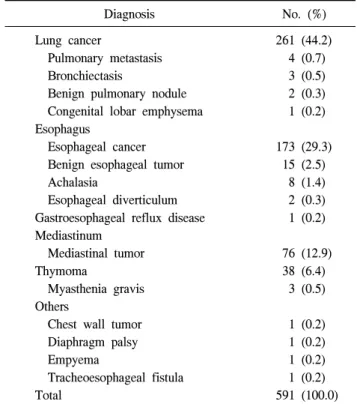
The indications for robotic thoracic surgery are summarized in Table 2. Three main indications were found for thoracic robotic surgery: pulmonary disease (n=271, 46%), esophageal disease (n=199, 34%), and mediastinal disease (n=117, 20%).

Lung cancer, esophageal cancer, and mediastinal tumors were the most common indications for thoracic robotic surgery (Table 2). Only a very small number of robotic operations were performed for diseases of the chest wall, pleura, dia- phragm, and airway. It was found that the number of lung cancer and esophageal cancer operations increased even after 2009. However, the frequency of mediastinal tumor oper- ations has remained essentially the same since 2009.

3) Robotic cardiac surgery

The indications for cardiac surgery are summarized in Table 3. Three major indications were found for robotic car- diac surgery: valvular heart disease (n=228, 67%), atrial sep- tal defects (n=79, 23%), and cardiac myxoma (n=27, 8%). Mitral valve surgery was the most common general indication in the category of valvular heart disease, and the most common spe- cific indication was mitral regurgitation without atrial fibri- llation (n=167, 49%). Robotic operations for ischemic heart disease were only performed in eight patients (2%). The case volume of robotic cardiac operations has remained steady since 2008.

4) Per-hospital analysis

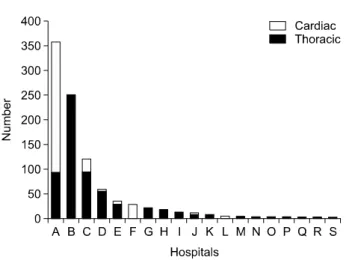
The case volumes of robotic surgery in each hospital are

shown in Fig. 2. Robotic operations were performed in 19

hospitals. Robotic thoracic operations were performed in 16

(4)

Fig. 2. Robotic surgery case volumes according to hospitals.

hospitals, and robotic cardiac operations were performed in 11 hospitals. The majority of the robotic operations (94% of cardiac operations and 74% of thoracic operations) were per- formed in three major hospitals. The degree of centralization of cardiac surgery was significantly (p<0.0001) higher than that of thoracic surgery. Eight hospitals (50%) performed more than 10 robotic thoracic operations. In comparison, only three hospitals (27%) performed more than 10 cases of ro- botic cardiac operations.

5) Per-surgeon analysis

One hospital did not submit data about the surgeons who performed robotic operations. Therefore, data about the sur- geons were analyzed for 18 hospitals. A total of 39 surgeons performed robotic operations, including 26 thoracic surgeons and 13 cardiac surgeons. Seven surgeons (27%) performed more than 10 robotic thoracic operations, whereas three sur- geons (23%) performed more than 10 robotic cardiac opera- tions. Eleven hospitals (61%) had more than two surgeons who performed robotic surgery. Seven hospitals (39%) had only one surgeon who performed robotic surgery.

DISCUSSION

This is the first study to report annual trends in robotic thoracic and cardiovascular surgery in Korea. The analysis was performed using the NEHA database of information sub- mitted by hospitals. Of a total of 932 cases, 63% were ro-

botic thoracic surgery and 37% were robotic cardiac surgery.

The annual volume of robotic surgery has continuously in- creased. However, the rate of increase is now lower than it was immediately after being introduced. We evaluated the centralization of cases, and found that robotic cardiac surgery was significantly more centralized than robotic thoracic surgery.

Robotic surgery has technological advantages over conven- tional thoracoscopic surgery. High-quality imaging with ×10 magnification and three-dimensional vision are the most im- portant advantages. High-quality imaging is very important for minimally invasive surgery, especially when the target tis- sue or organs have a complex structure or when a compli- cated operation is required. Furthermore, complete resection of a tumor can be achieved by clearly delineating tumor tis- sue and normal tissue. Another significant advantage is the free articulation of the robotic arm, which enables a surgeon to perform difficult procedures more easily than in thoraco- scopic surgery. Free articulation is useful when dissecting lymphatic tissues, performing complex valvular reconstruction, and when repairing organs or tissues. Theoretically, robotic surgery has many technological advantages. However, robotic surgery is not performed as frequently as might be expected for thoracic and cardiovascular disease because the advan- tages of robotic procedures have not been well established for thoracic and cardiac operations.

In this study, the most common indication for robotic thoracic surgery was lung cancer. Robot-assisted pulmonary resection was the major indication in other studies [8].

Whether robotic pulmonary resection is superior to other sur- gical modalities is not clear. Robotic surgery is likely to share the advantages of thoracoscopic surgery, including less postoperative pain, earlier recovery, and lower complication rates than open surgery. However, the benefits of robotic sur- gery over thoracoscopic surgery are unclear. Kent et al. [8]

reviewed the State Inpatient Database and reported a total of

430 robotic lobectomies. Their study found a significant in-

crease in the case volume of robotic pulmonary resection, and

the early outcomes include improved mortality, length of stay,

and overall complication rates in the robotic lobectomy group

compared to the open lobectomy group. However, they were

not able to demonstrate the superiority of robotic lobectomy

(5)

over thoracoscopic lobectomy. Swanson et al. [9] compared 335 robotic lobectomies to 3,818 thoracoscopic lobectomies and found no difference in the length of hospital stay or ad- verse events. One study did report better outcomes in the ro- botic surgery group. Farivar et al. [10] compared 181 robotic pulmonary resections with 4,612 thoracoscopic resections. A significant decrease in the length of stay was observed in the robotic surgery group, but the mortality and morbidity rates were not significantly lower. Therefore, the role of robotic pulmonary resection as an alternative to thoracoscopic surgery remains unclear.

Robotic esophageal surgery was the second indication that we identified for thoracic surgery. A small case series has been reported for robotic esophagectomy, but no large series or systematic review is currently available. Kim et al. [5] re- ported that robotic esophagectomy was a feasible operation with acceptable early outcomes. Of the 21 patients included in their study, none experienced respiratory complications or mortality. Comparative studies between robotic and thoraco- scopic esophagectomy involving small case series [11,12]

have reported comparable outcomes for robotic esophagec- tomy. A study conducted by Suda et al. [11] found that ro- botic surgery prevented vocal cord paralysis more effectively than thoracoscopic esophagectomy.

Mediastinal disease was another indication for robotic thoracic surgery. The superiority of robot-assisted surgery in the treatment of anterior mediastinal tumors has been estab- lished in several studies [7,13,14]. A shorter length of stay, less blood loss, and fewer complications than open sternot- omy have been reported [7,13] Robotic thymectomy was also found to have better results regarding control of myasthenia gravis than thoracoscopic thymectomy [14]. In anterior me- diastinal disease, better outcomes after robotic surgery have been repeatedly reported. However, no large series has yet been reported.

In this study, the most common indication for robotic car- diac surgery was valvular heart disease. Mitral valve repair has been established as the major indication for robot-assisted cardiac surgery in other studies [4]. However, it is not clear whether robotic mitral valve repair is superior to other surgi- cal modalities. Robotic surgery is likely to share the advan- tages of minimally invasive approaches, such as less post-

operative pain, early recovery, and lower complication rates than open surgery. However, controversy persists regarding whether robotic surgery is more advantageous than other min- imally invasive surgical modalities. Mihaljevic et al. [15] re- ported the results of 473 robotic mitral valve repairs from several cohorts in large multispecialty academic medical centers. They found that the cost of care for robotically as- sisted operations exceeded that of alternative approaches (by 26.8%, 32.1%, and 20.7% for complete sternotomy, partial sternotomy, and anterolateral thoracotomy, respectively). Higher operative costs were partially offset by lower postoperative costs and earlier return to work. The net differences in the cost of robotic surgery compared to the three other modalities were 15.6%, 15.7%, and 14.8%, respectively. However, roboti- cally assisted surgery can only be performed with a cost sim- ilar to that of conventional approaches in high-volume centers. Unfortunately, no report has assessed cost-effective- ness in Korea, and the results from the United States cannot directly be applied to the Korean medical system due to fun- damental differences in medical costs and the insurance system. Woo and Nacke [16] reported that robotic surgery patients had a significant reduction in blood transfusions and length of stay compared to sternotomy patients. Folliguet et al. [17] reported that the only advantage of robotic surgery was a shorter hospital stay (7 days vs. 9 days, p=0.05).

Repair for atrial septal defects was the second most com- mon indication for robotic cardiac surgery. Kim et al. [6] re- ported that robotic atrial septal defect closure was a feasible operation with acceptable early outcomes. No instances of mortality or serious surgical complications were observed in the 50 patients included in their study. They concluded that, in selected patients, complete port access can be helpful for obtaining better cosmetic results with less musculoskeletal injury. No study has been carried out comparing robotic and thoracoscopic atrial septal defect closure.

Cardiac myxoma was another indication for robotic surgery.

Gao et al. [18] reported that excellent results were obtained

in the robotic excision of atrial myxomas in 19 patients. No

operative deaths, strokes, or other complications occurred. No

tumor recurrences or septal leakage was observed over the

course of 18 months of follow-up [18]. However, the superi-

ority of robot-assisted surgery over the conventional approach

(6)

in treating myxoma has not been established.

Robot-assisted coronary artery bypass is a possible option for certain patients. Although some surgeons have reported some degree of experience with total endoscopic coronary by- pass (TECAB), the complexity and the lack of long-term re- sults after the procedure made it difficult to perform TECAB routinely [19,20].

In this study, we found that the case volume of robot-as- sisted surgery in Korea has increased over the study period.

Although it is difficult to compare Korean data to data from other countries, analogous findings have been reported in oth- er countries. Kent et al. [8] reported that the case volume of robot-assisted lung surgery in the United States increased from 0.2% to 3.4% between 2008 and 2010, while the case volume of thoracotomy decreased from 66% to 57%, repre- senting a gradual increase in robotic surgery for major lung disease.

However, the rate of increase in the case volume showed the characteristic pattern of change for new surgical proce- dures, which involves early growth and a later slowdown.

Although the reason for this phenomenon is unclear, one of the causes may be the small number of surgeons who per- formed robotic surgery. During the study period, the number of surgeons who performed robotic surgery did not increase significantly. There may be many reasons why many sur- geons are reluctant to perform robotic surgery, such as lack of evidence, higher cost, and resistance to new technology.

However, in this study, we were not able to determine which of the above considerations was the most important.

In this study, the annual case volume of robotic thoracic and cardiovascular surgery was found to have increased gradually. However, centralization in several centers was also observed. Centralization is an issue in the improvement of surgical outcomes. Hanneman et al. [21] reported that reduc- tions in six-month and two-year postoperative mortality were associated with increased surgical volumes of esophagectomy.

They found that the centralization of surgical esophagectomy was effectively established in the Netherlands. Centralization of robotic surgery has been documented for other diseases as well. Stitzenberg et al. [22] reported that both serial increases and decreases in prostatectomy volume were associated with robotic surgery. The volume increased in hospitals that ob-

tained robots, but decreased in hospitals that never obtained a robot. This trend potentiates the centralization of surgical vol- ume in high-volume centers, which results in an increased travel distance from the patient’s home to the hospital. An- derson et al. [23] confirmed that the presence of a robot was associated with a higher prostatectomy volume. Whether the centralization is a result of active quality improvement inter- ventions or patients’ preferences for high-quality medical ser- vices is beyond the scope of this study. We believe that cen- tralization to a small number of hospitals is a negative phe- nomenon, which may limit the spread of robotic surgery to other areas of the country.

Although the cost-benefit analysis of robotic surgery was not a main goal of this study, it is an important issue for un- derstanding the situation regarding robotic surgery in Korea.

In contrast to other surgical procedures that are reimbursed by the National Health Insurance Service in Korea, the surgi- cal fee for robotic surgery is paid by the patients themselves.

However, hospitals cannot charge for additional costs of sur- gical materials. In terms of cost-benefit analysis, robotic sur- gery is not an ideal surgical procedure for either patients or hospitals. Therefore, the advantages of robotic surgery should be confirmed by well-designed clinical studies and the addi- tional cost of robotic surgery should be justified by clinical benefits for patients.

In this study, we reviewed national data on robotic thoracic and cardiovascular surgery. Although we could not evaluate the efficacy of robotic surgery in this study because the data did not contain outcome parameters, recent national trends in robotic surgery were identified. A gradual increase in the fre- quency of robotic thoracic and cardiovascular operations in Korea was identified. However, it was observed that cases of robotic surgery were centralized in specific hospitals and most frequently performed by a small number of surgeons.

CONFLICT OF INTEREST

No potential conflict of interest relevant to this article was

reported.

(7)

ACKNOWLEDGMENTS

This study was supported by a Grant of the Samsung Vein Clinic Network (Daejeon, Anyang, Cheongju, Cheonan; Fund No. KTCS04-035).

REFERENCES

1. Biere SS, van Berge Henegouwen MI, Maas KW, et al.

Minimally invasive versus open oesophagectomy for patients with oesophageal cancer: a multicentre, open-label, rando- mised controlled trial. Lancet 2012;379:1887-92.

2. Cai YX, Fu XN, Xu QZ, Sun W, Zhang N. Thoracoscopic lobectomy versus open lobectomy in stage I non-small cell lung cancer: a meta-analysis. PLoS One 2013;8:e82366.

3. Mihaljevic T, Jarrett CM, Gillinov AM, et al. Robotic repair of posterior mitral valve prolapse versus conventional ap- proaches: potential realized. J Thorac Cardiovasc Surg 2011;

141:72-80.e1-4.

4. Lehr EJ, Rodriguez E, Chitwood WR. Robotic cardiac surgery.

Curr Opin Anaesthesiol 2011;24:77-85.

5. Kim DJ, Hyung WJ, Lee CY, et al. Thoracoscopic esoph- agectomy for esophageal cancer: feasibility and safety of ro- botic assistance in the prone position. J Thorac Cardiovasc Surg 2010;139:53-9.e1.

6. Kim JE, Jung SH, Kim GS, et al. Surgical outcomes of con- genital atrial septal defect using da VinciTM surgical robot system. Korean J Thorac Cardiovasc Surg 2013;46:93-7.

7. Seong YW, Kang CH, Choi JW, et al. Early clinical out- comes of robot-assisted surgery for anterior mediastinal mass: its superiority over a conventional sternotomy approach evaluated by propensity score matching. Eur J Cardiothorac Surg 2014;45:e68-73.

8. Kent M, Wang T, Whyte R, Curran T, Flores R, Gangadhar- an S. Open, video-assisted thoracic surgery, and robotic lo- bectomy: review of a national database. Ann Thorac Surg 2014;97:236-42.

9. Swanson SJ, Miller DL, McKenna RJ Jr, et al. Comparing robot-assisted thoracic surgical lobectomy with conventional video-assisted thoracic surgical lobectomy and wedge re- section: results from a multihospital database (Premier). J Thorac Cardiovasc Surg 2014;147:929-37.

10. Farivar AS, Cerfolio RJ, Vallieres E, et al. Comparing ro- botic lung resection with thoracotomy and video-assisted thoracoscopic surgery cases entered into the Society of

Thoracic Surgeons database. Innovations (Phila) 2014;9:10-5.

11. Suda K, Ishida Y, Kawamura Y, et al. Robot-assisted thor- acoscopic lymphadenectomy along the left recurrent lar- yngeal nerve for esophageal squamous cell carcinoma in the prone position: technical report and short-term outcomes.

World J Surg 2012;36:1608-16.

12. Weksler B, Sharma P, Moudgill N, Chojnacki KA, Rosato EL. Robot-assisted minimally invasive esophagectomy is equivalent to thoracoscopic minimally invasive esophage- ctomy. Dis Esophagus 2012;25:403-9.

13. Weksler B, Tavares J, Newhook TE, Greenleaf CE, Diehl JT. Robot-assisted thymectomy is superior to transsternal thymectomy. Surg Endosc 2012;26:261-6.

14. Ruckert JC, Swierzy M, Ismail M. Comparison of robotic and nonrobotic thoracoscopic thymectomy: a cohort study. J Thorac Cardiovasc Surg 2011;141:673-7.

15. Mihaljevic T, Koprivanac M, Kelava M, et al. Value of ro- botically assisted surgery for mitral valve disease. JAMA Surg 2014;149:679-86.

16. Woo YJ, Nacke EA. Robotic minimally invasive mitral valve reconstruction yields less blood product transfusion and shorter length of stay. Surgery 2006;140:263-7.

17. Folliguet T, Vanhuyse F, Constantino X, Realli M, Laborde F. Mitral valve repair robotic versus sternotomy. Eur J Car- diothorac Surg 2006;29:362-6.

18. Gao C, Yang M, Wang G, et al. Excision of atrial myxoma using robotic technology. J Thorac Cardiovasc Surg 2010;

139:1282-5.

19. Srivastava S, Gadasalli S, Agusala M, et al. Use of bilateral internal thoracic arteries in CABG through lateral thor- acotomy with robotic assistance in 150 patients. Ann Thorac Surg 2006;81:800-6.

20. Bonaros N, Schachner T, Lehr E, et al. Five hundred cases of robotic totally endoscopic coronary artery bypass graft- ing: predictors of success and safety. Ann Thorac Surg 2013;95:803-12.

21. Henneman D, Dikken JL, Putter H, et al. Centralization of esophagectomy: how far should we go? Ann Surg Oncol 2014;21:4068-74.

22. Stitzenberg KB, Wong YN, Nielsen ME, Egleston BL, Uzzo RG. Trends in radical prostatectomy: centralization, ro- botics, and access to urologic cancer care. Cancer 2012;

118:54-62.

23. Anderson CB, Penson DF, Ni S, Makarov DV, Barocas DA.

Centralization of radical prostatectomy in the United States.

J Urol 2013;189:500-6.

수치

Fig. 1. Annual trend of robotic thoracic and cardiovascular surgery.
Table 3. Indications for robotic cardiac surgery
Fig. 2. Robotic surgery case volumes according to hospitals.

참조

관련 문서

We aimed to study longitudinal trends in the epidemiology of neonatal sepsis at Seoul National University Children’s Hospital (SNUCH), a tertiary center in Korea, and compared