• 검색 결과가 없습니다.

Clinical Results of Cardiovascular Surgery in the Patients Older than 75 Years

N/A
N/A
Protected

Academic year: 2021

Share "Clinical Results of Cardiovascular Surgery in the Patients Older than 75 Years"

Copied!
7
0
0

로드 중.... (전체 텍스트 보기)

전체 글

(1)

ISSN: 2233-601X (Print) ISSN: 2093-6516 (Online)

1

Department of Thoracic and Cardiovascular Surgery, Seoul National University Bundang Hospital, Seoul National University College of Medicine,

2

Department of Cardiac Surgery, Republican Research Center of Emergency Medicine of Uzbekistan

Received: November 28, 2013, Revised: February 6, 2014, Accepted: February 10, 2014, Published online: October 5, 2014

Corresponding author: Jun Sung Kim, Department of Thoracic and Cardiovascular Surgery, Seoul National University Bundang Hospital, Seoul National University College of Medicine, 82 Gumi-ro 173beon-gil, Bundang-gu, Seongnam 463-707, Korea

(Tel) 82-31-787-7147 (Fax) 82-31-787-4050 (E-mail) [email protected]

C

The Korean Society for Thoracic and Cardiovascular Surgery. 2014. All right reserved.

CC
This is an open access article distributed under the terms of the Creative Commons Attribution Non-Commercial License (http://creative- commons.org/licenses/by-nc/3.0) which permits unrestricted non-commercial use, distribution, and reproduction in any medium, provided the original work is properly cited.

Clinical Results of Cardiovascular Surgery in the Patients Older than 75 Years

Dong Jin Kim, M.D.

1

, Kay-Hyun Park, M.D., Ph.D.

1

, Shukurjon S. Isamukhamedov, M.D.

2

, Cheong Lim, M.D., Ph.D.

1

, Yoon Cheol Shin, M.D., Ph.D.

1

, Jun Sung Kim, M.D.

1

Background: The balance of the risks and the benefits of cardiac surgery in the elderly remains a major concern.

We evaluated the early and mid-term clinical results of patients aged over 75 years who underwent major car- diovascular surgery. Methods: Two hundred and fifty-one consecutive patients, who underwent cardiac surgery at Seoul National University Bundang Hospital between July 2003 and June 2011, were included in this study (mean age, 78.7±3.4 years; male:female=130:121). Elective surgery was performed in 112 patients, urgent in 90, and emergency in 49. Results: Early mortality was 12.7% (32/251). Follow-up completion was 100%, and the mean fol- low-up duration was 2.8±2.2 years. Late mortality was 24.2% (53/219). There were 283 readmissions in a total of 109 patients after discharge. However, the reason for readmission was related more to non-cardiac factors (71.3%) than to cardiac factors. The overall survival estimates were 79.2% at the 1-year follow-up and 58.4% at the 5-year follow-up. Patients who underwent elective surgery had a lower early mortality rate (elective, 4.5%; urgent, 13.3%;

emergency, 30.6%) and better overall survival rate than those that underwent urgent or emergency surgery (p

<0.001). Conclusion: The timing of cardiac surgery was found to be an independent risk factor for early and late mortality. Thus, earlier referral and intervention may improve operative results. Further, comprehensive coordinated postoperative care is needed for other comorbid problems in aged patients.

Key words: 1. Cardiac surgical procedures 2. Aged

INTRODUCTION

Over the past few decades, the proportion of aged patients in Korea has increased. Based on Statistics Korea, the pop- ulation over the age of 75 years was 666,809 in 1990, about twice this number (1,432,417) in 2005, and thrice (2,046,485) in 2010. The population in the year of 2020 is predicted to be about 3,431,048.

The balance of the risks and the benefits of cardiac surgery

in aged patients is still a major concern because of their high operative risks, expected gain, and poor quality of life after surgery. There have been many acceptable results published in the western countries [1-4], and a few articles, which also presented good results, published in Korea [5-8]. However, to give more accurate information to the patients, their families, and clinicians, we certainly need more data about cardiac sur- gery performed in aged patients in the Korean population.

Therefore, in this study, we assess the hospital course and the

http://dx.doi.org/10.5090/kjtcs.2014.47.5.451

(2)

mid-term clinical status of patients aged more than 75 years who underwent cardiovascular surgery at a single center.

METHODS

Between July 2003 and June 2011, 1,468 cardiovascular operations (coronary artery bypass grafting [CABG, 723], valve [364], and thoracic aorta [381]) were performed at Seoul National University Bundang Hospital. Of the patients who underwent these operations, 251 consecutive patients aged over 75 years were included in this study. The patients’

preoperative status, characteristics, and intra-operative and peri-operative data were collected retrospectively, and the fol- low-up data were reviewed through outpatient clinic records or from telephone interviews. This study was approved by the Seoul National University Bundang Hospital’s institutional re- view board (IRB no. B-1108-134-102), and informed consent was waived by the IRB.

1) Data collection

The EuroSCORE (European system for cardiac operative risk evaluation) [9] was used for preoperative co-morbid variables. The cases were classified into three groups accord- ing to the timing of the operation: elective, urgent, and emergency. An elective operation was defined as when a pa- tient’s state was not critical at the referral date and the pa- tient was discharged home and re-admitted to the hospital on the scheduled date of operation. Urgent operations were per- formed in patients in an unstable state after the stabilization of vital signs by medication or interventions before the scheduled operative date. Emergency operations required im- mediate surgical intervention as the patient’s state was very unstable and surgical intervention was carried out on referral before the beginning of the next working day. Early mortality was defined as death occurring within 30 days or before discharge.

2) Statistical analysis

Statistical analysis was performed using IBM SPSS ver.

19.0 (IBM Co., Armonk, NY, USA). Continuous variables were analyzed using the Mann–Whitney U-test, and catego- rical variables were analyzed using the chi-square or Fisher’s

exact test. A probability value of less than 0.05 was consid- ered statistically significant. Early mortality and the associated variables were analyzed using a multiple logistic regression model. The survival analysis was assessed using a Kaplan–

Meier survival curve and included the timing of surgery, which was compared using the log-rank test.

RESULTS

The patients’ mean age was 78.7±3.4 years, the maximum age was 91 years, and the proportion of females was 48.2%

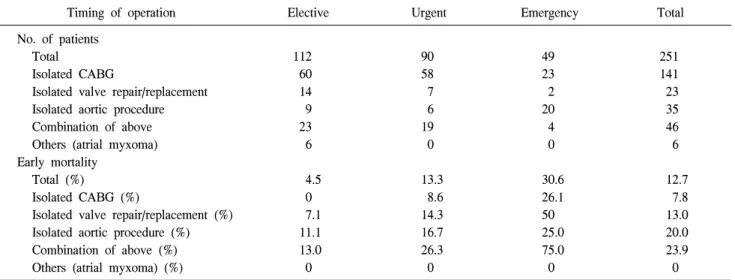
(121). Operative procedures, timing of the operation, and mortality rate are listed in Table 1. One hundred and sev- enty-one patients (68.1%) underwent CABG, making it the most commonly performed procedure. Excluding concomitant procedures, 141 patients underwent isolated CABG, and among them, 74 (52.5%) patients underwent off-pump sur- gery. Aortic valve surgery was performed in 41 patients, and 39 patients underwent replacement surgery. Mitral valve sur- gery was performed in 29 patients, and 12 patients underwent replacement surgery. Tricuspid valve surgery was performed in 12 patients, and 2 underwent replacement surgery. There were 10 patients who underwent total arch replacement; 3 pa- tients, thoracoabdominal aorta replacement; and the rest, aorta surgery for ascending aorta or hemiarch replacement. By comparing the operative procedures, we found that the early mortality rate was higher in patients who underwent aorta surgery.

The cause of early mortality is shown in Fig. 1. Cardiac- related death included heart failure and sudden cardiac arrest, which was the most common cause of death. However, there was no cardiac-related death in the elective surgery cases.

Infection-related death was defined as patients presenting no evidence of pneumonia or mediastinitis clinically but appear- ing to have infection signs (fever, leukocytosis, and/or ele- vated inflammatory serum markers) and proven to have bac- teremia in the blood culture.

The result of the risk factors for early mortality is listed in Table 2. Emergency operation, aorta operation, recent my- ocardial infarction (MI), and ejection fraction lower than 50%

had statistical significance in the univariate analysis. A further

logistic regression analysis was performed, and age, emer-

(3)

Table 1. Number of patients and early mortality rate according to the type procedure and timing of operation

Timing of operation Elective Urgent Emergency Total

No. of patients Total

Isolated CABG

Isolated valve repair/replacement Isolated aortic procedure Combination of above Others (atrial myxoma) Early mortality

Total (%)

Isolated CABG (%)

Isolated valve repair/replacement (%) Isolated aortic procedure (%) Combination of above (%) Others (atrial myxoma) (%)

112 60 14 9 23 6

4.5 0 7.1 11.1 13.0 0

90 58 7 6 19 0

13.3 8.6 14.3 16.7 26.3 0

49 23 2 20 4 0

30.6 26.1 50 25.0 75.0 0

251 141 23 35 46 6

12.7 7.8 13.0 20.0 23.9 0 CABG, coronary artery bypass grafting.

Fig. 1. Causes of early mortality. Values are presented as num- ber (%).

gency operation, aorta operation, and recent MI proved to be the independent predictors of early mortality.

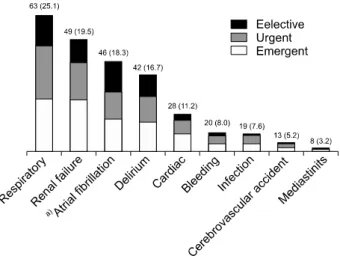
Postoperative complications and definitions are listed in Fig. 2 and Table 3, respectively. Two hundred and eighty- eight complications developed in 150 patients (59.8%). Forty patients (81.6%) developed complications in the emergency cases, 59 (69.4%) in the urgent ones, and 51 (44.0%) in the elective cases (p<0.001). The patients who underwent emer-

gency and urgent operations had a greater incidence of com- plications than the elective cases. Atrial fibrillation newly oc- curred in 46 patients, and the sinus conversion rate was 71.7% (33) before discharge.

The causes of late mortality are listed in Fig. 3A. The cause of late mortality was unknown in 39.6% of the patients as many of the patients expired at home or at a place other than a hospital. Consequently, there was no method to de- termine the exact cause of death for these patients.

All surviving patients (219) underwent complete follow-up.

The mean follow-up duration was 2.8±2.2 years. One hun- dred and ninety-nine patients (90.9%) were followed using outpatient clinic or inpatient clinic medical records. The other 20 patients (9.1%) received follow-up care at another hospital near their hometown. Therefore, we interviewed them over the phone. We investigated the reason of readmission for 199 patients who were able to review their hospital records; the findings are illustrated in Fig. 3B. There were 283 read- missions, in total, of the 109 patients. The reasons of read- mission for surgery-related complications were mediastinitis or wound problems, which needed in-hospital care. Patients with heart failure, those who required permanent pacemaker implantation for arrhythmia, and those who needed percuta- neous coronary intervention or redo cardiac operations were included in the group of patients with cardiac-related reasons.

There were many more patients who needed non-cardiac-re-

(4)

Table 2. Risk factors associated with early mortality

Risk factors Value Mortality (no.) Univariate Multivariate

Age (mean yr) EuroSCORE

Age corrected EuroSCORE Female

Emergency Urgency

Chronic obstructive pulmonary disease Diabetes mellitus

Hypertension Reoperation

Percutaneous corornary intervention history Peripheral vascular disease

Coronary artery bypass grafting Valve operation

Aorta operation Endocarditis

Cerebrovascular accident history Recent MI (<30 day)

Old MI

Ejection fraction<50%

Pulmonary artery pressure>40 mmHg Creatinine

Body surface area

78.69±3.37 10.04±3.04 5.65±3.04 121 (48.2) 49 (19.5) 90 (35.9) 20 (8.0) 94 (37.5) 184 (73.3) 8 (3.2) 24 (9.6) 67 (26.7) 171 (68.1) 66 (26.3) 52 (20.7) 7 (2.8) 42 (16.7) 56 (22.3) 17 (6.8) 80 (31.9) 68 (27.1) 1.19±0.57 1.60±0.16

16 15 12 0 11 26 2 4 8 18 12 11 1 8 14 2 16 13

0.062

<0.001

<0.001 0.828

<0.001 0.836 0.074 0.700 0.277 0.291 0.545 0.901 0.123 0.123 0.041 0.905 0.180 0.002 0.900 0.018 0.065 0.244 0.635

0.045

0.047

0.046

0.038

0.282

Values are presented as mean±standard deviation or number (%).

EuroSCORE, European system for cardiac operative risk evaluation; MI, myocardial infarction.

Fig. 2. Incidence of postoperative complications. Values are pre- sented as number (%).

a)

Sinus conversion 33 patients (71.7%).

Values are presented as number (%).

lated medical or surgical treatment than cardiac-related treat- ment for readmission (71.3% vs. 28.7%). 8 patients (from a total of 251, 3.2%) had an underlying neoplasm pre-

operatively and 23 patients (from a total of 199, 11.6%) had a newly detected neoplasm during the postoperative follow-up period.

Overall crude survival estimates (251) were 79.2% at the 1-year follow-up, 71.7% at the 2-year follow-up, 66.0% at the 3-year follow-up, and 58.4% at the 5-year follow-up. Among the cases of hospital survival (219), the survival estimates were 90.9% at the 1-year follow-up, 82.2% at the 2-year fol- low-up, 75.7% at the 3-year follow-up, and 67.0% at the 5-year follow-up. Survival estimates between the timing of sur- gery are listed in Fig. 4. Elective patients had a better survival rate than the urgent and emergency operative cases (p<0.001).

DISCUSSION

Age has been one of the most concerning factors for car-

diac surgery because of a high incidence of longer hospital-

ization, morbidity including operative mortality, and con-

(5)

Table 3. Definition and incidence of postoperative complications

Complications Definitions Value

Respiratory Renal failure

AF Delirium Cardiac

Bleeding Infection

Cerebrovascular accident Mediastinitis

Prolonged intubation (>24 hr), reintubation, or pneumonia

Increase of serum creatinine to ≥2.0 mg/dL or more than twice of the preoperative baseline level

New onset of AF/flutter requiring treatment

Attentional deficits & generalized severe disorganization of behavior

Arrest or atrioventricular block (permanent pacemaker insertion) or cardioversion/defibrillation for hemodynamic instability or intraaortic balloon pump/extracorporeal membrane oxygenator support, or prolonged inotorpics due to low cardiac output

Patient returned to the operating room for mediastinal bleeding/tamponade

Any postoperative infectous complication requiring antibiotics except for pneumonia and mediastinitis

Neurology & positive results in neurologic imaging Positive results on computed tomography & reexploration

63 (25.1) 49 (19.5)

46 (18.3) 42 (16.7) 28 (11.2)

20 (8.0) 19 (7.6)

13 (5.2) 8 (3.2) Values are presented as number (incidence %).

AF, atrial fibrillation.

Fig. 3. Causes of late deaths and re-hospitalization. (A) Late mortality. (B) Readmission. Values are presented as number (%).

Fig. 4. Survival curve of the patients who were discharged alive.

sequently, the unbalance of the cost–benefit ratio [10,11].

However, with the help of improving technologies and the development of cardiac surgery, the upper limit of age for

surgery seems to be increasing. In Korea, like other countries, the aged proportion of the population is progressively increas- ing, and the outcomes of cardiac surgery for these aged pop- ulations should be determined.

In our series, the overall operative mortality rate was 12.7% and that of the elective cases was only 4.5%.

However, those in poorer emergency condition showed a higher operative mortality rate (urgent, 13.3%; emergency, 30.6%). Previous reports of cardiac surgery for other Asian septuagenarians had outcomes similar to those of our study.

Nakano et al. [12] reported an operative mortality rate of 9%.

(6)

Shomura et al. [13] reported an operative mortality rate of 8.2% in elective cases and 47.6% in emergency/urgent cases.

For the western population, Katz et al. [14] reported an in-hospital mortality rate of 6.4%, but the mortality rate of the emergency cases was 9%.

Few articles on aged Korean patients have been published previously. Yoo et al. [7] reported that isolated CABG per- formed in patients over 75 years of age showed a lower op- erative mortality rate than our outcome (3.3% vs. 7.8%) [7].

Considering the relatively high proportion of emergency cases (5.5% [5/91] vs. 16.3% [23/141]), our operative mortality rate for isolated CABG did not seem inferior. Regarding the out- comes of octogenarians, only a few studies, each with a small study population of less than 25 patients, have been published [6,8]. In our data, there were 87 patients who were over 80 years of age. Among them, 20 patients (23.0%) un- derwent surgery in the emergency state and 7 (35%, 7/20) of these patients expired before discharge. The overall operative mortality rate in the octogenarians considered in our study was 18.4% (16/87) and that of the elective case was only 5.7% (2/35).

Postoperative complications have been reported in approx- imately 30% to 40% of cases in septuagenarians [15,16] and more in octogenarians [17,18]. Further, it should be noted that the definition of morbidity or the preoperative comorbid state varies among studies. In particular, the timing of surgery related to the preoperative status has been reported to have a notable correlation with postoperative morbidity [19-21]. The rate of complications in our data was 59.8%; 150 patients ex- perienced at least one complication after surgery, and the in- cidence of the complications was highly related to the timing of surgery (emergency vs. urgent vs. elective: 81.6% vs.

69.4% vs. 44.0%).

We have shown that the overall survival rate was 79.2% at the 1-year follow-up and 58.4% at the 5-year follow-up in our series. Similarly, Ogino et al. [22] reported 83.5% at the 1-year follow-up and 65.8% at the 5-year follow-up. Further, Lopez-Rodriguez et al. [15] reported 85% at the 1-year fol- low-up and 65% at the 5-year follow-up for the septuage- narians. Our data shows a lower survival rate than these data, but a strict meaningful comparison is difficult from other na- tionally representative studies because of different patient se-

lection and the preoperative patients’ co-morbid state. It is well known that emergency surgery is largely related to oper- ative results [23,24]. Specifically in the case of elderly pa- tients who had undergone surgery in an emergency status, in- ferior results have previously been reported for late outcomes [22,25]. The discharged patients who had undergone elective operations had excellent results in our study; the overall sur- vival rate was 97.9% at the 1-year follow-up and 78.1% at the 5-year follow-up. Patients who underwent emergency or urgent operations had a lower survival rate than those who underwent elective operations. The log-rank test revealed that the timing of surgery led to a significant difference in the long-term survival rate (p<0.001). Older patients hesitate to visit a hospital until they seem to be in a critically ill con- dition and might miss the right timing for surgery. Further, some patients are worried about their operative risk due to their old age and reject undergoing an operation even in a stable condition for elective surgery. In our study, the per- centage of elective cases was only 44.6% and that of the ur- gent/emergency cases was 55.4%, suggesting that patients de- layed surgery until it became critically necessary.

Among the discharged patients who survived after cardiac surgery, many of the patients had other underlying disorders that needed medical or surgical care. The rate of re-admission for cardiac-related problems was only 15.5% in our study, which means that appropriate surgical correction of cardiac disease will reduce cardiac-related discomfort. On the other hand, there were 71.3% patients who needed in-hospital care due to factors that were not cardiac related nor surgery re- lated, which implies that elderly patients need to be provided other coordinated care in order to improve the late outcomes.

In conclusion, cardiac surgery can be performed in the eld- erly safely, and the outcome will be much better if the pa- tient is in a stable condition. Emergency and urgent surgery was highly related to operative complications and mortality.

Hesitation in agreeing to undergo cardiac surgery because of

age might be a time-wasting decision and lead to losing the

opportunity for appropriate operative timing. Earlier referral

and intervention may save many more aged patients and

would produce better clinical outcomes. Further, because of

the co-morbidity in older patients, such as non-cardiac-related

medical and surgical problems, both cardiac problems and

(7)

pre- and postoperative comprehensive coordinated care must be considered for elderly patients.

CONFLICT OF INTEREST

No potential conflict of interest relevant to this article was reported.

ACKNOWLEDGMENTS

This article was partly supported by grant no. 11-2008-040 and 02-2009-034 from the Seoul National University Bundang Hospital Research Funds.

REFERENCES

1. Ghanta RK, Shekar PS, McGurk S, Rosborough DM, Aranki SF. Long-term survival and quality of life justify cardiac surgery in the very elderly patient. Ann Thorac Surg 2011;

92:851-7.

2. Krane M, Voss B, Hiebinger A, et al. Twenty years of car- diac surgery in patients aged 80 years and older: risks and benefits. Ann Thorac Surg 2011;91:506-13.

3. Speziale G, Nasso G, Barattoni MC, et al. Operative and middle-term results of cardiac surgery in nonagenarians: a bridge toward routine practice. Circulation 2010;121:208-13.

4. Alexander KP, Anstrom KJ, Muhlbaier LH, et al. Outcomes of cardiac surgery in patients > or = 80 years: results from the National Cardiovascular Network. J Am Coll Cardiol 2000;35:731-8.

5. Park JU, Lee WY, Kim KI, et al. Coronary artery bypass graft surgery in patients 70 years of age and older. Korean J Thorac Cardiovasc Surg 2006;39:28-34.

6. Kim DK, Lee CY, Lee KJ, Joo HC, Yoo KJ. The clinical outcomes of off-pump coronary artery bypass grafting in the octogenarians. Korean J Thorac Cardiovasc Surg 2005;38:

680-4.

7. Yoo DG, Kim CW, Park CB, et al. Coronary artery bypass grafting in elderly patients older than 75 years. Korean J Thorac Cardiovasc Surg 2005;38:123-31.

8. Park MK, Park SW, Lee SC, et al. Clinical outcome of car- diac surgery in octogenarians. J Korean Med Sci 2005;20:

747-51.

9. Roques F, Michel P, Goldstone AR, Nashef SA. The logistic EuroSCORE. Eur Heart J 2003;24:881-2.

10. Peigh PS, Swartz MT, Vaca KJ, Lohmann DP, Naunheim KS. Effect of advancing age on cost and outcome of coro- nary artery bypass grafting. Ann Thorac Surg 1994;58:

1362-6.

11. Rankin JS, Hammill BG, Ferguson TB Jr, et al. Determi- nants of operative mortality in valvular heart surgery. J Thorac Cardiovasc Surg 2006;131:547-57.

12. Nakano S, Takano H, Taniguchi K, et al. Evaluation of ear- ly and late results of open heart surgery in 74 patients 70 years of age and older. Nihon Geka Gakkai Zasshi 1991;92:

1139-42.

13. Shomura T, Okada Y, Nasu M, et al. Results and problems of open heart surgery in patients seventy years of age and older. Nihon Geka Gakkai Zasshi 1991;92:1131-4.

14. Katz NM, Hannan RL, Hopkins RA, Wallace RB. Cardiac operations in patients aged 70 years and over: mortality, length of stay, and hospital charge. Ann Thorac Surg 1995;

60:96-100.

15. Lopez-Rodriguez FJ, Gonzalez-Santos JM, Dalmau MJ, Bueno M. Cardiac surgery in the elderly: comparison of medium-term clinical outcomes in octogenarians and the eld- erly from 75 to 79 years. Rev Esp Cardiol 2008;61:579-88.

16. Kogan A, Ghosh P, Preisman S, et al. Risk factors for failed

“fast-tracking” after cardiac surgery in patients older than 70 years. J Cardiothorac Vasc Anesth 2008;22:530-5.

17. Rady MY, Ryan T, Starr NJ. Perioperative determinants of morbidity and mortality in elderly patients undergoing car- diac surgery. Crit Care Med 1998;26:225-35.

18. Barnett SD, Halpin LS, Speir AM, et al. Postoperative com- plications among octogenarians after cardiovascular surgery.

Ann Thorac Surg 2003;76:726-31.

19. Freeman WK, Schaff HV, O’Brien PC, Orszulak TA, Naessens JM, Tajik AJ. Cardiac surgery in the octoge- narian: perioperative outcome and clinical follow-up. J Am Coll Cardiol 1991;18:29-35.

20. Mullany CJ, Darling GE, Pluth JR, et al. Early and late re- sults after isolated coronary artery bypass surgery in 159 patients aged 80 years and older. Circulation 1990;82(5 Suppl):IV229-36.

21. Kolh P, Lahaye L, Gerard P, Limet R. Aortic valve replace- ment in the octogenarians: perioperative outcome and clin- ical follow-up. Eur J Cardiothorac Surg 1999;16:68-73.

22. Ogino H, Ueda Y, Sugita T, et al. Early and mid-term out- comes of cardiac and thoracic aortic surgery in over-75- year-olds with postoperative quality of life assessment. Jpn J Thorac Cardiovasc Surg 1999;47:57-62.

23. Kirsch M, Guesnier L, LeBesnerais P, et al. Cardiac oper- ations in octogenarians: perioperative risk factors for death and impaired autonomy. Ann Thorac Surg 1998;66:60-7.

24. Zingone B, Gatti G, Rauber E, et al. Early and late out- comes of cardiac surgery in octogenarians. Ann Thorac Surg 2009;87:71-8.

25. Rizzoli G, Bejko J, Bottio T, Tarzia V, Gerosa G. Valve

surgery in octogenarians: does it prolong life? Eur J

Cardiothorac Surg 2010;37:1047-55.

수치

Table 1. Number of patients and early mortality rate according to the type procedure and timing of operation
Fig. 2. Incidence of postoperative complications. Values are pre- pre-sented as number (%)
Fig. 4. Survival curve of the patients who were discharged alive.

참조

관련 문서